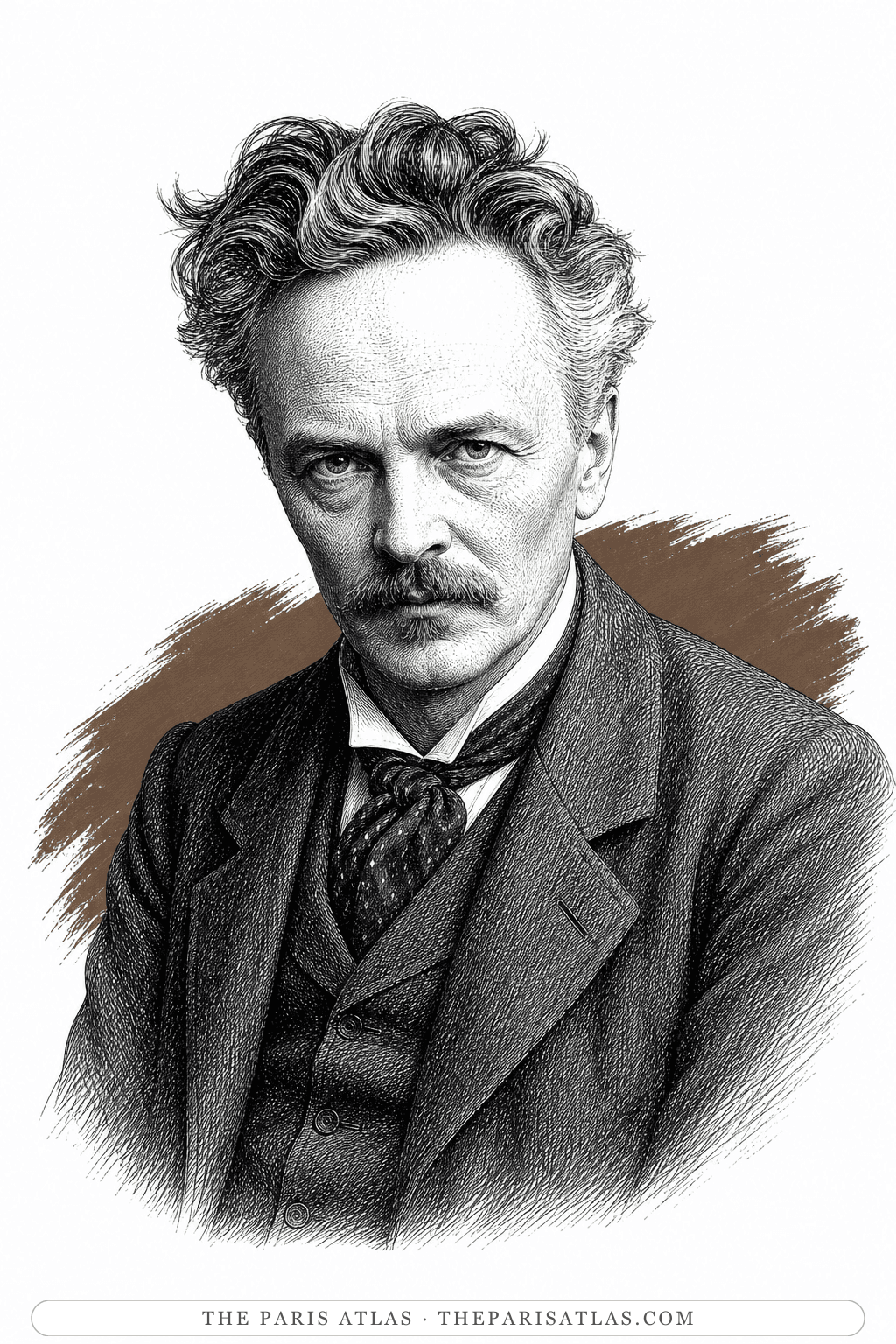
The Paris AtlasCharting the artists, works, and places worth returning to.
  • Filmmaker
  • Playwright
  • Author
· Swedish · 1918–2007

Ingmar Bergman

Swedish director of The Seventh Seal, Persona and Fanny and Alexander, whose sixty films put questions of faith, death and marriage on screen. James Baldwin profiled him in Nobody Knows My Name.

Details

Lived
1918–2007
Born
14 July 1918
Birthplace
Uppsala, Sweden
Birth name
Ernst Ingmar Bergman
Died
30 July 2007 · aged 89
Place of death
Fårö, Sweden
Nationality
Swedish
Profession
Film director, theatre director and screenwriter
Major works
The Seventh Seal, Wild Strawberries, Persona, Cries and Whispers, Scenes from a Marriage, Fanny and Alexander
Married
Else Fisher · married 1943, divorced 1945Ellen Lundström · married 1945, divorced 1950Gun Grut · married 1951, divorced 1959Käbi Laretei · married 1959, divorced 1969Ingrid von Rosen · married 1971 until her death in 1995
Partner
Harriet Andersson · 1952–1955Bibi Andersson · 1955–1959Liv Ullmann · 1965–1970
Children
Lena Bergman, Eva Bergman, Jan Bergman, Mats Bergman, Anna Bergman, Ingmar Bergman Jr., Maria von Rosen, Daniel Bergman, Linn Ullmann
Roles
FilmmakerPlaywrightAuthor

About Ingmar Bergman

Swedish film and theatre director, the maker of The Seventh Seal, Persona and Fanny and Alexander

Ingmar Bergman was a Swedish film and theatre director and screenwriter. He was born in Uppsala on 14 July 1918 and directed more than sixty films and documentaries, most of which he also wrote, along with more than 170 stage productions. The best known films are The Seventh Seal (1957), Wild Strawberries (1957), Persona (1966), Cries and Whispers (1972) and Fanny and Alexander (1982).

What he changed was the size of question a film was allowed to ask. Bergman put the silence of God, the fear of death and the wreckage of marriages on screen in stark, closely photographed chamber dramas. He made them cheaply in Sweden, with a recurring company of actors including Max von Sydow, Bibi Andersson and Liv Ullmann. Directors from Stanley Kubrick to Woody Allen named him the standard; Allen called him probably the greatest film artist since the invention of the motion picture camera.

He worked from the island of Fårö in the Baltic, where he lived, filmed and died in his sleep on 30 July 2007, aged 89. Three of his films won the Academy Award for best foreign-language film.

Uppsala, the parsonage, and the magic lantern, 1918–1937

Ernst Ingmar Bergman was born in Uppsala, Sweden, on 14 July 1918, the second of three children of Erik Bergman, a Lutheran minister who later became chaplain to the King of Sweden, and Karin Åkerblom, a nurse. The household ran on his father's strict ideas of discipline. For infractions such as wetting himself, the boy was locked in a dark closet. Sitting through his father's sermons, he studied the church instead: the arches, the coloured light, the medieval paintings of angels, saints, dragons and devils.

At nine he traded a set of tin soldiers for a magic lantern, an early image projector, and built a private theatre around it. He made his own scenery, marionettes and lighting, and spoke every part in puppet productions of the plays of August Strindberg. The toy gave his autobiography its title. He said he lost his religious faith at eight, though he only came to terms with the loss thirty years later, while making Winter Light.

In the summer of 1934, aged sixteen, he was sent to Germany on a family exchange and attended a Nazi rally in Weimar, where he saw Adolf Hitler speak. The German host family hung a portrait of Hitler by his bed. Bergman wrote in The Magic Lantern that for many years he was on Hitler's side, delighted by his successes and saddened by his defeats. The newsreels from the opened concentration camps ended it. The truth, he said, was a hideous shock that ripped him of his innocence. He made the admission publicly and repeatedly in later life.

Student theatre, Torment, and the first films, 1937–1955

Bergman enrolled at Stockholm University College in 1937 to study art and literature, spent most of his time in student theatre, became by his own account a genuine movie addict, and never graduated. A romantic entanglement led to a physical fight with his father and a break between them that lasted years. In 1942 a production of his own play Caspar's Death was seen by people from Svensk Filmindustri, the country's main film company, and he was hired to work on scripts.

His screenplay for Torment, filmed by the director Alf Sjöberg in 1944, was the breakthrough. The film's account of a sadistic schoolmaster set off a national argument about Swedish schools. The principal of Bergman's own old school called him a former problem child. Bergman answered that he had hated school as a principle, as a system and as an institution. The film's success won him his first chance to direct a year later. At twenty-six he was also running the Helsingborg City Theatre, the youngest theatre manager in Europe, beginning a parallel stage career that continued for six decades.

Through the late 1940s and early 1950s he wrote and directed more than a dozen features, ran the Gothenburg and later the Malmö city theatres, and assembled the beginnings of his standing company of actors. Sawdust and Tinsel and Summer with Monika, both released in 1953, are the films of this period that lasted.

The Seventh Seal, Wild Strawberries, and world fame, 1955–1963

Smiles of a Summer Night, a comedy of country-house pairings released in 1955, brought the first international success when it won a prize at the Cannes Film Festival the following year. Then came 1957, when Bergman released two films ten months apart. The Seventh Seal sent a medieval knight, played by Max von Sydow, into a chess game with Death against a background of plague. Wild Strawberries put Victor Sjöström, the great director of Sweden's silent era, in a car to Lund as an old professor auditing his life. The first won a special jury prize at Cannes; the second won the Golden Bear at the Berlin International Film Festival.

In March 1960 Time put him on its cover as "The Conjurer", the first foreign-language filmmaker on the magazine's cover since Leni Riefenstahl in 1936. In the early 1960s he made three chamber films on faith and its absence, Through a Glass Darkly (1961), Winter Light (1962) and The Silence (1963). Critics read them as a trilogy; Bergman first rejected the idea and later half adopted it. Through a Glass Darkly won the Academy Award for best foreign-language film, as The Virgin Spring had the year before.

Fårö, Persona, and the great chamber films, 1960–1975

From the early 1960s Bergman lived and worked mainly on Fårö, a small island off Gotland in the Baltic, whose bare shoreline appears in film after film. Persona (1966) put two women, an actress who has stopped speaking and the nurse who talks to her, alone in a house on the island until their identities blur. It starred Bibi Andersson and Liv Ullmann, won few awards, and is widely considered his masterpiece. Bergman himself named it, with Winter Light and Cries and Whispers, among the works he held in highest regard, and said that with Persona and Cries and Whispers he had pushed the boundary of what film could do.

Cries and Whispers (1972), photographed by Sven Nykvist in rooms of saturated crimson, followed two sisters and a servant through a third sister's death from cancer. It was nominated for the Academy Award for best picture, a rarity for a Swedish-language film, and was finished for about $450,000. Scenes from a Marriage (1973), a six-part television study of a marriage coming apart, cost about $200,000, ran on Swedish television, and was later cut for cinemas worldwide. Bergman financed his work without international backers, on low budgets, and said he never had a problem with funding.

The theatre ran alongside throughout. Bergman led the Royal Dramatic Theatre in Stockholm as its chief director from 1960 to 1966, and produced for television and radio steadily. In 1971 he received the Irving G. Thalberg Memorial Award at the Academy Awards ceremony.

The tax arrest and the Munich exile, 1976–1984

On 30 January 1976, two plainclothes police officers arrested Bergman at the Royal Dramatic Theatre, where he was rehearsing August Strindberg's The Dance of Death. The charge was tax evasion, over a transaction between his Swedish company and its Swiss subsidiary. The humiliation broke him. He suffered a nervous breakdown and was hospitalised with deep depression. On 23 March the special prosecutor dropped the charges entirely, saying the alleged crime had no legal basis and comparing it to charging a man with stealing his own car.

Cleared but disconsolate, Bergman vowed never to work in Sweden again, closed his Fårö studio, and moved to Munich in West Germany, despite public pleas from the Swedish prime minister Olof Palme. He ran Munich's Residenz Theatre from 1977 to 1984 and made films abroad: The Serpent's Egg (1977), Autumn Sonata (1978), which paired him with the actress Ingrid Bergman, no relation, and From the Life of the Marionettes (1980). He said later that the exile had effectively cost him eight years of his professional life.

He returned to Sweden to make Fanny and Alexander (1982), a family chronicle set in an Uppsala household like the one he was born into, and announced it as his last film for cinemas. It won four Academy Awards, including his third for best foreign-language film.

Fårö again, Saraband, and the end, 1984–2007

After Fanny and Alexander, Bergman kept writing and directing for television and the stage for another two decades. He wrote the scripts for The Best Intentions and Sunday's Children, filmed by Bille August and by his son Daniel Bergman. He published the autobiographies The Magic Lantern (1987) and Images: My Life in Film (1990). His last stage production was Henrik Ibsen's Ghosts, at the Brooklyn Academy of Music in 2003. The same year, at eighty-four, he directed Saraband, a television sequel to Scenes from a Marriage, and then retired.

He died in his sleep at his home on Fårö on 30 July 2007, aged 89, on the same day as the Italian director Michelangelo Antonioni. He was buried privately in the Fårö churchyard on 18 August, beside his fifth wife, Ingrid von Rosen, who had died of stomach cancer in 1995. Late in life he said he was not afraid of dying: on the contrary, he thought it would be interesting.

How Bergman worked

Bergman built a repertory company and kept it. Max von Sydow, Bibi Andersson, Harriet Andersson, Erland Josephson, Ingrid Thulin, Gunnel Lindblom and Gunnar Björnstrand each appeared in at least five of his features; Liv Ullmann, the last to join, appeared in ten. Many had started with him on stage in Helsingborg, Gothenburg or Malmö. The company let him write parts for known instruments and shoot fast.

With Sven Nykvist, his cinematographer from the early 1960s onward, the trust ran the other way. On the morning of a shoot Bergman described the mood and composition he wanted, then left Nykvist alone until the next day's discussion of rushes. Watching those rushes, Bergman asked one question only, not whether the work was great or terrible but whether it was sufficient or had to be reshot. In old age he said that if he missed one thing about filmmaking, it was working with Sven.

He wrote his own screenplays, carrying a film in his head for months or years before the writing, which he found tedious. In the later films he increasingly wrote only the ideas of a scene and let the actors find the exact words. The subjects stayed constant: mortality, loneliness, faith and desire, played out among a handful of people in closed rooms. He told Playboy in 1964 that he did not want to make merely intellectual films; he wanted audiences to feel his films, which mattered more to him than their understanding them.

Reception and changing reputation

Through the 1960s Bergman was treated as the last word in cinematic seriousness, the director around whom the idea of film as art was argued. Stanley Kubrick wrote to him in 1960 that his vision of life had moved him more deeply than any films had ever moved him, and called him the greatest filmmaker at work. Woody Allen's films quote and praise him repeatedly. The tide ran out somewhat after his death; the critic Jonathan Rosenbaum published a piece in 2007 titled "Scenes From an Overrated Career", and the argument it started is still cited.

Your vision of life has moved me deeply, much more deeply than I have ever been moved by any films. I believe you are the greatest film-maker at work today.

Stanley Kubrick, in a letter to Ingmar Bergman, 1960

The standing measures have held. Four of his films, The Seventh Seal, Wild Strawberries, Persona and Fanny and Alexander, appeared in the 2012 edition of Sight and Sound's greatest-films poll, and the magazine's 2002 directors' poll ranked him eighth among directors of all time. For his centenary in 2018 the Criterion Collection released a box set of thirty-nine features. James Baldwin, who spent an afternoon with him in Stockholm in 1959, published the encounter as "The Northern Protestant" in Nobody Knows My Name, the closest thing in that book to a straight profile.

After his death, his working papers went to the Swedish Film Institute: unproduced plays and scripts, a scenario abandoned as not alive enough, loose scenes set inside a womb, and an envelope marked, in his hand, "Complete disaster!". The Ingmar Bergman International Debut Award, given annually at the Gothenburg Film Festival, carries his name.

Life events

  1. 1918

    Born Ernst Ingmar Bergman in Uppsala, Sweden, on 14 July, the son of a Lutheran minister.

    Ingmar Bergman

  2. 1927

    Trades a set of tin soldiers for a magic lantern at the age of nine and begins staging puppet productions of August Strindberg's plays.

    Ingmar Bergman, The Magic Lantern: An Autobiography (1988)

  3. 1934

    Sent to Germany for the summer at sixteen, attends a Nazi rally in Weimar and sees Adolf Hitler, an enthusiasm he later renounced and wrote about publicly.

    Bergman admits Nazi past (1999)

  4. 1937

    Enrols at Stockholm University College to study art and literature, and disappears into student theatre.

    Ingmar Bergman

  5. 1944

    His screenplay for Torment, directed by Alf Sjöberg, becomes a national controversy and launches his career. At twenty-six he becomes Europe's youngest theatre manager, at Helsingborg.

    Ingmar Bergman

  6. 1955

    Smiles of a Summer Night brings his first international success at Cannes.

    Ingmar Bergman

  7. 1957

    Releases The Seventh Seal and Wild Strawberries ten months apart.

    Ingmar Bergman

  8. 1960

    Appears on the cover of Time as 'The Conjurer', the first foreign-language filmmaker there since 1936.

    Cinema: The Conjurer (1960)

  9. 1966

    Persona, with Bibi Andersson and Liv Ullmann, is released; Bergman later names it among the films where he pushed the medium furthest.

    Ingmar Bergman

  10. 1971

    Receives the Irving G. Thalberg Memorial Award at the Academy Awards. Marries Ingrid von Rosen, his fifth wife.

    Ingmar Bergman

  11. 1973

    Scenes from a Marriage runs on Swedish television; Cries and Whispers is nominated for the best-picture Academy Award.

    Ingmar Bergman

  12. 1976

    Arrested at the Royal Dramatic Theatre on tax-evasion charges that are dropped within weeks; suffers a breakdown and leaves Sweden for Munich.

    Ingmar Bergman

  13. 1982

    Returns to Sweden to make Fanny and Alexander, announced as his last film for cinemas; it wins four Academy Awards.

    Ingmar Bergman

  14. 2003

    Directs Saraband, a television sequel to Scenes from a Marriage, at eighty-four, and stages his final theatre production, Henrik Ibsen's Ghosts, in Brooklyn.

    Ingmar Bergman

  15. 2007

    Dies in his sleep at his home on Fårö on 30 July, aged 89, the same day as the director Michelangelo Antonioni.

    Mervyn Rothstein, Ingmar Bergman, Master Filmmaker, Dies at 89 (2007)

Who they drew from

Influence running inward — the writers and artists whose work fed theirs. Admiration is not acquaintance; these edges claim neither a meeting nor a friendship.

Illustrated portrait of August Strindberg

August Strindberg

The influence ran from childhood to the end: at nine Bergman staged puppet productions of August Strindberg's plays with a toy magic lantern, speaking all the parts, and he directed Strindberg on the professional stage all his life. He was rehearsing Strindberg's The Dance of Death at the Royal Dramatic Theatre on the day of his 1976 tax arrest. The chamber-play form Strindberg pioneered is the scale of Bergman's mature films.

Ingmar Bergman, The Magic Lantern: An Autobiography (1988); Ingmar Bergman

In works

Works in these pages connected to Ingmar through the claims of the graph.

Cover of Nobody Knows My Name by James Baldwin

Depicted in · Book

Nobody Knows My Name

James Baldwin · 1961

An afternoon with Bergman in Stockholm, and the closest thing in the collection to a straight profile.

James Baldwin, Nobody Knows My Name (1961), 'The Northern Protestant'

Questions about Ingmar Bergman

Who was Ingmar Bergman?

Ingmar Bergman (1918–2007) was a Swedish film and theatre director and screenwriter, the maker of The Seventh Seal, Wild Strawberries, Persona, Cries and Whispers and Fanny and Alexander. He directed more than sixty films, most of which he wrote himself, and more than 170 stage productions. Three of his films won the Academy Award for best foreign-language film, and directors from Stanley Kubrick to Woody Allen named him the greatest in the medium.

What are Ingmar Bergman's most famous films?

The Seventh Seal (1957), in which a medieval knight plays chess with Death; Wild Strawberries (1957), an old professor's reckoning with his life; and Persona (1966), widely considered his masterpiece. Later came Cries and Whispers (1972), Scenes from a Marriage (1973), and Fanny and Alexander (1982), which won four Academy Awards. Bergman's own short list was different: he named Winter Light, Persona and Cries and Whispers as the works he held in highest regard.

What was the connection between Ingmar Bergman and James Baldwin?

James Baldwin spent an afternoon with Bergman at the Filmstaden studios in Stockholm in 1959 and published the encounter as "The Northern Protestant" in his 1961 essay collection Nobody Knows My Name. It is the closest thing in the book to a straight profile: two writers comparing notes on fathers, God and exile. Baldwin concluded that the Swedish director, working at home among his own demons, had solved a problem Baldwin was still living.

Why did Ingmar Bergman leave Sweden?

Because of a tax case that collapsed almost immediately. On 30 January 1976, police arrested Bergman during a rehearsal at the Royal Dramatic Theatre in Stockholm and charged him with tax evasion. The special prosecutor dropped the charges on 23 March, saying the alleged crime had no legal basis. But the humiliation had already put Bergman in hospital with a breakdown, and he left Sweden for Munich, vowing never to work in his country again. He ran Munich's Residenz Theatre until 1984, and later reckoned the exile cost him eight years of his working life.

What is Fårö and why did Bergman live there?

Fårö is a small, sparse island off Gotland in the Baltic Sea. Bergman first went there to film Through a Glass Darkly in 1960, and from the early 1960s it became his home, his studio and one of his recurring locations. Persona, Hour of the Wolf, Shame and Scenes from a Marriage were all filmed there. He died at his Fårö home in 2007 and is buried in the island's churchyard. The Bergman Center on the island now runs an annual Bergman Week for visitors.

How did Ingmar Bergman die?

He died in his sleep at his home on the island of Fårö on 30 July 2007, at the age of 89. He had undergone hip surgery in October 2006 and made a difficult recovery. He was buried privately in the Fårö churchyard on 18 August 2007, next to his last wife, Ingrid von Rosen. The Italian director Michelangelo Antonioni died the same day.

Did Ingmar Bergman really support the Nazis as a young man?

Yes, by his own account, and he renounced it. Sent to Germany on a family exchange in 1934, the sixteen-year-old Bergman attended a Nazi rally in Weimar and saw Adolf Hitler speak; the host family hung Hitler's portrait by his bed. In The Magic Lantern he wrote that for many years he was on Hitler's side, delighted by his successes and saddened by his defeats. He said the newsreels from the liberated concentration camps ended it: the truth was a hideous shock that stripped him of his innocence, and he spoke about the episode openly for the rest of his life.

Sourced claims

Every connection the graph holds for Ingmar, with the evidence behind it.

Depicted in

Nobody Knows My Name

An afternoon with Bergman in Stockholm, and the closest thing in the collection to a straight profile.

James Baldwin, Nobody Knows My Name (1961), 'The Northern Protestant'

Influenced by

August Strindberg

The influence ran from childhood to the end: at nine Bergman staged puppet productions of August Strindberg's plays with a toy magic lantern, speaking all the parts, and he directed Strindberg on the professional stage all his life. He was rehearsing Strindberg's The Dance of Death at the Royal Dramatic Theatre on the day of his 1976 tax arrest. The chamber-play form Strindberg pioneered is the scale of Bergman's mature films.

Ingmar Bergman, The Magic Lantern: An Autobiography (1988); Ingmar Bergman

References

References

The sources below include biographies, scholarly essays, interviews, and primary materials that informed this page. They reflect both the historical record and ongoing critical conversations about Ingmar Bergman and their work.

  1. 1Ingmar Bergman

    Website
    Wikipedia
    Used for

    Reference article cross-checked for the chronology, the filmography, the theatre career, the tax case, and the marriages.

    View source
  2. 2Ingmar Bergman, Master Filmmaker, Dies at 89

    Periodical
    The New York Times, 2007
    Used for

    Mervyn Rothstein's obituary of 30 July 2007: the death at Fårö at 89, and the career summary.

    View source
  3. 3The Magic Lantern: An Autobiography

    Memoir
    Viking Press, 1988
    Used for

    Bergman's autobiography, for the Uppsala childhood, the magic lantern, and his own account of the 1934 summer in Germany.

  4. 4Images: My Life in Film

    Nonfiction
    Bloomsbury, 1994
    Used for

    His book-length account of the making of his films, including Torment as his effective directing debut.

  5. 5Bergman admits Nazi past

    Periodical
    BBC News, 1999
    Used for

    BBC report on his public account of the youthful Hitler enthusiasm and its end.

    View source
  1. 6Cinema: The Conjurer

    Periodical
    Time, 1960
    Used for

    The March 1960 cover story that introduced him to a mass American audience.

  2. 7Nobody Knows My Name

    Essays
    Dial Press, 1961
    Used for

    James Baldwin's 'The Northern Protestant', the Stockholm profile.

  3. 8Ingmar Bergman: A Reference Guide

    Nonfiction
    Amsterdam University Press, 2005
    Used for

    Birgitta Steene's reference guide, for dates and the stage chronology.

  4. 9The Passion of Ingmar Bergman

    Nonfiction
    Duke University Press, 1986
    Used for

    Frank Gado's critical study, for the Torment schools controversy and the early career.

  5. 10Ingmar Bergman: The Life and Films of the Last Great European Director

    Biography
    I.B. Tauris, 2009
    Used for

    Geoffrey Macnab's biography, for the school years and the shape of the late career.

i
Why these sources are here

These references anchor the page in the documented record and in the scholarly conversations around Ingmar Bergman. Every claim on this page traces back to one or more of the works listed here.

Explore more resources
Browse all authors