The Paris AtlasCharting the artists, works, and places worth returning to.
  • Filmmaker
  • Actor
· American · 1929–1989

John Cassavetes

The American actor and filmmaker who financed personal films outside the studio system and built them around the difficult, unfinished behavior of people in families and relationships.

Details

Lived
1929–1989
Born
9 December 1929
Birthplace
New York City
Died
3 February 1989 · aged 59
Place of death
Los Angeles
Nationality
American
Married
Gena Rowlands · 1954–1989
Children
Nick Cassavetes, Alexandra Cassavetes, Zoe Cassavetes
Roles
FilmmakerActor

About John Cassavetes

John Cassavetes (1929–1989) was an American actor, screenwriter, and director. He earned money in film and television, then used that money, his home, and a close group of collaborators to make independent features such as Shadows, Faces, A Woman Under the Influence, The Killing of a Chinese Bookie, and Opening Night.

His films can look spontaneous, but that does not mean they were simply improvised. Cassavetes wrote scripts, rehearsed actors, shot at length, and reshaped performances through exacting editing. The freedom is visible in how the actors behave; the structure came from sustained work before and after the camera rolled.

An actor who wanted control of the whole film

Cassavetes trained as an actor and worked steadily in live television and feature films during the 1950s. Acting gave him an income and taught him how production systems could narrow a performance. He began directing because he wanted to make films in which actors could pursue a scene beyond a studio's usual timing and polish.

  • Shadows (1959)

    His first independent feature, made in New York and later screened and studied by the Cinémathèque française.

What Shadows changed

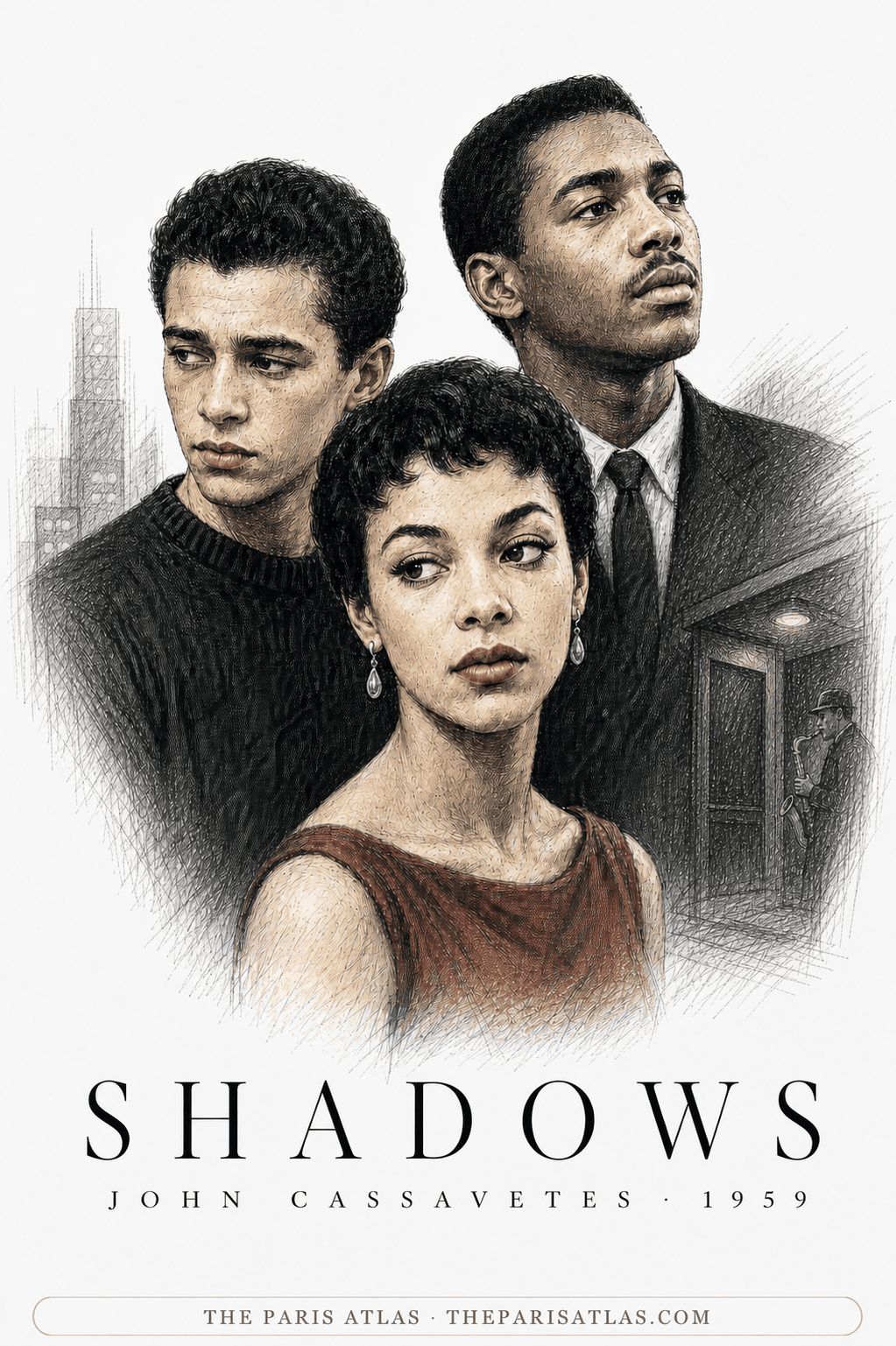
Shadows grew from an acting workshop and was made with a small crew, real New York locations, and money raised outside a studio. Cassavetes screened an early version in 1958, filmed new material, and completed the substantially revised version released in 1959. Its story follows three siblings and treats racial identity, intimacy, and humiliation as lived problems rather than a lesson delivered to the audience.

The film is often placed beside the French New Wave because both rejected the finished look and production rules of established studio cinema. The timing matters: Shadows and Jean-Luc Godard's Breathless were both largely filmed in 1959. It is more accurate to describe parallel experiments than to claim that one copied the other.

The films were independent, not accidental

Cassavetes returned to independent production after two difficult studio assignments. He financed work through acting jobs, loans, deferred pay, and personal risk. Faces took years to edit. For A Woman Under the Influence, he and Gena Rowlands put their house at risk. That method bought creative control, but it also made every film physically and financially demanding for the people around him.

The common description of his films as improvised is incomplete. Shadows began in workshop improvisation, but Cassavetes rewrote and rebuilt it. His later features were scripted and carefully edited. Actors had room to search inside a scene; they were not asked to invent an entire film without a plan.

Gena Rowlands and the working company

Gena Rowlands, an American stage and screen actor, married Cassavetes in 1954 and became his central artistic partner. Her performances as Mabel Longhetti in A Woman Under the Influence, Myrtle Gordon in Opening Night, and Gloria Swenson in Gloria gave the films much of their emotional range. Peter Falk, Ben Gazzara, Seymour Cassel, and members of both families returned across projects, forming a practical repertory company.

Why he belongs in a Paris atlas

The Paris connection is documented, not symbolic. French filmmakers Hubert Knapp and André S. Labarthe met Cassavetes in Hollywood in 1965 and again in Paris in 1968, when Faces was released there. Their filmed encounters became John Cassavetes (Hollywood 1965, Paris 1968). The Cinémathèque française later presented his work in retrospectives and continues to screen Shadows.

French film culture helped keep Cassavetes in an international conversation about independent cinema. That history does not turn him into a French New Wave director. It shows how Paris institutions received, discussed, and preserved an American filmmaker who was challenging studio practice at the same moment.

Life events

  1. 1929

    Born on 9 December in New York City.

  2. 1954

    Marries American actor Gena Rowlands.

  3. 1957–1959

    Develops, shoots, reshoots, and edits Shadows outside the studio system.

  4. 1965

    Begins filming Faces; Hubert Knapp and André S. Labarthe film their first encounter with him in Hollywood.

  5. 1968

    Faces is released in Paris; Knapp and Labarthe film Cassavetes there again.

  6. 1974

    Releases A Woman Under the Influence, starring Gena Rowlands and Peter Falk.

  7. 1980

    Gloria wins the Golden Lion at the Venice Film Festival, shared with Atlantic City.

  8. 1984

    Love Streams wins the Golden Bear at the Berlin International Film Festival.

  9. 1989

    Dies in Los Angeles on 3 February, aged 59.

Selected works

Cataloged from the holding institutions' records. Reproductions appear only where the rights are verified.

Cinema

Film

Shadows

1959 · Black-and-white feature film

John Cassavetes's first feature follows three siblings in New York as race, work, and romantic expectations press on their relationships. Made outside the studio system in two substantially different versions, it became an early landmark of postwar American independent film. Its loose surface came from workshop experiments, real locations, reshooting, and exacting editing—not from simply turning on a camera and asking actors to invent everything.

Shadows remains under copyright. This page currently uses no film frames or poster reproductions.

Questions about John Cassavetes

Who was John Cassavetes?

John Cassavetes was an American actor, screenwriter, and director who became a central figure in American independent cinema. His best-known films include Shadows, Faces, A Woman Under the Influence, and Opening Night.

Why is John Cassavetes important?

He showed that a filmmaker could make personal feature films outside normal studio control by using a small team, practical locations, acting income, loans, and direct distribution. His close attention to performance influenced later independent filmmakers.

Were John Cassavetes's films improvised?

Not in the simple sense. Shadows grew from acting exercises and improvisation, but Cassavetes rewrote and reshot it. His later films were scripted, rehearsed, and shaped through long, careful editing.

What was John Cassavetes's relationship with Gena Rowlands?

Gena Rowlands was his wife and closest artistic collaborator. They married in 1954, had three children, and worked together on films including Faces, A Woman Under the Influence, Opening Night, Gloria, and Love Streams.

Was John Cassavetes part of the French New Wave?

No. He was an American independent filmmaker working mainly in New York and Los Angeles. His early work developed at roughly the same time as the French New Wave, and French critics and film institutions became important to its international reception.

What connects John Cassavetes to Paris?

Faces was released in Paris in 1968, when French filmmakers Hubert Knapp and André S. Labarthe filmed an interview with him there. The Cinémathèque française has also screened his films and mounted a Cassavetes retrospective.

Sourced claims

Every connection the graph holds for John, with the evidence behind it.

Performed in · 1959

Shadows

John Cassavetes appears briefly as a man dancing in the nightclub; his principal credit is director.

Cinémathèque française — Shadows (John Cassavetes, 1959)

Sources and further reading

  • Cinémathèque française — John Cassavetes retrospective (2019)
  • Hubert Knapp and André S. Labarthe, Cinémathèque française — John Cassavetes (Hollywood 1965, Paris 1968) (1998)
  • Oliver Lunn, BFI — Where to begin with John Cassavetes (2016)
  • Gary Giddins, Criterion Collection — Shadows: Eternal Times Square (2004)
