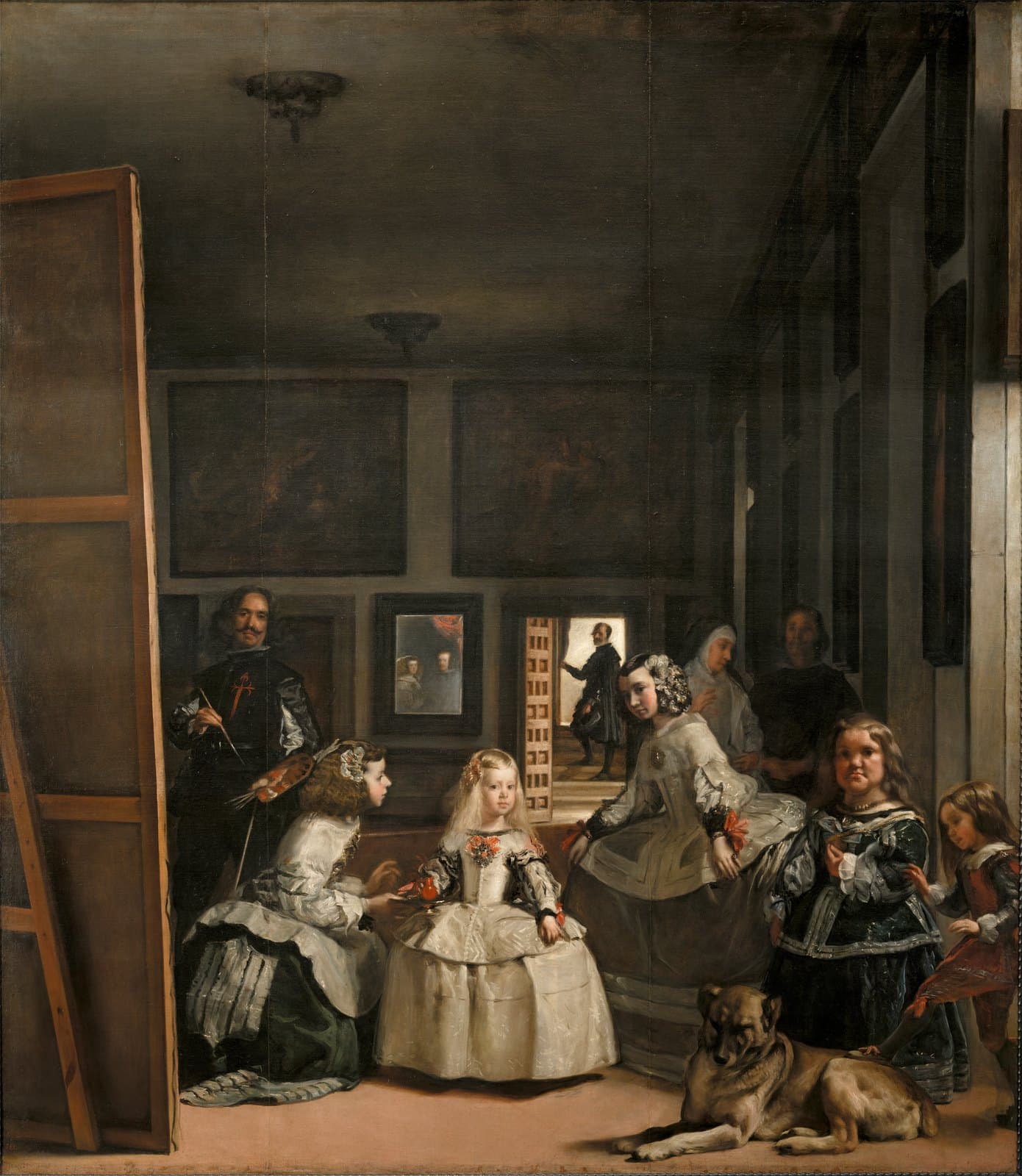
Diego Velázquez finished Las Meninas in 1656 at the court of Philip IV of Spain. It hangs in the Museo del Prado in Madrid. The picture shows the young Infanta Margarita Teresa among her attendants, with the painter standing at a canvas whose face is turned away. Philip IV and Queen Mariana appear only as a reflection in a mirror on the back wall.
Las Meninas, generally translated as The Ladies-in-Waiting or The Maids of Honor, is an oil painting completed by Diego Velázquez in 1656 and housed in the Museo del Prado, Madrid. It depicts members of the Spanish royal household in a palace interior, with Velázquez himself standing beside a large canvas. Although recognizable as a group portrait, its arrangement raises unusually complex questions about who is looking, who is being painted, and where the viewer belongs.[1]
Velázquez at the Spanish Court
By the time he painted Las Meninas, Velázquez had served Philip IV for more than three decades. His position extended beyond portrait painting into responsibilities within the royal household and supervision of artistic projects. Access to the royal collection, travel in Italy, and sustained familiarity with court life helped shape his mature work.[2]
The painting consequently presents more than an artist visiting a royal residence. Velázquez depicts himself as someone established within its social and professional world. His proximity to the royal child and her attendants reflects the unusual position he had achieved as both painter and court official.[3]
Who Appears in the Painting?
The illuminated figure near the center is the young Infanta Margarita Teresa, daughter of Philip IV and Queen Mariana of Austria. Two ladies-in-waiting attend her, while other members of the household occupy the foreground and the more shadowed space behind. A large dog lies at the right. Velázquez stands to the left, brush and palette in hand, looking outward from behind the enormous canvas whose painted surface is hidden from us.[1]
The doorway at the back supplies another source of light and a conspicuous human presence, drawing attention into the depth of the room. Between that doorway and the painter, a small mirror reflects the heads and shoulders of the king and queen. Their reflected appearance is crucial: the most powerful people associated with the scene are not shown standing openly among the foreground figures.[1]
The Mirror and the Viewer's Position
The most familiar interpretation places Philip IV and Mariana in front of the painted scene, approximately where the spectator stands. Velázquez would then be painting them while the infanta and her attendants are nearby. Another interpretation proposes that the mirror reflects the royal portrait on the hidden canvas rather than the monarchs themselves. The painting does not reveal that canvas, leaving the competing readings difficult to resolve conclusively.[4]
What is visible creates an unusual relationship with the audience. The painter's outward gaze seems to acknowledge a presence beyond the picture, while the royal reflection gives that unseen space political significance. The spectator can examine the royal household but is also made conscious of occupying a position toward which several people direct their attention. This interplay is central to the painting's enduring ambiguity.[5]
Light and the Appearance of Spontaneity
Velázquez's late technique used increasingly free and luminous brushwork. In Las Meninas, this handling allows clothing, faces, and surrounding space to appear convincing without every detail receiving equal definition. The painting depends on the relationship among passages of different clarity rather than on uniformly precise outlines.[6]
The effect helps make an elaborately organized composition resemble a passing moment. Some figures attend to the infanta, others look outward, and the painter appears temporarily interrupted in his work. The scene's apparent informality does not erase the structure of court life, but it gives that structure the immediacy of people sharing a room.[7]
The Red Cross Added to Velázquez's Chest
The red cross on Velázquez's clothing identifies the Order of Santiago, an honor he received after the painting's original completion. The emblem was therefore added later. An often-repeated story, recorded by the early biographer Antonio Palomino, says Philip IV painted it himself. That royal intervention remains an anecdote, not an established fact about the painting's execution.[8]
The addition nevertheless reinforces the picture's association with Velázquez's elevated status. The artist is represented not only as a working painter but as a member of the court whose service had received formal distinction.[9]
Importance and Legacy
Las Meninas belongs to the Baroque not because it relies on spectacular physical action, but because it makes representation and spectatorship part of its subject. Its courtly setting remains recognizable, yet the arrangement continually redirects attention between the room, the concealed painting, the mirror, and the space outside the frame. That unresolved relationship is a major reason the work has sustained such extensive interpretation.[10]
Close reading
Reading the work, detail by detail
Las Meninas gathers a court household in one dim palace room and keeps moving attention between them. These details run from the painter at the left to the mirror on the back wall, the lit doorway, and the children and the dog in the foreground.
1.The painter and his red cross
Velázquez stands back from his canvas with the brush lifted, looking out past it. The red cross of the Order of Santiago on his doublet was added after the painting was finished, because he did not hold the honor in 1656.
2.The canvas we never see
The picture Velázquez is working on stands with its painted side turned away, filling the left edge as bare wood and canvas. Because that surface is never revealed, the competing accounts of what he is painting cannot be settled from the picture itself.
3.Two faces in the mirror
The mirror is the one bright rectangle on a wall of darkened pictures, and it holds the heads and shoulders of Philip IV and Mariana of Austria. The king and queen appear nowhere else in the room.
4.A man in the lit doorway
José Nieto, the queen's chamberlain, holds back a curtain on a short flight of steps. The daylight behind him is a second source of light and pulls the eye all the way into the depth of the room.
5.The infanta and the red cup
The Infanta Margarita Teresa is the brightest figure in the room, her pale gown catching the light from the right. María Agustina Sarmiento kneels at her side with a red cup on a tray, an ordinary act of service caught mid-offer.
6.A foot on the sleeping dog
Nicolasito Pertusato presses a foot into the dozing mastiff, which does not stir. It is the only unmistakable movement in the picture, and it sits at the opposite corner from the painter's raised brush.
Diego Velázquez completes Las Meninas at the court of Philip IV. The Prado's own record gives the year and the medium, oil on canvas.
Las Meninas, 1656, oil on canvas, 320.3 by 279.1 cm (Museo Nacional del Prado, Madrid, P1174). The Infanta Margarita with her attendants, the painter at his easel, and Philip IV and Queen Mariana of Austria reflected in the mirror on the back wall. (Diego Velázquez (Museo Nacional del Prado), via Wikimedia Commons)
1659
A royal decree of 28 November admits Velázquez to the Order of Santiago. The red cross of that order is the emblem worn by the painter in the picture, and it was added to the canvas after the painting was first finished.
1660
Velázquez dies. Antonio Palomino later writes that the king ordered the red cross painted onto the figure after the painter's death, and that some said Philip IV added it himself.
1724
Antonio Palomino publishes his life of Velázquez, the earliest extended description of Las Meninas and the origin of the story about the cross.
1966
Michel Foucault opens Les mots et les choses with a long analysis of Las Meninas as a painting about representation itself, and the picture becomes a standard reference in later critical writing.
Where to see it
Museo del Prado
Madrid, Spain
A public viewing address has not yet been confirmed for this holding.
The Prado lists the painting in Room 012. Collection locations and gallery displays can change; check the official object record before making a special visit.
Frequently asked questions
Where is Las Meninas?
Las Meninas is in the Museo del Prado in Madrid, where the museum records it as inventory number P001174 and hangs it in Room 012. Displays change, so check the Prado's own object record before making a special visit.
When did Diego Velázquez paint Las Meninas?
Diego Velázquez completed the painting in 1656. He had by then served Philip IV, king of Spain, for more than three decades, in a role that extended beyond portrait painting into duties in the royal household and the supervision of artistic projects.
Who is the girl in the middle of Las Meninas?
The illuminated figure near the center is the young Infanta Margarita Teresa, daughter of Philip IV and Queen Mariana of Austria. Two ladies-in-waiting attend her, other members of the household occupy the foreground and the shadowed space behind, and a large dog lies at the right.
What does the mirror in Las Meninas show?
The small mirror on the back wall reflects the heads and shoulders of the king and queen, Philip IV and Mariana of Austria. The most familiar interpretation places the two of them in front of the painted scene, approximately where the spectator stands; another interpretation proposes that the mirror reflects the royal portrait on the hidden canvas rather than the monarchs themselves.
Why can't we see the canvas Velázquez is painting?
Velázquez stands to the left, brush and palette in hand, behind an enormous canvas whose painted surface is turned away from us. Because the painting never reveals that surface, the competing readings of what the mirror shows are difficult to resolve conclusively.
Why does Velázquez wear a red cross in Las Meninas?
The red cross marks the Order of Santiago. Diego Velázquez received that honor after the painting was finished, so the emblem was added later. An often-repeated story, recorded by the early biographer Antonio Palomino, says Philip IV painted it himself. That royal intervention remains an anecdote, not an established fact.
Why is Las Meninas considered a Baroque painting?
It belongs to the Baroque not because it relies on spectacular physical action, but because it makes representation and spectatorship part of its subject. The courtly setting stays recognizable while the arrangement redirects attention between the room, the concealed painting, the mirror, and the space outside the frame.
In the atlas
What the graph records about this work — every claim carries its citation.
Diego Velázquez finished Las Meninas in 1656 for Philip IV, king of Spain, and it hangs in the Museo del Prado in Madrid. It belongs to the Baroque less for physical drama than for making representation and spectatorship part of its subject: the painter stands at a canvas whose surface is hidden, and the king and queen appear only as two faces in a mirror on the back wall.
— Diego Velázquez, Las Meninas — collection record, P001174; Everett Fahy, Velázquez (1599–1660) — Heilbrunn Timeline of Art History (2003)
If you like Diego Velázquez
Explore painters from the same movements and circles.
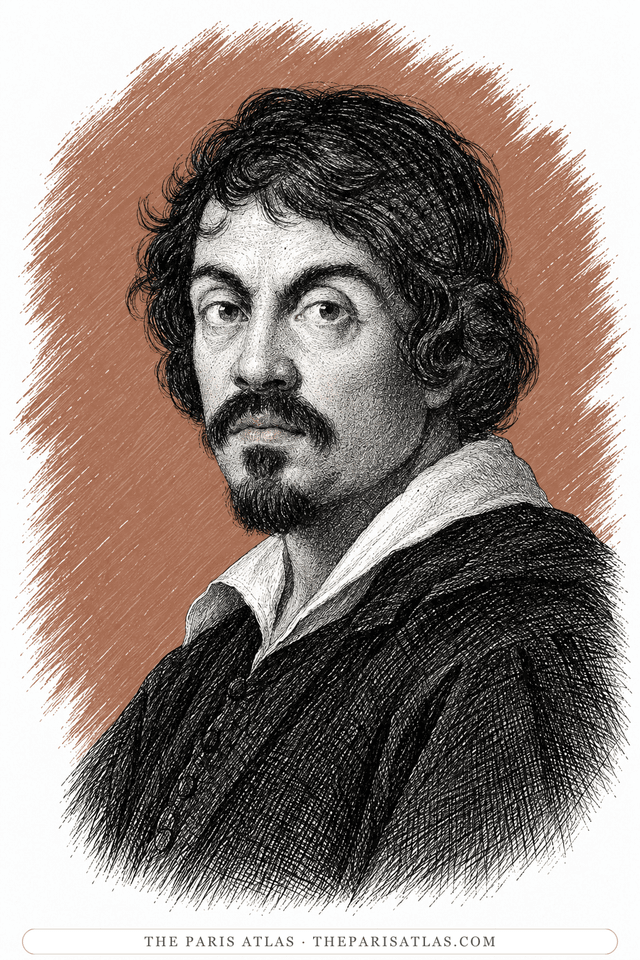
Caravaggio
Italian painter who worked from live models straight onto the canvas, without preparatory drawings, and lit them with a single hard light against a dark ground. He killed a man in Rome in May 1606, spent his last four years as a fugitive in Naples, Malta and Sicily, and died at thirty-eight.
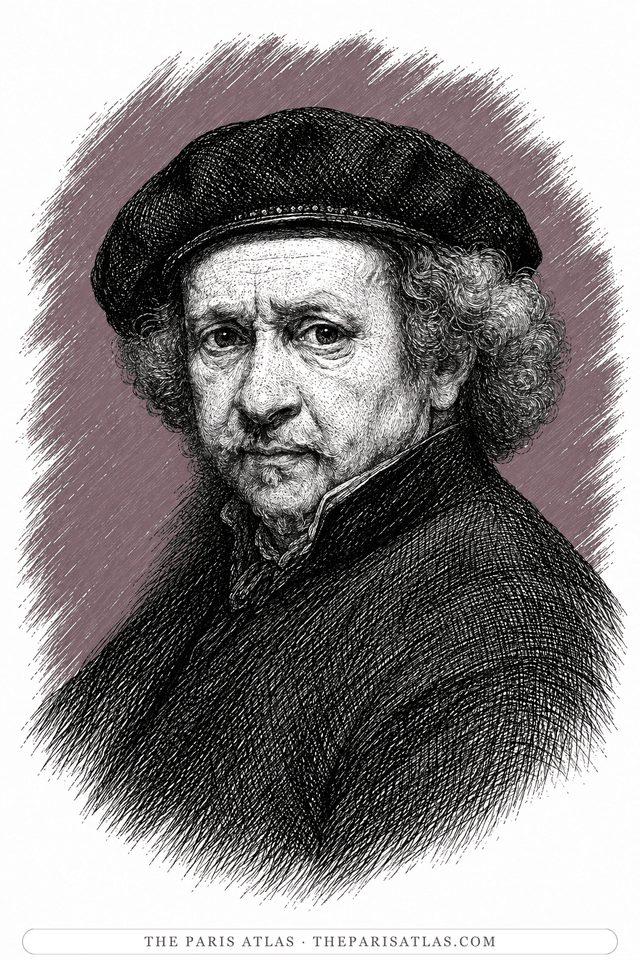
Dutch painter and etcher who worked in Leiden and Amsterdam and never traveled outside the Dutch Republic. He made about 300 etchings and roughly eighty self-portraits, trained some twenty-five painters, and was declared insolvent in 1656.
Dutch painter who worked in Delft and left fewer than forty paintings, most of them small scenes of one or two people in a quiet room lit from a window. Girl with a Pearl Earring, The Milkmaid and View of Delft are the best known.
Las Meninas, 1656, oil on canvas, 320.3 by 279.1 cm (Museo Nacional del Prado, Madrid, P1174). The Infanta Margarita with her attendants, the painter at his easel, and Philip IV and Queen Mariana of Austria reflected in the mirror on the back wall.1656 · Diego Velázquez (Museo Nacional del Prado), via Wikimedia Commons · Public domain
References
References
The sources below include collection records, catalogues, scholarly research, and primary materials that informed this page. They document Las Meninas, its making, and its place in cultural history.
1abcDiego Velázquez, Las Meninas — collection record
Website
Museo Nacional del Prado
Used for
The holding museum's own record: 1656, oil on canvas, Room 012, and the mirror reflecting Philip IV and Mariana of Austria. The 318 by 276 cm measurement is the one commonly published for the painting.
The mirror reflecting the king and queen, the absence of any agreed reading, and the 28 November 1659 decree admitting Velázquez to the Order of Santiago.
3↑Velázquez (1599–1660) — Heilbrunn Timeline of Art History
Website
The Metropolitan Museum of Art, Department of European Paintings (published October 2003, revised September 2009), 2003
Used for
Names the figures around the infanta and describes Velázquez's late handling of paint as increasingly free and luminous.
Velázquez's court appointments under Philip IV, his Italian journeys, and the badge of the Order of Santiago added to his self-portrait in Las Meninas.
Reads the picture as Velázquez's claim for painting as a liberal art and for the painter's standing at court.
11Le récit spéculaire: Essai sur la mise en abyme
Nonfiction
Éditions du Seuil, Paris, 1977
Used for
The common reading: a flat mirror projecting the double of the king and queen standing in front of the painting.
12Modern/Postmodern: A Study in Twentieth-century Arts and Ideas
Nonfiction
University of Pennsylvania Press, Philadelphia, 1989
Used for
On the spectator's uncertain position and the outward gazes of Velázquez, the infanta, and Mari Bárbola.
i
Why these sources are here
These references provide the documented foundation for this work's history and interpretation. Claim-level citations remain attached to the specific claims they support.



 View source