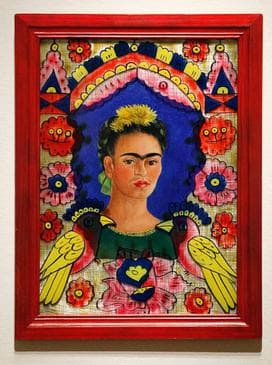
The Frame
by Frida Kahlo
A self-portrait the size of a postcard, painted in oil on a sheet of aluminium and set behind a sheet of glass that somebody else had already decorated with birds and flowers. Frida Kahlo bought the glass frame ready-made at a market in Juquila, in the Mexican state of Oaxaca. The picture was the only one she sold during her six weeks in Paris in 1939, and the buyer was the French state.
- c. 1938
- Oil on aluminium, with a reverse-painted glass frame
- Centre Pompidou, Musée national d'art moderneParis, France
About Frida Kahlo
What the painting shows
Frida Kahlo painted her own head and shoulders, facing forward, against a field of deep blue cut to the shape of a pointed arch. Her eyebrows are painted as one unbroken dark line above both eyes. She looks slightly to her own left rather than out at the viewer, and her mouth is closed. A cluster of shaggy yellow flowers is pinned flat on the crown of her head, and she wears a dark green blouse with a gold-trimmed neckline.
Everything around that portrait belongs to the glass in front of it. Two birds face inward at shoulder height, one on each side, each with a navy head, a yellow beak, a pink breast and a single large yellow wing sweeping down and outward. A navy heart holding a single yellow flower sits at the bottom centre, below the blouse. Four decorated bands stack above the blue arch, running from navy blobs and yellow tabs at the top down through an orange-red arc, a row of yellow scallops and a pink band dotted with red.
The painted surface measures 28.5 by 20.7 centimetres, roughly eleven by eight inches. With the glass frame the whole object is 32 by 24 centimetres and weighs half a kilogram. The Centre Pompidou catalogues the two parts as a set that can be taken apart, which is why the inventory number carries a bracketed number at the end.
She bought the frame at a market
The birds and flowers are not Frida Kahlo's work. They are a fixé-sous-verre, a reverse-glass painting, made by hand in Juquila in the state of Oaxaca and sold ready-made. The Centre Pompidou's object record names Juquila as the place of production, and the museum's own article on the picture states that Frida Kahlo bought the frame at a village market there.
Frames of that kind were made to hold something else: a mirror, a photographic portrait, or a devotional image. Frida Kahlo painted her self-portrait on a thin sheet of aluminium, scored to hold the paint, at a size that would drop into the opening the glass left at its centre. The decoration therefore sets the terms of the picture, and the painted face is fitted to them.
No artisan is named. Neither the museum's object record nor its article on the work identifies who painted the glass, and the description that circulates elsewhere — Mexican artisans from Juquila — is as far as the documentation goes.
The one picture she sold in Paris
André Breton, the French poet who had founded Surrealism in the 1920s, invited Frida Kahlo to Paris in January 1939 for a group exhibition called Mexique. She sent eighteen small paintings. The show opened at the galerie Renou et Colle on 10 March 1939 with a preface by André Breton and closed on the 25th, and her pictures hung among pre-Columbian sculpture, votive paintings and photographs by Manuel Álvarez Bravo.
The Centre Pompidou states the outcome plainly: The Frame is the only picture she managed to sell. Didier Schulmann, a curator at the museum, records that her eighteen paintings were shown among more than a hundred and fifty other objects. Marcel Duchamp, the French artist who had given up painting for chess and readymades, was the person who got her work into the exhibition at all.
Frida Kahlo spent much of the visit ill and short of money, and wrote home about how little she thought of the Paris art world. She left for New York when the show closed and never returned to France.
From the Jeu de Paume to the Pompidou
The Centre Pompidou records the acquisition as a purchase by the French state in 1939, assigned the same year. On 22 May 1939 the Musée du Jeu de Paume was told that the painted self-portrait by Madame Frida de Rivera had been added to its collection, and on 4 July it entered the museum's inventory under number 929. The object number the painting still carries, JP 929 P (1), begins with the initials of the Jeu de Paume.
Didier Schulmann records that it was the last painting to enter the Jeu de Paume before the building was turned into a store for art looted from Jewish collections. The picture later passed to the Musée national d'art moderne, and belongs today to that museum inside the Centre Pompidou.
The Louvre did not buy it
Frida Kahlo's house-museum in Coyoacán states that the Louvre acquired one of her self-portraits, and the purchase it refers to is real. The buyer was the French state, and the painting was assigned to the Musée du Jeu de Paume, then the national museum for contemporary foreign art. Encyclopaedia Britannica addresses the confusion directly and records that the French government made the purchase rather than the Louvre.
The Louvre has never held the picture. Its inventory number, its acquisition line and its present home are all documented by the Centre Pompidou.
The frame has lost some of its painting
The glass has not survived intact as a painted surface. The Centre Pompidou records that the varnish deteriorated over time and that this uncovered more of the portrait, which had originally been partly hidden behind the floral decoration. Some of the painting on the glass has been lost.
The effect now runs the opposite way to the one Frida Kahlo assembled. She set a small face behind a dense screen of flowers and birds; more of the face is visible today than she arranged to be.
Close reading
Reading the work, detail by detail
Frida Kahlo painted the portrait on a sheet of aluminium and left the surround to somebody else: the birds and flowers are painted on the glass that sits in front of it. The reproduction available is small, and it photographs the object as it hangs, red wooden frame and gallery wall included. The close views separate the two painted layers and show where they meet.
1.The brows meet and the gaze is level
The eyebrows are painted as one continuous dark line across both eyes. The eyes look slightly to her own left rather than straight out, and the mouth is closed. Cheeks and lips carry the only warm colour in the portrait layer.
2.Yellow flowers sit on top of her head
A cluster of shaggy yellow blooms is pinned flat on the crown of her head. The hair below it is dark and centre-parted, with no ribbon or braid worked into it. The flowers read against the deep blue directly behind her.
3.A blue arch stands behind the head
The blue field is not a flat background. It is cut to a pointed arch that peaks above her head and drops away on both sides. The portrait sits inside that shape like a figure in a niche.
4.A bird with yellow wings at each shoulder
Two birds face inward at shoulder height, one on each side. Each has a navy head, a yellow beak and a pink breast, with a single large yellow wing sweeping down and outward. A row of blue dots runs along the upper edge of both wings.
5.A navy heart holds a yellow flower
A dark navy heart sits at the bottom centre, directly below the green blouse. Inside it is a single yellow flower with a pale centre. Large pink petals streaked with red open around it, and a second navy shape sits just below.
6.The crest is built from stacked bands
Four bands stack above the blue arch. From the top down they run: navy blobs alternating with yellow tabs, an orange-red arc, a row of yellow scallops, then a pink band dotted with red. The two halves meet at the apex slightly out of true.
7.Each upper corner carries a triangle
The upper corners are filled with a pink triangular motif spotted with red, set above a solid navy triangle. A pale green shape sits inside the navy. A red rosette with a yellow centre occupies the space beside it.
8.A crosshatched ground shows through the glass
Between the painted flowers the glass is left clear, and a straw-coloured ground shows through. A fine crosshatch runs across it in even vertical and horizontal rows. The Centre Pompidou records that the portrait is painted on a thin sheet of aluminium scored to hold the paint.
9.The photograph includes the red frame
The reproduction records the object as it hangs. A red-painted wooden moulding with a rounded profile runs along the bottom, and the pale gallery wall shows beneath it. The painted glass stops at the inner edge of that moulding.
Timeline
1938
Painted in oil on a sheet of aluminium, sized to fit a reverse-painted glass frame bought at a market in Juquila, Oaxaca. The Centre Pompidou dates the work to 1938 as an inference rather than a documented fact.
1939
Sent to Paris with seventeen other small paintings for Mexique, the group exhibition André Breton had invited Frida Kahlo to join.
1939
Mexique opens at the galerie Renou et Colle on 10 March with a preface by André Breton, and closes on the 25th. The Frame is the only picture sold.
1939
Bought by the French state. On 22 May the Musée du Jeu de Paume is told the work has been added to its collection.
1939
Enters the Jeu de Paume inventory on 4 July under number 929 — the last painting to do so before the building became a store for looted art.
1986
Held by the Musée national d'art moderne, the museum inside the Centre Pompidou, where it remains.
2026
On loan to Frida: the making of an icon, which runs to 3 January 2027 and reaches Tate Modern in London on 25 June.
Where to see it
Centre Pompidou, Musée national d'art moderne
Paris, France
A public viewing address has not yet been confirmed for this holding.
The Centre Pompidou closed in September 2025 for a renovation running to 2030. The painting is on loan to Frida: the making of an icon, which runs to 3 January 2027 and reaches Tate Modern in London on 25 June 2026.
Frequently asked questions
Which Frida Kahlo painting is in Paris?
The Frame, painted around 1938 — a self-portrait in oil on aluminium, 28.5 by 20.7 centimetres, set behind a sheet of hand-painted glass. It belongs to the Musée national d'art moderne at the Centre Pompidou, object number JP 929 P (1). It is the only painting Frida Kahlo sold during her 1939 visit to Paris.
Did the Louvre buy a Frida Kahlo painting?
No. The French state bought The Frame in 1939 and assigned it to the Musée du Jeu de Paume, the national museum for contemporary foreign art at the time. The painting later passed to the Musée national d'art moderne and is held today at the Centre Pompidou. Encyclopaedia Britannica corrects the Louvre version of the story directly.
Did Frida Kahlo paint the frame?
No. The birds and flowers are a reverse-glass painting made by hand in Juquila, in the Mexican state of Oaxaca, and sold ready-made to hold a mirror, a photograph or a devotional image. Frida Kahlo bought it at a market and painted her self-portrait on aluminium to fit the opening at its centre. The Centre Pompidou catalogues the two parts as a set that can be separated.
How big is The Frame?
The painted aluminium sheet is 28.5 by 20.7 centimetres, about eleven by eight inches. With the glass frame the object measures 32 by 24 by 1.6 centimetres and weighs half a kilogram.
How many paintings did Frida Kahlo sell in Paris?
One. She sent eighteen small paintings to the exhibition Mexique, which ran at the galerie Renou et Colle from 10 to 25 March 1939. The Centre Pompidou records that The Frame was the only one she managed to sell, and the buyer was the French state.
Can you see The Frame at the Centre Pompidou?
Not at present. The Centre Pompidou closed in September 2025 for a renovation running to 2030. The painting is on loan to the touring exhibition Frida: the making of an icon, which runs to 3 January 2027 and reached Tate Modern in London on 25 June 2026. Check the museum's record before travelling.
More by Frida Kahlo
If you like Frida Kahlo
Explore painters from the same movements and circles.
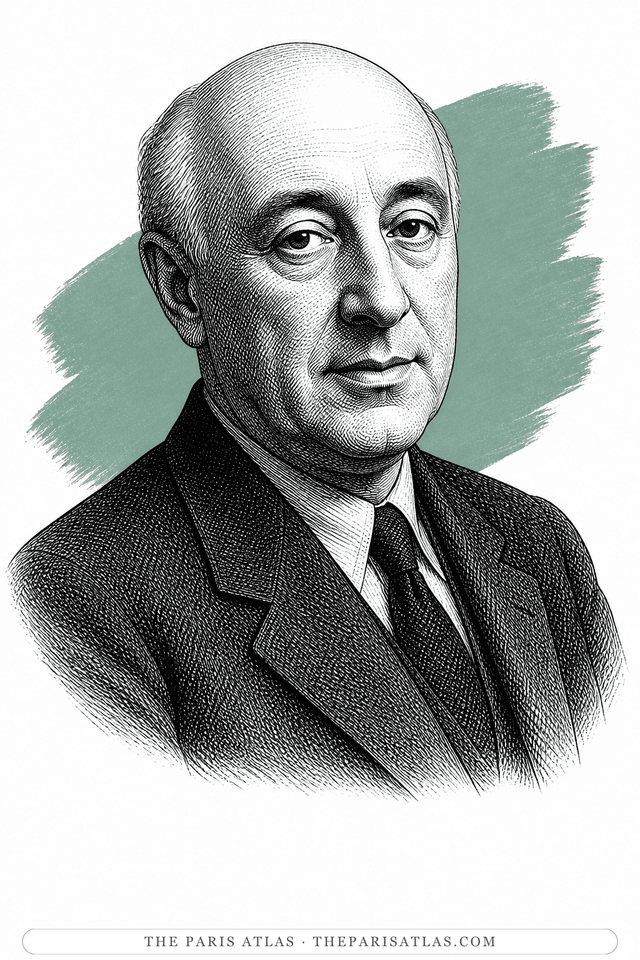
Jean Arp
Strasbourg-born sculptor and poet — Hans in German, Jean in French, both all his life — who co-founded Dada at the Cabaret Voltaire in 1916, composed collages by dropping torn paper 'according to the laws of chance', and settled at Meudon outside Paris in a house his wife Sophie Taeuber-Arp designed.
View artist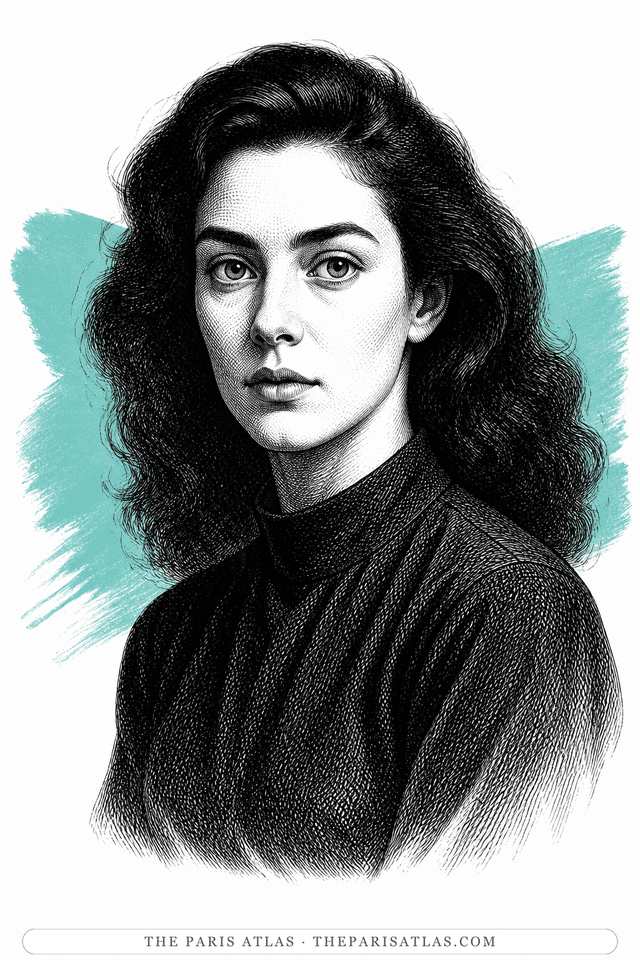
Leonora Carrington
English painter and writer who fled a debutante's future for Surrealist Paris at twenty, survived the war's wreckage of that life — internment for her lover Max Ernst, an asylum in Spain for her — and rebuilt herself in Mexico into one of the century's great painters of the uncanny.
View artist
Henri Cartier-Bresson
French photographer who turned a pocket-sized 35mm camera into an instrument of split-second composition — the idea the world knows as 'the decisive moment'. He trained as a painter, was taken prisoner in 1940 and escaped on his third try, photographed the Liberation of Paris in August 1944, co-founded the photographer-owned agency Magnum Photos in 1947, gave up reporting for drawing in the 1970s, and left Paris a foundation in the Marais that deliberately hangs no permanent display of his own pictures.
View artist
References
The sources below include collection records, catalogues, scholarly research, and primary materials that informed this page. They document The Frame, its making, and its place in cultural history.

1Frida Kahlo, The Frame (Le cadre), 1938 — collection record
WebsiteCentre Pompidou, Musée national d'art moderne, 1938Used forWeb source consulted for documented facts and historical context presented on the The Frame page.
2Focus on… The Frame by Frida Kahlo
WebsiteCentre PompidouUsed forWeb source consulted for documented facts and historical context presented on the The Frame page.
3Frida Kahlo in Paris — curated account of the 1939 stay, with dated letters
WebsiteCentre Pompidou, on Google Arts & CultureUsed forWeb source consulted for documented facts and historical context presented on the The Frame page.

4Mexique, galerie Renou et Colle, 1939 — exhibition dossier and Breton's preface
ArchiveAssociation Atelier André Breton, 1939Used forArchival evidence used to document the historical record connected to The Frame.
5Which of Frida Kahlo's paintings is in the Louvre in Paris? — correcting the attribution of the 1939 purchase
WebsiteEncyclopaedia BritannicaUsed forWeb source consulted for documented facts and historical context presented on the The Frame page.
6Frida: the making of an icon, 25 June 2026 – 3 January 2027 — press release
WebsiteTate Modern, London, 2026Used forWeb source consulted for documented facts and historical context presented on the The Frame page.
7Frida — dated life chronology
WebsiteMuseo Frida KahloUsed forWeb source consulted for documented facts and historical context presented on the The Frame page.
These references provide the documented foundation for this work's history and interpretation. Claim-level citations remain attached to the specific claims they support.
 Explore more resources