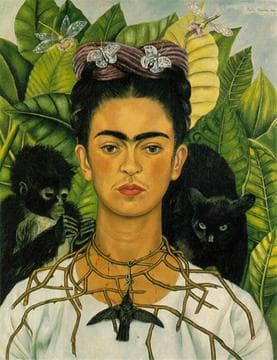
Self-Portrait with Thorn Necklace and Hummingbird
by Frida Kahlo
Frida Kahlo painted herself in front of a wall of leaves, wearing a circlet of thorn branches that cuts her throat, with a dead black hummingbird hanging from it. A spider monkey sits behind her right shoulder and a black cat behind her left. The photographer Nickolas Muray, her lover, bought the painting from her, and it is now at the Harry Ransom Center in Austin, Texas.
- 1940
- Oil on canvas mounted to board
- Harry Ransom Center, University of Texas at AustinAustin, Texas, United States
About Frida Kahlo
What the painting shows
Frida Kahlo faces forward in a plain white blouse with a squared neckline. Her eyebrows are painted as one dark unbroken line above both eyes, a faint shadow runs along her upper lip, and her mouth is closed. A thick braided band of dusty pink and mauve is wound across the top of her head, carrying two pale filigree butterfly ornaments. Two dragonflies fly clear of her hair, one at the upper left and one at the upper right.
A circlet of woody thorn branches is wound around her throat, with long tendrils running outward across both shoulders and down over the blouse. The spines press into her skin, and small red marks and thin trickles of blood show where they break it. A black hummingbird hangs from the necklace at the centre of her chest, its wings spread straight out to both sides and its long thin beak pointing down.
Behind her, broad leaves with strong parallel veins overlap in several layers, with one large pale leaf directly behind her head. No sky or ground shows through. The painting measures roughly 61 by 47 centimetres and is signed at the upper right.
The monkey and the cat
A shaggy dark spider monkey sits behind her right shoulder, at the left of the picture. Its muzzle is pale and turned outward, and one dark hand is closed around a thorn branch, drawing it away from her neck. A black cat sits behind her left shoulder, at the right of the picture, ears forward, its pale yellow-green eyes looking directly out at the viewer.
Frida Kahlo kept spider monkeys at the Casa Azul in Coyoacán, among them one called Fulang-Chang that Diego Rivera gave her. Neither the Harry Ransom Center nor the scholarly literature names the monkey in this particular painting, so it is a spider monkey rather than a named pet.
Painted in the year she remarried Diego Rivera
Frida Kahlo's divorce from Diego Rivera was finalised in November 1939, months after her return from Paris. She painted this self-portrait in 1940.
In the autumn of that year she travelled to San Francisco to be treated by the doctor Leo Eloesser, and she and Diego Rivera remarried there on 8 December 1940, his fifty-fourth birthday. The year of the painting is the year of the remarriage rather than of the separation.
Nickolas Muray, and how it reached Texas
Nickolas Muray was a Hungarian-born American photographer who lived from 1892 to 1965, and he was Frida Kahlo's lover during the years she travelled between Mexico, New York and Paris. The letters she wrote him from Paris in February 1939, complaining about the Surrealists and about André Breton in particular, are held at the Smithsonian's Archives of American Art.
The Harry Ransom Center records that Nickolas Muray bought this self-portrait from Frida Kahlo to help her through a period of financial difficulty, and that it acquired his collection of more than a hundred works of Mexican art in 1966. The painting's accession number, 66.6, follows that year. The Center's own summary page elsewhere gives 1965 and describes the painting as a gift from Frida Kahlo to Nickolas Muray.
The Center catalogues the work as Untitled, with the descriptive title in brackets, and credits it to the Nickolas Muray Collection of Mexican Art.
Where the painting is
The painting belongs to the Harry Ransom Center at the University of Texas at Austin. It is on loan to Tate Modern in London for Frida: The Making of an Icon, which runs from 25 June 2026 to 3 January 2027, so it is not in Austin at present.
It returns for Tokens of Friendship: The Nickolas Muray Collection of Mexican Art, which the Center is showing from 21 September 2027 to 9 January 2028. Frida Kahlo's Still Life with Parrot and Fruit of 1951 hangs in the same exhibition, with a drawing of 1930 she inscribed to Nickolas Muray.
Close reading
Reading the work, detail by detail
Frida Kahlo painted herself in front of a wall of leaves, wearing a necklace of thorns with a dead hummingbird hanging from it, a monkey at one shoulder and a black cat at the other. She gave the picture to the photographer Nickolas Muray, and it is now at the Harry Ransom Center in Austin, Texas. The close views place each animal and follow the thorns.
1.Joined brows above a closed mouth
The eyebrows are painted as one dark unbroken line above both eyes. A faint dark shadow is drawn along the upper lip. The eyes look straight out and the mouth is closed.
2.The thorns draw blood at the throat
A circlet of woody thorn branches is wound around her throat. Spines press into the skin along its length, and small red marks and thin trickles show where they break it. Long tendrils run outward from the circlet across both shoulders.
3.A dead hummingbird hangs at the centre
A black hummingbird hangs from the necklace at the centre of her chest. Its wings are spread straight out to both sides and its long thin beak points down. A dark green sheen is worked into the head and back.
4.The monkey is at her right, pulling a thorn
A shaggy dark monkey sits behind her right shoulder, at the left of the picture. Its muzzle is pale and turned outward. One dark hand is closed around a thorn branch and drawing it away from her neck.
5.The cat is at her left, watching
A black cat sits behind her left shoulder, at the right of the picture. Its ears are forward and its eyes are pale yellow-green. It looks directly out at the viewer rather than at her.
6.Two butterfly ornaments on a braided band
A thick braided band of dusty pink and mauve is wound across the top of her head. Two pale filigree butterfly ornaments are fixed to it, one either side of the centre, their wings open. The hair below the band is almost black.
7.Two dragonflies fly clear of her hair
A pale dragonfly with long narrow wings flies at the upper left, clear of her hair. The wings are translucent and finely veined. A second flies at the upper right against the large pale leaf, its body tinged pink.
8.The leaves close the picture off
Broad leaves with strong parallel veins overlap in several layers behind her. One large leaf directly behind her head is pale yellow-green rather than dark. No sky or ground shows through at any point.
Timeline
1939
Frida Kahlo writes to Nickolas Muray from Paris in February about her illness, the disorder of the exhibition Mexique and her contempt for the Paris art world. Her divorce from Diego Rivera is finalised in November.
1940
Paints the self-portrait, signed and dated at the upper right.
1940
Remarries Diego Rivera in San Francisco on 8 December, while there for treatment by the doctor Leo Eloesser.
1966
The Harry Ransom Center acquires the Nickolas Muray Collection of Mexican Art, more than a hundred works. The painting's accession number is 66.6.
2026
On loan to Tate Modern for Frida: The Making of an Icon, 25 June 2026 to 3 January 2027.
2027
Shown at the Harry Ransom Center in Tokens of Friendship: The Nickolas Muray Collection of Mexican Art, from 21 September to 9 January 2028.
Where to see it
Harry Ransom Center, University of Texas at Austin
Austin, Texas, United States
A public viewing address has not yet been confirmed for this holding.
On loan to Tate Modern in London for Frida: The Making of an Icon until 3 January 2027. It returns to Austin for Tokens of Friendship: The Nickolas Muray Collection of Mexican Art, 21 September 2027 to 9 January 2028.
Frequently asked questions
Where is Self-Portrait with Thorn Necklace and Hummingbird?
The Harry Ransom Center at the University of Texas at Austin, accession number 66.6, from the Nickolas Muray Collection of Mexican Art. It is on loan to Tate Modern in London until 3 January 2027, and returns to Austin for an exhibition opening on 21 September 2027.
What is the hummingbird in Frida Kahlo's self-portrait?
A dead black hummingbird, hanging from the circlet of thorn branches at the centre of her chest. Its wings are spread straight out to both sides and its long thin beak points down, so that it reads as the pendant of the necklace. A dark green sheen is worked into the head and back.
Which animal is on which side in Frida Kahlo's thorn necklace self-portrait?
The spider monkey is behind her right shoulder, which puts it at the left of the picture, and one of its hands is closed around a thorn branch. The black cat is behind her left shoulder, at the right of the picture, looking out at the viewer. Descriptions that use her left and right rather than the viewer's reverse the two.
Why is Frida Kahlo wearing thorns in this painting?
The circlet cuts her: the spines press into her throat and small red marks and trickles of blood show where they break the skin. She painted it in 1940, the year between her divorce from Diego Rivera in November 1939 and their remarriage in San Francisco on 8 December 1940.
Was the monkey in the painting Fulang-Chang?
There is no evidence for it. Frida Kahlo kept spider monkeys at the Casa Azul, one of them a gift from Diego Rivera called Fulang-Chang, but neither the Harry Ransom Center nor the scholarly literature identifies the monkey in this painting as any particular animal.
How did the Harry Ransom Center get the painting?
Through Nickolas Muray, the Hungarian-born American photographer who was Frida Kahlo's lover. The Center records that he bought the self-portrait from her to help her through a period of financial difficulty. It acquired his collection of more than a hundred works of Mexican art in 1966, the year the accession number 66.6 reflects. One of the Center's own pages instead gives 1965 and calls the painting a gift.
More by Frida Kahlo
If you like Frida Kahlo
Explore painters from the same movements and circles.
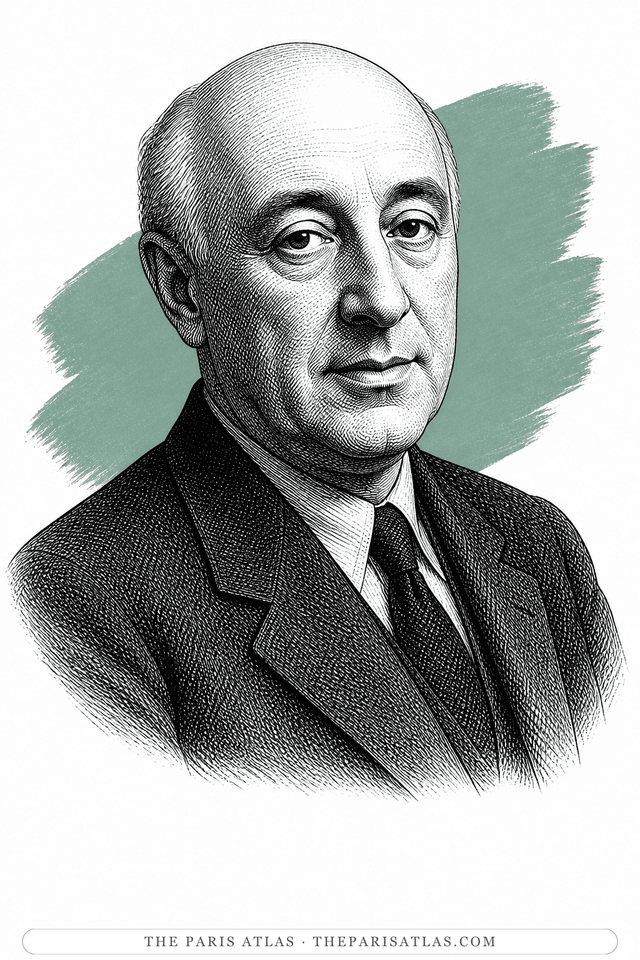
Jean Arp
Strasbourg-born sculptor and poet — Hans in German, Jean in French, both all his life — who co-founded Dada at the Cabaret Voltaire in 1916, composed collages by dropping torn paper 'according to the laws of chance', and settled at Meudon outside Paris in a house his wife Sophie Taeuber-Arp designed.
View artist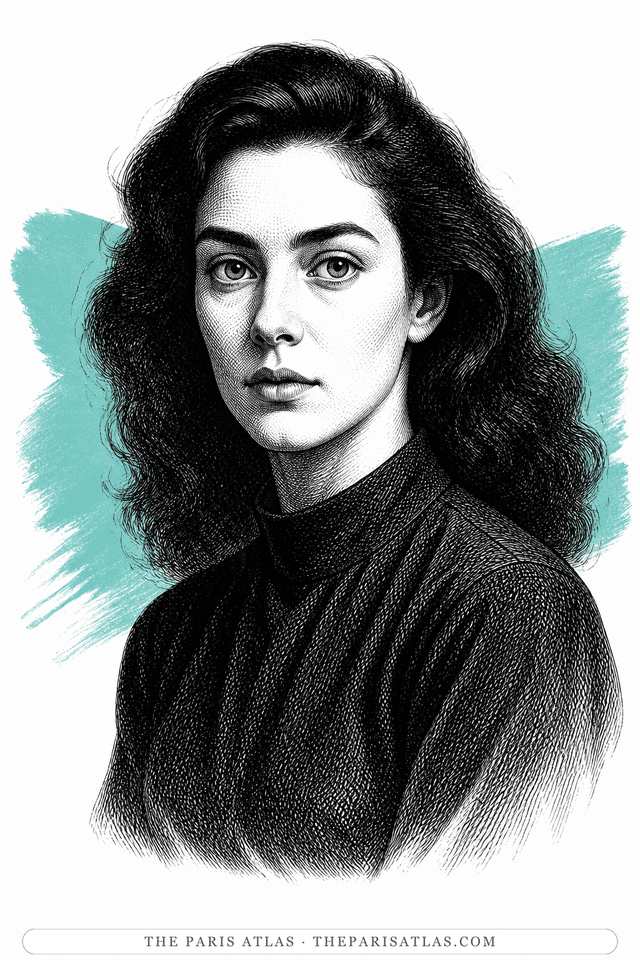
Leonora Carrington
English painter and writer who fled a debutante's future for Surrealist Paris at twenty, survived the war's wreckage of that life — internment for her lover Max Ernst, an asylum in Spain for her — and rebuilt herself in Mexico into one of the century's great painters of the uncanny.
View artist
Henri Cartier-Bresson
French photographer who turned a pocket-sized 35mm camera into an instrument of split-second composition — the idea the world knows as 'the decisive moment'. He trained as a painter, was taken prisoner in 1940 and escaped on his third try, photographed the Liberation of Paris in August 1944, co-founded the photographer-owned agency Magnum Photos in 1947, gave up reporting for drawing in the 1970s, and left Paris a foundation in the Marais that deliberately hangs no permanent display of his own pictures.
View artist
References
The sources below include collection records, catalogues, scholarly research, and primary materials that informed this page. They document Self-Portrait with Thorn Necklace and Hummingbird, its making, and its place in cultural history.

1Frida Kahlo, Untitled [Self-portrait with thorn necklace and hummingbird], 1940 — collection record
WebsiteHarry Ransom Center, University of Texas at AustinUsed forWeb source consulted for documented facts and historical context presented on the Self-Portrait with Thorn Necklace and Hummingbird page.

2Frida Kahlo self-portrait — the Nickolas Muray collection and the 1966 acquisition
Official recordHarry Ransom Center, University of Texas at Austin, 2013Used forOfficial record used to verify names, dates, institutional details, or other factual information on this page.
3View Frida Kahlo portrait and learn about its world travels — with the museum's own dimensions for the painting
PeriodicalRansom Center Magazine, 2010Used forContemporary reporting or criticism used to document the historical reception and context of Self-Portrait with Thorn Necklace and Hummingbird.
4Frida: the making of an icon, 25 June 2026 – 3 January 2027 — press release
WebsiteTate Modern, London, 2026Used forWeb source consulted for documented facts and historical context presented on the Self-Portrait with Thorn Necklace and Hummingbird page.
5Frida Kahlo, Paris, letter to Nickolas Muray, New York, 16 February 1939 — Nickolas Muray papers
ArchiveArchives of American Art, Smithsonian Institution, 1939Used forArchival evidence used to document the historical record connected to Self-Portrait with Thorn Necklace and Hummingbird.
6Biography of Frida Kahlo (official museum biography, PDF)
WebsiteMuseo Frida KahloUsed forWeb source consulted for documented facts and historical context presented on the Self-Portrait with Thorn Necklace and Hummingbird page.
These references provide the documented foundation for this work's history and interpretation. Claim-level citations remain attached to the specific claims they support.
 Explore more resources