Henry Ford Hospital
by Frida Kahlo
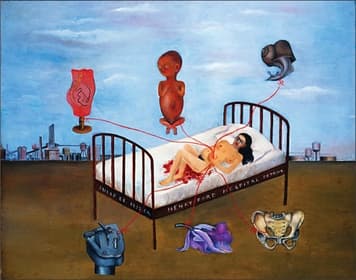
A hospital bed stands in an empty plain with Frida Kahlo lying naked and bleeding on it, and six objects float or lie around it, each joined to her hand by a red ribbon. She painted it in 1932, after losing a pregnancy at the Henry Ford Hospital in Detroit, on a sheet of metal rather than canvas. The bed itself carries the hospital's name and the date.
- 1932
- Oil on sheet metal
- Museo Dolores OlmedoMexico City, Mexico
About Frida Kahlo
What the painting shows
The bed is a dark metal frame with rails at both ends, standing in a wide plain of bare brown earth under a pale blue sky. Frida Kahlo lies on a white sheet with her head at the right, her dark hair spread across the pillow and a tear on her cheek. Her abdomen is still rounded. Bright red blood has pooled and spattered across the sheet beneath her hips and thighs.
Six thin red ribbons gather at her hand, which rests on her abdomen, and run out to six objects. Three float in the sky above the bed and three lie on the ground below it. The Museo Dolores Olmedo describes the objects as attached to her hand by those ribbons.
Factories occupy both horizons in a thin band: sheds, a tall chimney and water towers at the left, more industrial structures at the right. Between them and the bed there is nothing at all. The painted surface measures 30.5 by 38 centimetres, about twelve by fifteen inches.
The six objects
The Museo Dolores Olmedo, which owns the painting, sets out what each object is and what Frida Kahlo meant by it. Above the bed, from left to right, are a medical model of the pelvic zone on a small turned stand, a male foetus, and a snail. The museum reads the model as a reference to the fractures of her spine, the foetus as the wished-for son, and the snail as her own symbol for the slowness of the miscarriage.
On the ground, from left to right, are a machine, an orchid and a pelvic bone. The museum records the orchid as a flower Diego Rivera gave her. The machine is a grey steel object with bolts and a lever, identified elsewhere as part of an autoclave.
The objects are not drawn to a shared scale. The foetus is larger than a newborn, the snail is the size of a suitcase, and the orchid is bigger than the machine beside it.
Detroit, July 1932
Frida Kahlo was in Detroit because Diego Rivera had been commissioned to paint the Detroit Industry murals for the Detroit Institute of Arts. She lost the pregnancy on 4 July 1932. The Museo Dolores Olmedo records that the miscarriage had begun at home and concluded at the Henry Ford Hospital, where she was taken.
Diego Rivera began painting the murals on 25 July and finished on 13 March 1933. The miscarriage therefore fell three weeks before he started work on the walls, during the months he was in the city preparing them.
The factories on the horizon are the industrial Detroit that had brought them there. The Ford Motor Company plant is the subject Diego Rivera was about to spend eight months painting.
Painted like a votive tablet
The support is a sheet of metal. The Museo Dolores Olmedo records this as the first painting for which Frida Kahlo used metal, and connects the choice to the Mexican ex-voto. An ex-voto is a small votive tablet, painted in thanks for a rescue or a recovery and hung in a church.
Ex-votos are made on tin or sheet metal, at roughly this size, and they carry an inscription naming the person and the date. The lettering around the bed frame does the same work: HENRY FORD HOSPITAL DETROIT along the long side rail, and JULIO DE 1932 F.K. on the angled foot rail.
What the form does not carry here is the thanks. A votive tablet records a disaster survived through intervention, usually with a saint or a Virgin painted in one corner. The sky above this bed holds a foetus and a snail.
Where the painting is
The Museo Dolores Olmedo holds the picture at the La Noria hacienda in Xochimilco, in the south of Mexico City. The museum closed in 2020, and a plan announced in 2021 to move the collection to a new building in Chapultepec was dropped after opposition from Xochimilco residents and a complaint to the national human rights commission.
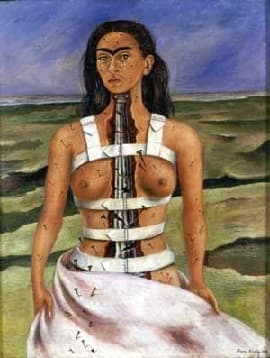
It reopened at its original site on 30 May 2026 with twenty-six paintings by Frida Kahlo and a hundred and forty-eight works by Diego Rivera. Henry Ford Hospital hangs in the reopening display, Frida Kahlo en dos tiempos, alongside The Broken Column. The museum publishes no catalogue record for individual objects.
Close reading
Reading the work, detail by detail
A hospital bed stands in an empty plain with a nude figure bleeding on it, and six objects float or lie around it, each tied to her abdomen by a red ribbon. Frida Kahlo painted it on sheet metal in 1932, the year she lost a pregnancy in Detroit. The close views identify the six objects and the writing on the bed.
1.Her head lies at the right, and she is crying
Her head lies at the right-hand end of the bed, with dark hair spread over a white pillow. The brows are dark and the lips are red. A single tear sits on her cheek.
2.Six ribbons gather at her hand
Six thin red ribbons gather at her hand, which rests on an abdomen still rounded from the pregnancy. The Museo Dolores Olmedo describes the objects as attached to her hand by those ribbons. Bright red blood has pooled and spattered across the sheet beneath her hips, and her knees are drawn up towards the left.
3.An anatomical model on a wooden stand
At the upper left a pink-red anatomical form is mounted on a turned wooden stand. A curled shape and a run of orange vessels are drawn in outline inside it. The Museo Dolores Olmedo identifies it as a medical model of the pelvic zone, referring to the fractures of her spine.
4.The foetus hangs above the bed
A foetus floats directly above the bed, larger than scale. Its eyes are closed and its hands are drawn up to the chest. The umbilical stump is visible at the abdomen, and the ribbon runs down from it.
5.A snail at the top right
A snail floats at the upper right, well above the horizon. Its shell is coiled and grey-brown, and the body is extended as if moving. A red ribbon is tied to it.
6.A blue-grey machine on the ground
A blue-grey metal machine stands on the bare ground at the lower left. The body is angular and stepped, with bolts showing and a lever at the top. It sits on a short cylindrical base.
7.A purple orchid at the bottom centre
An orchid lies on the bare earth at the bottom centre. The petals are fleshy and curling, worked in lavender and magenta. A dark stem runs out to the left and the ribbon attaches near it.
8.An anatomical pelvis at the bottom right
A pale cream pelvis sits on the earth at the bottom right, seen from the front. The sacrum, both hip bones and the openings beneath them are all drawn. A dark metal fitting crosses its centre, and small lettering is marked on the bone.
9.The bed carries the hospital's name and her initials
The long side rail of the bed reads HENRY FORD HOSPITAL DETROIT in pale capitals. The angled foot rail carries JULIO DE 1932 F.K., the month and year of the miscarriage followed by her initials. Both run around the frame as if stencilled on it.
10.Factories sit low on the horizon
At the left horizon a cluster of factory sheds, a tall chimney and a water tower are painted in a thin band. More industrial structures and water towers occupy the right horizon. They are small, and the plain between them and the bed is empty brown earth.
Timeline
1932
Frida Kahlo is in Detroit while Diego Rivera prepares the Detroit Industry murals for the Detroit Institute of Arts.
1932
She loses the pregnancy on 4 July and is taken to the Henry Ford Hospital in Detroit.
1932
Diego Rivera begins painting the murals on 25 July, three weeks after the miscarriage, and finishes on 13 March 1933.
1932
Paints Henry Ford Hospital on a sheet of metal, her first painting on that support, in the manner of a Mexican votive tablet.
2020
The Museo Dolores Olmedo closes, and a plan to move the collection to Chapultepec is announced in 2021 and later dropped.
2026
The museum reopens at the La Noria hacienda in Xochimilco on 30 May, with the painting in the display Frida Kahlo en dos tiempos.
Where to see it
Museo Dolores Olmedo
Mexico City, Mexico
A public viewing address has not yet been confirmed for this holding.
The museum reopened at the La Noria hacienda in Xochimilco on 30 May 2026, and shows the painting in the display Frida Kahlo en dos tiempos. It publishes no catalogue record for individual objects.
Frequently asked questions
What does Henry Ford Hospital by Frida Kahlo show?
The miscarriage she suffered in Detroit on 4 July 1932. Frida Kahlo painted herself naked and bleeding on a hospital bed in an empty plain, with the Detroit factories on the horizon and six objects joined to her hand by red ribbons. The bed frame is lettered HENRY FORD HOSPITAL DETROIT and JULIO DE 1932 F.K.
What are the six objects in Henry Ford Hospital?
Above the bed, from left to right: a medical model of the pelvic zone on a stand, a male foetus, and a snail. On the ground, from left to right: a machine, an orchid, and a pelvic bone. The Museo Dolores Olmedo records the snail as Frida Kahlo's symbol for the slowness of the miscarriage, the foetus as the wished-for son, and the orchid as a flower Diego Rivera gave her.
Where is Henry Ford Hospital by Frida Kahlo?
The Museo Dolores Olmedo, at the La Noria hacienda in Xochimilco in the south of Mexico City. The museum reopened at that site on 30 May 2026 after six years closed, and the painting hangs in the reopening display Frida Kahlo en dos tiempos.
What is Henry Ford Hospital painted on?
A sheet of metal, 30.5 by 38 centimetres. The Museo Dolores Olmedo records it as the first painting for which Frida Kahlo used a metal support, and links the choice to the Mexican ex-voto. Those are small votive tablets, painted on tin in thanks for a recovery and hung in a church.
Why was Frida Kahlo in Detroit in 1932?
Diego Rivera had been commissioned to paint the Detroit Industry murals for the Detroit Institute of Arts. He began painting on 25 July 1932 and finished on 13 March 1933. The miscarriage fell on 4 July, three weeks before he started work on the walls.
How big is Henry Ford Hospital?
30.5 by 38 centimetres, about twelve by fifteen inches — roughly the size of a sheet of paper, and the size Mexican votive tablets are usually made.
More by Frida Kahlo
If you like Frida Kahlo
Explore painters from the same movements and circles.
Jean Arp
Strasbourg-born sculptor and poet — Hans in German, Jean in French, both all his life — who co-founded Dada at the Cabaret Voltaire in 1916, composed collages by dropping torn paper 'according to the laws of chance', and settled at Meudon outside Paris in a house his wife Sophie Taeuber-Arp designed.
View artist
Leonora Carrington
English painter and writer who fled a debutante's future for Surrealist Paris at twenty, survived the war's wreckage of that life — internment for her lover Max Ernst, an asylum in Spain for her — and rebuilt herself in Mexico into one of the century's great painters of the uncanny.
View artist
Henri Cartier-Bresson
French photographer who turned a pocket-sized 35mm camera into an instrument of split-second composition — the idea the world knows as 'the decisive moment'. He trained as a painter, was taken prisoner in 1940 and escaped on his third try, photographed the Liberation of Paris in August 1944, co-founded the photographer-owned agency Magnum Photos in 1947, gave up reporting for drawing in the 1970s, and left Paris a foundation in the Marais that deliberately hangs no permanent display of his own pictures.
View artist
References
The sources below include collection records, catalogues, scholarly research, and primary materials that informed this page. They document Henry Ford Hospital, its making, and its place in cultural history.


1Henry Ford Hospital — the Museo Dolores Olmedo's own catalogue text, in Frida Kahlo: alas para volar
Exhibition catalogueFundación Casa de México en España, from documentation owned by the Museo Dolores Olmedo, 2022Used forCatalogue scholarship used to verify attribution, provenance, chronology, and interpretive context for Henry Ford Hospital.

2The museum — visiting hours and the collection at the La Noria hacienda, Xochimilco
WebsiteMuseo Dolores OlmedoUsed forWeb source consulted for documented facts and historical context presented on the Henry Ford Hospital page.
3Museo Dolores Olmedo to reopen in 2026 amid controversy — the cancelled move to Parque Aztlán
PeriodicalThe Art Newspaper, 2025Used forContemporary reporting or criticism used to document the historical reception and context of Henry Ford Hospital.
4Detroit Industry Murals
WebsiteDetroit Institute of ArtsUsed forWeb source consulted for documented facts and historical context presented on the Henry Ford Hospital page.
5Biography of Frida Kahlo (official museum biography, PDF)
WebsiteMuseo Frida KahloUsed forWeb source consulted for documented facts and historical context presented on the Henry Ford Hospital page.
These references provide the documented foundation for this work's history and interpretation. Claim-level citations remain attached to the specific claims they support.
 Explore more resources