The Paris AtlasCharting the artists, works, and places worth returning to.
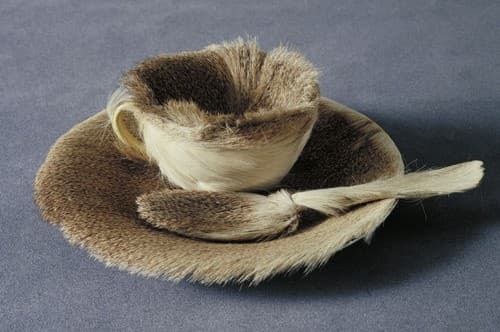
A teacup, saucer and spoon entirely covered in mottled brown and grey gazelle fur, the fur following the curve of the cup and the rim of the saucer, set against a plain pale background.

Artwork reproduction

SculptureSurrealism

Object

Le Déjeuner en fourrure

by Meret Oppenheim

Meret Oppenheim made Object in Paris in 1936 by covering a bought cup, saucer and spoon in gazelle fur. The set is instantly recognizable as tableware and immediately impossible to imagine drinking from. It is at the Museum of Modern Art in New York, and André Breton gave it a second title, Le Déjeuner en fourrure.

Created
1936
Medium
Fur-covered cup, saucer and spoon
Where to see it
Museum of Modern ArtNew York, United States

About Meret Oppenheim

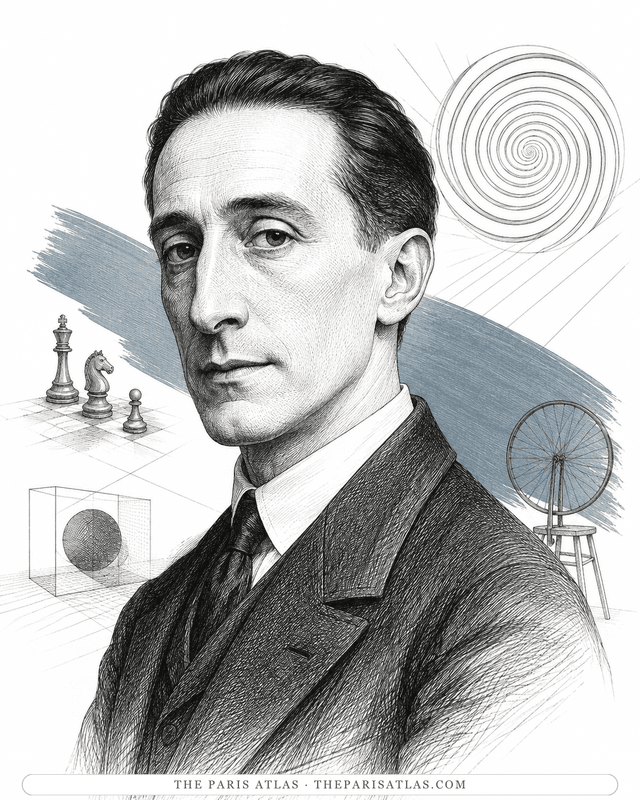
Illustrated portrait of Meret Oppenheim
Meret Oppenheim

1 work catalogued

Overview

Object is a Surrealist sculpture made by Meret Oppenheim in Paris in 1936. Consisting of a cup, saucer, and spoon covered with fur, it transforms familiar tableware into an object that remains immediately recognizable but becomes disturbing to imagine using. It belongs to the Museum of Modern Art in New York.

The Café Conversation Behind the Work

The idea began during a conversation with Pablo Picasso and Dora Maar in a Paris café. Picasso noticed Oppenheim's fur-trimmed bracelet and joked that other things could also be covered in fur. Oppenheim extended the suggestion to a cup and saucer. She subsequently bought a tea service at a department store and transformed it into the sculpture.

The story is memorable because it connects an apparently casual exchange with a carefully chosen artistic transformation. Oppenheim did not simply preserve the joke. She selected objects whose normal relationship with the hands and mouth would make the substitution of materials especially consequential.

Attraction and Repulsion

The work creates a conflict between different kinds of sensory anticipation. Fur can seem warm, soft, and appealing to touch, but those qualities become unpleasant when imagined inside the mouth. The cup's shape promises drinking; its surface frustrates that expectation. Recognition and refusal occur almost simultaneously.

That disturbance is Surrealist in a particular way. Surrealism did not have to build an imaginary world from nothing. It could take a familiar thing and make it show an unfamiliar side. Dreams, desire and unconscious association were its means of unsettling how stable ordinary experience appears.

Reception and Oppenheim's Larger Career

The sculpture appeared in Surrealist exhibitions in Paris and New York in 1936 and became one of the movement's most recognizable objects. André Breton gave it the alternative title Le Déjeuner en fourrure, usually translated as Luncheon in Fur. Its small scale did not prevent it from becoming a major challenge to conventional expectations of sculpture.

Its fame has sometimes overshadowed the breadth of Oppenheim's work. Her career extended across six decades and included painting, collage, jewelry, assemblage, relief, and sculpture in materials ranging from found natural objects to bronze and semiprecious stone. The fur-covered tea service is therefore best understood as one concentrated example of her inventiveness, not the complete definition of her achievement.

Close reading

Reading the work, detail by detail

A cup, saucer, and spoon retain their familiar shapes under a covering of fur. These six views examine the places where that covering changes how the objects look and how a viewer imagines using them.

The fur-covered rim and dark interior of Meret Oppenheim's cup.

1.The rim no longer feels drinkable

Long hairs stand up along the rim and continue into the dark opening. The cup still presents the familiar invitation to drink, but the surface at the point of contact has changed. Looking at the rim brings the imagined sensation of fur against the lips into conflict with the object's ordinary use.

The small curved handle at the left of Oppenheim's fur-covered cup.

2.The handle survives beneath the covering

The small loop at the left makes the cup immediately recognizable. Pale fur follows its curve without completely filling the opening. The handle therefore remains legible as a place for a finger, even though fur now covers the surface a finger would grip.

Pale fur curving across the front wall of the cup beneath a darker upper rim.

3.Fur follows the rounded wall

The pale hairs across the front follow the curve of the vessel. Light and dark patches give the covering its own irregular pattern while the rounded outline still describes a manufactured cup. The two kinds of surface remain visible together: the regular shape of tableware and the uneven texture of an animal's coat.

The broad, fur-covered left edge of the saucer and the gray surface around it.

4.A soft edge replaces a hard rim

The saucer's edge spreads into a fringe of individual hairs. That fringe weakens the crisp boundary expected from a hard dish and makes the object look less contained. The curved outline is still easy to follow, but its surface seems to extend slightly beyond the shape that supports it.

The fur-covered bowl of the spoon resting in front of the cup.

5.The spoon becomes a small pad

The spoon's oval bowl reads as a dense, soft pad. Its familiar concavity is harder to see because the fur covers the surface that would normally hold liquid. Placing it across the saucer brings the transformation close to the viewer, where the contrast between a utensil's purpose and its new texture is especially direct.

The pale, fur-covered spoon handle projecting to the right of the saucer.

6.The handle extends beyond the saucer

The long pale handle crosses the darker saucer and projects past its edge. It gives the compact group a clear outward direction. The hairs lie along its length, so the covering emphasizes the handle's narrow shape even as it changes the sensation that shape suggests to a hand.

Detail views use the same reproduction throughout. Source reproduction and collection information.

Timeline

  1. 1936

    In a Paris café, Pablo Picasso admires Meret Oppenheim's fur-trimmed bracelet and jokes that anything could be covered in fur. Oppenheim answers that a cup and saucer could be, then buys a tea service at a department store and does it.

  2. 1936

    The work is shown in Surrealist exhibitions in Paris and New York, and enters the collection of the Museum of Modern Art. André Breton titles it Le Déjeuner en fourrure.

Where to see it

Museum of Modern Art

New York, United States

A public viewing address has not yet been confirmed for this holding.

Held by the Museum of Modern Art. Gallery displays change, so check the museum's own object record before making a special visit.

Frequently asked questions

What is Meret Oppenheim's Object?

A teacup, saucer and spoon covered in gazelle fur, made in Paris in 1936. The set is ordinary tableware bought from a department store; the fur is the whole intervention. It is one of the most recognizable Surrealist objects.

Why is a fur-covered teacup disturbing?

Because fur feels one way to the hand and another to the mouth. It reads as warm and soft to touch, and repellent to drink from. The cup's shape promises drinking while its surface refuses it, and both reactions arrive at once.

How did Meret Oppenheim come up with the idea?

From a café conversation in Paris with Pablo Picasso and Dora Maar. Picasso noticed the fur-trimmed bracelet Oppenheim was wearing and joked that anything could be covered in fur. Oppenheim said a cup and saucer could be, then went to a department store, bought a tea service, and made it.

Why is it also called Le Déjeuner en fourrure?

André Breton gave it that alternative title, usually translated as Luncheon in Fur. Oppenheim's own title was the plainer one: Object.

How big is Object?

Small. The saucer is 23.7 centimetres across, the cup 10.9 centimetres, the spoon 20.2 centimetres long, and the whole thing stands 7.3 centimetres high. MoMA catalogues the three pieces separately, with an overall height for the set.

Is Object Meret Oppenheim's only important work?

No, though its fame can make it look that way. Her career ran across six decades and took in painting, collage, jewellery, assemblage, relief and sculpture, in materials from found natural objects to bronze and semiprecious stone.

In the atlas

What the graph records about this work — every claim carries its citation.

Associated with · 1936

Modern Art

Meret Oppenheim covered a bought cup, saucer and spoon in gazelle fur in Paris in 1936, after Pablo Picasso joked in a café that anything could be covered in fur. The fur is appealing to the hand and repellent to the mouth, so recognition and refusal arrive at once.
Meret Oppenheim, Object (Paris, 1936); Surrealism

If you like Meret Oppenheim

Explore sculptors from the same movements and circles.

  • Illustrated portrait of Jean Arp

    Jean Arp

    Strasbourg-born sculptor and poet — Hans in German, Jean in French, both all his life — who co-founded Dada at the Cabaret Voltaire in 1916, composed collages by dropping torn paper 'according to the laws of chance', and settled at Meudon outside Paris in a house his wife Sophie Taeuber-Arp designed.

    View artist
  • Illustrated portrait of Salvador Dalí

    Salvador Dalí

    The self-made icon of Surrealism — melting watches and manicured scandal — who arrived in Paris by way of two films written with Buñuel, dreamed together before the movement claimed them.

    View artist
  • Illustrated portrait of Marcel Duchamp

    Marcel Duchamp

    The century's quietest revolutionary — readymades, the abandonment of painting, chess on a Paris rooftop in Entr'acte, and one anemic film of spinning puns signed Rrose Sélavy.

    View artist
References

References

The sources below include collection records, catalogues, scholarly research, and primary materials that informed this page. They document Object, its making, and its place in cultural history.

  1. 1Meret Oppenheim, Object (Paris, 1936)

    Website
    The Museum of Modern Art
    Used for

    The holding museum's record: the 1936 date, the café conversation with Picasso and Dora Maar, the individual measurements, and Breton's alternative title.

    View source
  2. 2Surrealism

    Website
    The Metropolitan Museum of Art
    Used for

    Surrealism's interest in making familiar things disclose unfamiliar possibilities, through dreams, desire and unconscious association.

    View source
  1. 3Meret Oppenheim: My Exhibition

    Website
    Museum of Modern Art
    Used for

    MoMA's retrospective of Oppenheim, on the six decades and the range of media her career covered beyond this one object.

    View source
  2. 4Why Meret Oppenheim's Furry Teacup 'Object' Still Provokes and Puzzles

    Periodical
    Artnet News
    Used for

    On the object's continuing power to provoke, and on how thoroughly it has overshadowed the rest of her work.

    View source
i
Why these sources are here

These references provide the documented foundation for this work's history and interpretation. Claim-level citations remain attached to the specific claims they support.

Explore more resources