Paris
by Robert Frank
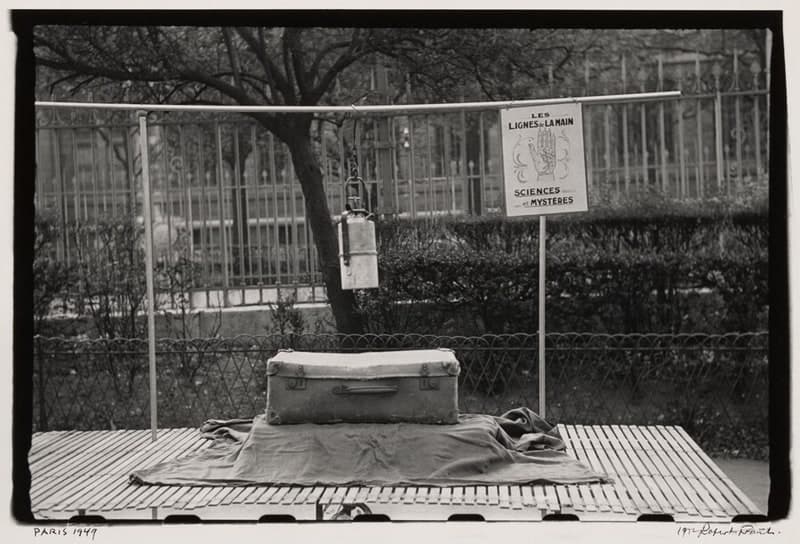
A battered suitcase sits on a folded tarpaulin spread over a slatted wooden handcart, beside park railings in Paris. A hand-lettered sign hanging above it reads LES LIGNES DE LA MAIN and, below a drawing of an open palm, SCIENCES ET MYSTÈRES. Robert Frank made the negative in 1949 and Sid Kaplan printed this sheet in 1972 for the National Gallery of Art's 1994.57.1.
- 1949, printed 1972
- Gelatin silver print
- National Gallery of ArtWashington, DC, United States
About Robert Frank

What the photograph shows
A flat handcart made of narrow wooden slats fills the lower third of the frame, seen almost square on. A folded canvas sheet is spread over it, rucked up at the right, and a pale suitcase stands in the middle of it, its corners capped in metal, two catches and a strap handle facing the camera.
Two thin poles rise from the cart and carry a horizontal bar across the top of the picture. A pale metal canister with a handle down its side hangs from a hook at the centre of the bar. At the right, a placard hangs from the same bar.
The placard is hand-lettered. LES LIGNES DE LA MAIN runs across the top, over an engraved-looking drawing of an open right palm with the lines marked and small symbols set along it, and SCIENCES ET MYSTÈRES runs across the bottom. The National Gallery of Art's own description of the photograph reads the sign as advertising palm readings.
Behind the cart stand a low ornamental wire fence with a looped top, a clipped hedge, tall park railings and bare trees. Robert Frank printed the negative to its edges, so a black border runs round the picture. He wrote PARIS 1949 in the left margin below it and signed 1972 Robert Frank at the right.
The sign and the book share a phrase
Les lignes de la main means the lines of the hand. Robert Frank published two books called The Lines of My Hand in 1972, one in Tokyo with Yugensha and one in New York with Lustrum Press. The National Gallery of Art dates this print to the same year.
No document connects the sign to the title. The Gallery records no Lines of My Hand number on the sheet, although it records one on the companion print bought with it: the verso of 1994.57.2 carries LOMH 28 in graphite. What can be said is that the phrase was in front of Robert Frank in a Paris street in 1949, and that he printed the picture in the year the books appeared.
Sid Kaplan made the print
The National Gallery of Art credits a second person on the object record. Under Associated Names, after Robert Frank, it lists Sid Kaplan, described as Printer, American. The page itself is titled Paris by Robert Frank, Sid Kaplan.
A photographic print is a separate object from a negative, and who made it changes the object. The negative is Robert Frank's work of 1949; the sheet in Washington is a 1972 print by Sid Kaplan from that negative, which is why the Gallery gives two dates and two names.
Robert Frank in Paris, 1949
The Robert Frank Foundation's chronology puts him in Paris that year. He had met the Paris-based Chinese painter San-Yu and agreed to swap apartments with him, then travelled through France, Switzerland, Italy and Spain with Zurich and Paris as his bases. He made a handmade book in Paris the same year and gave it to Mary Lockspeiser, whom he married in 1950.
The photographs he made in the city between 1949 and 1952 were gathered much later into a single book, Paris, edited by Ute Eskildsen and published by Steidl in 2008 with sixty-nine of them.
How it reached Washington
The print came from the dealer PaceWildensteinMacGill in New York. The National Gallery of Art bought it in 1994 with money given by the Prince Charitable Trusts, and the credit line reads Robert Frank Collection, Gift of the Prince Charitable Trusts.
It was bought as one of a pair. The second sheet, 1994.57.2, is another Paris photograph of 1949, and it came from the same dealer in the same purchase.
Close reading
Reading the work, detail by detail
The negative is printed to its edges, so a black rebate line frames the picture and the artist's writing sits outside that, in the white margin. Everything in the photograph stands on or above one flat handcart, and the background is a fence, a hedge and railings in three horizontal bands.
1.The sign is hand-lettered and hangs from a bar
The placard hangs by two short wires from a horizontal bar. LES LIGNES de LA MAIN is lettered across the top in heavy capitals with a lighter script de, and SCIENCES et MYSTÈRES across the bottom in the same hand. Dotted rules run out from the words to fill the line.
2.The palm on the sign is drawn like an engraving
The hand is drawn open, fingers up, with the main creases of the palm ruled in and small symbols set at the base of each finger. Two curling scrolls frame it left and right. The drawing style is that of a printed engraving rather than of the lettering around it.
3.The suitcase is worn at every corner
The case is pale, scuffed and slightly bowed along the top. Metal caps protect all four visible corners and two catches with keyhole plates sit either side of a flat strap handle. It stands square in the middle of the cart, on a canvas sheet that has been folded rather than spread flat.
4.A metal canister hangs from the crossbar
A pale cylindrical canister hangs from a hooked bracket at the centre of the bar, with a tall handle running down one side and a rim at the top. Nothing on it is lettered. It swings clear of the cart and hangs at about head height above the suitcase.
5.The cart is a bed of narrow slats
The deck is built of many narrow slats laid lengthways with dark gaps between them, and it runs the full width of the picture. Its front edge is squared off and carries dark fittings at intervals. The canvas sheet covers only the middle third of it.
6.Three horizontal bands close the background
Behind the cart the background stacks into bands: a low wire fence with a looped top edge, then a dark clipped hedge, then tall park railings with a rail across them, then bare branches. Each band runs the width of the frame, and none of them is in sharp focus.
7.Two dates, written twenty-three years apart
Below the black rebate line the sheet has a white margin, and PARIS 1949 is written across it at the left in capitals. At the right of the same margin the print is signed 1972 Robert Frank. The two inscriptions date the negative and the printing separately.
Timeline
1949
Photographed in Paris, where Robert Frank was based after agreeing to swap apartments with the painter San-Yu. He makes the handmade Mary's Book in the city the same year.
1972
Sid Kaplan makes this print. Robert Frank publishes The Lines of My Hand in Tokyo with Yugensha and in New York with Lustrum Press.
1994
Bought by the National Gallery of Art from PaceWildensteinMacGill with funds from the Prince Charitable Trusts, as 1994.57.1.
2008
Sixty-nine of the Paris photographs are published as the book Paris, edited by Ute Eskildsen for Steidl.
Where to see it
National Gallery of Art
Washington, DC, United States
A public viewing address has not yet been confirmed for this holding.
The National Gallery of Art states on the object record that the work's media is not available for download and directs image requests to the Gallery.
Frequently asked questions
What does the sign in Robert Frank's Paris say?
LES LIGNES DE LA MAIN across the top and SCIENCES ET MYSTÈRES across the bottom, with a drawing of an open palm between them. The phrase means the lines of the hand, and the National Gallery of Art's description of the photograph reads the sign as advertising palm readings.
Where is Robert Frank's Paris of 1949?
At the National Gallery of Art in Washington, accession number 1994.57.1. The Gallery bought it in 1994 from PaceWildensteinMacGill with funds from the Prince Charitable Trusts. It does not offer the image for download.
Who printed this photograph?
Sid Kaplan, in 1972. The National Gallery of Art lists him under Associated Names on the object record as Printer, American, and titles the page Paris by Robert Frank, Sid Kaplan. Robert Frank made the negative in 1949 and signed the print 1972 Robert Frank.
Is this photograph connected to The Lines of My Hand?
Nothing documents a connection. Robert Frank published two books called The Lines of My Hand in 1972, the year of this print, and the sign in the picture reads les lignes de la main. The National Gallery of Art records no Lines of My Hand number on the sheet, though it records LOMH 28 on the verso of the companion print bought with it.
Why is there a black border round the picture?
Because the negative was printed to its edges rather than cropped inside them. The black line is the unexposed film rebate, and it shows that nothing has been trimmed out of the frame.
How big is the print?
The image is 21.5 by 32.4 centimetres, about eight and a half by nearly thirteen inches, on a sheet of 27.9 by 35.4 centimetres. It is a gelatin silver print.
More by Robert Frank
References
The sources below include collection records, catalogues, scholarly research, and primary materials that informed this page. They document Paris, its making, and its place in cultural history.

1Robert Frank, Paris, 1949, printed 1972 by Sid Kaplan — collection record, accession 1994.57.1
Official recordNational Gallery of Art, WashingtonUsed forOfficial record used to verify names, dates, institutional details, or other factual information on this page.
2National Gallery of Art open data: objects and published images
ArchiveNational Gallery of ArtUsed forThe Gallery's own catalogue export, used for the tombstone fields, the inscription, the provenance and the printer credit.
3Robert Frank chronology, 1924–2019
Official recordRobert Frank FoundationUsed forOfficial record used to verify names, dates, institutional details, or other factual information on this page.
4Robert Frank bibliography: books, selected publications, and selected periodicals
Official recordRobert Frank FoundationUsed forOfficial record used to verify names, dates, institutional details, or other factual information on this page.
5Paris
Exhibition catalogueSteidl, Göttingen, 2008Used forCatalogue scholarship used to verify attribution, provenance, chronology, and interpretive context for Paris.
6The Robert Frank Collection — access and rights
ArchiveNational Gallery of Art, WashingtonUsed forArchival evidence used to document the historical record connected to Paris.
7Foundation — mission, board, gallery representation, and copyright licensing contact
Official recordRobert Frank FoundationUsed forOfficial record used to verify names, dates, institutional details, or other factual information on this page.
8Announcement of the June Leaf Art Foundation Inc. and the renaming of the June Leaf and Robert Frank Foundation to the Robert Frank Foundation
Official recordRobert Frank FoundationUsed forOfficial record used to verify names, dates, institutional details, or other factual information on this page.
These references provide the documented foundation for this work's history and interpretation. Claim-level citations remain attached to the specific claims they support.
 Explore more resources