Tree and Chair/Paris
by Robert Frank
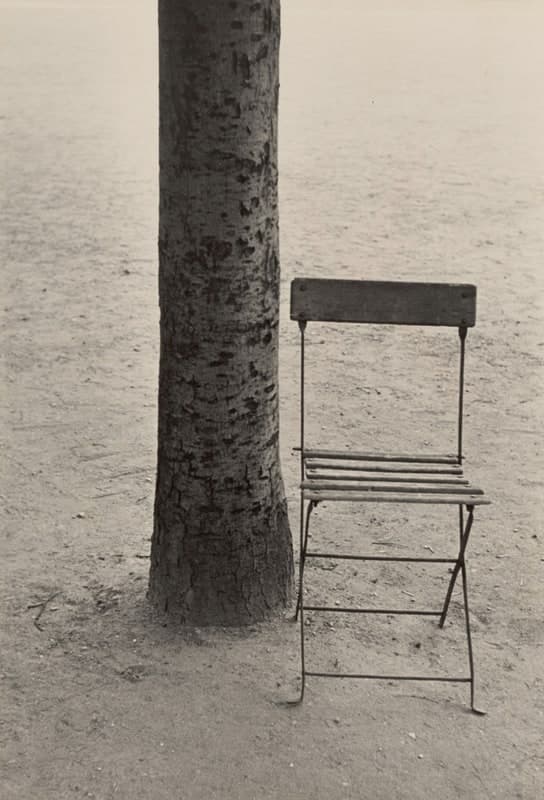
An empty folding park chair stands on bare sandy ground beside a tree trunk. Robert Frank made the photograph in Paris in 1949 and bound a print of it into Black White and Things, the book he assembled by hand in Zurich in 1952. The National Gallery of Art in Washington holds that volume complete, and this sheet is number 29 in its third section.
- 1949
- Gelatin silver print
- National Gallery of ArtWashington, DC, United States
About Robert Frank

What the photograph shows
A tree trunk rises out of the left half of the frame and runs off the top edge. Its bark is rough and pitted, and the ground banks slightly against its base. To the right of it stands a folding chair with a plain wooden backboard and five wooden slats for a seat, carried on a thin bent-steel frame with cross-braces and feet that curl into small points.
The chair is empty and stands square on open ground. Nothing else is in the picture. The ground is dry, pale and gritty, scattered with small stones and a few dropped twigs, and it runs flat to the top of the frame with no horizon, no sky and no buildings.
The print is warm-toned and the light is even. The picture is sharp from the bark in the foreground to the grain of the sand behind, which is unusual in Robert Frank's work and is the reason the chair reads as an object rather than a passing sight.
Plate 29 of Black White and Things
Robert Frank made Black White and Things by hand in Zurich in 1952, and the National Gallery of Art holds the whole thing as 1990.28.29.1-52. The Gallery describes the volume as front and back covers, sixteen typeset text pages and thirty-four gelatin silver prints on seventeen pages. It measures 37 by 40 by 7 centimetres.
The book is divided into three named sections, Black, White and Things. The printed contents page for the third lists the photograph as number 29: Tree and Chair/Paris 1949. The sheet itself carries 29 in graphite on its linen tape hinge.
Paris runs through the Things section. Its other plates include Tulipe/Paris 1950, Artificial Tulipe/Paris 1952, Horse and Cart/Paris 1949 and Horse and Children/Paris 1952.
What the book says it is doing
The introduction page carries two blocks of type. The first is a quotation, printed across the top and attributed on the page to Antoine de Saint-Exupéry, whose 1943 book Le Petit Prince it comes from.
“it is only with the heart that one can see rightly / what is essential is invisible to the eye”
The second block, at the foot of the same page, is Robert Frank's own statement of what the three sections are for.
“sombre people and black events / quiet people and peaceful places / and the things people have come in contact with / this, I try to show in my photographs”
A chair on empty ground belongs to the third of those three lines. The verso of the introduction page credits the cover and layout to Werner Zryd.
Robert Frank photographed Paris chairs repeatedly
Life magazine ran eleven of his Paris chair photographs on 21 May 1951, across pages 26 to 28, under the headline Speaking of Pictures: A Photographer in Paris Finds Chairs Everywhere. That is the published record of the subject, and it names the city rather than any one garden.
The chairs are often described as the Tuileries chairs. The National Gallery of Art's catalogue does not support the label: across its 5,036 Robert Frank objects, not one carries the word Tuileries in its title, and the only chair photograph in the Paris material is titled Tree and Chair/Paris.
How it reached Washington
Robert Frank gave the book to the National Gallery of Art in 1990, in the gift that founded the Robert Frank Collection there. The credit line on every sheet reads Robert Frank Collection, Gift of Robert Frank in Honor of the 50th Anniversary of the National Gallery of Art.
Black White and Things has been reissued twice from the Gallery's copy: in reduced format by Scalo and the National Gallery of Art in 1994, and again, smaller still, by Steidl and the Gallery in 2009.
Close reading
Reading the work, detail by detail
The print is warm-toned and sharp from the bark in front to the grain of the sand behind. There is no horizon, no sky and no third object: the whole frame is a trunk, a chair and the ground they stand on.
1.The trunk is scarred all the way up
The bark is grey and rough, broken by dark oval scars and short horizontal splits that run in bands round the trunk. The marks are evenly spread rather than clustered, and they give the trunk a texture that the sand behind it does not have at this magnification.
2.The back is one plain board
The back of the chair is a single flat board with a rivet through each end, carried on two thin steel uprights that run straight down past the seat. There is no shaping, no moulding and no decoration on it. The board is darker than the seat slats below.
3.Five slats, worn at the edges
The seat is five narrow wooden slats laid across a steel frame, with gaps between them wide enough to show the ground underneath. The front slat is the widest and its top edge is rounded off by wear. Each slat is fixed with a visible rivet at both ends.
4.The feet curl into points on bare sand
The legs end in small curls of steel that rest on the surface rather than sinking into it. The ground under them is dry and loose, not packed. A low cross-brace runs between the back legs at about ankle height, and its shadow falls in a thin line on the sand.
5.Sand has banked up against the trunk
Where the trunk meets the ground the sand rises against it in a shallow mound, so the base flares rather than cutting off sharply. There is no grating, no kerb and no ring of stones round it. The tone of the sand and the tone of the lower bark are close enough to blur the join.
6.The ground to the left is completely empty
To the left of the trunk the ground runs on with nothing on it but scattered stones, a few dropped twigs and the grain of the print. No path, no shadow of anything outside the frame, and no second chair. The emptiness is most of the picture's area.
7.The ground runs off the top of the frame
At the top of the picture the sand simply continues to the edge. There is no horizon line, no railing, no building and no sky. The camera was pointed down far enough that the ground becomes a flat pale field behind the two objects rather than a receding surface.
Timeline
1949
Photographed in Paris, where Robert Frank was based after swapping apartments with the painter San-Yu.
1951
Life publishes eleven Paris chair photographs on 21 May under the headline Speaking of Pictures: A Photographer in Paris Finds Chairs Everywhere.
1952
Bound into Black White and Things, made by hand in Zurich, with cover and layout by Werner Zryd.
1990
Given to the National Gallery of Art with the rest of the Robert Frank Collection. The volume is accessioned as 1990.28.29.1-52 and this sheet as 1990.28.29.30.
1994
Black White and Things reissued in reduced format by Scalo and the National Gallery of Art.
2009
Reissued again, smaller, by Steidl and the National Gallery of Art.
Where to see it
National Gallery of Art
Washington, DC, United States
A public viewing address has not yet been confirmed for this holding.
One sheet of the bound volume Black White and Things, 1990.28.29.1-52. The National Gallery of Art states that the work's media is not available for download.
Frequently asked questions
Where is Robert Frank's Tree and Chair/Paris?
At the National Gallery of Art in Washington, as sheet 1990.28.29.30 inside the complete copy of Black White and Things that the Gallery accessions as 1990.28.29.1-52. Robert Frank gave it in 1990. The Gallery does not offer the image for download.
Is Tree and Chair/Paris taken in the Tuileries?
The National Gallery of Art does not say so. Its title for the photograph is Tree and Chair/Paris and it names no garden. Of the 5,036 Robert Frank objects in the Gallery's catalogue, none has the word Tuileries in its title, so the attribution has no support in the museum's own record.
What is Black White and Things?
A book Robert Frank made by hand in Zurich in 1952, in three sections called Black, White and Things. The National Gallery of Art describes its copy as a volume with front and back covers, sixteen typeset text pages and thirty-four gelatin silver prints on seventeen pages, measuring 37 by 40 by 7 centimetres.
Which plate is Tree and Chair/Paris?
Number 29, in the Things section. The book's own printed contents page lists it as 29 Tree and Chair/Paris 1949, and the sheet carries 29 in graphite on its linen tape hinge.
How big is Tree and Chair/Paris?
The image is 35.1 by 23.6 centimetres, about fourteen by nine inches, on a sheet 35.1 by 31.6 centimetres. It is a gelatin silver print.
What does the introduction to Black White and Things say?
It prints two things. Across the top, a line attributed to Antoine de Saint-Exupéry: it is only with the heart that one can see rightly, what is essential is invisible to the eye. At the foot, Robert Frank's own sentence about sombre people and black events, quiet people and peaceful places, and the things people have come in contact with.
More by Robert Frank
References
The sources below include collection records, catalogues, scholarly research, and primary materials that informed this page. They document Tree and Chair/Paris, its making, and its place in cultural history.


1Robert Frank, Tree and Chair/Paris, 1949 — collection record, accession 1990.28.29.30
Official recordNational Gallery of Art, WashingtonUsed forOfficial record used to verify names, dates, institutional details, or other factual information on this page.
2National Gallery of Art open data: objects and published images
ArchiveNational Gallery of ArtUsed forThe Gallery's own catalogue export, used for the volume record 1990.28.29.1-52 and for the printed contents and introduction pages transcribed in its inscription fields.
3Robert Frank bibliography: books, selected publications, and selected periodicals
Official recordRobert Frank FoundationUsed forOfficial record used to verify names, dates, institutional details, or other factual information on this page.
4Robert Frank chronology, 1924–2019
Official recordRobert Frank FoundationUsed forOfficial record used to verify names, dates, institutional details, or other factual information on this page.
5Speaking of Pictures: A Photographer in Paris Finds Chairs Everywhere
PeriodicalLife, vol. 30, no. 21, 21 May 1951, pp. 26–28, 1951Used forContemporary reporting or criticism used to document the historical reception and context of Tree and Chair/Paris.
6The Robert Frank Collection — access and rights
ArchiveNational Gallery of Art, WashingtonUsed forArchival evidence used to document the historical record connected to Tree and Chair/Paris.
7Foundation — mission, board, gallery representation, and copyright licensing contact
Official recordRobert Frank FoundationUsed forOfficial record used to verify names, dates, institutional details, or other factual information on this page.
8Announcement of the June Leaf Art Foundation Inc. and the renaming of the June Leaf and Robert Frank Foundation to the Robert Frank Foundation
Official recordRobert Frank FoundationUsed forOfficial record used to verify names, dates, institutional details, or other factual information on this page.
These references provide the documented foundation for this work's history and interpretation. Claim-level citations remain attached to the specific claims they support.
 Explore more resources