Parade—Hoboken, New Jersey
by Robert Frank
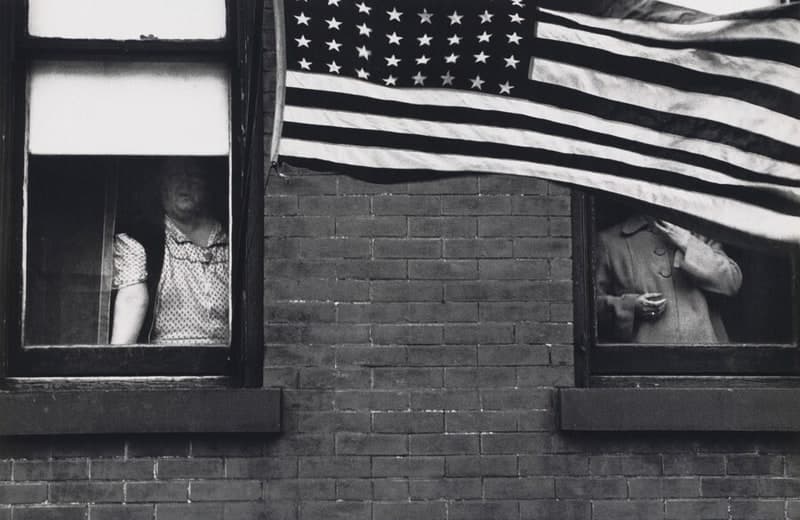
Two people watch from separate windows in a brick wall while an American flag hangs across the wall between and above them. The flag covers the second person's head completely. Robert Frank made the photograph in Hoboken, New Jersey, in 1955 and printed this sheet in September 1977; the National Gallery of Art holds it as 1991.82.5.
- 1955, printed 1977
- Gelatin silver print
- National Gallery of ArtWashington, DC, United States
About Robert Frank

What the photograph shows
The wall runs across the whole frame: dark brick with pale mortar, laid in slightly uneven courses, with two windows in it and a projecting sill under each.
At the left window a heavy-set woman leans forward on the sill in a short-sleeved dress printed with a small repeating pattern. Her bare forearm rests on the ledge. Her face is behind the glass of the raised lower sash, with a white roller blind above it, and it is blurred and shadowed rather than sharp.
At the right window stands a second person in a light buttoned coat with a rounded collar. One hand is raised to about chin height, the other held near the waist. The head is not visible at all, because the flag hangs in front of it.
The flag fills the top right of the picture. Its canton is at the upper left of the cloth, and the National Gallery of Art's description of the photograph counts eight columns of stars in it, which is the forty-eight-star flag the United States used from 1912 until 1959. The stripes billow out across the brick and run off the right edge of the frame.
Robert Frank wrote 1955 HOBOKEN in the margin at the lower left and signed at the lower right. On the verso he wrote R. Frank. / 1977 Sept., which dates the printing.
The photograph the book opens with
The National Gallery of Art indexes Robert Frank's contact sheets against the plates of his book. The sheet for Guggenheim roll 104 is titled Guggenheim 104/Americans 1--Hoboken, New Jersey, accession 1990.28.2125, which places plate 1 in Hoboken. The next sheet, 1990.28.2126, is titled Guggenheim 107/Americans 2--Hoboken, New Jersey, so plates 1 and 2 are both Hoboken pictures.
The Gallery's own titles are the record here. No object page consulted prints a plate number as a field.
Published in Paris in 1958
Robert Frank photographed across the United States in 1955 and 1956 on two Guggenheim Fellowships, then chose eighty-three pictures for a book that no American publisher would take.
He went to Paris in June 1957 with a maquette to work on it with the publisher Robert Delpire, whom he had met in 1952 and whose magazine Neuf gave him a whole issue in December 1952. Robert Delpire published the book in November 1958 as Les Américains, volume five of his Encyclopédie essentielle series and number three of its Série Histoire, with texts assembled and presented by the French writer Alain Bosquet alongside the photographs.
The Bibliothèque nationale de France catalogues that edition at 174 pages in an oblong format of 19 by 21 centimetres, under Encyclopédie essentielle 5. Its record transcribes the title page as Textes réunis et présentés par Alain Bosque, without the final t.
Grove Press followed in New York with the same eighty-three photographs under the title The Americans, dropping the French texts and printing an introduction by Jack Kerouac instead. The imprint is dated 1959, but the Robert Frank Foundation's chronology records that the book was not issued until 15 January 1960. The Museum of Modern Art's published collection data records that it bought its own print of the Hoboken photograph on 22 April 1959.
Two prints in Washington, twenty-two years apart
The National Gallery of Art holds two prints of the photograph and they are not the same object. This one, 1991.82.5, was made in September 1977 and measures 22.7 by 35 centimetres. The Gallery bought it in 1991 from the dealer PaceWildensteinMacGill with money from the Robert B. Menschel Fund.
The second, 2014.155.7, is much larger at 31.3 by 47.5 centimetres and is inscribed below the image PARADE HOBOKEN New Jersey 1955. Dr J. Patrick and Patricia A. Kennedy gave it in 2014. Anyone citing the photograph should name the accession number rather than the title.
Close reading
Reading the work, detail by detail
The wall is photographed square on, so the brick courses run level across the frame and the two windows sit like two panels in it. The flag is the only thing in the picture that moves, and it is also the only thing that is out of focus.
1.Her face never resolves
She is at the window, leaning forward, but her face is behind the glass of the raised lower sash with a white roller blind hanging above it. The glass is dirty and the light on it is flat, so the features break up into shadow. Eyes, nose and mouth can be placed but not read.
2.Her bare forearm is sharp
Below the glass her forearm rests on the sill, bare from a short sleeve, and it is the sharpest flesh in the photograph. The dress is printed with a small repeating pattern of pale dots that stays legible right across the bodice. A dark collar or shawl lies over her shoulders.
3.The flag covers the second head entirely
At the right window a hand is raised to about chin height with the fingers loosely together. Above that hand there is nothing but cloth: a white stripe of the flag runs across the opening where the head would be. No part of the face, hair or neck is visible anywhere in the frame.
4.The coat is buttoned to a rounded collar
The coat is pale and plainly cut, buttoned up the front with four large buttons to a small rounded collar. A second hand is held near the waist with the fingers curled. The cuffs are wide. Nothing about the clothing settles who is wearing it.
5.The canton counts out in columns
The star field hangs at the upper left of the cloth, its stars set in even columns on a dark ground. The National Gallery of Art's description of the photograph counts eight columns. Toward the fold at the lower right of the canton the stars blur, because the cloth is moving.
6.The stripes fold and run off the frame
The stripes lift away from the wall in long folds, and each white band brightens along the crest of its fold and darkens in the trough. They run off the right edge of the picture, so the length of the flag is not shown. The blur here is movement, not focus.
7.The wall between the windows is hard dark brick
Between and below the windows the wall is dark, hard-fired brick with pale mortar. The courses are slightly uneven and a few bricks sit proud of their neighbours. A dark stone sill projects under each window and casts a thin shadow along the course beneath it.
Timeline
1955
Photographed in Hoboken, New Jersey, during the first Guggenheim Fellowship year. Robert Frank inscribed the print 1955 HOBOKEN.
1957
Robert Frank travels to Paris in June with a maquette of the Guggenheim photographs to work with Robert Delpire on publication.
1958
Robert Delpire publishes eighty-three of them in Paris in November as Les Américains, with texts assembled by Alain Bosquet.
1959
Grove Press dates its New York edition, The Americans, to this year. The Museum of Modern Art buys its print of the Hoboken photograph on 22 April.
1960
The Grove Press edition is issued on 15 January, according to the Robert Frank Foundation's chronology.
1977
Robert Frank makes this print in September and dates the verso R. Frank. / 1977 Sept.
1991
Bought by the National Gallery of Art from PaceWildensteinMacGill with the Robert B. Menschel Fund, as 1991.82.5.
2014
A second, larger print enters the Gallery as 2014.155.7, the gift of Dr J. Patrick and Patricia A. Kennedy.
Where to see it
National Gallery of Art
Washington, DC, United States
A public viewing address has not yet been confirmed for this holding.
Recorded on view in the East Building Concourse galleries when the object record was checked in September 2026. The National Gallery of Art states that the work's media is not available for download.
Frequently asked questions
What does Parade—Hoboken, New Jersey show?
Two people at two windows in a brick wall, with a large American flag hanging across the wall above and between them. The woman at the left window leans on the sill, her face behind glass and hard to read. The flag covers the second person's head completely.
Where is Robert Frank's Parade—Hoboken, New Jersey?
The National Gallery of Art in Washington holds two prints, 1991.82.5 of 1977 and the larger 2014.155.7. The Museum of Modern Art holds 411.1959, bought in April 1959. The Art Institute of Chicago and the Metropolitan Museum of Art do not hold the photograph.
Is it the first photograph in The Americans?
The National Gallery of Art's contact-sheet titles place plate 1 of the book in Hoboken: the sheet for Guggenheim roll 104 is catalogued as Guggenheim 104/Americans 1--Hoboken, New Jersey. No museum object page consulted states a plate number as a field, so the contact-sheet titles are the record.
How many stars are on the flag?
The National Gallery of Art's description of the photograph counts eight columns of stars. That is the forty-eight-star flag, the United States flag from 1912 until Alaska and Hawaii were admitted in 1959. The photograph was made in 1955.
When was this print made?
In September 1977, twenty-two years after the negative. Robert Frank wrote R. Frank. / 1977 Sept. on the verso, and the National Gallery of Art dates the object 1955, printed 1977. The image measures 22.7 by 35 centimetres on a sheet of 27.9 by 35.6 centimetres.
What is the Paris connection?
The book was published in Paris before it reached America. Robert Delpire brought out eighty-three of Robert Frank's American photographs in November 1958 as Les Américains, with texts assembled by Alain Bosquet. Grove Press published the same eighty-three in New York under a 1959 imprint, issued on 15 January 1960, with an introduction by Jack Kerouac.
More by Robert Frank
References
The sources below include collection records, catalogues, scholarly research, and primary materials that informed this page. They document Parade—Hoboken, New Jersey, its making, and its place in cultural history.


1Robert Frank, Parade—Hoboken, New Jersey, 1955, printed 1977 — collection record, accession 1991.82.5
Official recordNational Gallery of Art, WashingtonUsed forOfficial record used to verify names, dates, institutional details, or other factual information on this page.
2National Gallery of Art open data: objects and published images
ArchiveNational Gallery of ArtUsed forThe Gallery's own catalogue export, used for the tombstone fields, the inscription, the provenance, the second print 2014.155.7 and the contact-sheet titles 1990.28.2125 and 1990.28.2126.
3Robert Frank, Parade—Hoboken, New Jersey, 1955 — collection record, accession 411.1959
Official recordThe Museum of Modern ArtUsed forOfficial record used to verify names, dates, institutional details, or other factual information on this page.
4Les américains, textes réunis et présentés par Alain Bosquet, photographies de Robert Frank — catalogue record, Encyclopédie essentielle 5
Official recordBibliothèque nationale de France, 1958Used forOfficial record used to verify names, dates, institutional details, or other factual information on this page.
5Robert Frank bibliography: books, selected publications, and selected periodicals
Official recordRobert Frank FoundationUsed forOfficial record used to verify names, dates, institutional details, or other factual information on this page.
6Robert Frank chronology, 1924–2019
Official recordRobert Frank FoundationUsed forOfficial record used to verify names, dates, institutional details, or other factual information on this page.
7National Gallery of Art to Premiere Looking In: Robert Frank's "The Americans", press release, 14 February 2008
Official recordNational Gallery of Art, Washington, 2008Used forOfficial record used to verify names, dates, institutional details, or other factual information on this page.
These references provide the documented foundation for this work's history and interpretation. Claim-level citations remain attached to the specific claims they support.
 Explore more resources