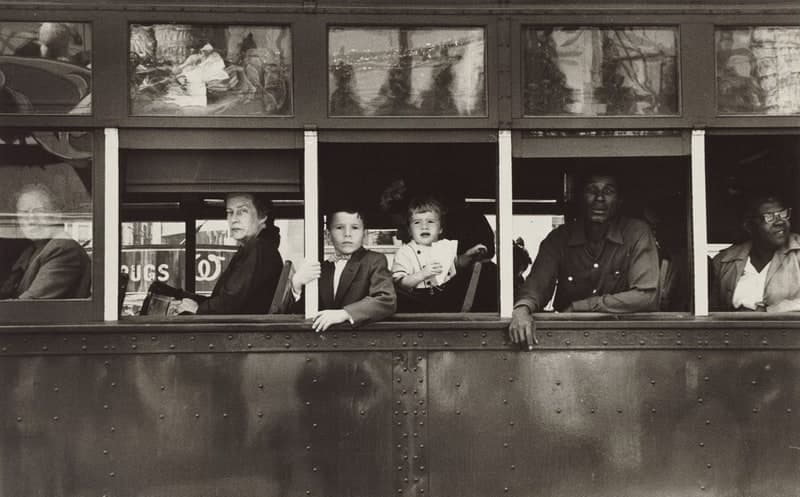
Trolley—New Orleans
by Robert Frank
Six passengers look out of the windows along one side of a New Orleans streetcar. The National Gallery of Art describes the seating order plainly: the four people at the front are white, the two at the back are Black. Robert Frank made the photograph in 1955, and it went into the book Robert Delpire published in Paris in 1958 as Les Américains.
- 1955
- Gelatin silver print
- National Gallery of ArtWashington, DC, United States
About Robert Frank

What the photograph shows
The picture is horizontal and shows only the middle section of a streetcar, cut off at both ends. A riveted metal flank fills the bottom third. Above it runs a row of five windows, and above those a row of smaller transom panes.
The National Gallery of Art's own description of the photograph sets out who is in the windows and where. The four people at the front end, to the left, are white. The two people at the back, to the right, are Black. The seating order is the subject.
- A man behind the closed glass of the first window, at the left edge.
- An older woman in a dark coat, looking straight out under arched eyebrows with her lips pressed together.
- A boy in a jacket and a checked bow tie, one hand on the white window post.
- A small child beside him with an open mouth, holding a folded white paper, with the dark shape of a woman lost in the interior behind them.
- A Black man in a long-sleeved button-down shirt, leaning on the ledge on both forearms.
- A Black woman in glasses at the right edge, looking back over her shoulder, up and away. Her window is cut by the frame.
The transom panes above reflect the street behind the camera rather than showing the inside of the car. A shop sign reading DRUGS and a large script letter appear through the first window, behind the older woman.
It was published in Paris before it was published in America
Robert Frank photographed across the United States in 1955 and 1956 on two Guggenheim Fellowships. The National Gallery of Art counts 767 rolls of film, more than 27,000 images and more than 1,000 work prints from the nine months on the road. He chose eighty-three pictures for a book, and no American publisher would take it.
He travelled to Paris in June 1957 with a maquette to work on the book with the publisher Robert Delpire, whom he had met in 1952. Robert Delpire brought it out in November 1958 as Les Américains, volume five of his Encyclopédie essentielle series and number three of its Série Histoire, with the photographs accompanied by texts assembled and presented by the French writer Alain Bosquet.
The Bibliothèque nationale de France catalogues that edition at 174 pages in an oblong format of 19 by 21 centimetres. Its record transcribes the title page as Textes réunis et présentés par Alain Bosque, without the final t, and files the book under Encyclopédie essentielle 5.
Grove Press published the same eighty-three photographs in New York as The Americans, with an introduction by Jack Kerouac in place of the French texts. The imprint is dated 1959, but the Robert Frank Foundation's chronology records that the book was not issued until 15 January 1960.
Which plate it is, and what the Gallery can show
The National Gallery of Art indexes Robert Frank's contact sheets against the book. The sheet covering this negative is titled Guggenheim 340/Americans 18 and 19--New Orleans, accession 1990.28.2141, and because it covers two plates at once the Gallery's own data does not settle which of the two this photograph is.
The Gallery also holds a second print of the image, 1990.28.316, catalogued as a work print and marked 340 A in blue crayon with a red mark beside it. Those are darkroom notes, and 340 matches the Guggenheim roll number in the contact-sheet title.
The Museum of Modern Art devoted a whole short book to the single photograph: Lucy Gallun's Robert Frank: Trolley—New Orleans, forty-eight pages, published in 2021.
Four museums, four spellings
The title is not stable across institutions. The National Gallery of Art and the Metropolitan Museum of Art both print Trolley—New Orleans with an em dash. The Art Institute of Chicago prints Trolley, New Orleans with a comma. The Museum of Modern Art's published collection data gives Trolley--New Orleans with two hyphens.
The prints differ too. The Gallery's sheet here is 21 by 31.6 centimetres; the Art Institute's 1961.943 is 21.9 by 33.2 centimetres on a mount; the Museum of Modern Art's 504.1996 is 23.1 by 34 centimetres. A citation of this photograph needs an accession number, not a title.
The print Lee Friedlander gave
This sheet belonged to the photographer Lee Friedlander, who acquired it in 1977. He and Maria Friedlander gave it to the National Gallery of Art in 2001, and the credit line reads Gift of Maria and Lee Friedlander. It sits outside the Robert Frank Collection, the archive Robert Frank himself gave the Gallery from 1990.
Robert Frank signed it at the lower left in black ink: Robert Frank 1956. The Gallery dates the photograph 1955. His signature and the tombstone do not agree, and the Gallery prints both.
Close reading
Reading the work, detail by detail
The camera was level with the windows and close enough that the car fills the frame and runs off both sides. Five window openings divide the picture into panels, and each panel is lit differently, so some faces are in daylight and some are inside shadow.
1.She looks straight back at the camera
She is the only person in the row looking straight into the lens. Her eyebrows are arched high, her mouth is closed and pressed flat, and her hands rest below the sill on a dark bag. The light reaches her face from the left, which separates it from the black interior behind.
2.A shop sign shows through the closed window
Through the first window, which is closed, the street on the far side of the car shows as a shop front. The letters UGS of a DRUGS sign read clearly, with a large script initial beside them. The glass flattens it all into the same plane as the passengers.
3.The boy holds the window post
He wears a dark jacket and a small checked bow tie, and he has one hand curled round the white post between the windows and the other laid flat on the sill. He is looking out and slightly down, past the camera. The white post beside him is the brightest thing in the row.
4.The small child is mid-sound
The child stands rather than sits, in a light jacket with buttons and a collar, holding a folded white paper in both hands at chest height. The mouth is open. An adult's dark sleeve reaches in from the right, and behind them both the interior is almost solid black.
5.He leans on both forearms
He has both forearms flat on the window ledge and his hands loosely together, which brings his shoulders forward into the light. The shirt is a plain long-sleeved button-down with the buttons catching the light down the front. His head is tilted slightly up and his eyes are open and steady.
6.The last passenger is cut by the frame
At the right edge a woman in glasses and a pale jacket over a white blouse looks back over her shoulder, up and away from the camera. The frame cuts her window in half, so part of her and part of the opening are outside the picture. Hers is the only face turned away.
7.The upper panes hold the street behind the camera
The row of small panes above the passengers does not show the inside of the car. It reflects what is behind the camera: foliage, a lit building front, the shapes of people, and a smear of light along the middle pane. The reflections are soft and the passengers below are sharp.
8.The bottom third is bare metal
Below the sill the car is a plain metal panel with two horizontal rows of rivet heads running the width of the picture and streaks of wear coming down from the seams. It carries no lettering and no number. It takes up roughly a third of the frame and gives the row of heads a solid base.
Timeline
1955
Photographed in New Orleans during the first of the two Guggenheim Fellowship road trips. The National Gallery of Art dates the photograph to this year; Robert Frank signed this print 1956.
1957
Robert Frank travels to Paris in June with a maquette of the Guggenheim photographs to work with Robert Delpire on publication.
1958
Robert Delpire publishes eighty-three of the photographs in Paris in November as Les Américains, with texts assembled by Alain Bosquet.
1959
Grove Press dates its New York edition, The Americans, to this year, with an introduction by Jack Kerouac in place of the French texts.
1960
The Grove Press edition is issued on 15 January, according to the Robert Frank Foundation's chronology.
1977
Lee Friedlander acquires this print.
2001
Given to the National Gallery of Art by Maria and Lee Friedlander, as 2001.8.1.
2021
The Museum of Modern Art publishes Lucy Gallun's Robert Frank: Trolley—New Orleans, a forty-eight-page book about the single photograph.
Where to see it
National Gallery of Art
Washington, DC, United States
A public viewing address has not yet been confirmed for this holding.
Recorded on view in the West Building, Ground Floor, Gallery G29 when the object record was checked in September 2026. The National Gallery of Art states that the work's media is not available for download.
Frequently asked questions
What does Trolley—New Orleans show?
Six passengers at the windows along one side of a New Orleans streetcar in 1955. The National Gallery of Art's description of the photograph states the seating order: the four people at the front are white, and the two at the back are Black. The car is cut off at both ends of the frame.
Where is Robert Frank's Trolley—New Orleans?
Prints are in several collections. The National Gallery of Art in Washington holds 2001.8.1, given by Maria and Lee Friedlander, and a work print, 1990.28.316. The Art Institute of Chicago holds 1961.943, the Metropolitan Museum of Art 2005.100.454, and the Museum of Modern Art 504.1996.
What is the Paris connection?
The book the photograph belongs to was published in Paris first. Robert Delpire brought out eighty-three of Robert Frank's American photographs in November 1958 as Les Américains, in his Encyclopédie essentielle series, with texts assembled by Alain Bosquet. Grove Press published the same eighty-three in New York under a 1959 imprint, issued on 15 January 1960, with an introduction by Jack Kerouac.
Which plate is it in The Americans?
The National Gallery of Art's contact sheet for the negative is titled Guggenheim 340/Americans 18 and 19--New Orleans, so the Gallery's own data covers two plates at once and does not settle which of them this is. No museum record consulted here states a single plate number.
Why is the title spelled differently in different museums?
Because each institution catalogues it its own way. The National Gallery of Art and the Metropolitan Museum of Art both print Trolley—New Orleans with an em dash. The Art Institute of Chicago prints Trolley, New Orleans with a comma. The Museum of Modern Art's published data gives Trolley--New Orleans with two hyphens.
How big is the National Gallery of Art's print?
The sheet is 21 by 31.6 centimetres, about eight and a quarter by twelve and a half inches. It is a gelatin silver print, signed by Robert Frank at the lower left in black ink.
More by Robert Frank
References
The sources below include collection records, catalogues, scholarly research, and primary materials that informed this page. They document Trolley—New Orleans, its making, and its place in cultural history.


1Robert Frank, Trolley—New Orleans, 1955 — collection record, accession 2001.8.1
Official recordNational Gallery of Art, WashingtonUsed forOfficial record used to verify names, dates, institutional details, or other factual information on this page.
2National Gallery of Art open data: objects and published images
ArchiveNational Gallery of ArtUsed forThe Gallery's own catalogue export, used for the tombstone fields, the inscription, the provenance, the second print 1990.28.316 and the contact-sheet title 1990.28.2141.
3Robert Frank, Trolley, New Orleans, 1955 — collection record, reference number 1961.943
Official recordArt Institute of ChicagoUsed forOfficial record used to verify names, dates, institutional details, or other factual information on this page.
4Robert Frank, Trolley—New Orleans, 1955 — collection record, accession 2005.100.454
Official recordThe Metropolitan Museum of ArtUsed forOfficial record used to verify names, dates, institutional details, or other factual information on this page.
5Robert Frank bibliography: books, selected publications, and selected periodicals
Official recordRobert Frank FoundationUsed forOfficial record used to verify names, dates, institutional details, or other factual information on this page.
6Robert Frank chronology, 1924–2019
Official recordRobert Frank FoundationUsed forOfficial record used to verify names, dates, institutional details, or other factual information on this page.

7Robert Frank: Trolley—New Orleans
NonfictionThe Museum of Modern Art, New York, 2021Used forPublished analysis and historical context used in preparing the Trolley—New Orleans page.
8Les américains, textes réunis et présentés par Alain Bosquet, photographies de Robert Frank — catalogue record, Encyclopédie essentielle 5
Official recordBibliothèque nationale de France, 1958Used forOfficial record used to verify names, dates, institutional details, or other factual information on this page.
9National Gallery of Art to Premiere Looking In: Robert Frank's "The Americans", press release, 14 February 2008
Official recordNational Gallery of Art, Washington, 2008Used forOfficial record used to verify names, dates, institutional details, or other factual information on this page.
These references provide the documented foundation for this work's history and interpretation. Claim-level citations remain attached to the specific claims they support.
 Explore more resources