
Collage · Dada
Untitled (Collage with Squares Arranged according to the Law of Chance)
Torn-paper fragments explore chance as an alternative to fully controlled composition.
Strasbourg-born sculptor and poet — Hans in German, Jean in French, both all his life — who co-founded Dada at the Cabaret Voltaire in 1916, composed collages by dropping torn paper 'according to the laws of chance', and settled at Meudon outside Paris in a house his wife Sophie Taeuber-Arp designed.
Jean Arp had two first names and used both, which is the biography in miniature: born Hans Peter Wilhelm Arp in Strasbourg in 1886, when Alsace was German, he became French with the province in 1919 — Hans when speaking German, Jean in French, one artist on either side of every border that mattered. He was in Zurich in 1916 among the founders of Dada at the Cabaret Voltaire, and his contribution outlasted the cabaret: collages made by dropping torn paper and fixing it where it fell, 'arranged according to the laws of chance' — chance admitted into composition, a door most of twentieth-century art walked through after him.
In Zurich he met the Swiss artist Sophie Taeuber; they married in 1922 and became modern art's most complete working couple — duo-collages, shared exhibitions, and from the late 1920s the house-studio at Meudon outside Paris that she designed. Arp signed on with the Surrealists at their first exhibition in 1925, left doctrine behind to co-found Abstraction-Création with Piet Mondrian and others in 1931, and from the 1930s made the biomorphic marble and bronze Concretions — swelling, navel-and-cloud forms — that carried his fame after the war, to the Venice sculpture prize of 1954. Sophie's death in 1943 broke the middle of his life; the Fondation Arp keeps the Meudon house as they left it.
Arp was born on 16 September 1886 in Strasbourg, then capital of German-annexed Alsace, to a German father and Alsatian mother — a bilingual childhood that made the later double name a fact rather than an affectation. He trained in Weimar and briefly at the Académie Julian in Paris, showed with the Blaue Reiter in Munich in 1912, and spent the war in neutral Zurich, having convinced the German consulate — by one much-told account, with a deliberately deranged display of paperwork — that he was unfit for conscription.[1]
In February 1916 the Cabaret Voltaire opened in a Zurich alley, and Arp was among its founders — with Hugo Ball, Tristan Tzara, Richard Huelsenbeck and Marcel Janco — making reliefs and collages for its walls while the stage manufactured nonsense against a continent manufacturing corpses. His Dada was the gentle wing: no manifestos of destruction, but torn-paper squares dropped and glued where they landed, According to the Laws of Chance — the humility of letting accident compose, which he kept for fifty years.[2]
He met Sophie Taeuber in Zurich in 1915 — teacher, dancer, and maker of the era's most severe geometric abstraction — and from then on the biographies interleave: duo-collages signed by both, the turned-wood Dada Heads, her dances at the cabaret performed in masks Janco made. They married in 1922, and when they settled outside Paris in 1926 it was Sophie who designed the house-studio at Meudon, a white functionalist building the couple filled with work made side by side and sometimes jointly.[3]
Paris took them in as it took every movement's veterans: Arp showed at the first Surrealist exhibition in 1925, and in 1931 helped found Abstraction-Création — the umbrella association of abstract artists that included Piet Mondrian — when Surrealist doctrine grew too narrow. His sculpture arrived in the same decade: the Concretions, biomorphic marbles and bronzes that swell like torsos, clouds and fruit at once, abstraction with a pulse. He wrote poetry in both his languages all the while, and is a minor classic of German verse in his own right.
In January 1943, in exile in Zurich, Sophie Taeuber-Arp died of carbon-monoxide poisoning from a faulty stove at the house where they were staying. Arp's grief reorganized the rest of his life — years of little sculpture, much poetry and prayer, and a permanent guardianship of her reputation; her retrospectives and catalogues were substantially his doing. The Swiss collector Marguerite Hagenbach, long a friend of both, became his companion and, in 1959, his second wife.[3]
The post-war decades brought the honours of a founder who had outlived the movements: the Venice Biennale's sculpture prize in 1954, the UNESCO relief in Paris, commissions and retrospectives across two continents. He died in Basel on 7 June 1966, at seventy-nine, and is buried in Locarno with both wives. The Meudon house Sophie built is now the Fondation Arp, kept much as the two of them worked in it.
Around 1916 Arp arrived at the method most associated with his Dada years: collage made from torn paper dropped onto a sheet and fixed where it landed. The account he gave of it is that he lost patience with a drawing.[4]
Arp tore up a drawing he had given up on, dropped the pieces on the floor, and looked at how they had landed. The arrangement was better than what he had been trying to make, so he glued them down where they fell. The works are titled Collage Arranged According to the Laws of Chance.
How literal the dropping was has been argued about ever since; the surviving collages look composed. What matters is the principle. Arp was proposing that the artist's taste is an obstacle, that chance is a natural process rather than a gimmick, and that a work made this way belongs to the same order of things as a leaf or a stone. The Surrealists' chance games followed, and so, by other routes, did John Cage's chance procedures.
From about 1930 Arp turned to sculpture in the round, in plaster, marble and bronze, and made the smooth swelling forms that fill the museums.
He called them concretions, and refused the word abstract. Abstraction, he argued, means taking something away from the world; what he was doing was adding to it. A concretion is something that has grown or set, like a fruit or a pebble or a curd, and the sculptures are meant to be new objects rather than simplified versions of old ones.[1]
The concretions have no fixed orientation, and several are titled as though caught mid-change: Human Concretion, Growth, Pagoda Fruit. Arp went on making them for thirty-five years.
Arp wrote poetry throughout his life, in German and in French, and published more than twenty collections.
Arp's early poems belong to Dada and read like it: nonsense arithmetic, animals behaving as furniture, sentences that dismantle themselves halfway. The later ones, particularly after Sophie Taeuber-Arp's death in 1943, are quieter and closer to elegy.
He treated the writing and the sculpture as one activity, and said the poems were made the way the collages were: by letting words fall together and keeping what landed well.
Sophie Taeuber-Arp designed the house at Meudon, west of Paris, and the couple moved into it in 1929. She was the trained one — she had taught design in Zurich for over a decade — and the building is hers.
Arp lived and worked there for the rest of his life, apart from the war years. In 1959, sixteen years after Sophie's death, he married Marguerite Hagenbach, a Swiss collector who had been a friend of them both.
He died at Basel on 7 June 1966, at seventy-nine. The house at Meudon is now a museum holding his work and Sophie's together, which is the arrangement he wanted.
Born Hans Peter Wilhelm Arp in Strasbourg on 16 September, under the German Empire.
Meets Sophie Taeuber in Zurich; the duo-collages begin.
Co-founds Dada at the Cabaret Voltaire with Ball, Tzara, Huelsenbeck and Janco.
Tears up a drawing, drops the pieces, and glues them where they fall, beginning the Collages Arranged According to the Laws of Chance.
Alsace returns to France and Hans becomes, officially, Jean.
Marries Sophie Taeuber.
Shows at the first Surrealist exhibition in Paris.
The couple settle at Meudon outside Paris, in the house-studio Sophie designs.
Moves into the house at Meudon, west of Paris, designed by Sophie Taeuber-Arp.
Turns to sculpture in the round and begins the works he calls concretions, refusing the word abstract.
Co-founds Abstraction-Création with Mondrian and others; the biomorphic Concretions follow.
Leaves occupied France for the south and then for Zurich.
Sophie Taeuber-Arp dies of carbon-monoxide poisoning in Zurich in January; his work nearly stops for years.
Grand prize for sculpture at the Venice Biennale.
Marries Marguerite Hagenbach, a Swiss collector and a friend of both Arps, sixteen years after Sophie's death.
Dies in Basel on 7 June, aged seventy-nine; the Meudon house becomes the Fondation Arp.
Collage · Dada
Torn-paper fragments explore chance as an alternative to fully controlled composition.

Met · 1930
Fellow founders of Abstraction-Creation in Paris in 1931, the association that gathered the city's abstract painters and sculptors after Cercle et Carre.
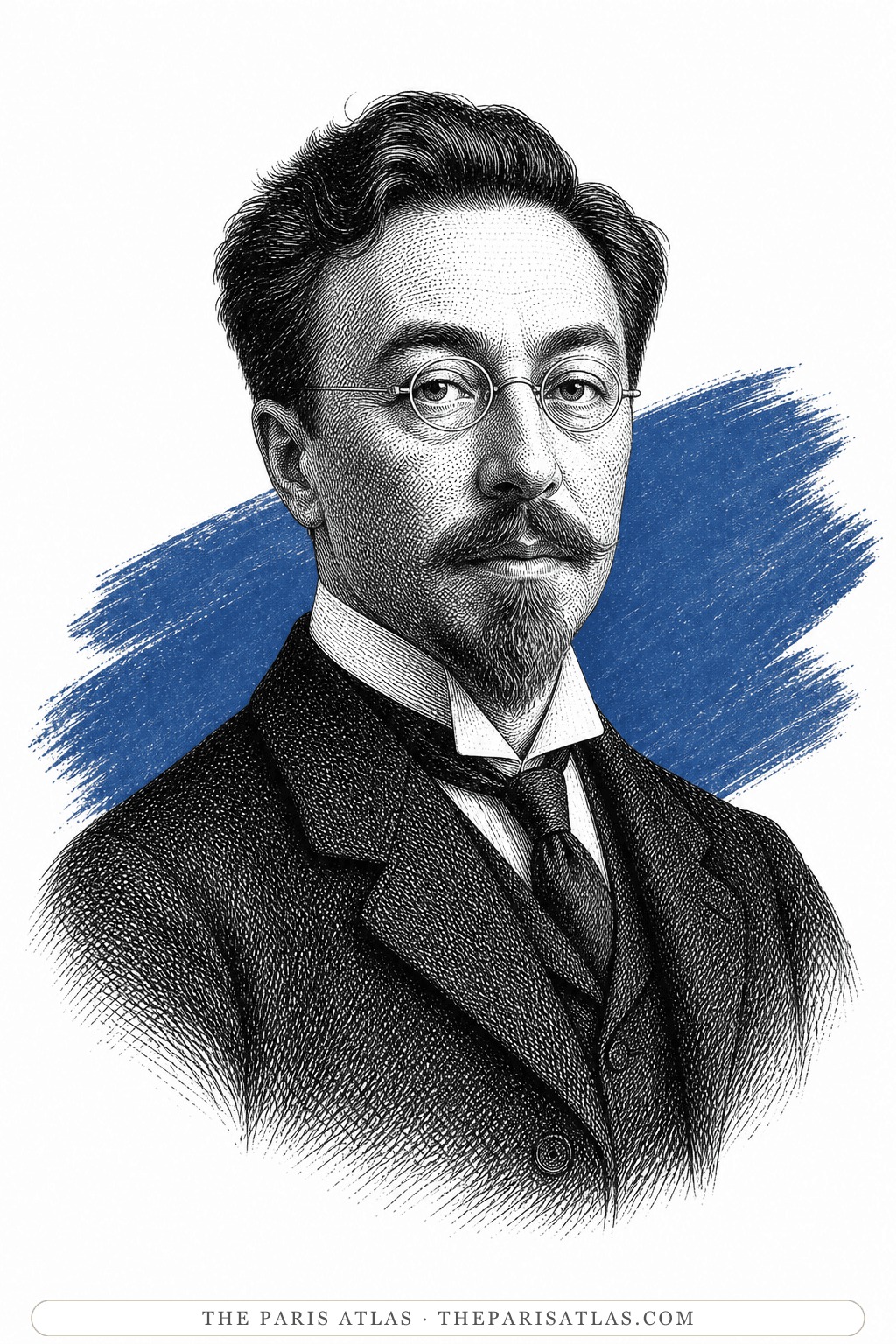
The Centre Pompidou's account of Kandinsky's Paris decade names his Surrealist friends, Arp and Miro in particular, as the artists who most directed his pictorial evolution there - the shift from Bauhaus geometry to the soft biomorphic forms of the late work.
Art & literary movement · 1924–1966
Showed at the first Surrealist exhibition in Paris in 1925 and with the movement through the twenties, then stepped outside doctrine in 1931 to co-found the broader Abstraction-Creation association.
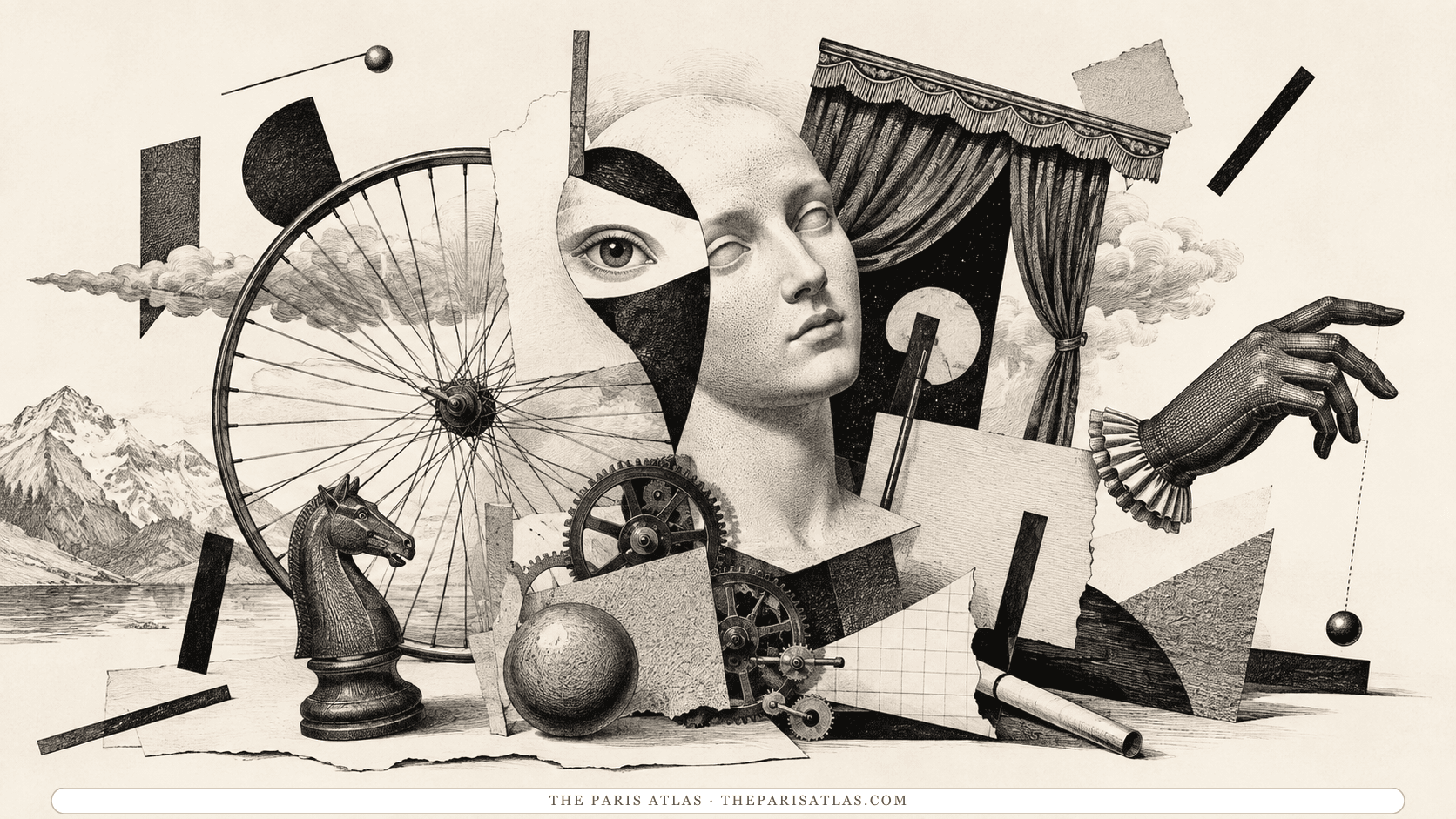
Art movement · c. 1916–1924
A founder at the Cabaret Voltaire in Zurich in 1916, contributing chance-arranged collages and biomorphic reliefs.
Both, sequentially and simultaneously. Born in Strasbourg in 1886 under the German Empire as Hans Arp, he became a French citizen when Alsace returned to France in 1919 and was Jean in French for the rest of his life — while remaining Hans whenever he spoke or published in German. He wrote poetry in both languages and treated the double name as a fact of Alsace rather than a pose.
A founder. He was at the Cabaret Voltaire in Zurich from its opening in February 1916, alongside Hugo Ball, Tristan Tzara, Richard Huelsenbeck and Marcel Janco, supplying the visual art — abstract reliefs and the torn-paper collages 'arranged according to the laws of chance' — while the stage supplied the noise. He later carried Dada's methods to Cologne and Paris, and his chance procedures became one of the century's most-used artistic tools.
A Swiss artist — and in much recent judgment the more radical abstractionist of the couple. She and Arp met in Zurich in 1915, married in 1922 and worked in deliberate concert: duo-collages, the Dada Heads, her dance at the Cabaret Voltaire, the radically abstract interiors of the Aubette entertainment complex in Strasbourg, and the Meudon house-studio she designed. She died in January 1943 of carbon-monoxide poisoning from a faulty stove in Zurich; Arp spent much of his remaining life securing her reputation. Switzerland put her on the 50-franc note.
The biomorphic sculptures he began in the 1930s — swelling forms in marble, limestone and bronze that suggest torsos, buds, clouds and fruit without depicting any of them. Arp called them concretions because they grew like natural accretions rather than being carved toward a subject. They made his post-war fame, culminating in the 1954 Venice Biennale sculpture prize.
The Fondation Arp at Meudon-Clamart, just south-west of Paris — the actual house-studio Sophie Taeuber-Arp designed in 1927, kept with the couple's work and furniture and open to visitors on set days. The Centre Pompidou holds the major museum collection, and his large relief stands at the UNESCO headquarters. The museum of modern art in Strasbourg, his birthplace, holds a major collection of its own.
Works Arp began around 1916 by tearing up a drawing, dropping the pieces on the floor, and gluing them where they landed. How literal the dropping was is argued about, since the surviving collages look composed, but the principle held: the artist's taste is an obstacle, and chance is a natural process rather than a gimmick.
Because he rejected the word abstract. Abstraction, he argued, means taking something away from the world, while he was adding to it. A concretion is something that has grown or set — a fruit, a pebble, a curd — and the sculptures are meant to be new objects rather than simplified versions of existing ones.
Throughout his life, in German and French, publishing more than twenty collections. The early poems belong to Dada and read like it; those after Sophie Taeuber-Arp's death in 1943 are quieter and closer to elegy. He said they were made the same way as the collages, by letting words fall together and keeping what landed well.
Sophie Taeuber-Arp. She was the trained designer of the two, having taught in Zurich for over a decade, and the couple moved in during 1929. Arp worked there for the rest of his life apart from the war years, and it is now a museum holding both their work.
Associated with · 1925–1931
Showed at the first Surrealist exhibition in Paris in 1925 and with the movement through the twenties, then stepped outside doctrine in 1931 to co-found the broader Abstraction-Creation association.
Met · 1930
Fellow founders of Abstraction-Creation in Paris in 1931, the association that gathered the city's abstract painters and sculptors after Cercle et Carre.
Influenced · 1934–1944
The Centre Pompidou's account of Kandinsky's Paris decade names his Surrealist friends, Arp and Miro in particular, as the artists who most directed his pictorial evolution there - the shift from Bauhaus geometry to the soft biomorphic forms of the late work.
Associated with
A founder at the Cabaret Voltaire in Zurich in 1916, contributing chance-arranged collages and biomorphic reliefs.
The sources below include biographies, scholarly essays, interviews, and primary materials that informed this page. They reflect both the historical record and ongoing critical conversations about Jean Arp and their work.


Web source consulted for documented facts and historical context presented on the Jean Arp page.

Archival evidence used to document the historical record connected to Jean Arp.
Web source consulted for documented facts and historical context presented on the Jean Arp page.
These references anchor the page in the documented record and in the scholarly conversations around Jean Arp. Every claim on this page traces back to one or more of the works listed here.
 Explore more resources