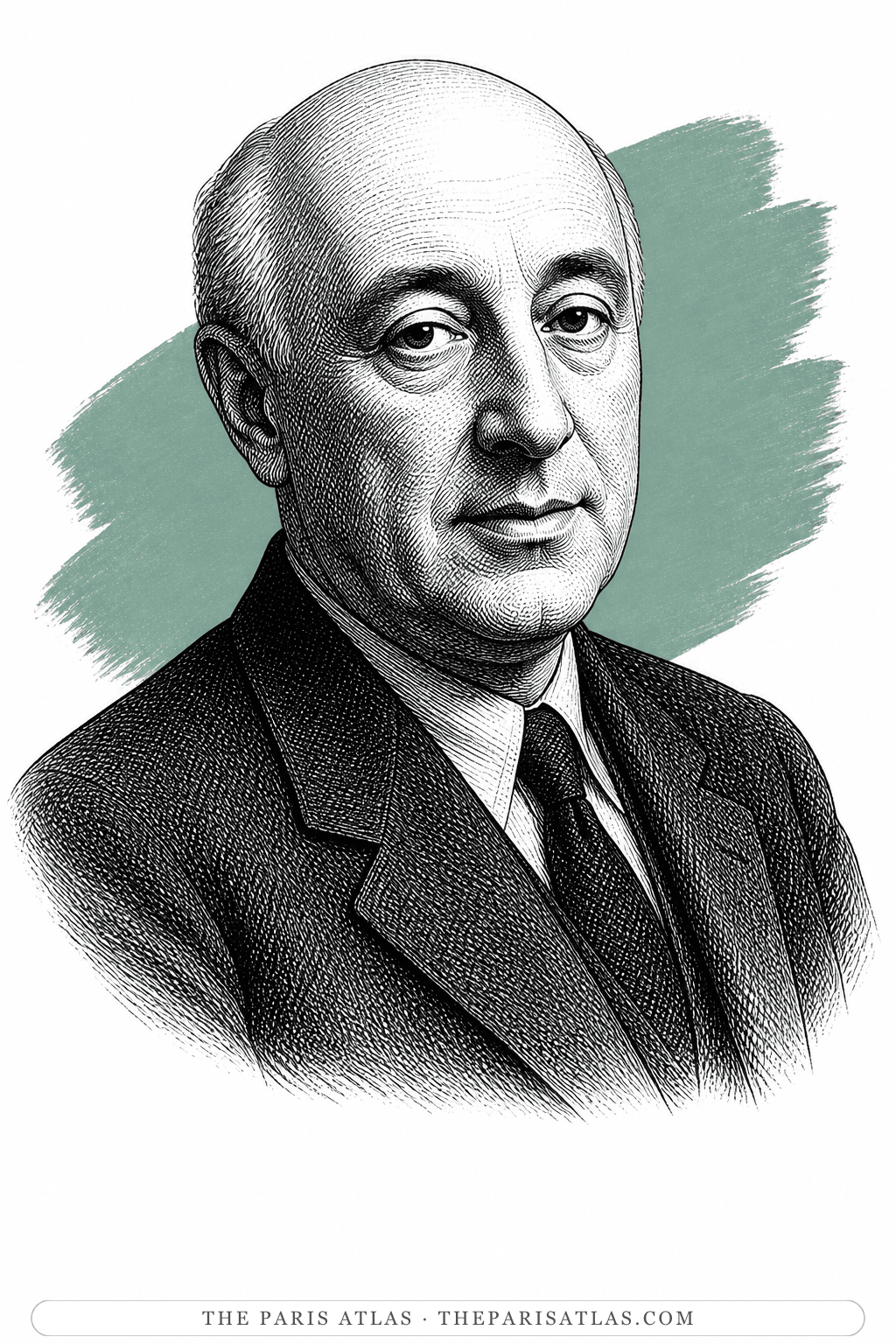
About Jean Arp
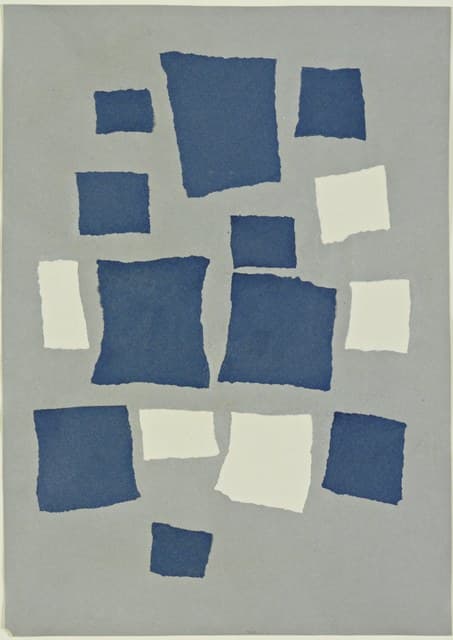
What the collage is made from
Blue and white paper fragments sit across a colored paper support. Their edges are irregular because Arp tore the paper, then pasted the pieces down. The work is modest in scale—48.5 by 34.6 centimeters—and contains no represented figure or scene.
The title supplies the procedure that the picture itself cannot prove: the squares were arranged according to chance rather than a fully predetermined composition.
Chance—and the return of judgment
MoMA relates the account that Arp tore up a drawing, let the pieces fall, and discovered in their accidental pattern the expression he had been trying to force. Fixing the fragments where they landed made gravity and accident participants in the work.
Yet the museum also points out how ordered the surviving collage looks. Chance may have begun the arrangement without ending Arp's involvement: selecting paper, tearing it, recognizing a usable result, and pasting it permanently were still artistic decisions.
A Zurich Dada work
Arp made the collage in Zurich in 1916–17, during the first years of Dada. The movement's artists distrusted the claims of reason and order made by a culture then engaged in the First World War. Chance offered one way to interrupt inherited rules of composition.
The result is not simply disorder. It turns the process of composing into the subject: viewers are left to decide how much of the pattern belongs to accident and how much to the eye that chose to preserve it.
Close reading
Reading the work, detail by detail
Arp's torn squares look casual, but their spacing creates a measured field of weight, interval, and drift. Six close views show how irregular edges and changing densities keep chance from appearing either chaotic or mechanically ordered.
1.The largest upper block leans off balance
The biggest shape in the upper field hangs slightly askew, its edges visibly torn rather than ruled. Its weight is offset by open gray space and smaller fragments on either side.
2.Two small squares refuse alignment
The fragments resemble one another in colour but differ in size, angle, and height. Their near-repetition lets the eye imagine a grid that the work immediately declines to complete.
3.The center gathers without locking together
Several darker forms approach one another while narrow gray channels remain between them. The cluster feels momentarily settled, yet every gap preserves the possibility of further movement.
4.White paper becomes an active shape
The pale pieces are not empty background; their rough perimeters make them as assertive as the blue forms. Tonal reversal turns absence into another kind of material presence.
5.A broken row almost establishes order
Five pieces spread laterally with enough regularity to suggest a line. Their different proportions and tilts keep that order provisional, poised between placement and fall.
6.The final square makes empty space visible
A single fragment sits below the denser arrangement with gray surrounding it on every side. Its isolation gives the lower field a palpable scale and brings the downward drift to a quiet stop.
Where to see it
Museum of Modern Art, New York
11 West 53 Street, New York, NY 10019, United States
Displays and loans can change. Check whether this work is on view before making a special trip.
Plan your visit on the museum’s official website (opens in a new tab)Frequently asked questions
Who made Collage with Squares Arranged according to the Law of Chance?
Jean (Hans) Arp made it in Zurich in 1916–17, during the first phase of Dada.
What materials did Arp use?
MoMA records torn-and-pasted paper and colored paper on colored paper. The sheet measures 48.5 by 34.6 centimeters.
How did chance shape the collage?
Accounts describe Arp allowing torn pieces to fall and then pasting them in the resulting arrangement, making accident a starting point for composition.
Was the arrangement entirely random?
Not necessarily. MoMA notes that the collage's ordered appearance suggests Arp did not relinquish all control, even if chance initiated the pattern.
Where is the collage?
It belongs to the Museum of Modern Art in New York, where it is catalogued as object 457.1937. Display status can change, so consult MoMA's object page before visiting.
If you like Jean Arp
Explore artists from the same movements and circles.
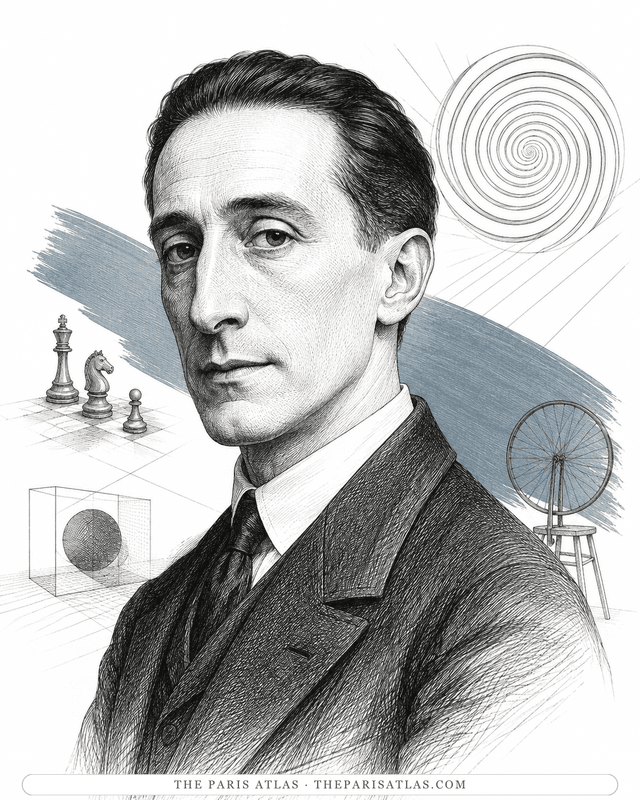
Marcel Duchamp
The century's quietest revolutionary — readymades, the abandonment of painting, chess on a Paris rooftop in Entr'acte, and one anemic film of spinning puns signed Rrose Sélavy.
View artist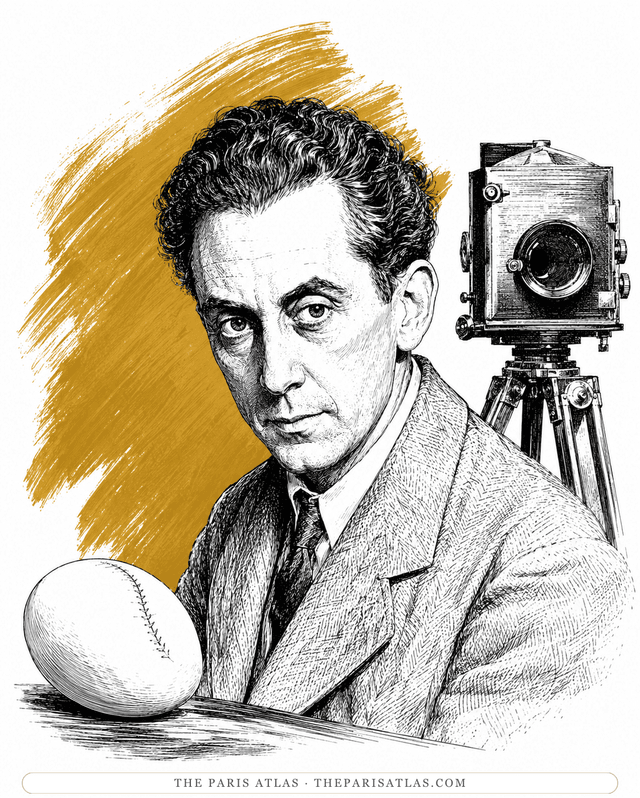
Man Ray
Montparnasse's American eye — portraitist of the whole expatriate quarter, inventor of the rayograph, and maker of films (Emak-Bakia, L'Étoile de mer) that treated the camera as another darkroom.
View artist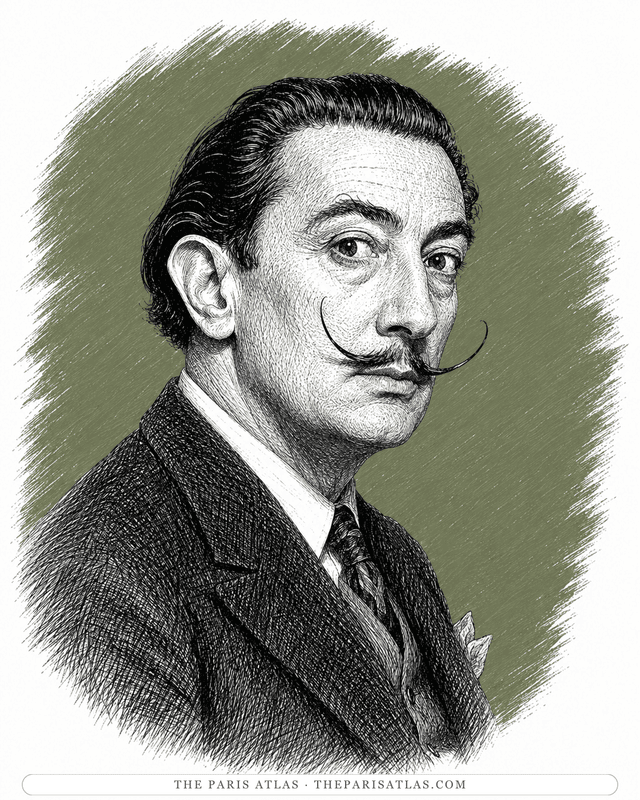
Salvador Dalí
The self-made icon of Surrealism — melting watches and manicured scandal — who arrived in Paris by way of two films written with Buñuel, dreamed together before the movement claimed them.
View artist
References
The sources below include collection records, catalogues, scholarly research, and primary materials that informed this page. They document Untitled (Collage with Squares Arranged according to the Law of Chance), its making, and its place in cultural history.


1Jean (Hans) Arp, Untitled (Collage with Squares Arranged according to the Law of Chance)
Official recordMuseum of Modern ArtUsed forOfficial collection record for the title, date, materials, dimensions, provenance, and the museum's discussion of chance and control.

2Jean (Hans) Arp, Untitled (Collage with Squares Arranged according to the Laws of Chance)
WebsiteMuseum of Modern ArtUsed forMoMA audio commentary on Arp's chance-collage procedure.
3Jean Arp — Biography — Fondation Arp, Clamart
WebsiteFondation Arp, ClamartUsed forWeb source consulted for documented facts and historical context presented on the Untitled (Collage with Squares Arranged according to the Law of Chance) page.
4Dada
WebsiteMuseum of Modern ArtUsed forWeb source consulted for documented facts and historical context presented on the Untitled (Collage with Squares Arranged according to the Law of Chance) page.
These references provide the documented foundation for this work's history and interpretation. Claim-level citations remain attached to the specific claims they support.
 Explore more resources