The self-made icon of Surrealism — melting watches and manicured scandal — who arrived in Paris by way of two films written with Buñuel, dreamed together before the movement claimed them.
In images
Details
Lived
1904–1989
Born
11 May 1904
Birthplace
Figueres, Catalonia
Died
23 January 1989 · aged 84
Place of death
Figueres, Catalonia
Nationality
Spanish
Married
Gala Dalí · 1934–1982
Roles
PainterFilmmakerSculptor
Also known as
Salvador Domingo Felipe Jacinto Dalí i Domènech
About Salvador Dalí
Who was Salvador Dalí?
Salvador Dalí was a Catalan-Spanish painter, filmmaker, writer, sculptor, and designer who became one of the most recognizable artists of the twentieth century. He is most closely associated with Surrealism, although his career also crossed cinema, fashion, advertising, religious painting, and public performance.
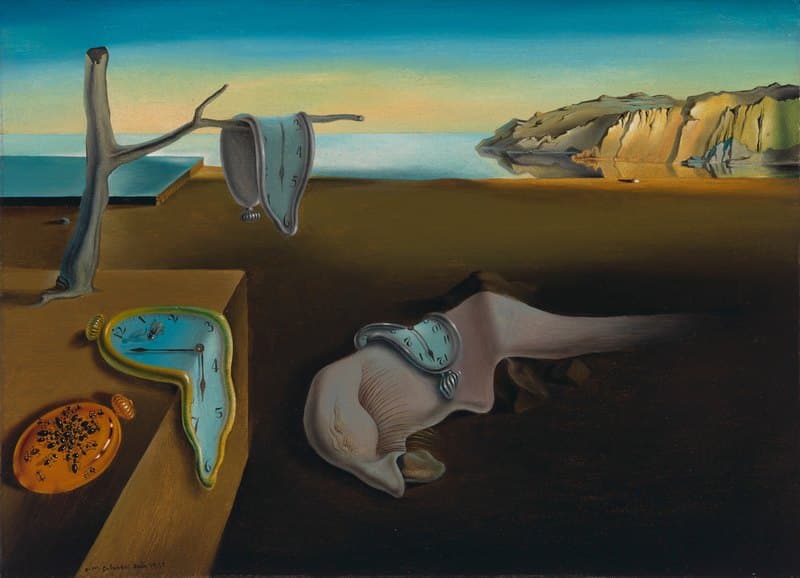
His paintings joined a controlled, almost Old Master-like technique to images drawn from dreams, psychoanalysis, private memory, religion, science, and the coast of Catalonia. Melting watches, deserted landscapes, insects, eggs, crutches, and bodies that change identity became part of his visual language. The Persistence of Memory made that language widely familiar, but it was one work in a career that continually changed its subjects and media.
Paris was essential to that transformation. Dalí first visited in 1926, met Pablo Picasso, and studied the Louvre. By 1929 he had collaborated with Luis Buñuel on Un Chien Andalou, entered the Paris Surrealist circle, opened his first solo exhibition in the city, and begun the partnership with Gala Dalí that shaped the rest of his life and career.
Salvador Dalí, illustrated
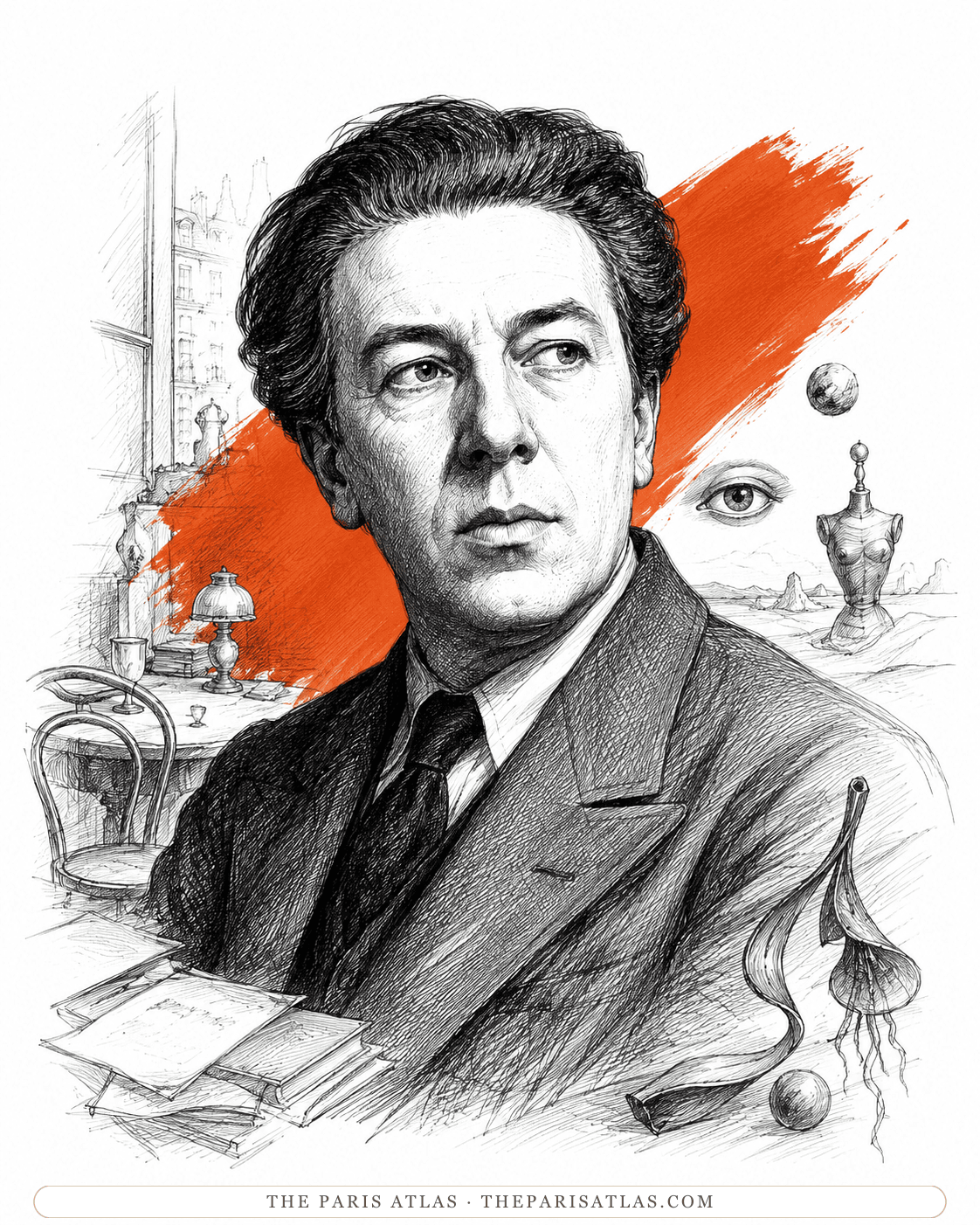
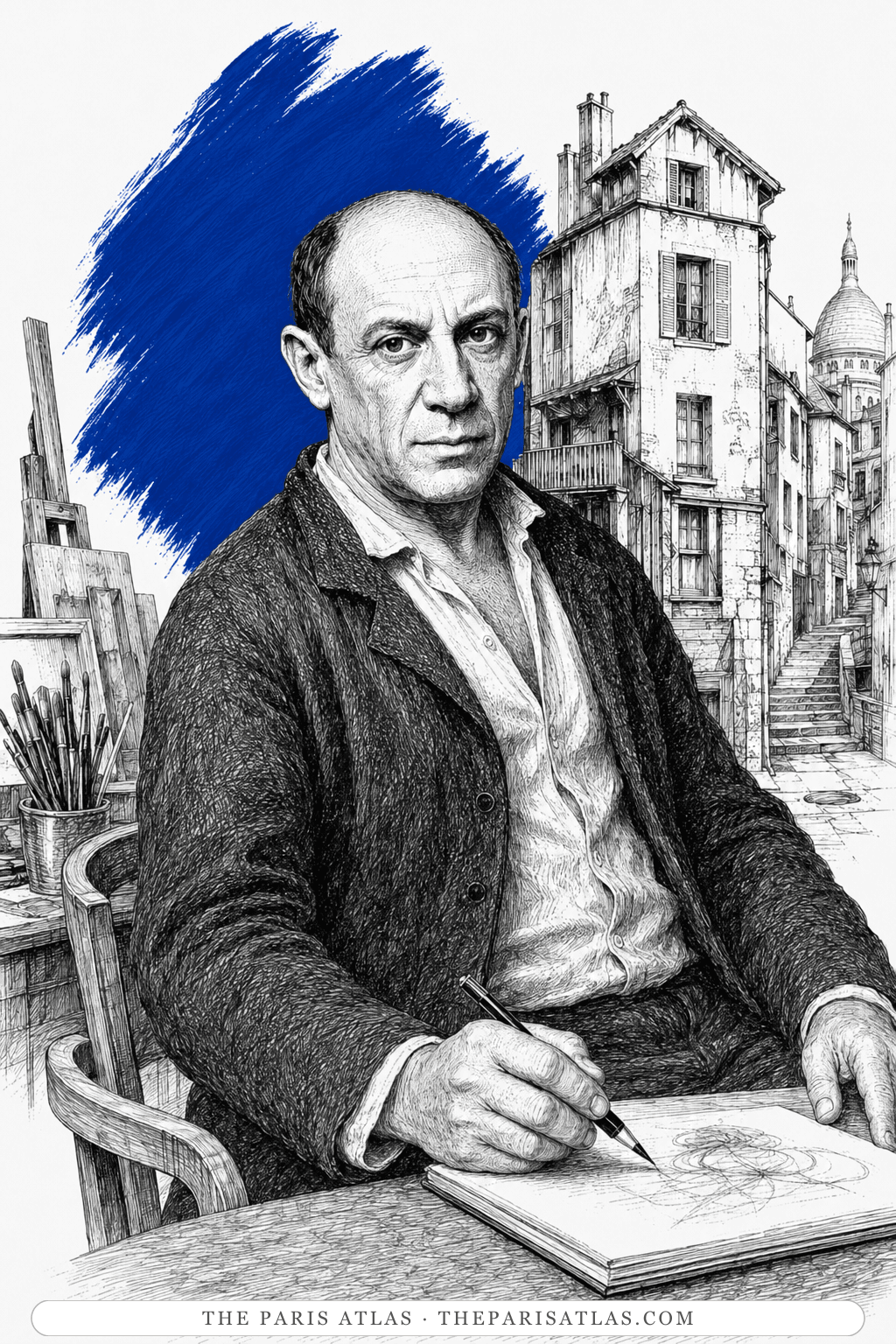
Scenes from Dalí's life. These are illustrations rather than photographs; the documentary images are further down the page and in the gallery.
At the harbour rail.With Babou, the ocelot he travelled with.The ocelot on his shoulders, and the cane.An egg raised like a sceptre. The egg recurs in the work and in the self-presentation.Head back, hair loose.Seated, without the props.A skull, a candle and a cross. The Catholic material of the late work, arranged as a still life.Beside one of the stilt-legged elephants, a figure he painted for forty years.At the easel, painting the elephants into a desert.
Illustrations — The Paris Atlas
Figueres, and the first Salvador
Salvador Dalí was born in Figueres, in the Empordà plain of Catalonia, on 11 May 1904. His father was the town notary, a position that made the family comfortable and local. Nine months before the birth, his parents had buried their first son, also called Salvador, dead of a stomach infection at twenty-one months.[1][2]
Dalí grew up carrying the dead child's name and made a great deal of it later. In The Secret Life of Salvador Dalí (1942) he wrote that his parents took him to the grave at five and told him he was his brother's return. That memoir invents where it pleases and cannot establish what anyone said in 1909. What is documented is the brother, the shared name, and that Dalí was still painting the subject in 1963.[3]
The family summered at Cadaqués, on the Costa Brava, where the road ends and the rock of Cap de Creus goes into the sea in shapes that do not look like geology. He painted those rocks for sixty years. The landscape behind the melting watches is not invented. It is the coast a few hours from the house he was born in.
The coast he came back to for sixty years. (Illustration — The Paris Atlas)
Madrid: the Residencia, and the expulsion
In 1922 he entered the Real Academia de Bellas Artes de San Fernando in Madrid and took a room at the Residencia de Estudiantes, the liberal students' hall that housed most of a generation. Two of its residents mattered permanently: Federico García Lorca, already writing the poems that would make him famous, and Luis Buñuel, who had come to study entomology and left wanting to make films.[2]
The friendship with Lorca was the closest of his life and, on Lorca's side, more than a friendship. Dalí spent decades giving different accounts of what had and had not happened between them, and the accounts do not reconcile. Ian Gibson, who wrote the standard biography of each man, treats the evasions as the subject rather than a gap in the record.[2]
The Academy expelled him in 1926. He had refused to sit his final examination on the grounds that nobody on the faculty was competent to examine him. He was twenty-two and had already had a solo show in Barcelona.[1]
Paris, 1929
He had been to Paris once before, in April 1926, and went straight to Pablo Picasso's studio. The visit rested on a reputation he had not yet earned in France. Joan Miró, a Catalan a decade ahead of him and already attached to the Surrealists, had brought his own Paris dealer to Figueres to look at Dalí's work and had spoken about him to Picasso. Dalí arrived in the city already introduced.[2]
That first journey was also an art-historical tour. He studied the Louvre, visited Versailles, and went to Fontainebleau in search of Jean-François Millet's house and studio.[4] The route matters because Dalí did not arrive in Paris only to reject the past. Picasso and the museums offered different models of artistic authority, and he wanted both.
The work that got him in was a film. He and Buñuel wrote Un Chien Andalou in six days at Figueres by trading dreams, on a rule that no image survive if either of them could explain it. It premiered at the Studio des Ursulines on 6 June 1929, and the Surrealists took both authors in almost immediately.[4]
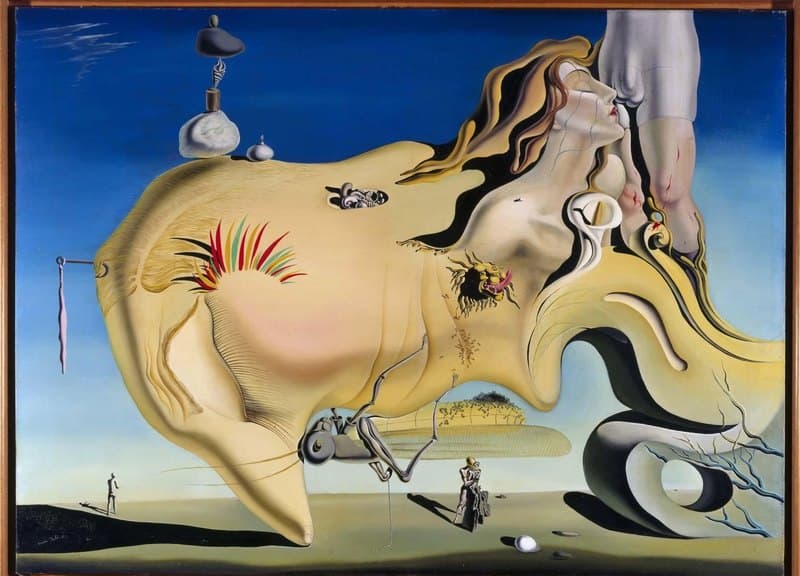
His first Paris solo exhibition opened at Camille Goemans's gallery on 20 November 1929. The group included The Great Masturbator, The Lugubrious Game, Illumined Pleasures, and other paintings in which an exact, academic finish made irrational scenes appear physically present. Film brought him into the group. The Goemans exhibition established the painter Paris would recognize.[4]
Dalí also reported on the city for the Catalan newspaper La Publicitat in seven articles called Documentary—Paris—1929. He named the Louvre and artists, but also the Ritz, Claridge, Carlton, and the bar at La Coupole. The dispatches show that museums, Surrealist debate, luxury hotels, publicity, and fashionable spectacle already belonged to the same Paris in his imagination.[4]
That summer Dalí invited the group to Cadaqués. Paul Éluard came with his wife Gala and their daughter, and René Magritte came with his. Éluard sat for a portrait during the visit. By the end of it Gala had decided to stay with Dalí, and did, for the next fifty-three years. Dalí finished the portrait of her husband after she had gone.
Dalí in Paris in 1934, photographed by Carl Van Vechten. The mustache is still an ordinary one. (Carl Van Vechten, Library of Congress · Public domain)
Gala: partner, manager, and model
Calling Gala Dalí his muse describes only what is visible in the paintings. From 1929 she organized schedules, negotiated with dealers and patrons, assessed work, coordinated projects, and managed the practical structure of his career. Dalí supplied the work and the public performance. Gala helped make both sustainable.
Her contribution reached specific productions. She proofread and helped prepare The Secret Life of Salvador Dalí and worked with him on the Dream of Venus pavilion for the 1939 New York World's Fair. The double signature “Gala Salvador Dalí,” used on paintings including The Sacrament of the Last Supper, acknowledged the partnership without implying that she secretly painted the canvases.
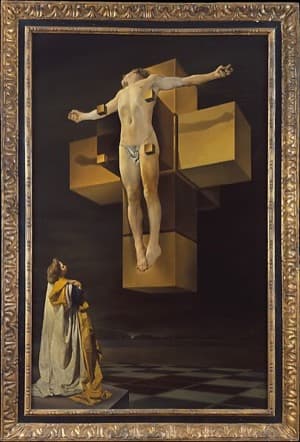
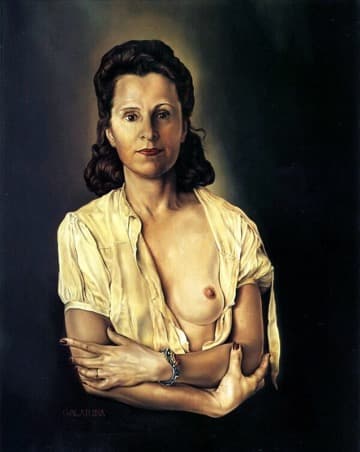
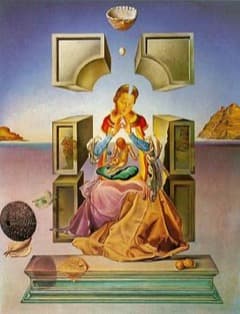
Gala also remained a principal subject. Across portraits, religious works, and mythological scenes she appears as herself, the Virgin, Leda, witness, and organizing presence. Galarina, Leda Atomica, The Madonna of Portlligat, Galatea of the Spheres, and Crucifixion (Corpus Hypercubus) show how her image changed with Dalí's own movement from Surrealism toward classicism and nuclear mysticism.
The paranoiac-critical method
Surrealism's founding method was automatism: write or draw fast enough that the conscious mind cannot intervene. Dalí wanted the opposite discipline. His paranoiac-critical method took the delusional habit of reading one thing as another and used it deliberately, at full technical control, to build images that hold two readings at once. A bay becomes a face. A group of figures becomes a skull. The picture is executed with nineteenth-century patience and describes something that cannot happen.[1]
The method was slow and the finish academic. Nothing here is painted fast. (Illustration — The Paris Atlas)
The Persistence of Memory, painted in 1931, carried the method to everyone else. It is small: 24.1 by 33 centimetres, about the size of a sheet of paper. The Museum of Modern Art has had it since 1934, given anonymously, and it has been among the museum's most-visited objects for most of the time since.[5]
The soft watches. The paintings themselves are in New York and Figueres. (Illustration — The Paris Atlas)
1929: Un Chien Andalou, and a first Paris solo show at the Galerie Goemans.
1931: The Persistence of Memory.
1936: the diving suit. He lectured at the London International Surrealist Exhibition in a deep-sea diver's helmet, holding two borrowed wolfhounds, and had to be freed with a spanner when he could not breathe. The audience took the distress for part of the act.
1936: Soft Construction with Boiled Beans, subtitled Premonition of Civil War, finished months before the war began.
The sources of the Dalí image
The coast around Cadaqués, Port Lligat, and Cap de Creus supplied the hard rocks, empty bays, low horizons, and long shadows of the mature paintings. Dalí did not invent a generic dream desert. He repeatedly made a documented Catalan landscape carry events that could not happen within it.
His illusionism came from sustained study of historical painting. Velázquez, Vermeer, Raphael, Leonardo, and Ingres offered control of space, contour, stillness, and modeled form. Giorgio de Chirico's deserted plazas and unrelated objects provided a more recent precedent for making precision itself unsettling.
Jean-François Millet's Angelus became a lifelong obsession. Dalí treated its two praying peasants as a latent drama of desire, aggression, and death, then recast them as shadows, ruins, sculptures, and components of Surrealist objects. The calm nineteenth-century scene became raw material for his own theory of obsessive interpretation.
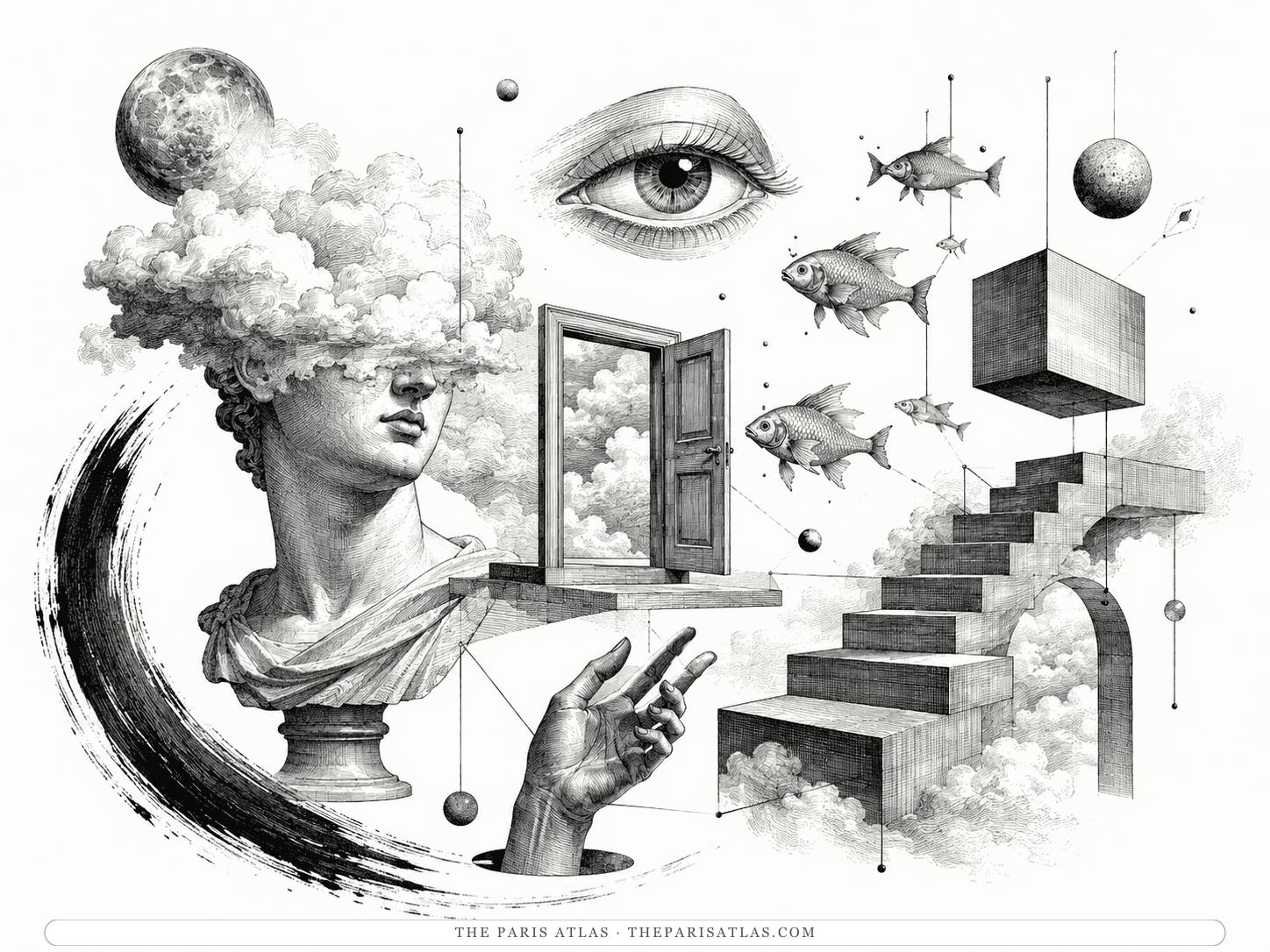
Soft watches, bodies, and instruments turn fixed structures into unstable matter.
Crutches support physical forms and suggest psychological dependence.
Ants and insects recur around decay, anxiety, and obsessive attention.
Eggs, drawers, bread, fish, and other familiar objects acquire private and often changing associations.
Double images make a face become a landscape, a group become a body, or one object become another.
Gala appears as portrait subject, sacred figure, mythological character, and collaborator named in the signature.
These motifs are guides, not a dictionary. Dalí reused forms in different contexts and often supplied competing explanations. The safest interpretation begins with what a specific work shows, when it was made, and which source actually documents the proposed meaning.
Expelled from the movement he had made famous
André Breton decided who belonged to Surrealism, and the group tried Dalí in 1934. The charges were political: an insufficient hostility to Hitler, and an interest in the imagery of authority that his colleagues could not read as ironic. He survived that hearing.[2]
He did not survive 1939. By then he was designing department-store windows in New York and selling steadily, and Breton expelled him for good, having first rearranged the letters of his name into Avida Dollars. Dalí spent the next forty years as the most famous Surrealist alive and a member of nothing.[2][1]
Dalí with Man Ray in Paris in 1934, the year the group put him on trial. Photograph by Carl Van Vechten. (Carl Van Vechten, Library of Congress · Public domain)
Freud, once
Surrealism took its working theory of the unconscious from Sigmund Freud, and Dalí had read The Interpretation of Dreams as a student. He tried for years to meet him, including a wasted trip to Vienna in 1937. The introduction was finally made in London by Stefan Zweig and Edward James, the English poet who was then buying almost everything Dalí produced.[6]
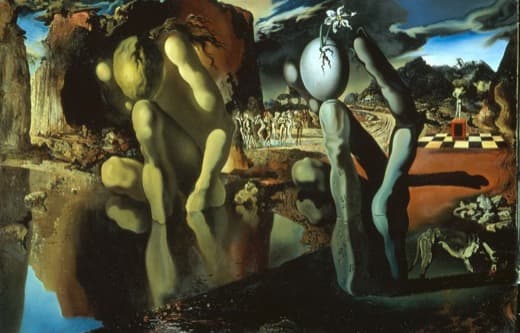
They met on 19 July 1938 at Freud's house in Hampstead. Freud was eighty-two and had a year to live. Dalí brought Metamorphosis of Narcissus to show him, the conversation went badly in a shared bad French, and while James and Freud talked Dalí sat and drew the old man's head, comparing the skull to a snail.[6]
That young Spaniard, however, with his candid and fanatical eyes, and his undeniable technical mastery, has made me reconsider my opinion.
Eight years in America
Dalí and Gala left Europe in 1940 and spent the war in the United States, much of it in California. The Museum of Modern Art gave him a retrospective in 1941, when he was thirty-seven. He published The Secret Life of Salvador Dalí in 1942, designed the dream sequence for Hitchcock's Spellbound in 1945, and began a short film with Walt Disney called Destino that was abandoned in 1946 and finished by the studio in 2003.[1][3]
These are the years that fixed his reputation. He came out of them internationally famous and commercially busy, and permanently suspect to the people who had made him.
Los Angeles, 19 June 1944: a newspaper photographer puts Dalí in an empty bathtub at the Ambassador Hotel, and Dalí sits in it in a suit. The persona is being made here as deliberately as the paintings were. (Los Angeles Times photographic archive, UCLA Library Special Collections · CC BY 4.0)
Beyond painting
Dalí treated film, printmaking, fashion, furniture, theater, shop windows, publishing, advertising, jewelry, and performance as connected fields. These projects were not all equal in ambition or quality, but they make a painter-only account of his career incomplete.
Cinema remained important after Un Chien Andalou and L'Âge d'or. He designed the dream sequence for Alfred Hitchcock's Spellbound in 1945 and began Destino with Walt Disney in 1946. Montage, abrupt scale changes, close-ups, and transformations across time also shaped how he conceived painted images.
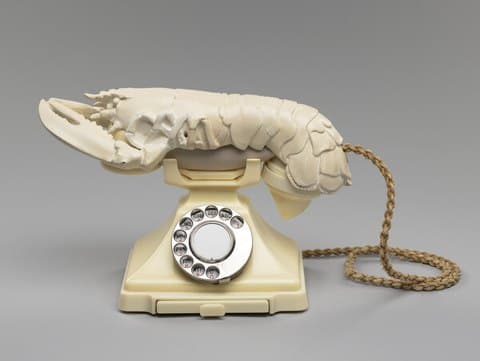
In Paris he worked with Elsa Schiaparelli on projects including the lobster dress and shoe hat. With Edward James, he moved Surrealist imagery into furniture and working objects, including Lobster Telephone. Patronage and fabrication were part of those objects from the beginning.
His graphic work ranged from 1930 collaborations with Breton, Éluard, and René Char to later illustrated editions of Don Quixote, The Divine Comedy, Alice's Adventures in Wonderland, and the Bible. Printers and publishers helped translate his drawings through etching, lithography, stencil, serigraphy, and photomechanical reproduction.[7]
The mustache, clothes, declarations, pets, publicity events, and television appearances formed another medium. Dalí understood that mass media could distribute an artist's identity as widely as an image. That skill expanded his audience and fed the commercial objections that had already separated him from Breton.
Port Lligat, and the religious paintings
They returned to Spain in 1948 and to the house at Port Lligat, a fisherman's cottage outside Cadaqués they had bought in 1930 and enlarged room by room for the rest of their lives. The work changed. Dalí called the new phase nuclear mysticism and built it out of two things at once: Catholic subject matter and the physics of the atom, which he had been reading about since Hiroshima.
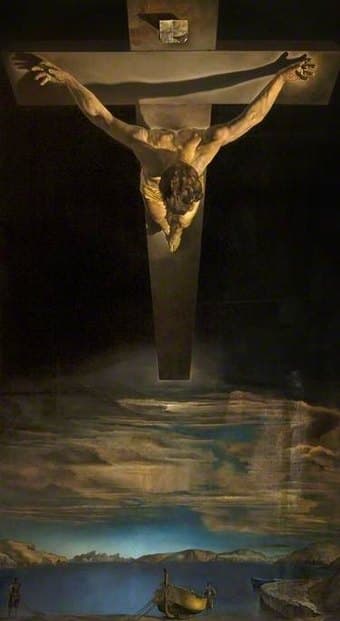
Christ of Saint John of the Cross (1951) hangs in Glasgow and shows the crucifixion from above, without a nail or a wound in sight. Crucifixion (Corpus Hypercubus) (1954), at the Metropolitan Museum of Art, sets the body against an unfolded four-dimensional cube. He and Gala, married civilly since 1934, married again in a Catholic ceremony in 1958.
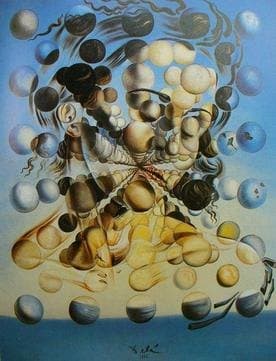
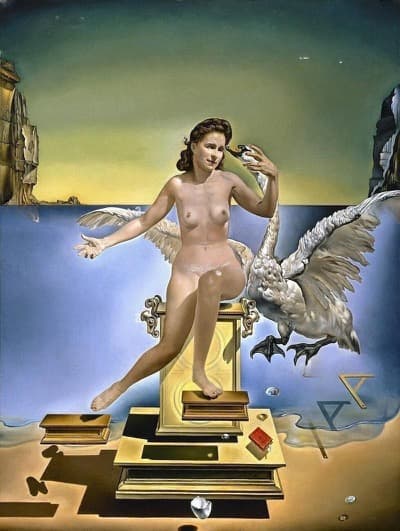
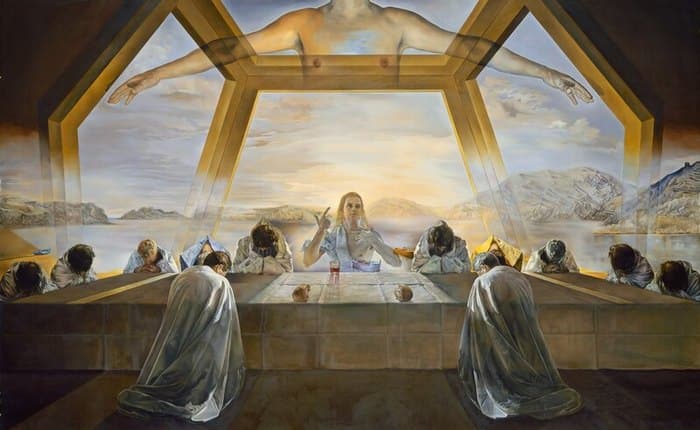
Nuclear mysticism was wider than religious painting. Galatea of the Spheres and Galatea in Creation break figures into suspended units. Leda Atomica makes bodily contact disappear, while The Sacrament of the Last Supper organizes the Eucharist through a dodecahedron. In the 1960s and 1970s he extended the same appetite for scientific imagery into stereoscopy, holography, optical illusion, DNA, and the fourth dimension.
The later work also intensified his study of old masters. Velázquez remained a reference from Dalí's school writing through his final decades, while Vermeer ranked even higher in his private hierarchy. Classicism and science were not competing retreats from Surrealism. He treated both as tools for making improbable visions appear authoritative.
Dalí and Gala. She managed the work and the money from 1929 until her death in 1982. (Illustration — The Paris Atlas)
Franco
Lorca was shot by Nationalist forces near Granada in August 1936, a month into the civil war, and has no known grave. Dalí returned to Franco's Spain twelve years later and stayed. His public statements about the regime were neither neutral nor few.
In September 1975, when the government executed five militants over international protest, Dalí told the press that the executions were correct and that there should have been more of them. He was seventy-one and Franco had two months to live. The remarks were reported at the time and he did not retract them.
This record keeps the politics next to the work rather than under it. Gibson's biography, the fullest account there is, argues that the politics and the showmanship came from the same source, and a reader can weigh that. What is not in dispute is that the closest friend of his youth was killed by the side he later praised.
The museum, and after
The Teatre-Museu Dalí opened in Figueres in 1974, built inside the shell of the municipal theatre that had burned at the end of the civil war, on the site where he had shown work for the first time at fourteen. He designed the whole of it, geodesic dome included, and it is the largest single object he made.
Paris gave him a different form of monument in December 1979, when the Centre Pompidou opened a retrospective spanning 1920 to 1980. The exhibition occupied the Grande Galerie and Forum and used a Hector Guimard Métro entrance in its staging. Fifty years after the Goemans show, the former Surrealist scandal figure had become the subject of a national museum spectacle.
Gala died in 1982. Dalí moved into the castle at Púbol that he had bought for her, painted very little, and was badly burned in a fire there in 1984. He died in Figueres on 23 January 1989, of heart failure, at eighty-four, and is buried in the crypt under the stage of his museum.
In July 2017 a Spanish court had the body exhumed to settle a paternity claim, which the DNA test then disproved. The embalmer who had prepared him in 1989 was present and reported that the mustache was intact and still set at ten past ten.
A free drawing class, 8 September 1976. Dalí was seventy-two, the museum had been open two years, and the press came to the lesson. (Anefo, Nationaal Archief (Netherlands) · CC0)Late, at a table above the bay. (Illustration — The Paris Atlas)
Life events
1904
Born in Figueres, Catalonia, on 11 May, nine months after the death of an elder brother of the same name.
— The Dalí Museum, St. Petersburg — Salvador Dalí timeline; Ian Gibson, The Shameful Life of Salvador Dalí (1997)
1922
Enters the San Fernando academy in Madrid and moves into the Residencia de Estudiantes, where he meets Federico García Lorca and Luis Buñuel.
— Ian Gibson, The Shameful Life of Salvador Dalí (1997)
1925
First solo exhibition, at the Galeries Dalmau in Barcelona.
— The Dalí Museum, St. Petersburg — Salvador Dalí timeline
1926
Expelled from the academy for refusing examination. On his first Paris trip he visits Picasso's studio, the Louvre, Versailles, and Millet's house and studio at Fontainebleau.
— The Dalí Museum, St. Petersburg — Salvador Dalí timeline; Ian Gibson, The Shameful Life of Salvador Dalí (1997); Montse Aguer, A Dalí Tour in Paris (2015)
1929
Un Chien Andalou premieres at the Studio des Ursulines on 6 June. He joins the Surrealist group, publishes seven Paris dispatches, opens his first Paris solo exhibition at Galerie Goemans, and begins his life with Gala after the summer at Cadaqués.
Dalí in Paris, 1934, by Carl Van Vechten — five years after Un Chien Andalou introduced him to the city, the self-made icon still under construction. (Carl Van Vechten, Library of Congress)
— Ian Gibson, The Shameful Life of Salvador Dalí (1997); Fundació Gala-Salvador Dalí — catalogue raisonné, chronology, and museums; Montse Aguer, A Dalí Tour in Paris (2015)
1930
Contributes to Buñuel's L'Âge d'or and develops the paranoiac-critical method as a controlled alternative to Surrealist automatism.
— Dalí at the Epicentre of Cinema (2007); The Dalí Museum, St. Petersburg — Salvador Dalí timeline
1931
Paints The Persistence of Memory, 24.1 by 33 centimetres. The Museum of Modern Art acquires it in 1934 as an anonymous gift.
— The Museum of Modern Art — collection records
1934
Tried by the Surrealist group over his politics, and survives the hearing. Marries Gala in a civil ceremony.
— Ian Gibson, The Shameful Life of Salvador Dalí (1997)
1936
Lectures at the London International Surrealist Exhibition in a deep-sea diving suit and has to be freed from the helmet. Paints Soft Construction with Boiled Beans months before the civil war begins; Lorca is shot near Granada in August.
— Ian Gibson, The Shameful Life of Salvador Dalí (1997)
1938
Meets Sigmund Freud in London on 19 July, introduced by Stefan Zweig and Edward James, carrying Metamorphosis of Narcissus to show him.
— Freud Museum London — Freud, Dalí and the Metamorphosis of Narcissus
1939
André Breton expels him from the Surrealist group and renames him Avida Dollars. Dalí and Gala work on the Dream of Venus pavilion for the New York World's Fair.
— Ian Gibson, The Shameful Life of Salvador Dalí (1997); The Dalí Museum, St. Petersburg — Salvador Dalí timeline; Gala-Salvador Dalí — Fundació Gala-Salvador Dalí
1940–1948
The American years. A Museum of Modern Art retrospective in 1941, The Secret Life in 1942, the dream sequence for Hitchcock's Spellbound in 1945, and the abandoned Disney film Destino.
Dalí photographed in an empty bathtub at the Ambassador Hotel in Los Angeles, 19 June 1944, in a suit, with a drawing on his knee and an arm reaching in from off-frame. A newspaper assignment during the American years, staged to look like one of his paintings. (Los Angeles Times photographic archive, UCLA Library Special Collections)
— The Dalí Museum, St. Petersburg — Salvador Dalí timeline; Salvador Dalí, translated by Haakon M. Chevalier, The Secret Life of Salvador Dalí (1942)
1948–1958
Returns to Port Lligat and to Catholic subjects under the name nuclear mysticism: Christ of Saint John of the Cross (1951), Crucifixion (Corpus Hypercubus) (1954). He and Gala remarry in church in 1958.
— Fundació Gala-Salvador Dalí — catalogue raisonné, chronology, and museums
1960s–1970s
Expands his graphic work and experiments with stereoscopy, holography, optical illusion, DNA, and reinterpretations of Velázquez.
— Graphic Work; Carme Ruiz, Salvador Dalí and Science (2000); Exhibition of Works Inspired by Velázquez (2015)
1969
Gives Gala the castle at Púbol and advances plans for the Dalí Theatre-Museum in Figueres.
— Salvador Dalí and Gala: Dual Timeline — Fundació Gala-Salvador Dalí
1974
The Teatre-Museu Dalí opens in Figueres, inside the burnt shell of the town theatre.
Dalí giving a free drawing class, 8 September 1976, at seventy-two: a model on a dais, students on the floor, press photographers in among them. The photographer is unrecorded and the archive does not name the room. (Anefo, Nationaal Archief (Netherlands))
— Fundació Gala-Salvador Dalí — catalogue raisonné, chronology, and museums
1975
Publicly approves the Franco government's execution of five militants and says more should have been executed.
— Ian Gibson, The Shameful Life of Salvador Dalí (1997)
1979–1980
The Centre Pompidou presents Salvador Dalí: Retrospective 1920–1980 in its Grande Galerie and Forum.
— Salvador Dalí: Retrospective 1920–1980 (1979)
1982–1984
Gala dies in 1982. Dalí moves to the castle at Púbol and is badly burned in a fire there in 1984.
— Fundació Gala-Salvador Dalí — catalogue raisonné, chronology, and museums
1989
Dies in Figueres on 23 January, of heart failure, and is buried in the crypt of his own museum.
— Fundació Gala-Salvador Dalí — catalogue raisonné, chronology, and museums; The Dalí Museum, St. Petersburg — Salvador Dalí timeline
Salvador Dalí quotes
Verbatim, as recorded by the witnesses of the era — sources on every quotation.
“
The only difference between me and a madman is that I am not mad.
— Salvador Dalí, The Secret Life of Salvador Dalí (1942)
“
At the age of six I wanted to be a cook. At seven I wanted to be Napoleon. And my ambition has been growing steadily ever since.
— Salvador Dalí, Diary of a Genius (1964), the opening lines
“
Every morning upon awakening, I experience a supreme pleasure: that of being Salvador Dalí.
How Salvador appears in its pages: The subject of "Benefit of Clergy", the essay a publisher cut out of a printed book. Orwell reviews the painter's autobiography, states what he thinks of the incidents in it, states that its author can draw better than almost anyone attacking him, and refuses to let either judgement dispose of the other.
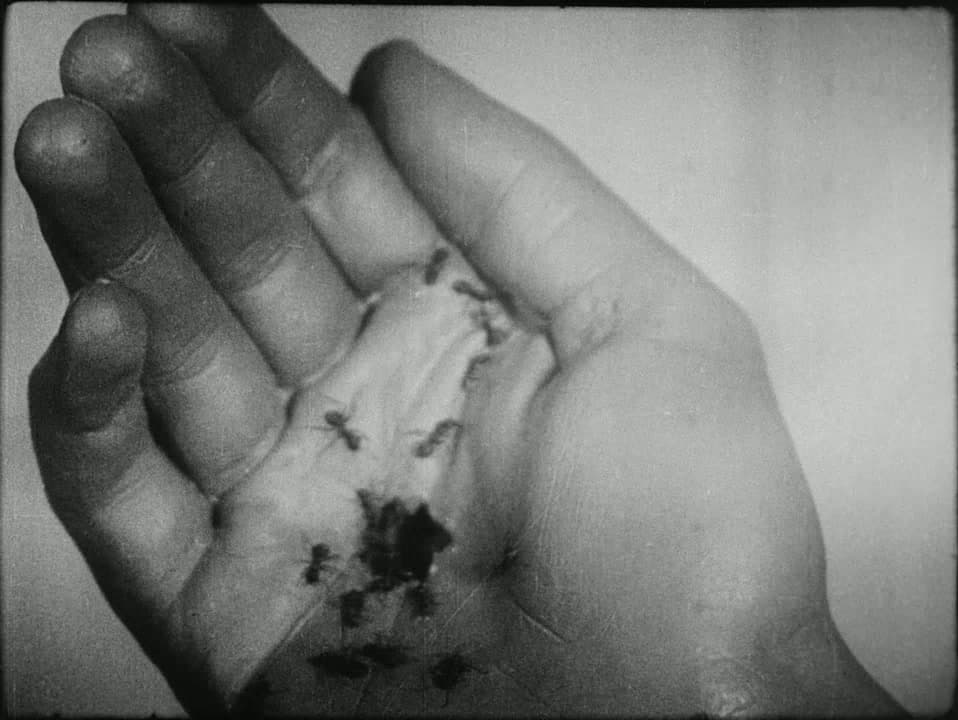
A cloud crosses the moon; a razor crosses an eye — and cinema acquires its most famous seventeen minutes. Written in six days by two young Spaniards trading dreams, on one rule: no image that could be explained. Ants pour from a hole in a palm, a man drags pianos loaded with dead donkeys and live priests, and a Paris premiere its director attended with stones in his pockets ends, to his disgust, in applause.
Luis Buñuel, Salvador Dalí, Un Chien Andalou, 1929. Image: public domain (US).
Dalí's 1951 crucifixion seen simultaneously from above and across the bay of Port Lligat. The uninjured body, modeled by stuntman Russell Saunders, joins Catholic subject matter to the atomic geometry Dalí called nuclear mysticism.
Dalí worked for six months on this 1945 portrait of Gala, recasting her through Raphael's La Fornarina and signing the canvas with both of their names.
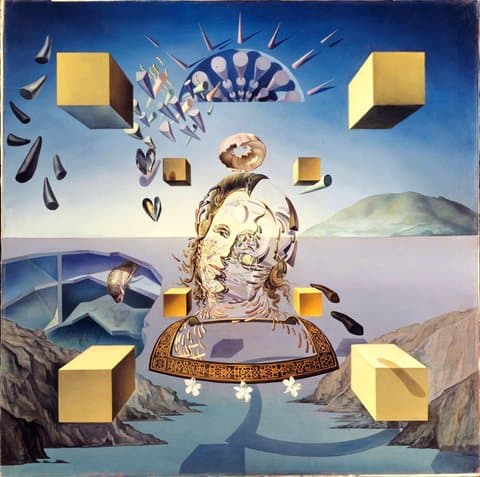
A classical female bust forms and dissolves among floating cubes, shells, flowers, and rhinoceros-horn spirals over the Catalan coast. Painted around 1954, it joins ancient sculptural form to the atomic and mathematical imagery of Dalí's nuclear mysticism.
Dalí reconstructs Gala's face from suspended spheres in this 1952 portrait, a compact statement of the atomic or corpuscular painting he called nuclear mysticism.
Gala becomes the mythological Leda in a composition ordered by a pentagon and the golden ratio. Figure, swan, books, egg and sea remain suspended without touching.
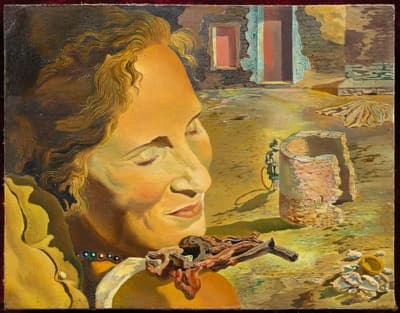
Dalí compressed Gala, two lamb chops and a sunlit stone courtyard into a panel smaller than a credit card. His later explanation connected the meat with a desire to devour her.
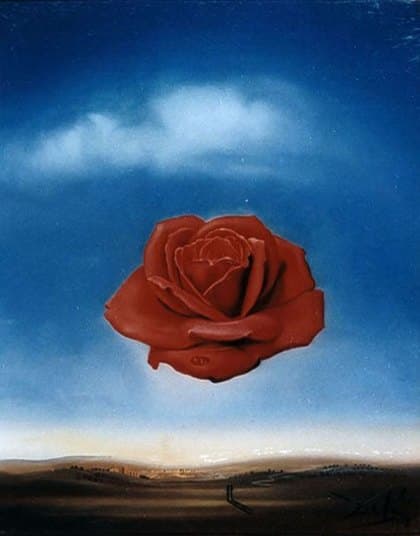
A monumental red rose suspended over a nearly empty plain, painted at the scale of a small devotional image in 1958. Its precise illusion and unexplained levitation place a familiar flower between still life, landscape, and vision.
Dalí's nine-foot-wide 1955 meditation on the Eucharist, with a transparent Christ, twelve bowed participants, bread and wine inside a dodecahedral space overlooking Port Lligat. It joins Renaissance symmetry, Catholic ritual, and nuclear mysticism.
Salvador Dalí turned the crouching Narcissus into a stone hand holding an egg and flower. This guide explains the double image, the Greek myth, the companion poem, and the painting's documented journey from Edward James to Sigmund Freud and Tate.
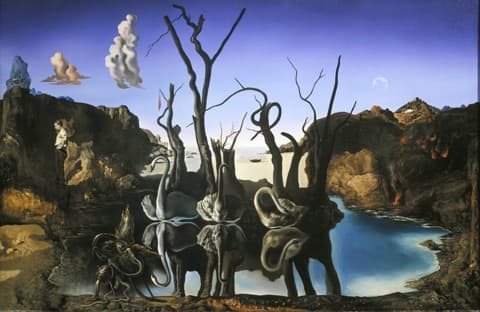
Salvador Dalí turned three swans and their reflections into three elephants. This guide shows how the double image works and traces the painting from Edward James through Nazi looting to its present private collection.
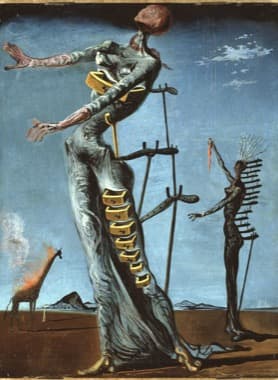
Salvador Dalí's small 1937 painting shows two distorted human figures supported by crutches while a giraffe burns in the distance. This guide separates what is visible from what the surviving records can prove.
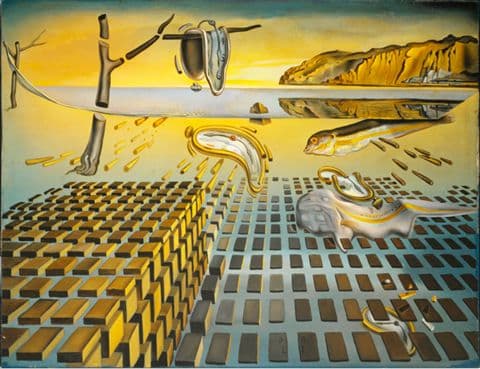
Salvador Dalí returned to his 1931 melting-watches painting and rebuilt it for the atomic age. The same coastline, tree, watches, and soft face now break apart across water and a grid of floating blocks.
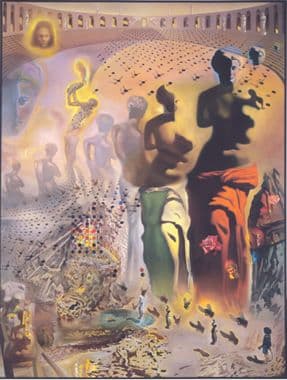
Salvador Dalí's monumental painting hides a bullfighter's face inside repeated images of the Venus de Milo. This guide shows where to find the face, the bull, the arena, and the other images.
A working 1930s telephone with a painted plaster lobster fitted over its receiver, designed by Dalí for the patron Edward James and fabricated by Green & Abbott. Eleven lobster receivers turned a Surrealist image into a functional household object.
Breton put Dalí on trial before the group in 1934 over his politics, expelled him in 1939, and coined the anagram Avida Dollars for him. The two went on attacking each other in print for decades.
— Ian Gibson, The Shameful Life of Salvador Dalí (1997)
At the Residencia de Estudiantes in Madrid, where both were students. It became the closest friendship of Dalí's life and, on Lorca's side, more than that; Dalí's later accounts of it contradict one another and cannot all be true.
— Ian Gibson, The Shameful Life of Salvador Dalí (1997)
Miró was a decade ahead of him and already with the Surrealists. He brought his own Paris dealer to Figueres to look at Dalí's work and spoke about him to Picasso, which is why Dalí arrived in Paris introduced rather than unknown.
— Ian Gibson, The Shameful Life of Salvador Dalí (1997)
Also at the Residencia. Seven years later they wrote Un Chien Andalou together in six days at Figueres, and followed it with L'Âge d'Or; the collaboration did not survive the thirties.
— Ian Gibson, The Shameful Life of Salvador Dalí (1997)
In Paris in 1929, and again that summer at Cadaqués, where Éluard sat for a portrait and his wife Gala left with the painter. Dalí finished the portrait after she had gone.
— Ian Gibson, The Shameful Life of Salvador Dalí (1997); Fundació Gala-Salvador Dalí — catalogue raisonné, chronology, and museums
Once, on 19 July 1938, at Freud's house in London, arranged by Stefan Zweig and Edward James after years of failed attempts. Dalí brought Metamorphosis of Narcissus and drew Freud while the others talked. Freud wrote to Zweig the next day that the visit had changed his opinion of the Surrealists.
— Freud Museum London — Freud, Dalí and the Metamorphosis of Narcissus
A contract drawn up in the summer of 1936 gave James virtually everything Dalí produced in exchange for an allowance, and ran to the end of 1938. The Lobster Telephone and the Mae West Lips Sofa were made under it.
— National Galleries of Scotland — Salvador Dalí and Edward James, Lobster Telephone
Civil ceremony in Paris on 30 January 1934, and a private religious ceremony at the Els Àngels shrine near Girona in 1958. She ran the money and the negotiations with galleries and patrons for the whole of it.
— The Dalí Museum, St. Petersburg — Gala Dalí; Salvador Dalí and Gala: Dual Timeline — Fundació Gala-Salvador Dalí, 1934 and 1958
Met · 1929
She arrived at Cadaqués in August 1929 as Paul Éluard's wife, on a holiday visit to a painter ten years younger than her. She stayed on after her husband went back to Paris.
— The Dalí Museum, St. Petersburg — Gala Dalí; Salvador Dalí and Gala: Dual Timeline — Fundació Gala-Salvador Dalí, 1929
They met in Paris in the spring of 1929, and that August Magritte travelled to Cadaqués with his wife Georgette at Dalí's invitation. The Royal Museums of Fine Arts of Belgium, who showed the two painters together, call the visit decisive.
— Royal Museums of Fine Arts of Belgium — Dalí & Magritte exhibition
Nearly twenty years before he was a couturier, Dior was an art dealer. Describing the programme of the gallery he opened at 34 rue La Boétie in 1928 with Jacques Bonjean, he separated the artists he admired from the ones he knew: shows centred on 'the masters we admired most: Picasso, Braque, Matisse, and Dufy, and the painters we knew personally and already held in high esteem: Christian Bérard, Salvador Dalí, Max Jacob, the Berman brothers'. His second gallery, with Pierre Colle at 29 rue Cambacérès, mounted a Surrealism exhibition in 1933.
The Musée des Arts Décoratifs dates their first collaboration to 1936. The house's own catalogue of Schiaparelli's work with artists lists the results under Dalí's name: the Skeleton Dress, the lobster-print dress, the Shoe Hat, the suit with drawer-shaped pockets, and the bottle for the perfume Le Roy Soleil. The Philadelphia Museum of Art, which holds the dress, records that the lobster motif was the result of the collaboration with Dalí. The direction of work ran from painting into cloth: Dalí supplied the images, Schiaparelli's workrooms made them wearable.
— Schiaparelli et les artistes — the house's catalogue of Elsa Schiaparelli's collaborations with Dalí, Cocteau, Giacometti, Man Ray, Fini and Oppenheim; Shocking ! Les mondes surréalistes d'Elsa Schiaparelli — exhibition, 6 July 2022 to 22 January 2023, with the house chronology (2022); Elsa Schiaparelli, Woman's Dinner Dress, February 1937 — collection object
Who Inspired Salvador Dalí
People whose work inspired Salvador Dalí. They did not necessarily meet or know one another.
Dalí read The Interpretation of Dreams as a student in Madrid and built the paranoiac-critical method on psychoanalytic ground. The influence runs one way: Freud had not heard of him before 1938 and thought the Surrealists cranks.
— Ian Gibson, The Shameful Life of Salvador Dalí (1997); Freud Museum London — Freud, Dalí and the Metamorphosis of Narcissus
De Chirico's metaphysical cityscapes of 1909–1919, with their long shadows, empty arcades and mannequins, were the direct visual source the Surrealists built on. Salvador Dalí is named among the painters who acknowledged the debt, alongside Max Ernst, René Magritte and Yves Tanguy, whose whole vocation began on seeing a de Chirico in a dealer's window.
Salvador Dalí painted a small copy of Vermeer's The Lacemaker in front of the original at the Louvre in 1955. It measures 23.5 by 19.7 cm and is now in the Robert Lehman Collection at the Metropolitan Museum of Art in New York. In the same year he painted the Paranoiac-critical Study of Vermeer's 'The Lacemaker', now in the Guggenheim Museum, in which the figure breaks into rhinoceros horns. On 30 April 1955 he painted beside a rhinoceros at the Vincennes zoo with a reproduction of the picture, and in December 1955 he told an audience of about two thousand at the Sorbonne that everything departs from the rhinoceros horn and from Vermeer's Lacemaker.
— Salvador Dalí, The Lacemaker (after Vermeer), 1955 — Robert Lehman Collection; Paranoiac-critical Study of Vermeer's 'The Lacemaker' — catalogue raisonné P 703; People, Dec. 26, 1955 (1955); Jonathan Janson, Vermeer-Related Works of Art: The Lacemaker
Salvador Dalí reworked Velázquez for more than twenty years. The Dalí Theatre-Museum in Figueres holds eleven paintings he made between 1960 and 1982 from Velázquez pictures, among them Las Meninas, the portraits of the Infanta Margarita, the jester Calabacillas and Sebastián de Morra. The museum also holds his sculpture Bust of Velázquez Turning into Three Figures Conversing and the hologram Holos! Holos! Velázquez! Gabor!, which used Las Meninas.
— Exhibition of Works Inspired by Velázquez (2015)
Movements
The artistic and literary currents this life ran through.
Joined the Paris group in 1929 on the strength of Un Chien Andalou, was tried by it in 1934, and was expelled in 1939. He went on making Surrealist images for fifty years without membership, which is why the dates close and the association does not.
— Ian Gibson, The Shameful Life of Salvador Dalí (1997); MoMA — Surrealism (collection term)
Salvador Dalí’s Places
The cataloged places connected to Salvador Dalí — through the books, and through the documented record.
Places you can enter today appear first, followed by addresses to see from outside and sites that have vanished.
The Persistence of Memory, the 1931 painting of soft watches draped over a branch, a box and a sleeping face, in a landscape taken from the coast at Cap de Creus. It is in the Museum of Modern Art in New York and is smaller than most people expect, at 24.1 by 33 centimetres. He also wrote and designed Un Chien Andalou with Luis Buñuel in 1929, which is the work that brought him into Surrealism.
Was Salvador Dalí a Surrealist?
He joined the Paris group in 1929 and was expelled from it in 1939. Between those dates the group also put him on trial, in 1934, over his politics; André Breton, who ran the movement, coined the anagram Avida Dollars for him at the expulsion. He went on making Surrealist images for another fifty years without belonging to the movement, which is why he is both its most recognizable painter and a former member of it.
What is the paranoiac-critical method?
Dalí's term for using delusional perception on purpose. Where the Surrealists wrote automatically to bypass the conscious mind, Dalí trained himself to see one thing as another and then painted the double image at full technical control. It is why his pictures can be read two ways at once, and why they are executed in an academic nineteenth-century manner rather than a loose one.
Did Salvador Dalí meet Sigmund Freud?
Once, on 19 July 1938, at Freud's house in London, after years of failed attempts. Stefan Zweig and the patron Edward James arranged it. Dalí brought the painting Metamorphosis of Narcissus and drew Freud while the others talked. Freud wrote to Zweig the next day that the young Spaniard had made him reconsider his low opinion of the Surrealists.
Who was Gala Dalí?
Elena Ivanovna Diakonova, Russian-born, and married to the poet Paul Éluard when she met Dalí during a visit to Cadaqués in the summer of 1929. She left with Dalí, married him civilly in 1934 and in church in 1958, and managed his career and his money until her death in 1982. She is the model in a great many of the paintings.
Did Gala create Dalí's paintings?
There is no evidence that Gala secretly painted his canvases. Her documented contribution was substantial but different: she managed negotiations and schedules, assessed work, coordinated projects, proofread The Secret Life, collaborated on the Dream of Venus pavilion, and helped construct the financial and practical framework of his career.
Did Salvador Dalí live in Paris?
Paris was a major professional and social base, especially from 1929 through the 1930s, but the Fundació identifies Port Lligat as his only permanent residence. He first visited Paris in 1926, returned for film, exhibitions, publishing, and Surrealist activity, and continued using the city later in life.
Which artists influenced Salvador Dalí?
His sources included Picasso, Giorgio de Chirico, Velázquez, Vermeer, Raphael, Leonardo, Ingres, and Jean-François Millet. Freud, cinema, photography, the Catalan coast, atomic science, mathematics, and Catholic imagery were equally important. Their weight changed across his career.
What did Salvador Dalí make besides paintings?
Films, prints, illustrated books, sculpture, furniture, fashion projects, theater and shop-window designs, jewelry, advertising, photographs, performances, stereoscopic works, and holographic experiments. Major collaborators included Luis Buñuel, Elsa Schiaparelli, Edward James, Alfred Hitchcock, Walt Disney, printers, publishers, and fabricators.
What did Salvador Dalí think of Franco?
He praised him publicly and repeatedly. Dalí returned to Spain in 1948 and lived there under the dictatorship for the rest of his life, and in September 1975 he told the press that the government had been right to execute five militants and should have executed more. Federico García Lorca, the closest friend of his youth, had been shot by Nationalist forces in 1936.
Why was Salvador Dalí expelled from the Surrealists?
Officially, for his politics and his commerce. The group tried him in 1934 over what it read as sympathy for authoritarian imagery and an unwillingness to condemn Hitler, and he survived that hearing. By 1939 he was designing shop windows in New York and selling hard, and Breton expelled him for good.
Where is Salvador Dalí buried?
In the crypt beneath the stage of the Teatre-Museu Dalí in Figueres, the museum he designed and opened in 1974. His body was exhumed in July 2017 for a paternity test that came back negative, and reburied. The embalmer reported that the mustache had survived intact.
Where can you see Salvador Dalí's paintings?
The largest collections are the Teatre-Museu Dalí in Figueres, the Dalí Museum in St. Petersburg, Florida, and the Museo Reina Sofía in Madrid. Individually: The Persistence of Memory is at the Museum of Modern Art in New York, Christ of Saint John of the Cross at Kelvingrove in Glasgow, and Crucifixion (Corpus Hypercubus) at the Metropolitan Museum of Art.
Connections and Sources
Salvador Dalí’s connections to people, places, and works, with the sources behind each one.
Joined the Paris group in 1929 on the strength of Un Chien Andalou, was tried by it in 1934, and was expelled in 1939. He went on making Surrealist images for fifty years without membership, which is why the dates close and the association does not.
— Ian Gibson, The Shameful Life of Salvador Dalí (1997); MoMA — Surrealism (collection term)
Breton put Dalí on trial before the group in 1934 over his politics, expelled him in 1939, and coined the anagram Avida Dollars for him. The two went on attacking each other in print for decades.
— Ian Gibson, The Shameful Life of Salvador Dalí (1997)
At the Residencia de Estudiantes in Madrid, where both were students. It became the closest friendship of Dalí's life and, on Lorca's side, more than that; Dalí's later accounts of it contradict one another and cannot all be true.
— Ian Gibson, The Shameful Life of Salvador Dalí (1997)
Miró was a decade ahead of him and already with the Surrealists. He brought his own Paris dealer to Figueres to look at Dalí's work and spoke about him to Picasso, which is why Dalí arrived in Paris introduced rather than unknown.
— Ian Gibson, The Shameful Life of Salvador Dalí (1997)
Also at the Residencia. Seven years later they wrote Un Chien Andalou together in six days at Figueres, and followed it with L'Âge d'Or; the collaboration did not survive the thirties.
— Ian Gibson, The Shameful Life of Salvador Dalí (1997)
In Paris in 1929, and again that summer at Cadaqués, where Éluard sat for a portrait and his wife Gala left with the painter. Dalí finished the portrait after she had gone.
— Ian Gibson, The Shameful Life of Salvador Dalí (1997); Fundació Gala-Salvador Dalí — catalogue raisonné, chronology, and museums
Once, on 19 July 1938, at Freud's house in London, arranged by Stefan Zweig and Edward James after years of failed attempts. Dalí brought Metamorphosis of Narcissus and drew Freud while the others talked. Freud wrote to Zweig the next day that the visit had changed his opinion of the Surrealists.
— Freud Museum London — Freud, Dalí and the Metamorphosis of Narcissus
The restaurant's popular history names Dalí among its regulars, alongside a long roster of other diners. No first-hand account, letter or dated record places him here, and the guide literature that repeats the roster does not say where it comes from — so this is reported rather than documented.
Salvador Dalí spent childhood summers at Es Llaner in Cadaqués, worked in an early town studio, and from 1930 made nearby Portlligat his principal home and studio, apart from the couple's years abroad, until Gala Dalí died in 1982.
— The Dalinian Triangle — Fundació Gala-Salvador Dalí; Salvador Dalí House-Museum Portlligat
Un Chien andalou ran here for eight months from October 1929. L'Âge d'or premiered on 28 November 1930; on 3 December Catholic youth groups and members of far-right leagues threw ink at the screen and wrecked the Surrealist paintings in the adjoining room, and on 11 December the prefecture banned the film and seized the copies. It was not shown publicly again until 1981.
— Focus on… "An Andalusian Dog", by Luis Buñuel; Dual timeline — Salvador Dalí biography; « L'Âge d'or » interdit
Dalí's first film with Luis Buñuel was shown to the public here from 6 June 1929. It was around the film's presentation that he met Paul Éluard and Gala, who visited him in Cadaqués that summer and stayed for the rest of his life.
— Focus on… "An Andalusian Dog", by Luis Buñuel; Dual timeline — Salvador Dalí biography
Dalí's Paris base for roughly three decades, returning for long annual stays with Gala and an entourage. The suite served as studio and stage at once, at the point where his self-presentation had become part of the work.
The Dalí Foundation names the Coupole bar among the fashionable Paris places Dalí used and cited — part of the Montparnasse circuit that ran alongside his Surrealist years in the city.
A contract drawn up in the summer of 1936 gave James virtually everything Dalí produced in exchange for an allowance, and ran to the end of 1938. The Lobster Telephone and the Mae West Lips Sofa were made under it.
— National Galleries of Scotland — Salvador Dalí and Edward James, Lobster Telephone
Dalí read The Interpretation of Dreams as a student in Madrid and built the paranoiac-critical method on psychoanalytic ground. The influence runs one way: Freud had not heard of him before 1938 and thought the Surrealists cranks.
— Ian Gibson, The Shameful Life of Salvador Dalí (1997); Freud Museum London — Freud, Dalí and the Metamorphosis of Narcissus
Civil ceremony in Paris on 30 January 1934, and a private religious ceremony at the Els Àngels shrine near Girona in 1958. She ran the money and the negotiations with galleries and patrons for the whole of it.
— The Dalí Museum, St. Petersburg — Gala Dalí; Salvador Dalí and Gala: Dual Timeline — Fundació Gala-Salvador Dalí, 1934 and 1958
She arrived at Cadaqués in August 1929 as Paul Éluard's wife, on a holiday visit to a painter ten years younger than her. She stayed on after her husband went back to Paris.
— The Dalí Museum, St. Petersburg — Gala Dalí; Salvador Dalí and Gala: Dual Timeline — Fundació Gala-Salvador Dalí, 1929
They met in Paris in the spring of 1929, and that August Magritte travelled to Cadaqués with his wife Georgette at Dalí's invitation. The Royal Museums of Fine Arts of Belgium, who showed the two painters together, call the visit decisive.
— Royal Museums of Fine Arts of Belgium — Dalí & Magritte exhibition
Nearly twenty years before he was a couturier, Dior was an art dealer. Describing the programme of the gallery he opened at 34 rue La Boétie in 1928 with Jacques Bonjean, he separated the artists he admired from the ones he knew: shows centred on 'the masters we admired most: Picasso, Braque, Matisse, and Dufy, and the painters we knew personally and already held in high esteem: Christian Bérard, Salvador Dalí, Max Jacob, the Berman brothers'. His second gallery, with Pierre Colle at 29 rue Cambacérès, mounted a Surrealism exhibition in 1933.
The Musée des Arts Décoratifs dates their first collaboration to 1936. The house's own catalogue of Schiaparelli's work with artists lists the results under Dalí's name: the Skeleton Dress, the lobster-print dress, the Shoe Hat, the suit with drawer-shaped pockets, and the bottle for the perfume Le Roy Soleil. The Philadelphia Museum of Art, which holds the dress, records that the lobster motif was the result of the collaboration with Dalí. The direction of work ran from painting into cloth: Dalí supplied the images, Schiaparelli's workrooms made them wearable.
— Schiaparelli et les artistes — the house's catalogue of Elsa Schiaparelli's collaborations with Dalí, Cocteau, Giacometti, Man Ray, Fini and Oppenheim; Shocking ! Les mondes surréalistes d'Elsa Schiaparelli — exhibition, 6 July 2022 to 22 January 2023, with the house chronology (2022); Elsa Schiaparelli, Woman's Dinner Dress, February 1937 — collection object
De Chirico's metaphysical cityscapes of 1909–1919, with their long shadows, empty arcades and mannequins, were the direct visual source the Surrealists built on. Salvador Dalí is named among the painters who acknowledged the debt, alongside Max Ernst, René Magritte and Yves Tanguy, whose whole vocation began on seeing a de Chirico in a dealer's window.
Salvador Dalí painted a small copy of Vermeer's The Lacemaker in front of the original at the Louvre in 1955. It measures 23.5 by 19.7 cm and is now in the Robert Lehman Collection at the Metropolitan Museum of Art in New York. In the same year he painted the Paranoiac-critical Study of Vermeer's 'The Lacemaker', now in the Guggenheim Museum, in which the figure breaks into rhinoceros horns. On 30 April 1955 he painted beside a rhinoceros at the Vincennes zoo with a reproduction of the picture, and in December 1955 he told an audience of about two thousand at the Sorbonne that everything departs from the rhinoceros horn and from Vermeer's Lacemaker.
— Salvador Dalí, The Lacemaker (after Vermeer), 1955 — Robert Lehman Collection; Paranoiac-critical Study of Vermeer's 'The Lacemaker' — catalogue raisonné P 703; People, Dec. 26, 1955 (1955); Jonathan Janson, Vermeer-Related Works of Art: The Lacemaker
Salvador Dalí reworked Velázquez for more than twenty years. The Dalí Theatre-Museum in Figueres holds eleven paintings he made between 1960 and 1982 from Velázquez pictures, among them Las Meninas, the portraits of the Infanta Margarita, the jester Calabacillas and Sebastián de Morra. The museum also holds his sculpture Bust of Velázquez Turning into Three Figures Conversing and the hologram Holos! Holos! Velázquez! Gabor!, which used Las Meninas.
— Exhibition of Works Inspired by Velázquez (2015)
References
References
The sources below include biographies, scholarly essays, interviews, and primary materials that informed this page. They reflect both the historical record and ongoing critical conversations about Salvador Dalí and their work.
1abcdeThe Dalí Museum, St. Petersburg — Salvador Dalí timeline
Website
Used for
Web source consulted for documented facts and historical context presented on the Salvador Dalí page.
Dalí's own memoir, cited for what he claimed rather than for what happened - the account of being taken to his dead brother's grave, and the American years it closes on.
The foundation's account of Dalí's Paris: the 1926 route through the Louvre, Versailles and Millet's Fontainebleau, the premiere of Un Chien Andalou at the Studio des Ursulines on 6 June 1929, the Goemans exhibition that November, and the seven Documentary—Paris—1929 dispatches for La Publicitat.
The foundation on the printmaking: the illustrated editions and the etching, lithography, stencil, serigraphy and photomechanical processes behind them.
20Schiaparelli et les artistes — the house's catalogue of Elsa Schiaparelli's collaborations with Dalí, Cocteau, Giacometti, Man Ray, Fini and Oppenheim
Website
Maison Schiaparelli, Paris
Used for
Web source consulted for documented facts and historical context presented on the Salvador Dalí page.
These references anchor the page in the documented record and in the scholarly conversations around Salvador Dalí. Every claim on this page traces back to one or more of the works listed here.










 View source