The Meditative Rose
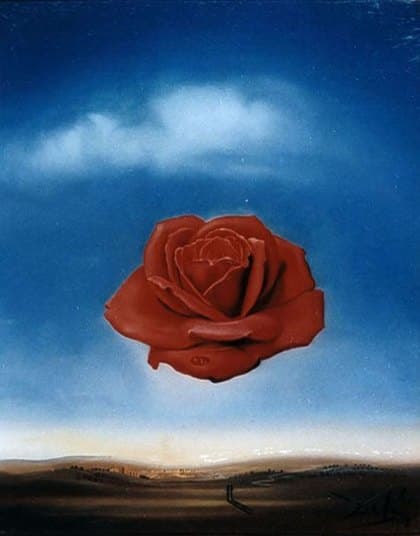
A monumental red rose suspended over a nearly empty plain, painted at the scale of a small devotional image in 1958. Its precise illusion and unexplained levitation place a familiar flower between still life, landscape, and vision.
- 1958
- Oil on canvas
About Salvador Dalí
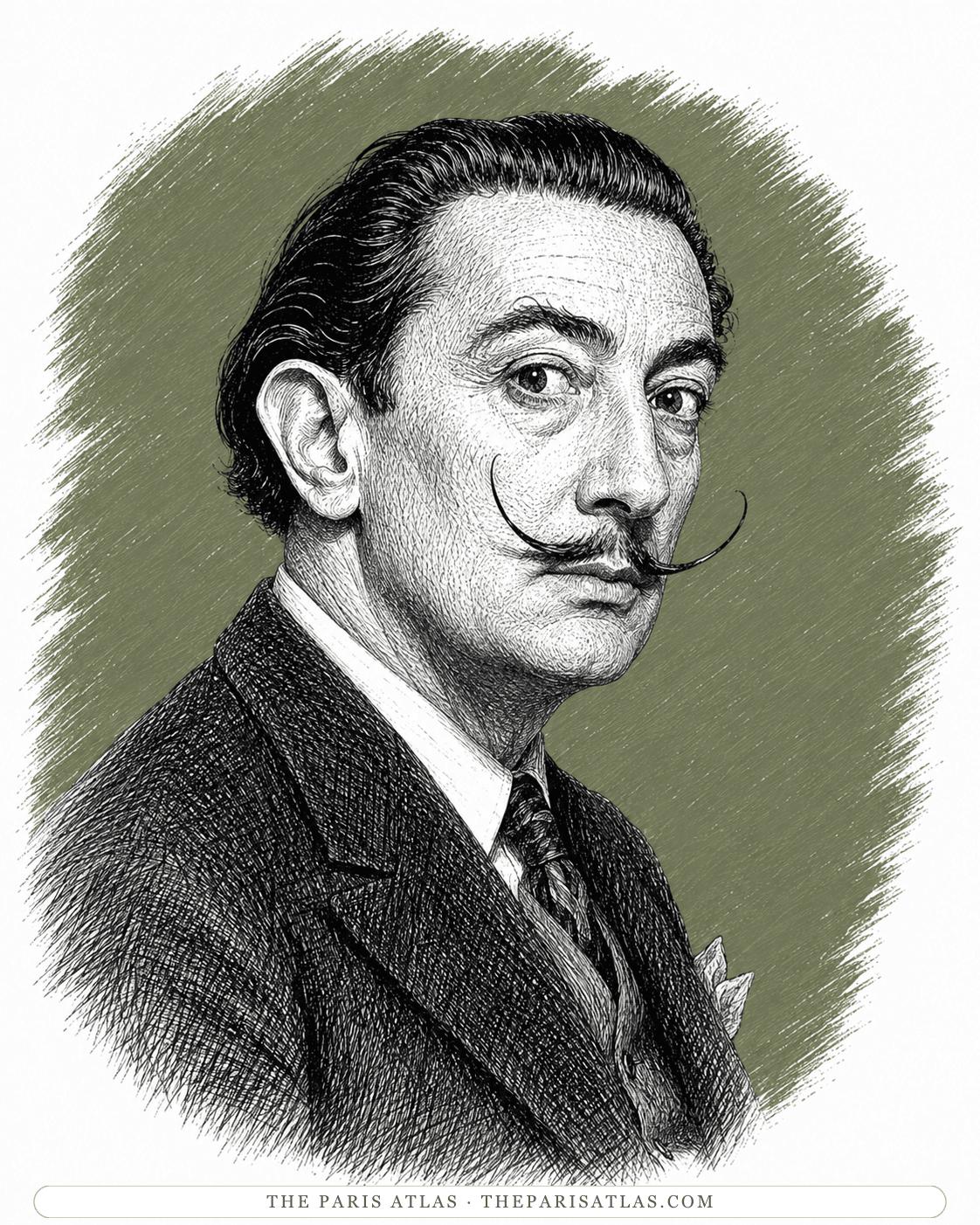
A route through Dalí's work
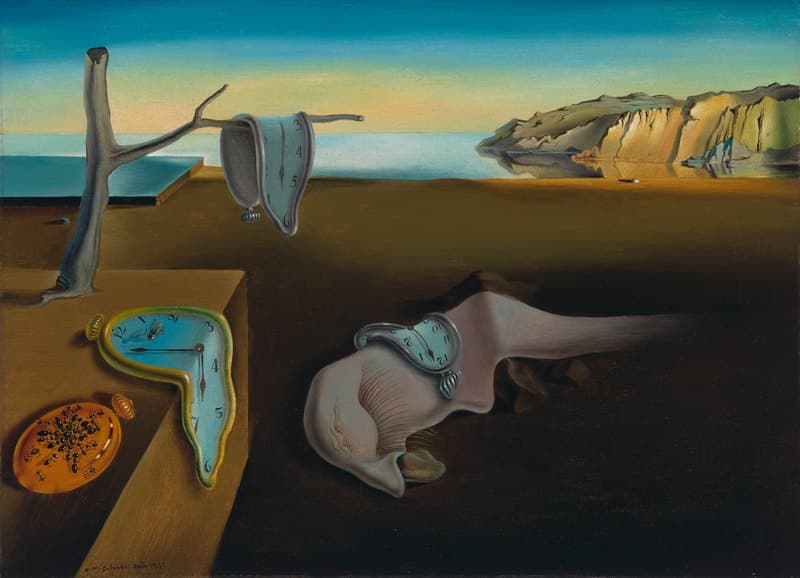
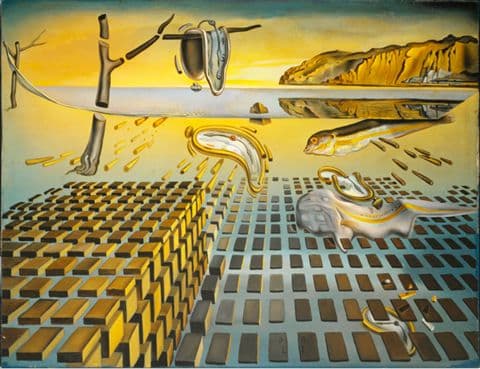
To compare this spare later image with Dalí's best-known Surrealist landscape, see The Persistence of Memory. Both isolate a familiar object in an unnaturally still space, but the rose replaces melting and decay with suspension and calm.
What the painting shows
A single red rose, far larger than life, floats in a clear blue sky. Below it stretches a nearly featureless plain: a low horizon, faint undulations, two small figures a long way off, and a drop of dew beneath the flower. The canvas is only 36 by 28 centimetres, so the image feels concentrated rather than expansive.
Dalí painted the rose petal by petal in the precise academic finish he prized. The stem has been removed and no visible support explains the flower's position. With almost every surrounding detail suppressed, scale and placement carry the entire disturbance.
How the image works
The flower occupies the place a sun, moon, or apparition might hold in a traditional landscape. Its warm red is set against a cool, almost uniform blue, while the tiny figures below establish a human scale. Because the rose is meticulously real and physically impossible at the same time, the painting does not need a double image or a crowded dream scene to become strange.
The drop beneath the flower gives the suspended object a small event and a downward pull. It also sharpens the contrast between Dalí's illusionistic detail and the broad, quiet fields of sky and ground.
Meaning without a fixed key
Roses carry established associations with love, beauty, mortality, and, in Christian imagery, the Virgin Mary. Dalí made the painting during his religious and nuclear-mysticism period, so a devotional reading is reasonable. The Fundació catalogue does not assign the rose a single symbolic meaning, however, and the image does not identify a saint, narrative, or ritual.
Its power lies partly in that openness. The rose can suggest a sacred presence, a beloved person, or an impossible natural specimen without becoming an illustration of one interpretation.
Where it fits in Dalí's later work
By 1958 Dalí was combining traditional painting technique with Catholic imagery, atomic theory, and forms suspended in space. The Meditative Rose uses only the last of those devices. Matter appears isolated from ordinary gravity, but the effect is achieved through a flower rather than the spheres, cubes, or religious figures found elsewhere in his late work.
The painting matters because it shows how little Dalí needed to make an image uncanny. Its economy also complicates the common division between his crowded Surrealist pictures and his later religious works: this is a late painting that remains dreamlike while refusing spectacle.
The object and its record
Dalí signed and dated the lower-right corner. A long, partly damaged inscription on the back describes the rose alone against a very even celestial-blue ground and records practical instructions connected with the work. The catalogue raisonné lists Mr. and Mrs. Arnold M. Grant of New York in its provenance.
The painting was exhibited in Tokyo in 1964, New York in 1965–66, Madrid in 1983, Segovia in 2001, and Barcelona in 2004. It remains in a private collection and is catalogue raisonné number P 738 under the primary title The Rose.
Close reading
Reading the work, detail by detail
The painting gives almost its entire sky to one immaculate rose, then makes human life tiny beneath it. The close views reveal that its meditation is a problem of scale and impossible suspension.
1.The rose is painted like a planet
Petals are modeled with enough light and shadow to give the flower planetary volume. A small droplet beneath it intensifies the sense of arrested gravity. The rose is enlarged beyond symbol into environment.
2.The lovers are almost lost to scale
The two figures are minute, close together, and dwarfed by empty land and flower. Their intimacy is protected by distance: the painting refuses portrait detail and lets the relationship register as a single shared silhouette.
3.A low horizon gives the flower the world
The land is compressed into a narrow strip, leaving the sky as a nearly empty field. That compositional decision, more than the flower's literal size, makes the rose feel immeasurable.
4.The petals turn inward around a dark center
The inner petals overlap in a series of curved ridges, each catching a narrow line of light. Darkness deepens between them toward the center. This familiar structure gives the enlarged flower its solidity: the rose remains recognizable through the small, repeated folds that would belong to a bloom held in the hand.
5.The outer petals give the flower a heavy edge
The outer petals spread into broad, almost horizontal ledges before turning down into shadow. Their dark lower edges make the flower appear thick and heavy. The surrounding blue contains no stem or support, so careful modeling intensifies the improbability of the bloom's position in the air.
6.Tiny figures break the dark land
Tiny upright figures break the dark foreground, with long shadows extending beside them. Behind the figures, the land rises toward a thin pale horizon. The small interruption gives the immense flower a measure of human scale without competing with its bright color or clear outline.
Timeline
1958
Dalí signed and dated The Rose, a small oil painting of a monumental flower suspended above two distant figures.
1964
Shown in the Salvador Dalí exhibition at the Tokyo Prince Hotel Gallery.
1965–1966
Exhibited at New York's Gallery of Modern Art in Salvador Dalí, 1910–1965.
2004
Included in Dalí: elective affinities at Palau Moja in Barcelona. The painting remains in a private collection.
Where to see it
Private collection
No public viewing address is listed for this private collection.
Frequently asked questions
What is The Meditative Rose?
A small 1958 oil painting by Salvador Dalí showing a single oversized red rose floating in a blue sky above an almost empty plain. Its strangeness comes from scale, suspension, and precise illusion rather than a crowded dream scene.
Why is it so different from his famous paintings?
It removes the melting forms, double images, and props of his best-known Surrealist work — the soft watches of The Persistence of Memory above all. An ordinary flower is made enormous and placed where a sun or apparition might be. It comes from his later religious and nuclear-mysticism period.
What does the rose mean?
The catalogue does not give it a fixed meaning. Roses have long associations with love, beauty, mortality, and the Virgin Mary. Because Dalí painted it during his religious period, a devotional reading is reasonable, but it is not the only supported interpretation.
Why does the rose seem monumental if the painting is small?
The two tiny figures on the plain provide scale, while the rose occupies a large part of the sky. The contrast makes the flower appear immense even though the canvas is only 36 by 28 centimetres.
How big is it?
36 by 28 centimetres — small, roughly the size of a sheet of paper.
Where is it now?
A private collection. It is catalogued by the Fundació Gala-Salvador Dalí as catalogue raisonné number P 738, under the title The Rose.
More by Salvador Dalí
If you like Salvador Dalí
Explore painters from the same movements and circles.
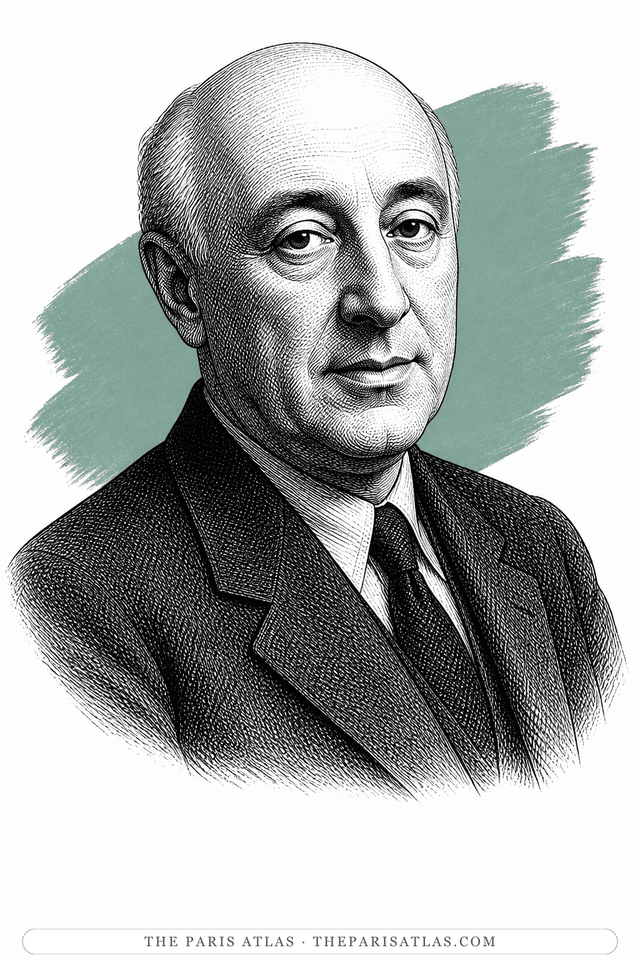
Jean Arp
Strasbourg-born sculptor and poet — Hans in German, Jean in French, both all his life — who co-founded Dada at the Cabaret Voltaire in 1916, composed collages by dropping torn paper 'according to the laws of chance', and settled at Meudon outside Paris in a house his wife Sophie Taeuber-Arp designed.
View artist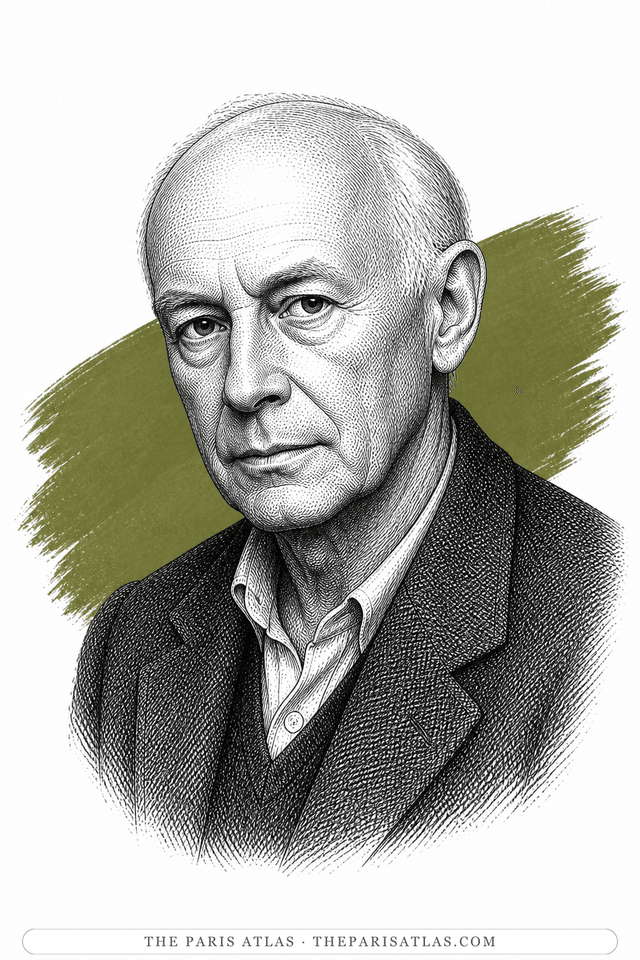
Henri Cartier-Bresson
French photographer who turned a pocket-sized 35mm camera into an instrument of split-second composition — the idea the world knows as 'the decisive moment'. He trained as a painter, was taken prisoner in 1940 and escaped on his third try, photographed the Liberation of Paris in August 1944, co-founded the photographer-owned agency Magnum Photos in 1947, gave up reporting for drawing in the 1970s, and left Paris a foundation in the Marais that deliberately hangs no permanent display of his own pictures.
View artist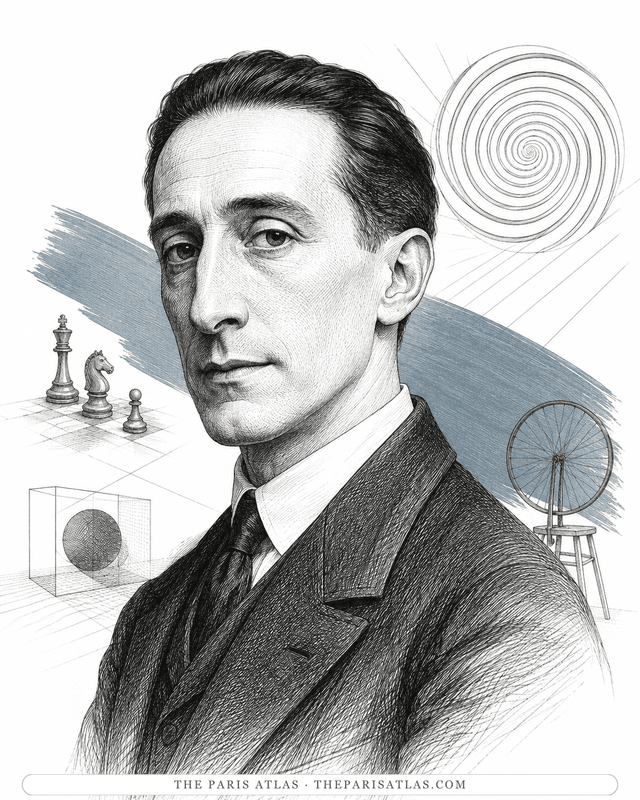
Marcel Duchamp
The century's quietest revolutionary — readymades, the abandonment of painting, chess on a Paris rooftop in Entr'acte, and one anemic film of spinning puns signed Rrose Sélavy.
View artist
References
The sources below include collection records, catalogues, scholarly research, and primary materials that informed this page. They document The Meditative Rose, its making, and its place in cultural history.


1The Rose, catalogue raisonné no. P 738
WebsiteFundació Gala-Salvador DalíUsed forWeb source consulted for documented facts and historical context presented on the The Meditative Rose page.
2Salvador Dalí and Science
WebsiteCentre for Dalinian Studies, Fundació Gala-Salvador Dalí, 2000Used forWeb source consulted for documented facts and historical context presented on the The Meditative Rose page.
3Salvador Dalí
WebsiteArt Institute of ChicagoUsed forThe Art Institute of Chicago's artist record supplies independent museum context for Dalí's postwar painting.
4Dual timeline — Salvador Dalí biography
WebsiteFundació Gala-Salvador DalíUsed forThe Fundació Dalí chronology places the 1958 canvas within the artist's nuclear-mystical and religious period.
These references provide the documented foundation for this work's history and interpretation. Claim-level citations remain attached to the specific claims they support.
 Explore more resources