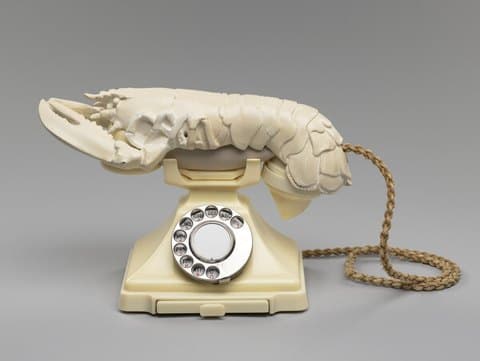
A working 1930s telephone with a painted plaster lobster fitted over its receiver, designed by Dalí for the patron Edward James and fabricated by Green & Abbott. Eleven lobster receivers turned a Surrealist image into a functional household object.
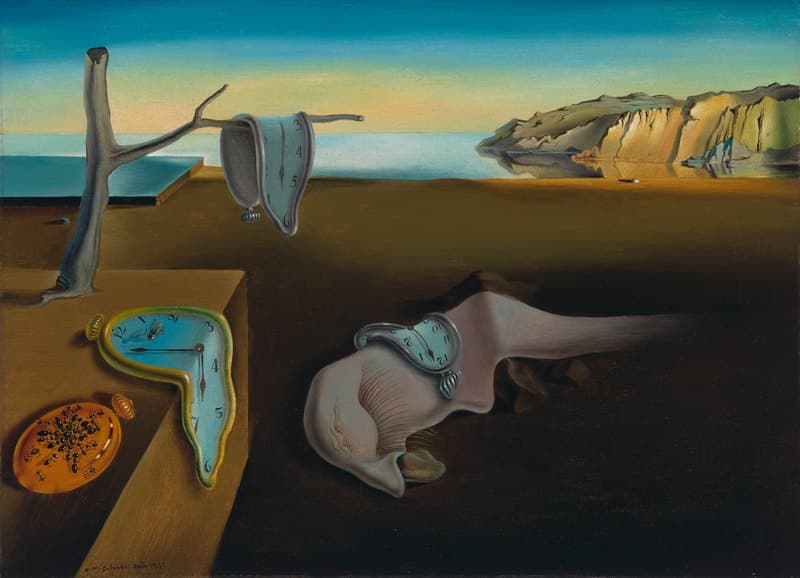
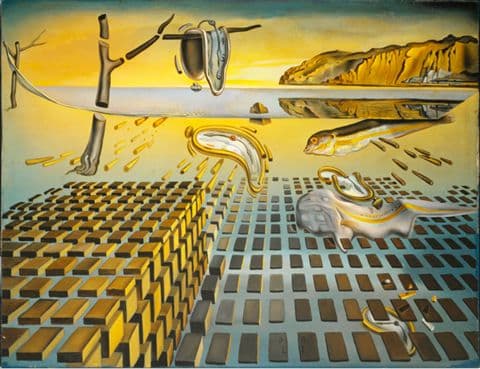
For Dalí's best-known painted transformation of an everyday object, see The Persistence of Memory. Its soft watches and this impossible telephone use different Surrealist strategies to make familiar things behave incorrectly.
What it is
A standard British telephone of the 1930s has a painted plaster lobster fitted over its receiver. The lobster is hollow underneath and has an opening at the tail for the cord, so the telephone remains functional. To answer, a user lifts the lobster and brings it to the ear.[1]
The physical encounter is important. A familiar household action now involves the weight, claws, and segmented body of a crustacean. The irrational pairing enters touch, use, and domestic routine rather than remaining confined to an image.
Made for Edward James
The object was made for Edward James, the English poet and collector who became Dalí's principal patron in the later 1930s. The National Galleries of Scotland records eleven lobster receivers for telephones in James's London house and at West Dean in Sussex: seven white and four red.[1]
The museum credits Dalí and James together. Dalí supplied the design and recurring imagery. James commissioned the functional objects and provided the domestic settings in which they were used.[1]
Who fabricated the object
The lobster receivers were made by Green & Abbott, a London decorating and design firm. Surviving correspondence and an invoice document practical questions of casting, fitting, color, and payment.[1]
That record prevents the object from being reduced to a single flash of inspiration. It was a collaboration among an artist, a patron, and skilled fabricators who converted a drawing and staged experiment into a repeatable working object.
Why a lobster, and why a telephone
Lobsters and telephones already appeared in Dalí's imagery. In a 1935 drawing, a telephone and lobster share the same scene. In 1936 he reportedly placed a live lobster on a red telephone for James, turning the visual association into a temporary object before plaster versions were fabricated.[1]
The curved lobster tail occupies the part of the receiver held near the mouth. Dalí called an exhibited version Aphrodisiac Telephone, making the erotic suggestion explicit without fixing the object to a single symbolic code.[1]
A three-dimensional collage
The National Galleries places Lobster Telephone within Surrealist object sculpture, a practice that brought unrelated found and fabricated things together in three dimensions. Like collage, the method preserves the identity of each component while creating a new relationship between them.[1]
The telephone remains legible as modern communications technology and the lobster remains anatomically recognizable. Their incompatibility is the source of the work. Nothing needs to melt or transform, as the watches of The Persistence of Memory do; here, ordinary objects have simply been rearranged into an impossible function.
Surrealism in the house
Surrealism sought encounters that would disrupt rational habit and expose desire, fear, or humor within everyday life. Lobster Telephone brought that ambition out of painting and poetry and into a patron's interior.
Its status as a working appliance matters. The piece was furniture, sculpture, joke, and provocation at once. It helped establish a route from Surrealist imagery into design, fashion, and collectible objects.
The white one, and how it stayed in Britain
All eleven began in James's collection and later passed to the foundation he established at West Dean. Examples entered collections in several countries. The National Galleries' object is one of the white versions, sometimes called White Aphrodisiac Telephone.[1]
When it faced export in 2018, the United Kingdom placed a temporary bar on its departure. The National Galleries of Scotland then acquired it with support from the Art Fund. James had been born near North Berwick, giving the Scottish acquisition a direct biographical connection.[1]
Why Lobster Telephone matters
Lobster Telephone is one of the clearest examples of Dalí's ideas surviving a change of medium. The precise dream image became a usable object through patronage and fabrication, without losing its discomfort or humor.
It also makes the people around the artwork visible. Edward James was not merely an owner after the fact, and Green & Abbott were not invisible hands. Commission, design, manufacture, domestic use, and museum acquisition all belong to the object's history.
Close reading
Reading the work, detail by detail
The object is immediately funny and remains disturbing after the joke lands. Close views show why: the lobster does not decorate the telephone but replaces the part meant to touch the face.
1.A natural body is fitted to an industrial one
The lobster's segmented body follows the horizontal role of a handset closely enough to seem designed for it. Organic shell and molded telephone casing rhyme in gloss and curve, making the substitution look uncannily practical.
2.The claws occupy the mouthpiece
The most aggressive part of the animal is placed where a speaker's mouth would approach. Function is converted into bodily threat without changing the recognizable silhouette of a phone call.
3.The ordinary dial makes the absurdity usable
The base remains bureaucratically normal: numbered dial, cord, cradle. That untouched familiarity matters. A completely invented object would be fantasy; this is an everyday tool made impossible by one exact replacement.
4.The open claw breaks the receiver silhouette
The claw opens into a pointed gap where a telephone receiver would normally present a smooth, compact end. The pale finish unites shell and telephone visually, but this broken outline makes the substitution unmistakable. A familiar object becomes difficult to imagine holding against the face.
5.The cord makes a second kind of curve
The braided cord drops from the tail and forms a loose loop beside the rigid base. Its coarse, repeated texture differs from the smooth pale shell. The loop also extends the sculpture across the supporting surface, making the improbable handset look connected to a working apparatus.
6.The base keeps its small practical details
Below the circular dial, the base ends in a straight ledge with a small rectangular pull. These modest manufactured details survive the change above them. The base remains recognizable as a desk telephone beneath the lobster handset.
Timeline
1935
Dalí made a New York drawing that paired a lobster with a telephone.
1936
A live lobster was placed on a red telephone for Edward James, translating the drawing into a temporary object.
1938
A lobster telephone was shown in Paris at the Exposition Internationale du Surréalisme as Aphrodisiac Telephone.
1938
Green & Abbott made eleven lobster receivers for James's London and West Sussex telephones: seven white and four red.
2018
The National Galleries of Scotland acquired this white version after a temporary UK export bar. Accession GMA 5623.
Where to see it
National Galleries of Scotland
75 Belford Road, Edinburgh EH4 3DR, United Kingdom
Displays and loans can change. Check whether this work is on view before making a special trip.
A Surrealist object of 1938: a working telephone fitted with a painted plaster lobster, so the lobster is lifted to speak. Dalí designed it for Edward James, and Green & Abbott fabricated the receivers.
Did the telephone actually work?
Yes. The lobster is hollow, with a hole in the tail for the cord, and sits over a standard receiver of the period, so the phone functioned normally. The Surrealist point was to put the irrational inside an object in daily use.
Why did Dalí combine a lobster and a telephone?
Both appeared in his 1930s imagery. Their shapes and associations create an erotic and comic disturbance, made explicit in the alternative title Aphrodisiac Telephone. The pairing developed from drawing to a live-lobster experiment and then to fabricated objects.
Who physically made the lobster receivers?
Green & Abbott, a London decorating and design firm. Correspondence and an invoice document their role in casting, fitting, and finishing Dalí's design for Edward James.
How does it fit Surrealism?
It works like a three-dimensional collage, joining recognizable but incompatible objects and placing the irrational inside ordinary domestic use. It is a major example of Surrealist object sculpture.
How many were made?
Eleven, cast in 1938 for Edward James's telephones in London and West Sussex — seven left white and four painted red. Examples are now in museums in several countries.
Who is Edward James?
The English poet and collector who was Dalí's principal patron in the 1930s, buying most of what Dalí made under a 1936 contract. The Lobster Telephone and the Mae West Lips Sofa were made for his houses. He has his own page here.
Where is it now?
The National Galleries of Scotland, accession GMA 5623, on display at Modern One at the last check of the museum's record. It was bought for the nation in 2018 after a UK export bar.
In the atlas
What the graph records about this work — every claim carries its citation.
Dalí first showed a lobster telephone at the Exposition Internationale du Surréalisme in Paris in January 1938, as Aphrodisiac Telephone. It is the movement's idea of the irrational erupting inside an everyday object, made literal in a working phone.
— National Galleries of Scotland — Salvador Dalí and Edward James, Lobster Telephone, GMA 5623
Explore sculptors from the same movements and circles.
Jean Arp
Strasbourg-born sculptor and poet — Hans in German, Jean in French, both all his life — who co-founded Dada at the Cabaret Voltaire in 1916, composed collages by dropping torn paper 'according to the laws of chance', and settled at Meudon outside Paris in a house his wife Sophie Taeuber-Arp designed.
The century's quietest revolutionary — readymades, the abandonment of painting, chess on a Paris rooftop in Entr'acte, and one anemic film of spinning puns signed Rrose Sélavy.
German painter who entered France without papers in 1922 on Paul Éluard's passport, helped found Surrealism, and kept inventing techniques for it — frottage, grattage, the collage novel. Twice a war's enemy: a German artilleryman in the first, an interned 'undesirable foreigner' in the second.
The sources below include collection records, catalogues, scholarly research, and primary materials that informed this page. They document Lobster Telephone, its making, and its place in cultural history.
1abcdefghiNational Galleries of Scotland — Salvador Dalí and Edward James, Lobster Telephone
Website
Used for
Web source consulted for documented facts and historical context presented on the Lobster Telephone page.
These references provide the documented foundation for this work's history and interpretation. Claim-level citations remain attached to the specific claims they support.
















 View source