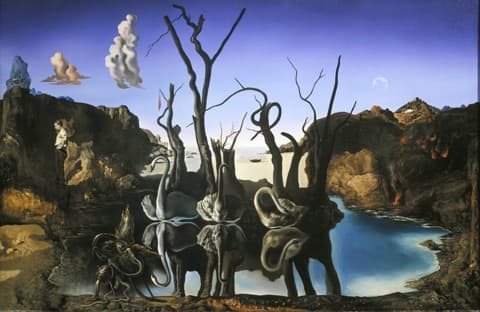
Swans Reflecting Elephants
Salvador Dalí turned three swans and their reflections into three elephants. This guide shows how the double image works and traces the painting from Edward James through Nazi looting to its present private collection.
- 1937
- Oil on canvas
About Salvador Dalí
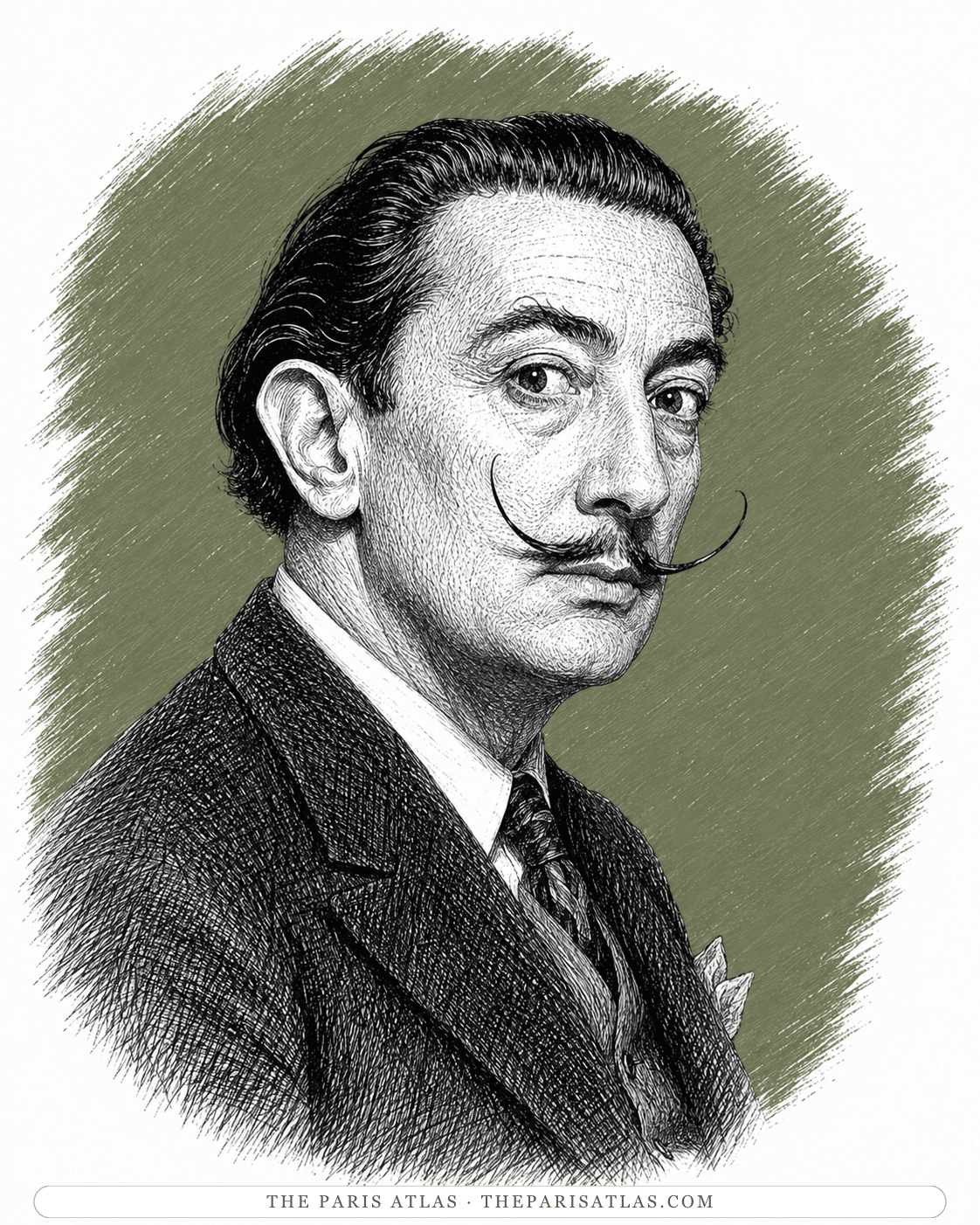
A route through Dalí's work
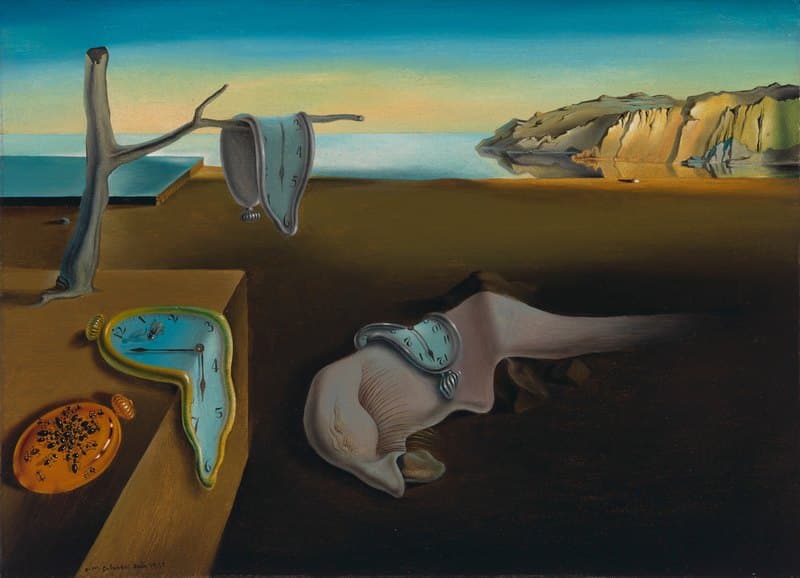
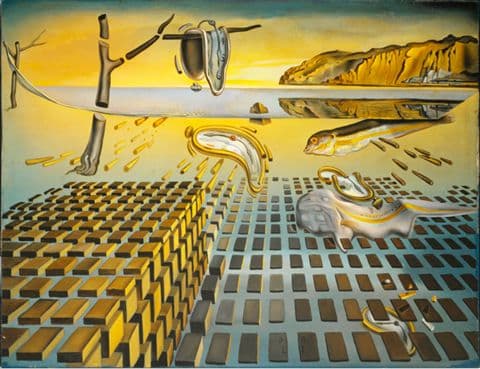
The same Catalan rocks appear in The Persistence of Memory, painted six years earlier. Comparing the two shows Dalí moving from softened objects toward a double image in which swans and trees become elephants through reflection.
What the painting shows
Three swans float on a still lake at the centre of Swans Reflecting Elephants. Bare trees rise directly behind them. Rocky banks close the water on both sides, low mountains cross the horizon, and a small moon hangs in the blue sky at upper right.[1]
A human figure stands on the left bank. Another small reddish figure appears near the rocks on the right. They give the landscape scale, but the central event is in the water: the swans, trees, and reflections combine into a second group of animals.
How to find the elephants
Start with the three white swans. Each swan's rounded body becomes the upper part of an elephant's head. Its long curved neck continues downward in the water as an elephant's trunk. Dark gaps and highlights around the swan bodies become ears and faces.[2]
Then look at the bare trees. Their trunks and reflected forms extend around the swans and supply the elephants' upright legs and bodies. The same painted shapes therefore support two readings: birds floating across a lake and elephants standing toward the viewer.
The title gives away the transformation, but it does not make it automatic. Most viewers see the swans first because they sit in ordinary landscape space. The elephants appear only after the eye joins objects to their reflections.
Reading the picture, detail by detail
The double image in Swans Reflecting Elephants only works because Dalí got every physical detail of both readings right at the same time. The passages below reward looking at each side of the illusion separately before combining them.[3]
The three swans in the centre are painted with the anatomical accuracy Dalí used for animals throughout his career. Each swan has a rounded white body, a specific curve to its neck, and dark grey shading where the neck meets the water. They are floating on a still lake at what reads as late-afternoon light, and Dalí gave each swan a slightly different pose so the group does not become a repeating pattern.
The bare trees rising behind the swans have the pale bark and split branches of the trees around Dalí's house at Port Lligat in winter. Their trunks and branches reach up into the sky and reach down into the water in reflection. Dalí painted the trees dead — no leaves — because he needed their trunks to read as vertical elephant legs and their upper branches to read as elephant ears.
The transformation happens at the waterline. Each swan's rounded body becomes an elephant's head. Each swan's long curved neck reflected in the water becomes an elephant's trunk, hanging down. The bark and reflected branches of the trees become the folded ears and the wrinkled body of each elephant. The three swan-elephants stand facing the viewer, trunks curled — a composition Dalí had drawn in preparatory sketches before he committed to the finished painting.
The swan-neck-becoming-trunk is where the transformation is most literal. The curve of the neck above the waterline continues into a curve of trunk below it, painted as one shape rather than as two separately-drawn objects that happen to align. Dalí used a single unbroken line across the two zones so the viewer's eye reads it as continuous.
Read as a group, the three elephants stand facing the viewer with trunks curled, a composition Dalí had drawn in preparatory sketches before committing to the finished canvas. The elephants only exist in the reflected zone; the swans above them are the same object seen the other way up.
The trick is that the elephants are not painted underneath the swans. They exist because the viewer reorganises what is already on the canvas. Dalí described this in his notes as an image that a viewer had to construct — one set of paint marks, two subjects, and the switch between them happening entirely in the viewer's head.
The standing human figure on the left bank is unnamed in the Fundació catalogue. He has his back to the viewer, wears a long red-brown cloak, and appears to be watching the swans-elephants. In the painting's proportions he is small — the height of one of the trees — and Dalí seems to have added him partly to give the illusion a witness inside the picture.
A second small reddish figure stands near the rocks on the right — the same size as the figure on the left bank, and the second of Dalí's two witnesses inside the picture. Where the left-hand figure watches from the shore, the right-hand figure is closer to the rocks and looks out over the same scene.
The rocky cliffs on both sides of the lake are the same Cap de Creus formations Dalí had painted in The Persistence of Memory six years earlier. He used them repeatedly through his career; the yellow rock, the eroded shape at the top, and the way the light strikes the west face at late afternoon are all specific to the coast north of Port Lligat where he lived. The Alps of Metamorphosis of Narcissus, from the same year, do not appear here.
The small pale moon at the upper right, hanging above the mountains in a clear blue sky, is unusual for Dalí's coastal paintings from this period. Most of his Cap de Creus works are late-afternoon scenes without lunar motifs — the moon here gives the sky a second light source and marks the painting as belonging to a late hour rather than an early one.
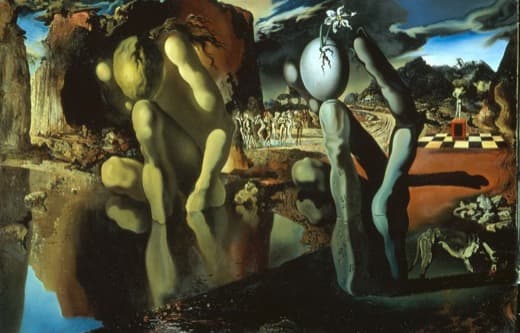
The signature at the lower left reads 'Gala Salvador Dali 1937.' Like Metamorphosis of Narcissus, painted the same year, this canvas belongs to Dalí's mid-1930s practice of signing with his wife's name joined to his own. Edward James, the English poet and Dalí's principal patron in these years, was the first owner. He liked the painting enough to name his own 1982 memoir Swans Reflecting Elephants after it.
Why this is not an ordinary mirror reflection
A normal reflection repeats the object above it. Dalí uses that expectation and then breaks it. The water does reflect the swan necks and tree trunks, but the repeated shapes also belong to a different animal with a different scale.
The elephants are not painted as a separate hidden outline. They exist because the viewer reorganizes the swans, water, and trees. If the canvas is divided into isolated details, the effect weakens; the double image depends on the whole central group.
The method behind the double image
Dalí called his approach the paranoiac-critical method. The Art Institute of Chicago summarizes it as a way of making objective forms support alternative readings, like the double images he developed during the 1930s.
The method does not require the viewer to believe a hallucination is real. It asks the painter to construct an ambiguous image precisely enough that the eye can move between two plausible subjects. Here the switch is unusually clear: swans become elephants without any part of the paint moving.
The specific connection to Pablo Picasso
Art historian Haim Finkelstein identifies a close precursor in a drawing by Pablo Picasso. Published with an essay by André Breton in Cahiers d'Art in 1935, Picasso's drawing combined a swan and its reflection into a scorpion.
Finkelstein argues that Dalí reiterated that visual idea in 1937 by changing the second animal and expanding the device into a finished landscape. This is a documented scholarly connection, not a claim that the two compositions are identical or that Picasso co-authored Dalí's painting.
Where it fits in Dalí's 1937 work
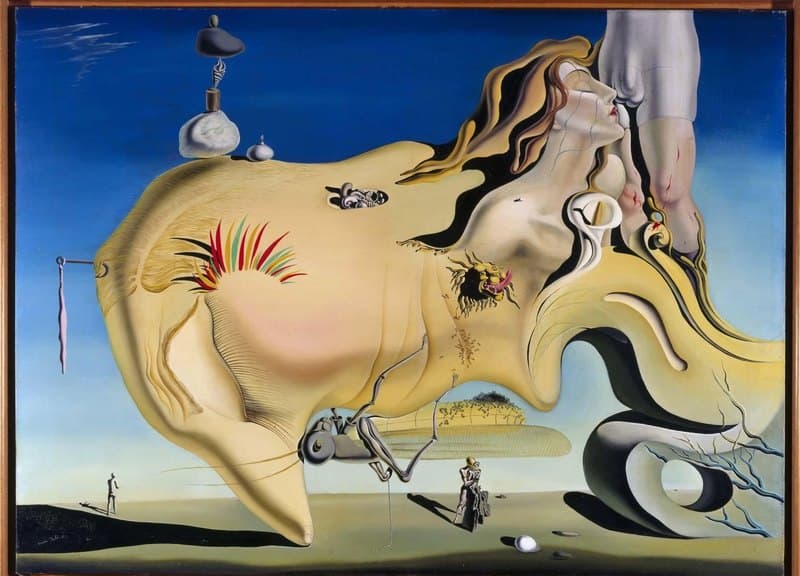
Swans Reflecting Elephants belongs to a concentrated period of double images. Fundació Gala-Salvador Dalí research lists it with The Great Paranoic, The Image Disappears, and the later Endless Enigma as examples in which one painted scene can be seen in several forms.
The Spanish Civil War was underway, and other Dalí paintings of 1936 and 1937 address violence more directly. This canvas has an uneasy rocky landscape, but its catalogue does not define it as a war allegory. Its strongest documented subject is perception itself.
Edward James was the first recorded owner
The catalogue's first provenance entry is Edward James, the English poet and collector who became Dalí's principal patron in the later 1930s. Their 1936 agreement gave James virtually everything Dalí produced through the end of 1938 in exchange for an allowance.
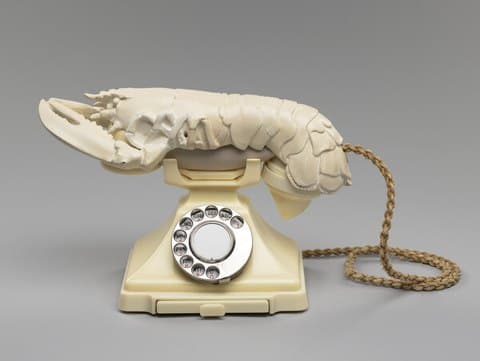
That relationship also produced objects for James's houses, including Lobster Telephone. Swans Reflecting Elephants remained important to him: he used its title for his 1982 memoir, Swans Reflecting Elephants: My Early Years.
The painting was looted during World War II
The Fundació catalogue records that the German army looted the painting during the occupation of France. From 1940 to 1944 it was stored at the Jeu de Paume museum in Paris in the room known as the Salle des Martyrs.
The French Ministry of Culture explains that this room held modern works the Nazi authorities classified as “degenerate,” often while deciding whether to destroy or exchange them. The public Dalí catalogue does not identify the exact seizure, recovery, or return route for this canvas, so those missing steps should remain missing rather than be reconstructed from other cases.[4]
From Edward James to a private collection
After Edward James, the next public provenance event is a Sotheby's London auction on 30 June 1976. The painting then belonged to Cavalieri Holding in Geneva and returned to auction at Sotheby's New York on 9 May 1995.[1]
The Fundació now lists the location only as a private collection. No current owner's name appears in the public catalogue, and the work is not on permanent public display. It has nevertheless travelled to major exhibitions, including the Centre Pompidou's Dalí retrospective in 1979–80 and the Fondation Beyeler's Surrealism in Paris in 2011–12.[1]
Its signature, size, and title
The canvas measures 51 by 77 centimetres, about 20 by 30.3 inches. Dalí signed and dated it in the lower-left corner with the joined inscription “Gala Salvador Dali 1937.” Gala Dalí's name in the signature reflects Dalí's established shared public identity with his wife and working partner; the catalogue still attributes the painting to Salvador Dalí.[1]
The common English title describes the optical device directly. The French title, Cygnes reflétant des éléphants, means the same thing. They are not separate versions of the work.
Why Swans Reflecting Elephants matters
This is one of Dalí's clearest demonstrations of a double image because a reader can learn the transformation step by step. The swan bodies become heads, the necks become trunks, and the trees help complete the elephants. The idea is complex, but the viewing task is concrete.[5]
The later history gives the page a second reason to exist. A famous optical puzzle was also an object owned by a patron, seized during the Nazi occupation, stored in the Jeu de Paume, sold twice at auction, and eventually returned to private view. Its visual and material histories belong together.[6]
Timeline
1929
Dalí joins André Breton's Surrealist group in Paris.
1931
Dalí publishes his Paranoiac Face example while developing the alternative readings he later called the paranoiac-critical method.
1935
A Picasso drawing of a swan and its reflection forming a scorpion appears with André Breton's Picasso poète in Cahiers d'Art.
1936
Edward James begins the patronage agreement under which he receives most of Dalí's production through 1938.
1937
Dalí paints Swans Reflecting Elephants and signs it “Gala Salvador Dali 1937.” Edward James is its first recorded owner.
1940–1944
The German army loots the painting in occupied France and stores it in the Jeu de Paume's Salle des Martyrs in Paris.
1973
Shown in a Salvador Dalí exhibition at the Louisiana Museum of Modern Art in Humlebæk, Denmark.
30 June 1976
Auctioned at Sotheby's in London.
1979–1980
Included in the Centre Pompidou's Salvador Dalí retrospective in Paris as catalogue number 227.
9 May 1995
Auctioned at Sotheby's in New York.
2011–2012
Loaned to the Fondation Beyeler for Surrealism in Paris. The catalogue now records a private collection.
Where to see it
Private collection
No public viewing address is listed for this private collection.
Frequently asked questions
Who painted Swans Reflecting Elephants?
Salvador Dalí painted it in 1937. The Fundació Gala-Salvador Dalí lists it as catalogue raisonné number P 454.
How do the swans turn into elephants?
The swans' rounded bodies become the elephants' heads and their long necks continue into the reflections as trunks. Bare trees and their reflected trunks help form the elephants' legs and bodies.
How many swans and elephants are in the painting?
There are three swans in the central group, and the combined swans, trees, and reflections produce three elephant forms. They are two readings of the same painted shapes, not six separately drawn animals.
What does Swans Reflecting Elephants mean?
Its clearest documented subject is unstable perception: one landscape supports two valid images. More specific claims about love, war, or the unconscious are interpretations rather than meanings fixed by the catalogue or artist.
What is Dalí's paranoiac-critical method?
It was his deliberate method for making an objective scene support alternative, irrational readings. In this painting, a viewer can move back and forth between birds on water and elephants standing in the same space.
Did Pablo Picasso inspire the painting?
Art historian Haim Finkelstein connects it to Picasso's 1935 drawing in which a swan and its reflection form a scorpion. The source supports a specific visual precedent, not co-authorship or a claim that Dalí copied the whole composition.
Who is the person on the left?
The official catalogue does not identify the small standing figure on the left bank. Names sometimes attached to the figure should therefore be treated as interpretation unless a stronger source is produced.
Was Swans Reflecting Elephants stolen by the Nazis?
Yes. The Fundació catalogue says the German army looted it during the occupation of France and stored it at the Jeu de Paume in the Salle des Martyrs from 1940 to 1944.
Who first owned Swans Reflecting Elephants?
Edward James, the English poet, collector, and major Dalí patron, is the first owner listed in the provenance. He later used the painting's title for his 1982 memoir.
Where is Swans Reflecting Elephants now?
It is in a private collection. The current owner is not named in the Fundació's public catalogue, and the painting is not on permanent public display.
How big is Swans Reflecting Elephants?
It measures 51 by 77 centimetres, approximately 20 by 30.3 inches. It is an oil painting on canvas.
Why does the signature include Gala?
Dalí signed the lower left “Gala Salvador Dali 1937,” part of his established practice of joining Gala Dalí's name to his public identity. The catalogue attributes the painting to Salvador Dalí; the signature is not evidence that Gala painted it.
More by Salvador Dalí
If you like Salvador Dalí
Explore painters from the same movements and circles.
Jean Arp
Strasbourg-born sculptor and poet — Hans in German, Jean in French, both all his life — who co-founded Dada at the Cabaret Voltaire in 1916, composed collages by dropping torn paper 'according to the laws of chance', and settled at Meudon outside Paris in a house his wife Sophie Taeuber-Arp designed.
View artist
Henri Cartier-Bresson
French photographer who turned a pocket-sized 35mm camera into an instrument of split-second composition — the idea the world knows as 'the decisive moment'. He trained as a painter, was taken prisoner in 1940 and escaped on his third try, photographed the Liberation of Paris in August 1944, co-founded the photographer-owned agency Magnum Photos in 1947, gave up reporting for drawing in the 1970s, and left Paris a foundation in the Marais that deliberately hangs no permanent display of his own pictures.
View artist
Marcel Duchamp
The century's quietest revolutionary — readymades, the abandonment of painting, chess on a Paris rooftop in Entr'acte, and one anemic film of spinning puns signed Rrose Sélavy.
View artist
In images
References
The sources below include collection records, catalogues, scholarly research, and primary materials that informed this page. They document Swans Reflecting Elephants, its making, and its place in cultural history.

2↑Imaginary Portrait of Lautréamont at the Age of Nineteen Obtained According to the Paranoiac-Critical Method
WebsiteArt Institute of ChicagoUsed forWeb source consulted for documented facts and historical context presented on the Swans Reflecting Elephants page.

3↑Shifting Identities: Dalí Looks to Picasso c. 1935–36
PeriodicalAvant-garde Studies, The Dalí Museum, 2015Used forContemporary reporting or criticism used to document the historical reception and context of Swans Reflecting Elephants.
4↑Vue 1 de la salle 15 — Salle des Martyrs, Jeu de Paume
ArchiveFrench Ministry of Culture, POP / Rose Valland databaseUsed forArchival evidence used to document the historical record connected to Swans Reflecting Elephants.
5↑Salvador Dalí and Science
WebsiteCentre for Dalinian Studies, Fundació Gala-Salvador Dalí, 2000Used forWeb source consulted for documented facts and historical context presented on the Swans Reflecting Elephants page.
6↑Records of the Claims Conference Relating to Nazi-Era Cultural Property
ArchiveU.S. National Archives and Records AdministrationUsed forArchival evidence used to document the historical record connected to Swans Reflecting Elephants.
7National Galleries of Scotland — Salvador Dalí and Edward James, Lobster Telephone
WebsiteUsed forWeb source consulted for documented facts and historical context presented on the Swans Reflecting Elephants page.
These references provide the documented foundation for this work's history and interpretation. Claim-level citations remain attached to the specific claims they support.
 Explore more resources