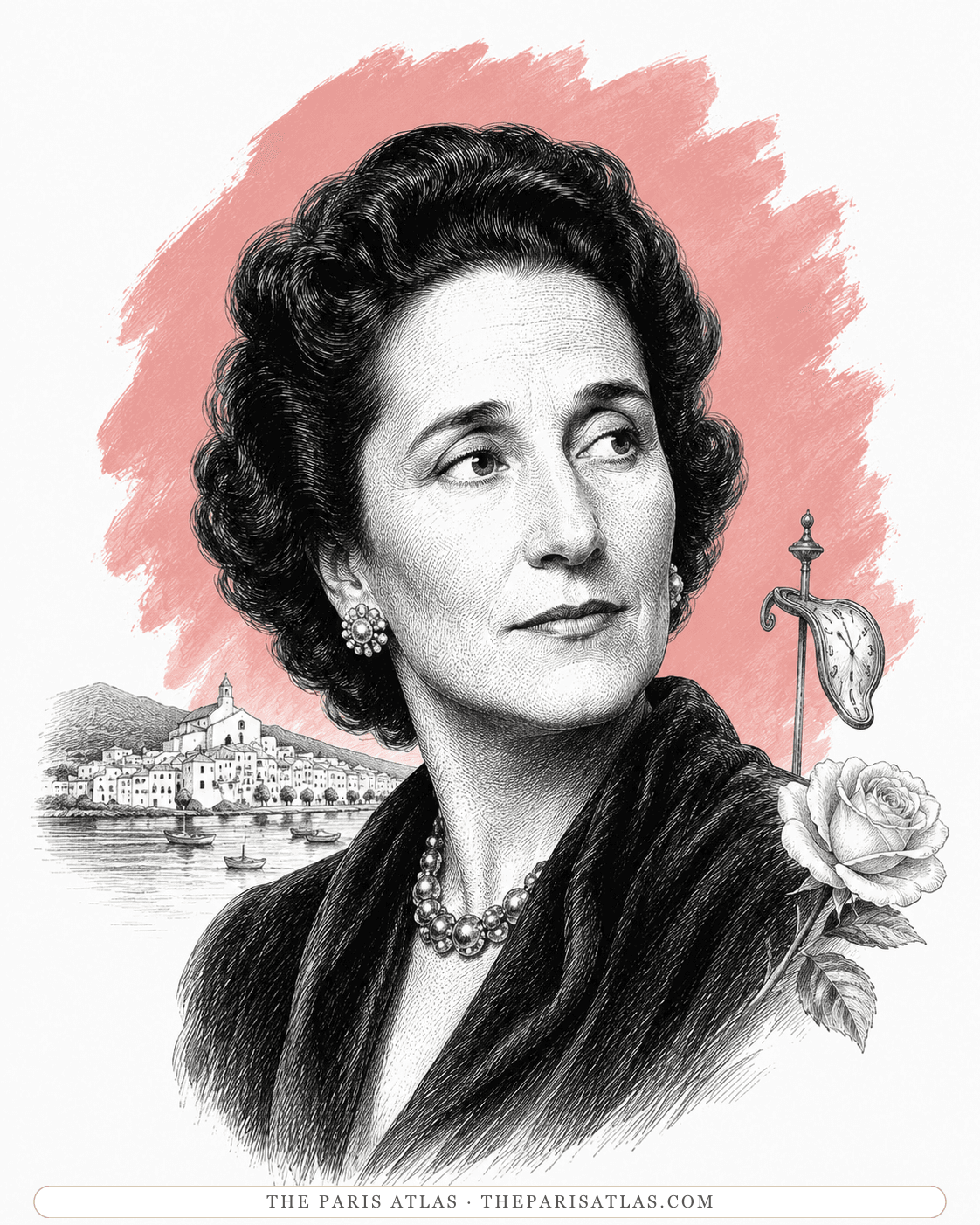
Depicts · 1945
Gala Dalí
Dalí's classical half-length portrait of Gala, titled in comparison with Raphael's La Fornarina.
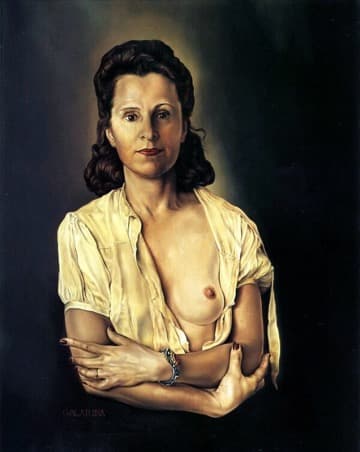
Dalí worked for six months on this 1945 portrait of Gala, recasting her through Raphael's La Fornarina and signing the canvas with both of their names.
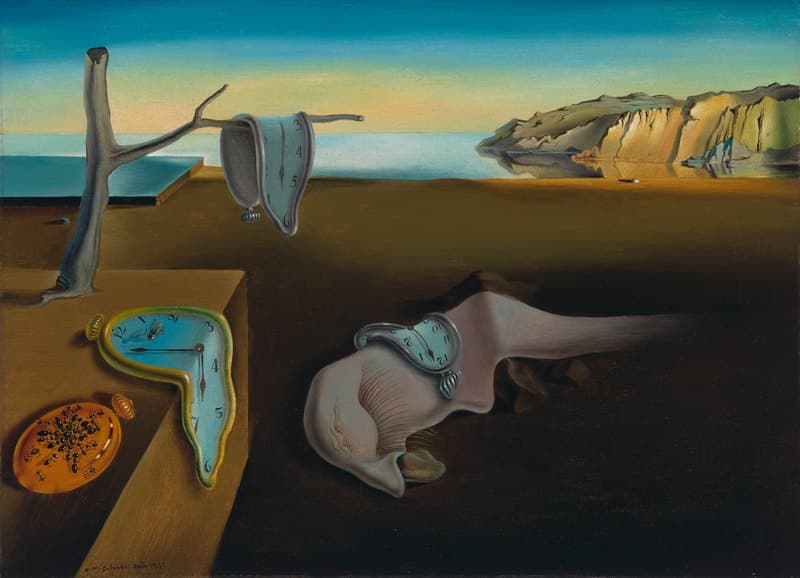
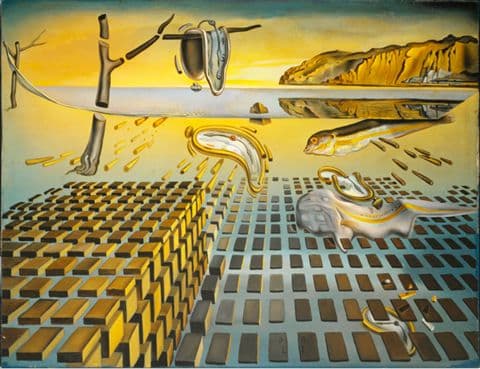
Galarina belongs to the transition between Dalí's early Surrealism and his later classicism. Start with The Persistence of Memory to see the dream imagery and precise technique from which this more traditional portrait developed.
Gala sits half-length against a dark, nearly empty ground. Her pale blouse opens across one breast, her forearms cross firmly in front of her body, and her face turns directly toward the viewer. The strong light and restricted setting keep attention on skin, fabric and the interlocking shape of her arms.[1]
Unlike Dalí's dream landscapes of the 1930s, the picture offers no swarm of symbols. Its strangeness is quieter: an exacting, frontal likeness that presents Gala with the gravity of an old-master sitter.
Dalí said he began the portrait in 1944 and completed it over six months, working three hours a day. The statement appeared in the catalogue for its first exhibition, Recent Paintings by Salvador Dalí, at the Bignou Gallery in New York from 20 November to 29 December 1945. The account was part of Dalí's public framing of a new technical seriousness. The smooth transitions of flesh, the controlled lighting and the compact composition all support his announced return to patient, classical painting after the automatic and dream-based experiments associated with Surrealism.[1][2]
Dalí said that Gala was to him what the woman known as La Fornarina had been to Raphael. He formed the title Galarina by joining Gala's name to the Renaissance portrait's familiar name.[1]
The comparison identifies Gala as an intimate sitter bound to the painter's identity and places Dalí in a lineage with Raphael. The composition does not copy La Fornarina. It uses the earlier portrait to claim seriousness and continuity for Dalí's own painting.
In the same 1945 text, Dalí offered an elaborate reading of Gala's pose. He compared her crossed arms to the weave of a basket and her breast to the crust of bread. He then contrasted the portrait with his earlier Portrait of Gala with Two Chops Balanced on Her Shoulder, which he associated with a desire to devour her.[1]
The comparison is useful because it comes from Dalí, but it remains an artist's interpretation of his own image. Visually, the arms do create a closed, basket-like structure. His explanation turns that structure into nourishment and changes Gala from an object of appetite into the person who contains it.
The lower-left signature reads “Gala Salvador Dalí 1945,” with GALARINA inscribed nearby. The catalogue records the painting as Dalí's work, so the signature is not evidence of joint authorship.[1][2]
It does show how deliberately he folded Gala into his public identity. She was the sitter and the person who managed negotiations, patrons and the business of his career. Her name on the painted surface makes that union visible without reducing her role to posing.[3][4]
Galarina was painted during the Dalís' wartime years in the United States. Its old-master reference and finish belong to the broader turn toward classicism that Dalí promoted in the 1940s. That turn redirected the precision he had used for irrational scenes toward portraiture, religious subjects and historical models. Within Gala's sequence of portraits, Galarina stands between the erotic disruptions of the early 1930s and the mythological and sacred roles of Leda Atomica and The Madonna of Portlligat.[2][4]
The painting is one of the clearest statements of the shared Dalí-Gala persona. It presents a recognizable woman, invokes Raphael, turns her body into the artist's metaphor for bread and carries both names in the signature.
It also records a transition in Dalí's art. The image keeps the psychological intensity of Surrealism while adopting the format, finish and ambition of Renaissance portraiture.
Close reading
Dalí announced this portrait as evidence of renewed classical discipline. The details show what that claim looks like in practice: controlled flesh, hard contours, and a sitter made inseparable from the act of painting her.
1.Gala's face is modeled without theatrical expression
The gaze is direct but emotionally withheld. Smooth transitions across cheek, brow, and hair replace Surrealist distortion. Dalí makes restraint itself the portrait's intensity.
2.The body is arranged as a compact classical volume
The folded arm closes the composition and turns the torso into a self-contained mass. Light moves gradually across skin instead of breaking it into symbols. The pose makes intimacy formal and guarded at once.
3.The empty ground isolates every contour
There is no room, landscape, or accessory to explain the sitter. Against the dark field, the contour of shoulder and arm carries unusual weight. Dalí uses emptiness to make patient drawing visible.
4.The crossed hands close the lower edge
The fingers lie across the opposite arm, closing the pose with a low horizontal band. Small highlights on the bracelet interrupt the gradual changes of light across the skin. The hands give the portrait a firm lower boundary while introducing a concentration of fine detail below the face.
5.The blouse gathers into narrow ridges of light
Thin ridges of light describe the blouse as it gathers over the shoulder and meets the sleeve. Beside the softly shaded upper arm, the fabric looks crisp and lightly wrinkled. Dalí distinguishes cloth from skin through these changes in edge and texture rather than through a large change of color.
6.A narrow glow separates the hair from the ground
The background lightens close to the upper contour of the hair, then darkens farther away. This restrained change gives the head space without describing a wall or room. A few brighter strands within the dark mass keep the coiffure from becoming a flat silhouette.
1944–45
Dalí spends six months painting the portrait, according to his statement for its first exhibition.
1945
Exhibited at the Bignou Gallery in New York and dated in the double signature “Gala Salvador Dalí.”
1954
Shown in Dalí's exhibition at the Sale dell'Aurora Pallavicini in Rome.
1965–66
Included in the Salvador Dalí, 1910–1965 exhibition at New York's Gallery of Modern Art.
Dalí Theatre-Museum, Figueres
Plaça Gala i Salvador Dalí 5, 17600 Figueres, Girona, Spain
Displays and loans can change. Check whether this work is on view before making a special trip.
Plan your visit on the museum’s official website (opens in a new tab)Galarina is Gala Dalí. Salvador Dalí invented the title by combining her name with La Fornarina, the familiar title of Raphael's portrait of a woman closely associated with him.
Dalí's 1945 exhibition text compared the breast to the crust of bread and the crossed arms to a bread basket. That is the artist's stated interpretation. The pose also aligns the picture with the tradition of intimate Renaissance portraiture.
He said it took six months, working three hours a day, beginning in 1944 and completing the canvas in 1945.
No evidence establishes joint authorship. The catalogue records Salvador Dalí as the painter. The unusual signature, “Gala Salvador Dalí 1945,” makes their joined public identity visible but does not change the attribution.
It belongs to Dalí's return to classicism in the 1940s. The picture retains the psychological charge of his Surrealist work while using the controlled finish and concentrated format of an old-master portrait.
The Fundació Gala-Salvador Dalí owns it, and it is associated with the Dalí Theatre-Museum in Figueres.
Depicts · 1945
Dalí's classical half-length portrait of Gala, titled in comparison with Raphael's La Fornarina.
Explore painters from the same movements and circles.
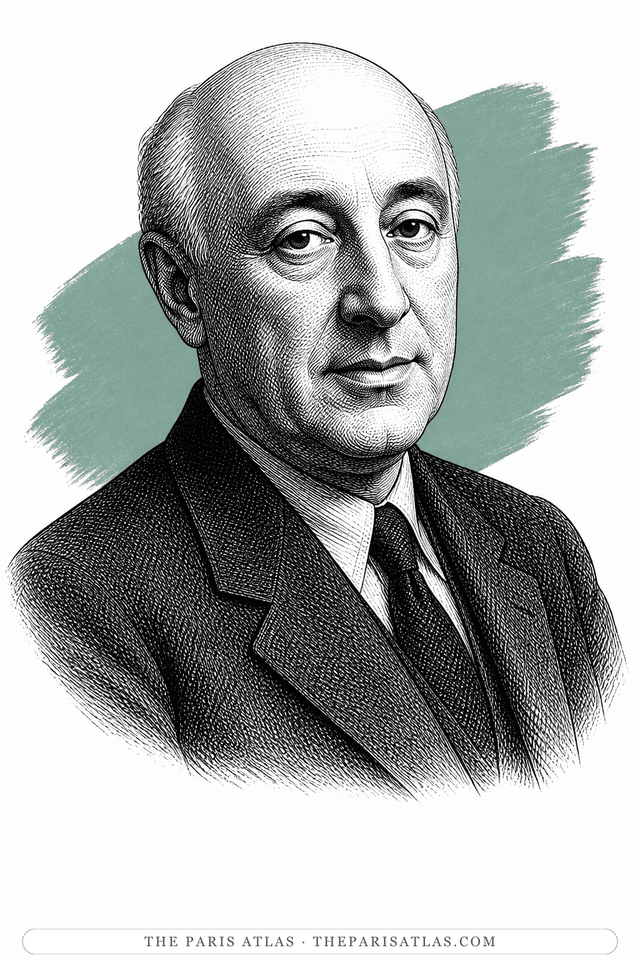
Strasbourg-born sculptor and poet — Hans in German, Jean in French, both all his life — who co-founded Dada at the Cabaret Voltaire in 1916, composed collages by dropping torn paper 'according to the laws of chance', and settled at Meudon outside Paris in a house his wife Sophie Taeuber-Arp designed.
View artist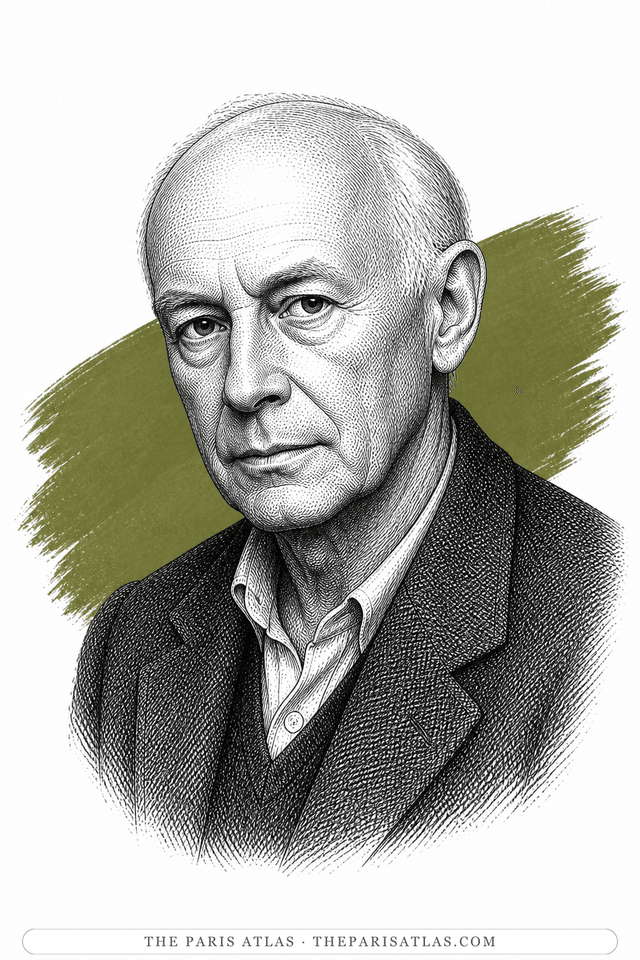
French photographer who turned a pocket-sized 35mm camera into an instrument of split-second composition — the idea the world knows as 'the decisive moment'. He trained as a painter, was taken prisoner in 1940 and escaped on his third try, photographed the Liberation of Paris in August 1944, co-founded the photographer-owned agency Magnum Photos in 1947, gave up reporting for drawing in the 1970s, and left Paris a foundation in the Marais that deliberately hangs no permanent display of his own pictures.
View artist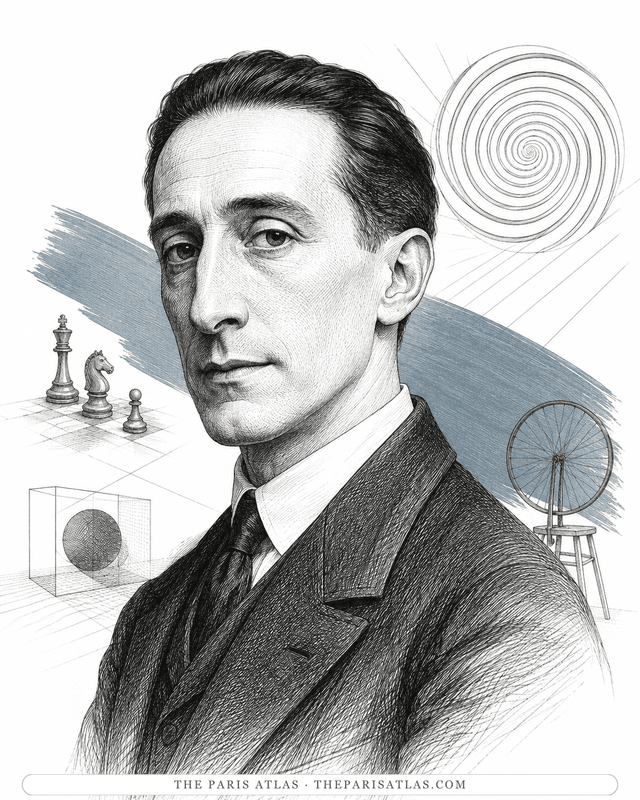
The century's quietest revolutionary — readymades, the abandonment of painting, chess on a Paris rooftop in Entr'acte, and one anemic film of spinning puns signed Rrose Sélavy.
View artistThe sources below include collection records, catalogues, scholarly research, and primary materials that informed this page. They document Galarina, its making, and its place in cultural history.


Web source consulted for documented facts and historical context presented on the Galarina page.
These references provide the documented foundation for this work's history and interpretation. Claim-level citations remain attached to the specific claims they support.
 Explore more resources