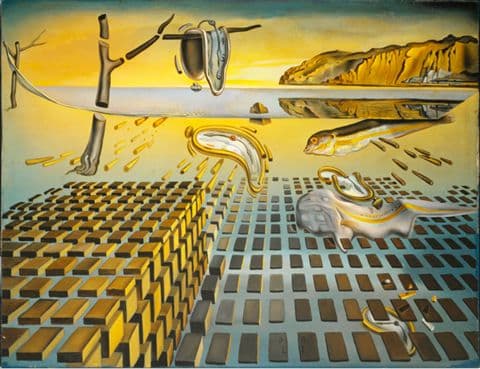
The Disintegration of the Persistence of Memory
Salvador Dalí returned to his 1931 melting-watches painting and rebuilt it for the atomic age. The same coastline, tree, watches, and soft face now break apart across water and a grid of floating blocks.
- 1952–1954
- Oil on canvas
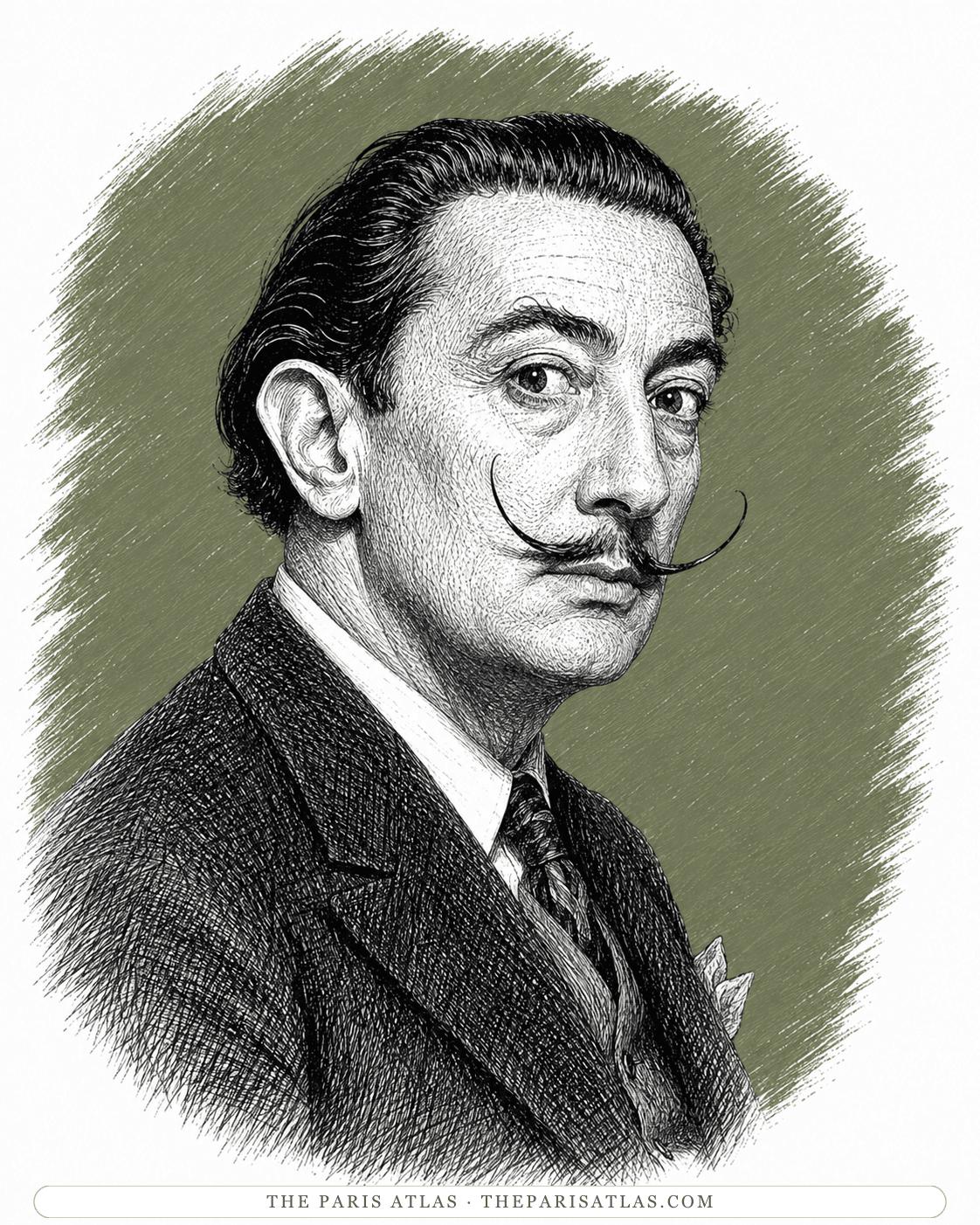
About Salvador Dalí
What the painting shows
The Disintegration of the Persistence of Memory is a small landscape divided by a straight waterline. Above it are the yellow cliffs of the Catalan coast, a bare tree, and a soft watch hanging in the air. Below it, more watches, the familiar soft profile, a fish, and dozens of rectangular blocks appear suspended in clear water.
The blocks form a grid that recedes toward the horizon. On the left they gather into a dense stack. On the right there are larger gaps between them. Thin horn-shaped fragments and other small forms float between the watches. Nothing rests securely on the ground because the earlier ground has become an ordered field of separate units.
How it changes the 1931 painting
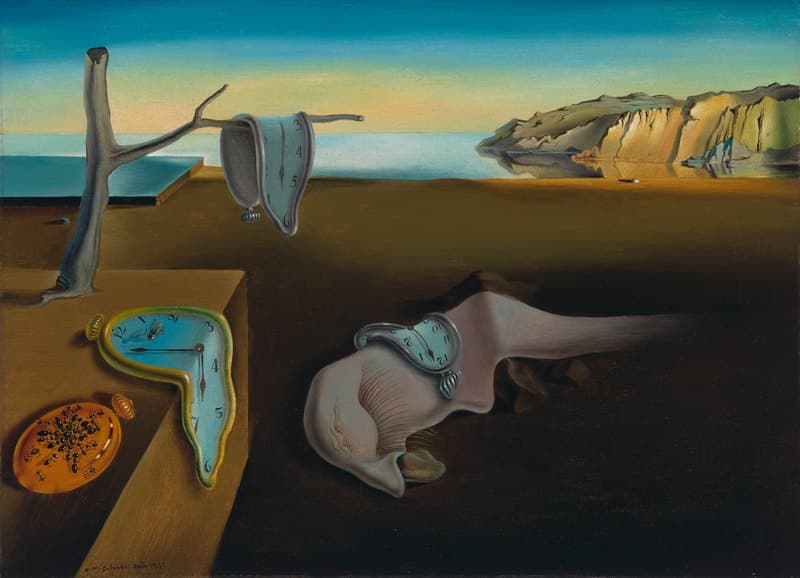
Dalí did not make a loose variation. He reused the main structure of The Persistence of Memory: the cliffs remain at upper right, the dead tree remains at left, and the soft watches and sleeping profile return. Even the width is the same 33 centimetres. The later canvas is only 1.3 centimetres taller.
The major change is that the solid scene has opened. The wooden block from 1931 has become many rectangular units. The tree is cut by the waterline. Watches separate from their supports, and one begins to break into curved pieces. The second painting asks what happens when a famous image is treated as matter that can be divided.
Why Dalí returned to it twenty years later
Between the two paintings, Dalí's public interests changed. The first canvas belonged to his early Surrealist work. After the atomic bombings of Hiroshima and Nagasaki in 1945, he began speaking repeatedly about atoms, nuclear physics, the discontinuity of matter, religion, and classical painting.
The Fundació Gala-Salvador Dalí describes this later program as nuclear mysticism. Dalí wanted to combine modern scientific ideas with religious and metaphysical claims. Returning to his best-known early image allowed him to show that change directly: the old dream landscape survives, but its material world no longer looks continuous.
Reading the picture, detail by detail
The Disintegration is the same width as the 1931 canvas and only 1.3 centimetres taller. The passages below are worth looking at closely, and each one changes in meaning when read against the same detail in the 1931 painting.
The dead tree at the left is the same Port Lligat olive from the 1931 painting, but the waterline cuts across its trunk. Above the line the tree is solid and bark-covered. Below the line the tree becomes a hollow silhouette with light passing through it, painted as if the trunk had lost its interior when it went underwater.
The waterline itself is a hard horizontal line across the middle of the picture. Above it, ordinary perspective holds — the sky, the cliffs, the tree above the cut. Below it, objects float without stable weight, and each element above the line is answered by its inverted reflection or its underwater counterpart. Dalí made the boundary between the two worlds a single painted edge.
The Cap de Creus cliffs above the waterline are the same yellow rock formation Dalí had painted in the 1931 canvas — the coastline he could see from his house at Port Lligat. In the Disintegration, the cliffs are the picture's most stable element: solid rock, unchanged, while everything else in the painting has come apart.
There are four watches in the picture. The watch hanging in the air above the waterline is intact — case, face, numerals, hands. The three below the water have begun to come apart. One is separating along a curved fracture into two horn-shaped pieces. Another is thinning into ribbons. A third has broken entirely and its parts float at different depths. The four watches are arranged in a sequence from whole to dissolved, so the viewer sees the same object at four stages of disintegration in one picture.
The soft profile from the 1931 painting is still there, still asleep, still with its eye closed and one long lash. It is now underwater. Its outline is thinner than in 1931: in the earlier canvas the face was a heavy grey mass on dry ground, and here it is barely more solid than the water around it. Dalí kept the profile recognisable and reduced its physical substance at the same time.
The grid of rectangular blocks at the lower half is the most invented part of the picture. Each block is painted in perspective — smaller as it recedes toward the horizon — and lit from the same direction as everything else, so the blocks read as physical objects even though they hang suspended in water. On the left they cluster tight together. Dalí described the blocks as an image of discontinuous matter — the visual equivalent of what physicists meant by atoms — while painting them with the strict perspective rules of an academic still life.
On the right side of the underwater zone, the same grid opens into wider gaps. Clear water shows between and behind the suspended blocks, so the eye can read the grid as three-dimensional rather than as a flat pattern. The looser spacing on the right and the tighter stacking on the left give the picture its sense of matter breaking apart in stages across the frame.
The horn-shaped fragments — small, curved, off-white or bone-coloured — appear near the disintegrating watches and near the soft profile. The catalogue raisonné calls them rhinoceros-horn forms; the rhinoceros-horn shape had become one of Dalí's fixations after 1950, and he associated it with the mathematical logarithmic spiral he claimed to see in Vermeer's Lacemaker. In the Disintegration, the horns are the visible edge of the disintegration process, the shape watches take as they come apart.
The fish swimming near the upper right cliff is the specific object Dalí's 1954 long title names — The Chromosome of a Highly-Colored Fish's Eye Starting the Harmonious Disintegration of the Persistence of Memory. Dalí painted the fish with the same precision as the watches, at a scale small enough that many viewers miss it. He gave it a long formal title so the viewer would notice it and read the picture as beginning at the fish's eye.
What “corpuscular” means here
The painting's first short title was Persistance de la mémoire corpusculaire, or The Corpuscular Persistence of Memory. Corpuscular means made from particles or small separate bodies. The grid of blocks gives that idea a visible form.
The blocks should not be read as a scientifically accurate diagram of atoms. Dalí borrowed the language and implications of modern physics, then invented his own pictorial system. The painting turns discontinuous matter into an image a viewer can see, not a model a physicist could use.
Why the waterline matters
A hard horizontal line separates air from water. Above it, the cliffs still look solid and the sky follows ordinary perspective. Below it, objects float without stable weight. The tree crosses both zones, making the division especially clear.
Water also changes how the repeated scene works. The 1931 canvas presents one dry shelf of ground beside a calm bay. The later painting extends the bay through the picture so that the viewer seems to look into a submerged version of the earlier world.
The fish and Dalí's much longer title
A fish swims below the cliffs near the upper right. It is not incidental. When the painting was shown at Carstairs Gallery in 1954, Dalí gave it the long title The Chromosome of a Highly-Colored Fish's Eye Starting the Harmonious Disintegration of the Persistence of Memory.
The title links the fish's eye and a chromosome to the scene's breakup, but the canvas does not label a specific chromosome or present a literal biological process. It is another example of Dalí joining scientific vocabulary to an image whose logic is poetic rather than technical.
Why the painting has several titles
The 1952–53 Carstairs catalogue used the French title Persistance de la mémoire corpusculaire. The 1954 catalogue used the much longer English title and printed Dalí's invented word “distintegration.” The Fundació's catalogue corrects that spelling to “disintegration.”
The Disintegration of the Persistence of Memory is now the common English title. The Corpuscular Persistence of Memory remains the catalogue's main translated title. They refer to the same painting, not two different sequels.
What the painting means
The safest meaning begins with the comparison. A remembered image persists: viewers can still recognize the landscape and watches. At the same time, its physical structure comes apart. Persistence and disintegration happen together.[1]
William Jeffett, a scholar at The Dalí Museum, also places the soft watches within the older still-life tradition of the memento mori, an object that reminds viewers of time and death. The later atomic setting does not erase that meaning. It gives the same unstable watches a new material world.[1]
Its size and current location
The canvas measures 25.4 by 33 centimetres, or 10 by 13 inches. Like the 1931 painting, it is much smaller than most reproductions suggest. The dense grid therefore depends on very controlled, miniature-scale painting.[2]
The work belongs to The Dalí Museum in St. Petersburg, Florida. The earlier Persistence of Memory belongs to the Museum of Modern Art in New York, so the two paintings are not normally displayed together.[1]
From Carstairs Gallery to The Dalí Museum
The painting appeared in Dalí's First Mystico-Nuclear Paintings exhibition at Carstairs Gallery in New York in December 1952 and January 1953, then returned to the same gallery's 1954 exhibition under the longer fish-and-chromosome title.[2]
The catalogue raisonné records Carstairs Gallery and then A. Reynolds and Eleanor Reese Morse in its provenance. The Morses built the collection that became The Dalí Museum. Later loans included major Dalí exhibitions in Venice, Tokyo, Melbourne, and St. Petersburg.[2]
Why The Disintegration of the Persistence of Memory matters
The painting is a rare case in which an artist revisits a world-famous work and makes the comparison part of the subject. Dalí does not simply add more melting watches. He asks whether an image can remain recognizable after its apparent matter has been divided into separate pieces.
It also gives a direct way into nuclear mysticism. The term can sound obscure when presented as a theory. Here its basic operation is visible: an early Surrealist scene is retained, submerged, fragmented, and rebuilt through the scientific language Dalí adopted after 1945.[3]
Timeline
1931
Dalí paints The Persistence of Memory, the small melting-watches scene that the later canvas reworks.
6 August 1945
The atomic bombing of Hiroshima makes a lasting impression on Dalí; he later dates the start of his sustained atomic interests to this event.
1951
Dalí publishes his Mystical Manifesto, setting out the combination of modern physics, religious mysticism, and classical painting that he called nuclear mysticism.
1952–1954
Dalí paints The Disintegration of the Persistence of Memory and signs it at the lower centre.
December 1952–January 1953
Carstairs Gallery in New York lists it as The Corpuscular Persistence of Memory in an exhibition of Dalí's first mystico-nuclear paintings.
December 1954–January 1955
Carstairs exhibits it again under the long title about a fish's eye, a chromosome, and the disintegration of memory.
2009
Loaned to the National Gallery of Victoria in Melbourne for Salvador Dalí: Liquid Desire.
Where to see it
The Dalí Museum, St. Petersburg, Florida
One Dalí Boulevard, St. Petersburg, FL 33701, United States
Displays and loans can change. Check whether this work is on view before making a special trip.
Plan your visit on the museum’s official website (opens in a new tab)Frequently asked questions
What is The Disintegration of the Persistence of Memory?
It is Salvador Dalí's 1952–54 reworking of his 1931 melting-watches painting. The same coastline, tree, watches, and soft profile return, but the scene is divided by water and broken into a grid of separate blocks.
What is the difference between the two Persistence of Memory paintings?
The 1931 painting presents soft watches on a dry coastal shelf. The 1952–54 version submerges much of that scene, suspends the watches and profile, and replaces solid ground with a receding grid of blocks. They have the same width, but belong to different phases of Dalí's career.
Why did Dalí repaint The Persistence of Memory?
He used the familiar scene to show how his thinking had changed after 1945. The early Surrealist dream is rebuilt through his later interest in atoms, discontinuous matter, religion, and what he called nuclear mysticism.
What does The Disintegration of the Persistence of Memory mean?
The remembered image persists even as its physical structure breaks apart. The painting holds recognition and disintegration together: the viewer still sees the famous watches and coast, but they now occupy a divided, particle-like world.
Is the painting about the atomic bomb?
The atomic bombings were an important catalyst for Dalí's postwar atomic interests, and The Dalí Museum connects this painting's fragmentation to that changed world. The canvas is not a literal picture of a bombing; it uses disintegrating matter as its visual subject.
Is the grid a scientifically accurate picture of atoms?
No. Dalí borrowed the language of particles and modern physics, but the rectangular blocks are his visual metaphor for discontinuous matter, not an accurate atomic model.
Why is there a fish in the painting?
Dalí's long 1954 title says that the chromosome of a brightly colored fish's eye begins the scene's harmonious disintegration. The fish supports that title, but the image does not diagram a real chromosome or biological process.
Why does the painting have different titles?
It was first catalogued in French as Persistance de la mémoire corpusculaire, then shown under a much longer English title. The Disintegration of the Persistence of Memory became the common English name. All three titles refer to the same canvas.
How big is The Disintegration of the Persistence of Memory?
It measures 25.4 by 33 centimetres, or 10 by 13 inches. It has the same 33-centimetre width as the 1931 Persistence of Memory and is only 1.3 centimetres taller.
Where is The Disintegration of the Persistence of Memory?
It belongs to The Dalí Museum in St. Petersburg, Florida. The original 1931 Persistence of Memory is at the Museum of Modern Art in New York.
More by Salvador Dalí










If you like Salvador Dalí
Explore painters from the same movements and circles.

Jean Arp
Strasbourg-born sculptor and poet — Hans in German, Jean in French, both all his life — who co-founded Dada at the Cabaret Voltaire in 1916, composed collages by dropping torn paper 'according to the laws of chance', and settled at Meudon outside Paris in a house his wife Sophie Taeuber-Arp designed.
View artist
Henri Cartier-Bresson
French photographer who turned a pocket-sized 35mm camera into an instrument of split-second composition — the idea the world knows as 'the decisive moment'. He trained as a painter, was taken prisoner in 1940 and escaped on his third try, photographed the Liberation of Paris in August 1944, co-founded the photographer-owned agency Magnum Photos in 1947, gave up reporting for drawing in the 1970s, and left Paris a foundation in the Marais that deliberately hangs no permanent display of his own pictures.
View artist
Marcel Duchamp
The century's quietest revolutionary — readymades, the abandonment of painting, chess on a Paris rooftop in Entr'acte, and one anemic film of spinning puns signed Rrose Sélavy.
View artist
In images
References
The sources below include collection records, catalogues, scholarly research, and primary materials that informed this page. They document The Disintegration of the Persistence of Memory, its making, and its place in cultural history.


3↑Salvador Dalí and Science
WebsiteCentre for Dalinian Studies, Fundació Gala-Salvador Dalí, 2000Used forWeb source consulted for documented facts and historical context presented on the The Disintegration of the Persistence of Memory page.

4Salvador Dalí and the Spanish Baroque: From Still Life to Velázquez
EssaysThe Dalí Museum, Avant-garde Studies, 2007Used forPublished analysis and historical context used in preparing the The Disintegration of the Persistence of Memory page.
These references provide the documented foundation for this work's history and interpretation. Claim-level citations remain attached to the specific claims they support.
 Explore more resources