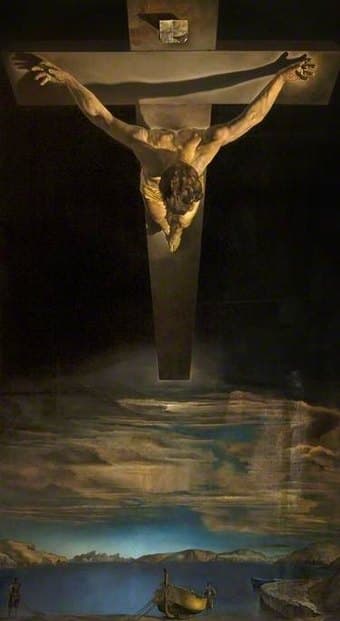
Christ of Saint John of the Cross
Dalí's 1951 crucifixion seen simultaneously from above and across the bay of Port Lligat. The uninjured body, modeled by stuntman Russell Saunders, joins Catholic subject matter to the atomic geometry Dalí called nuclear mysticism.
- 1951
- Oil on canvas
About Salvador Dalí
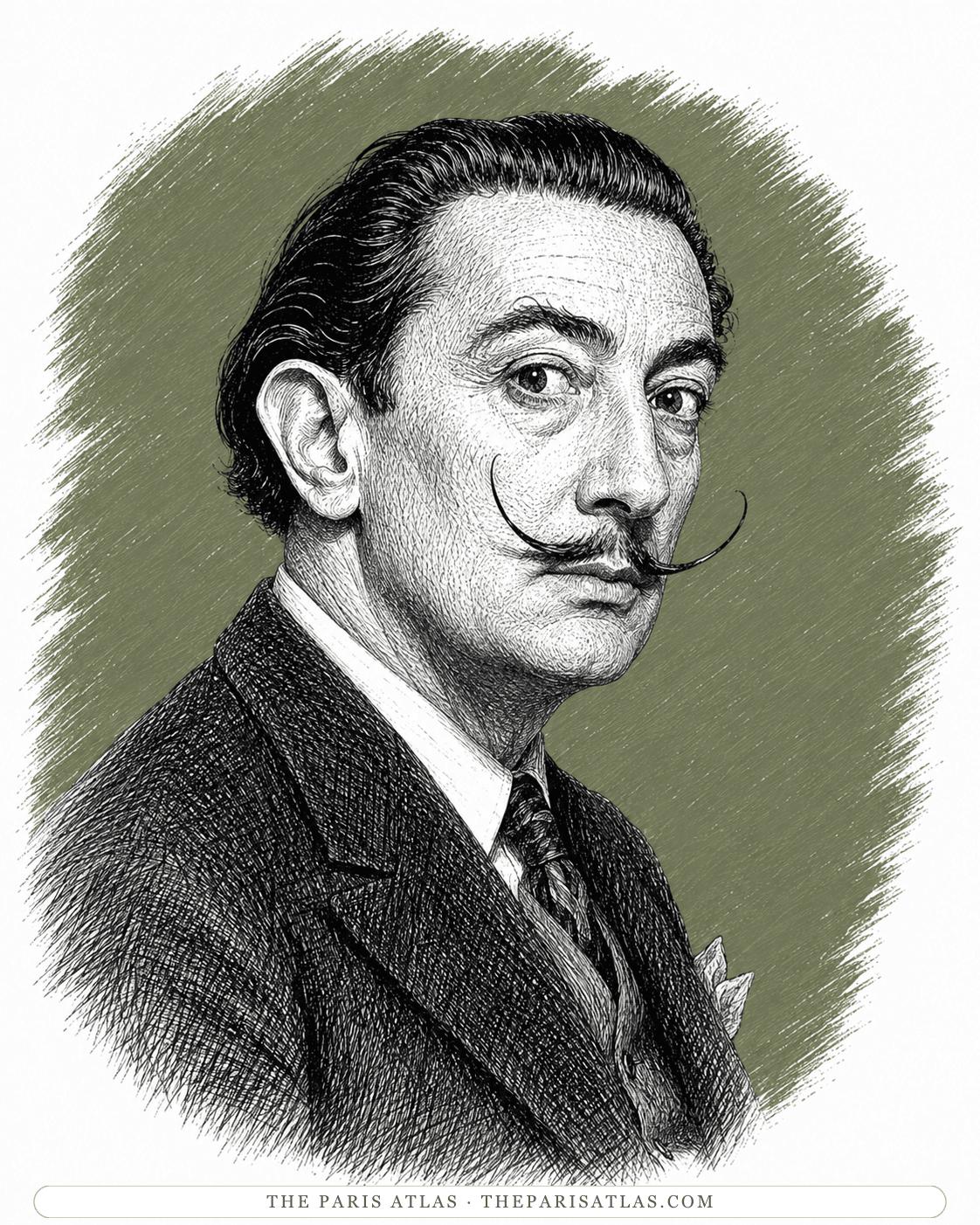
A route through Dalí's work
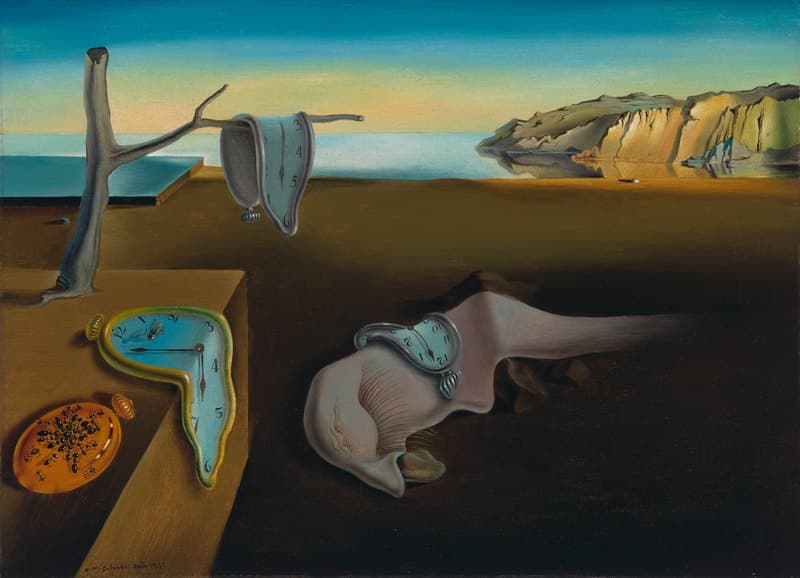
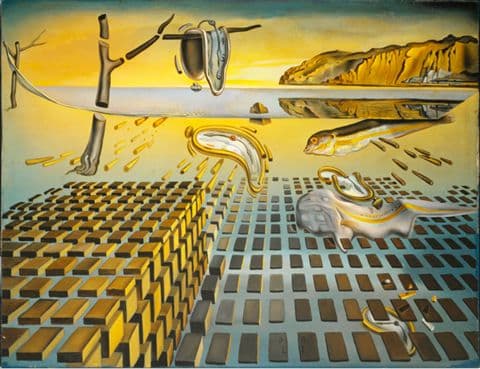
To see the early Surrealist image from which most viewers know Dalí, begin with The Persistence of Memory. Comparing its small dream landscape with this monumental religious canvas shows how radically his subjects and scale changed after the 1930s.
What the painting shows
The cross hangs against a black upper field and tilts forward so the viewer looks down on Christ's bowed head and shoulders. At the same time, the lower half opens horizontally across still water, boats, fishermen, and low hills. The painting therefore combines two incompatible viewpoints within one continuous image.
The body is unmarked. There are no nails, blood, crown of thorns, or wound in the side. Far below is the harbor at Port Lligat, where Salvador Dalí and Gala lived after returning from the United States.[1]
Why there are no nails
Dalí gave more than one dream account of the painting. In Glasgow Museums' summary, he first imagined blood and wounds translated into red carnations and white jasmine. A second dream removed the traditional signs of suffering altogether. He wanted the body to appear perfect and divine.[1]
The result changes the emotional register of the crucifixion. Physical agony is suppressed in favor of suspension, distance, and controlled form. Whether that produces spiritual clarity or aestheticizes suffering is part of the painting's continuing critical tension.
The drawing behind the viewpoint
The downward angle derives from a small crucifixion drawing by the sixteenth-century Carmelite mystic Saint John of the Cross. Dalí did not copy its rough execution, but he adopted its radical aerial position and expanded it into a carefully modeled figure over a real landscape.[1]
The title names that source. It does not mean Saint John is represented in the painting. Dalí used the earlier drawing as a compositional authority for a modern religious image.
The body was modeled by Russell Saunders
Christ's body was modeled by Russell Saunders, a Hollywood stunt performer and body double who had worked in more than one hundred films. Saunders posed while suspended from the ceiling for $35 a day.[1]
The practical setup helps explain the foreshortening across the shoulders and back. A religious vision was built through close observation of an athletic body under unusual physical conditions.
Port Lligat and the figures below
The harbor is recognizable as Port Lligat, but the fishermen are not simply painted from daily life. Glasgow Museums identifies their sources in works by Louis Le Nain and Diego Velázquez. Dalí joined a contemporary Catalan setting to quotations from seventeenth-century painting.[1]
That combination was typical of his later classicism. Old-master models, precise illusion, and a personal landscape were used to construct a modern Catholic image rather than to recreate a historical event.
Christ as the nucleus
Dalí made the painting while formulating nuclear mysticism, his attempt to connect Catholic belief with the new physics that followed the atomic age. In a preparatory sketch, a triangle organizes Christ's body and a circle occupies the head. Dalí wrote that a 1950 “cosmic dream” made the figure represent the nucleus of the atom and then the unity of the universe.[1][2]
The science is symbolic rather than explanatory. Atomic theory does not prove the religious claim, and the image is not a scientific diagram. Its importance lies in Dalí's effort to make geometry and modern physics serve a traditional sacred subject.
How Glasgow came to own it, copyright and all
Tom Honeyman, director of Glasgow Museums, saw the painting in London and negotiated the price down from £12,000 to £8,200. The acquisition drew a protest and petition from critics of the expense. Funds left from the 1901 Glasgow International Exhibition paid for it.[1]
The price included copyright, which is why Glasgow Museums, rather than the Dalí estate, controls reproduction rights to the painting. It went on display at Kelvingrove on 5 June 1952.[1]
Why the painting matters
Christ of Saint John of the Cross is one of the clearest statements of Dalí's later program. It combines a mystic's drawing, a Hollywood model, old-master references, a personal landscape, and atomic symbolism in an image that remains immediately legible as a crucifixion.
Its public history is equally important. The purchase was controversial, the canvas was attacked and restored in 1961, and in 2005 it was voted Scotland's favorite painting. Those changes in reception show how a disputed contemporary acquisition can become part of a city's cultural identity.[1]
Close reading
Reading the work, detail by detail
Dalí makes a familiar Crucifixion strange by moving the viewer above it. The close views show how the painting links an impossible aerial body to an insistently local Catalan shore.
1.The body is seen from a viewpoint no witness could occupy
The head hides the face and the shoulders widen toward the crossbar. Without wounds, nails, or frontal expression, the body becomes a powerful foreshortened structure. Devotion is redirected from suffering to suspended form.
2.The cross hangs without visible support
The cross does not stand on Golgotha; it projects over darkness like an object in space. Dalí isolates its hard geometry so completely that it reads as both religious emblem and engineered construction.
3.The sacred event opens onto Port Lligat
Below the cosmic black field is a calm, specific shore with boat and figures. Their small scale makes the cross immense, while the familiar bay brings the vision back into Dalí's lived geography.
4.The hands spread toward the ends of the crossbar
The arms spread across the wide crossbar, with the hands close to its outer ends. Light picks out the flesh against the flatter brown wood. From this raised viewpoint, the shoulders and arms form a broad span above the sharply narrowing body, making the foreshortening immediately legible.
5.The boat makes the lower world habitable
The boat, shore, and small figures occupy a narrow band at the bottom. Their low position and ordinary scale give the viewer a foothold beneath the cross. A clear blue passage of water separates the distant hills from the foreground, restoring a readable landscape after the great darkness above.
6.The body casts a second shape across the wood
A dark curve sweeps across the wood behind the arms. It follows the body's projection into space while remaining flatter and less detailed than the illuminated flesh. The shadow gives the view from above a convincing material relationship: body and timber occupy different distances from the light.
Timeline
1951
Dalí painted the aerial crucifixion over the bay of Port Lligat, its downward composition based on a drawing by the sixteenth-century mystic Saint John of the Cross.
1952
Glasgow bought the painting and its copyright for £8,200 after the price was reduced from £12,000. It went on display at Kelvingrove on 5 June.
1961
A gallery visitor attacked and tore the canvas. It was restored and returned to view.
2005
Voted Scotland's favorite painting in a public poll.
Where to see it
Kelvingrove Art Gallery and Museum, Glasgow
Argyle Street, Glasgow G3 8AG, United Kingdom
Displays and loans can change. Check whether this work is on view before making a special trip.
Plan your visit on the museum’s official website (opens in a new tab)Frequently asked questions
What is Christ of Saint John of the Cross?
A 1951 painting by Salvador Dalí of the crucifixion seen from above, with an unmarked body and no nails, blood or crown of thorns, hanging over the bay of Port Lligat. It is at Kelvingrove Art Gallery and Museum in Glasgow.
Why are there no nails or blood?
Dalí described a sequence of dreams. An early idea translated wounds into flowers. A later vision removed nails, blood, thorns, and wounds. He chose an intact, idealized body rather than a physically tortured one.
Why is it named after Saint John of the Cross?
The unusual downward viewpoint follows a small drawing of the crucifixion by the sixteenth-century Spanish mystic Saint John of the Cross. The title refers to that source, not to a portrait of the saint.
What is the water beneath the cross?
The bay of Port Lligat, on the Catalan coast, where Dalí lived. He placed his own harbour, with a boat and fishermen, under the crucifixion.
Who modeled the body of Christ?
Russell Saunders, a Hollywood stunt performer and body double. He posed while suspended from the ceiling for $35 a day, giving Dalí a real body to study from the unusual overhead angle.
How does the painting fit nuclear mysticism?
Dalí treated Christ as a symbolic nucleus and used geometric planning to join Catholic belief with the language of atomic science. It is a religious interpretation of modern physics, not a scientific demonstration.
Why does Glasgow own the copyright?
When Glasgow bought the painting in 1952, for £8,200, the purchase included the copyright. Reproduction rights are therefore held by Glasgow Museums rather than by the Dalí estate — an unusual arrangement.
Where is it now?
Kelvingrove Art Gallery and Museum, Glasgow, where it has hung since 1952.
More by Salvador Dalí
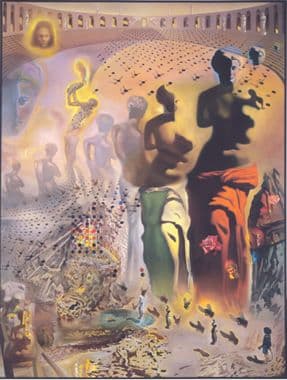
If you like Salvador Dalí
Explore painters from the same movements and circles.
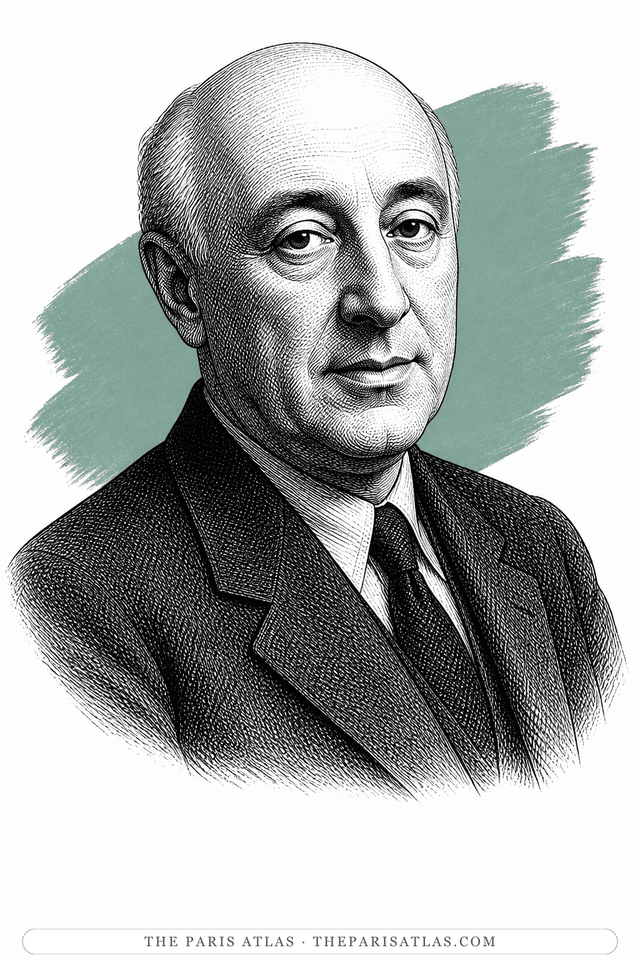
Jean Arp
Strasbourg-born sculptor and poet — Hans in German, Jean in French, both all his life — who co-founded Dada at the Cabaret Voltaire in 1916, composed collages by dropping torn paper 'according to the laws of chance', and settled at Meudon outside Paris in a house his wife Sophie Taeuber-Arp designed.
View artist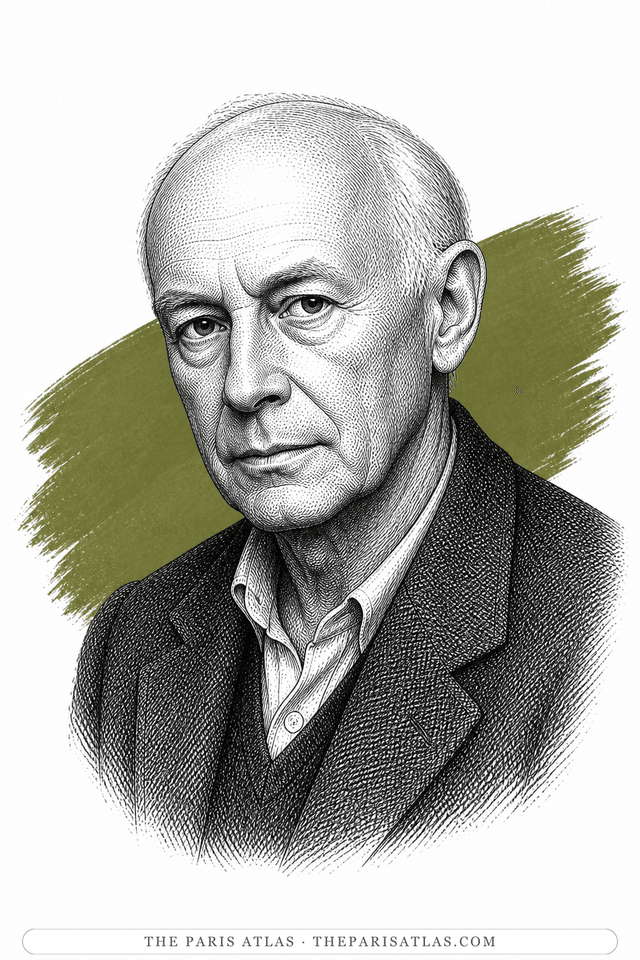
Henri Cartier-Bresson
French photographer who turned a pocket-sized 35mm camera into an instrument of split-second composition — the idea the world knows as 'the decisive moment'. He trained as a painter, was taken prisoner in 1940 and escaped on his third try, photographed the Liberation of Paris in August 1944, co-founded the photographer-owned agency Magnum Photos in 1947, gave up reporting for drawing in the 1970s, and left Paris a foundation in the Marais that deliberately hangs no permanent display of his own pictures.
View artist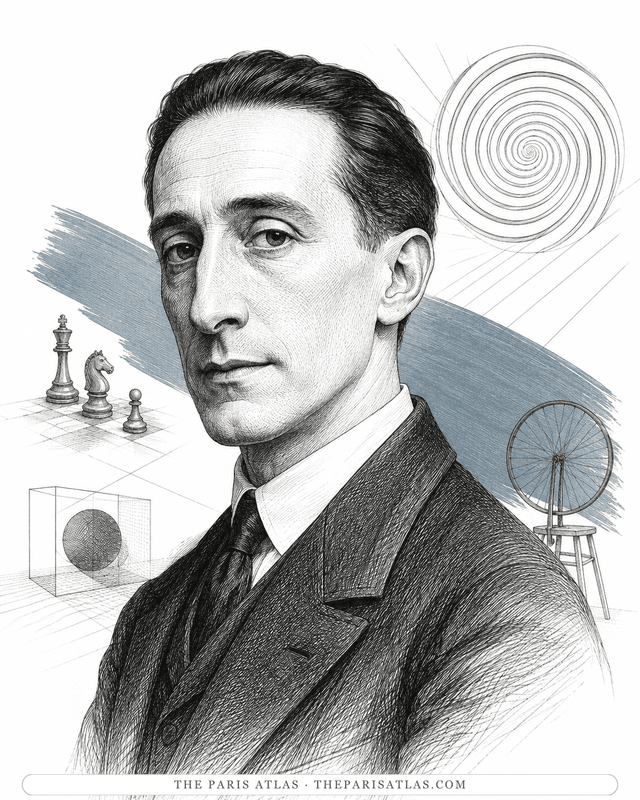
Marcel Duchamp
The century's quietest revolutionary — readymades, the abandonment of painting, chess on a Paris rooftop in Entr'acte, and one anemic film of spinning puns signed Rrose Sélavy.
View artist
References
The sources below include collection records, catalogues, scholarly research, and primary materials that informed this page. They document Christ of Saint John of the Cross, its making, and its place in cultural history.


2↑Fundació Gala-Salvador Dalí — catalogue raisonné of paintings
WebsiteUsed forWeb source consulted for documented facts and historical context presented on the Christ of Saint John of the Cross page.
3Salvador Dalí
WebsiteArt Institute of ChicagoUsed forThe Art Institute of Chicago's artist record provides museum context for Dalí's career and postwar religious painting.
4Salvador Dalí
WebsiteThe Museum of Modern ArtUsed forMoMA's scholarly essay supplies independent critical context for Dalí's imagery, technique and Surrealist legacy.
These references provide the documented foundation for this work's history and interpretation. Claim-level citations remain attached to the specific claims they support.
 Explore more resources