The poets who shaped Symbolism
Charles Baudelaire: correspondences and modern experience
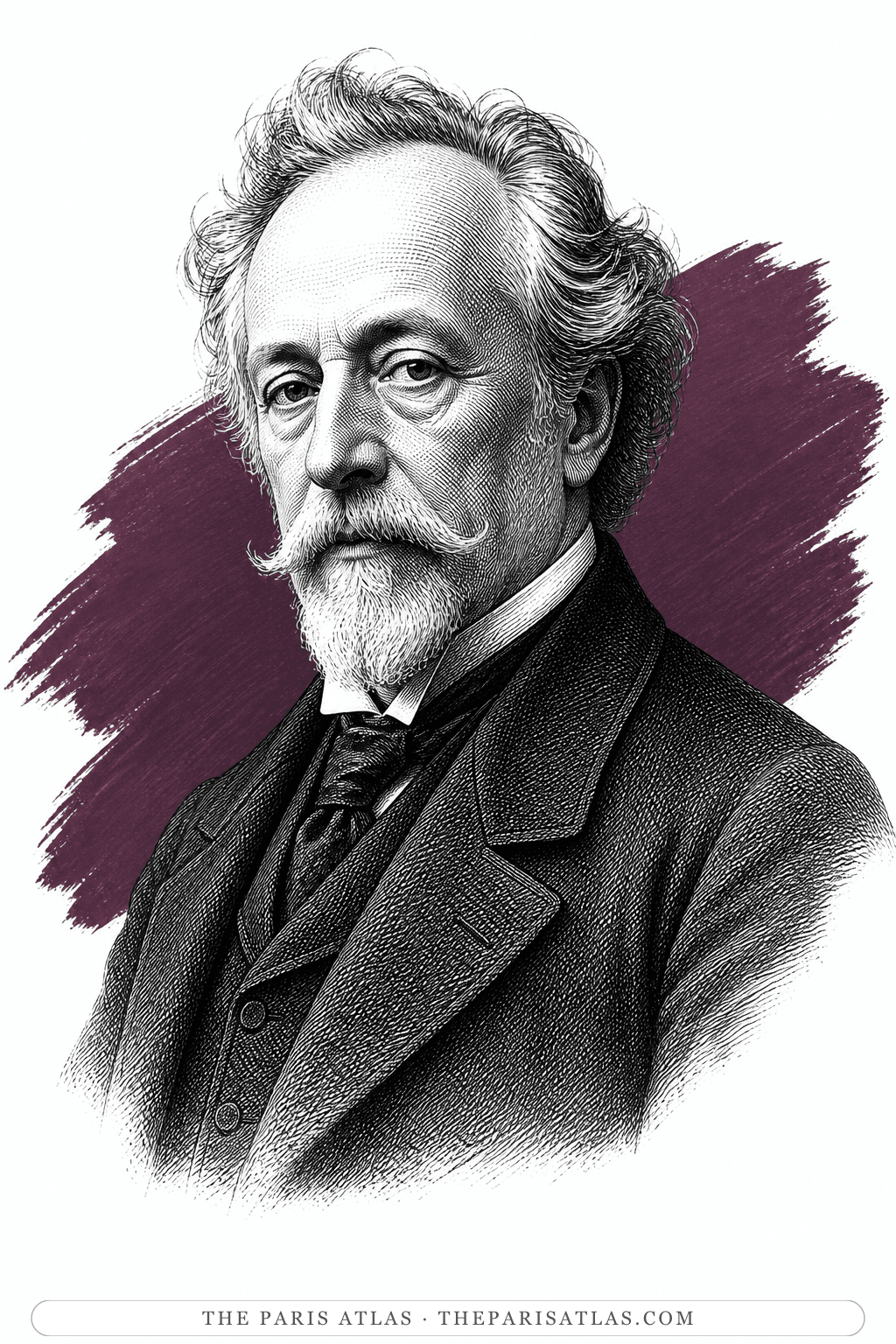
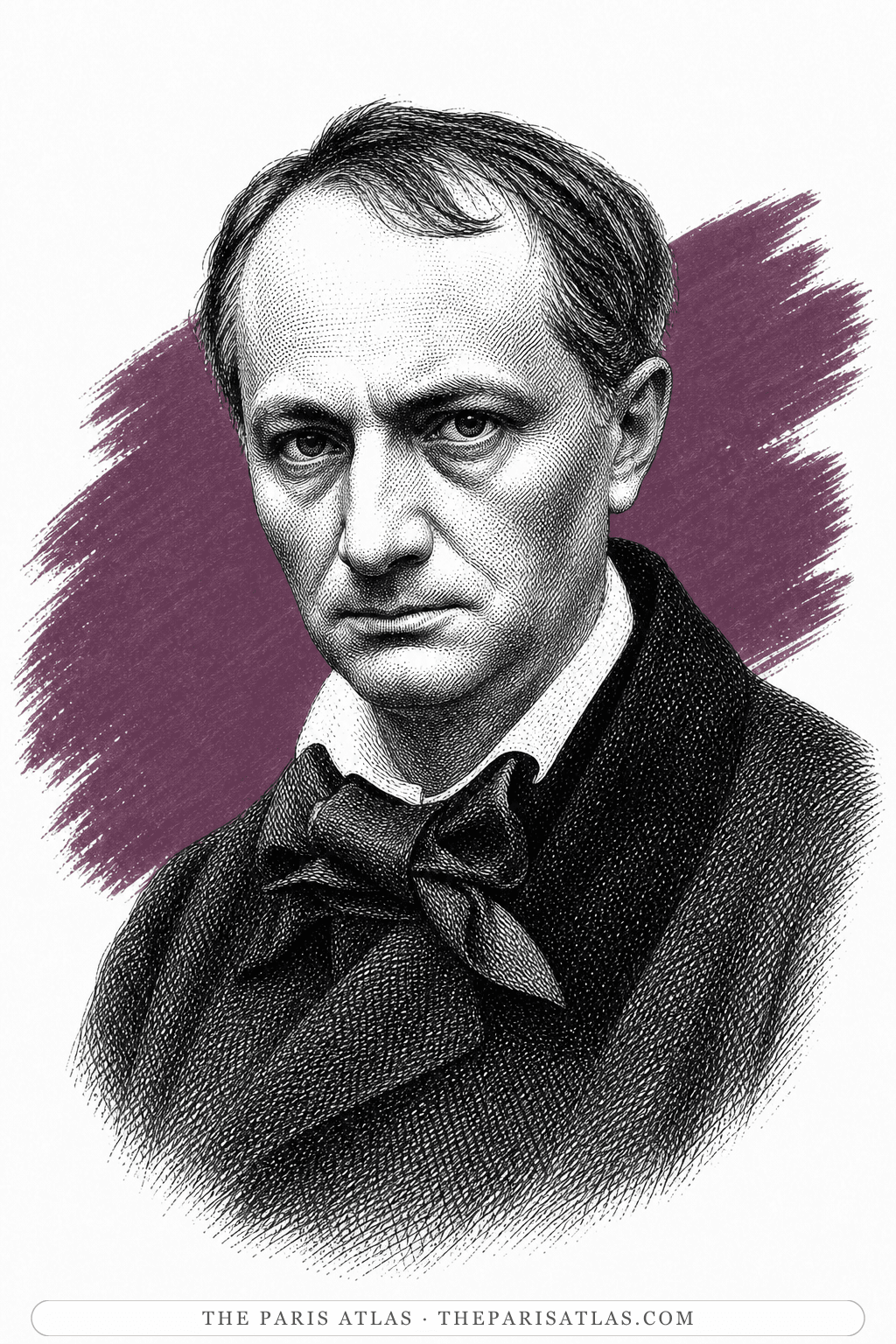
Charles Baudelaire (1821–1867), a French poet and art critic, was a crucial predecessor rather than a member of the movement named in 1886. Mallarmé, Verlaine, and Arthur Rimbaud recognized in his writing a way to connect modern experience with spiritual unease, sensual intensity, and the imaginative possibilities of language. His importance rests not only on the poems collected in Les Fleurs du mal, but also on his criticism and experiments in prose poetry.[20]
Les Fleurs du mal appeared in Paris in 1857 through the publishers Auguste Poulet-Malassis and Eugène de Broise. Its first edition contained one hundred numbered poems, preceded by “Au lecteur.” The book was prosecuted that summer on charges concerning religion and public morality. On 20 August, the court convicted Baudelaire and his publishers of offending public morals and ordered the suppression of six poems; the religious charge did not result in a conviction. The ban on those poems was not overturned in France until 1949. A second edition, published in February 1861, contained 126 numbered poems.[20][32]
“Correspondances” became particularly important to later Symbolist thinking. It proposes a world in which sensations and meanings answer one another: scents, colors, and sounds do not remain isolated but enter into relationships. The poem makes perception itself seem interpretive, as though the visible world contains intimations of something that cannot be directly stated.[3][32]
The Bibliothèque nationale de France preserves an intimate record of this process in Baudelaire’s corrected printing proofs. In the first proof of “Correspondances,” he capitalized the word symboles; in the third, he removed the capital. The revision does not reveal a complete artistic theory, but it shows the poet attending closely to the weight carried by a word that later became central to the movement’s name.[32]
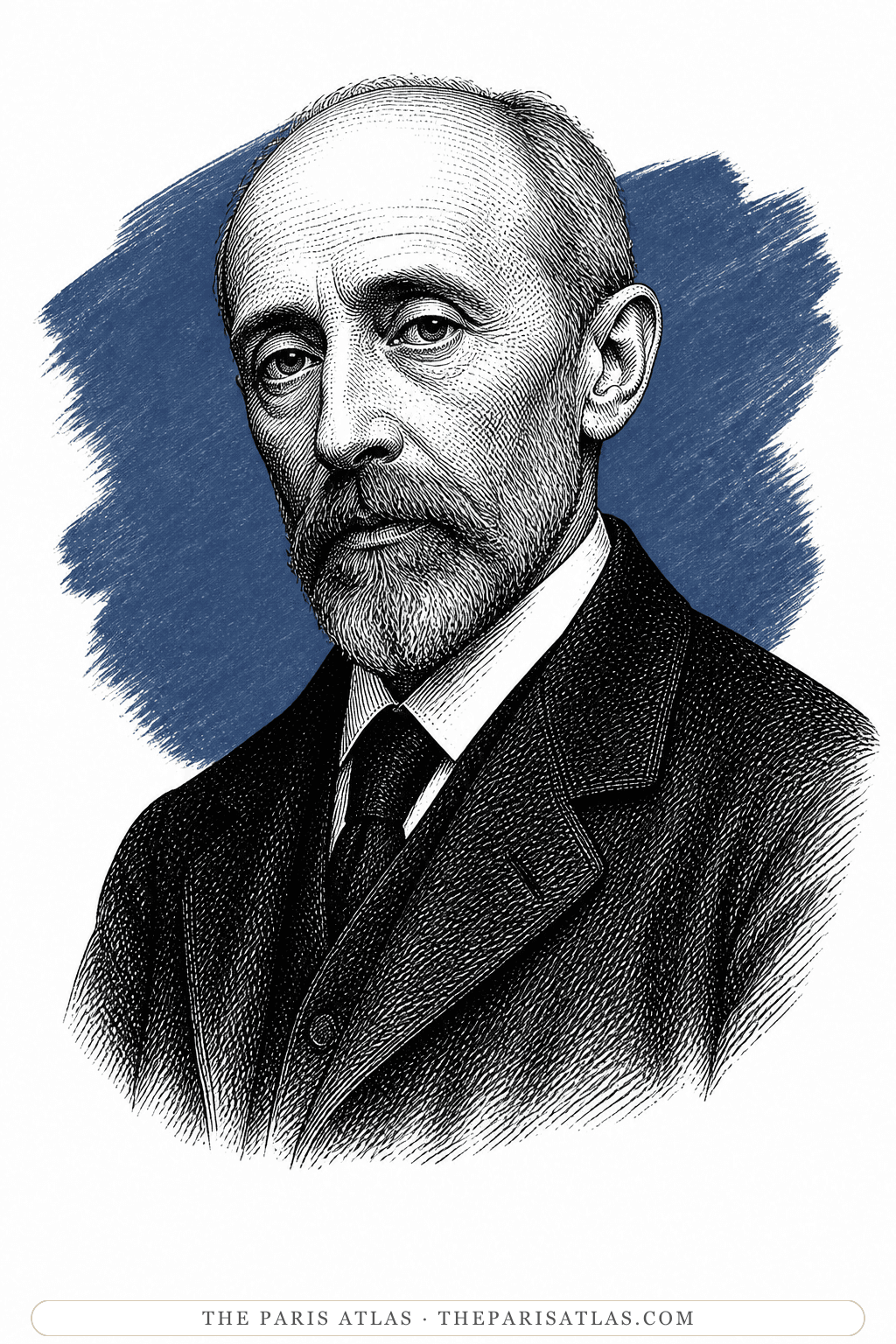
Stéphane Mallarmé (1842–1898), born in Paris on 18 March 1842, worked as an English teacher while developing one of the most demanding and influential bodies of poetry of the century. Younger writers gathered around him, and in 1896 he was elected “Prince of Poets,” an informal literary distinction. He nevertheless resisted being treated as the commander of a school.[10][33]
Mallarmé’s poetry makes meaning through sound, syntax, association, and omission. A poem is not simply an idea transferred into attractive language; its words create relationships that did not exist before the poem. An often-repeated anecdote captures this distinction. The painter Edgar Degas complained that he had plenty of ideas but could not make a satisfactory sonnet. Mallarmé answered that poems were made with words, not ideas. The exchange survives as a recollected anecdote.[10]
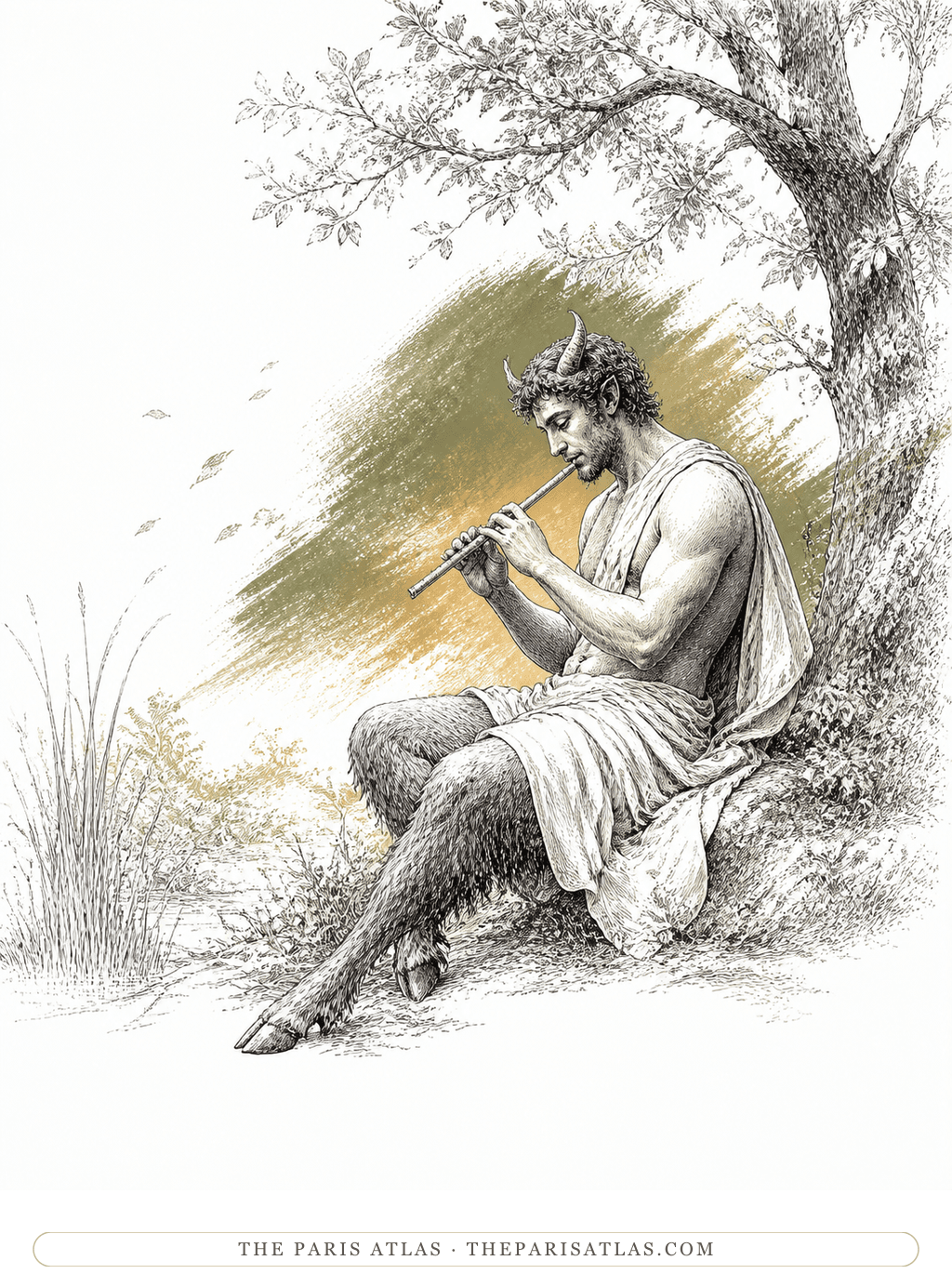
His L’Après-midi d’un faune began in an earlier form in 1865 and appeared as an independent illustrated publication in April 1876 after difficulties finding acceptance. The faun, a creature from classical mythology, tries to distinguish sensual experience from imagination: were the nymphs he remembers real, dreamed, or transformed by desire? The uncertainty is not incidental to the poem. It is its organizing condition.[16][34]
Édouard Manet supplied four wood-engraved illustrations or ornaments for the 1876 edition. Princeton University Library’s account describes them as printed in black and tinted pink by Manet himself, a practical response to the expense of color printing. The volume, published by Alphonse Derenne, made the encounter between poetry and visual art a physical object: text, image, paper, and color belonged to the same experience.[16]
Paul Verlaine: music, nuance, and the “cursed poets”
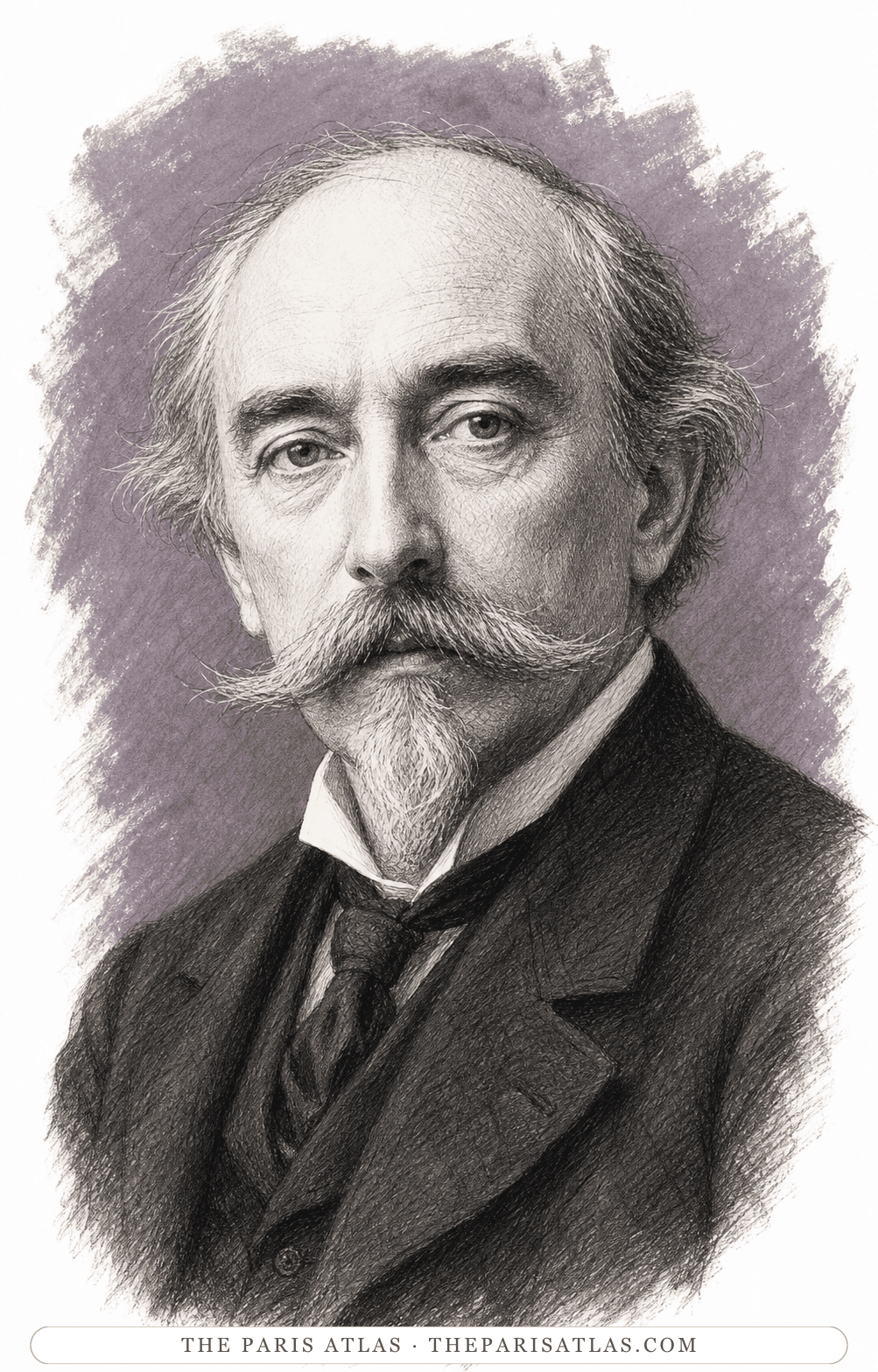
Paul Verlaine (1844–1896), born in Metz on 30 March 1844, began in the orbit of Parnassian poetry, which valued formal discipline and finish. His own reputation came increasingly to rest on a different quality: the ability to make uncertain feelings audible through rhythm, half-tones, and apparently simple words. Young Symbolist and Decadent writers revered him, although he too resisted the role of an official leader. He died in Paris on 8 January 1896.[21][35]
In “Art poétique,” generally dated to 1874 and included in Jadis et naguère in 1884, Verlaine put musicality before rhetorical display. His preference for odd-numbered syllabic lines and for nuance rather than heavy assertion offered younger poets a model of suggestive writing. The poem is often treated as a Symbolist statement, although it preceded Moréas’s manifesto.[21][35]
Verlaine also helped establish the modern idea of the poète maudit, the “cursed poet” whose originality brought estrangement rather than recognition. His essays began appearing in 1883 and were collected as Les Poètes maudits in 1884. That first collection discussed Tristan Corbière, a French poet of bitter wit and irregular rhythms; Arthur Rimbaud; and Mallarmé. The expanded edition of 1888 added the poet Marceline Desbordes-Valmore, the writer Auguste de Villiers de l’Isle-Adam, and Verlaine himself under the anagram “Pauvre Lelian.”[36]
Paul Verlaine’s relationship with Arthur Rimbaud had ended catastrophically. On 10 July 1873, in Brussels, Verlaine shot and wounded the younger poet and was sentenced to two years in prison. Their violent separation and Verlaine’s imprisonment became part of the biographical history through which later readers encountered their poetry.[21][35]
Arthur Rimbaud: visionary language and the abandonment of poetry
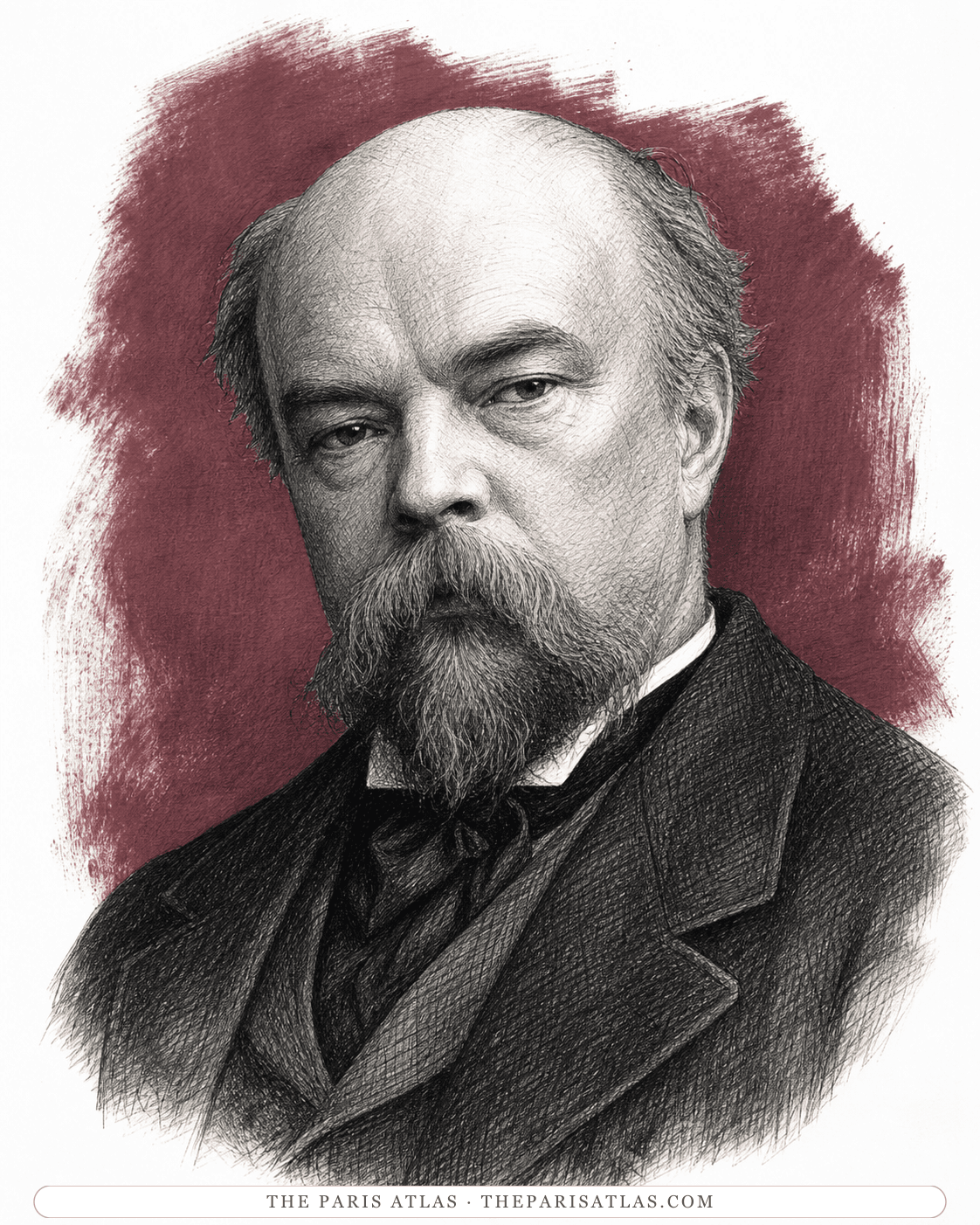
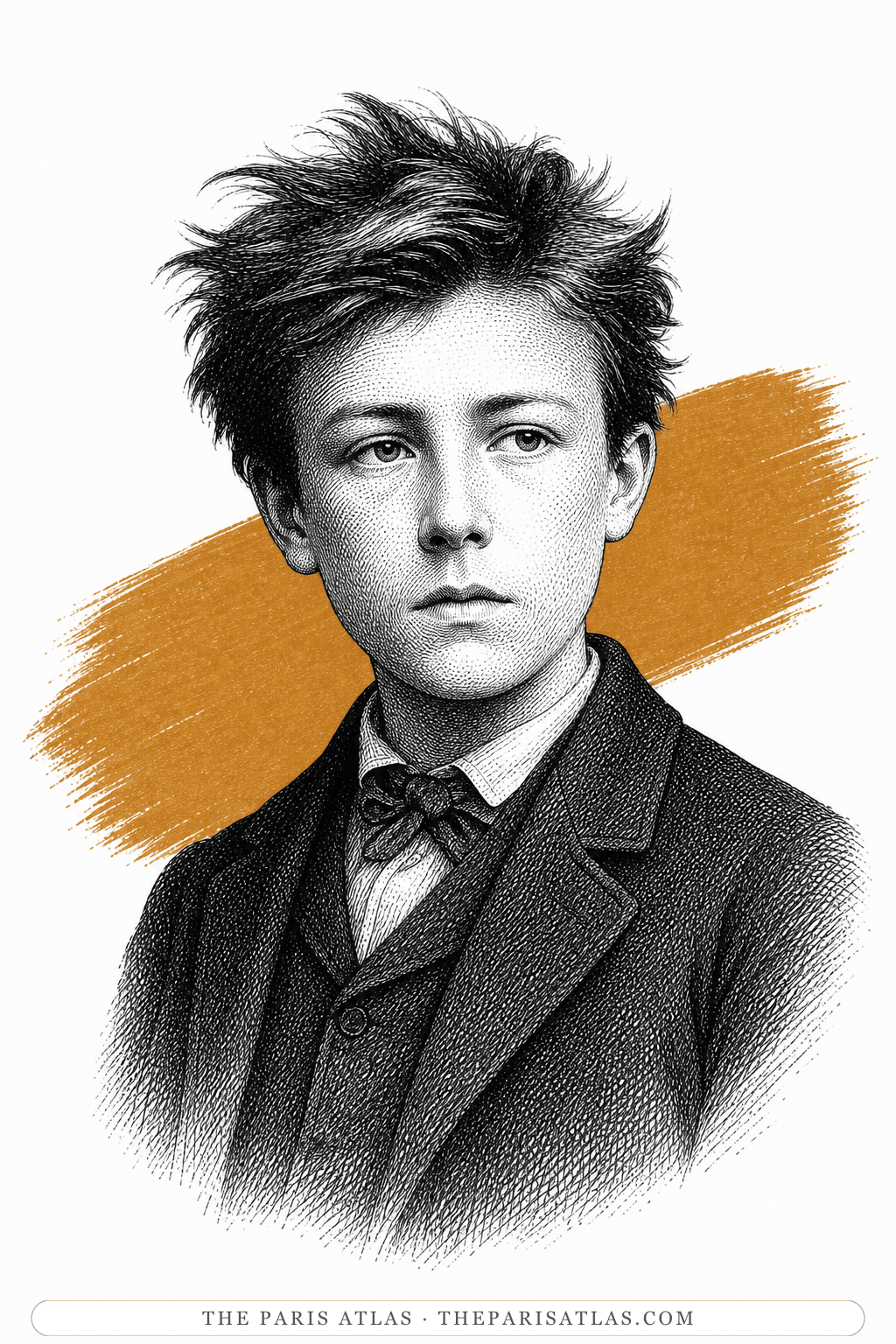
Arthur Rimbaud (1854–1891) was born in Charleville on 20 October 1854. He met Verlaine in September 1871, when he was sixteen, and produced almost all his poetry between approximately 1870 and 1875. His work was therefore largely complete before Symbolism became a named movement. Later writers found in it a radical example of language breaking with ordinary description and with the stable, self-possessed voice expected of a poet.[37][38]
Rimbaud dated Une saison en enfer from April to August 1873. Printed in Brussels, it initially attracted little attention; most copies remained uncollected with the printer. Its early circulation was very limited. The work returned to view through the French literary review La Vogue in 1886.[39]
The composition of Illuminations is harder to date precisely, although much of it is generally placed in the years around 1873–1875. Rimbaud passed manuscripts to Verlaine at their last meeting in February 1875. Publication followed in 1886, with the involvement of Félix Fénéon, the French critic and editor who also championed new painting. Younger Symbolists encountered these extraordinary texts after their author had largely abandoned literary life.[40]
Rimbaud stopped writing poetry around the age of twenty. He subsequently traveled, briefly served as a soldier, reached Java, and worked as a merchant in the Horn of Africa, including involvement in the arms trade. His later correspondence concerns business and practical affairs rather than a continuing poetic career. A tumor in his leg brought him back to Marseille, where the leg was amputated. He died there on 10 November 1891, aged thirty-seven. His short literary career and subsequent silence became part of the fascination surrounding his work.[37][38]
Gustave Moreau: mythology, spectacle, and the imagination
A painter established before the manifesto
Gustave Moreau (1826–1898) was one of the principal painters later claimed as a Symbolist predecessor. Trained at the École des Beaux-Arts in Paris, he drew on the work of Eugène Delacroix, the leading Romantic painter, and Théodore Chassériau, a younger painter who became his friend. His Italian journey of 1857–1859 deepened his interest in Renaissance painting and in older religious and decorative traditions, including Byzantine art.[43][44]
Moreau’s paintings are often filled with jewels, plants, elaborate architecture, and references to different historical cultures. Their richness can look like the opposite of modern simplification. Yet their settings are rarely intended as straightforward archaeological reconstructions. They create an imagined world in which an encounter between two figures acquires the density and remoteness of a dream.[11][13]
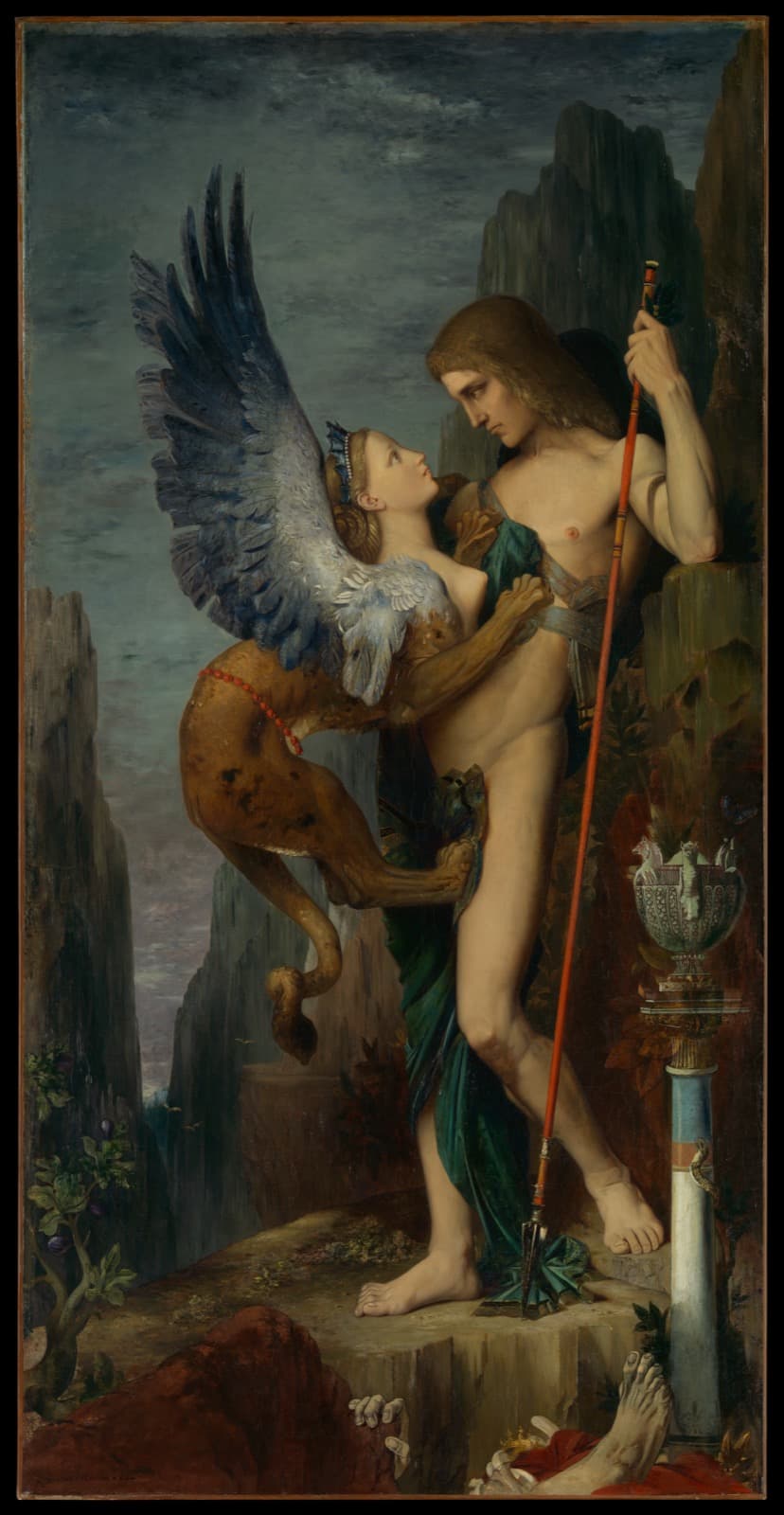
His breakthrough came with Oedipus and the Sphinx, exhibited at the Paris Salon in 1864 and now in the Metropolitan Museum of Art in New York. The sphinx—a creature combining a woman’s head with an animal body and wings—clings to Oedipus as the two stare at one another. The remains of earlier victims appear below them. Moreau makes the confrontation physically intimate rather than treating it as a distant episode in a heroic narrative.[11]
The traditional riddle asks what moves on four legs in the morning, two at noon, and three in the evening. The answer is a human being, crawling in infancy, walking upright in adulthood, and using a stick in old age. Knowing the answer explains the myth, but the painting’s tension remains in the locked gazes and the dangerous contact between the figures. It can be read as an encounter between knowledge and mystery without being reduced to that interpretation.[11]
Orpheus after the violence
Moreau painted Orphée in 1865; the French state purchased it in 1866, and it now belongs to the Musée d’Orsay. In Greek mythology, Orpheus is a poet and musician whose art can move living creatures and even the powers of the underworld. Accounts of his death describe his destruction by the Maenads, the female followers of the god Dionysus, with his rejection of women among the explanations given for their violence.[12]
Moreau chose not to paint the attack. Instead, he imagined a young woman in richly ornamented Eastern dress contemplating the musician’s severed head, which rests upon his lyre. Her face and the dead poet’s echo one another, and their lowered or closed eyes produce a strange stillness. The subject becomes an encounter with what survives of song, beauty, or inspiration after physical destruction.[12]
Smaller details connect the scene to the history of music. The turtles in the foreground recall the traditional invention of the lyre from a tortoise shell, while tiny musicians occupy the rocks above. They make the setting more densely associative, inviting the eye to move between the human drama and the objects around it.[12]
Salome and The Apparition
Moreau’s images of Salome became central to the literary culture of the 1880s and 1890s. In the biblical story, the daughter of Herodias dances before the ruler Herod Antipas and, at her mother’s prompting, demands the head of John the Baptist. Later art and literature increasingly transformed Salome herself into the embodiment of destructive desire. Moreau’s paintings were important in that transformation.[13]
John the Baptist’s severed head, encircled by a halo and dripping with blood, appears before a horrified Salome in Gustave Moreau’s The Apparition. Moreau added this supernatural confrontation to the biblical account of the dance and execution. The invented vision makes Salome face the head she demanded. Moreau developed the subject in different media: a celebrated watercolor was shown at the Salon of 1876, while an oil version belongs to the Musée Gustave Moreau.[13]
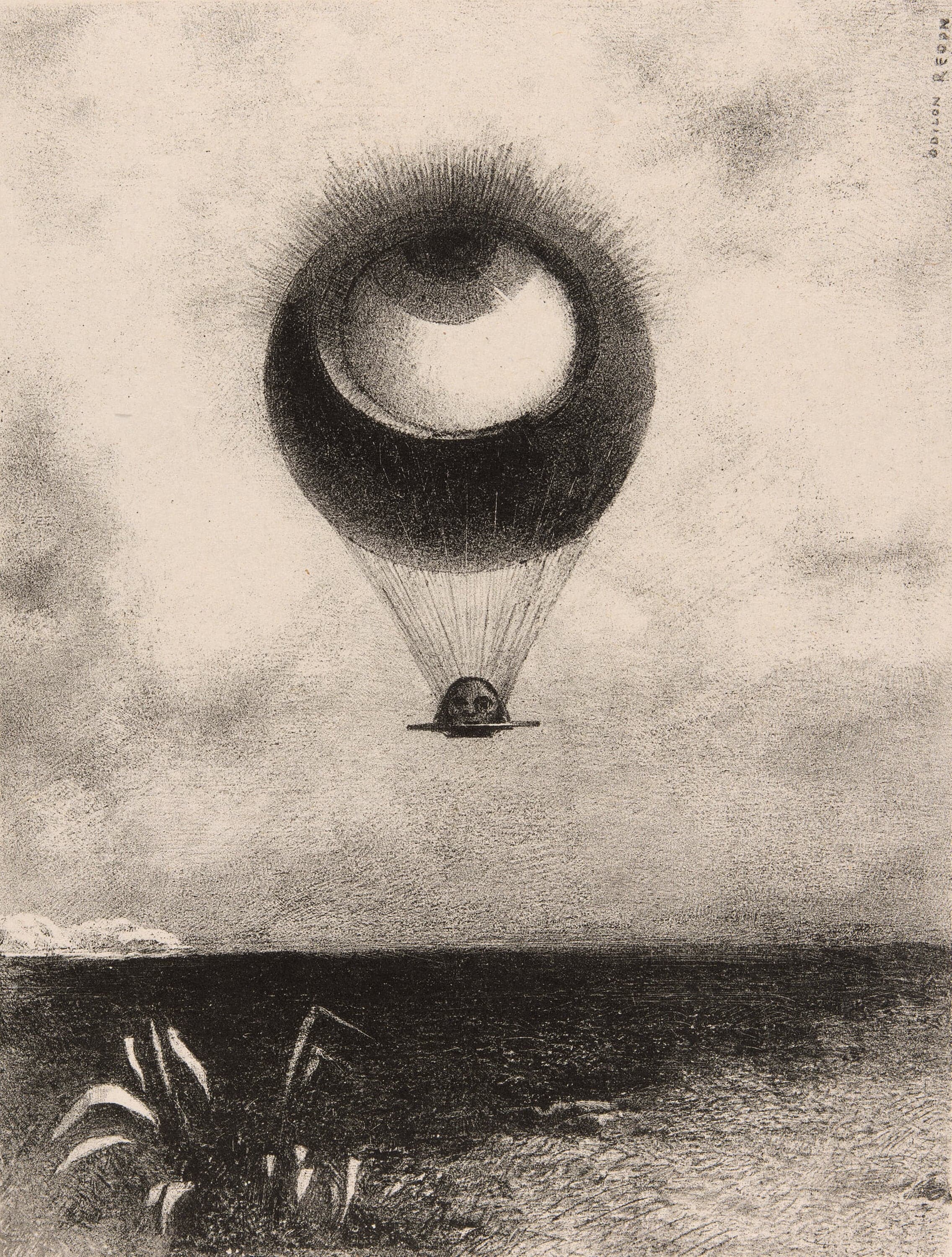
The novelist Joris-Karl Huysmans subsequently made Moreau’s Salome pictures objects of intense contemplation in À rebours. That book enlarged the painter’s literary following, but Moreau had already been publicly successful for two decades. His admirers included Odilon Redon and Oscar Wilde, whose own work helped carry the subject into new forms.[11][13][45]
Moreau the teacher
Moreau’s career included periods of hostile criticism and withdrawal from the Salon, followed by official recognition. He was elected to the Académie des Beaux-Arts in 1888 and became a professor at the École des Beaux-Arts in 1892. His students included Henri Matisse, Georges Rouault, Albert Marquet, and Henri Manguin, all painters whose mature work differed considerably from his own.[43][44]
Gustave Moreau encouraged his students to develop their own styles rather than reproduce his manner. His studio became an important connection between nineteenth-century Symbolism and Fauvism, whose intense color caused a sensation at the Salon d’Automne in Paris in 1905. Moreau’s students carried his defense of artistic independence into work that often left his mythological subjects behind.[43][44][46]
The house that became a museum
The Moreau family acquired the house at 14 rue de La Rochefoucauld in 1852. It remained central to the painter’s adult life. After the deaths of his mother and his long-standing companion Alexandrine Dureux, Moreau increasingly organized his work and surroundings for preservation. In 1895 he had the house transformed, creating large studio galleries above the domestic rooms.[43]
The house was to preserve not only finished paintings but the process of invention: studies, drawings, unfinished compositions, and repeated variations. Moreau’s arrangements included display panels that could be turned to reveal drawings. In a will made in 1897, he left the property and its contents to the French state. Moreau died on April 18, 1898.[47][43][48]
The museum opened to the public on 14 January 1903, with his former student Georges Rouault as its first curator. The accumulated paintings and thousands of works on paper make the building an unusually direct record of an artist’s imagined world. It is not simply a room devoted to Moreau within a larger museum: the house itself forms part of what he left.[47][48]
Paul Gauguin, Pont-Aven, and the transformation of color
Brittany as a place of experiment
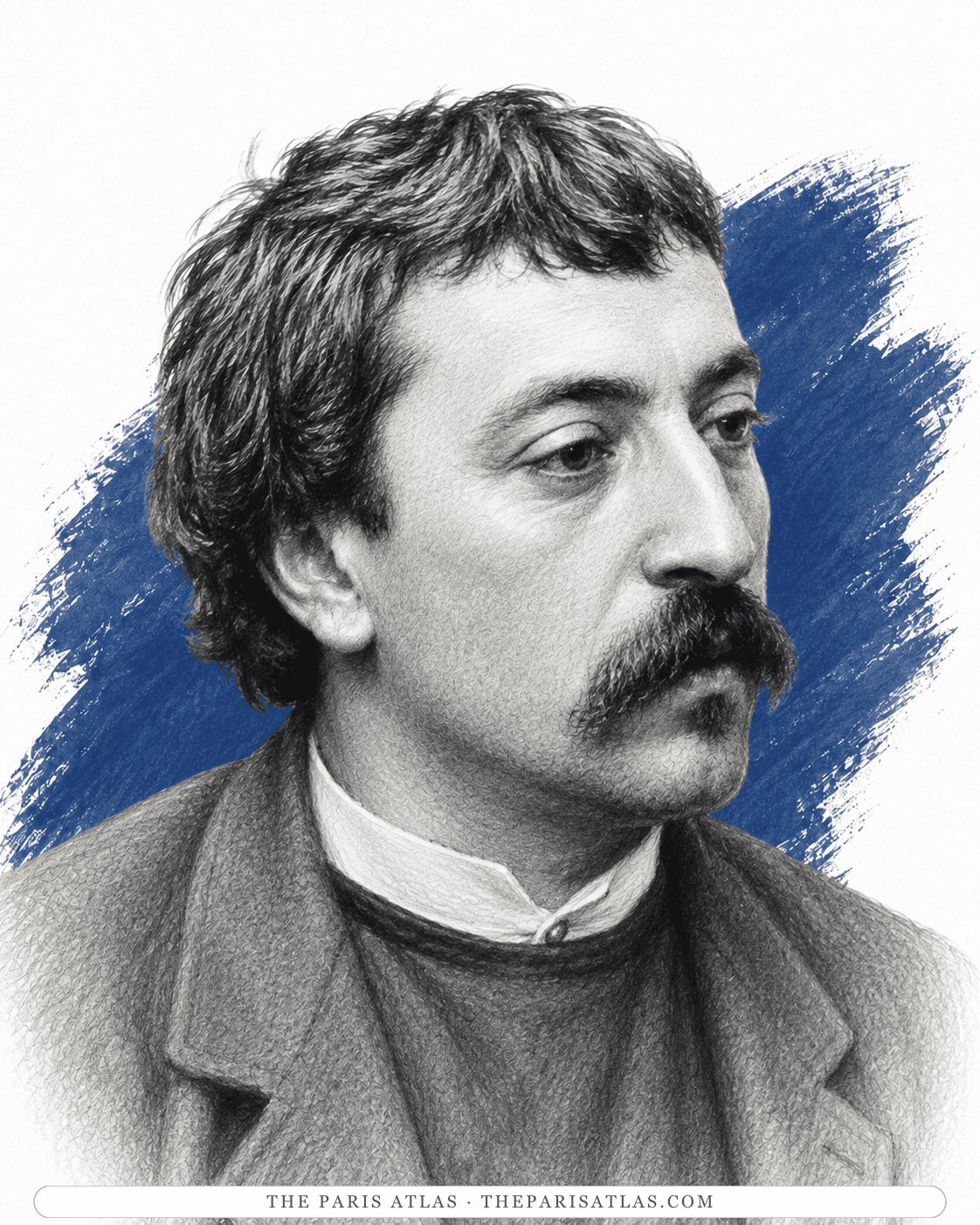
The French painter Paul Gauguin (1848–1903) had taken part in Impressionist exhibitions before developing a different approach to color and form. His paintings gave color an expressive force that went beyond realistic description. This made him central to Symbolism, whether he painted a mythological subject or a Breton landscape.[60][17]
He first visited Pont-Aven in Brittany in the summer of 1886. Artists had been drawn to the area since the middle of the nineteenth century, including American painters who helped establish its reputation as a colony. The attraction was partly visual—the coastal light, the harbour and mills, the Bois d’Amour, and the nearby Trémalo chapel—and partly practical. Rooms, studio space, and models were comparatively accessible, and the town was accustomed to welcoming painters.[61][62]
Gauguin encountered Émile Bernard, a young French painter, in Brittany in 1886; their exchange became particularly important in 1888. The expression “Pont-Aven School” was applied retrospectively. It describes an informal circle whose members exchanged ideas outside a formal academy. The artists shared discoveries, argued over them, and later disputed who had originated particular innovations.[61][62][63]
Vision of the Sermon
In Vision of the Sermon (Jacob Wrestling with the Angel), painted in 1888 and now in the National Galleries of Scotland, Breton women in white bonnets occupy the foreground while a biblical struggle takes place beyond them. The ground is an extraordinary flat red. A diagonal tree separates parts of the composition without providing the familiar recession of a naturalistic landscape.[27]
The painting refers to the episode in Genesis in which Jacob wrestles through the night with a mysterious divine being, conventionally represented in art as an angel. Gauguin’s subject is not simply that ancient event. It is the event as imagined by people who have heard it described. In a letter to the Dutch painter Vincent van Gogh, written around 26 September 1888, Gauguin explained that the landscape and the struggle existed in the imagination of the praying women.[27][64]
This distinction makes the picture an especially clear example of Symbolist painting. It places physical figures and an inward vision in the same visual field without pretending that the two belong to an ordinary observed scene. The National Galleries of Scotland acquired the painting in 1925; Aurier had already used it as a central example in his 1891 account of Symbolism in painting.[9][27]
Paul Gauguin attempted to give Vision of the Sermon to a church, but the offer was refused. His contemporary letter names the church at Pont-Aven. Émile Bernard’s later account, written in 1904, differs over the location: it names the priest at nearby Névez. According to Bernard, the priest objected that the women’s enormous bonnets and backs dominated the canvas, while the sacred event appeared at a distance. He considered the picture insufficiently religious.[64]
Cloisonnism, Synthetism, and the argument over invention
Two terms associated with the Pont-Aven painters describe related but different things. Cloisonnism concerns the appearance of a picture: areas of relatively flat color separated by strong outlines, resembling the partitions in cloisonné enamel. The name was coined by the French writer and critic Édouard Dujardin in 1888 in relation to work by Louis Anquetin, a painter closely associated with Bernard.[29][65][63]
Synthetism is a broader conception. It involves bringing together the appearance of a subject, the artist’s feelings about it, and the formal arrangement of color and line. Working from memory could assist this process because it encouraged selection and transformation rather than continuous adjustment to the object immediately before the painter.[29][66]
The distribution of credit remains an important part of the history. Bernard’s Breton Women in a Meadow, also associated with the title Le Pardon, preceded Vision of the Sermon by a short interval, and he later argued that Gauguin had taken credit for ideas they had developed together. Bernard and Anquetin’s experiments were central to the new language of flat color and strong outlines, while Gauguin gave it a distinctive imaginative force. The dispute grew out of an unusually productive exchange.[65][67][17][63]
Tahiti and an imagined alternative to Europe
Gauguin’s search for an alternative to European urban society eventually took him to Tahiti. His desire to find a supposedly less industrialized world influenced how he represented the island, but the place he encountered was already shaped by French colonial rule, missionary activity, trade, and changing local customs. His pictures are consequently imaginative constructions rather than transparent records of an untouched society.[60][17][68]
Gauguin combined local observation with remembered European art, invented religious imagery, and sources from different cultures. The result could be powerful and imaginative while remaining distinct from a documentary account of Polynesian life. His conflicts with colonial officials and his own position as a European artist belong to that history together.[17][68]
Gauguin’s great painting of 1897–1898, now in the Museum of Fine Arts, Boston, is nearly four meters wide and was painted on coarse burlap. It was made during a period of financial difficulty, physical illness, emotional distress, and conflict with the colonial authorities. Its title gives the work the form of three questions rather than an explanation.[68]
Gauguin described the composition as moving from right to left, beginning with a sleeping infant and ending with an old woman close to death. Between them, figures of different ages occupy a setting whose gestures and objects do not resolve into a single familiar story. The painting can be read as a meditation on the course of life, but the artist resisted having it reduced to a catalog of known symbols.[68]
Its physical presentation was part of the conception. Gauguin painted yellow corners so that the image could resemble a mural deteriorating at the edges against a golden wall, and he asked for a plain white frame. When it was exhibited in Paris at Ambroise Vollard’s gallery in 1898, Thadée Natanson, a critic and editor of La Revue blanche, found it obscure but connected that obscurity to its invitation to consider human destiny. For Gauguin, a complete verbal explanation risked destroying the painting’s character as a poem.[68]
Paul Sérusier, Le Talisman, and the Nabis
A small painting with an exceptional reputation
Paul Sérusier (1864–1927), a French painter with a background in philosophical study, spent time at Pont-Aven in 1888. In October, under Gauguin’s guidance, he painted a small landscape at the Bois d’Amour. According to the later recollection of the painter Maurice Denis, Gauguin encouraged Sérusier to put down the colors he perceived forcefully: yellow for the trees, pure ultramarine for a blue shadow, vermilion for red leaves. The lesson was to trust and organize a color sensation rather than correct it toward conventional naturalism.[18][69]
The resulting panel, Le Talisman, Paysage au Bois d’Amour, measures 27 by 21.5 centimeters. The wood, path, beech trees, and mill of the landscape are compressed into patches of color. An inscription on the reverse records its making in October 1888 under Gauguin’s direction at Pont-Aven. When Sérusier returned to Paris and showed it to fellow students at the Académie Julian, the picture became a demonstration that painting need not be an exercise in copying.[69]
A famous story says that Paul Sérusier painted Le Talisman on the lid of a cigar box. That account was long repeated, including in museum literature, but the Musée d’Orsay’s later material investigation identified the support as a small wooden panel, probably poplar, and questioned the cigar-box explanation. The familiar cigar-box story thus belongs to the painting’s founding legend, while the surviving support points toward an ordinary painter’s panel.[18][70]
The title Le Talisman reflects the almost initiatory status it acquired among the young painters. Denis remembered the work as a liberation from the belief that a painting had to reproduce appearances. The Musée d’Orsay acquired it in 1985 with assistance from the collector Philippe Meyer. The recognizable landscape became a starting point for a much wider freedom in the use of color.[69]
Who were the Nabis?
The circle that developed around these ideas became known as the Nabis, a name derived from the Hebrew word for prophets. The group took shape around 1888–1889 and remained active through the 1890s. The Metropolitan Museum of Art dates its beginnings to 1888, while the Art Institute of Chicago and Cleveland Museum of Art emphasize 1889, and the Bibliothèque nationale de France describes its public activity through the decade 1890–1900. The dates mark different stages in the circle’s formation and public activity.[18][71][72][73][74]
The poet and physician Henri Cazalis has been credited with suggesting the name, notably in Tate’s account, although the attribution is not uniform across histories of the group. The prophetic comparison expressed the young painters’ sense of bringing a new conception of painting into being. They had become frustrated with strictly representational teaching at the Académie Julian, and Sérusier’s panel gave their dissatisfaction a tangible form.[71][69]
The Nabis were not all mystics, nor did they share identical subjects. Some pursued religious and esoteric imagery; others concentrated on domestic interiors, urban life, and decorative design. Their connection with Symbolism lies in their rejection of simple imitation and their interest in the expressive organization of a surface.[18][72][75]
Maurice Denis and the ordered surface
Maurice Denis (1870–1943), a French painter and the group’s most persistent theorist, published “Définition du néo-traditionnisme” in the journal Art et critique in August 1890 under the pseudonym Pierre Louis. He was nineteen. The essay was later reprinted in Théories, which can cause confusion about its original date.[76][77][70]
Maurice Denis’s 1890 essay “Définition du néo-traditionnisme” opens with a proposition that became one of modern art’s most frequently cited statements. Before representing a horse, a nude, or a story, a painting is a flat surface on which colors have been arranged. The sentence does not mean that Denis considered subject matter worthless. He remained deeply interested in religious painting. For Denis, the arrangement of color and form shaped the meaning of a picture’s subject.[76][77]
Sérusier likewise continued to think about painting as a structured discipline. He made comparatively few prints and eventually published his own treatise, ABC de la peinture, in 1921. The group’s interest in color and the surface was therefore accompanied by sustained reflection, not merely an enthusiasm for vivid effects.[74]
The artists and their different practices
Pierre Bonnard (1867–1947), a French painter and printmaker, became known as the “Japanese Nabi” because of his interest in Japanese prints. Their cropping, asymmetry, and treatment of patterned surfaces offered alternatives to conventional European pictorial space. His France-Champagne poster, published in 1891, was his first print and first color lithograph. It helped show how a medium strongly associated with advertising could become an arena for ambitious modern design; color lithography itself, however, had a longer history.[72][74]
Édouard Vuillard (1868–1940), another French painter, developed an especially close relationship between decorative surfaces and domestic subjects. He increasingly worked in distemper, a medium in which pigment is mixed with a water-based glue binder. Its matte appearance suited his treatment of figures, furniture, and patterned interiors. Alongside these intimate rooms, he produced extensive work for theaters and decorative commissions.[72][75]
Félix Vallotton (1865–1925), a Swiss-born artist who arrived in Paris at sixteen, developed a sharply different graphic language. His black-and-white woodcuts used strong contrasts to expose tensions in public and private life, and some of his work reflected anarchist sympathies. Aristide Maillol (1861–1944), later best known as a sculptor, also worked in painting, textiles, and prints. Vallotton and Maillol were the Nabis most closely associated with woodcut, while color lithography dominated much of the group’s printed output.[74][78]
Paul Ranson (1864–1909), a French painter and designer, worked on wallpaper and theatrical material as well as paintings. Henri-Gabriel Ibels (1867–1936), a painter, printmaker, and illustrator, made programs for the 1892–1893 season of André Antoine’s Théâtre Libre and developed a distinctive involvement with cabaret posters and illustrated song sheets. Ker-Xavier Roussel (1867–1944), a French painter, married Vuillard’s sister Marie in 1893 and increasingly painted mythological pastorals after 1900. Their different interests make the group more varied than a list of shared principles suggests.[72][73][74]
Art beyond the easel
The Nabis worked across sets, costumes, theater programs, stained-glass designs, ceramics, wallpaper, posters, book illustration, and decorative panels for private interiors. These were not simply commercial sidelines to their paintings. They offered ways to place expressive color and design within the spaces and objects of everyday life.[18][74][75]
Denis became the first of the group to provide the illustrations for an entire book when he worked on André Gide’s Le Voyage d’Urien in 1893. Theater offered another form of collaboration. When Ubu Roi was staged with marionettes in 1898, Bonnard made the puppets and Vuillard the sets. A literary work could become a coordinated experiment in bodies, images, scale, and performance.[74][79]
The group exhibited together through 1899, but its members gradually followed increasingly individual paths. Denis’s Hommage à Cézanne, painted in 1900, shows artists gathered around a work by the painter Paul Cézanne in Vollard’s gallery and has often been treated as a retrospective image of their shared decade. There was no single, clearly documented event that explains every aspect of the group’s dispersal. Bonnard and Vuillard continued the intimate domestic painting for which they are now particularly well known.[18][74]
Symbolism in music
Why music mattered
Music offered Symbolist writers an example of an art that could organize feeling without explaining an object or telling a complete story. Composers, in turn, responded to literature concerned with suggestion, ambiguity, and states of consciousness. The relationship was reciprocal rather than a one-way borrowing of poems as subjects.[4][93]
Claude Debussy is the composer most closely associated with Symbolism. The French composers Gabriel Fauré and Paul Dukas also drew on Symbolist drama, as did Arnold Schoenberg in Austria and Béla Bartók in Hungary. Their different approaches show that these literary connections extended across musical schools.[4]
Maeterlinck’s Pelléas et Mélisande supplied the subject for Fauré’s incidental music and Schoenberg’s symphonic poem. Dukas made an opera from Maeterlinck’s Ariane et Barbe-Bleue. Bartók’s Bluebeard’s Castle sets a libretto by Béla Balázs, who had attended Dukas’s opera in Paris. The prologue to Bluebeard’s Castle asks whether the story unfolds in the outside world or within the mind.[94][95][96]
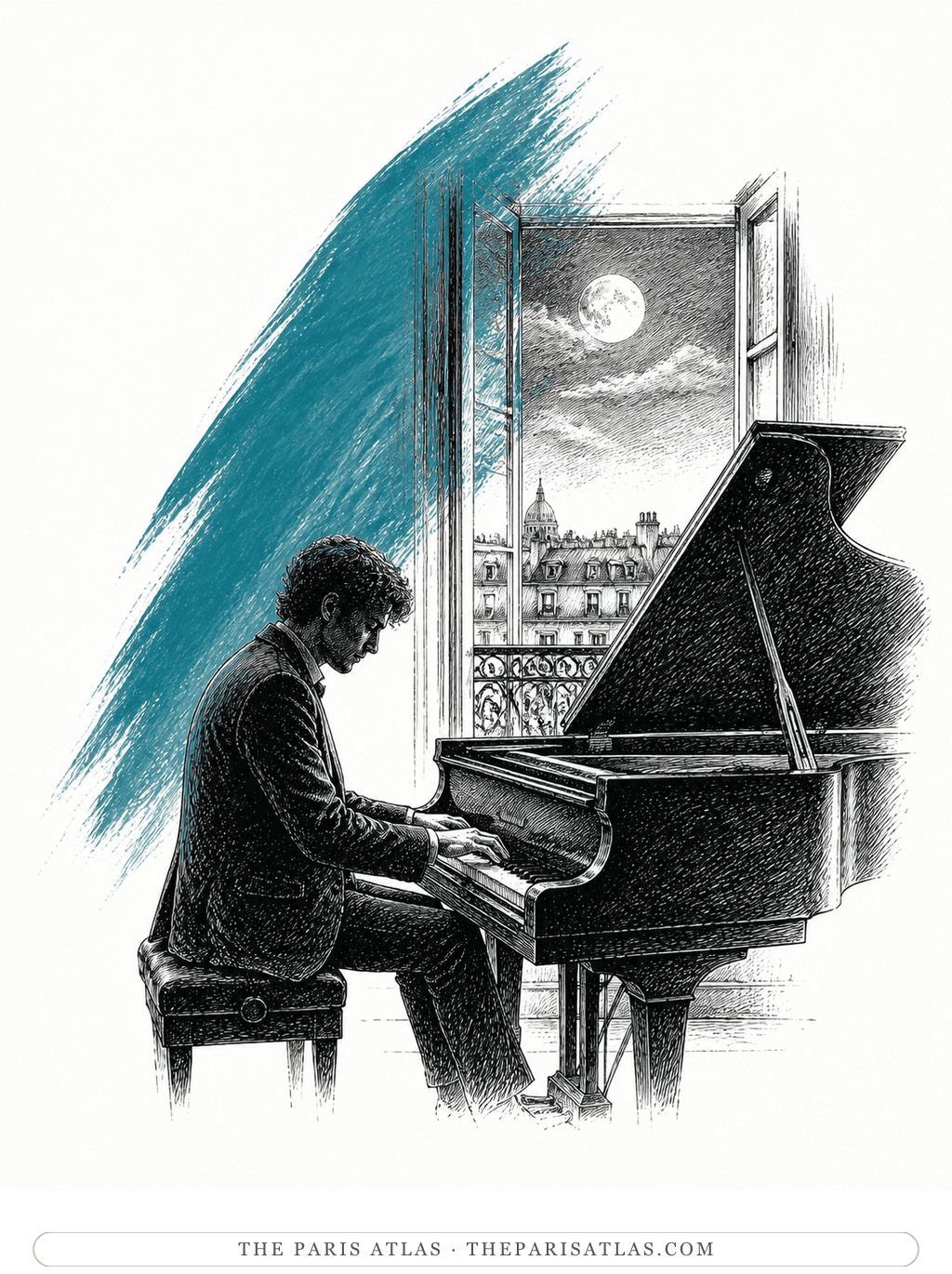
Claude Debussy (1862–1918) became part of Mallarmé’s literary circle, and his music developed in close dialogue with the poet’s work. Mallarmé asked him to write music for a proposed staging of L’Après-midi d’un faune. The theatrical project was abandoned, but Debussy continued to work on music inspired by the poem. His orchestral Prélude à l’après-midi d’un faune, composed between 1892 and 1894 and completed in the autumn of 1894, emerged as an independent work.[5][34][97][98][99]
The opening flute line immediately establishes a music that seems to hover rather than announce a stable destination. Shifting harmonies, instrumental color, and recurring but transformed phrases create a world comparable to the faun’s uncertain recollection. Debussy described the relationship as a free illustration, not a literal translation in which each phrase corresponded to a line of verse.[34]
The first performance took place in Paris on 22 December 1894 at a concert of the Société Nationale de Musique, conducted by the Swiss musician Gustave Doret. The audience requested an encore, although critical responses were not unanimously enthusiastic. One dismissive response characterized the work as more enjoyable to compose than to hear.[97][100][98]
Stéphane Mallarmé praised Debussy’s Prélude à l’après-midi d’un faune in a letter to the composer and in a quatrain inscribed in a copy of his poem L’Après-midi d’un faune. He praised the music for carrying the poem toward a light and imaginative world beyond what he had expected. The inscription evokes the light breathed into the faun’s flute. Together, the letter and the inscribed verse record the poet’s lasting appreciation.[97][100][98]
Pelléas et Mélisande and the angry playwright
Debussy’s only completed opera was based on Maeterlinck’s Pelléas et Mélisande. He secured the playwright’s permission at the end of the summer of 1893 and completed a substantial version of the score in August 1895, although orchestration and revision continued before the first production. The work finally reached the Opéra-Comique in Paris on 30 April 1902. André Messager, a French composer and conductor, directed the performance; the baritone Jean Périer sang Pelléas, and the Scottish-born soprano Mary Garden sang Mélisande.[90][91]
The opera’s expressive force depends less on conventional declarations than on the relationship between restrained speech, orchestral implication, and what remains unsaid. The characters’ words can seem simple while the musical setting makes them emotionally unstable. The work is one of the clearest continuations of Symbolist literary drama into another medium.[4][91][93]
The production also generated a very concrete dispute. Maeterlinck wanted his partner, the singer Georgette Leblanc, to perform Mélisande. When Garden received the role, he publicly dissociated himself from the opera and expressed the wish that it fail. His hostile article appeared before the opening, turning a casting dispute into an argument about the ownership and identity of a work.[90]
The general rehearsal on 28 April encountered laughter and disruption. Garden later recalled the mismatch between the poetic drama the performers believed they were presenting and an audience behaving as though it were at the Folies-Bergère. Maeterlinck himself did not become reconciled to Debussy’s achievement until 1920, two years after the composer’s death.[90]
Erik Satie and the Rose+Croix
Erik Satie (1866–1925), a French composer who worked as a pianist at the Chat Noir cabaret, became Debussy’s friend and also participated for a time in Péladan’s circle. He composed music associated with the Rose+Croix, including Première Pensée Rose+Croix in 1891.[101][102]
Péladan’s dramatic text Le Fils des étoiles prompted three preludes, first performed in the context of the Rose+Croix salon on 19 March 1892. The program described them as “admirably oriental,” language that reveals the exotic associations through which this music was presented. Their role was to establish an atmosphere around a spoken text rather than accompany a conventional operatic drama.[102]
Satie soon broke with Péladan. His Vexations, generally dated to 1893, belongs to the period after that association. The Guggenheim’s account raises questions about whether he expected it to be performed and whether a joke at the expense of mystical pretension lay behind it. No secure evidence permits those intentions to be settled neatly. Satie’s relationship with ceremonial seriousness was capable of turning toward skepticism and absurdity.[86]
Symbolist or Impressionist music?
Both labels have been applied to Debussy, but they describe different aspects of a work. “Symbolist” can identify a literary source or a commitment to indirect expression; “Impressionist” has often been used for qualities of sonority, color, and atmosphere. The Palazzetto Bru Zane, a center devoted to French Romantic music, usefully describes the Prélude as Symbolist in inspiration while already Impressionist in its realization.[4]
The vocabulary traveled between arts with different histories. In Debussy’s case, the link with Symbolism takes concrete form in his friendships with writers and in works based on Mallarmé’s poetry and Maeterlinck’s theater.[34][4][90]
Symbolism beyond France
Belgium: Khnopff, Delville, Ensor, and Les XX
Belgium was a major center, not simply a place that received a finished French movement. The Brussels society Les XX, or “the Twenty,” was founded in 1883 and operated until 1893. Its secretary, Octave Maus (1856–1919), was a lawyer and art critic who subsequently helped organize La Libre Esthétique. Together, the two organizations supported an international exhibition culture extending into 1914.[103]
The Brussels group Les XX fostered substantial exchanges with French artists. Georges Seurat, the French painter associated with Neo-Impressionism, showed A Sunday on La Grande Jatte at the Les XX exhibition of 1887. Artists working through different formal methods could encounter one another within the same network. Despite hostile criticism, the international exhibition activity organized by Les XX continued through its successor, La Libre Esthétique.[103]
Fernand Khnopff (1858–1921), born at Grembergen and active in Brussels, developed images of isolation, idealized figures, and uncertain encounters. His Des caresses (Caresses), painted in 1896 and held by the Royal Museums of Fine Arts of Belgium, brings a human figure into contact with a leopard-bodied sphinx. The long, narrow painting—just over one and a half meters wide—makes the contact appear both tender and unsettling. The viewer is not told whether to understand the caress as affection, seduction, domination, or danger.[31]
The Belgian painter Jean Delville (1867–1953) pursued art shaped by spiritual ideals and esoteric beliefs. He took part in the Rose+Croix exhibitions. His overtly spiritual subjects differed from Khnopff’s more ambiguous encounters, showing the range of work associated with Symbolism.[1][85]
James Ensor (1860–1949), based in Ostend, approached modern life through masks, crowds, caricature, and grotesque religious imagery. His enormous Christ’s Entry into Brussels in 1889 was painted in 1888; the later year belongs to its title. Now in the J. Paul Getty Museum, it depicts a modern carnival procession in which the haloed Christ is almost overwhelmed by the surrounding faces. The haloed Christ is partly a self-portrait, placing Ensor within the crowd as an isolated, misunderstood figure.[104][105]
The canvas is more than four meters wide. According to the familiar account of its early history, Les XX, the very society Ensor helped found, rejected it. It was not publicly exhibited until 1929. The episode makes a useful counterpoint to the image of a uniformly supportive avant-garde: an artist could find his most aggressive work difficult to show even among those committed to new art.[104]
Norway: Edvard Munch and modern anxiety
Edvard Munch (1863–1944), the Norwegian painter and printmaker, spent time in Paris before becoming closely involved with the German art world in the early 1890s. His work shared Symbolism’s interest in subjective experience, but did not require classical mythology or an exotic setting. Illness, jealousy, loneliness, desire, and fear could be expressed through modern people and places. The term “Symbolic Naturalism” has sometimes been used to describe this connection between recognizable modern life and its emotional transformation.[2]
Edvard Munch developed the works associated with his Frieze of Life through the 1890s and beyond. The project gathered selected paintings into changing arrangements, linking works made at different moments in his career. Its images return to relationships between love, suffering, anxiety, and death, with individual paintings acquiring new significance when placed together. A major arrangement was exhibited in Berlin in 1902.[2][106]
Edvard Munch’s The Scream of 1893 is the best-known example of his use of landscape to convey anxiety. The landscape does not merely surround the distressed figure: its colors and curves participate in the disturbance. The celebrated painted 1893 version belongs to Norway’s National Museum in Oslo. MUNCH, the separate museum devoted to the artist, holds other versions and related works. Each version has its own medium, history, and holding collection.[107][106]
Britain: the Pre-Raphaelite inheritance and Beardsley
British Symbolism drew on work made before Moréas’s manifesto. The poet and painter Dante Gabriel Rossetti (1828–1882), associated with the Pre-Raphaelite Brotherhood, offered one important precedent. Another was George Frederic Watts (1817–1904), a painter of allegorical subjects. Their pictures connected beauty, desire, and memory with moral or spiritual reflection.[1]
Edward Burne-Jones (1833–1898) was a British painter and designer associated with the later Pre-Raphaelite movement. His King Cophetua and the Beggar Maid of 1884, now in Tate’s collection, places a king and an idealized young woman within an ornate, carefully arranged setting. When shown at the Paris international exhibition of 1889, the painting brought his work to a wider European audience. It influenced artists including Khnopff and the young Picasso.[108][109]
Aubrey Beardsley (1872–1898), a British illustrator, developed a much sharper black-and-white language. His images for Oscar Wilde’s Salomé joined elegance with erotic suggestion, grotesquerie, and visual wit. The Victoria and Albert Museum dates the first version of The Toilette of Salome to 1893.[110][111]
Wilde wrote Salomé in French; its publication in French in 1893 preceded the illustrated English edition of 1894. The play developed in a cross-Channel setting rather than belonging solely to English literary culture. Beardsley’s illustrations sit at the intersection of Symbolism, Decadence, and Art Nouveau, showing how closely literary subjects and graphic design could interact.[110][111][112]
Switzerland: Arnold Böcklin and Ferdinand Hodler
Arnold Böcklin (1827–1901), a Swiss painter, was another important predecessor. His mythological landscapes made recognizable natural settings seem inhabited by forces outside ordinary experience. Island of the Dead, first painted in 1880, became one of the most influential images of the period.[2][113]
Böcklin produced several versions. In the version now at the Metropolitan Museum of Art, a boat bearing a coffin and a white-clad figure approaches an island of cypresses and rock. The widowed patron Marie Berna commissioned it after seeing a related, unfinished composition in his Florence studio. The combination of a specific memorial circumstance and an unexplained destination helped the subject reach far beyond its original context. The Russian composer Sergei Rachmaninoff later responded to it in his 1909 orchestral work The Isle of the Dead.[113]
Ferdinand Hodler (1853–1918), also Swiss, used simplified bodies and repeated arrangements to give human experience a monumental character. His The Night, painted in 1889–1890, joins sleeping figures with the frightening presence of a dark, shrouded form. Rejected from a Geneva exhibition in 1891 on grounds of propriety, it became an important early statement of his treatment of death, vulnerability, and the rhythms of the human body.[114]
The Netherlands: Jan Toorop
Jan Toorop (1858–1928), a Dutch artist born in Java, brought together Symbolist subject matter and a highly distinctive use of line. His The Three Brides, dated 1892–1893 and held by the Kröller-Müller Museum, is a large work on paper in chalk, pencil, and charcoal, not an oil painting.[115]
Its figures are bound into an intricate linear environment rather than placed in a conventionally measurable space. The three brides suggest different conditions or possibilities of human existence, while the surrounding forms prevent the scene from becoming an ordinary wedding narrative. The work demonstrates how naturally Symbolist imagery could converge with the flowing lines associated with Art Nouveau.[115]
Vienna: Gustav Klimt and the Secession
Gustav Klimt (1862–1918), an Austrian painter and a leading figure in the Vienna Secession, developed another intersection of symbolic meaning and decorative surface. Pattern, bodily gesture, and ornamental richness could turn a human figure into an image of longing, danger, or fulfillment. The Vienna Secession, founded in 1897, provided an institutional setting for such experiments.[2][116]
Klimt’s Beethoven Frieze, made for the Secession’s 1902 exhibition honoring the composer Ludwig van Beethoven, connects painting, architecture, sculpture, and music within a single exhibition project. Its sequence includes human aspiration, threatening forces, and the possibility of fulfillment through the arts. Rather than merely decorating an interior, it gives visible form to an account of desire and struggle.[116]



 View source