The Paris AtlasCharting the artists, works, and places worth returning to.

Art & literary movement · Europe · c. 1790–1850

Romanticism

A European movement that put emotion, imagination and individual freedom at the heart of art, against a classical system that had spent two centuries setting rules for both. Its French peak came in the 1830s, when Paris was, by the reckoning of the museum now devoted to the period, the capital of Romanticism.

What Romanticism was

Romanticism was a way of making art that treated feeling as the point rather than the risk. It began in Europe at the end of the eighteenth century and ran through the nineteenth, and the Musée de la Vie romantique — the Paris museum in the house where the movement's circle met on Friday evenings — describes it in one line: it put emotion, imagination and freedom at the heart of creation.

That sounds mild now because it won. At the time it meant something specific and contested: that a poem could be about the poet's own grief, that a painting could take its subject from a recent shipwreck or a street barricade instead of from Roman history, that a play could break the rules it had been obeying for two hundred years, and that the artist's own judgement outranked the rules of the institutions that trained him.

It was never one style and never one country. Germany had the Sturm und Drang and Goethe's The Sorrows of Young Werther, published in 1774 and read across Europe. Britain had Lord Byron, the poet whose life and early death made the model of the doomed rebel, and the painters J. M. W. Turner and John Constable. Spain had José de Espronceda, Italy had Alessandro Manzoni, and France had, above everyone, Victor Hugo. In music it ran from Beethoven and Schubert through Frédéric Chopin and Franz Liszt at the piano to Hector Berlioz, whose Symphonie fantastique of 1830 asked an orchestra to tell a story.

Classicism, and its rules

What it was reacting against

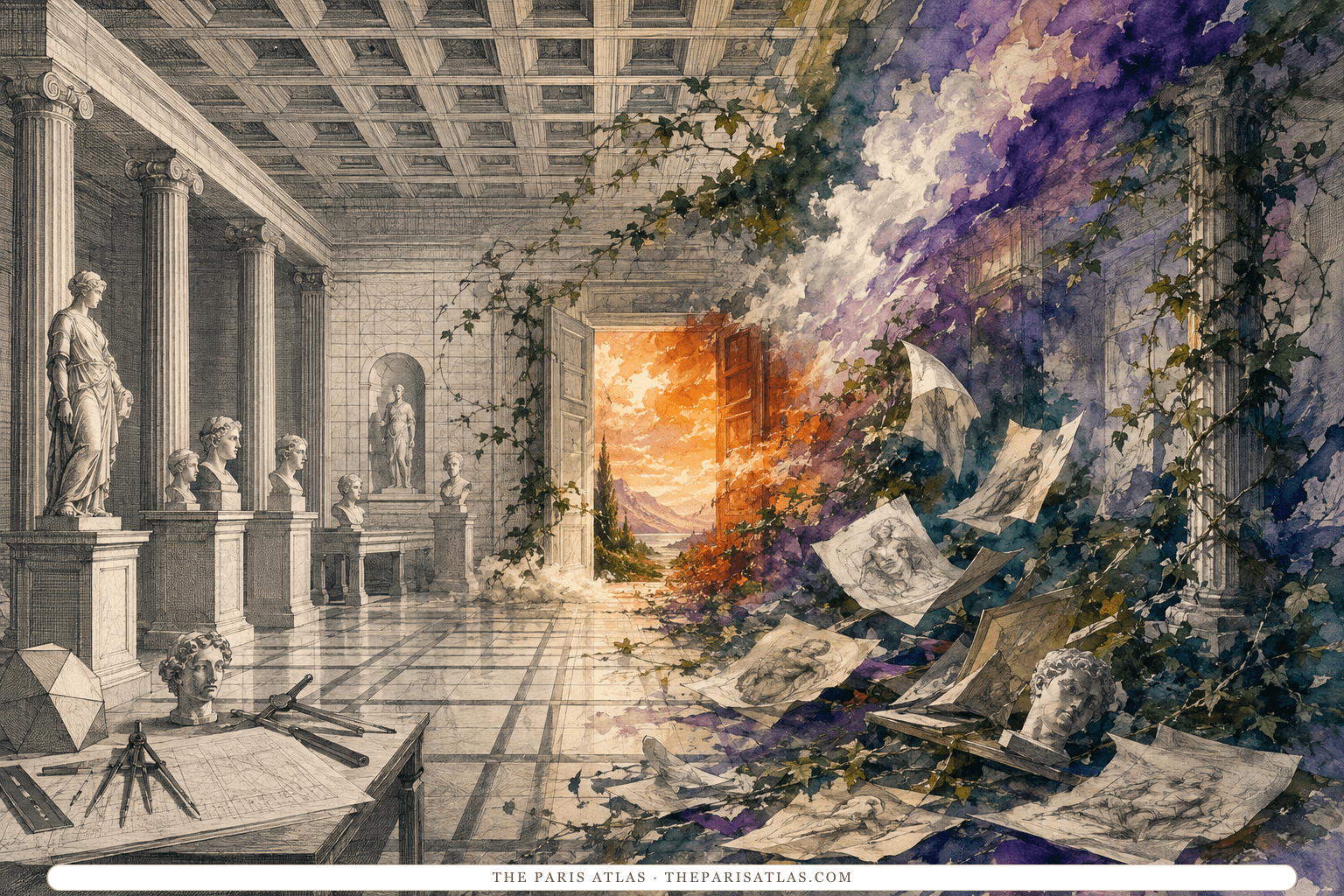
The thing Romanticism pushed against has a name: classicism, the system that still governed French art at the start of the nineteenth century. Classicism took its models from Greece and Rome, prized clear drawing, calm figures and balanced composition, and — crucially — believed that art improved when it followed rules. Those rules were taught by the state's own art school, enforced by the jury of the Salon, the official exhibition that decided which paintings the French public saw, and defended at the Comédie-Française, the state theatre.

In the theatre the rules were explicit. A serious play was supposed to obey the three unities inherited from the seventeenth century: one action, in one place, inside one day. Tragedy and comedy did not mix. Kings spoke in verse of a particular kind, and the vocabulary of ordinary life stayed off the stage.

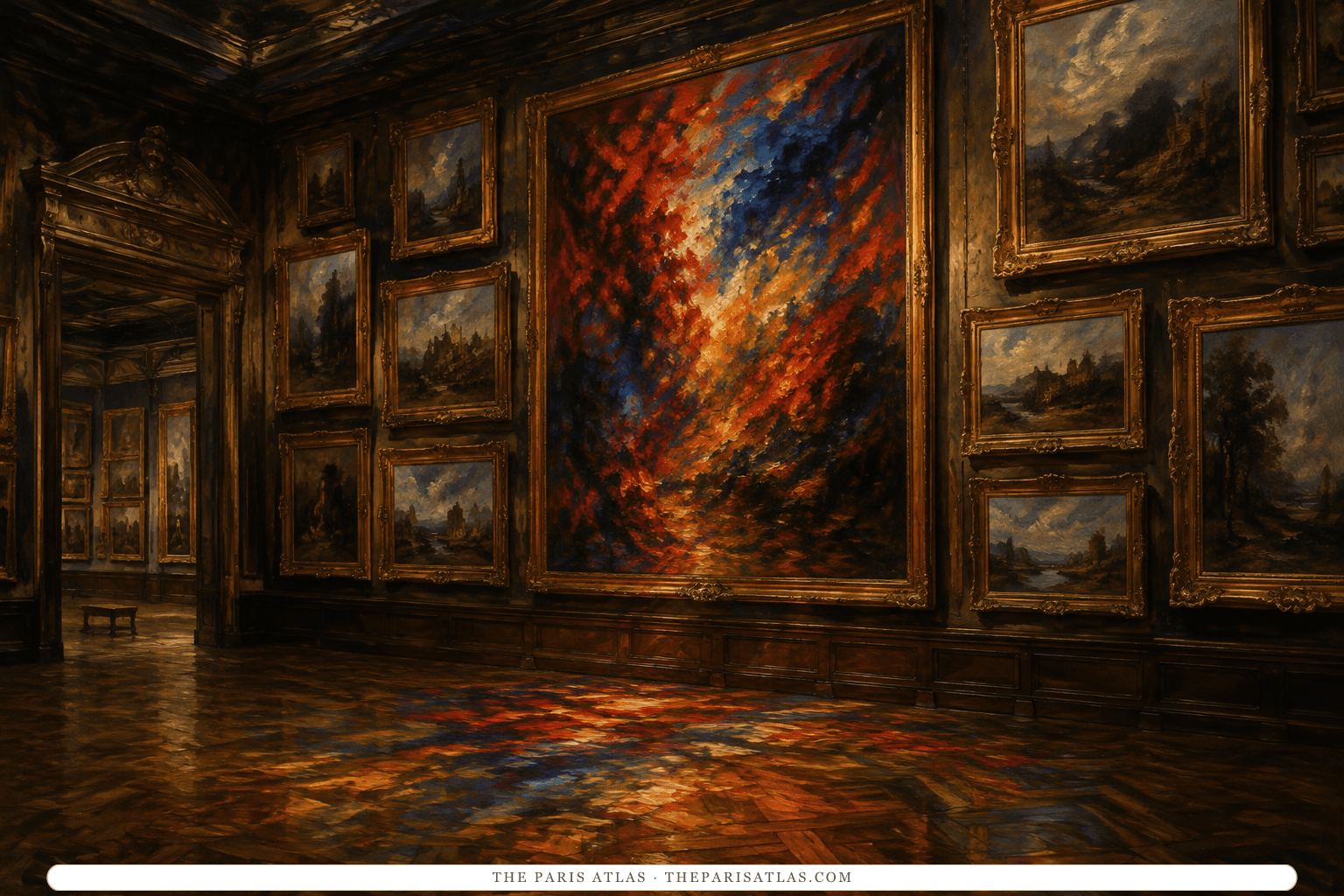
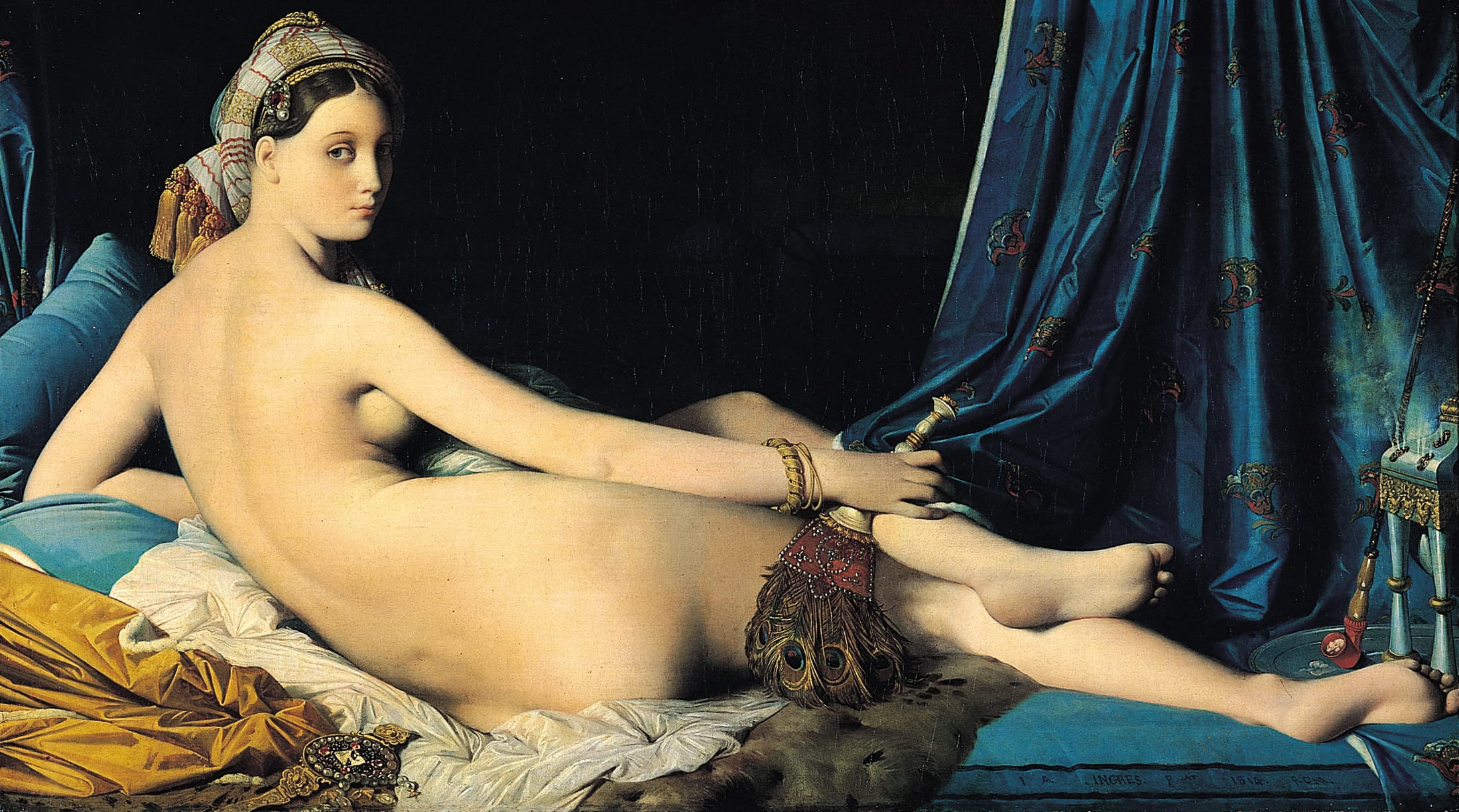
In painting, the argument came down to line against colour. The classical side, led by Jean-Auguste-Dominique Ingres, held that a picture is built on drawing: a firm outline first, everything else in its service. Eugène Delacroix built pictures out of colour, movement and visible brushwork, and chose subjects that were violent, foreign, literary or lifted from that month's news. The quarrel was fought in the press and at the Salon for thirty years, which is why so much writing about nineteenth-century French painting is organised as a contest between the two.

Comédie-Française

The battle of Hernani, 25 February 1830

The manifesto came first. In 1827 Victor Hugo, then twenty-five, published a play called Cromwell with a long preface attacking the classical rules — there are, he wrote, neither rules nor models — and arguing that art should be free to hold the grotesque and the sublime in the same frame. Nobody staged the play. Everybody read the preface. Théophile Gautier, who was a schoolboy when it appeared, later said it shone in their eyes like the tablets of the law on Sinai.

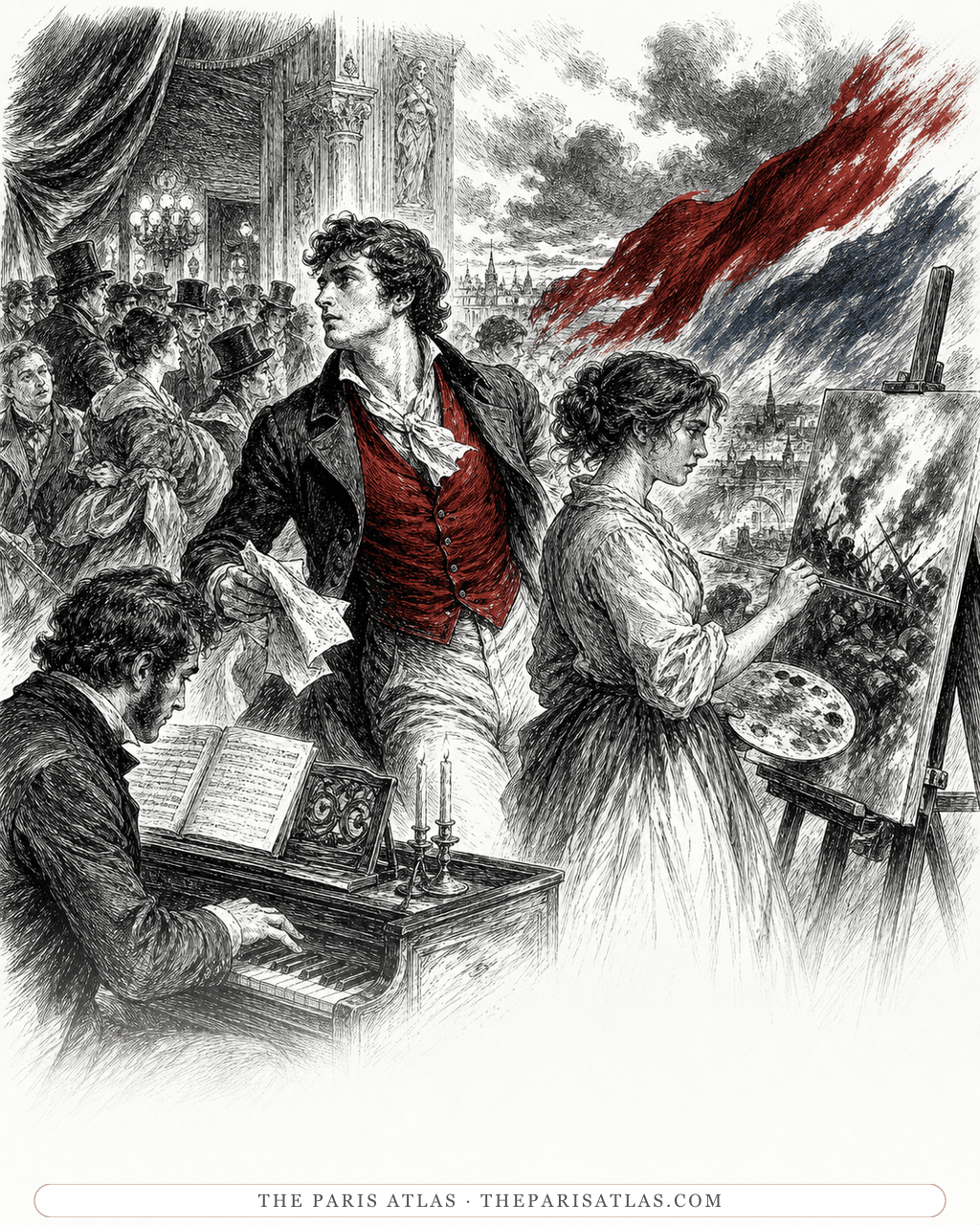
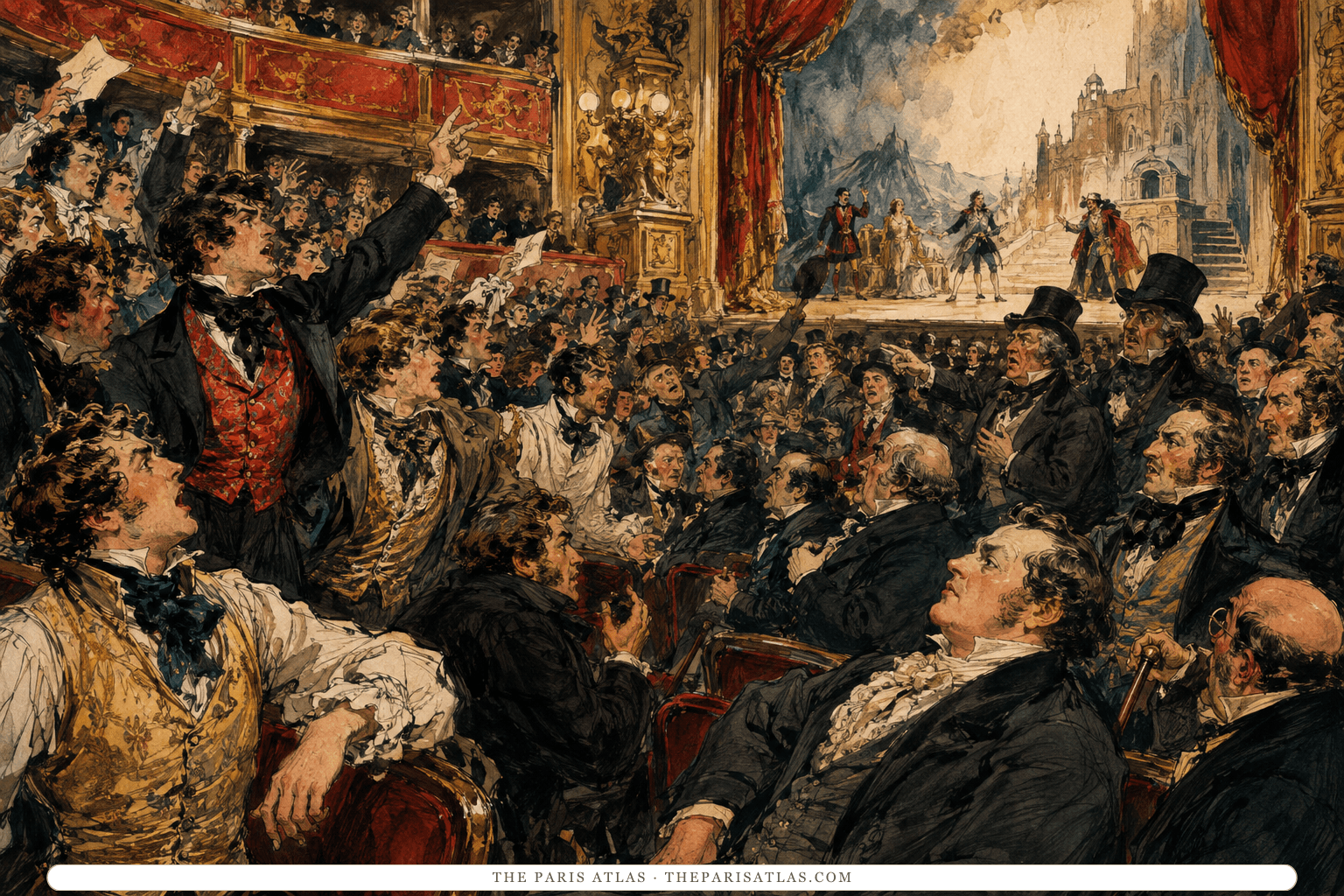
The argument was settled three years later, in a theatre, by a crowd. Hugo's play Hernani opened at the Comédie-Française on the evening of 25 February 1830. It broke the unities, put an outlaw at its centre, and ran its verse across the line-endings in ways that offended people who cared about such things. Hugo's supporters filled the house to shout down the traditionalists who had come to hiss: Gautier in a red waistcoat, the novelist Honoré de Balzac, the poet Gérard de Nerval and the composer Hector Berlioz among them.

From the fourth act, set in Charlemagne's tomb, the Romantics had the room. The evening has been known ever since as the bataille d'Hernani, the battle of Hernani, and the noise went on through the performances that followed. It was a real victory and a temporary one: by 1850 the plays of Hugo's generation were losing the stage to bourgeois drama.

1822–1831

Delacroix at the Salon

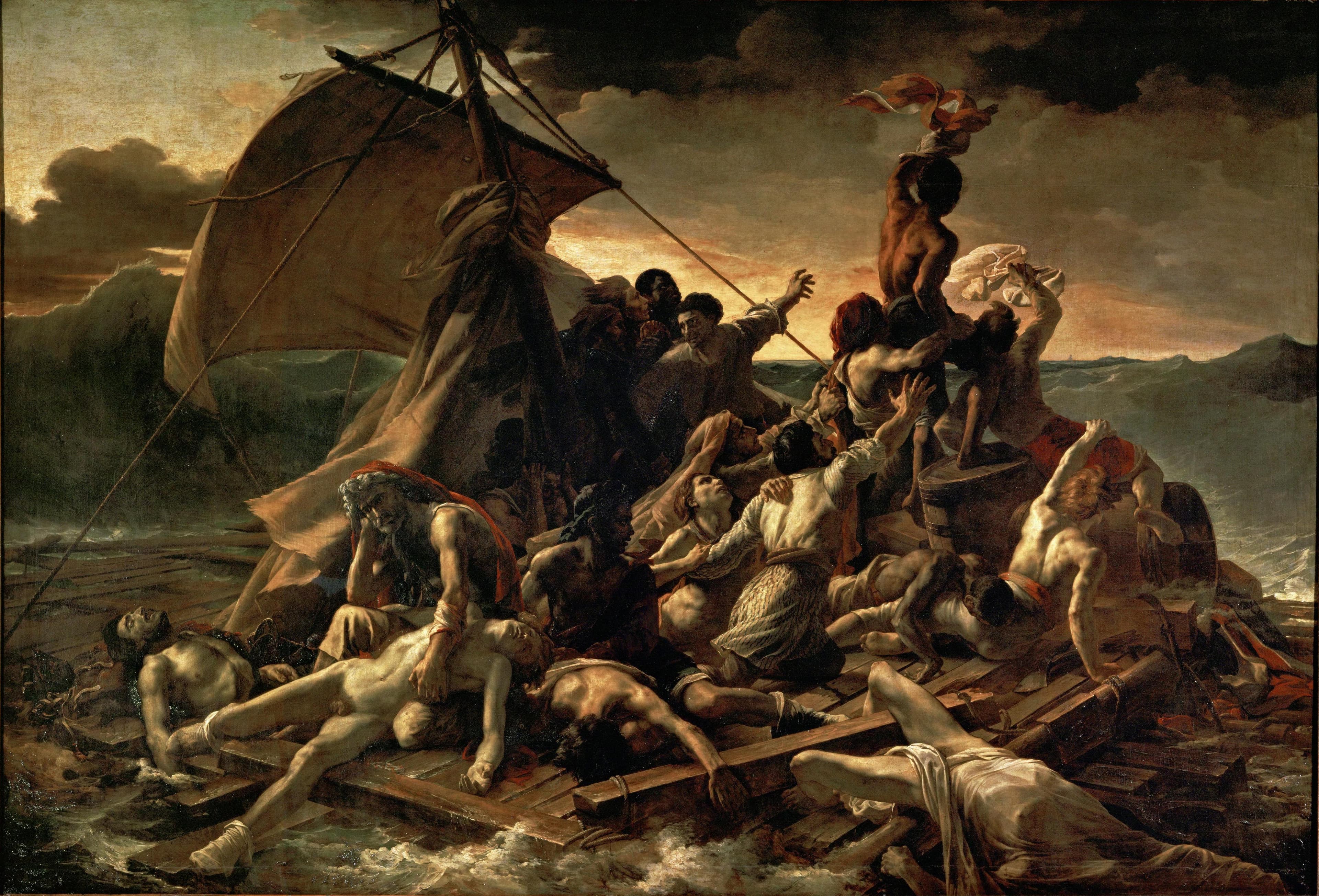
Eugène Delacroix arrived through the same door, one Salon at a time. He entered the studio of the painter Pierre-Narcisse Guérin in 1815, and modelled for Théodore Géricault's The Raft of the Medusa — the 1819 canvas of survivors on a makeshift raft from a French shipwreck, painted at the size normally reserved for history, which the Louvre still shows as the opening of Romanticism in French painting. Delacroix's own debut came in 1822 with Dante and Virgil in Hell. The Massacre at Chios followed in 1824, taken from the war then being fought for Greek independence — the war Byron died in that same year — and The Death of Sardanapalus in 1827, taken from a play by Lord Byron. That last picture fixed him as Romanticism's standard-bearer and gave the classical school something to aim at.

Then the street supplied a subject. In July 1830 three days of fighting in Paris brought down Charles X and put Louis-Philippe on the throne. Delacroix painted the barricades between September and December of that year: a bare-breasted allegorical figure of Liberty carrying the tricolour over the dead, with a factory worker, a boy with two pistols and a man in a top hat behind her. The Louvre's record of the picture is exact about what happened next. The jury admitted it on 13 April 1831; it hung at that year's Salon, which ran from 1 May to 15 August, as number 511; and the State bought it in August for three thousand francs. Its full title is still Le 28 juillet 1830. La Liberté guidant le peuple — the date first, then the allegory.

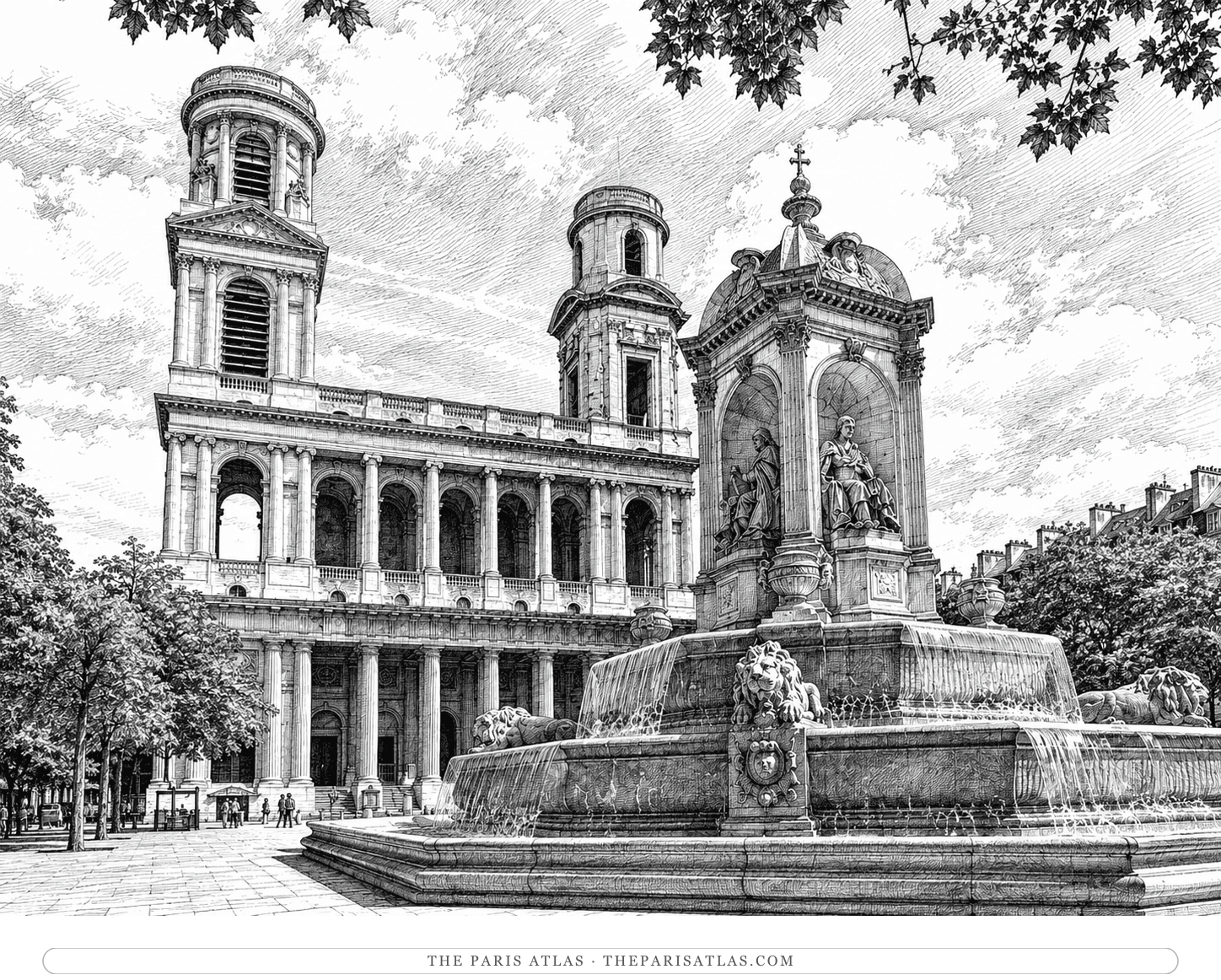
The rest of his life was Paris work. He went to Morocco with a French diplomatic mission in 1832 and came back with material for the next thirty years. From 1849 to 1861 he painted the chapel of the Holy Angels in the church of Saint-Sulpice, including Jacob Wrestling with the Angel. He died on 13 August 1863 in his apartment on the rue de Furstemberg, which is now the Musée national Eugène-Delacroix.

La Nouvelle Athènes, 1830s

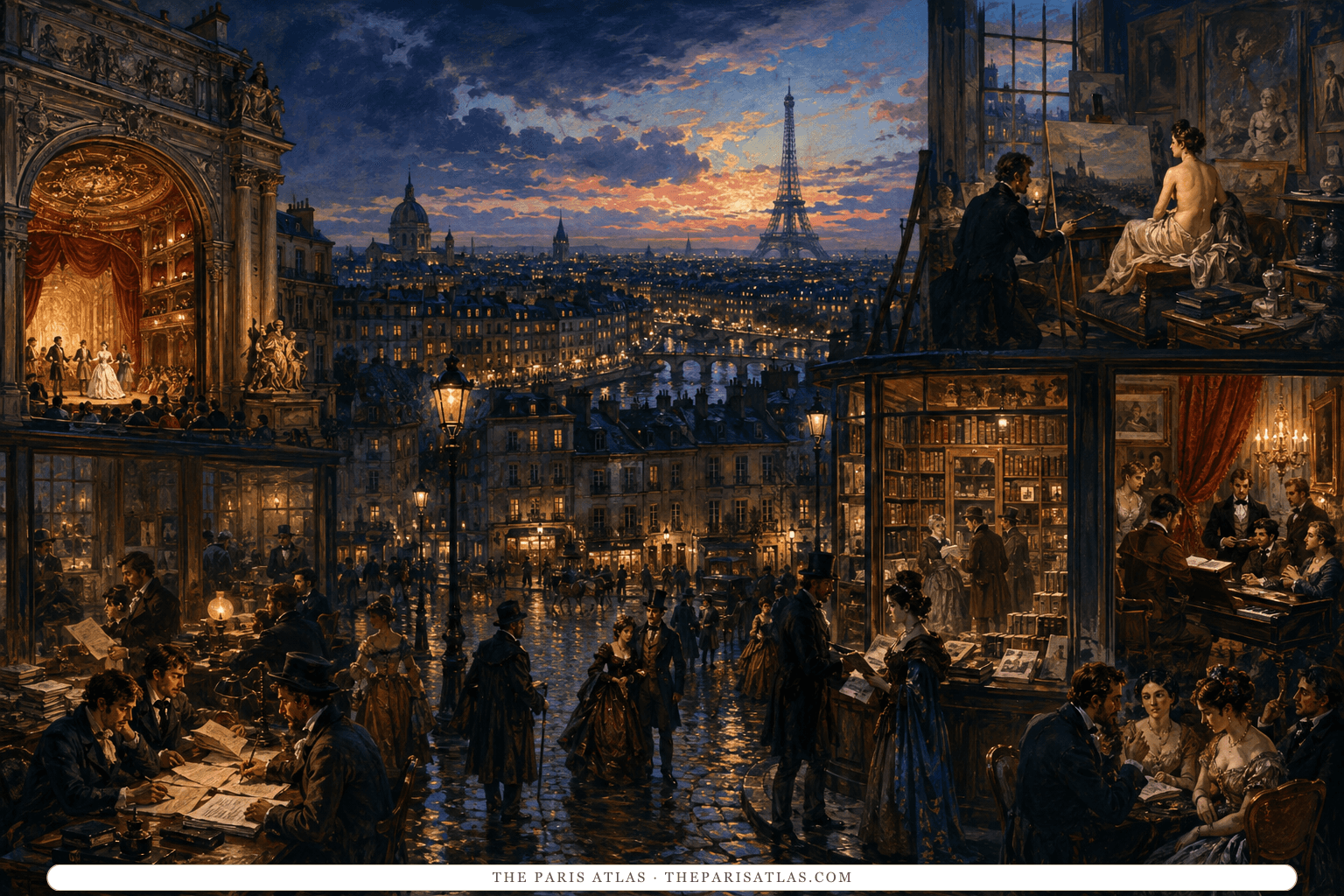
Paris, capital of Romanticism

The movement had a Paris address, and it was not on the left bank. The Nouvelle Athènes — a quarter of neoclassical houses in what is now the 9th arrondissement, north of the grands boulevards — filled in the 1820s and 1830s with painters, writers and actresses, close to the newspapers and theatres that paid them.

On 17 July 1830, days before the revolution, the Dutch-born painter Ary Scheffer took a nine-year lease on a house at 16 rue Chaptal, and worked there until his death in 1858. Every Friday he opened it. The people who came through include Eugène Delacroix, George Sand, Frédéric Chopin, Franz Liszt, the singer Pauline Viardot, the poet Alfred de Musset and Théophile Gautier. The house is now the Musée de la Vie romantique, run by the City of Paris.

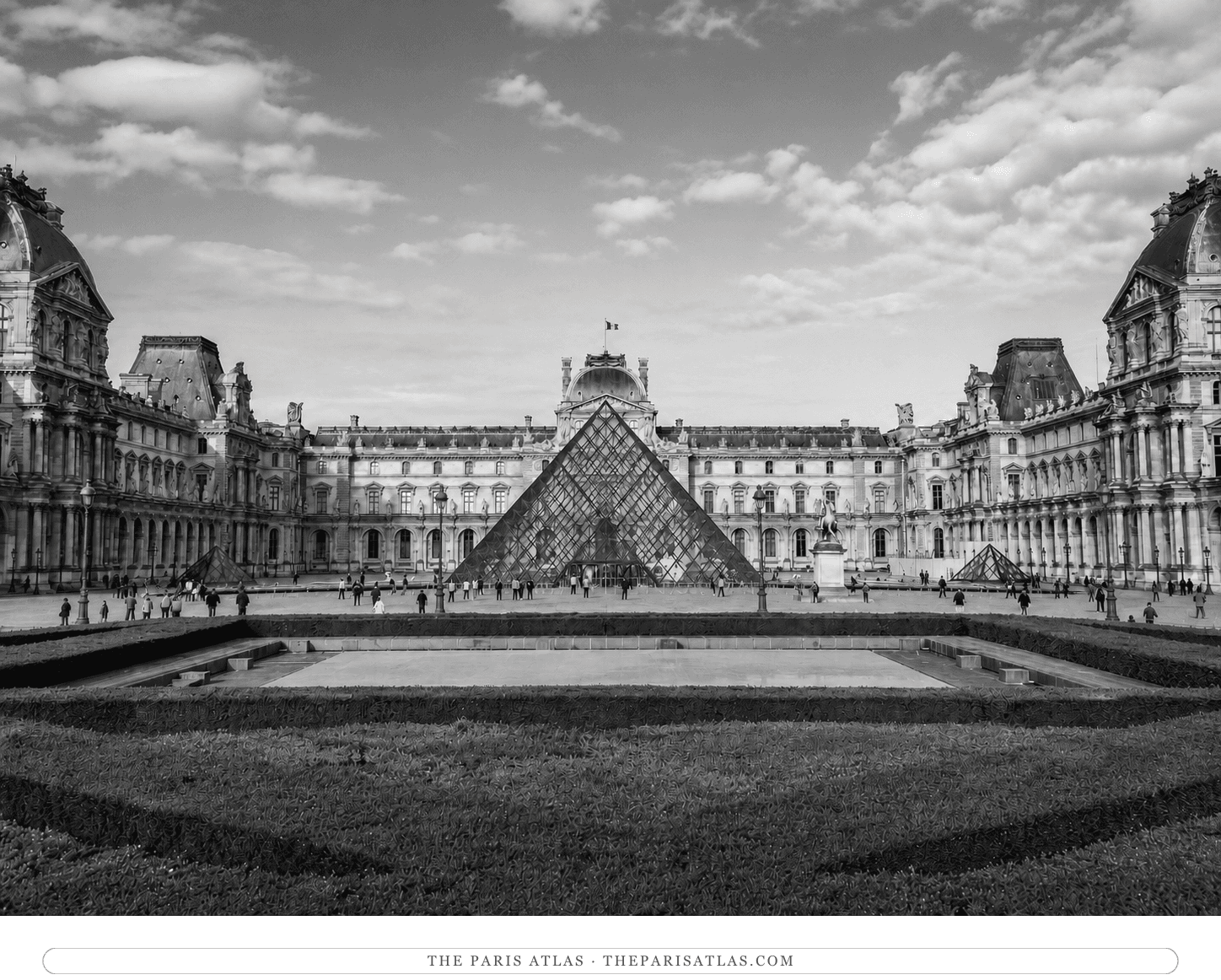
Two streets and one square carry the rest of it. Victor Hugo lived on the second floor of the Hôtel de Rohan-Guéménée on the place des Vosges from 1832 to 1848, and the apartment opened as a museum on 30 June 1903, founded by his friend and literary executor Paul Meurice. Delacroix's studio on the rue de Furstemberg is a museum too. And Liberty Leading the People hangs in the Louvre, ten minutes' walk from where the barricades in it were built.

Who carried it in France

Victor Hugo is the centre of the French account. He wrote the manifesto, won the theatre fight, produced the novels — Notre-Dame de Paris in 1831, known in English as The Hunchback of Notre-Dame, and Les Misérables in 1862 — and turned the movement's language of liberty into a political career, nineteen years of which he spent in exile for opposing the emperor Napoleon III. When he died in 1885, Paris gave him a state funeral and the Panthéon.

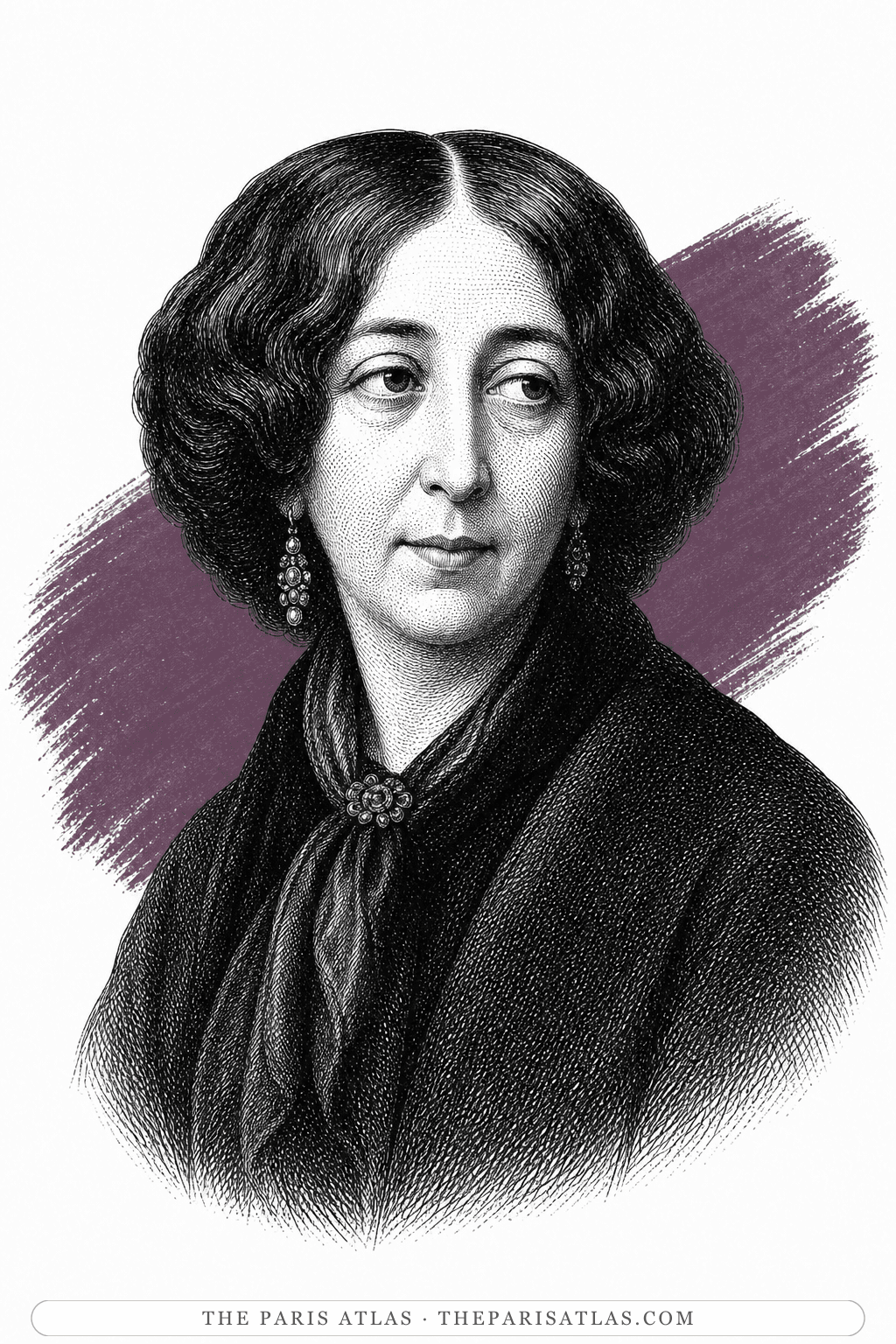
Around him: Alphonse de Lamartine, the poet of intimate meditation who became a politician in the revolution of 1848; and George Sand, who published under a man's name and wrote novels that explored human passion while arguing for equality and emancipation, which is why the museum calls her romanticism social and feminist at once.

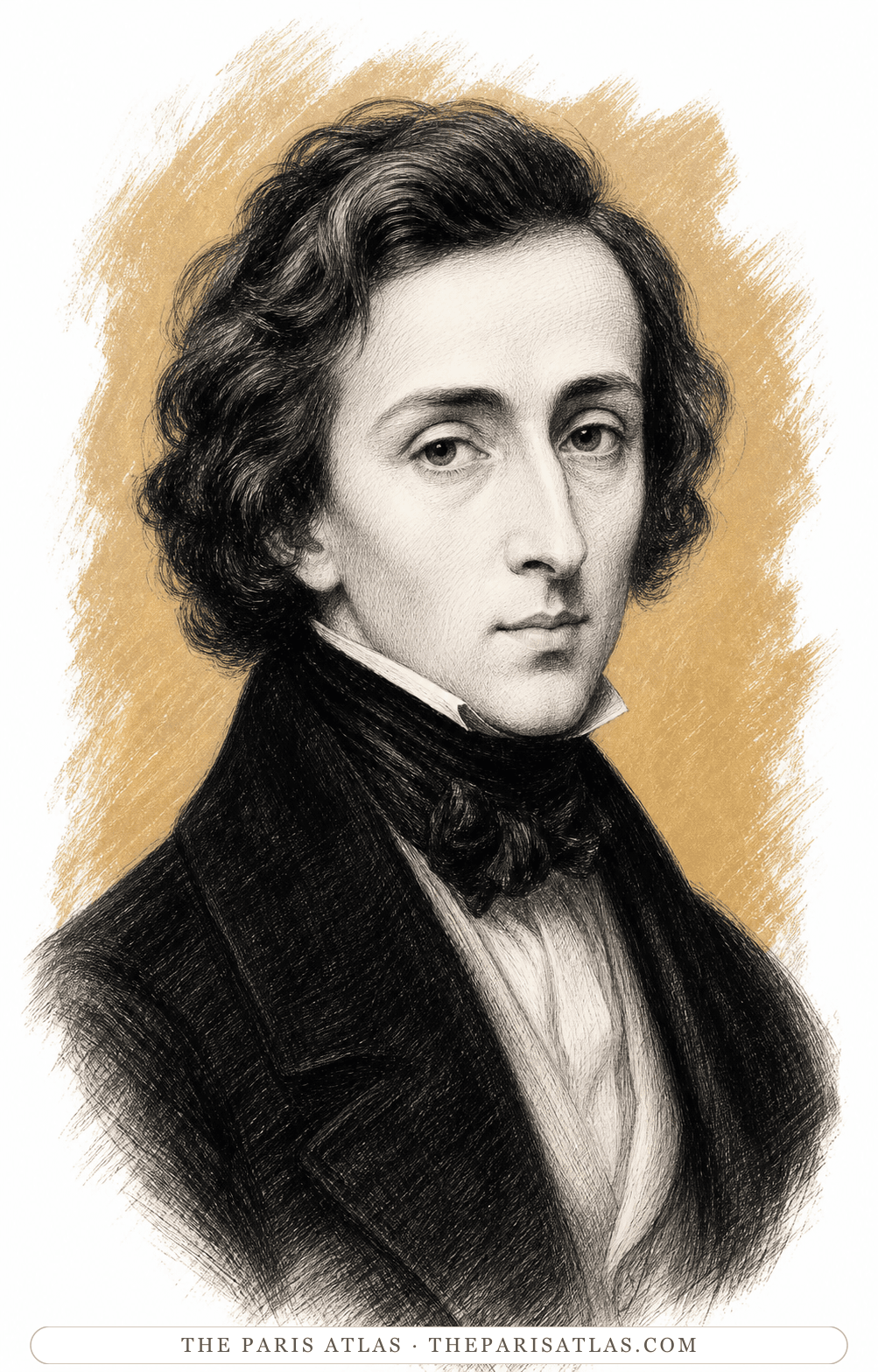
In painting the French pair are Delacroix and Géricault, who died at thirty-two in 1824 and is buried under a bronze relief of his own Raft at Père-Lachaise. In music, the two pianists of the movement, Chopin and Liszt, were regulars at the rue Chaptal evenings; Chopin died in Paris in 1849 and is buried at Père-Lachaise as well.

In the atlas's catalog

The movement's works cataloged so far, from the holding institutions' records. Reproductions appear only where the rights are verified.

Théodore Géricault's Raft of the Medusa: dead and living shipwreck survivors crowded on a timber raft, rising toward a Black man who waves cloth at a tiny rescue ship on the horizon

Artwork reproduction

Painting · French Romanticism

The Raft of the Medusa

Théodore Géricault · 1818–1819 · Oil on canvas

Théodore Géricault made this monumental painting from a recent French naval disaster. It shows the survivors of the Méduse raft trying to signal the distant rescue ship Argus after nearly two weeks at sea.

Théodore Géricault, The Raft of the Medusa, 1818–1819. Musée du Louvre, Paris. Image: public domain.

Follow it through the atlas

Timeline

  1. 1774

    Goethe publishes The Sorrows of Young Werther in Germany; the Sturm und Drang gives the coming movement its first mass audience.

  2. 1819

    Théodore Géricault shows The Raft of the Medusa at the Salon — a recent shipwreck painted at the scale of history, with the young Delacroix posing for one of the figures.

  3. 1824

    Delacroix exhibits The Massacre at Chios, taken from the Greek war of independence then being fought — the war in which Byron died that year.

  4. 1827

    Hugo publishes Cromwell with the preface that attacks the classical unities and becomes the movement's manifesto; Delacroix shows The Death of Sardanapalus, taken from a play by Byron.

  5. 1830

    25 February: Hernani opens at the Comédie-Française and Hugo's supporters take the house. 17 July: Ary Scheffer leases 16 rue Chaptal. 27–29 July: three days of fighting bring down Charles X.

  6. 1830–1831

    Delacroix paints Liberty Leading the People between September and December; the jury admits it on 13 April 1831, it hangs at the Salon as number 511, and the State buys it in August for 3,000 francs.

  7. 1832

    Delacroix travels to Morocco with a French diplomatic mission; Hugo moves into the place des Vosges, where he will live for sixteen years.

  8. 1849–1861

    Delacroix paints the chapel of the Holy Angels at Saint-Sulpice, his last great commission, while working from the studio on the rue de Furstemberg.

  9. 1858

    Ary Scheffer dies at 16 rue Chaptal, ending the Friday evenings that had gathered Delacroix, Sand, Chopin and Liszt for a generation.

  10. 1885

    Hugo's state funeral carries the last of the Romantic generation to the Panthéon.

  11. 1903–1987

    The movement becomes a museum circuit: Hugo's apartment on the place des Vosges opens on 30 June 1903, and the Scheffer house on the rue Chaptal takes the name Musée de la Vie romantique in 1987.

Romanticism: frequently asked questions

What was Romanticism?

A European movement in art, literature and music, running from the end of the eighteenth century through the nineteenth, that put emotion, imagination and individual freedom at the centre of what art is for. It valued feeling over rules, the artist's own judgement over the training of academies, and subjects drawn from myth, nature, recent politics and private life over the Greek and Roman models the previous system had prescribed.

What was Romanticism reacting against?

Classicism, the system that still governed French art in 1800: models taken from Greece and Rome, clear drawing over colour, and a set of rules enforced by the state's art school, the Salon jury that chose what paintings the public saw, and the Comédie-Française. In the theatre the rules were the three unities — one action, one place, one day — which is exactly what Hugo attacked in 1827 and broke on stage in 1830.

What was the battle of Hernani?

The opening night of Victor Hugo's play Hernani at the Comédie-Française on 25 February 1830, when his supporters packed the theatre to shout down the traditionalists who had come to hiss it. Théophile Gautier led them in a red waistcoat, with Honoré de Balzac, Gérard de Nerval and Hector Berlioz in the crowd. From the fourth act the Romantics had the room, and the evening is remembered as the moment Romantic drama won the French stage.

Who were the main French Romantics?

Victor Hugo above all, as poet, playwright and novelist; Alphonse de Lamartine and George Sand in literature; Eugène Delacroix and Théodore Géricault in painting; Hector Berlioz in music, with Frédéric Chopin and Franz Liszt at the piano in Paris. François-René de Chateaubriand is usually called the father of French Romanticism, a generation before the rest.

Why is Liberty Leading the People a Romantic painting?

Because of what it does with a real event. Delacroix painted it in the months after the three days of street fighting in July 1830 that brought down Charles X, and he mixed an allegorical figure of Liberty with unidealised corpses and a crowd of identifiable Paris types. Its full title puts the date first: Le 28 juillet 1830. La Liberté guidant le peuple. A classical painter would have taken the subject from antiquity; Delacroix took it from the previous summer.

Where can you see Romanticism in Paris?

Liberty Leading the People and The Raft of the Medusa are at the Louvre. The Musée national Eugène-Delacroix occupies the painter's last apartment and studio on the rue de Furstemberg, and his murals are in the chapel of the Holy Angels at Saint-Sulpice. The Maison de Victor Hugo is the apartment on the place des Vosges where he lived from 1832 to 1848. The Musée de la Vie romantique is Ary Scheffer's house at 16 rue Chaptal, where the Friday evenings were held.

When did Romanticism end?

There is no single date. In the French theatre the turn came around 1850, when the plays of Hugo's generation gave way to bourgeois drama; in painting, Realism and then Impressionism took over the argument about what a picture should show. Delacroix went on working until 1863, and Hugo until 1885, so the movement's own people outlived the movement by decades.

Sources

  • Le romantisme
  • Histoire de la maison — Musée de la Vie romantique
  • Cromwell et sa préface
  • Bataille d'Hernani
  • Victor Hugo
  • Musée national Eugène-Delacroix, Biography of Eugène Delacroix (2026)
  • Musée national Eugène-Delacroix, Delacroix at Saint-Sulpice (2026)
  • Le 28 juillet 1830. La Liberté guidant le peuple (RF 129)
  • Musée du Louvre, Romanticism, topicality, sensuality — The Raft of the Medusa (2026)
  • History of the Museum
  • Antonin Louis Neurdein, Funérailles de Victor Hugo : cortège et foule devant l'entrée du Panthéon, 1er juin 1885 (1885)