The Death of Sardanapalus
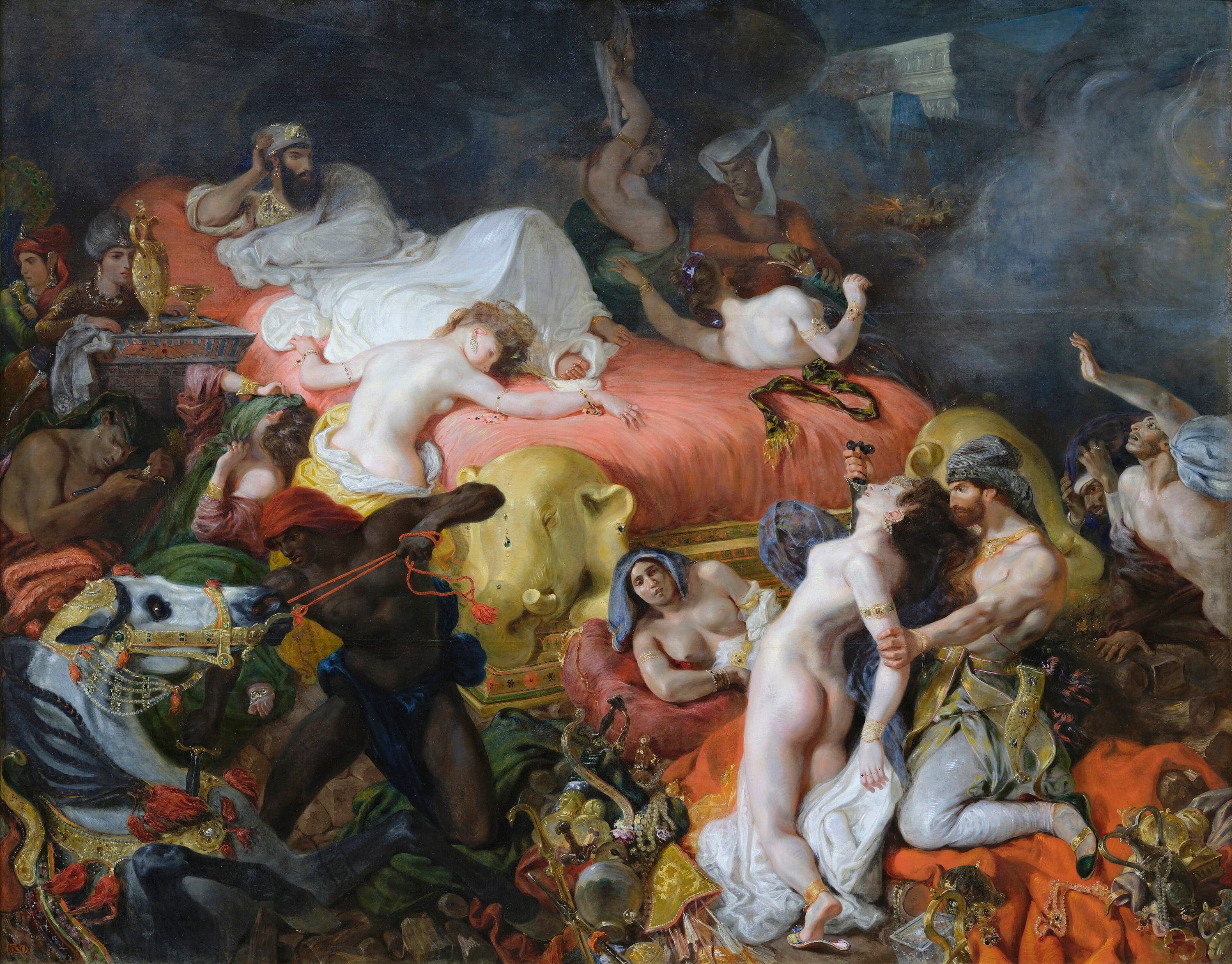
An Assyrian king lies on a red bed and watches his horses, his treasure and the women of his household being killed on his orders. Eugène Delacroix took the subject from Lord Byron's verse tragedy of 1821 and showed the painting at the Salon of 1827. It went badly enough that he kept the canvas for eighteen years before selling it, and the Louvre only bought it in 1921. At 392 by 496 centimetres it is the largest painting he made.
- 1827
- Oil on canvas
About Eugène Delacroix
What the painting shows
Sardanapalus, the last king of Assyria, lies propped on one elbow at the top left of a vast bed hung with red. He is calm and does not move. Everything below him is being destroyed on his instruction. A servant drags a rearing white horse by the bridle. A man pushes a dagger into a woman's chest, and other women lie sprawled across the bedclothes. Gold cups, jewellery and cloth spill down the front of the picture, and the bedpost nearest the viewer is carved as an elephant's head.
The composition runs on a single diagonal from the upper left, where the king is, to the lower right, where the bodies and the treasure pile up. There is no clear floor and no steady light source. Smoke moves across the top left corner. Delacroix gives the viewer no calm place to stand in the picture, and the king's stillness sits oddly against everything happening beneath him.
The canvas is 392 by 496 centimetres, close to thirteen feet by sixteen. It is the largest Delacroix painted, and it hangs in the Salle Mollien of the Denon wing, the room the Louvre keeps for its big Romantic pictures.
Where the subject comes from
Lord Byron published a verse tragedy called Sardanapalus in 1821, and the Musée national Eugène-Delacroix records the play as the painting's source. Byron never came to Paris. His work reached French readers in translation through the 1820s, and Edmond Estève's study of Byron's effect on French Romanticism traces how thoroughly the poems and plays were absorbed by French writers and painters of Delacroix's generation.
The king of the title was a figure from Greek accounts of Assyria rather than the Assyrian record — a ruler said to have burned himself, his household and his possessions rather than surrender a besieged city. Delacroix was twenty-nine when he painted it.
The Salon of 1827 and eighteen years in the studio
The painting was shown at the Salon that opened in Paris in November 1827 and ran into 1828, as number 1630 in the catalogue; the Louvre records it hanging there from February to April 1828. The reception did not lead anywhere. No buyer came forward and no state purchase followed, which for a canvas of this size was a serious outcome — it had cost a great deal to make and there was nowhere to put it.
Delacroix kept it for eighteen years. In July 1846 he sold it to Daniel David Wilson for 6,000 francs. It then moved through the dealer Paul Durand-Ruel, the collector James Duncan of Benmore, and Baron Joseph Raphaël Vitta, who sold it to the Louvre in 1921 for 700,000 francs. The museum's artistic council approved the purchase on 27 June 1921, paid for out of the income from a bequest.
The 2023 cleaning
The painting was off the wall from October 2022 to July 2023 for relining, cleaning, retouching and work on the varnish, and returned to the Salle Mollien in September 2023. The treatment was paid for by Isabelle Ealet-Corbani.
Taking off the old varnish was the point of the exercise. The Louvre describes the result as restoring the range of colour and the variety of surface that earlier treatments had flattened, and notes a practical side effect: the cleaned canvas now makes the paintings hanging around it look too dark. It is one stage of a programme the museum began in 2019 to treat the large Romantic paintings in that room, starting with Delacroix.
Close reading
Reading the work, detail by detail
Everything in the picture slides down and to the right, away from the king. He is the only still thing in it. Reading across the canvas in close view shows how little of the violence Delacroix puts near him, and how much attention the gold and the animals get compared with the people being killed.
1.The king, propped on one elbow
He rests his cheek on his hand and looks down at what he has ordered, without moving. Everyone else in the canvas is straining, falling or being held. Delacroix keeps him in the darkest, quietest corner and paints him more loosely than anything else in the picture.
2.A woman face down across the bed
She lies where the king can see her, already dead or unconscious. The bracelets and the pearl in her hair are painted with the same attention as the gold vessels below. Delacroix does not distinguish between the possessions being destroyed and the people.
3.An elephant's head holds up the bed
The bed stands on gilded elephants. It is the clearest piece of invented Assyria in the painting — Delacroix had never travelled east when he made it, and the setting comes from reading rather than looking. The gold is laid on thickly enough to catch the light in the room.
4.A horse hauled down by the bridle
The horse takes up as much canvas as any person and is painted with more care than most of them. Its eye is the one in the picture showing real panic. The bridle is loaded with pearls and gold plate, so the animal is dressed as treasure and is being destroyed as treasure.
5.A dagger held above a bare throat
This is the only place in the painting where a killing is actually shown in progress. It sits at the far right edge, well away from the king, and is half covered by a blue veil. The composition keeps the violence at the margins and the luxury in the middle.
6.Gold piled at the foot of the canvas
Cups, plate, a glass sphere and loose jewellery are stacked along the bottom of the picture where a foreground figure would normally be. Delacroix gives the objects the front row. It is the part of the canvas closest to the viewer and it holds no people at all.
Timeline
1821
Lord Byron publishes the verse tragedy Sardanapalus, the painting's literary source.
1827
Painted. Shown at the Salon that opens in November as catalogue number 1630; the Louvre records it on the wall from February to April 1828.
1846
Sold in July to Daniel David Wilson for 6,000 francs, after eighteen years in Delacroix's possession.
1921
Bought from Baron Joseph Raphaël Vitta for 700,000 francs; the artistic council approves the purchase on 27 June. Inventoried as RF 2346.
2022–23
Relined, cleaned and revarnished between October and July, funded by Isabelle Ealet-Corbani. Back in the Salle Mollien in September 2023.
Where to see it
Musée du Louvre, département des Peintures
A public viewing address has not yet been confirmed for this holding.
Frequently asked questions
Where is The Death of Sardanapalus?
The Musée du Louvre in Paris, in the Salle Mollien — room 700 of the Denon wing, on level 1, with the Romantic paintings. Its inventory number is RF 2346. It hangs in the same room as Liberty Leading the People.
What story does The Death of Sardanapalus tell?
Sardanapalus, described in Greek accounts as the last king of Assyria, is besieged and decides not to surrender. He has his horses, his treasure and the women of his household destroyed in front of him, and then dies in the fire. Delacroix took the subject from Lord Byron's verse tragedy Sardanapalus, published in 1821.
How big is The Death of Sardanapalus?
392 by 496 centimetres, roughly thirteen feet by sixteen. It is the largest painting Delacroix made, which is part of why failing to sell it at the Salon of 1827 mattered so much.
Why did Delacroix keep The Death of Sardanapalus for so long?
Because nobody bought it. It was shown at the Salon of 1827 and attracted neither a private buyer nor a state purchase, so it stayed with him. He finally sold it in July 1846, eighteen years later, to Daniel David Wilson for 6,000 francs.
When did the Louvre acquire The Death of Sardanapalus?
In 1921, from Baron Joseph Raphaël Vitta, for 700,000 francs. The museum's artistic council approved the purchase on 27 June 1921 and paid for it out of the income from a bequest. The canvas had passed through Daniel David Wilson, the dealer Paul Durand-Ruel and the collector James Duncan of Benmore before that.
Has The Death of Sardanapalus been restored?
Yes, most recently between October 2022 and July 2023, when it was relined, cleaned and revarnished and returned to the Salle Mollien that September. The work was funded by Isabelle Ealet-Corbani and forms part of a Louvre programme begun in 2019 to treat the large Romantic canvases in that room.
More by Eugène Delacroix
If you like Eugène Delacroix
Explore painters from the same movements and circles.

Théodore Géricault
French painter who turned the recent Méduse disaster into a monumental modern history painting and a defining work of French Romanticism.
View artist
Tarsila do Amaral
Brazilian painter who spent the 1920s moving between São Paulo and Paris, studied Cubism under André Lhote, Albert Gleizes and Fernand Léger, and used what she learned to paint Brazilian towns, railways, plants and bodies. Her 1928 painting Abaporu prompted the manifesto that gave the Anthropophagic movement its name.
View artist
Arman
French-American artist, lifelong friend of Yves Klein, and a founder of New Realism.
View artist
References
The sources below include collection records, catalogues, scholarly research, and primary materials that informed this page. They document The Death of Sardanapalus, its making, and its place in cultural history.


1Delacroix — The Death of Sardanapalus
WebsiteMusée du LouvreUsed forWeb source consulted for documented facts and historical context presented on the The Death of Sardanapalus page.

2Sardanapale révélé : cette restauration rend justice à la palette et à l'audace de Delacroix
Official recordMusée du LouvreUsed forOfficial record used to verify names, dates, institutional details, or other factual information on this page.
3Biography of Eugène Delacroix
WebsiteMusée national Eugène-Delacroix, 2026Used forWeb source consulted for documented facts and historical context presented on the The Death of Sardanapalus page.

4Byron et le romantisme francais: essai sur la fortune et l'influence de l'oeuvre de Byron en France de 1812 a 1850
NonfictionHachette, Paris, 1907Used forPublished analysis and historical context used in preparing the The Death of Sardanapalus page.
These references provide the documented foundation for this work's history and interpretation. Claim-level citations remain attached to the specific claims they support.
 Explore more resources