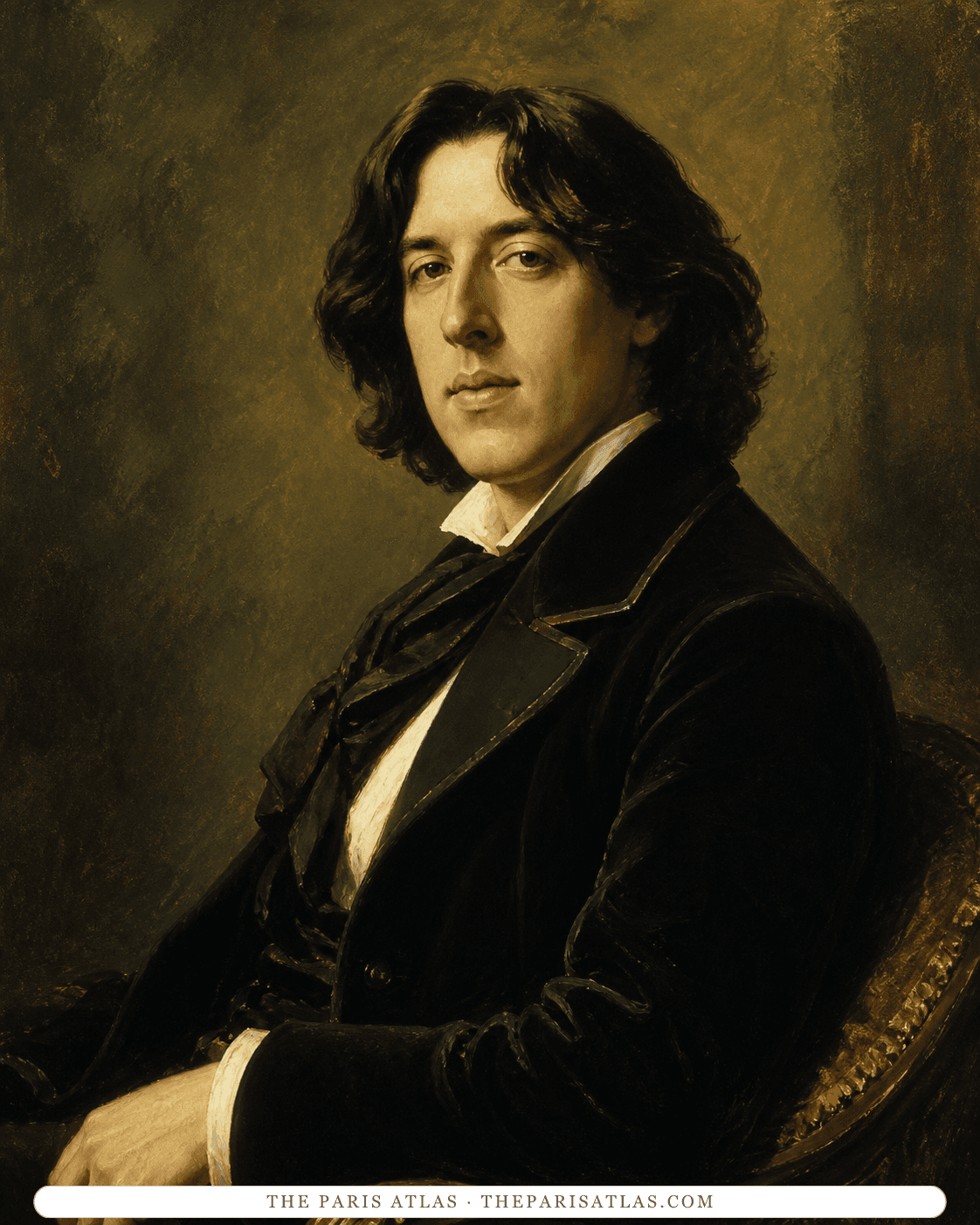

The Ballad of Reading Gaol
A long poem about a prisoner's execution and the institution that makes every person inside share the waiting, fear, shame, and isolation.
Read our take
by Oscar Wilde
Oscar Wilde's first commercial book, a decorated collection shaped by classical myth, Catholic imagery, travel, love, and the Aesthetic movement.
Poems collects the verse Oscar Wilde wrote as a student and young public figure. It includes poems about Greece and Italy, religious doubt, desire, historical figures, and beautiful objects. The book made his name visible before he became a successful playwright, but its borrowed styles also show a young writer still learning from earlier poets — Keats, Milton, Swinburne, and Rossetti are all audibly present in the diction and metre.
Wilde paid to have Poems produced. David Bogue printed a small edition of 250 copies in June 1881 at Wilde's expense — a common Victorian arrangement for a first book of poetry — and a second edition of 250 followed within weeks. Wilde was twenty-six, had just graduated from Magdalen College, Oxford, and was living in London at Keats House on Tite Street with the artist Frank Miles.
The collection helped establish the carefully dressed, publicly quotable figure who would lecture across the United States on art and beauty the following year, but it also records a serious classical education and repeated conflict between pagan beauty and Christian belief. The prize-winning 'Ravenna' (which had won Oxford's Newdigate Prize in 1878) opens the book; sonnets, songs, and longer dramatic pieces fill it out.
The reviews were not kind. Punch published a parody; the Athenaeum called Wilde 'derivative'; and the Oxford Union — the debating society where Wilde had been a member as a student — voted in a notorious 1881 division to return its presentation copy to the author on the grounds that the poems were plagiarised from Wilde's models. The vote was 188 for return, 180 against. Modern editors regard the charge as harsh but not baseless: the collection is a young poet's education displayed in public.
The collection moves among classical landscapes ('Ravenna,' the Greek eclogues, 'The Garden of Eros'), Renaissance and Italian settings ('Rome Unvisited,' 'Sonnet on the Massacre of the Christians in Bulgaria'), Catholic imagery (Wilde was drawn to Rome and Newman throughout his twenties), and personal lyrics addressed or half-addressed to unnamed beloveds.
'Charmides' and 'The Sphinx' (the latter published separately in 1894 and not in this volume) belong to the same Aesthetic-decadent line of long dramatic pieces about beauty and its cost.
Read the 1881 volume as the beginning of Wilde's career and then compare its formal decoration with the plainer prison voice of The Ballad of Reading Gaol seventeen years later — the same poet under conditions that permitted no decoration at all.
Impression du Matin begins by arranging the Thames through color and musical terms, then lets the noise of work interrupt the composition. The barge and country wagons connect the dawn to ordinary movement through the city. Yet the final stanza singles out a woman who does not join that awakening. Her isolation unsettles the busy scene, while the speaker's fiery and stony descriptions turn her into another striking image. The poem makes visible how aesthetic attention can notice someone without knowing her.
La Bella Donna della mia Mente opens with a speaker too exhausted to sing, who asks birds to supply the music of praise. The beloved is assembled through comparisons with plants, fruit and moving water, so that admiration depends on a succession of substitutes. But the final image changes the force of that ornament. The flower exposed to rain suggests vulnerability rather than an untouchable ideal. Love and pain occupy the same body, interrupting the speaker's effort to preserve perfect beauty.
It shows the education and artistic vocabulary behind the later plays and essays.
It is useful context, but The Ballad of Reading Gaol is the stronger first choice for Wilde's poetry.
The 1881 volume was reviewed harshly — the Oxford Union voted to return its presentation copy to the author — and gives the clearest picture of Wilde before he learned his own tone.
1878
'Ravenna' wins Oxford's Newdigate Prize for verse. Wilde delivers the poem publicly in the Sheldonian Theatre.
1879
Wilde leaves Oxford and moves to London.
June 1881
David Bogue publishes Poems in an edition of 250 copies, printed at Wilde's expense. A second edition of 250 follows within weeks.
November 1881
The Oxford Union votes 188–180 to return its presentation copy of Poems on the grounds that the poems are derivative.
1882
Wilde begins his year-long lecture tour of the United States and Canada, giving Poems national visibility.
1892
Wilde publishes a revised edition of Poems, removing some early pieces and adding later work.
1898
The Ballad of Reading Gaol, Wilde's other major book of verse, is published seventeen years after Poems.
A long poem about a prisoner's execution and the institution that makes every person inside share the waiting, fear, shame, and isolation.
Read our take
Four essays and dialogues in which Oscar Wilde argues that criticism is creative, art need not copy life, and a work should not be reduced to a moral lesson.
Read our takeIt is Wilde's first commercial book — a collection of verse written during and after his Oxford years, published by David Bogue in London in June 1881 in an edition of 250 copies Wilde paid for himself. It contains the Newdigate Prize poem 'Ravenna,' the long dramatic piece 'Charmides,' and lyrics, sonnets, and songs across classical, Italian, English, and religious subjects.
Yes. He paid for the first edition of 250 copies. It was a common Victorian arrangement for a first book of poetry from a poet without a track record; Wilde arranged a second edition of 250 within weeks, also at his expense.
In a notorious November 1881 vote, the Oxford Union voted 188 to 180 to return the presentation copy of Poems Wilde had sent them, on the grounds that the poems were derivative of Wilde's models. Modern editors regard the charge as harsh but not baseless — the collection wears its education on its sleeve.
'Ravenna,' which had already won the Oxford Newdigate Prize for verse in 1878, is the collection's opener and the poem that had brought Wilde public attention before the book appeared. 'Charmides,' the long dramatic piece about a young man's desecration of a statue of Athena, is the collection's other most-anthologised piece.
The two volumes are separated by seventeen years, two trials, and a two-year prison sentence. The 1881 Poems is a decorated, allusive, publicly literary collection by a young poet learning from Keats, Milton, and Swinburne. The Ballad of Reading Gaol (1898) is written in a stripped, ballad-metre voice under conditions that permitted no decoration at all. Reading them together gives the clearest picture of what the intervening years did to Wilde's writing.
Yes. Wilde issued a revised edition in 1892 that removed some of the more embarrassing early pieces and added later work; modern Collected Poems editions typically follow post-1892 arrangements rather than the 1881 original. Readers who want the book Wilde actually published in 1881 should choose a facsimile or a scholarly edition of that specific text.
Explore authors with a similar voice, perspective, and influence.
Both writers use style, performance, and social comedy to examine the roles assigned to women, artists, and people whose private lives do not fit public rules.
View author
The doctor of the Paris slums who wrote the century's blackest, funniest novel — and changed the sound of French prose.
View author
The Brooklyn dropout who arrived in Paris broke at thirty-eight and wrote the exuberant, banned books that ended American censorship.
View authorThe sources below include the primary text, editions, scholarship, archival materials, and other records that informed this page. They document Poems, its publication, and its place in literary history.


The primary text represented by this page, used for descriptions of the work’s contents and for any quoted passages shown here.
Two complete lyrics in Robert Ross's 1913 collected text; not a collation with the 1881 edition.

Used to place Poems within Oscar Wilde's published work and verify its bibliographic context.
Used for independent biographical, archival, or historical context surrounding Oscar Wilde's career and the period in which Poems appeared.
Used to cross-check authorship, chronology, and the work's place in Oscar Wilde's wider catalogue.
Used to verify Oscar Wilde's bibliography and place Poems within the broader chronology of Oscar Wilde's career.
The primary text is the baseline reference for every book page. Additional references document publication history, interpretation, and historical context where that evidence is available.
 Explore more resources