The Paris AtlasCharting the artists, works, and places worth returning to.
  • Author
  • Journalist
  • Actor
  • Critic
· French · 1873–1954

Colette

The French novelist who wrote the Claudine books under Willy’s name, earned her independence on the music-hall stage, and made women’s private lives a serious literary subject.

56 books on our shelvesComplete list of Colette books

In images

Details

Lived
1873–1954
Born
28 January 1873
Birthplace
Saint-Sauveur-en-Puisaye, France
Died
3 August 1954 · aged 81
Place of death
Paris, France
Nationality
French
Married
Henry Gauthier-Villars (Willy) · 1893–1910Henry de Jouvenel · 1912–1925Maurice Goudeket · 1935–1954
Partner
Mathilde de Morny (Missy) · c. 1906–1911
Children
Colette de Jouvenel (Bel-Gazou)
Roles
AuthorJournalistActorCritic
Also known as
Sidonie-Gabrielle Colette · Colette Willy · Colette de Jouvenel

About Colette

Colette was a French novelist, journalist, actor, and music-hall performer whose writing changed the portrayal of women’s private lives in modern literature. Born Sidonie-Gabrielle Colette in Burgundy in 1873, she first became famous as the principal writer of the bestselling Claudine novels, initially published only under the name of her first husband, Willy. She left that marriage, supported herself on the Paris stage, and built a second career under her own name.

Best known internationally for Gigi, Colette also wrote The Vagabond, Chéri, The House of Claudine, The Ripening Seed, Sido, and The Cat. Her prose is admired for its sensual exactness, psychological control, and attention to desire, aging, independence, animals, gardens, and the physical world. By the end of her life she had become the first woman to preside over the Académie Goncourt and had received national funeral honours.

Colette, illustrated

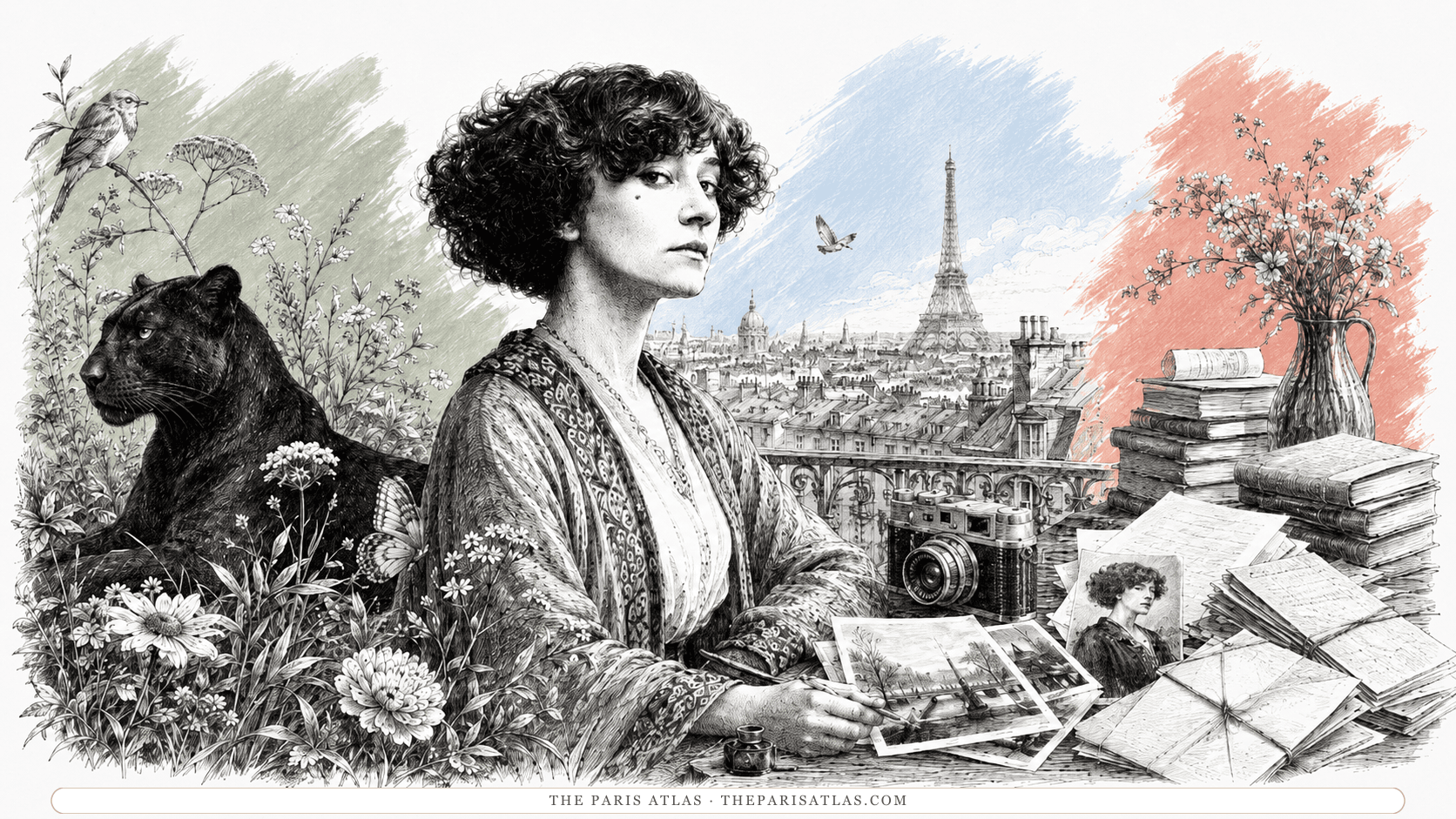
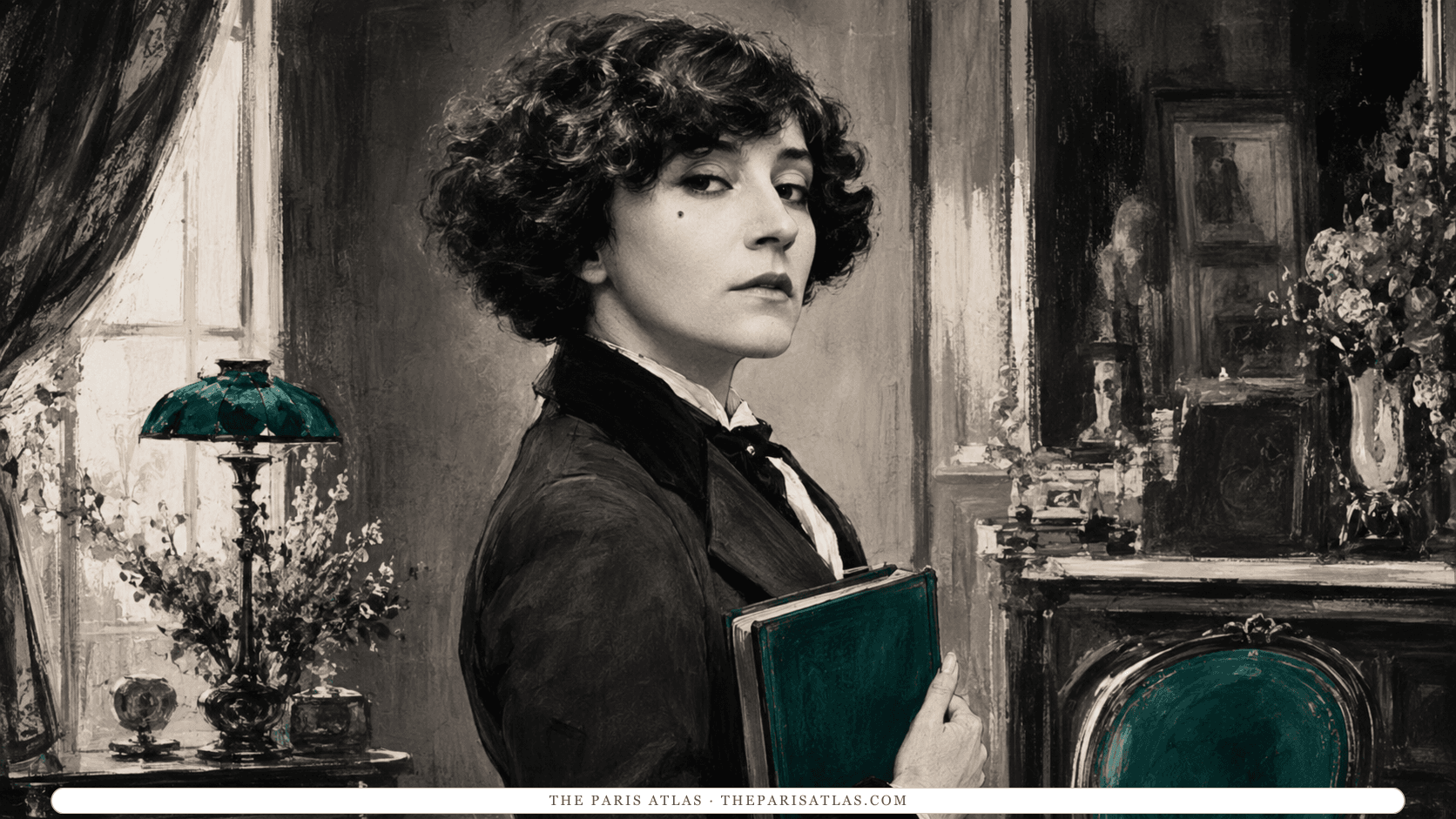
Scenes from Colette’s life, drawn for The Paris Atlas. These are original editorial illustrations, not documentary photographs.

Colette in Paris.
Colette and Missy walking in Paris.
Colette at a Paris café.
Colette onstage.
The Claudine collars and boxed goods.
Claudine perfume, soap, and cigarettes.
Reading on the chaise longue.
At the desk by the window.
With a cigarette, over an open book.
Illustrations — The Paris Atlas

Burgundy, Sido, and the lost house

Sidonie-Gabrielle Colette was born on 28 January 1873 in Saint-Sauveur-en-Puisaye, a village in Burgundy. Her father, Jules-Joseph Colette, was a former army captain. Her mother, Adèle Eugénie Sidonie Landoy, always called Sido, became the central figure of Colette’s childhood and later writing.

Colette, seated at center, with her parents and siblings around 1880. Her mother Sido and the family home in Burgundy later became central subjects in her writing. (Unidentified photographer, via Wikimedia Commons · Public domain)

Sido taught her daughter to attend closely to weather, plants, animals, and the changing seasons. That training remained visible throughout Colette’s work. Gardens, fur, food, temperature, and light are rarely background detail in her fiction; they register how a character understands a room, another body, or a change in mood.

Financial trouble forced the family to leave Saint-Sauveur in 1891. Colette repeatedly returned to the house and garden in The House of Claudine and Sido. Memory did not make the childhood home a factual inventory. She rebuilt it as a literary place where family character, natural observation, and loss could be examined together.

Her name: Sidonie-Gabrielle Colette

Colette is a pen name in the plainest possible form: her own surname. She was born Sidonie-Gabrielle Colette on 28 January 1873, and Colette was her father’s family name. She published first under Willy’s name, then as Colette Willy and Colette de Jouvenel, before settling on the single word readers now use. It is spelled with one l, not two: Colette, not Collette.

As a given name, Colette is a French diminutive of Nicole, from the Greek Nikolaos, “victory of the people”; Saint Colette of Corbie, born Nicolette Boellet in 1381, fixed the short form as a name in its own right. The writer, though, was not given it as a first name at all. Her first names were Sidonie and Gabrielle — the name that made her famous was a surname she chose to keep.

Willy, Claudine, and the missing name

In 1893, at twenty, Colette married the Parisian music critic and literary entrepreneur Henry Gauthier-Villars, universally known by his pen name, Willy. He was fourteen years older and ran an established writing business in which assistants produced books, reviews, and columns published under his recognizable name.

Colette and Henry Gauthier-Villars, known as Willy, around 1900, the year Claudine at School appeared under his name. (Unidentified photographer, via Wikimedia Commons · Public domain)
Colette, Willy, and Toby. (Illustration — The Paris Atlas)

At Willy’s suggestion, Colette turned her memories of school into Claudine at School. The novel appeared in 1900 under the single name “Willy” and became a sensation. Claudine in Paris, Claudine Married, and Claudine and Annie followed. The books drew on Colette’s experience and voice, while Willy controlled the public brand, the publishing relationships, and much of the income.

The authorship history changed gradually. Colette began signing other work as Colette Willy in 1904. From 1909, editions of the Claudine books credited “Willy et Colette Willy.” She is now recognized as their principal writer, but it would be inaccurate to say that the early publication record simply changed from his name to hers alone.

An illustrated 1903 edition of Claudine à l’école. The cover credits only Willy, although Colette was the principal writer. (Société d’Éditions Littéraires et Artistiques, scan via Wikimedia Commons · Public domain)

Willy did not only publish Claudine; he merchandised her. The character became one of the earliest modern examples of literary brand licensing, her schoolgirl image printed on and sold as a range of consumer goods:

  • Perfume, soaps, and lotions.
  • Cigarettes.
  • “Claudine collars” and clothing cut to the schoolgirl look.
  • Lingerie and other goods carrying her name.

He also promoted the books with the women themselves. When Claudine reached the stage, the title role went to the actress Polaire, who wore the character’s cropped hair, white collar, and schoolgirl smock offstage as well as on. Willy then had Colette cut her hair to match and appeared in public with the two of them dressed identically, presenting them as his “twins” and letting the pairing suggest more than a resemblance. Promotional photographs of Colette and Polaire in matching collars and bobbed hair kept the novels visible while binding Colette’s identity ever more tightly to her husband’s commercial invention.

The music hall and Missy

Colette separated from Willy in 1906 and needed an income she controlled. For roughly six years she worked as an actor, dancer, and mime in Paris music halls and on tour. The work was physically demanding and often insecure. It also gave her direct knowledge of dressing rooms, touring companies, exhausted bodies, and the economics of performance.

Colette and Mathilde de Morny, known as Missy, in theatrical costume in 1906, during Colette’s first year as a professional stage performer. (Anthony and Cautin-Berger, via Gallica/BnF · Public domain)

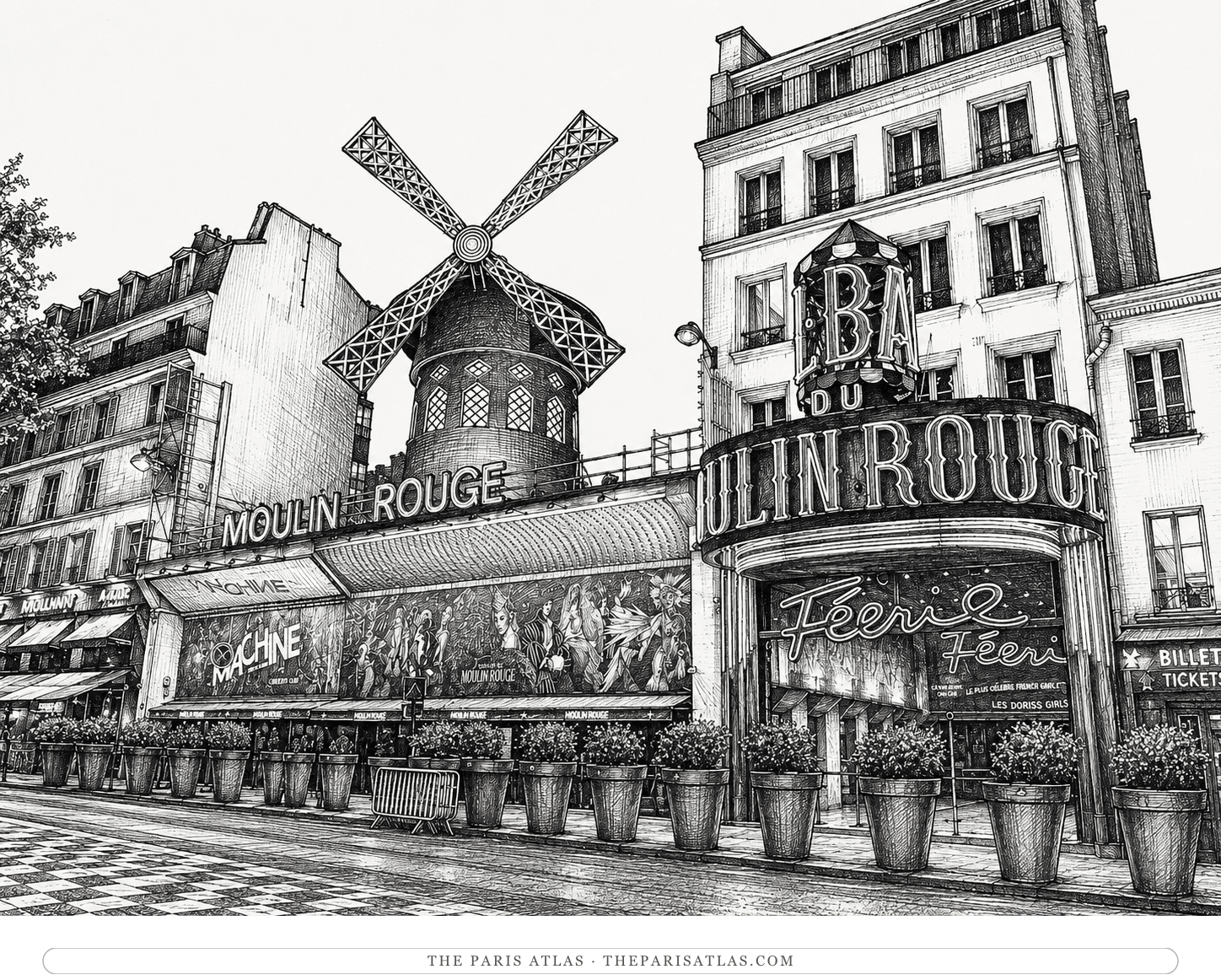
Her partner during this period was Mathilde de Morny, Marquise de Belbeuf, known as Missy. Missy wore masculine clothing, supported Colette materially and emotionally, and performed beside her. At the Moulin Rouge in January 1907, their onstage kiss in the pantomime Rêve d’Égypte provoked an uproar; the police prevented the original production from continuing.

Colette and Missy at the music hall. (Illustration — The Paris Atlas)
Colette performing in Rêve d’Égypte in 1907. Her onstage kiss with Missy at the Moulin Rouge caused an uproar and the original production was stopped. (Léopold-Émile Reutlinger, via Wikimedia Commons · Public domain)

The stage was both a public declaration of independence and a job. Colette later used its practical details in The Vagabond and The Other Side of the Music Hall. The Vagabond’s divorced performer, Renée Néré, must decide whether romantic security is worth surrendering the autonomy she has acquired through work.

Colette performing. (Illustration — The Paris Atlas)

Women, desire, and The Pure and the Impure

Colette’s relationships with women ran through her adult life, alongside her marriages. During the Willy years she had an affair with the American Georgie Raoul-Duval, a liaison Willy ended up sharing. When she left Willy she lived for a time with the American writer and salon host Natalie Clifford Barney, and the two stayed friends until her death. The central relationship was with Mathilde de Morny, known as Missy, through the music-hall years.

She made this material into literature most directly in The Pure and the Impure (Le Pur et l’impur), a set of conversations about desire, jealousy, and love between women among the demimonde she had known. It first appeared in 1931–32, serialized as Ces plaisirs until scandalized readers cut it short, and she revised it under her preferred title in 1941. Colette thought it her best book, and called it “the nearest I shall ever come to writing an autobiography.”

She resists a single label: she married three men and loved women, and her writing treats desire between women as ordinary human experience rather than as scandal or tragedy. The Pure and the Impure appeared only four years after Radclyffe Hall’s The Well of Loneliness had been banned.

Journalism, Henry de Jouvenel, and Bel-Gazou

Colette began writing regularly for Le Matin in December 1910. Journalism sharpened the speed of her observation. She reported on trials and public events, wrote criticism, and described rooms, clothes, gestures, and social types without treating newspaper work as separate from literary craft.

Colette in conversation at a café. (Illustration — The Paris Atlas)
Colette’s professional press card, displayed beside her Legion of Honour card. Journalism remained a substantial part of her working life. (FreCha, via Wikimedia Commons · CC BY-SA 4.0)

At the newspaper she met its editor Henry de Jouvenel, whom she married in December 1912. Their daughter, Colette de Jouvenel, called Bel-Gazou, was born in 1913. During the First World War, Colette continued to produce journalism, wartime observations, and fiction while Jouvenel moved through journalism, diplomacy, and politics.

Sem’s lithograph of Colette with her daughter Colette de Jouvenel, known as Bel-Gazou. (Georges Goursat, known as Sem, Bibliothèques de Paris · Public domain)

The marriage deteriorated in the early 1920s. Colette began a relationship with Jouvenel’s teenage son Bertrand, a troubling episode that belongs in the biography without being converted into a neat explanation for her fiction. Her divorce from Henry was pronounced in April 1925.

A major writer in her own name

The Vagabond, published in 1910, established the terms of Colette’s independent career. Chéri followed in 1920 and made her standing harder to dismiss. Its relationship between Léa, an aging former courtesan, and a much younger man is examined through habit, vanity, desire, dependency, and the knowledge that time changes the value society assigns to a woman’s body.

Colette in 1932, during the decade of Sido and The Cat. (Agence Mondial Photo-Presse, Bibliothèque nationale de France · Public domain)
The 1920 French title page of Chéri, the novel that consolidated Colette’s standing as a major writer. (Arthème Fayard edition, BEIC and Internet Archive scan · Public domain)
  • The House of Claudine (1922) — linked stories that reconstruct the Burgundy childhood and family home.
  • The Ripening Seed (1923) — an unsentimental account of adolescent sexuality and unequal experience.
  • The End of Chéri (1926) — the consequences of age, war, and emotional immaturity after the earlier novel.
  • Break of Day (1928) and Sido (1930) — books in which memoir, self-portrait, and fiction continually exchange places.
  • The Cat (1933) — a marriage disturbed by a husband’s attachment to his cat, observed without reducing the animal to a symbol.
  • Gigi (1944) — the Paris novella that became her most widely adapted work.
Colette walking in Paris with a book. (Illustration — The Paris Atlas)
A signed copy of La Chatte with Colette’s inscription and the paw print of one of her cats, displayed in the BnF’s Les mondes de Colette exhibition. (FreCha, via Wikimedia Commons · CC BY-SA 4.0)

Colette repeatedly drew from her own life, but autobiography was material rather than a guarantee of literal truth. She rearranged experience, divided aspects of herself among characters, and used remembered scenes to test what a person can know about desire, age, jealousy, and freedom.

Colette writing with a cat nearby. (Illustration — The Paris Atlas)

Colette’s writing style

Colette’s writing is known for sensual precision, psychological insight, and close attention to the physical world. Rather than depending on elaborate plots, she often builds meaning through small gestures and changes in atmosphere: the scent of a garden, the texture of an animal’s fur, the temperature of a room, or a shift in a lover’s expression.

Colette in a garden with a cat. (Illustration — The Paris Atlas)
Colette with several of her cats in the 1930s. She treated animals as individual presences in her fiction rather than as decorative symbols. (Henri Manuel, via Wikimedia Commons · Public domain)

The prose can be lyrical, but it is controlled. Description is paired with unsentimental observation about desire, aging, jealousy, independence, and the unequal expectations placed on women. Her characters are rarely purely innocent or guilty. Appetite, memory, vanity, tenderness, and self-protection usually coexist.

  • Women seeking financial or emotional independence.
  • Desire across differences of age and social position.
  • The tension between domestic security and personal freedom.
  • Childhood, memory, and the impossibility of fully recovering the past.
  • Aging, beauty, and the changing body.
  • Animals observed as beings with personalities and desires of their own.

Colette is often read as an important feminist literary figure, although she did not consistently identify with organized feminism. Her importance lies less in a fixed political program than in the authority she gave to women’s work, perception, bodies, and private decisions.

Ravel, Musidora, and the artistic circle

Colette’s work crossed literature, theatre, music, and film. She wrote the libretto for Maurice Ravel’s L’Enfant et les sortilèges, in which furniture, animals, and household objects turn against a destructive child. Ravel received the text in 1917; the completed work premiered in Monte Carlo in 1925.

Colette in evening dress. (Illustration — The Paris Atlas)

Her friendship with Musidora joined literature to early cinema. From 1916 to 1920, Musidora adapted Colette’s work for the screen, including projects based on Minne and The Vagabond. Their correspondence continued for decades after the films.

Claudine reached the screen without her as well: Claudine à l’école was filmed in 1937 by Serge de Poligny, a loose adaptation that stripped out the sapphic material of the original.

Colette also wrote directly for the screen. She supplied the French dialogue for Lac aux Dames (1934), Marc Allégret’s adaptation of a Vicki Baum novel set at a lakeside resort, which gave Simone Simon one of her first major roles.

  • Georges Wague, the mime who trained her and became a stage partner.
  • Marguerite Moreno, the actor and close friend with whom she maintained a long correspondence.
  • Rachilde, the novelist and critic who recognized Colette’s authorship during the Claudine years.
  • Sacha Guitry, whose 1909 comedy C’te pucelle d’Adèle featured Colette and was dedicated to her.
Colette with friends at Rozven in Brittany during the 1920s. The house, first acquired by Missy, remained connected with Colette’s work and personal circle. (Unidentified photographer, via Wikimedia Commons · Public domain)

Maurice Goudeket and the Occupation

Colette met the writer and businessman Maurice Goudeket in 1925. Sixteen years younger, he became her companion, literary organizer, and, in 1935, her third husband. Their marriage lasted until her death.

Because Goudeket was Jewish, the German occupation placed him in immediate danger. German authorities arrested him on 12 December 1941, in a round-up of prominent Jewish men in occupied Paris, and sent him to the Compiègne internment camp. Colette contacted influential people seeking his release; he was freed on 6 February 1942 and later moved to the unoccupied zone. The surviving record does not establish one simple intervention as the sole cause of his release.

Her own wartime position remains difficult. She worked to protect Goudeket and wrote about the hardships of occupied Paris, while continuing to publish in outlets that accommodated or were controlled by the occupation authorities. Both facts belong in an account of how she maintained a public career during the war.

Gigi and late fame

Published in 1944, Gigi follows a young Parisian being trained for the regulated world of wealthy men and courtesans. Gigi refuses the proposed arrangement and demands marriage and public recognition. The ending works within the social limits of its period, but the refusal gives the girl a decision that the older women around her had not possessed.

Colette before the mirror. (Illustration — The Paris Atlas)

The novella became a French film in 1949, a 1951 Broadway play, and the 1958 musical film starring Leslie Caron. Colette encountered the little-known Audrey Hepburn during filming in Monte Carlo and selected her for the Broadway title role. The production introduced Hepburn to American audiences. The 1958 film won the Academy Award for Best Picture and made Gigi Colette’s most familiar title outside France.

Colette in a theatre dressing room. (Illustration — The Paris Atlas)

The Palais-Royal apartment

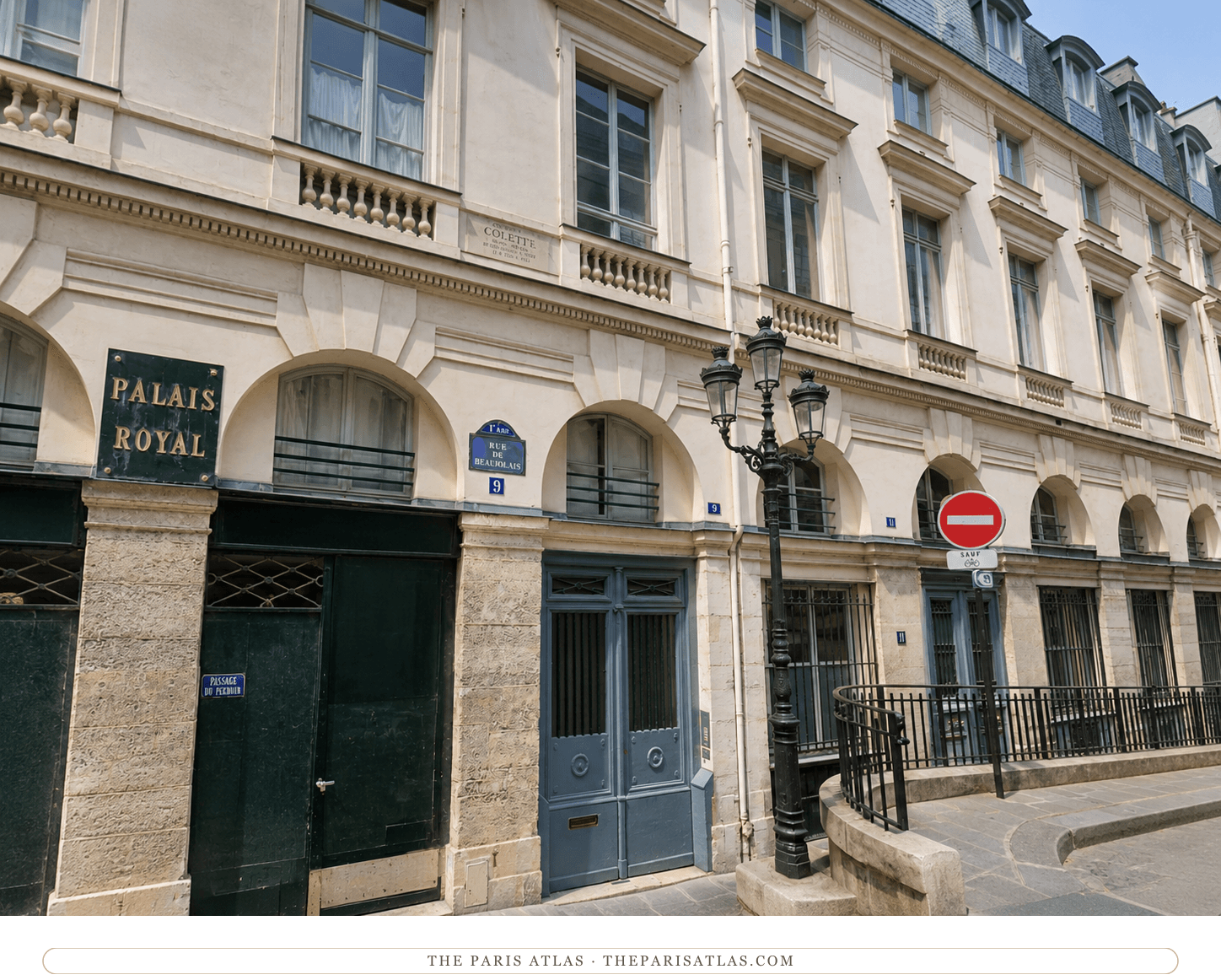
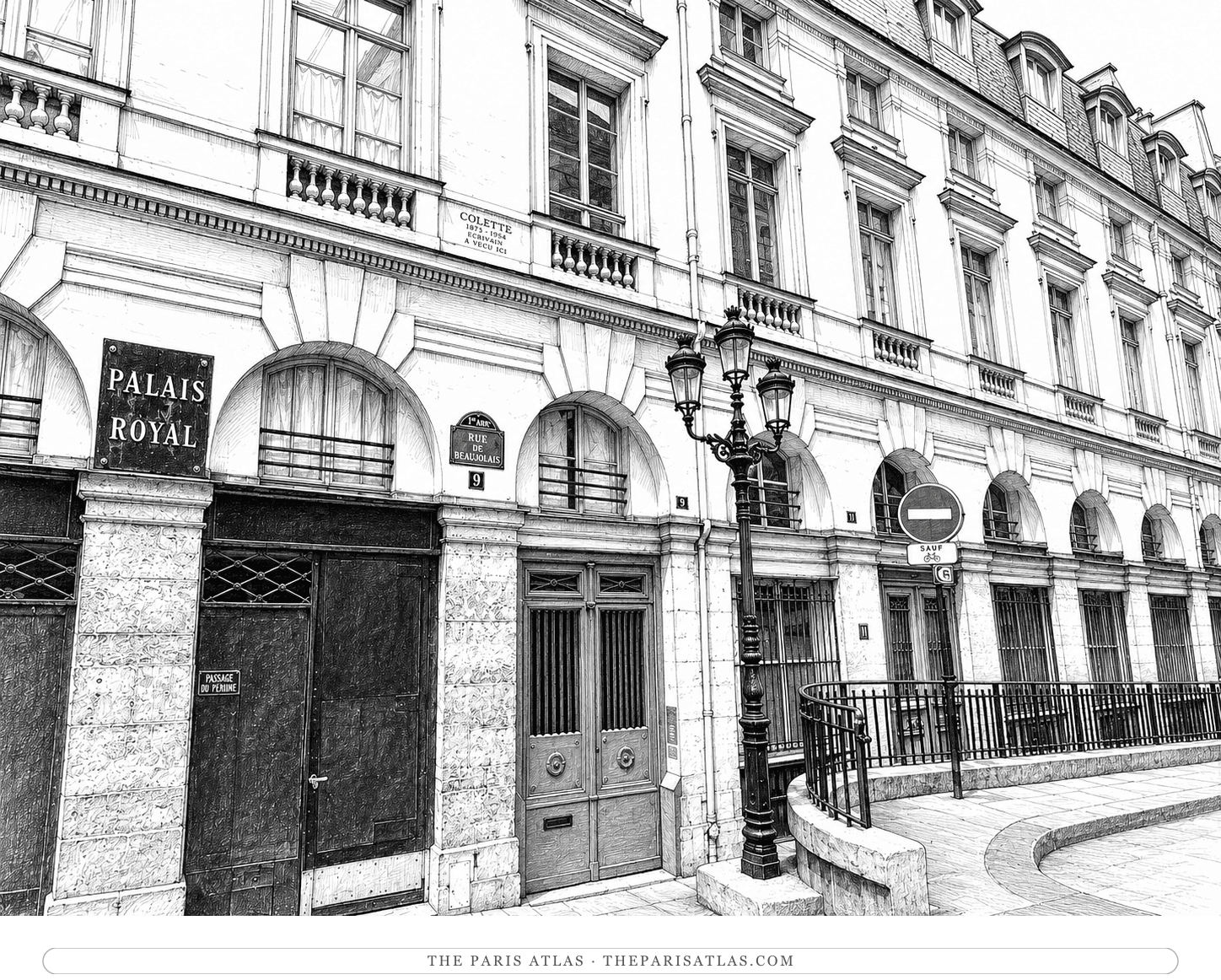
Colette’s most famous Paris address was 9 rue de Beaujolais, overlooking the Palais-Royal garden. She first lived in a low entresol there from 1926 to 1930. In 1938 she returned to a larger first-floor apartment and remained for the rest of her life.

Colette reading at a Paris window. (Illustration — The Paris Atlas)
Colette beside a balcony or open window. In her later years, arthritis increasingly confined her to her Palais-Royal apartment. (Unidentified photographer, Musée Carnavalet, Paris Musées · CC0)

Severe arthritis increasingly restricted her movement. She worked from the bed she called her “raft,” receiving writers, actors, politicians, and friends in the apartment. The windows still gave her material: garden weather, passersby, animals, and the small routines of the Palais-Royal entered her late writing.

Honours, death, and legacy

Colette entered Belgium’s Royal Academy of French Language and Literature in 1935. She joined the Académie Goncourt in 1945 and became its first woman president in 1949. In 1953 she was the first woman raised to Grand Officer of the Legion of Honour. The Nobel archive records one nomination for the 1948 literature prize; a nomination should not be mistaken for finalist status.

Colette in later life. (Illustration — The Paris Atlas)

She died at 9 rue de Beaujolais on 3 August 1954, aged eighty-one. The Catholic Church declined a religious funeral because she had been divorced. France granted national funeral honours in the courtyard of the Palais-Royal, and she was buried at Père-Lachaise Cemetery.

Her lasting achievement was to turn intimate experience into literature without making it small. Domestic life, sexual negotiation, aging, animals, work, and remembered landscapes became subjects through which social power and personal freedom could be examined with unusual precision.

Colette among books. (Illustration — The Paris Atlas)

Colette on screen: the 2018 film

Colette’s early life was dramatized in the 2018 film Colette, directed by Wash Westmoreland. Keira Knightley plays Colette, Dominic West plays Willy, and Denise Gough plays Mathilde de Morny. The film follows the move from Burgundy to Belle Époque Paris, the success of the Claudine novels under Willy’s name, and Colette’s struggle for public and creative independence.

The film does not attempt to cover her whole career. It concentrates on the first marriage, authorship dispute, relationships with women, and stage work that separated Colette’s identity from Willy’s. Chéri, Sido, Gigi, the Palais-Royal years, and her later institutional honours lie outside its main period.

Colette in masculine evening dress. (Illustration — The Paris Atlas)

Life events

  1. 1873

    Born Sidonie-Gabrielle Colette in Saint-Sauveur-en-Puisaye on 28 January.

    Bibliothèque nationale de France — Colette authority record

  2. 1891

    Her family leaves the Burgundy house later reconstructed in The House of Claudine and Sido.

    Colette, seated at center, with her parents and siblings around 1880. Her mother Sido and the family home in Burgundy later became central subjects in her writing. (Unidentified photographer, via Wikimedia Commons)

    Société des amis de Colette — Chronology

  3. 1893

    Marries Henry Gauthier-Villars, known as Willy, and enters literary and theatrical Paris.

    Bibliothèque nationale de France — Colette authority record

  4. 1900

    Claudine at School appears under Willy’s name and becomes a bestseller.

    Colette and Henry Gauthier-Villars, known as Willy, around 1900, the year Claudine at School appeared under his name. (Unidentified photographer, via Wikimedia Commons)

    Gallica — Colette in the classics of twentieth-century literature

  5. 1904–09

    Begins signing work as Colette Willy; from 1909, Claudine editions credit both Willy and Colette Willy.

    Gallica — Colette in the classics of twentieth-century literature; Bibliothèque nationale de France — Colette authority record

  6. 1906–12

    Separates from Willy and works professionally as an actor, dancer, and mime in Paris music halls and on tour.

    Colette in a 1909 Reutlinger studio pose, during her years as a music-hall performer. (Atelier Reutlinger)

    Grande Chancellerie de la Légion d’honneur — Colette

  7. 1907

    Rêve d’Égypte with Mathilde de Morny provokes an uproar at the Moulin Rouge.

    Colette performing in Rêve d’Égypte in 1907. Her onstage kiss with Missy at the Moulin Rouge caused an uproar and the original production was stopped. (Léopold-Émile Reutlinger, via Wikimedia Commons)

    Lou Thomas, BFI — Wash Westmoreland on Colette (2019)

  8. 1910

    Divorces Willy, begins regular work for Le Matin, and publishes The Vagabond.

    A 1910 title page for La Vagabonde, naming its author as Colette Willy. The novel drew directly on her work as a touring music-hall performer. (Paul Ollendorff edition, scan via Wikimedia Commons)

    Société des amis de Colette — Chronology; Bibliothèque nationale de France — Colette: online resources

  9. 1912–13

    Marries Henry de Jouvenel; their daughter, Colette de Jouvenel, is born the following year.

    Sem’s lithograph of Colette with her daughter Colette de Jouvenel, known as Bel-Gazou. (Georges Goursat, known as Sem, Bibliothèques de Paris)

    Bibliothèque nationale de France — Colette authority record; Société des amis de Colette — Chronology

  10. 1916–20

    Musidora adapts Colette’s work for the screen; Chéri appears in 1920 and consolidates Colette’s literary standing.

    The 1920 French title page of Chéri, the novel that consolidated Colette’s standing as a major writer. (Arthème Fayard edition, BEIC and Internet Archive scan)

    La Cinémathèque française — Musidora (biographical article); Société des amis de Colette — Chronology

  11. 1925

    Divorces Henry de Jouvenel, meets Maurice Goudeket, and sees L’Enfant et les sortilèges premiere with music by Maurice Ravel.

    Société des amis de Colette — Chronology; Paris Opera — L’Enfant et les sortilèges

  12. 1930–35

    Publishes Sido and The Cat, marries Maurice Goudeket, and enters Belgium’s Royal Academy.

    Colette with several of her cats in the 1930s. She treated animals as individual presences in her fiction rather than as decorative symbols. (Henri Manuel, via Wikimedia Commons)

    Société des amis de Colette — Chronology; Bibliothèque nationale de France — Colette authority record

  13. 1938

    Returns to 9 rue de Beaujolais, overlooking the Palais-Royal garden, where she will spend the rest of her life.

    Société des amis de Colette — Chronology

  14. 1941–42

    Maurice Goudeket is arrested and interned at Compiègne, released after eight weeks, and later moves to the unoccupied zone.

    Société des amis de Colette — Chronology

  15. 1944–49

    Publishes Gigi, enters the Académie Goncourt in 1945, receives one nomination for the 1948 Nobel Prize in Literature, and becomes the Goncourt’s first woman president in 1949.

    Société des amis de Colette — Chronology; Grande Chancellerie de la Légion d’honneur — Colette; Nobel Prize nomination archive — Sidonie Gabrielle Colette

  16. 1951

    Selects Audrey Hepburn for the Broadway adaptation of Gigi, introducing the actor to American audiences.

    Library of Congress — Colette resource guide

  17. 1953

    Becomes the first woman raised to Grand Officer of the Legion of Honour.

    Grande Chancellerie de la Légion d’honneur — Colette

  18. 1954

    Dies at 9 rue de Beaujolais on 3 August; receives national funeral honours and is buried at Père-Lachaise.

    Grande Chancellerie de la Légion d’honneur — Colette; Société des amis de Colette — Chronology

Colette quotes

Verbatim, as recorded by the witnesses of the era — sources on every quotation.

I want to do what I want. I want to play pantomime, even comedy. I want to dance naked, if a leotard bothers me and humiliates my figure.
Colette, The Tendrils of the Vine (Les Vrilles de la vigne, 1908)

Selected works

Cataloged from the holding institutions' records. Reproductions appear only where the rights are verified.

Cinema

House poster illustration for Lac aux Dames: a woman in a dark maillot and white headscarf holds a rope beside a young man at a lakeside, a sailboat behind, above the title in the house style

Editorial illustration

Film

Lac aux Dames

1934 · About 106 minutes, black and white

Lac aux Dames (Lake of Ladies) is a 1934 French film directed by Marc Allégret and set at a lakeside summer resort. It was adapted from a novel by the Austrian writer Vicki Baum, with dialogue by Colette working from a scenario by Allégret and Jean-Georges Auriol. Simone Simon played Puck in one of her first major roles, alongside Jean-Pierre Aumont and Michel Simon, with music by Georges Auric and sets by Lazare Meerson. The film belongs to the run of early-1930s pictures that established Allégret and helped launch a generation of French screen actors.
Marc Allégret, Colette, Lac aux Dames, 1934.

People they knew

Documented connections — every one carries its source.

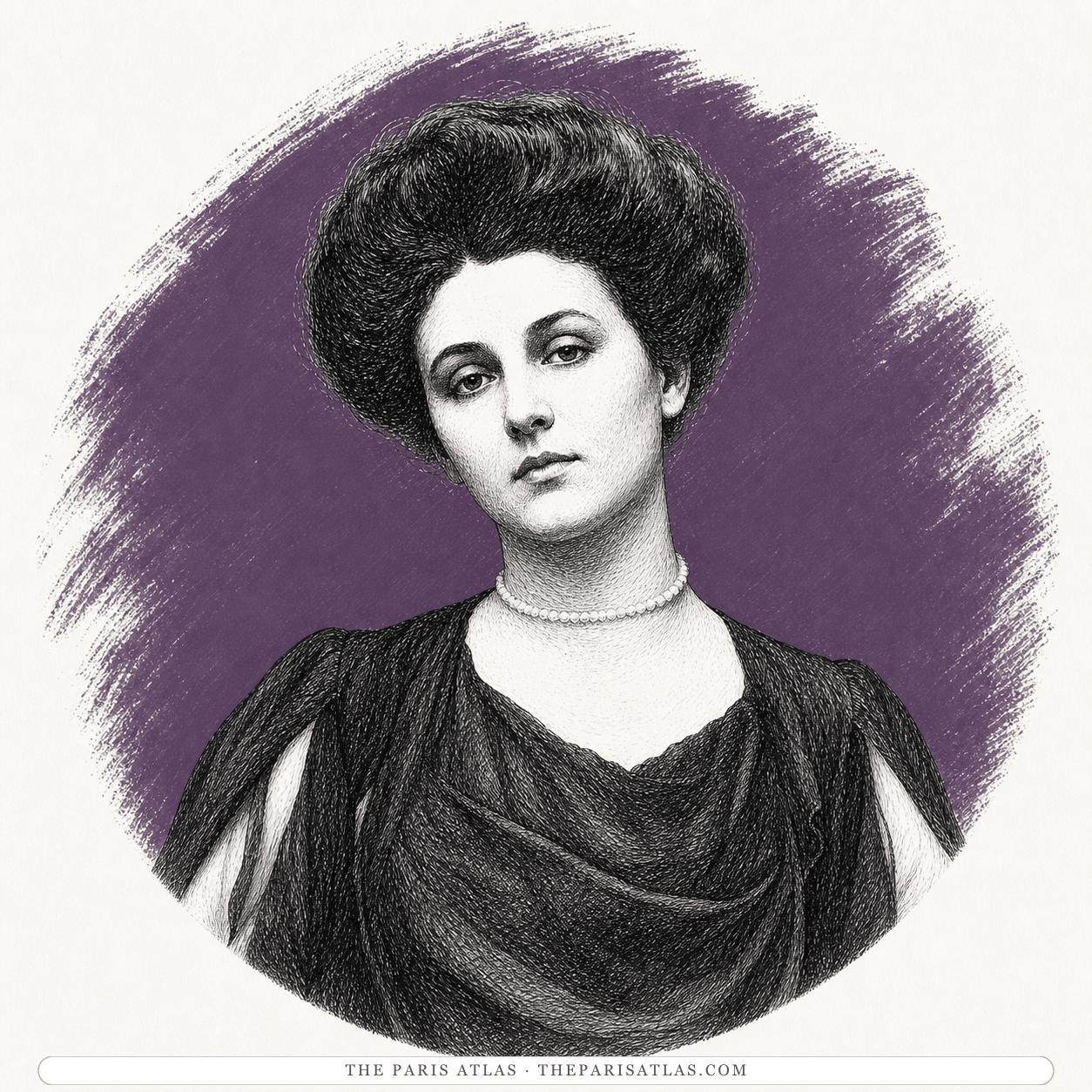
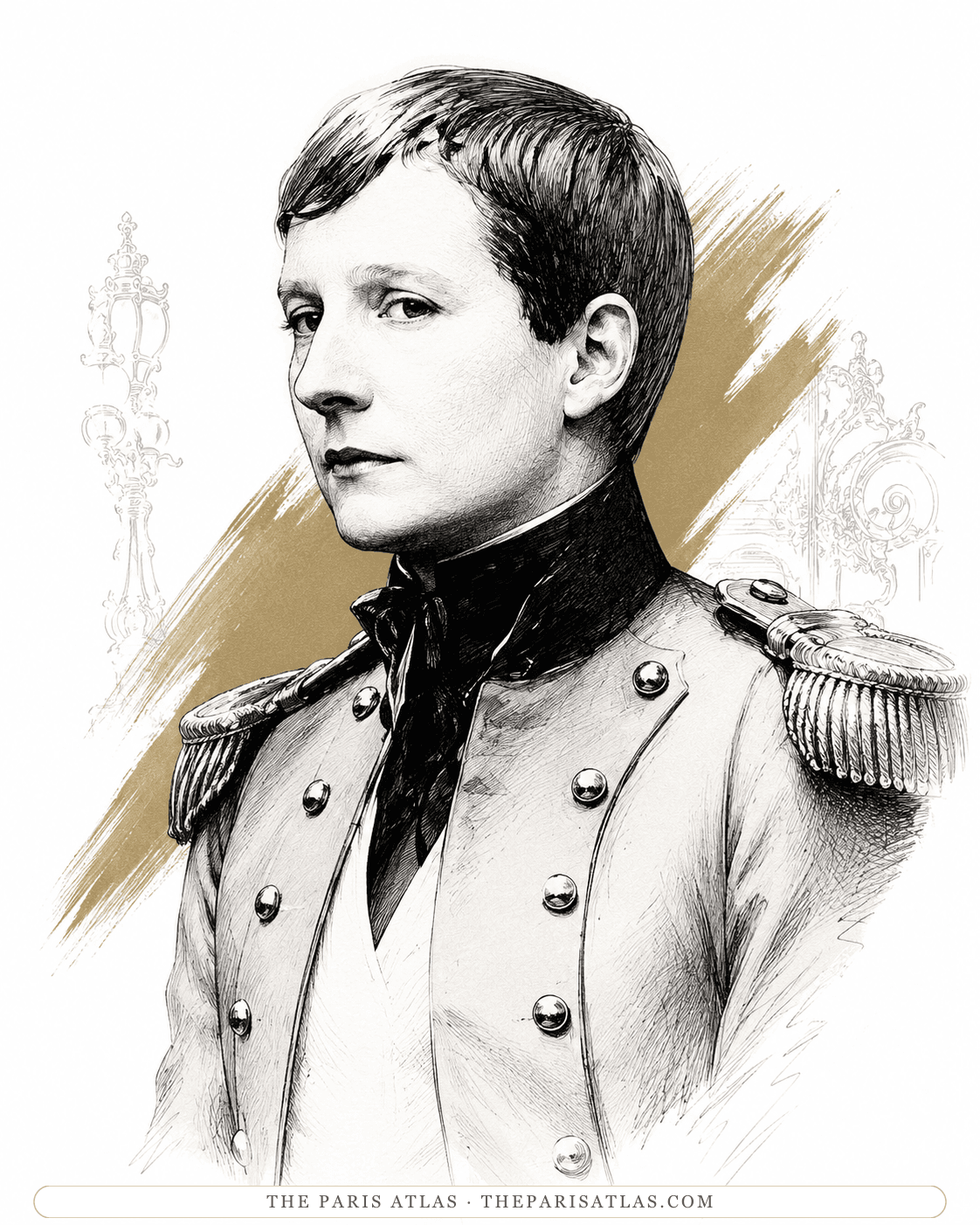
Illustrated portrait of Mathilde de Morny

Mathilde de Morny

  • Actor
  • Sculptor

Collaborated with · 1906–1907

Colette and Mathilde de Morny, known as Missy, were partners and stage collaborators. Their pantomime Rêve d’Égypte caused an uproar at the Moulin Rouge in January 1907.

Bibliothèque nationale de France — The Worlds of Colette (2025); Lou Thomas, BFI — Wash Westmoreland on Colette (2019)

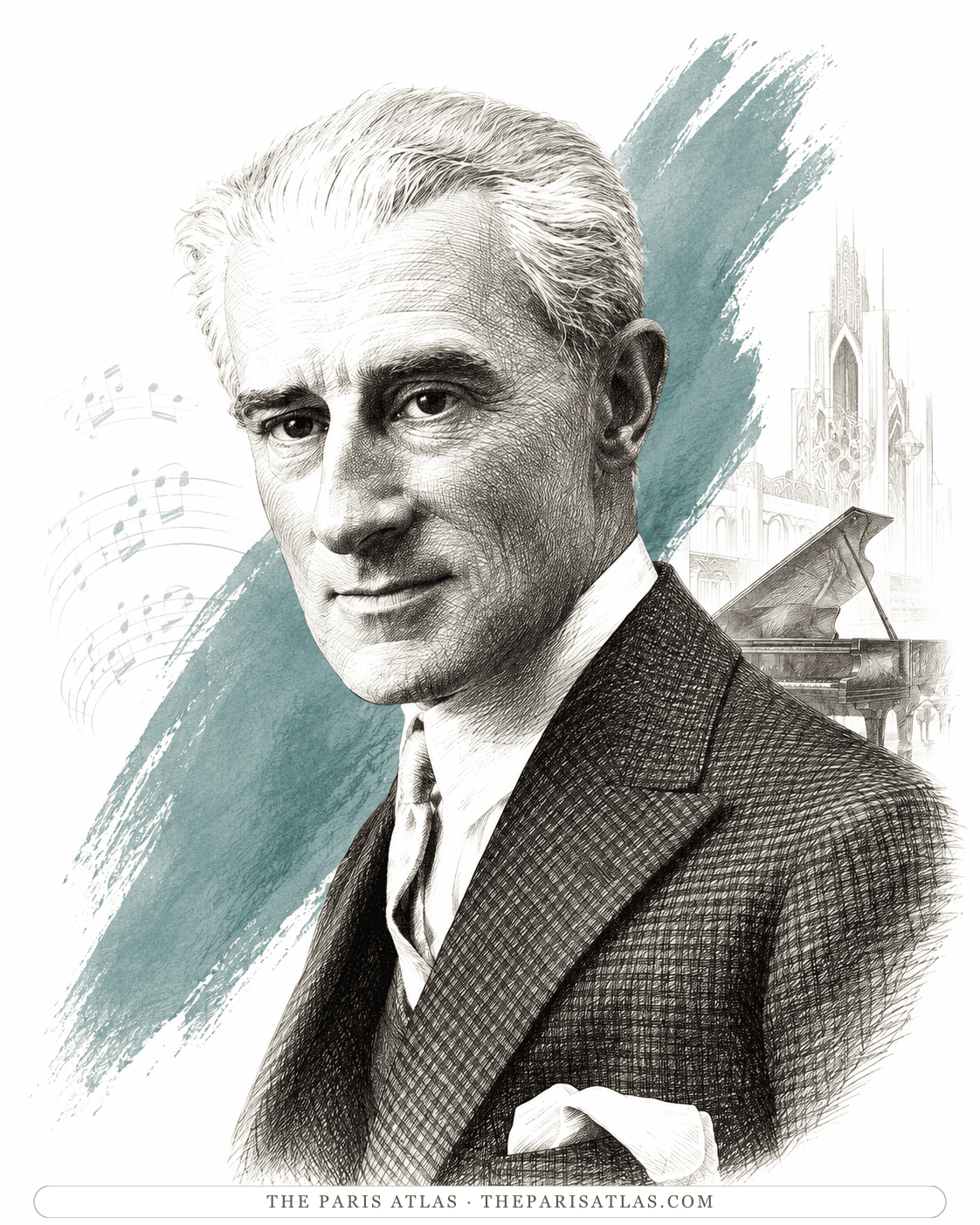
Illustrated portrait of Maurice Ravel

Maurice Ravel

  • Musician

Collaborated with · 1917–1925

Colette wrote the libretto and Maurice Ravel composed the music for L’Enfant et les sortilèges, first performed in Monte Carlo in 1925.

Paris Opera — L’Enfant et les sortilèges

Illustrated portrait of Henry de Jouvenel

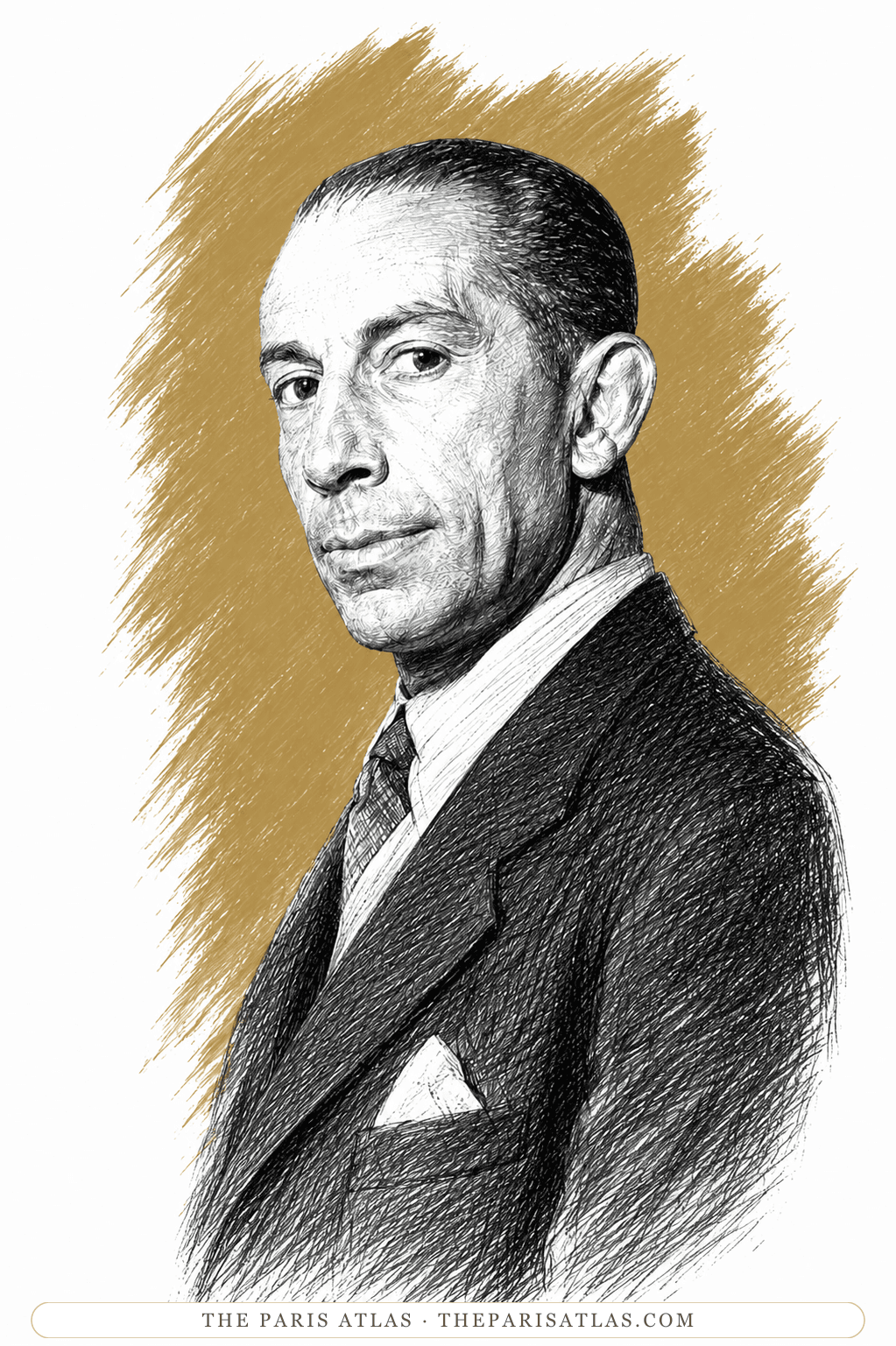
Henry de Jouvenel

  • Journalist
  • Editor
  • Statesman

Married to · 1912–1925

Colette married Le Matin editor Henry de Jouvenel in December 1912. Their daughter, Colette de Jouvenel, was born in 1913; the divorce was pronounced in April 1925.

Bibliothèque nationale de France — Colette authority record; Société des amis de Colette — Chronology

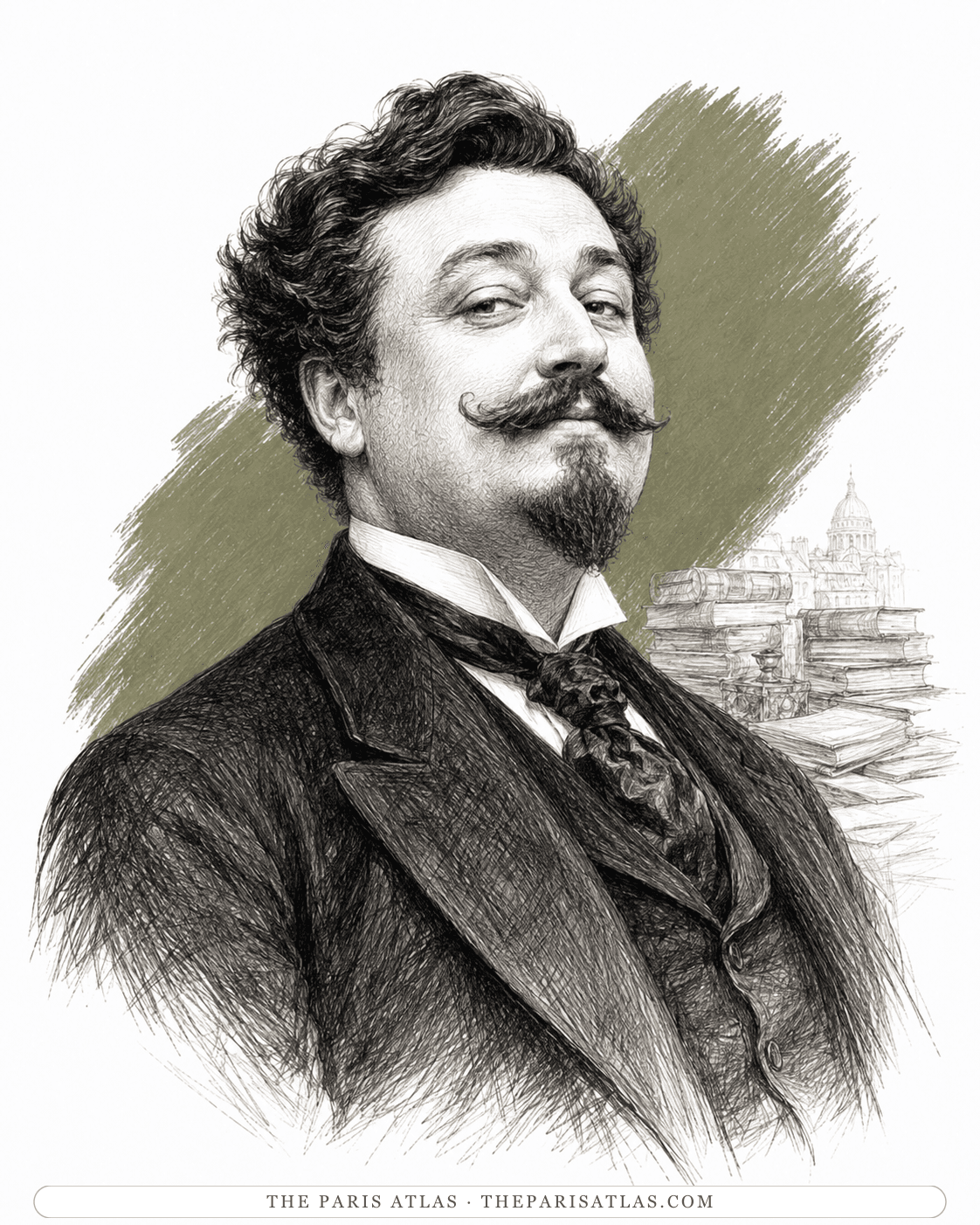
Illustrated portrait of Maurice Goudeket

Maurice Goudeket

  • Author

Married to · 1935–1954

Colette married Maurice Goudeket in 1935 after a decade together. He remained her husband, companion, and literary organizer until her death.

Bibliothèque nationale de France — Colette authority record; Société des amis de Colette — Chronology

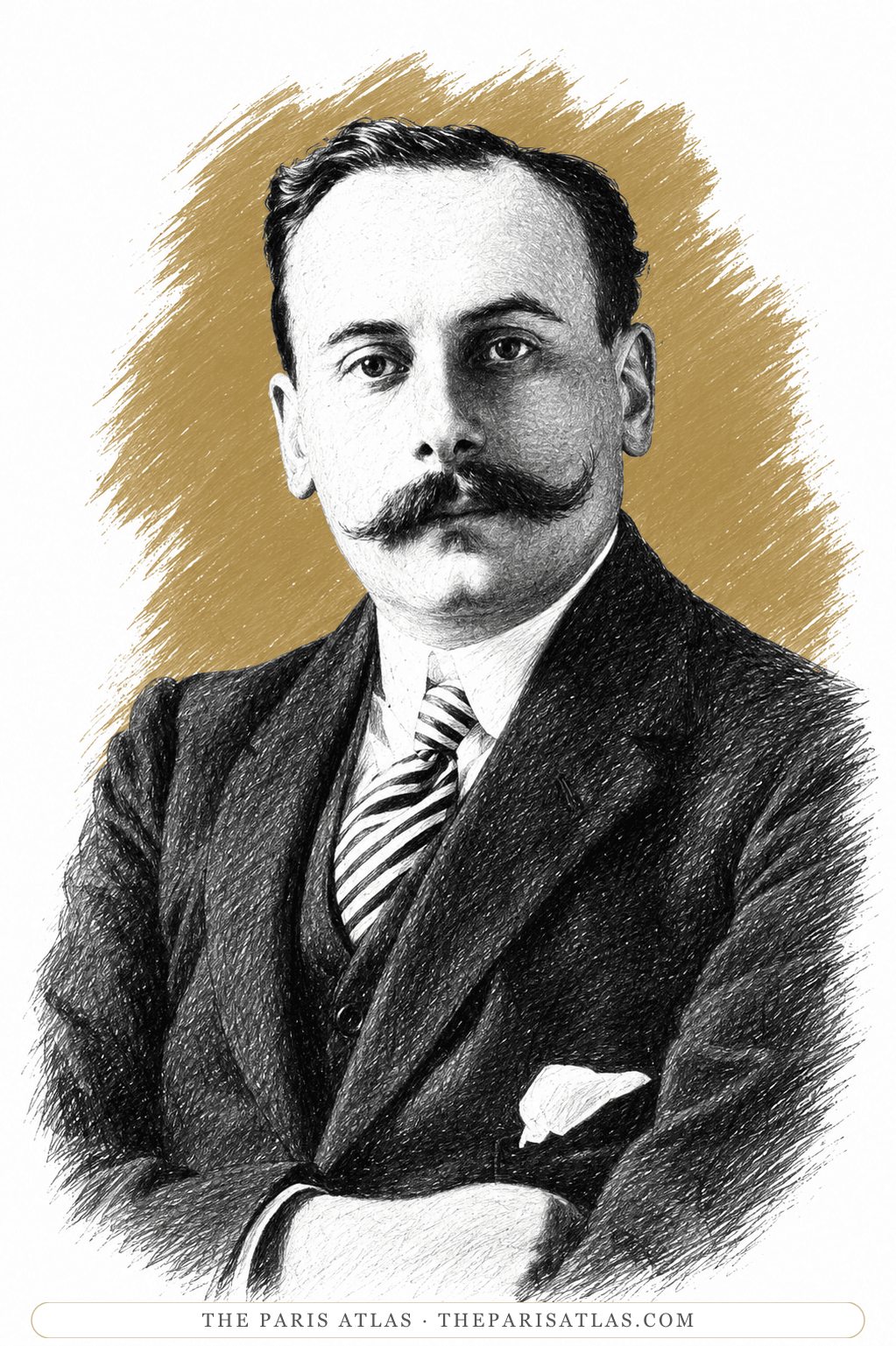
Illustrated portrait of Henry Gauthier-Villars

Henry Gauthier-Villars

  • Author
  • Critic
  • Journalist

Married to · 1893–1910

Colette married Henry Gauthier-Villars, known as Willy, in 1893. Her first Claudine novels appeared under his established pen name; they separated in 1906 and divorced in 1910.

Bibliothèque nationale de France — Colette authority record; Société des amis de Colette — Chronology

Illustrated portrait of Audrey Hepburn

Audrey Hepburn

  • Actor

Met · 1951

Colette encountered the little-known Audrey Hepburn during filming in Monte Carlo and selected her for the 1951 Broadway adaptation of Gigi.

Library of Congress — Colette resource guide

Illustrated portrait of Jean Cocteau

Jean Cocteau

  • Poet
  • Playwright
  • Illustrator
  • +1

Met · 1938

Colette and Jean Cocteau were close friends and Palais-Royal neighbors from the late 1930s until her death in 1954, living around the same garden and writing admiringly of one another. Colette described his rooms in Paris de ma fenêtre.

Judith Thurman, Secrets of the Flesh: A Life of Colette (1999)

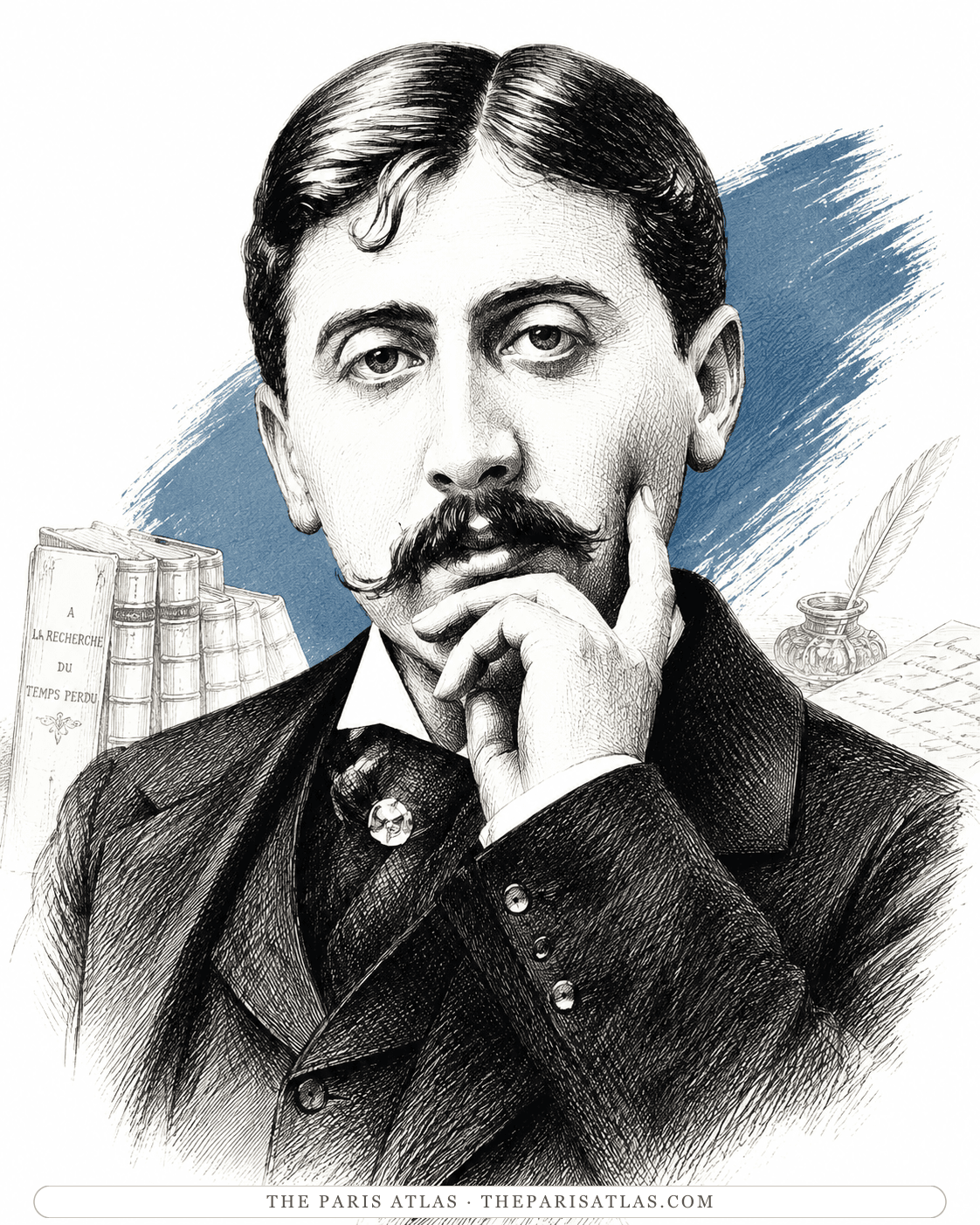
Illustrated portrait of Marcel Proust

Marcel Proust

  • Author
  • Critic
  • Translator

Met · 1895

By Colette's own account they first met in the 1890s at the salon of Madame Arman de Caillavet. They exchanged admiring letters around 1919: reading Colette's Mitsou, Proust wrote that he had wept for the first time in a long while. Colette left a first-hand portrait of Proust from both the salon years and a later meeting.

Laurence Teyssandier, Regards de Colette sur Proust, in Marcel Proust 9: Proust et les autres (2014); Marcel Proust, Letter from Marcel Proust to Colette on Mitsou (1919) (1919)

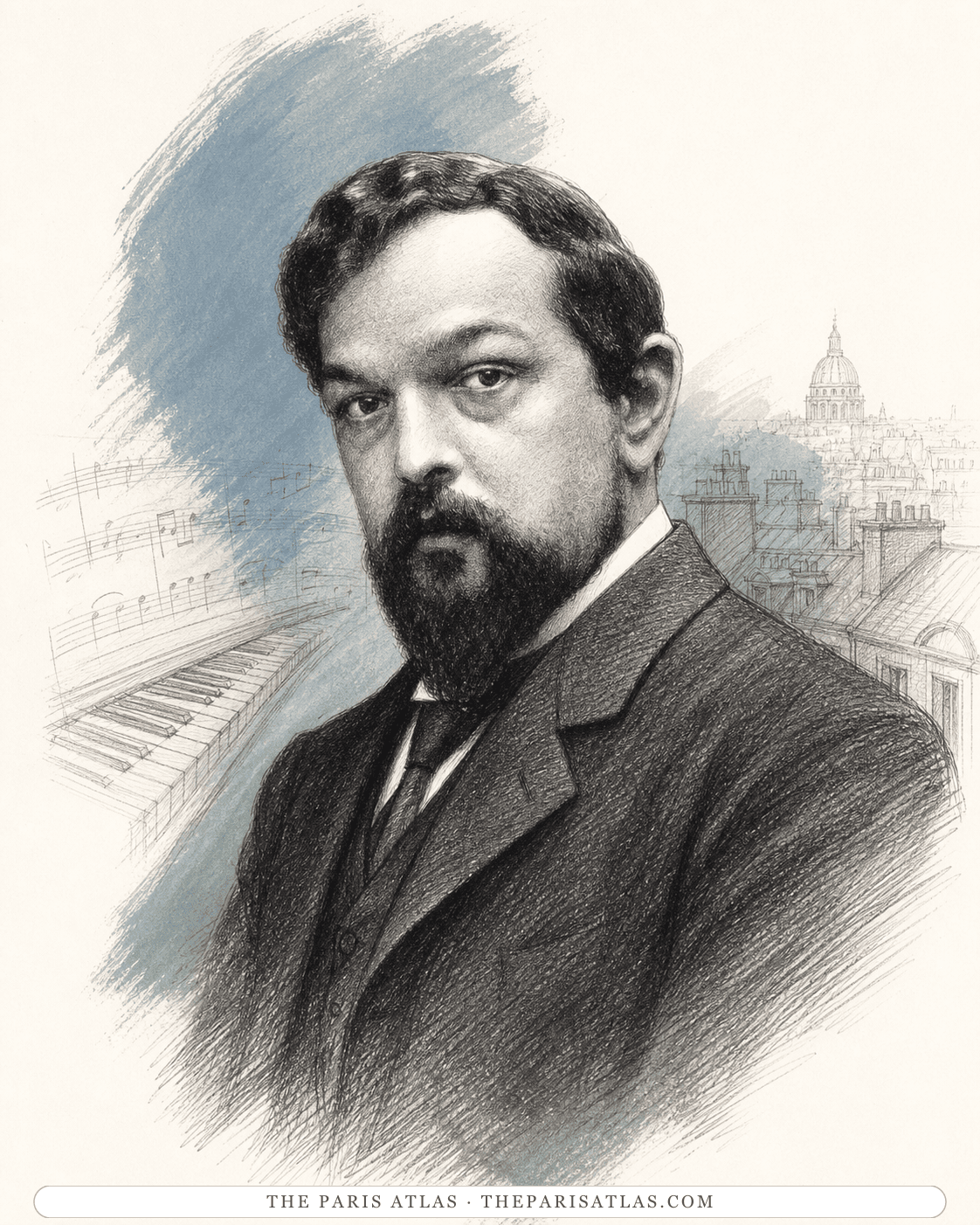
Illustrated portrait of Claude Debussy

Claude Debussy

  • Musician
  • Critic

Met · 1895

Willy championed Debussy as a music critic, and Colette knew and especially admired the composer. A copy of Debussy's 1895 letter to Willy survived in Colette's collection; she later recalled Debussy in Mes apprentissages.

Debussy–Colette: copy of Debussy's 10 October 1895 letter to Willy

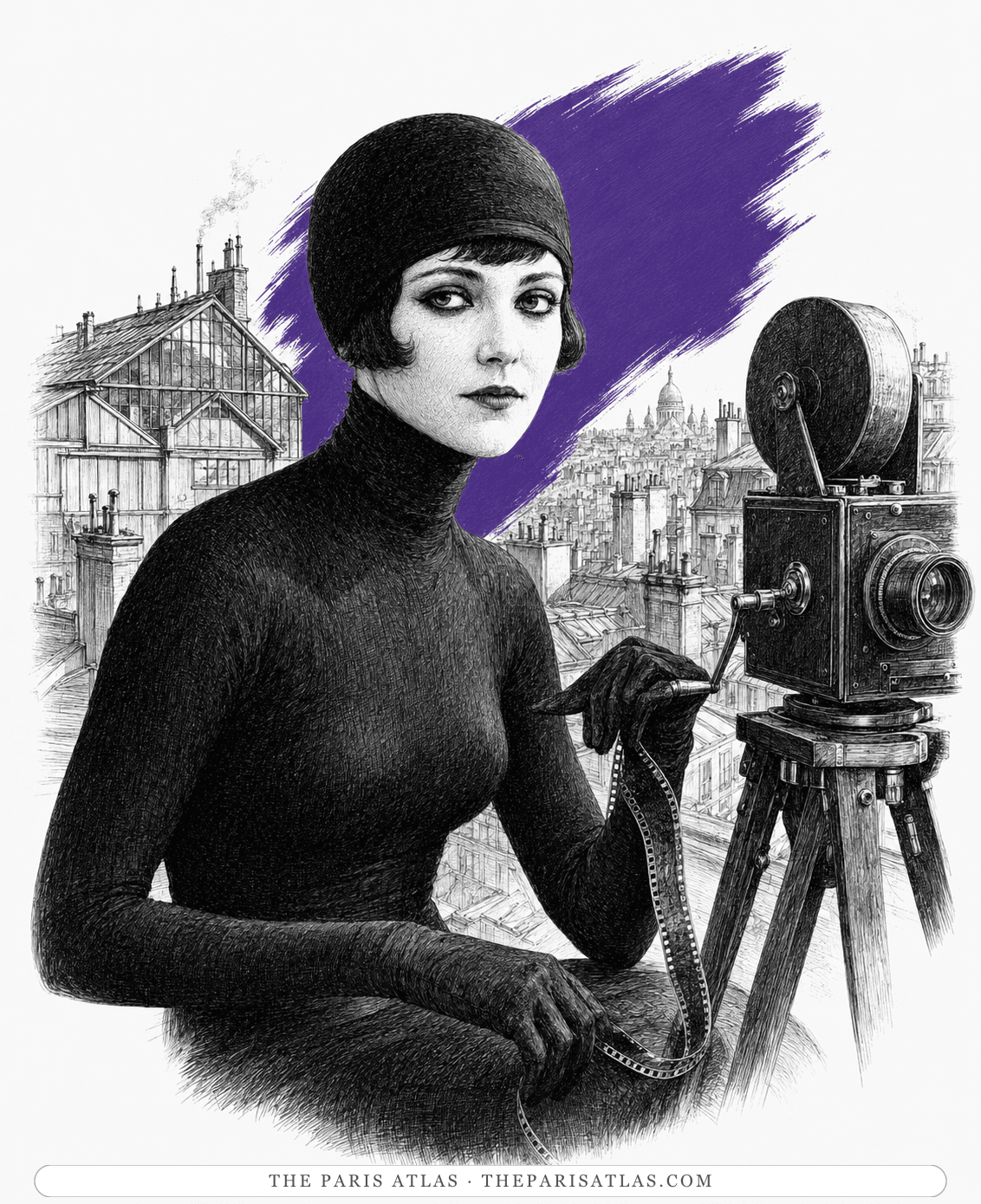
Illustrated portrait of Musidora

Musidora

  • Actor
  • Filmmaker
  • Author

Collaborated with · 1916–1920

From 1916 to 1920 Musidora adapted her friend Colette for the screen — Minne and La Vagabonde among the projects. The friendship outlasted the films by decades; their correspondence, published as Un bien grand amour, runs from 1908 to 1953.

La Cinémathèque française — Musidora (biographical article)

Illustrated portrait of Natalie Clifford Barney

Natalie Clifford Barney

  • Author
  • Poet
  • Salon host
  • +2

Met · 1906

Colette performed in the theatricals Barney staged for friends at 20 rue Jacob, and was one of the French writers the Académie des Femmes honoured from 1927. Suzanne Rodriguez's biography counts her among Barney's lovers, in the years around Colette's separation from Willy; the friendship outlasted the affair and ran until Colette's death in 1954. The start year is approximate — the sources place the two together from the middle of the 1900s without fixing a first meeting.

Anna Livia, Barney, Natalie Clifford (1876–1972), in Women in World History: A Biographical Encyclopedia (2002); Suzanne Rodriguez, Wild Heart: A Life — Natalie Clifford Barney's Journey from Victorian America to Belle Époque Paris (2002); Natalie Clifford Barney — French Women & Feminists in History: A Resource Guide

Marc Allégret

  • Filmmaker

Collaborated with · 1934

Colette wrote the French dialogue for Lac aux Dames, Allégret's adaptation of a Vicki Baum novel. It is one of the few times she wrote directly for the screen, and the film gave Simone Simon her first substantial role.

Unifrance — Lac aux dames (Marc Allégret, 1934)

Illustrated portrait of Rachilde

Rachilde

  • Author
  • Critic
  • Playwright
  • +1

Met · 1900

Rachilde reviewed the Claudine novels for the Mercure de France while they were appearing under Henry Gauthier-Villars's name, and pointed at Colette's hand in them at a time when her part was supposed to be a secret. Both were later honoured by Natalie Clifford Barney's Académie des Femmes, and Colette named Rachilde in Le Fanal bleu in 1949. The start year is approximate: it marks the Claudine years rather than a first meeting the sources fix.

Nelly Sanchez, Rachilde, célébrité sulfureuse des lettres de la Belle Époque (2019); Anna Livia, Barney, Natalie Clifford (1876–1972), in Women in World History: A Biographical Encyclopedia (2002)

Illustrated portrait of Renée Vivien

Renée Vivien

  • Poet
  • Translator
  • Author

Met · 1906

Colette took a ground-floor apartment at 44 rue de Villejust after leaving Henry Gauthier-Villars and found that its courtyard garden connected through a gate to Vivien's ground floor at 23 avenue du Bois de Boulogne. She became a regular visitor and kept about thirty of Vivien's letters. Her chapter in Le Pur et l'Impur, published in 1932, is the fullest eyewitness account of Vivien's last years — the darkened rooms, the nailed-shut window, the dinners at which Vivien barely ate, and the tumblers her maid kept hidden under a sewing chair.

Colette, Le Pur et l'Impur (1932); Renée Vivien — biography

Books by Colette

Cover of Claudine at School by Colette

Modernist fiction

The sardonic Burgundian schoolgirl whose diary made Colette famous — published, at first, under her husband's name.

4.4
Cover of Claudine in Paris by Colette

Modernist fiction

Claudine leaves Burgundy for the capital, and the schoolgirl's sharp eye is turned on Parisian society and her own heart.

4.2
Cover of Claudine Married by Colette

Modernist fiction

Marriage does not tame Claudine — the third novel takes the series into its most openly erotic and disenchanted territory.

4.2
Cover of Claudine and Annie by Colette

Modernist fiction

The fourth Claudine novel hands the story to another woman — Annie, learning to leave a husband who has always decided for her.

4.1
Cover of Minne by Colette

Minne

Colette1904

Modernist fiction

A sheltered Paris girl feeds on romantic fantasy until it pulls her out into the night — the first of the Minne novels.

3.9
Cover of Animal Dialogues by Colette

Short stories

Colette's cat and dog talk over the household — the early book she counted as her first step free of the Claudine machine.

3.8
Cover of Minne's Misadventures by Colette

Modernist fiction

The sequel takes Minne past sheltered fantasy into the harder education of marriage, dissatisfaction, and desire.

3.8
Cover of The Sentimental Retreat by Colette

Modernist fiction

The fifth and final Claudine book: Claudine spends a winter in her friend Annie's country house while her husband is away being treated, and the cycle closes in a minor key.

4.0
Cover of The Tendrils of the Vine by Colette

Short stories

The early collection in which Colette's short prose became unmistakably her own — lyric reveries, animal pieces, and music-hall sketches side by side.

4.0
Cover of The Innocent Libertine by Colette

Modernist fiction

Colette rebuilds the two Minne novels into one — a young woman whose apparent innocence coexists with the beginnings of her own liberty.

4.0
Cover of The Vagabond by Colette

Modernist fiction

A divorced music-hall performer is offered love and security, and has to decide what her independence is worth.

4.4
Cover of The Shackle by Colette

Modernist fiction

The sequel to The Vagabond reverses its ending: the woman who chose freedom gives herself to a dependent, possessive love.

4.0
Cover of Music-Hall Sidelights by Colette

Short stories

The music hall seen from behind — the tired, precarious, intimate world of performers, by a writer who had lived it.

4.0
Cover of Peace Among the Beasts by Colette

Short stories

A wartime book of animals — an imagined refuge 'where there is no war,' and one of Colette's decisive works about the otherness of beasts.

3.9
Cover of The Long Hours by Colette

Memoir & autofiction

Colette's war album — the First World War seen from hospitals, the rear, and ruined ground, without a word of bombast.

3.9
Cover of In the Crowd by Colette

Memoir & autofiction

Short chronicles of the street and the throng — Colette watching the anonymous life of the city pass.

3.5
Cover of Mitsou by Colette

Modernist fiction

A music-hall performer and a young officer conduct a wartime romance by letter, and the wit the title promises turns out to be hard-won.

4.1
Cover of Chéri by Colette

Modernist fiction

An aging courtesan and the beautiful young man she has kept for six years — the novel that made Colette a major writer.

4.5
Cover of The Lighted Room by Colette

Memoir & autofiction

Chronicles across a single year — wartime hardship and the urge to reclaim ordinary life, with the child Bel-Gazou at the edges.

3.7
Cover of My Mother's House by Colette

Memoir & autofiction

Short, luminous memories of a Burgundy childhood, gathered around the mother who presides over them.

4.3
Cover of Journey for Myself by Colette

Memoir & autofiction

Short prose of weather, illness, waiting, and travel — a mutable self-portrait Colette reworked heavily between 1922 and 1928.

3.8
Cover of The Ripening Seed by Colette

Modernist fiction

Two childhood companions on a Breton shore cross into adulthood the summer an older woman intervenes.

4.2
Cover of The Hidden Woman by Colette

Short stories

Twenty-two short, dark tales of love's hidden side — betrayal, solitude, and illusion, told in the manner of a modern Maupassant.

4.2
Cover of Everyday Adventures by Colette

Memoir & autofiction

Small events turned into surprise — Colette's chronicles of the minor, and a seedbed for the books that followed.

3.6
Cover of Four Seasons by Colette

Memoir & autofiction

Twelve fashionable chronicles that follow the turning year — a private printing for a patron's friends, later folded into Journey for Myself.

3.5
Cover of The Last of Chéri by Colette

Modernist fiction

Chéri comes home from the war to a changed Paris and an aged Léa, and cannot live in either — the harsh sequel to Chéri.

4.4
Cover of Break of Day by Colette

Memoir & autofiction

A woman past fifty, alone in a Provence summer, decides what a life no longer organized around love can be.

4.1
Cover of The Other One by Colette

Modernist fiction

A wife and her husband's mistress discover that their bond with each other matters more than the man they share.

4.1
Cover of Sido by Colette

Sido

Colette1930

Memoir & autofiction

Colette's portrait of her mother — and, around her, her father and wild siblings — often called the finest thing she wrote.

4.5
Cover of Prisons and Paradise by Colette

Memoir & autofiction

A wide gathering of Colette's prose on animals, the Midi, appetite, and secrecy — where confinement and ecstasy turn out to be kin.

4.0
Cover of Paradis terrestres (1932) by Colette

Memoir & autofiction

Colette's animal pieces printed as a rare Swiss art book, with wood-engraved beasts by Paul Jouve — not to be confused with the 1953 photobook of almost the same name.

3.9
Cover of The Cat by Colette

Modernist fiction

A new marriage and a beloved cat, and a jealousy that turns out to run the wrong way — Colette's coldest short novel.

4.4
Cover of Duo by Colette

Duo

Colette1934

Modernist fiction

A husband learns of his wife's old, brief affair, and a close marriage comes apart over a few days in the country.

4.1
Cover of My Apprenticeships by Colette

Memoir & autofiction

Colette's cold, exact memoir of her first marriage — the writing factory in which the Claudine novels were made and signed by another man.

4.2
Cover of Bella-Vista by Colette

Short stories

Four late stories that keep hard subjects under a calm surface — and a title tale built on a revelation that changes everything you have read.

4.2
Cover of Le Toutounier by Colette

Modernist fiction

The sequel to Duo: widowed Alice returns to her sisters and the battered old couch where the family regroups and survives.

4.0
Cover of Hotel Room by Colette

Modernist fiction

A Colette-like narrator, alone in a provincial hotel, is drawn into the private drama of the strangers around her.

3.9
Cover of Julie de Carneilhan by Colette

Modernist fiction

A proud, aging aristocrat, reduced but unbroken, is drawn back into the schemes of the ex-husband she still half-loves.

4.1
Cover of The Pure and the Impure by Colette

Essays & criticism

Colette's most personal book — a meditation on desire, pleasure, and the varieties of love, built from portraits rather than plot.

4.2
Cover of Looking Backwards by Colette

Memoir & autofiction

A wartime gathering of short pieces and memories — miscellaneous by design, and revealing precisely because it is unsettled.

3.8
Cover of From My Window by Colette

Memoir & autofiction

Occupied Paris, watched and described from a single window — practical, intimate, and an irreplaceable record of the city's wartime life.

4.0
Cover of The Kepi by Colette

Short stories

Four wartime stories of frustrated love, shadowed by backward glances at the Paris circles of Colette's youth.

4.0
Cover of Gigi by Colette

Gigi

Colette1944

Modernist fiction

The girl raised to be a rich man's mistress, and the man who changes the terms himself — Colette's most adapted story.

4.3
Cover of Three… Six… Nine… by Colette

Memoir & autofiction

Colette tells her life through the rooms she lived in — an autobiography written as a sequence of Paris addresses.

4.0
Cover of The Evening Star by Colette

Memoir & autofiction

Late reflections written from an immobile chair — memory, the war years, and lost friends, gathered under the evening star.

4.3
Cover of For a Flower Album by Colette

Memoir & autofiction

Twenty-two flower portraits written from memory — late Colette turning description of a rose or a poppy into a kind of self-portrait.

4.0
Cover of The Blue Lantern by Colette

Memoir & autofiction

One of Colette's last books — written from her chair as her body failed, and set against decline rather than defeated by it.

4.3
Cover of In a Familiar Land by Colette

Memoir & autofiction

Late prose of landscape, memory, and homage — Colette on familiar ground, seeing it new through the eye of a painter friend.

3.7
Cover of Intermittent Journal by Colette

Memoir & autofiction

A collectible late volume that is not, despite its title, a diary — a mixed gathering of chronicles and tales, printed in a small run.

3.5
Cover of Stroke by Stroke by Colette

Memoir & autofiction

A late book of portraits — the writers, performers, and painters Colette had known, drawn from memory in a few exact strokes.

3.8
Cover of The Flower of Youth by Colette

Memoir & autofiction

A late, deliberately mixed gathering — chronicles, tales, and prefaces bound together as one of Colette's collectible last volumes.

3.5
Cover of At Hand by Colette

Memoir & autofiction

A late gathering of Colette's short prose — first published not as a standalone book but as a named section of her Complete Works.

3.6
Cover of Paradis terrestre (1953) by Colette

Memoir & autofiction

Colette's prose set against fifty photographs by Izis — a late book-club photobook, and not the 1932 art book of nearly the same name.

3.8
Cover of Ladies of the Past by Colette

Memoir & autofiction

Colette's last book — a short return to the old women of her childhood village, published in the year she died.

3.8
Cover of Earthly Paradise by Colette

Memoir & autofiction

The life told in her own words — an autobiography assembled after her death from some forty of her books, and the English Colette most readers meet.

4.4

Colette’s Places

The cataloged places connected to Colette — through the books, and through the documented record.

Places you can enter today appear first, followed by addresses to see from outside and sites that have vanished.

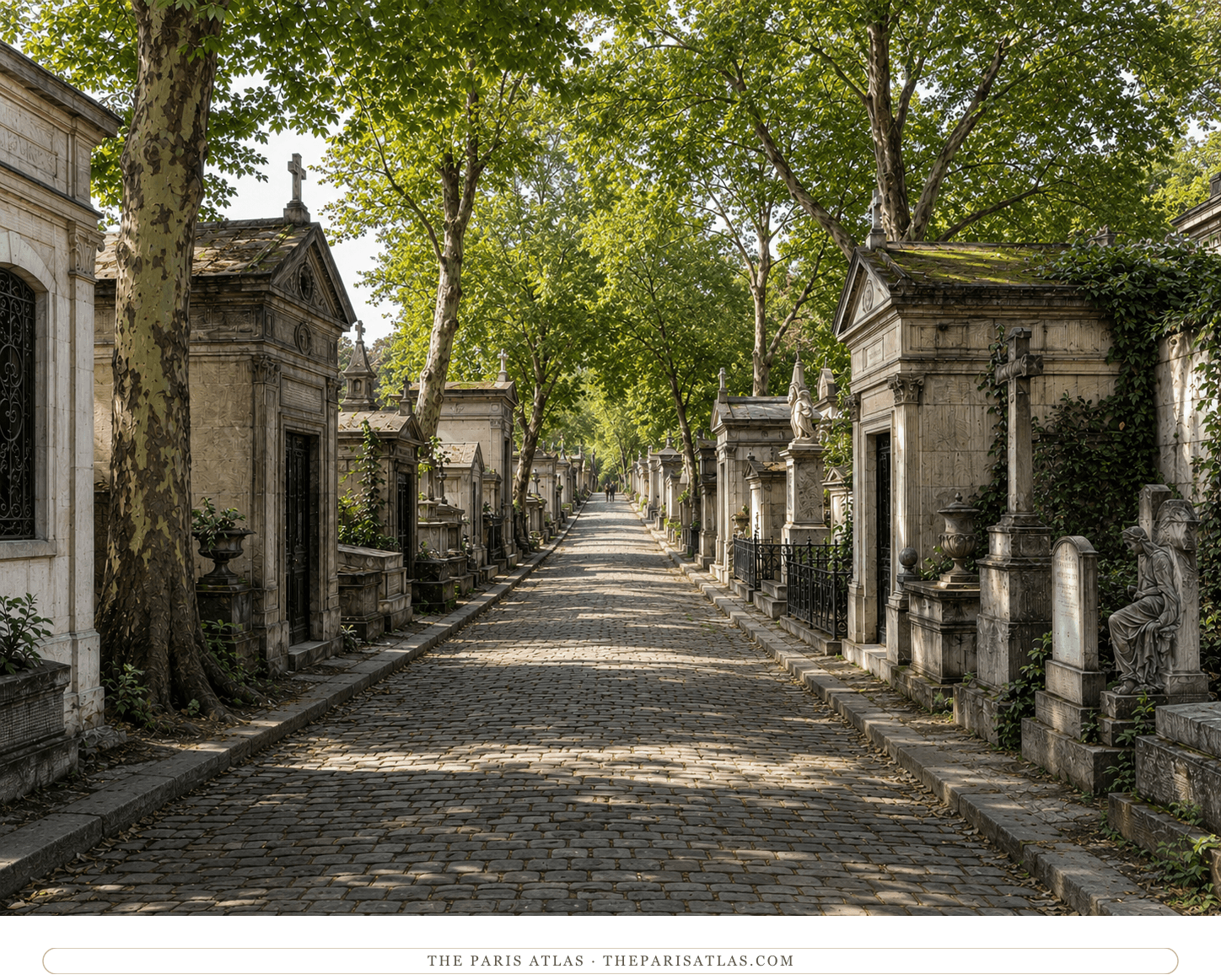
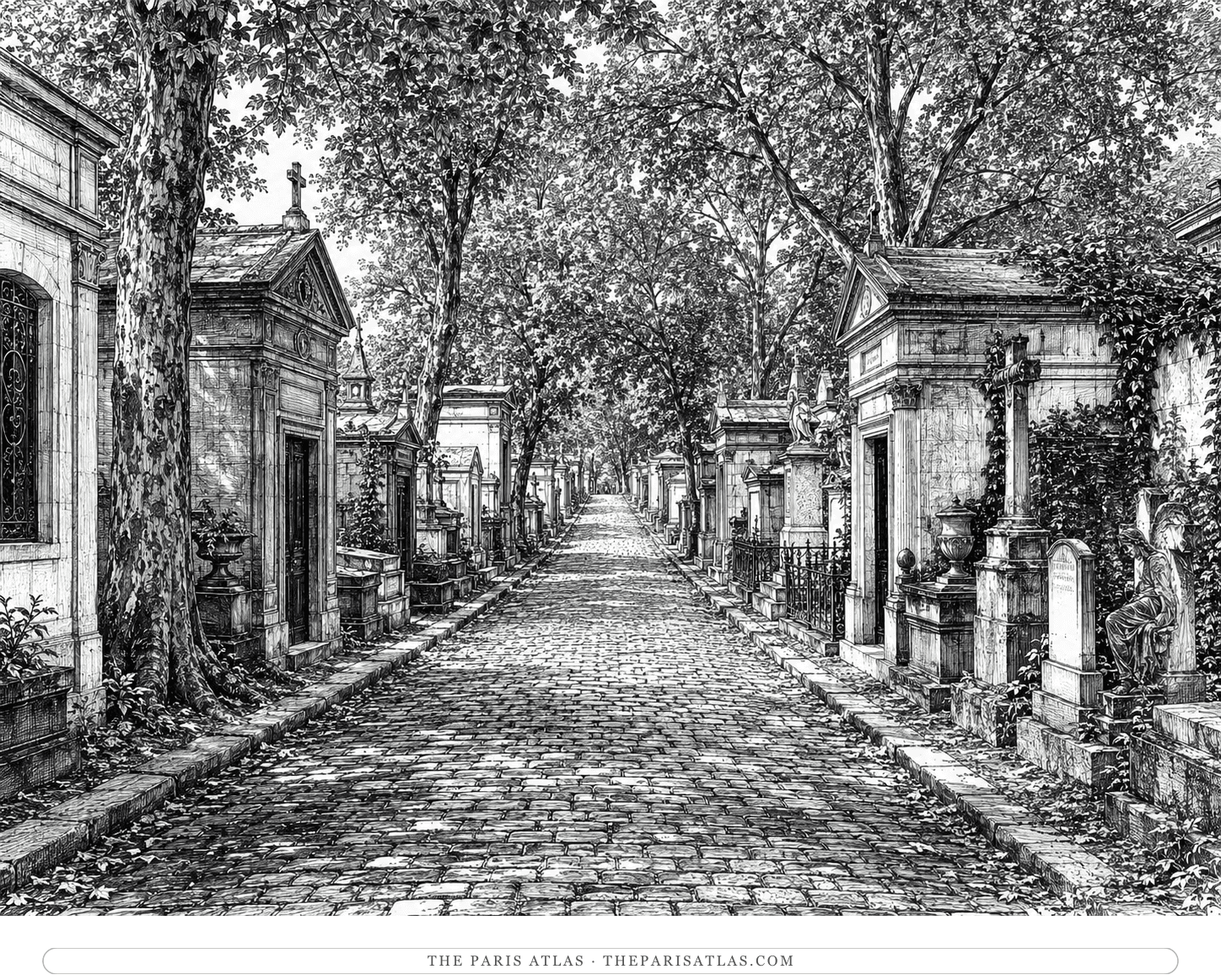
A tree-lined cobbled avenue at Père-Lachaise in summer light, moss-roofed chapel tombs and ivy on either side

Cemetery · Ménilmontant

Open — go in

Père-Lachaise Cemetery

After national funeral honours in the Palais-Royal courtyard, Colette was buried at Père-Lachaise Cemetery.

Visit the place
The Galerie Vivienne passage in colour, mosaic floor, shopfronts and glass roof

Landmark · Vivienne

Open — go in

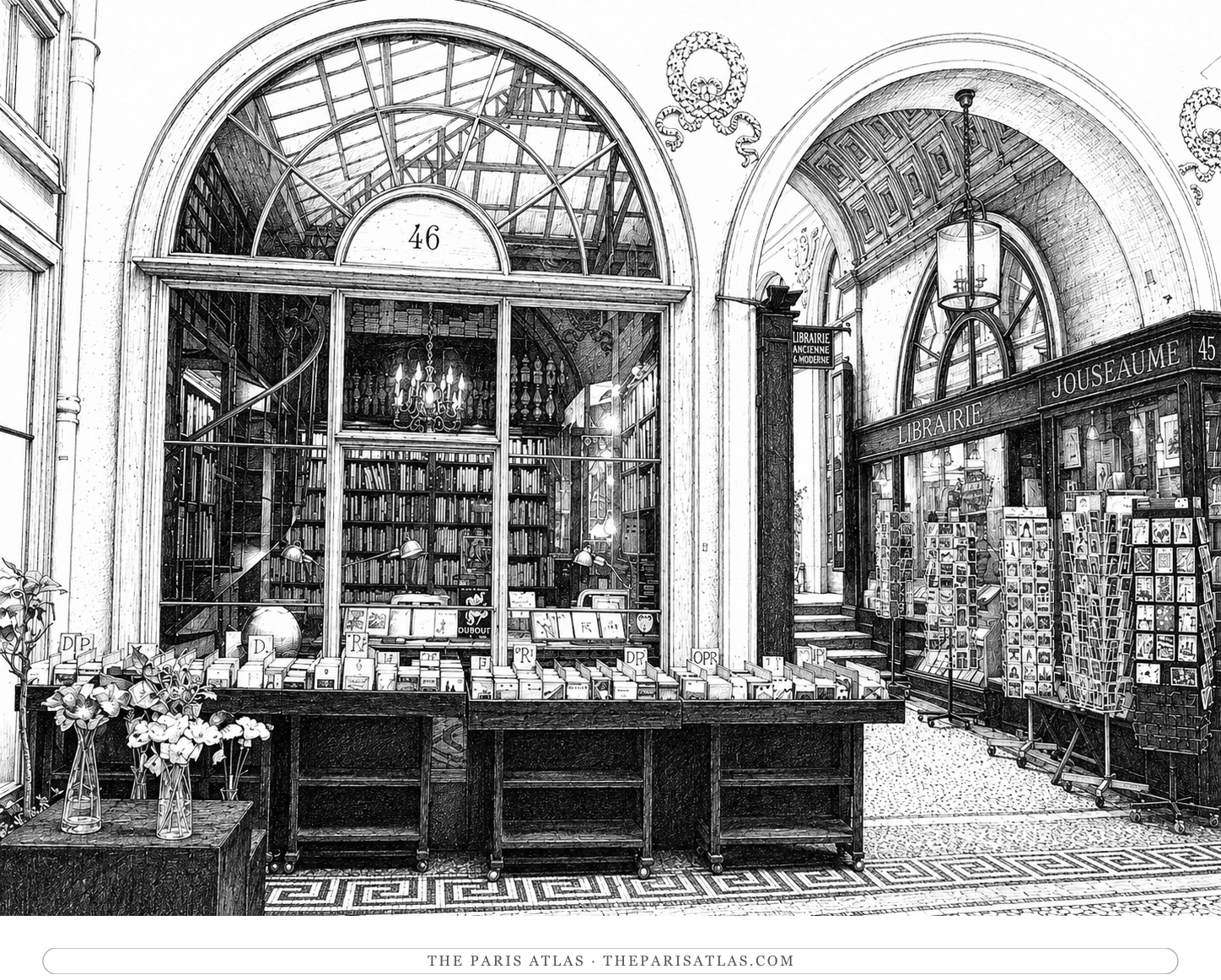
Galerie Vivienne

Colette frequented the Galerie Vivienne from her nearby Palais-Royal home, often with Jean Cocteau. The City of Paris describes the passage's Petit-Siroux bookshop, now the Librairie Jousseaume, as her repaire.

Visit the place
The Palais-Royal garden gates and colonnade in colour, clipped trees and gravel walks beyond

Park · Palais-Royal

Open — go in

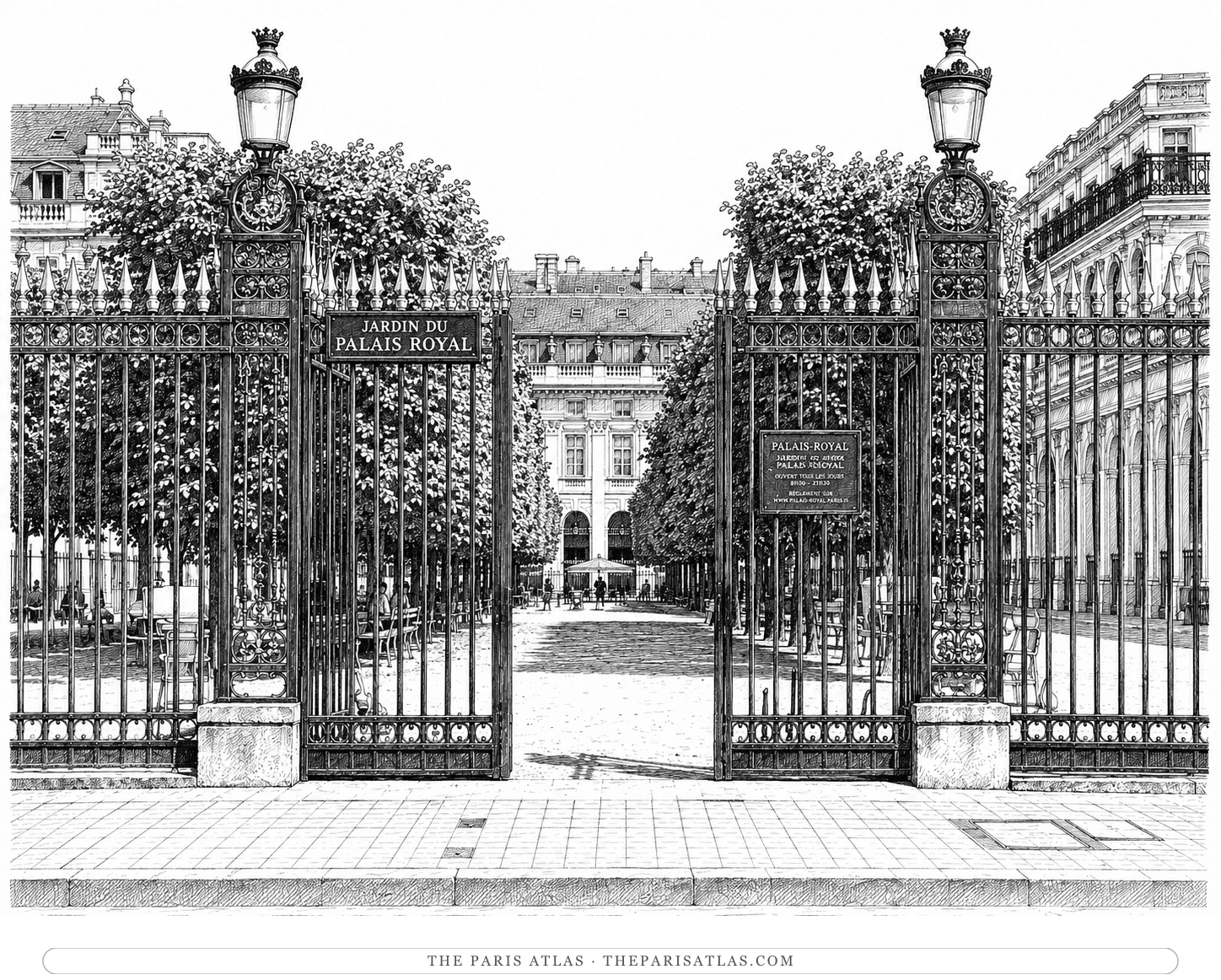
Jardin du Palais-Royal

From her first-floor apartment Colette watched and walked the Palais-Royal garden for the last years of her life; it is the subject of Le Fanal bleu (1949). Her state funeral was held in the courtyard of the Palais-Royal in 1954.

Visit the place
The Grand Véfour dining room in colour, its painted panels, mirrors and red banquettes

Restaurant · Palais-Royal

Open — go in

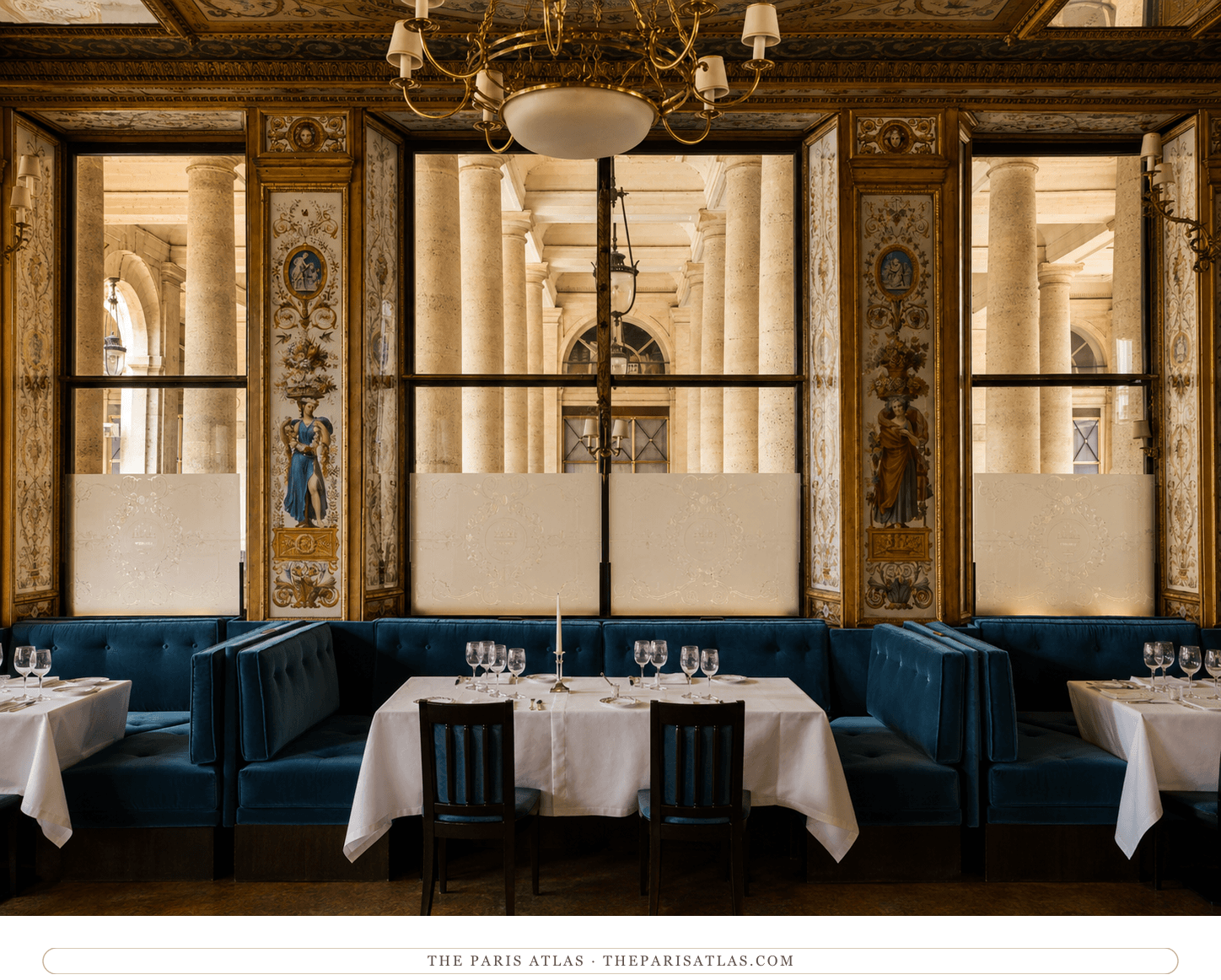
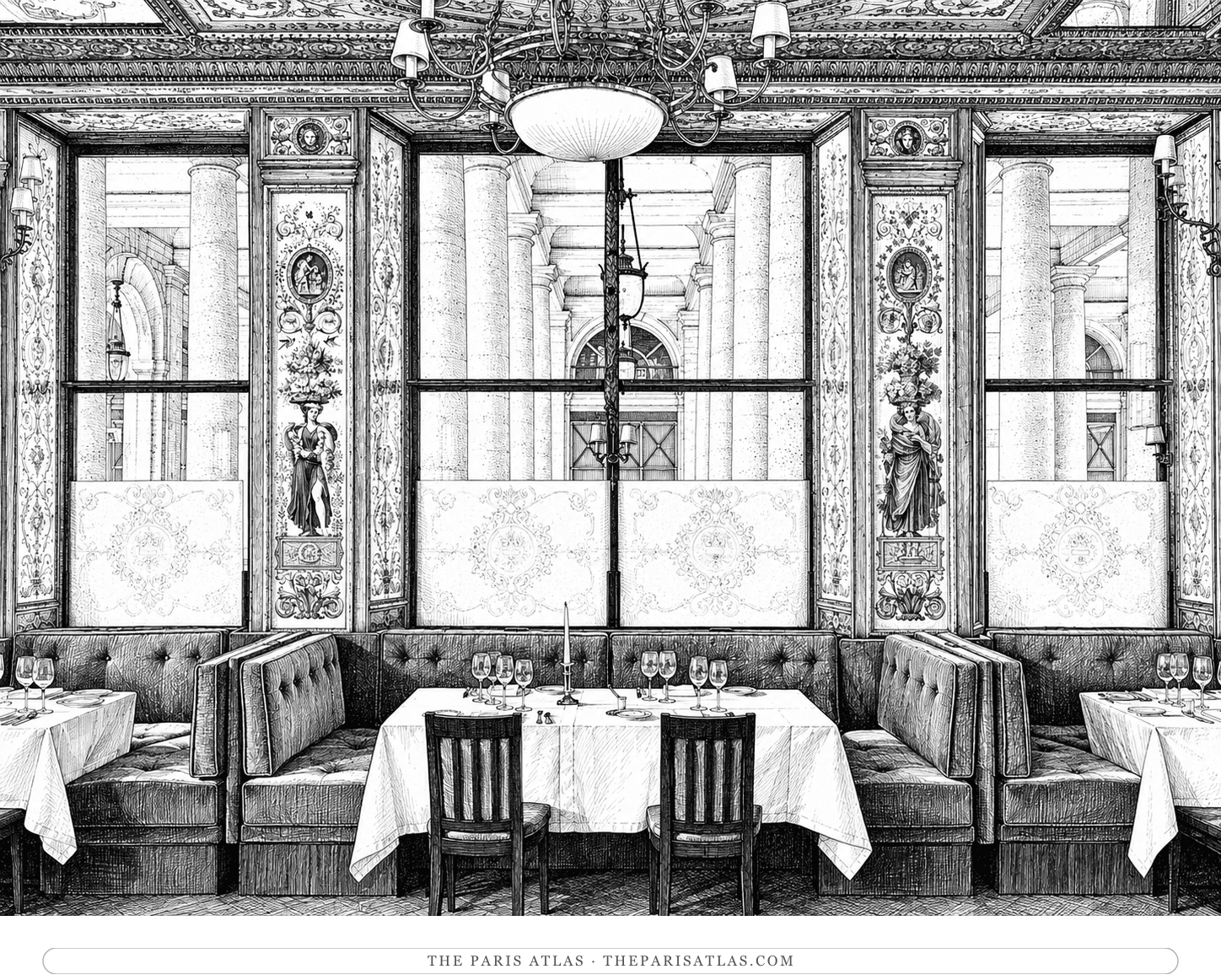
Le Grand Véfour

The City of Paris names Le Grand Véfour a restaurant Colette favored. The restaurant reopened in 1948, a short walk from her Palais-Royal apartment, and a brass plaque marks her banquette beside Jean Cocteau's.

Visit the place
The Moulin Rouge lit red at night, the windmill and neon signage in colour

Nightclub · Pigalle

Open — go in

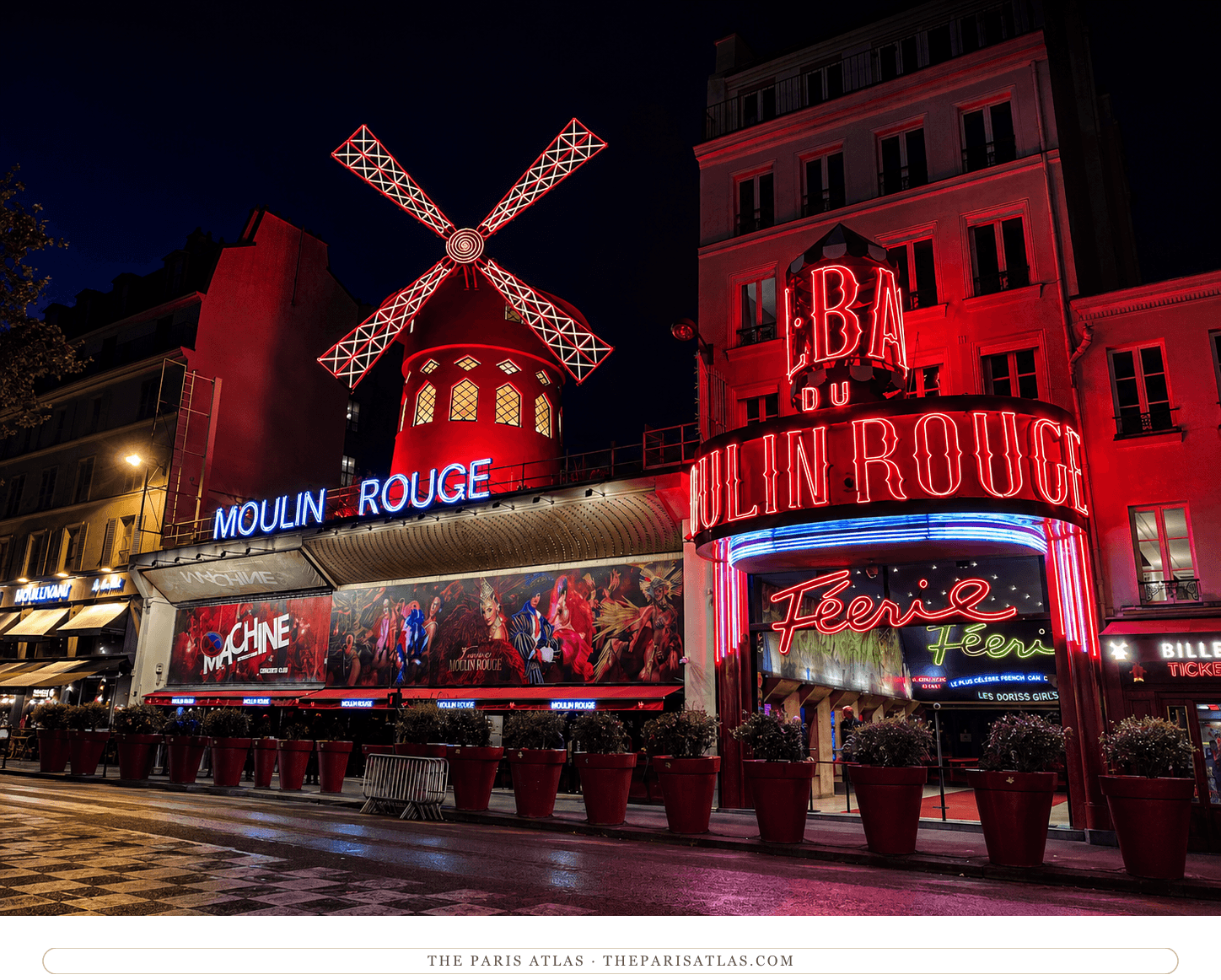
Moulin Rouge

Colette performed the mime Rêve d'Égypte with Mathilde de Morny (Missy) on 3 January 1907; their kiss caused a riot, and the police banned the piece.

Visit the place
The Olympia façade and marquee in colour on boulevard des Capucines

Theatre · Opéra

Open — go in

L'Olympia

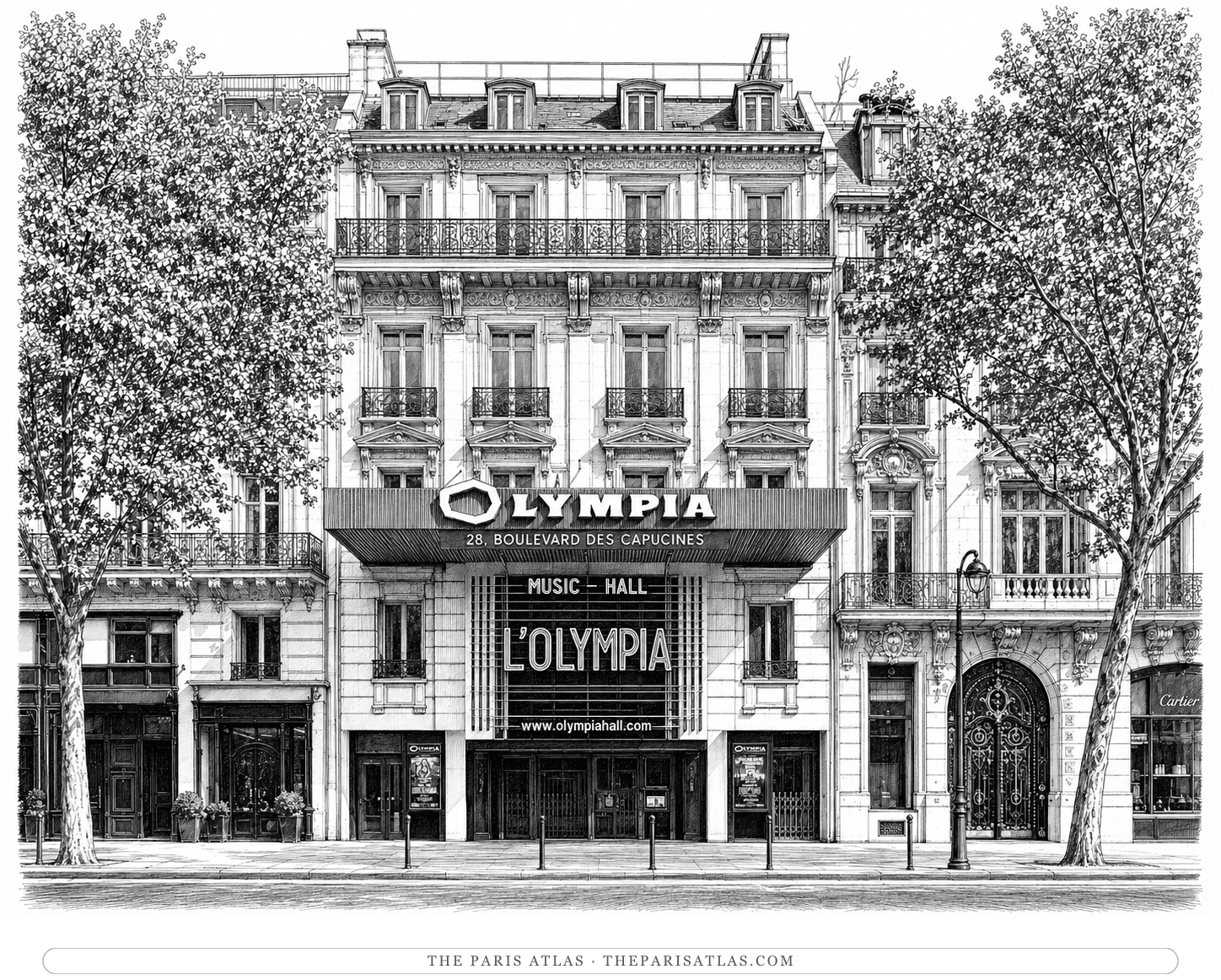
Colette played the title role in the pantomime La Romanichelle at the Olympia, 1 October–2 November 1906.

Visit the place
The Théâtre des Mathurins auditorium in colour, seats and gilded balconies toward the stage

Theatre · Madeleine

Open — go in

Théâtre des Mathurins

Colette's public stage debut: she played a faun in the mimed drama Le Désir, la Chimère et l'Amour, 6–25 February 1906.

Visit the place
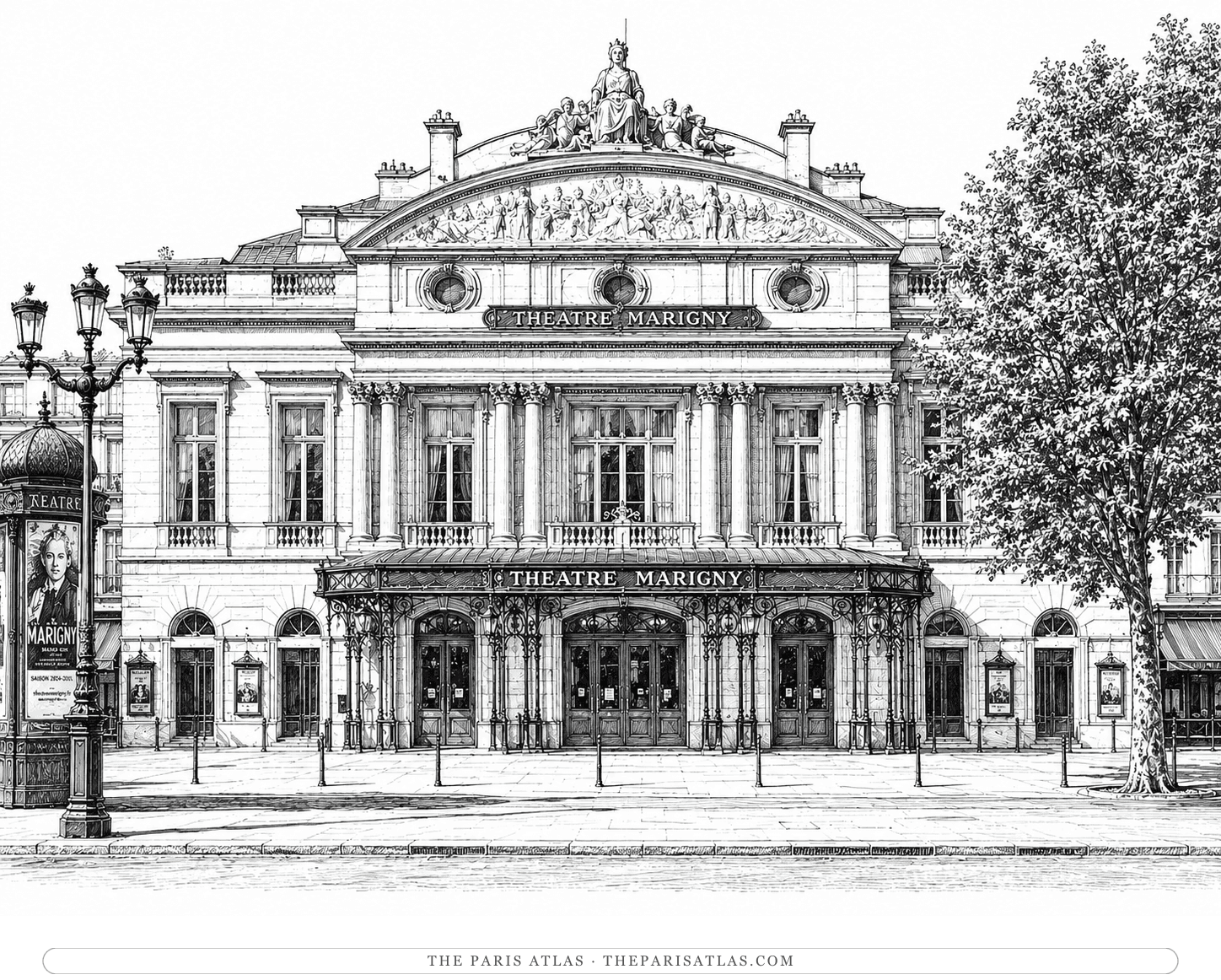
The Théâtre Marigny pavilion in colour amid the gardens off the Champs-Élysées

Theatre · Champs-Élysées

Open — go in

Théâtre Marigny

Colette played Paniska in Charles Van Lerberghe's Pan at the Théâtre Marigny, 28–30 November 1906.

Visit the place
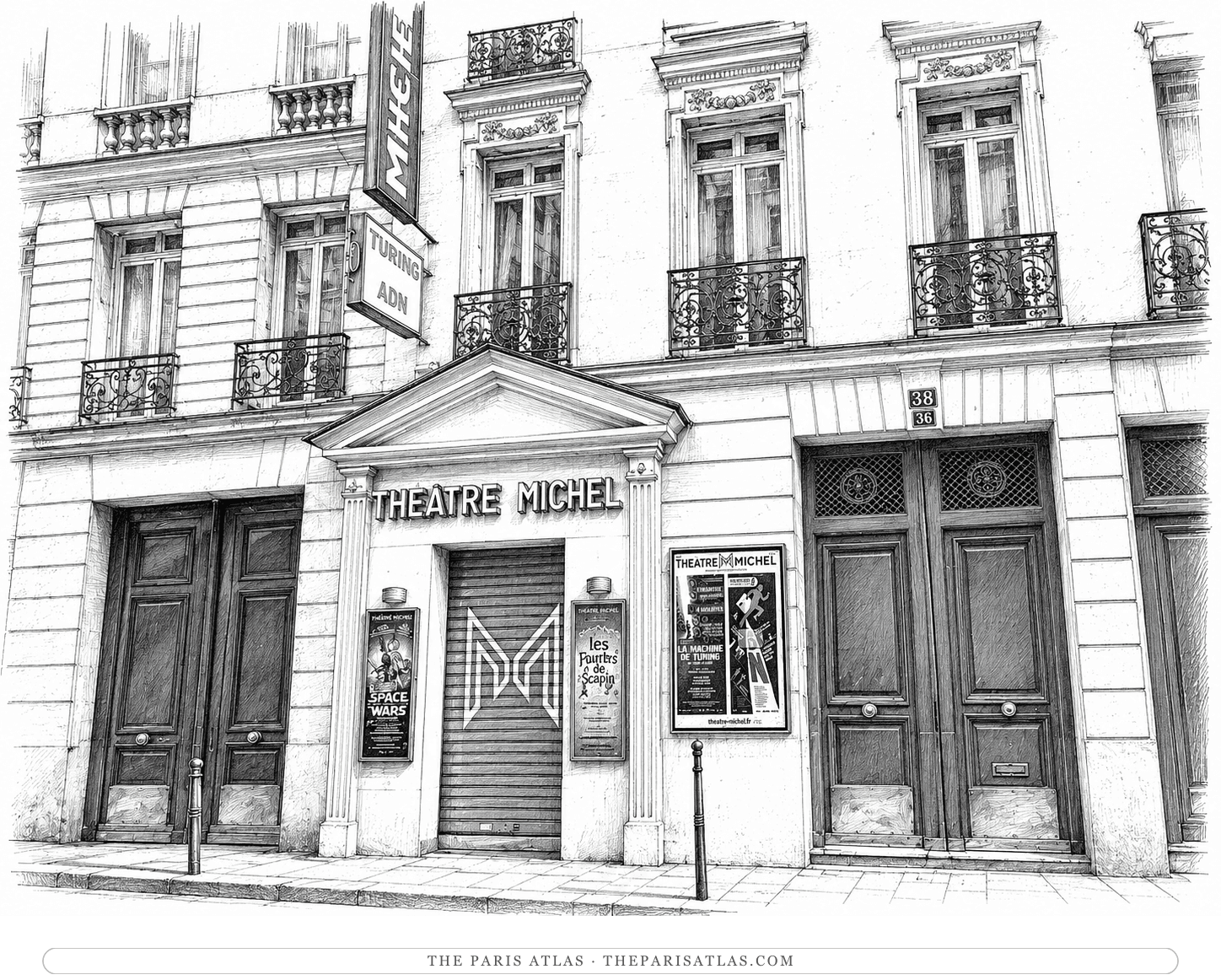
The Théâtre Michel entrance in colour on rue des Mathurins, with current playbills

Theatre · Madeleine

Open — go in

Théâtre Michel

The stage adaptation of Colette's Chéri premiered at the Théâtre Michel on 13 December 1921; Colette played Léa herself at the hundredth performance on 26 February 1922.

Visit the place
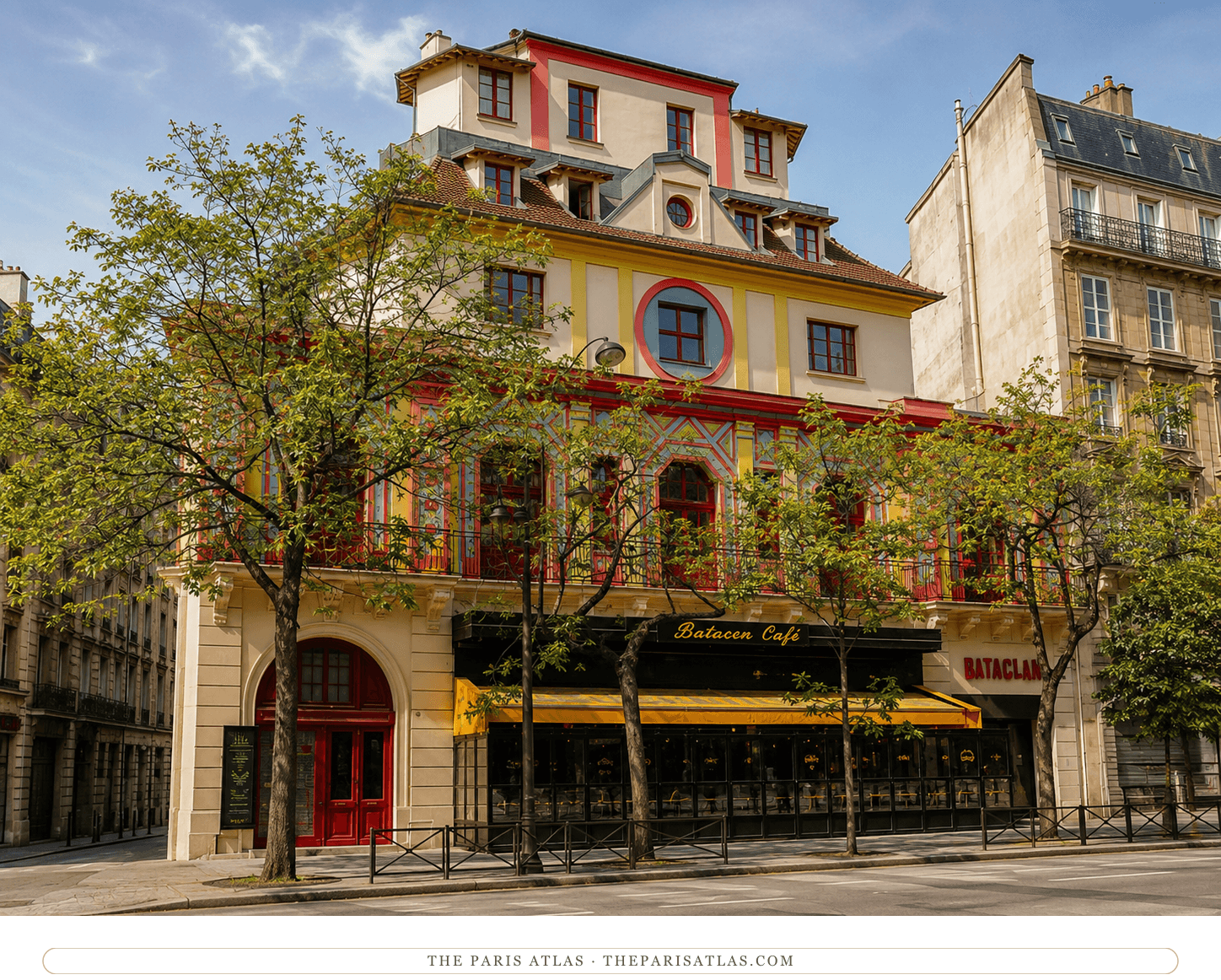
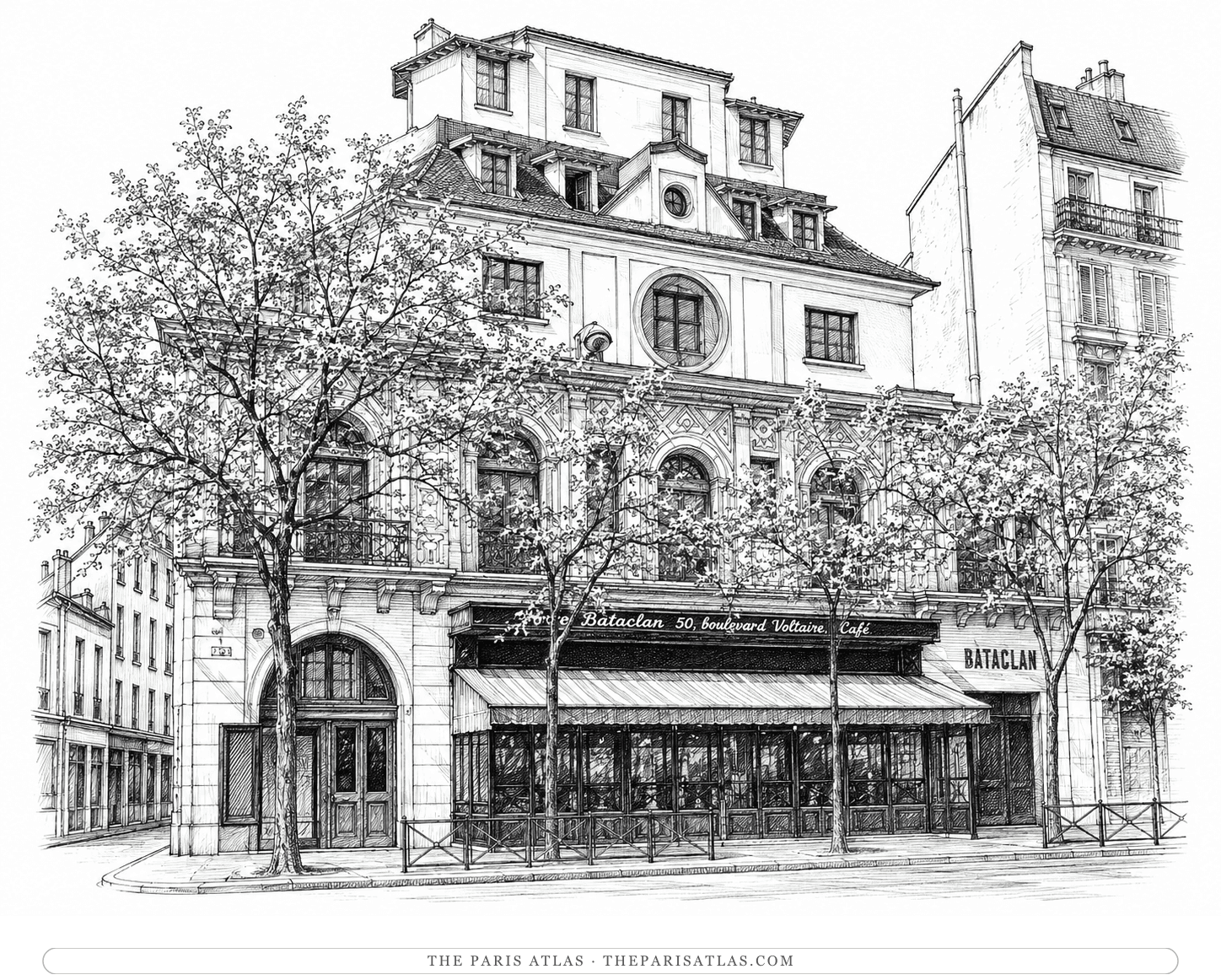
The Bataclan façade and café terrace in colour on boulevard Voltaire

Theatre · Oberkampf

Open — go in

Bataclan

Colette performed at the Bataclan across 1911 and 1912, near the end of her music-hall years. In late August 1911 she created the mimodrama Aux Bat. d'Af. with Georges Wague, followed by a revival of her pantomime La Chair; in 1912 she appeared in the revue Ça grise and a revival of L'Oiseau de nuit.

Visit the place
The 9 rue de Beaujolais frontage in colour, its doorway, street lamp and Palais-Royal wall sign

Apartment · Palais-Royal

Outside only

9 rue de Beaujolais

Two residencies at 9 rue de Beaujolais: the entresol from November 1926 to 1930, then the first-floor 'étage noble' overlooking the Palais-Royal garden from January 1938 until her death on 3 August 1954, with an interval on the Champs-Élysées between.

Visit the place
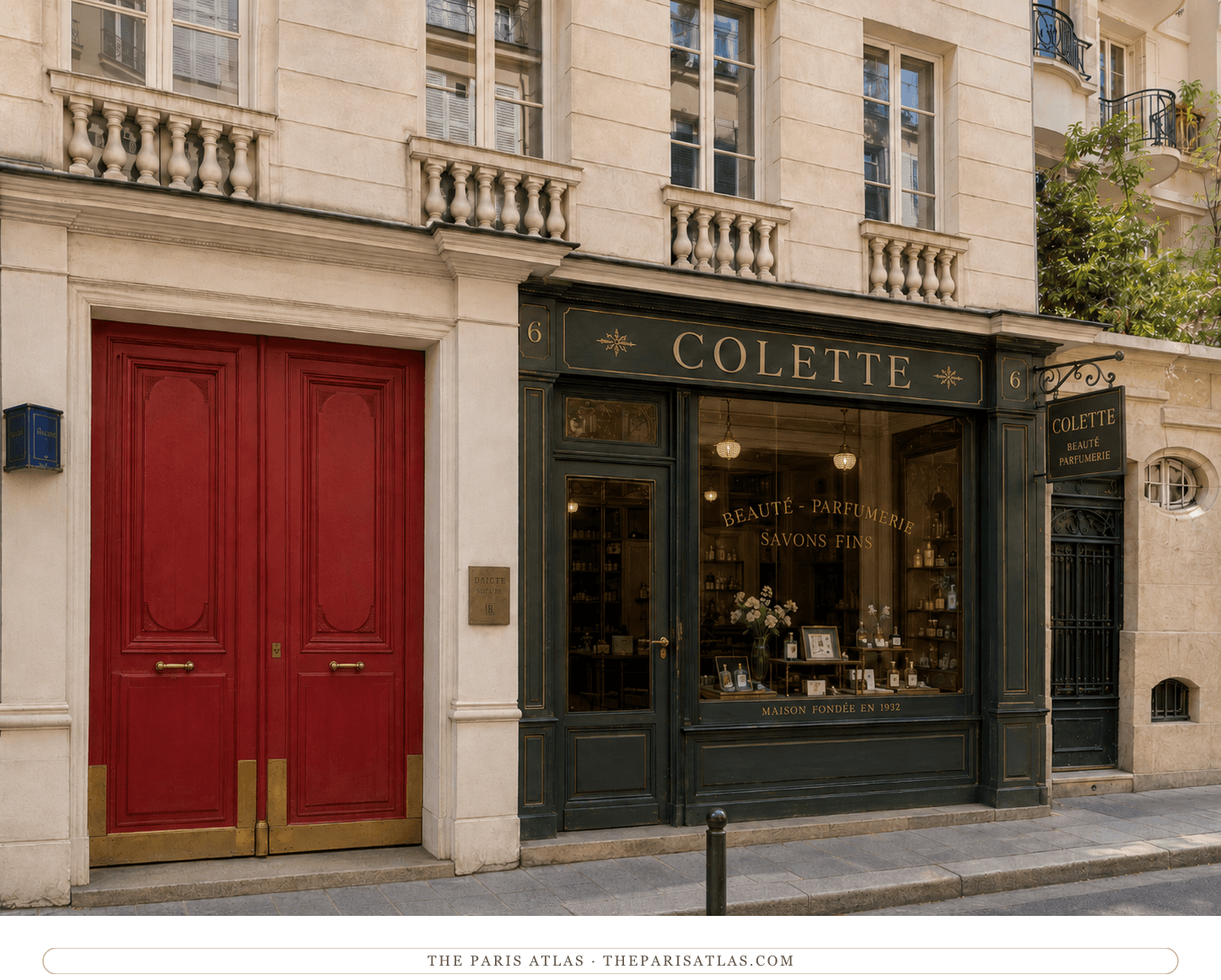
The imagined Colette beauty-shop storefront in colour, a dark-green front with gold lettering and a display of perfumes

Shop · Madeleine

Outside only

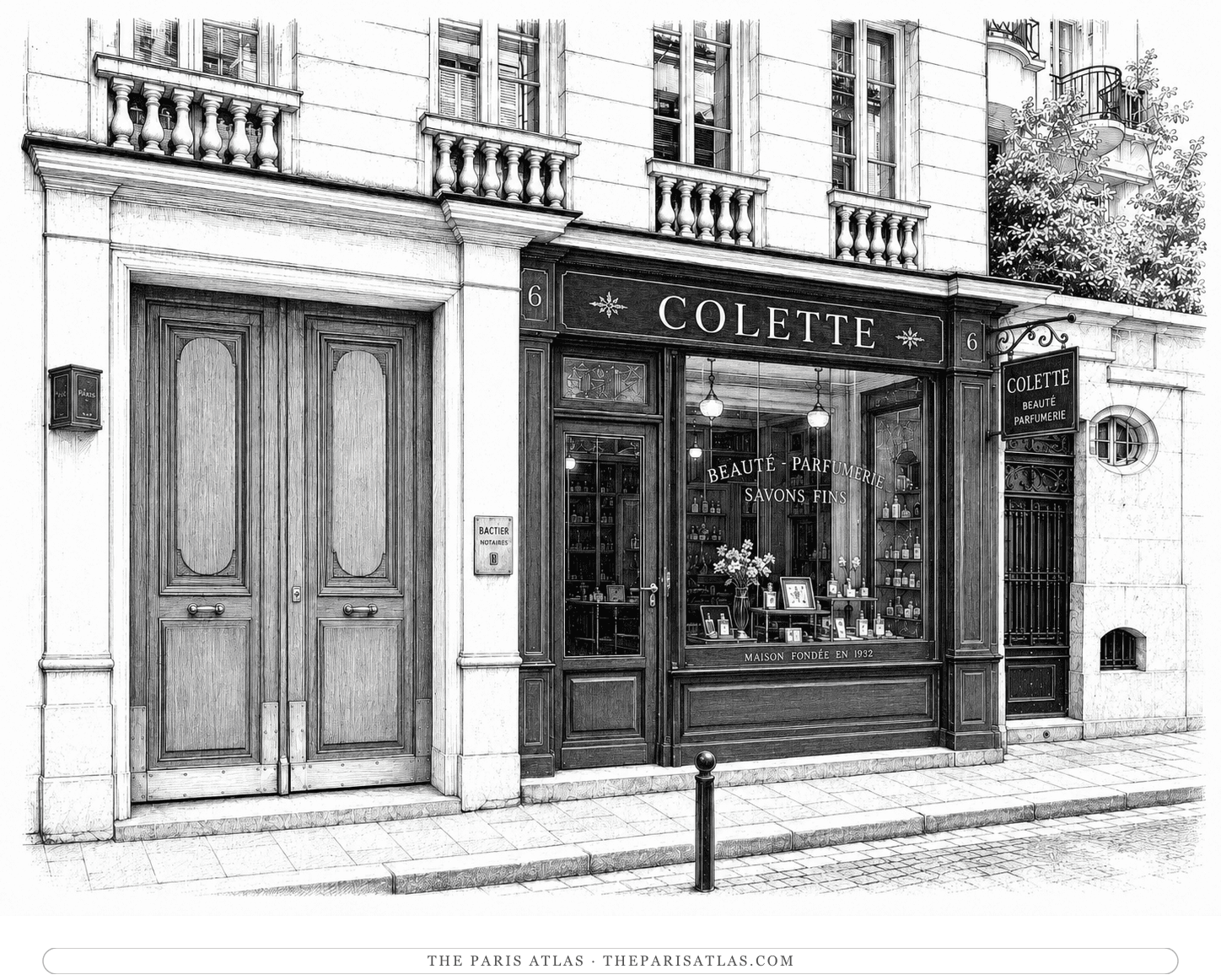
6 rue de Miromesnil

Colette opened her beauty shop at 6 rue de Miromesnil on 1 June 1932, selling cosmetics she made herself and making up clients in person. The short-lived venture closed after little more than a year.

Visit the place
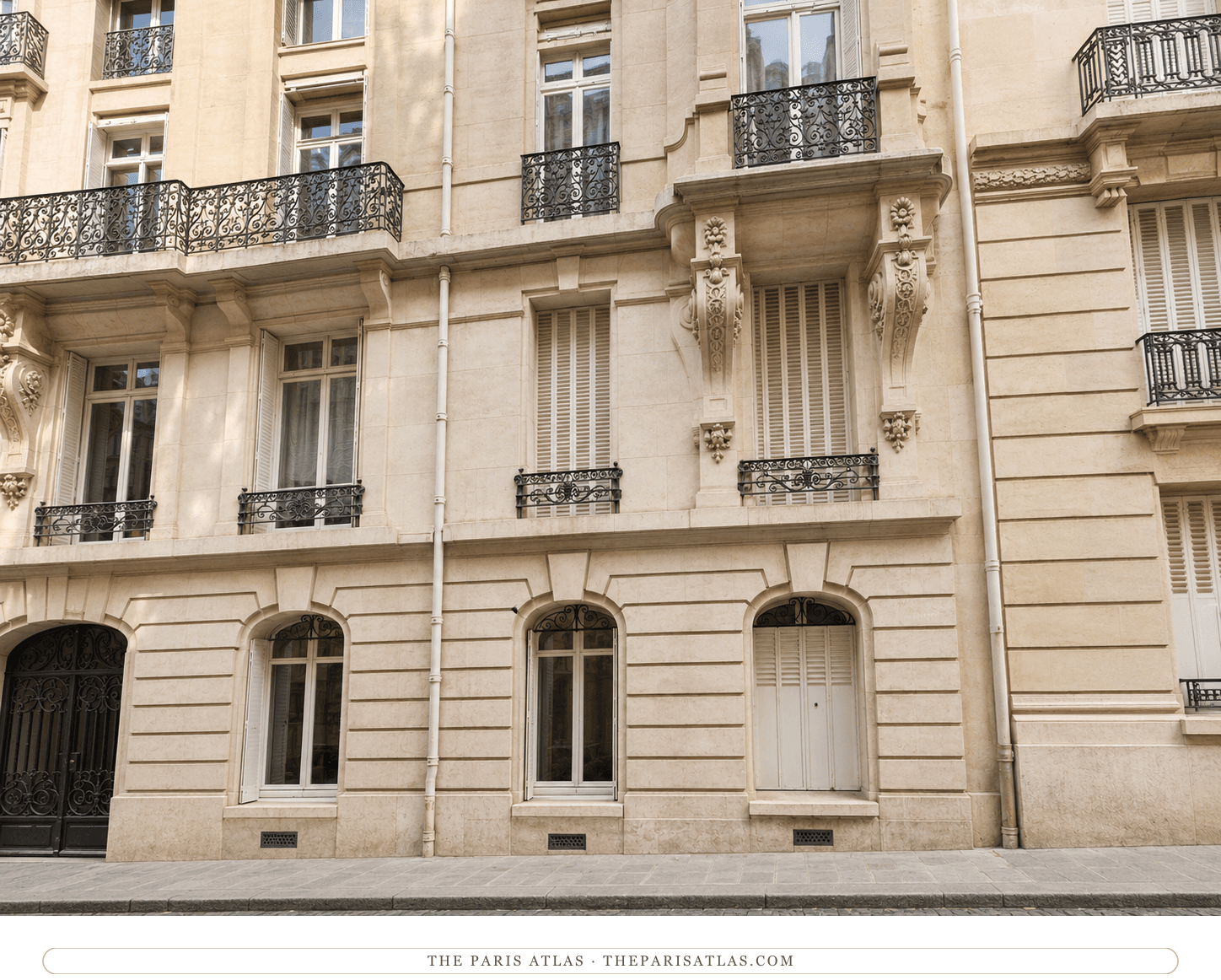
The 2 rue Georges-Ville frontage in colour, its stone balconies on a quiet street near the Avenue Foch

Apartment · Chaillot

Outside only

2 rue Georges-Ville

The home of Mathilde de Morny (Missy), where Colette lived much of the time during their relationship after leaving Willy, while keeping apartments of her own nearby.

Visit the place
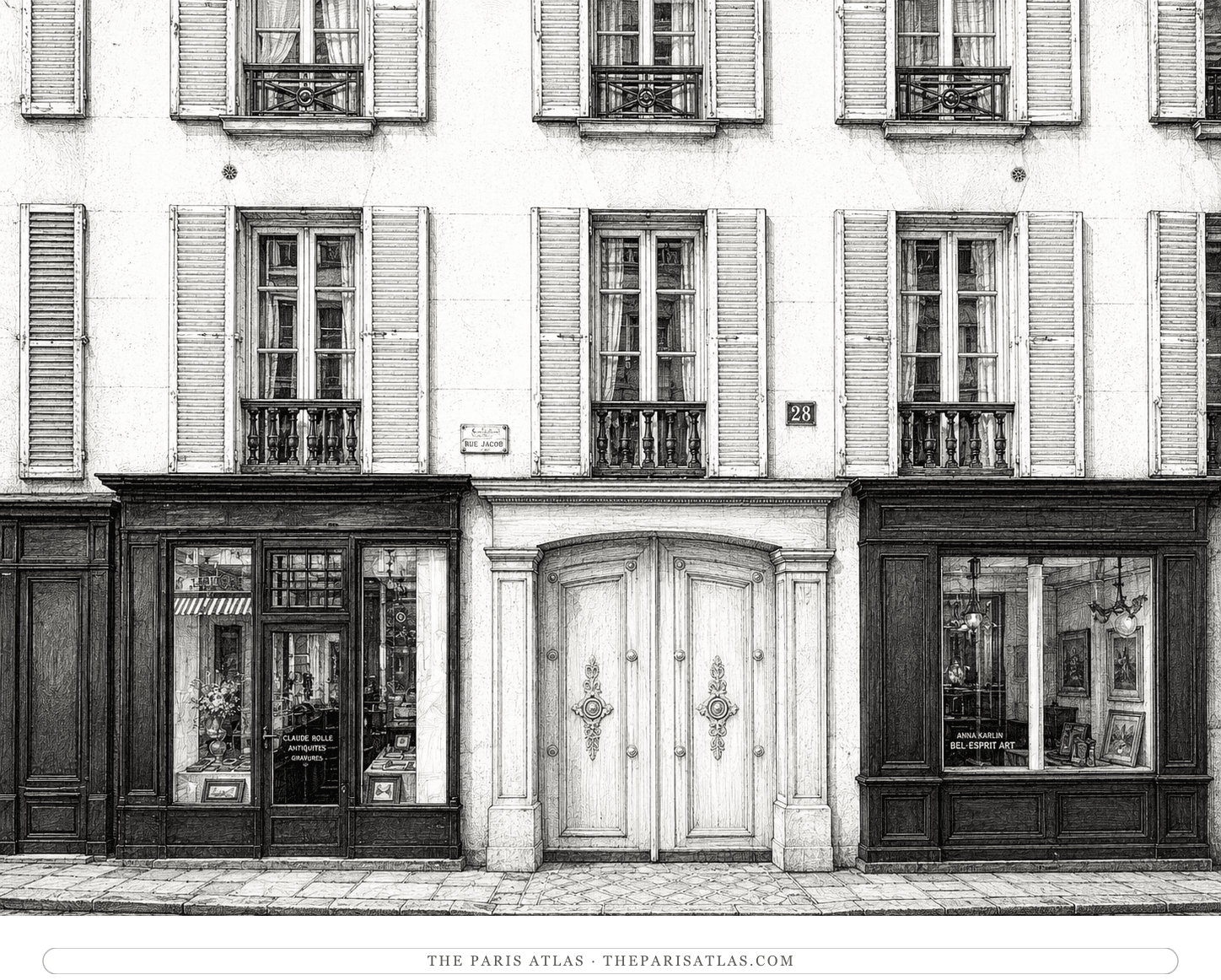
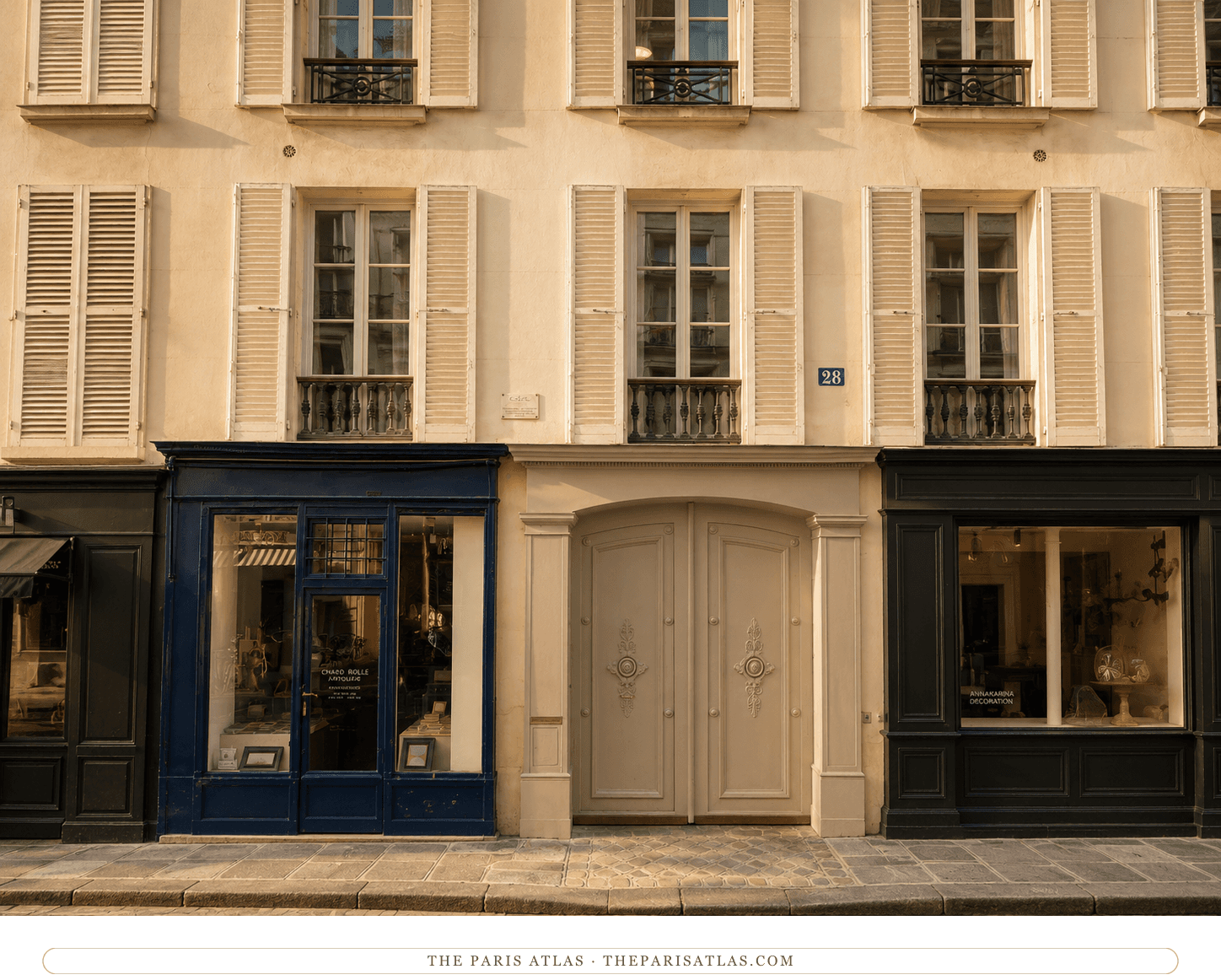
The 28 rue Jacob frontage in colour, its shuttered windows and ground-floor shops on the Left Bank street

Apartment · Saint-Germain-des-Prés

Outside only

28 rue Jacob

Colette's first Paris home, a third-floor apartment taken with her husband Willy after their 1893 marriage.

Visit the place
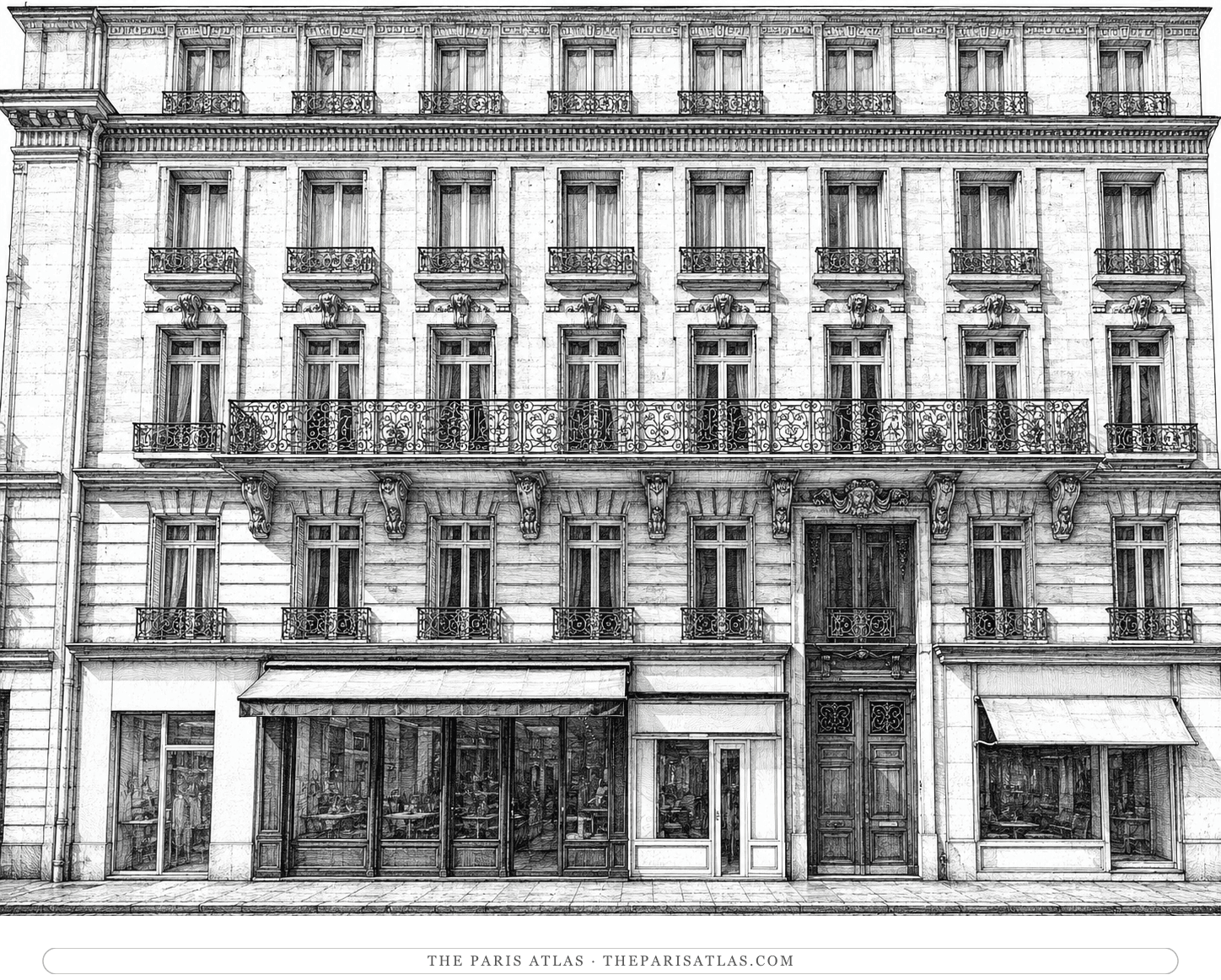
The 93 rue de Courcelles frontage in colour, its stone façade and street-level shops near Parc Monceau

Apartment · Plaine Monceau

Outside only

93 rue de Courcelles

A sixth-floor former studio near Parc Monceau where Colette and Willy lived as the Claudine novels began to appear under his name.

Visit the place
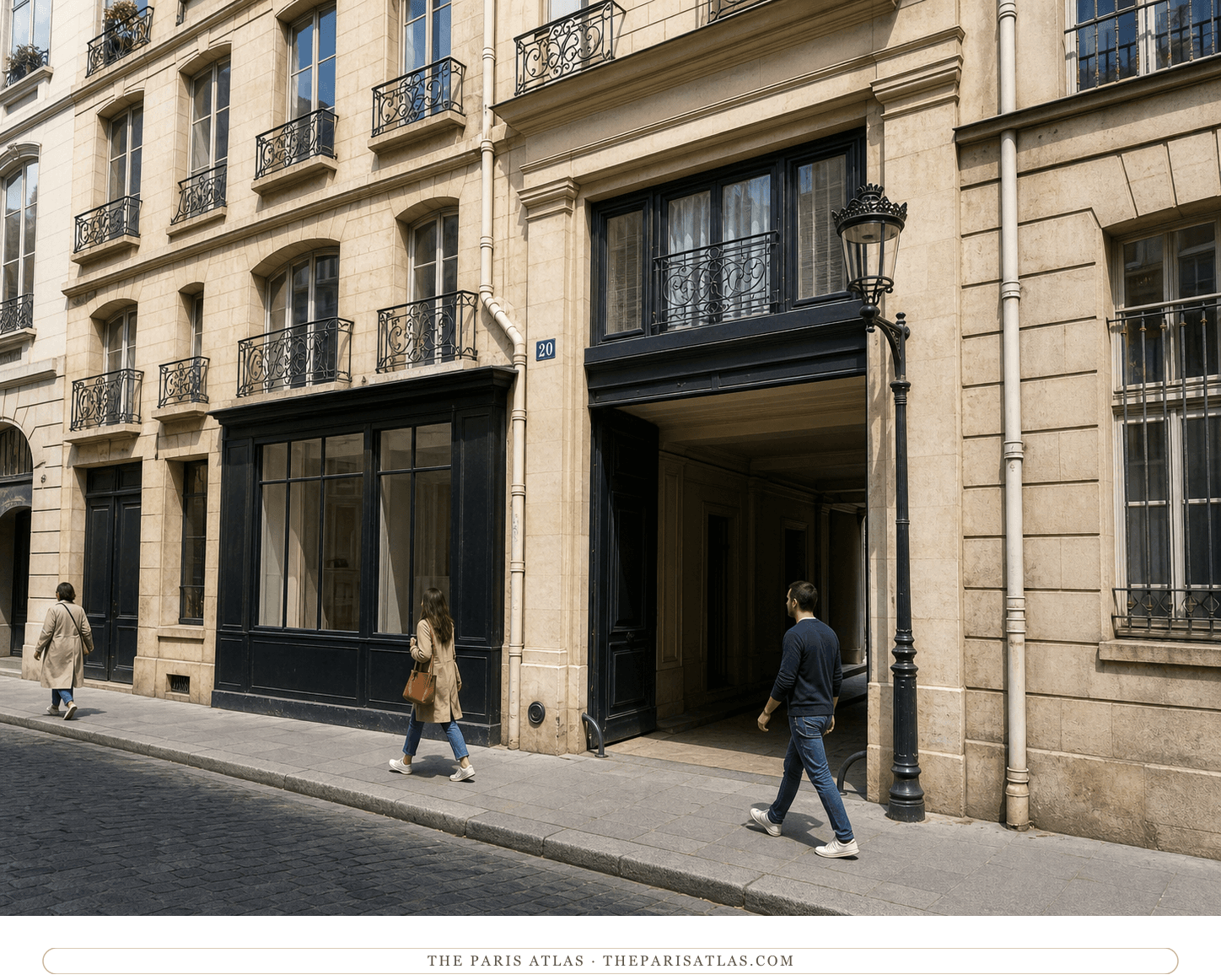
Present-day color view of the pale stone frontage and numbered entrance at 20 rue Jacob

Salon · Saint-Germain-des-Prés

Outside only

20 rue Jacob

Colette took part in the salon repeatedly. She gave Barney the first hearing of her stage version of La Vagabonde there, and the Académie des Femmes honoured her from 1927. She had lived four doors along at 28 rue Jacob from 1893 to 1896, before Barney arrived on the street. No first or last visit is fixed by the sources.

Visit the place
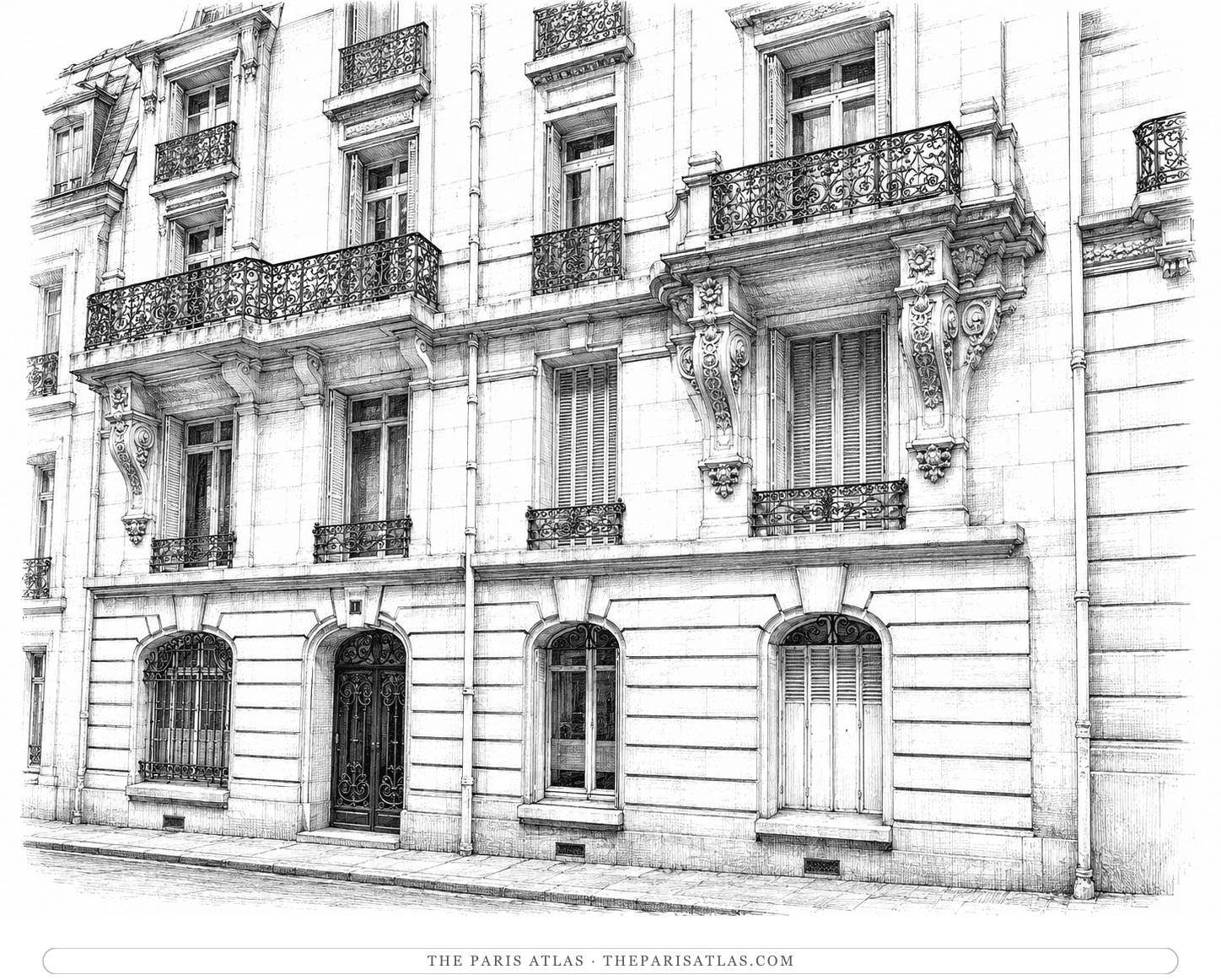
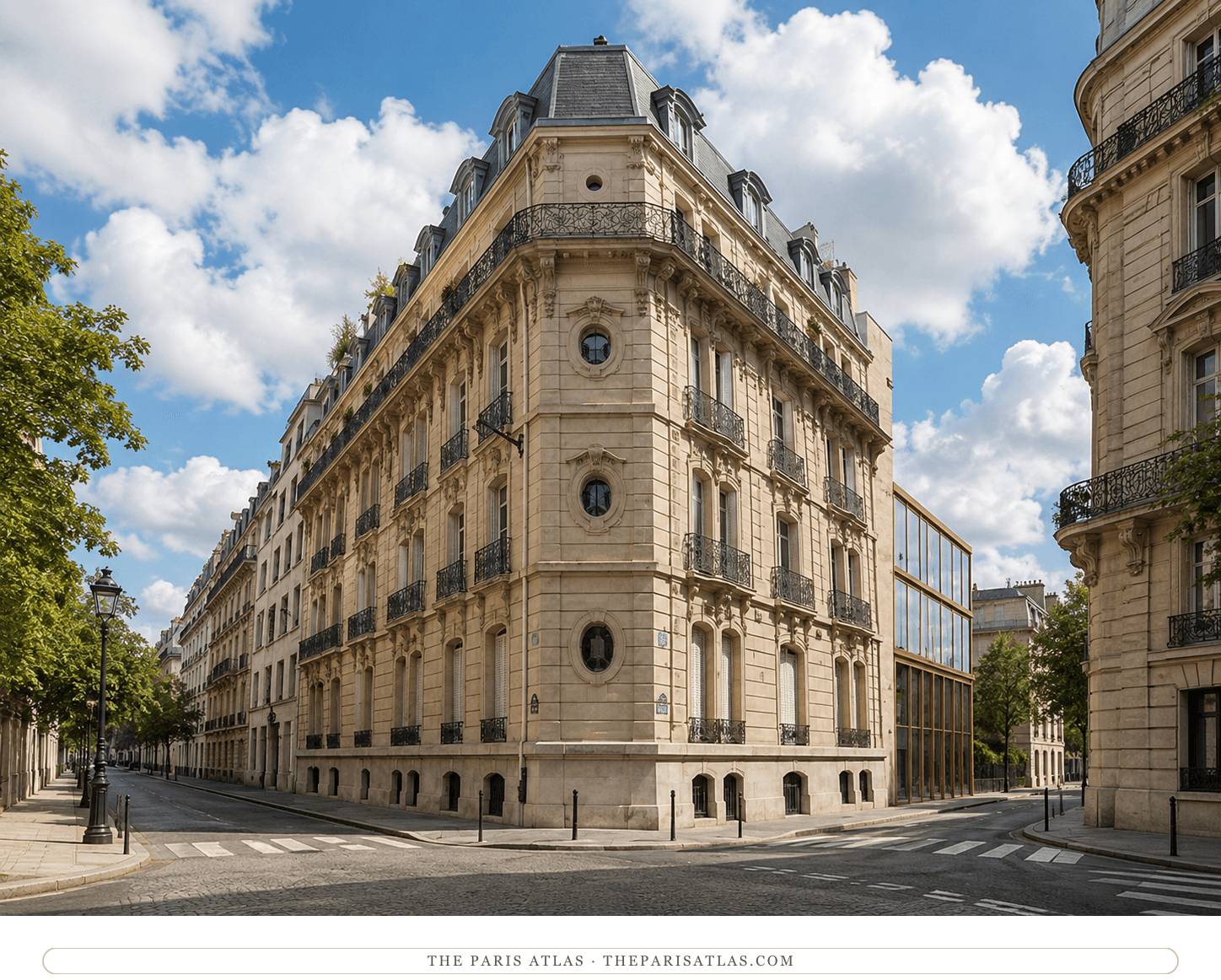
The same Haussmann-era building rendered in colour, an imagined reconstruction

Apartment · Plaine Monceau

Outside only

177 bis rue de Courcelles

The larger apartment of the Claudine peak, where Colette kept a gymnasium; she left in 1906 as the marriage to Willy ended.

Visit the place
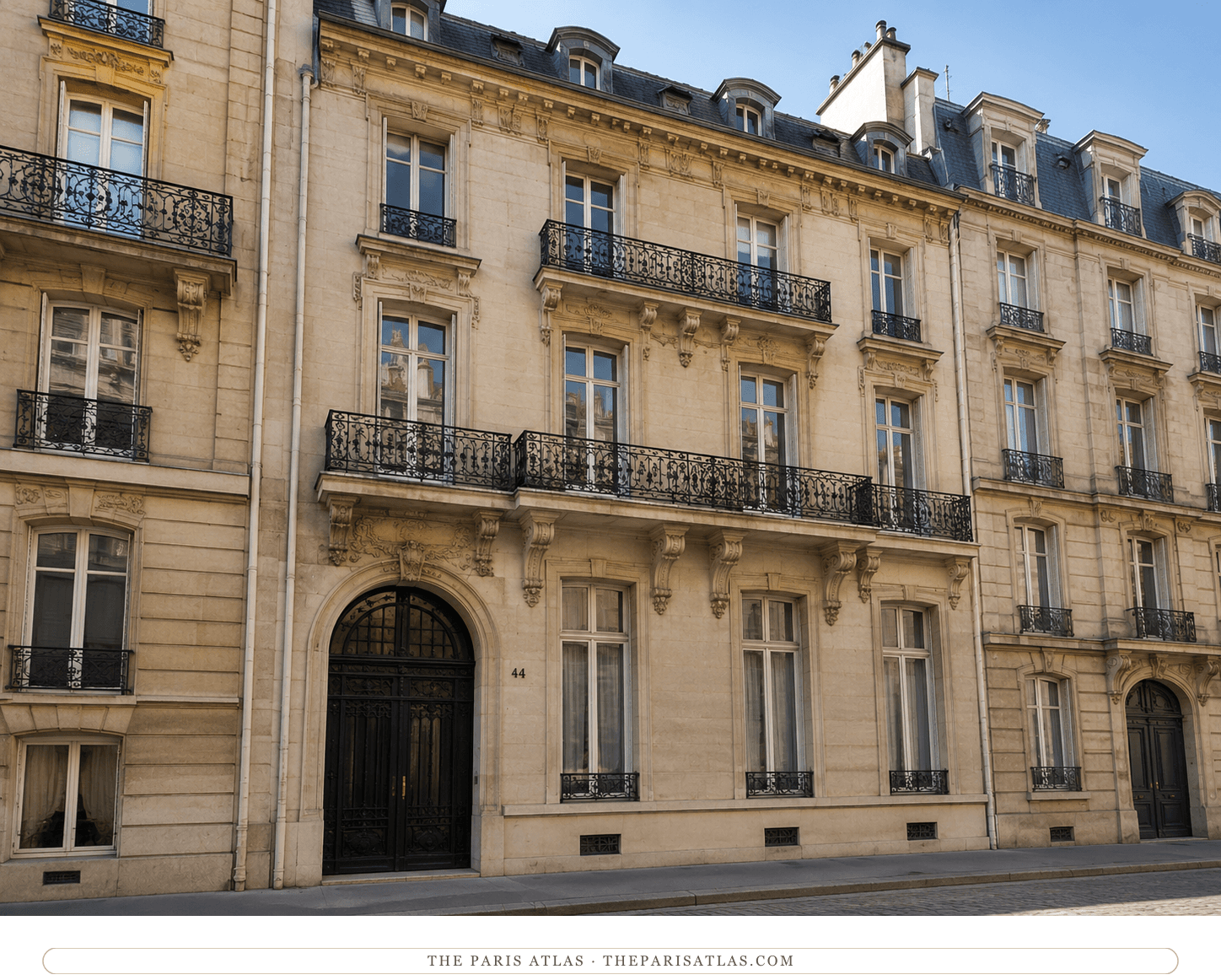
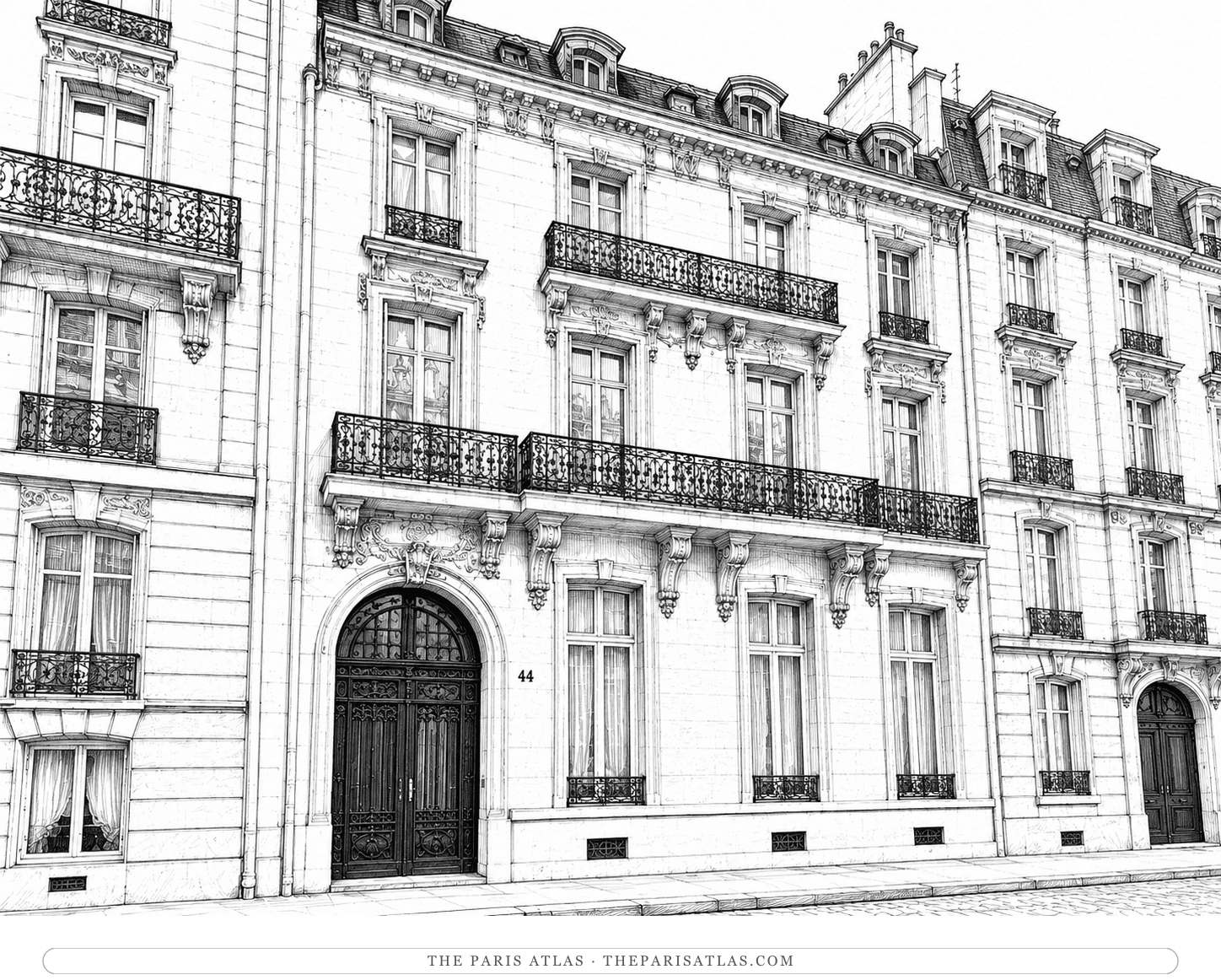
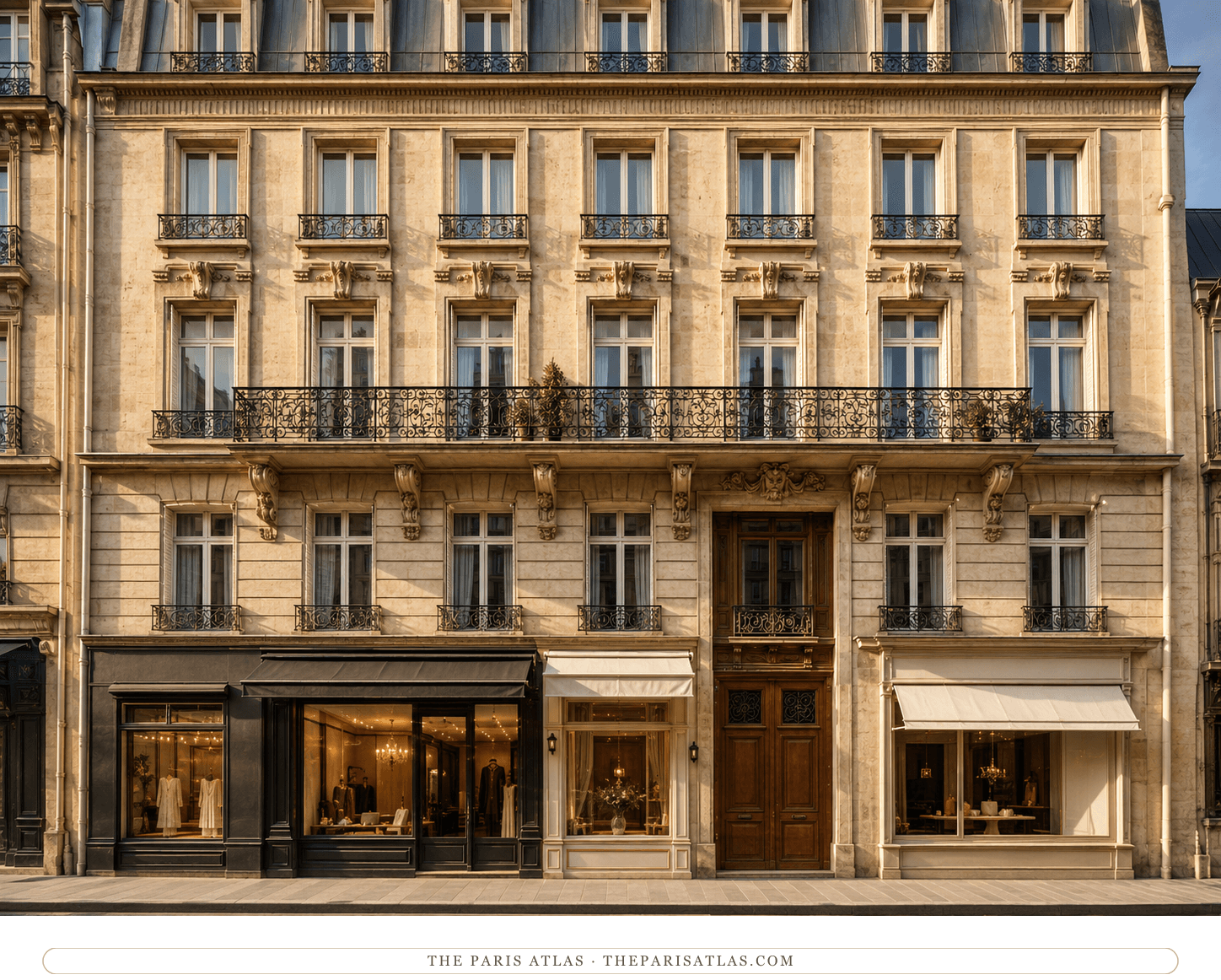
The same Haussmann-era façade in colour, in warm stone with black iron balconies

Apartment · Chaillot

Outside only

44 rue de Villejust

A ground-floor apartment Colette rented on her own after leaving Willy; the building was demolished around 1908 and the street later renamed rue Paul-Valéry.

Visit the place
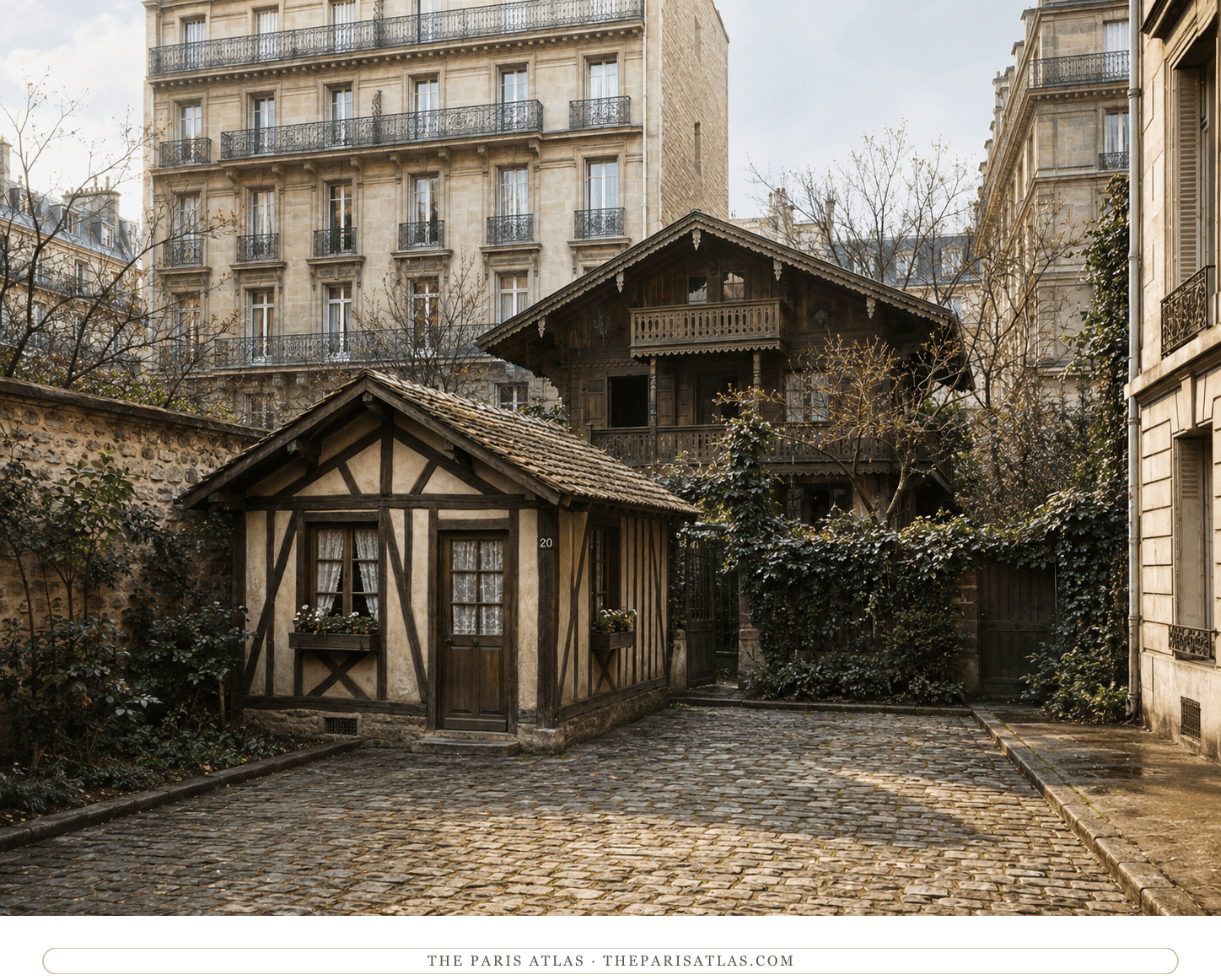
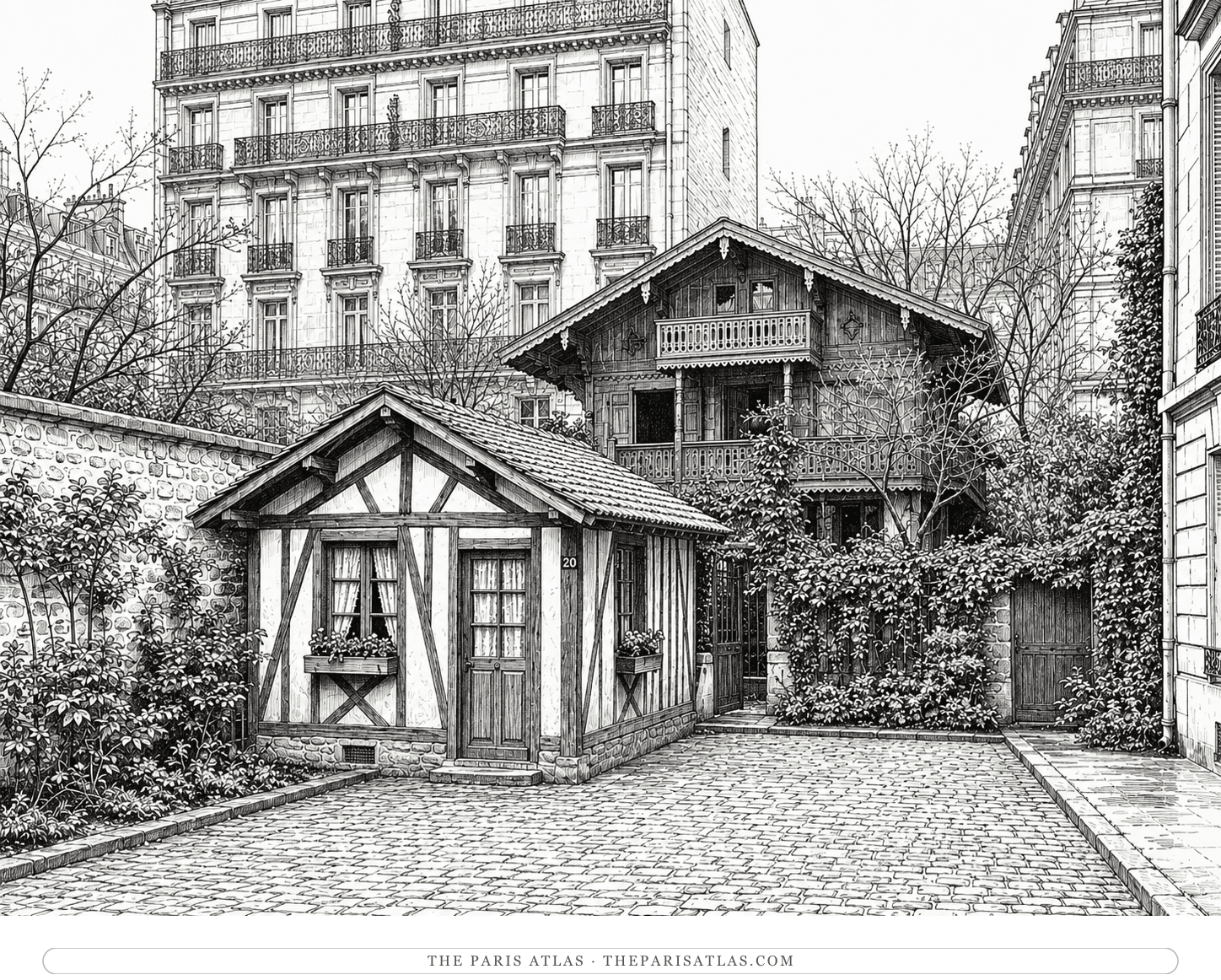
The same ivy-covered wooden chalet in colour, warm timber walls and green shutters in a leafy garden

House · Passy

Outside only

57 rue Cortambert

Henry de Jouvenel's house in Passy, where Colette lived from October 1911 through their 1912 marriage and the 1913 birth of their daughter.

Visit the place
The same mansion and garden in colour, pale stone behind mature trees

House · Auteuil

Outside only

69 boulevard Suchet

Colette's Auteuil home for a decade, through the end of her marriage to Henry de Jouvenel (divorced 1924); she left in 1926 for the rue de Beaujolais.

Visit the place

From the journal

Recent coverage of Colette's world

All stories

Real history

Colette's Three Earthly Paradises

If you have gone looking for Colette's Earthly Paradise and come back confused, the fault is not yours. There are three of them, and they are not editions of one another.

Adriana Pope · · 4 min read

Organizations

Honoured by · 1927-01

Académie des Femmes

Colette took the first of the Académie's evenings, on 14 January 1927, and performed scenes from her own stage version of La Vagabonde. Anna Livia counts her among the French writers of the Académie; Anne Charles supplies the date and the reading.

Anne Charles, Barney Opens Her Paris Salon (2022), Summary of Event, read 2026-08-10; Anna Livia, Barney, Natalie Clifford (1876–1972), in Women in World History: A Biographical Encyclopedia (2002)

Questions about Colette

What was Colette’s real name?

Her full name was Sidonie-Gabrielle Colette. She signed work as Colette Willy and Colette de Jouvenel before using her birth surname alone as her final pen name.

Is it spelled Colette or Collette?

Colette, with one l. “Collette” is a common misspelling. She was born Sidonie-Gabrielle Colette in 1873 and used the surname alone as her final pen name.

What does the name Colette mean?

As a given name, Colette is a French diminutive of Nicole and Nicolette, from the Greek Nikolaos, meaning “victory of the people.” The writer Colette, however, was not given it as a first name: she was born Sidonie-Gabrielle Colette, and Colette was her father’s surname, which she kept as her pen name.

Who was Willy?

Willy was the pen name of Colette’s first husband, Henry Gauthier-Villars, a Paris music critic and literary entrepreneur. The first Claudine novels were published under his name.

Did Willy write the Claudine books?

Colette is recognized as the principal writer of the Claudine novels. They first appeared only under Willy’s name, and from 1909 editions credited both “Willy et Colette Willy.”

Why did Colette become a stage performer?

She needed an independent income after separating from Willy. Acting, dance, and mime also gave her a public identity and supplied material for The Vagabond and her writing about music-hall life.

Who was Missy in Colette’s life?

Missy was Mathilde de Morny, Colette’s partner and stage collaborator during the music-hall years. Their onstage kiss in Rêve d’Égypte caused an uproar at the Moulin Rouge in 1907.

Was Colette bisexual?

Colette had significant relationships with both women and men. She married three times and had affairs and partnerships with women, the longest with Mathilde de Morny (“Missy”). She did not use a fixed label, and her book The Pure and the Impure is her fullest treatment of desire between women.

How many times was Colette married?

Three times: to Henry Gauthier-Villars, known as Willy; Henry de Jouvenel; and Maurice Goudeket.

Did Colette have children?

She had one daughter, Colette de Jouvenel, born in 1913 and commonly called Bel-Gazou.

What is distinctive about Colette’s writing?

Its sensual exactness and psychological control. Colette lets scents, textures, animals, bodily gestures, and small changes in atmosphere carry arguments about desire, aging, jealousy, work, and freedom.

What is Colette’s most famous book?

Internationally, Gigi is probably the best known because of its stage and film adaptations. Chéri, The Vagabond, Sido, The House of Claudine, and the Claudine series are at least as central to her literary reputation.

Where did Colette live in Paris?

Her most famous home was 9 rue de Beaujolais overlooking the Palais-Royal garden. She returned there in 1938 and died in the apartment in 1954.

How did Colette die?

She died of natural causes at eighty-one, at home at 9 rue de Beaujolais in Paris, on 3 August 1954. Her last years were increasingly confined by arthritis. France gave her national funeral honours in the courtyard of the Palais-Royal, and she was buried at Père-Lachaise.

Where is Colette buried?

At Père-Lachaise Cemetery in Paris, after national funeral honours in the courtyard of the Palais-Royal.

What does the 2018 film Colette cover?

It concentrates on Colette’s early career: her marriage to Willy, the Claudine authorship dispute, relationships with women, music-hall work, and emergence as an independent writer. It does not cover most of her later literary career.

Is the 2018 film Colette based on a true story?

Yes. It is a biographical drama about Colette’s real early life — her marriage to Willy, the dispute over who wrote the Claudine novels, and her relationships with Missy and others — with the compression and invented dialogue of a feature film. It covers only her first marriage and emergence as a writer, not her later career.

Sourced claims

Every connection the graph holds for Colette, with the evidence behind it.

Buried at · 1954

Père-Lachaise Cemetery

After national funeral honours in the Palais-Royal courtyard, Colette was buried at Père-Lachaise Cemetery.

Grande Chancellerie de la Légion d’honneur — Colette; Société des amis de Colette — Chronology

Collaborated with · 1906–1907

Mathilde de Morny

Colette and Mathilde de Morny, known as Missy, were partners and stage collaborators. Their pantomime Rêve d’Égypte caused an uproar at the Moulin Rouge in January 1907.

Bibliothèque nationale de France — The Worlds of Colette (2025); Lou Thomas, BFI — Wash Westmoreland on Colette (2019)

Collaborated with · 1917–1925

Maurice Ravel

Colette wrote the libretto and Maurice Ravel composed the music for L’Enfant et les sortilèges, first performed in Monte Carlo in 1925.

Paris Opera — L’Enfant et les sortilèges

Married to · 1912–1925

Henry de Jouvenel

Colette married Le Matin editor Henry de Jouvenel in December 1912. Their daughter, Colette de Jouvenel, was born in 1913; the divorce was pronounced in April 1925.

Bibliothèque nationale de France — Colette authority record; Société des amis de Colette — Chronology

Married to · 1935–1954

Maurice Goudeket

Colette married Maurice Goudeket in 1935 after a decade together. He remained her husband, companion, and literary organizer until her death.

Bibliothèque nationale de France — Colette authority record; Société des amis de Colette — Chronology

Married to · 1893–1910

Henry Gauthier-Villars

Colette married Henry Gauthier-Villars, known as Willy, in 1893. Her first Claudine novels appeared under his established pen name; they separated in 1906 and divorced in 1910.

Bibliothèque nationale de France — Colette authority record; Société des amis de Colette — Chronology

Met · 1951

Audrey Hepburn

Colette encountered the little-known Audrey Hepburn during filming in Monte Carlo and selected her for the 1951 Broadway adaptation of Gigi.

Library of Congress — Colette resource guide

Met · 1938

Jean Cocteau

Colette and Jean Cocteau were close friends and Palais-Royal neighbors from the late 1930s until her death in 1954, living around the same garden and writing admiringly of one another. Colette described his rooms in Paris de ma fenêtre.

Judith Thurman, Secrets of the Flesh: A Life of Colette (1999)

Met · 1895

Marcel Proust

By Colette's own account they first met in the 1890s at the salon of Madame Arman de Caillavet. They exchanged admiring letters around 1919: reading Colette's Mitsou, Proust wrote that he had wept for the first time in a long while. Colette left a first-hand portrait of Proust from both the salon years and a later meeting.

Laurence Teyssandier, Regards de Colette sur Proust, in Marcel Proust 9: Proust et les autres (2014); Marcel Proust, Letter from Marcel Proust to Colette on Mitsou (1919) (1919)

Frequented

Galerie Vivienne

Colette frequented the Galerie Vivienne from her nearby Palais-Royal home, often with Jean Cocteau. The City of Paris describes the passage's Petit-Siroux bookshop, now the Librairie Jousseaume, as her repaire.

Une balade sur les pas de Sidonie devenue Colette; Galerie Vivienne — official site

Frequented · 1938–1954

Jardin du Palais-Royal

From her first-floor apartment Colette watched and walked the Palais-Royal garden for the last years of her life; it is the subject of Le Fanal bleu (1949). Her state funeral was held in the courtyard of the Palais-Royal in 1954.

Une balade sur les pas de Sidonie devenue Colette; Société des amis de Colette — Chronology

Frequented · 1948–1954

Le Grand Véfour

The City of Paris names Le Grand Véfour a restaurant Colette favored. The restaurant reopened in 1948, a short walk from her Palais-Royal apartment, and a brass plaque marks her banquette beside Jean Cocteau's.

Une balade sur les pas de Sidonie devenue Colette; Le Grand Véfour

Lived at · 1926–1954

9 rue de Beaujolais

Two residencies at 9 rue de Beaujolais: the entresol from November 1926 to 1930, then the first-floor 'étage noble' overlooking the Palais-Royal garden from January 1938 until her death on 3 August 1954, with an interval on the Champs-Élysées between.

Société des amis de Colette — Lieux de vie; Une balade sur les pas de Sidonie devenue Colette

Performed at · 1907

Moulin Rouge

Colette performed the mime Rêve d'Égypte with Mathilde de Morny (Missy) on 3 January 1907; their kiss caused a riot, and the police banned the piece.

Société des amis de Colette — Chronology; Une balade sur les pas de Sidonie devenue Colette

Performed at · 1906

L'Olympia

Colette played the title role in the pantomime La Romanichelle at the Olympia, 1 October–2 November 1906.

Société des amis de Colette — Chronology

Performed at · 1906

Théâtre des Mathurins

Colette's public stage debut: she played a faun in the mimed drama Le Désir, la Chimère et l'Amour, 6–25 February 1906.

Société des amis de Colette — Chronology

Performed at · 1906

Théâtre Marigny

Colette played Paniska in Charles Van Lerberghe's Pan at the Théâtre Marigny, 28–30 November 1906.

Société des amis de Colette — Chronology; Une balade sur les pas de Sidonie devenue Colette

Performed at · 1921–1922

Théâtre Michel

The stage adaptation of Colette's Chéri premiered at the Théâtre Michel on 13 December 1921; Colette played Léa herself at the hundredth performance on 26 February 1922.

Société des amis de Colette — Chronology

Worked at · 1932–1933

6 rue de Miromesnil

Colette opened her beauty shop at 6 rue de Miromesnil on 1 June 1932, selling cosmetics she made herself and making up clients in person. The short-lived venture closed after little more than a year.

Société des amis de Colette — Chronology

Lived at · 1902–1906

177 bis rue de Courcelles

The larger apartment of the Claudine peak, where Colette kept a gymnasium; she left in 1906 as the marriage to Willy ended.

Société des amis de Colette — Lieux de vie; Société des amis de Colette — Chronology

Lived at · 1906–1911

2 rue Georges-Ville

The home of Mathilde de Morny (Missy), where Colette lived much of the time during their relationship after leaving Willy, while keeping apartments of her own nearby.

Sur les pas des écrivains : Colette; Société des amis de Colette — Chronology

Lived at · 1893–1896

28 rue Jacob

Colette's first Paris home, a third-floor apartment taken with her husband Willy after their 1893 marriage.

Société des amis de Colette — Lieux de vie; Sur les pas des écrivains : Colette

Lived at · 1906–1908

44 rue de Villejust

A ground-floor apartment Colette rented on her own after leaving Willy; the building was demolished around 1908 and the street later renamed rue Paul-Valéry.

Société des amis de Colette — Lieux de vie; Sur les pas des écrivains : Colette

Lived at · 1911–1916

57 rue Cortambert

Henry de Jouvenel's house in Passy, where Colette lived from October 1911 through their 1912 marriage and the 1913 birth of their daughter.

Société des amis de Colette — Lieux de vie; Société des amis de Colette — Chronology

Lived at · 1916–1926

69 boulevard Suchet

Colette's Auteuil home for a decade, through the end of her marriage to Henry de Jouvenel (divorced 1924); she left in 1926 for the rue de Beaujolais.

Société des amis de Colette — Lieux de vie; Société des amis de Colette — Chronology

Lived at · 1896–1902

93 rue de Courcelles

A sixth-floor former studio near Parc Monceau where Colette and Willy lived as the Claudine novels began to appear under his name.

Société des amis de Colette — Lieux de vie; Société des amis de Colette — Chronology

Performed at · 1911–1912

Bataclan

Colette performed at the Bataclan across 1911 and 1912, near the end of her music-hall years. In late August 1911 she created the mimodrama Aux Bat. d'Af. with Georges Wague, followed by a revival of her pantomime La Chair; in 1912 she appeared in the revue Ça grise and a revival of L'Oiseau de nuit.

Colette sur scène; Une balade sur les pas de Sidonie devenue Colette

Frequented

20 rue Jacob

Colette took part in the salon repeatedly. She gave Barney the first hearing of her stage version of La Vagabonde there, and the Académie des Femmes honoured her from 1927. She had lived four doors along at 28 rue Jacob from 1893 to 1896, before Barney arrived on the street. No first or last visit is fixed by the sources.

Baptiste Essevaz-Roulet and William Pesson, Le temple de l'amitié, rue Jacob à Paris, mythes et révélations (2008); Anna Livia, Barney, Natalie Clifford (1876–1972), in Women in World History: A Biographical Encyclopedia (2002); Natalie Clifford Barney — French Women & Feminists in History: A Resource Guide

Honoured by · 1927-01

Académie des Femmes

Colette took the first of the Académie's evenings, on 14 January 1927, and performed scenes from her own stage version of La Vagabonde. Anna Livia counts her among the French writers of the Académie; Anne Charles supplies the date and the reading.

Anne Charles, Barney Opens Her Paris Salon (2022), Summary of Event, read 2026-08-10; Anna Livia, Barney, Natalie Clifford (1876–1972), in Women in World History: A Biographical Encyclopedia (2002)

Met · 1895

Claude Debussy

Willy championed Debussy as a music critic, and Colette knew and especially admired the composer. A copy of Debussy's 1895 letter to Willy survived in Colette's collection; she later recalled Debussy in Mes apprentissages.

Debussy–Colette: copy of Debussy's 10 October 1895 letter to Willy

Collaborated with · 1916–1920

Musidora

From 1916 to 1920 Musidora adapted her friend Colette for the screen — Minne and La Vagabonde among the projects. The friendship outlasted the films by decades; their correspondence, published as Un bien grand amour, runs from 1908 to 1953.

La Cinémathèque française — Musidora (biographical article)

Met · 1906

Natalie Clifford Barney

Colette performed in the theatricals Barney staged for friends at 20 rue Jacob, and was one of the French writers the Académie des Femmes honoured from 1927. Suzanne Rodriguez's biography counts her among Barney's lovers, in the years around Colette's separation from Willy; the friendship outlasted the affair and ran until Colette's death in 1954. The start year is approximate — the sources place the two together from the middle of the 1900s without fixing a first meeting.

Anna Livia, Barney, Natalie Clifford (1876–1972), in Women in World History: A Biographical Encyclopedia (2002); Suzanne Rodriguez, Wild Heart: A Life — Natalie Clifford Barney's Journey from Victorian America to Belle Époque Paris (2002); Natalie Clifford Barney — French Women & Feminists in History: A Resource Guide

Collaborated with · 1934

Marc Allégret

Colette wrote the French dialogue for Lac aux Dames, Allégret's adaptation of a Vicki Baum novel. It is one of the few times she wrote directly for the screen, and the film gave Simone Simon her first substantial role.

Unifrance — Lac aux dames (Marc Allégret, 1934)

Met · 1900

Rachilde

Rachilde reviewed the Claudine novels for the Mercure de France while they were appearing under Henry Gauthier-Villars's name, and pointed at Colette's hand in them at a time when her part was supposed to be a secret. Both were later honoured by Natalie Clifford Barney's Académie des Femmes, and Colette named Rachilde in Le Fanal bleu in 1949. The start year is approximate: it marks the Claudine years rather than a first meeting the sources fix.

Nelly Sanchez, Rachilde, célébrité sulfureuse des lettres de la Belle Époque (2019); Anna Livia, Barney, Natalie Clifford (1876–1972), in Women in World History: A Biographical Encyclopedia (2002)

Met · 1906

Renée Vivien

Colette took a ground-floor apartment at 44 rue de Villejust after leaving Henry Gauthier-Villars and found that its courtyard garden connected through a gate to Vivien's ground floor at 23 avenue du Bois de Boulogne. She became a regular visitor and kept about thirty of Vivien's letters. Her chapter in Le Pur et l'Impur, published in 1932, is the fullest eyewitness account of Vivien's last years — the darkened rooms, the nailed-shut window, the dinners at which Vivien barely ate, and the tumblers her maid kept hidden under a sewing chair.
Colette, Le Pur et l'Impur (1932); Renée Vivien — biography

Browse all authors