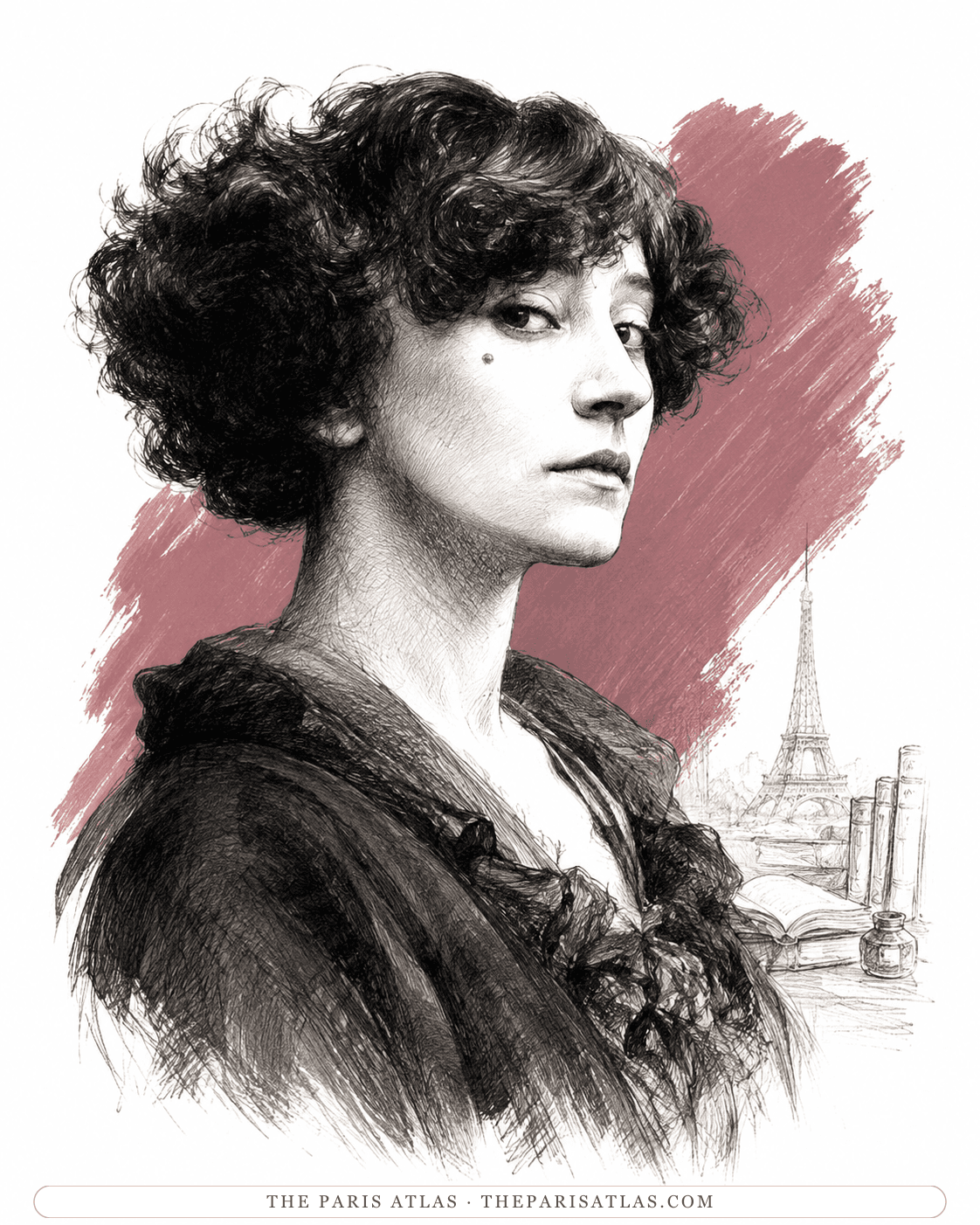


Ladies of the Past
by Colette
Colette's last book — a short return to the old women of her childhood village, published in the year she died.
- 1954
About Colette
The story, briefly
Spoiler-freeLadies of the Past is the last book Colette published in her lifetime. It is a short piece of nostalgic prose about the old women she remembered from her native village, Saint-Sauveur-en-Puisaye in Burgundy — figures like Madame Bourgneuf, Madame Jarry, and Madame de Cadalvène, recalled through remembered interiors, sweets, windows, clocks, and provincial stubbornness. First printed in a newspaper in 1951, it appeared as a separate book in 1954, the year of her death. (What's inside is described below.)
The story, in more detail
The book returns Colette, at the very end, to where she began. Its subject is the old women of Saint-Sauveur-en-Puisaye, the Burgundy village of her childhood — village presences rather than plot characters, brought back through the exact domestic detail she had trusted all her life: a clock, a window, a bowl of sweets, a habit held to for decades. The memory is sharpened by age and loss, and the portraits are tender without being soft.
It carries a particular weight as her final book. First published in Le Figaro littéraire in 1951, it was issued as a separate volume by Éditions Estienne in 1954 — the year Colette died — which makes it both her last lifetime publication and a last return to the childhood landscape that produced My Mother's House and Sido.
Read beside those earlier memoirs, Ladies of the Past closes a circle: the writer who had made her mother's Burgundy household one of the great subjects of French prose comes back, at the end, to the same streets and the women who lived on them.
What's inside
There is no plot. The book is a short piece of nostalgic prose about the old women Colette remembered from her childhood village, Saint-Sauveur-en-Puisaye. Figures such as Madame Bourgneuf, Madame Jarry, and Madame de Cadalvène are recalled not as characters in a story but as village presences, brought back through remembered interiors, sweets, windows, clocks, and provincial stubbornness.
Its place in Colette's life is part of what the page records. First printed in a newspaper in 1951, it appeared as a separate book in 1954, the year of her death — her last lifetime publication, and a final return to the Burgundy childhood of My Mother's House and Sido.
Themes and analysis
The taste of a village visit
The village women return first as names that Colette can remember only in the priest's familiar order. Identity survives through a repeated sound before it takes visible form. Madame Bourgneuf's colored sweets then give that persistence a sensory scale: a small ceremony can preserve the feeling of an entire visit. Such details are affectionate but also socially exact. Salons, servants, property and carefully maintained habits frame these women's leisure. Colette's portraits do not offer a representative village census; they recover the particular presences through which a child learned to recognize her world.
Waiting for the clock to strike
The child prefers waiting for a clock's tiny hammer to the games offered outside. Memory gives that apparently idle attention a lasting value, but the ending refuses to make vivid recollection a guarantee of truth. Colette admits that writers misrecognize the places they believe they have faithfully described. Even returning to her village for burial no longer seems inevitable; Paris remains a possible resting place. The clock scene therefore belongs to a selective inward country, not a recovered past held intact. Remembering can sustain attachment while allowing distance to loosen possession.
Why we recommend it
The final book
Colette's last lifetime publication, appearing in the year of her death.
A circle closed
It returns to the Burgundy childhood that produced her greatest memoirs, My Mother's House and Sido.
Portraits from memory
Old village women brought back through exact domestic detail, tender without being soft.
What this book explores
Bring it to book club
- This was Colette's last book, and it returns to her childhood village. Why might a writer end where she began?
- The old women are village presences, not plot characters. What does Colette's method of domestic detail preserve about them?
- Read beside My Mother's House and Sido, what does this final book add to Colette's portrait of Saint-Sauveur?
Timeline
1951
The piece is first printed in Le Figaro littéraire.
Before June 1954
École Estienne’s students design the separate edition with ruled pages, violet printing, and blue paper, transforming the newspaper text into a school-made art book.
1954
Ces dames anciennes is published as a book by Éditions Estienne — Colette's last book, in the year of her death.
Book editions
Hardcover
- Hardcover
- 1954
Paperback
- Paperback
Reader reviews
Readers may also like

Sido
The companion portrait of Colette's mother and childhood world, to which this book returns.
Read our take
The Blue Lantern
The other late book of Colette's final years, close to this one in time.
Read our takeLadies of the Past: frequently asked questions
Who wrote Ladies of the Past?
Colette. Ces dames anciennes was her last book, first printed in Le Figaro littéraire in 1951 and published as a separate volume in 1954, the year she died.
Is this really Colette's last book?
Yes. Ces dames anciennes was her final lifetime publication, appearing in 1954, the year of her death.
What is the book about?
It is a short piece of nostalgic prose about the old women Colette remembered from her childhood village, Saint-Sauveur-en-Puisaye — village figures recalled through remembered interiors, sweets, clocks, and provincial habit.
Is it a novel?
No. It is a short work of memory-writing, without a plot.
Is Ladies of the Past available in English?
There is no securely verified standalone English edition of the book.
If you like Colette
Explore authors with a similar voice, perspective, and influence.

Henry Miller
The Brooklyn dropout who arrived in Paris broke at thirty-eight and wrote the exuberant, banned books that ended American censorship.
View author
Louis-Ferdinand Céline
The doctor of the Paris slums who wrote the century's blackest, funniest novel — and changed the sound of French prose.
View author
Martha Gellhorn
War correspondent who covered the Spanish Civil War, D-Day, and conflicts across five more decades; Hemingway's third wife, 1940–1945.
View author
References
References
The sources below include the primary text, editions, scholarship, archival materials, and other records that informed this page. They document Ladies of the Past, its publication, and its place in literary history.


1Ladies of the Past
NovelColette, 1954Used forThe primary text represented by this page, used for descriptions of the work’s contents and for any quoted passages shown here.
2Ces dames anciennes — Estienne 1954 text
WebsiteWikisourceUsed forComplete French Estienne 1954 text, pp. 1–26, read for the opening remembered names, sweets and clock, and the closing qualification of memoir's truth and possession. No original newspaper, English-translation, independent biographical or physical-edition design comparison. The new readings complicate rather than replace the existing nostalgic overview.
3Colette — bibliography of original editions
WebsiteSociété des amis de ColetteUsed forThe Société des amis de Colette bibliography verifies the original edition's publisher and publication date.
4Société des amis de Colette — Chronology
WebsiteUsed forUsed to verify Ladies of the Past's bibliographic context and its place within Colette's published work.

5Bibliothèque nationale de France — The Worlds of Colette
Exhibition catalogueUsed forUsed for independent archival, institutional, or historical context surrounding Colette and Ladies of the Past.
6Library of Congress — Colette resource guide
WebsiteUsed forUsed to cross-check chronology, publication history, and the circumstances in which Ladies of the Past appeared.
7Bibliothèque nationale de France — Colette: online resources
WebsiteUsed forUsed for an additional scholarly or biographical perspective on Ladies of the Past and Colette's wider career.
8Colette — publication history of ladies of the past
WebsiteSociété des amis de ColetteUsed forPublication and revision history used for the timeline.
i
Why these sources are here
The primary text is the baseline reference for every book page. Additional references document publication history, interpretation, and historical context where that evidence is available.
 Explore more resources