
Minne
The first half of the story — the sheltered girl before marriage and disappointment.
Read our take
by Colette
The sequel takes Minne past sheltered fantasy into the harder education of marriage, dissatisfaction, and desire.
The sequel to Minne follows its heroine's 'strayings' — sentimental, erotic, and cognitive. Married now but unsatisfied, Minne takes lover after lover looking for a physical response she has never had and says so plainly to each of them, until she finally gets it — from her husband, in Monte-Carlo, in the second-to-last chapter. Published in 1905 under Willy's name, it completes the two-book Minne design that Colette later dismantled and rebuilt as The Innocent Libertine (1909). (What's inside is described below.)
Les Égarements de Minne — Minne's wanderings or strayings — deepens the story the first book began. Where Minne was about a sheltered girl's fantasies, the sequel is about what happens when a young woman acts on them inside the constraints of an adult life, and finds that neither marriage nor experiment delivers the satisfaction she was promised or promised herself.
The book is bibliographically overshadowed by the 1909 revision. Read beside The Innocent Libertine, it helps reveal what Colette chose to prune, normalize, or sharpen when she reclaimed the Minne material from the Willy phase — which is one reason modern reference works tend to treat the three books together.
Reliable scene-level detail for this title is thinner than for Colette's canonical novels; what is secure is the arc, not every episode. The book's real subject is not simply whom Minne loves but how she learns to read the codes of love badly, then better.
Minne is older now and married, and the fantasies that drove the first novel have given way to a duller, more adult dissatisfaction. The comfortable life she has entered does not answer the longing that her sheltered girlhood built, and She goes looking through a series of affairs, and her complaint is blunter than romantic dissatisfaction: she feels nothing physically, and tells the men so. The book follows those 'strayings' to the one night that finally answers them, and to what she does with a man who cannot survive her.
Its interest is less the catalogue of Minne's adventures than the education inside them — how a woman schooled on romance learns, through repeated misrecognition, to read desire and disappointment more accurately. The novel extends the first book's subject, the distance between fantasy and reality, into the harder territory of marriage and adult appetite. Colette later gathered this material and its predecessor into the single revised novel, The Innocent Libertine, where the arc reaches its more finished form.
Skating offers Minne a pleasure that has to be learned rather than simply bestowed. Chapter XIV moves from fear and aching legs to balance, speed and the ability to leave her instructor's arm. Yet technical progress does not deliver the transforming happiness she expects from watching Polaire. The rink's approaching closure gives that expectation a deadline. When Jacques appears, her circling begins to resemble a search for escape rather than free movement. The scene grants Minne genuine bodily skill while exposing how readily a new activity becomes another test that life must pass.
The Riviera first disappoints the promise of its photographs: wind, grey water and defensive vegetation replace an effortless paradise. After the casino, clearer skies do not erase Minne's estrangement. She can find the coast beautiful without liking it, and the sea's openness intensifies her loneliness. That distinction loosens the assumption that an attractive setting must produce the right feeling. Beside her, Antoine becomes less certain of his authority as a husband; his hesitation exposes how little he has asked what she wants. The shared journey brings their emotional distance into view rather than automatically resolving it.
The sequel takes the sheltered dreamer of the first book into marriage and adult appetite, and the harder lessons that follow.
Read against the 1909 revision, it shows what she chose to change when she reclaimed the Minne material as her own.
The book's subject — a woman taught to desire what cannot satisfy her — is one Colette would return to for the rest of her career.
1904
Minne introduces the heroine whose marriage and sexual dissatisfaction the sequel explores.
1905
Minne's Misadventures is published under Willy's name — the second of the two Minne novels.
1909
Colette combines and rewrites both Minne novels into the revised The Innocent Libertine.
The first half of the story — the sheltered girl before marriage and disappointment.
Read our take
The 1909 revision that combined and rewrote both Minne novels into their finished form.
Read our take
The other early Colette study of a marriage that fails to satisfy the woman inside it.
Read our take
Another young woman navigating the adult economy of desire, to a very different end.
Read our takeColette. Les Égarements de Minne was published in 1905 under her husband Willy's name.
It follows Minne past the sheltered fantasies of the first novel into marriage and adult dissatisfaction, tracing her 'strayings' — the sentimental and erotic wanderings of a woman searching for a fulfillment that eludes her.
Yes. It is the sequel to Minne (1904). The two books were later combined and rewritten by Colette into the single revised novel The Innocent Libertine (1909).
It helps, since the sequel continues the same heroine's education. Alternatively, the revised novel The Innocent Libertine folds both books into one continuous story.
Les Égarements de Minne is not widely translated on its own; English readers usually meet the material through The Innocent Libertine.
Explore authors with a similar voice, perspective, and influence.

The Brooklyn dropout who arrived in Paris broke at thirty-eight and wrote the exuberant, banned books that ended American censorship.
View author
The doctor of the Paris slums who wrote the century's blackest, funniest novel — and changed the sound of French prose.
View author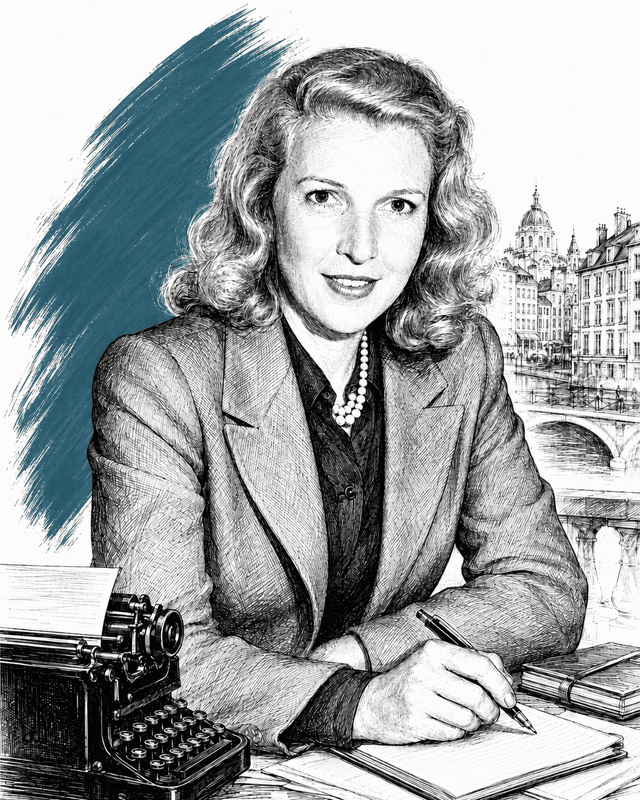
War correspondent who covered the Spanish Civil War, D-Day, and conflicts across five more decades; Hemingway's third wife, 1940–1945.
View authorThe sources below include the primary text, editions, scholarship, archival materials, and other records that informed this page. They document Minne's Misadventures, its publication, and its place in literary history.


The primary text represented by this page, used for descriptions of the work’s contents and for any quoted passages shown here.
Primary French transcription of the 1905 Ollendorff second edition. Complete chapters XIII–XIV were read for the rink sequence; chapter XXII's passage from the disappointing Riviera weather through the couple's return and closing conversation was read for the second analysis. This is not the revised 1909 L’Ingénue libertine, and no full-volume or first-versus-second-edition collation is claimed.
Used to place Minne's Misadventures within Colette's published work and verify its bibliographic context.

Used for independent biographical, archival, or historical context surrounding Colette's career and the period in which Minne's Misadventures appeared.
Used to cross-check authorship, chronology, and the work's place in Colette's wider catalogue.
Used to verify Colette's bibliography and place Minne's Misadventures within the broader chronology of Colette's career.
The primary text is the baseline reference for every book page. Additional references document publication history, interpretation, and historical context where that evidence is available.
 Explore more resources