Antoine
Minne's husband — the steady, unsatisfying reality against which her wandering appetite measures itself.
To make Minne happy. He treats it as a promise he gave when he married her rather than as anything she owes him back.
The book

At a glance
- Twenty-four
- Two years, to his first cousin Minne, whom he had wanted since he was seventeen
- The Pleyel piano works in Paris, under Gustave Lyon, reconstructing ancient stringed instruments; he is billed to lecture on them at the salle Pleyel
- A flat on the avenue de Villiers near the place Pereire. He dresses in a small room off his study, because Minne will not have men's clothes near hers
- Paul, the doctor of the first Minne novel, now dying in a bare whitewashed room with a nurse, and openly blaming Minne for his sister's death
- Ma poupée, my doll, and ma Minne
Who they are in the book
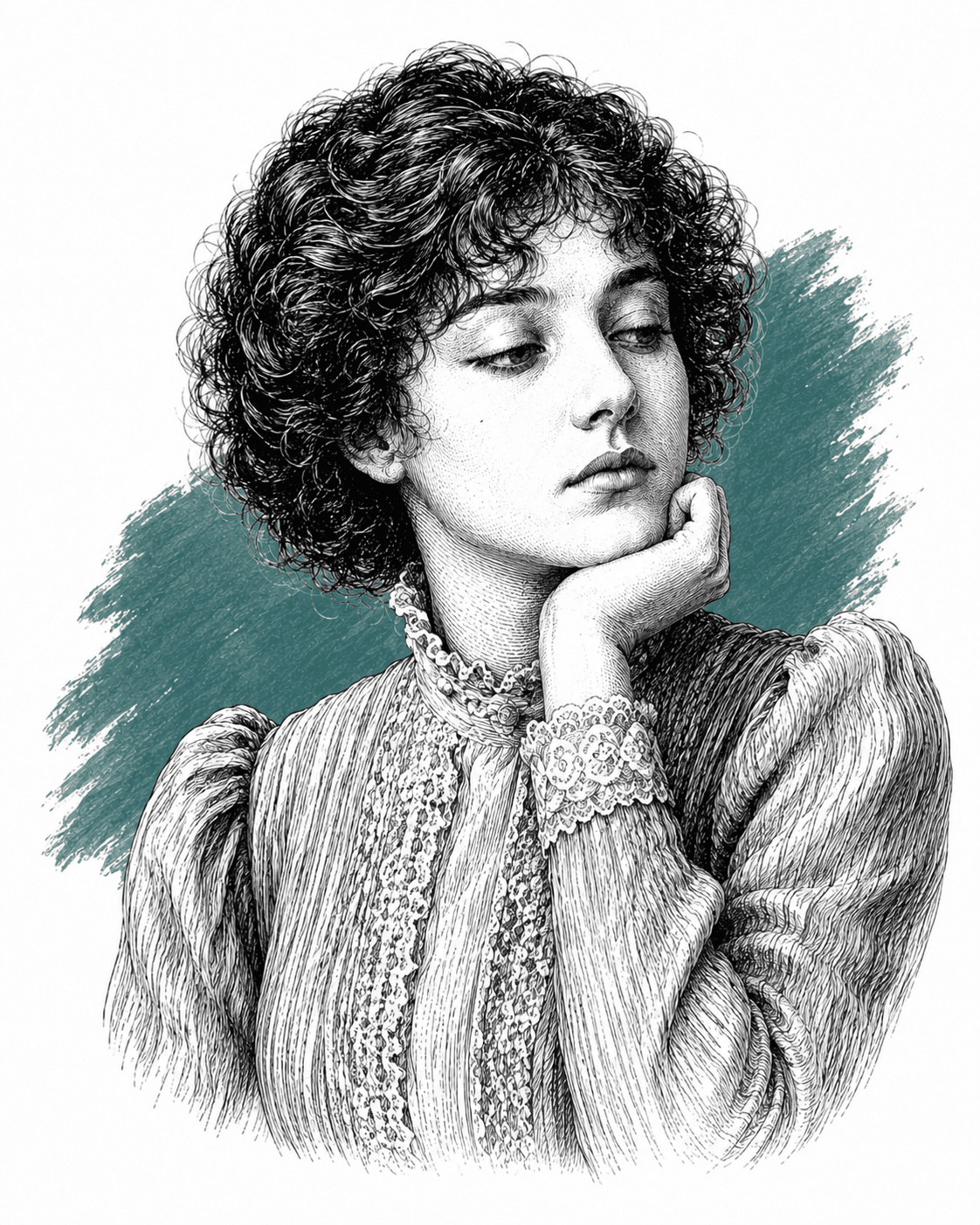
Spoiler-freeAntoine is Minne's husband, and was her cousin first. He is twenty-four, very tall, and has grown a full beard to be taken seriously by men older than himself. He works at the Pleyel piano works in Paris, where he reconstructs ancient stringed instruments: a barbytos, a kind of Greek lyre, whose template the head of the firm sketched out for him the way you hand a child a corner of the laboratory to play in. He is aware that he is not clever and does not pretend otherwise.
He got what he had wanted since he was seventeen, and the wedding night was a catastrophe. Minne's account of it, given early in the book, is that he read her cry of pain as a compliment, then wept and thanked her, then explained that ever since the morning she was carried home unconscious as a girl he had wondered whether the truth had been kept from him. She lay awake all night with her hair caught in his fingers, working out that she had made a mistake in marrying what she calls a sort of brother.
He tells her he loves her constantly and means it flatly, without shading, for good. She finds this contemptible rather than touching, and privately tests the idea by imagining herself announcing with equal conviction that she does not love him. For most of the marriage he notices nothing, because he is not looking. Then he starts looking, and does it badly: he compares old photographs of her, hires a detective out of a newspaper advertisement, and shouts at her about where she has been.
The last part of the book is him deciding what to do about being unable to make her happy. He does not throw her out, and he does not confront her. He arrives somewhere stranger than either, and puts it to her in a hotel room in Monte-Carlo.
How Antoine Is Portrayed
- What he does for a livingAt the Pleyel works he rebuilds instruments he says are Greek or Egyptian, and prepares a lecture on ones found in tombs of the eighteenth dynasty. He admits to himself that he would have been just as happy with motor cars, but reckons the barbytos might get him a scrap of red ribbon in the end. Two visiting musicians argue about whether it needs a sixth string, and his boss calls him, in front of them, an instrument-maker for mummies.
- What he looks like at twenty-fourToo tall, with a long horse's face, a nose with a bump in the middle, and a great deal of hair on his face and elsewhere. Minne notes that he is awkward in clothes and comfortable without them, the way well-built men are, and concludes that he is no worse than anybody else and that she knows him too well.
- He says it plainly, and it counts against himHe has no capacity for pretence and none for moderation. His tenderness is too tender, his gaiety too gay, his worry too worried. Minne's view, formed while agreeing politely with his father that one should distrust one's first impulse, is that people who do not lie spontaneously are simply lazy, too idle to arrange the truth a little, if only out of politeness.
- The dinner partyAt the Chaulieus', where the house speciality is a well-staged row, he is handed the poor old aunt because he is the only polite person present. Then the hostess turns her back on the academician she has been flattering and works on Antoine instead, to leave the field clear for another man with his wife. He notices, and his one concern is that Minne should not see, because he does not want a scene in the cab.
- The day he asks about his beardStanding at the chimneypiece holding his beard in both hands, he asks Minne whether he should have it cut off. She laughs at him so sharply and so insultingly that it hurts to hear, and he recognises the laugh: it is the one she gave in bed one night when the electric bell-pull was tapping the wall in time. She tells him to cut it, or not to, or to cut half of it, or to clip himself like a poodle, but to do something and move, because seeing him standing there is unbearable.
- The evening he finds her asleepHe comes home early and quietly for once and finds Minne asleep on the sofa with her hat on the table and her gloves flung across a statuette. He leans over her feeling like a man opening a stolen letter. Her mouth has gone down at the corners and her breathing has changed, and what he thinks is that this is not the same Minne, and that even the sleep is a kind of lie, because it is a face she never shows him.
- The photographs he takes to workHe carries photographs of Minne at every age to the Pleyel laboratory in his briefcase and compares them there, ashamed of doing it. Here she is at twelve with her hair in ringlets, and he thinks that anyone who was not an idiot would have been alarmed by those eyes. Here she is thin with a sad mouth, the year they found her fainting at the front door with mud in her hair.
- The detective agencyHe picks an agency out of a newspaper small ad and climbs three flights of a building on the rue des Dames, past a windowless concierge's box, a bannister he will not touch, and lavatories opening onto the stairs. Through the door he hears the proprietor screaming at an employee for losing a woman in a department store. Inside there is a desk drawer holding an apple, a bread stick, a sausage and a cosh. The rate is a louis a day plus cabs, payable in advance. Antoine pays it, having already decided it is hopeless.
- What he works out while she is shouting at himMinne comes home and recites the whole of the detective's itinerary at him, street by street, in a voice that goes through his nerves. Halfway through he stops hearing her. What he understands instead is that he was about to make the mistake of treating her as an enemy, that she has nobody else in the world, and that he will follow her at a distance with his hands out, the way mothers walk behind a child taking its first steps.
In the hotel room at Monte-Carlo, sitting on the edge of her bed while she says she is cold, he works up to it in the plainest words he can find, and hates himself for how coarse they sound. He tells her he was an idiot the month before, that you can no more stop someone loving somebody than stop the earth turning, that he wants her to ask him for anything that would please her, including the things a woman does not usually ask her husband for, and to come to him and complain: someone did something to me, Antoine, tell him off, or kill him. What he has privately promised himself is that she can make a fool of him as long as she does not cry.
Her answer is to tell him to get into her bed. She intends it as payment and intends to fake it. She does not have to. What he and three other men had failed to do in two years happens that night, largely because he stops, notices that something is wrong with her, and pays attention to what she does next rather than to what he is doing.
In the morning he comes back from town with a straw hat on, cheerful, with the sun out and the sea blue, carrying gossip and the Paris papers. He reads her the notice: Jacques Couderc has been found at home with a bullet through his temple, murder ruled out, motive unknown. Then he asks her, with no suspicion whatever, whether the boy had been paying her some attention lately. She tells him none of it matters. He never learns anything, and the book ends there.
If you like Minne's Misadventures


If you like Colette
Explore authors with a similar voice, perspective, and influence.

Henry Miller
The Brooklyn dropout who arrived in Paris broke at thirty-eight and wrote the exuberant, banned books that ended American censorship.
View author
Louis-Ferdinand Céline
The doctor of the Paris slums who wrote the century's blackest, funniest novel — and changed the sound of French prose.
View author
Martha Gellhorn
War correspondent who covered the Spanish Civil War, D-Day, and conflicts across five more decades; Hemingway's third wife, 1940–1945.
View author