

Chéri
The other great Colette study of jealousy and possession, from the courtesan's world instead of the marriage bed.
Read our take
by Colette
A new marriage and a beloved cat, and a jealousy that turns out to run the wrong way — Colette's coldest short novel.
Alain Amparat is a young man of settled tastes who loves two things: the family house he grew up in and Saha, his grey pedigree cat. When he marries the modern, impatient Camille, the three of them move into a borrowed flat high above Paris, and Camille discovers that she is not the first attachment in her husband's life. Published in 1933, The Cat is a short, exact novel in which a marriage is tested and found wanting through the presence of an animal Colette refuses to treat as a symbol. (The full plot, including the ending, is below.)
Colette spent her life among cats and wrote about them more seriously than almost any other novelist. The Cat is the fullest result: a marriage story in which the animal is a genuine third party, with her own preferences, dignity, and will, rather than a metaphor for something in the humans. Saha is drawn with the same attention Colette gives Alain and Camille, and the novel's power depends on the reader taking her exactly as seriously as they do.
The book is very short and built on a simple domestic situation: a new husband who cannot let go of his childhood house and his cat, and a new wife who expected to be the center of the life she married into. Colette lets the ordinary furniture of a marriage — a flat, a balcony, a routine — carry the whole weight, and turns a small household into a study of instinct against modern arrangement.
It first reached readers serialized in the weekly Marianne in the spring of 1933 and appeared as a book the same year. It is generally counted among Colette's major short novels.
Alain Amparat is about to marry Camille Malmert. He is a young man of conservative, sensual tastes, deeply attached to the old family house and garden where he grew up and to Saha, the grey pedigree cat he has raised. Camille is his opposite — quick, modern, direct in her appetites — and she believes marriage will make her the whole of his world. While the family house is being renovated, the couple moves into a friend's ninth-floor flat, and Saha comes with them.
In the confined, high apartment the marriage begins to show its fault line. Alain returns constantly, in feeling and often in person, to the house and to the cat; Camille finds herself sharing her husband with an animal that plainly prefers him and plainly does not care for her. Her jealousy is real, and it has nowhere to go, because its object is a cat.
Alone with Saha on the ninth-floor balcony, Camille pushes the cat over the edge. Saha survives the fall. When Alain works out what his wife has done — and watches how she behaves toward the animal afterward — the marriage is finished for him: a woman who could try to kill Saha is a woman he cannot love or trust. He takes the cat and returns to his mother's house and garden, leaving Camille behind. The novel gives the animal the last, unanswerable claim on him.
Alain's breakfast ritual turns the garden into a place where adulthood can be postponed. The precisely buttered bread and familiar spoon restore childhood habits, while his mother's voice belongs to the background of comfort rather than to a conversation he must follow. Yet Saha does not simply confirm this protected world. Her attention to birds and a mole, and her sudden bite, give her interests beyond soothing him. The passage makes his tenderness real while exposing the selective attention through which he imagines that he and the cat understand one another.
When Alain points out Saha waiting above the street, the beautiful sight immediately becomes an argument about whom she loves. His taunt to Camille turns affection for the cat into a way of excluding his wife. The silent ascent in the lift brings their bodies close without restoring conversation, and the noise of running water later helps him evade her questions. Colette makes the distance within the marriage audible as well as visible: Alain can attend intensely to Saha's presence while refusing the attention that Camille asks of him.
Few novelists write a cat as a full third party in a marriage. Colette does, and the book's disturbing force depends on it.
No affair, no money, no grand betrayal — just a flat, a balcony, and a jealousy with nowhere to go. Colette makes the domestic lethal.
The novel resolves without comfort or moral, letting the cat hold the final claim. It is among her most quietly ruthless books.

A young man of conservative, sensual tastes, bound to his childhood house and his cat — and unable to make room in either for a wife.

Alain's modern, impatient wife, who expected to be the center of the marriage and finds herself second to a cat.
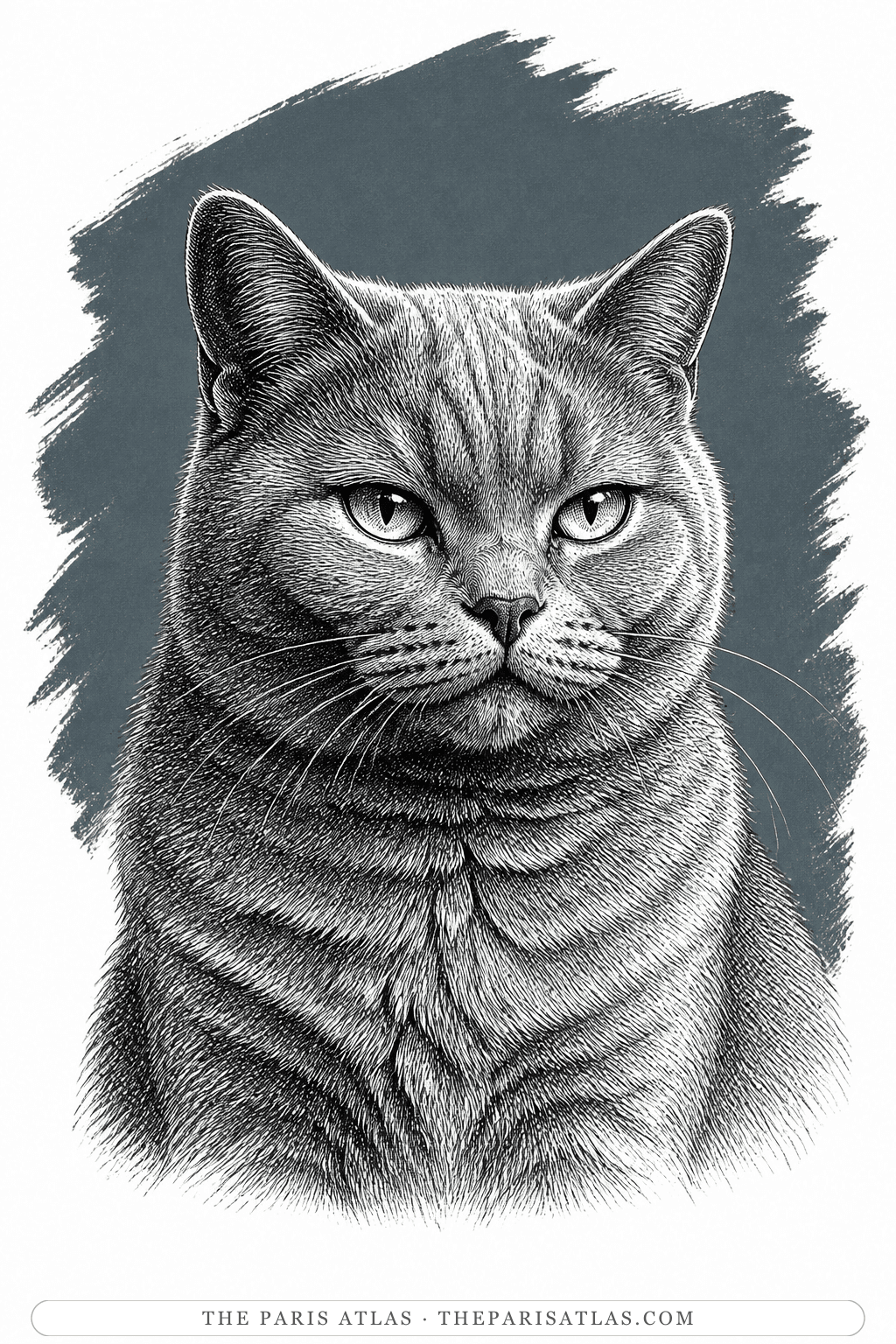
Alain's grey pedigree cat — the third party in the marriage, written with her own will and dignity, and the novel's final claim.
Early 1933
Colette begins the short novel while also working in her beauty business; her letters record the difficulty of its composition.
April–June 1933
Marianne publishes nine installments from 12 April to 7 June.
June 1933
The novel appears in book form after its magazine serialization.
The other great Colette study of jealousy and possession, from the courtesan's world instead of the marriage bed.
Read our take
The same year's-turn attention to bodies, appetite, and cruelty, in adolescence rather than marriage.
Read our take
Colette's animals and gardens again, here as the quiet counterweight to human failure.
Read our take
The French novelist Colette. La Chatte was published in 1933.
A young man, Alain, loves his cat Saha and his childhood home. When he marries the modern, impatient Camille, her jealousy of the cat becomes the fault line that breaks the marriage.
Saha is the third point of the marriage's triangle, and the crisis of the novel turns on Camille's jealousy of her. Saha survives the story; the full plot, including how it resolves, is below.
It draws on her lifelong attention to cats, whom she observed and wrote about closely. No single real cat is documented as the model for Saha.
It is a short novel — a novella, readable in an evening — and is often counted among Colette's major works of short fiction.
Explore authors with a similar voice, perspective, and influence.

The Brooklyn dropout who arrived in Paris broke at thirty-eight and wrote the exuberant, banned books that ended American censorship.
View author
The doctor of the Paris slums who wrote the century's blackest, funniest novel — and changed the sound of French prose.
View author
War correspondent who covered the Spanish Civil War, D-Day, and conflicts across five more decades; Hemingway's third wife, 1940–1945.
View authorThe sources below include the primary text, editions, scholarship, archival materials, and other records that informed this page. They document The Cat, its publication, and its place in literary history.


The primary text represented by this page, used for descriptions of the work’s contents and for any quoted passages shown here.
French primary text: chapter II and selected passages in chapter VII; used for the added readings, not translation or first-edition metadata.
The Société des amis de Colette bibliography verifies the original edition's publisher and publication date.
Used to place The Cat within Colette's published work and verify its bibliographic context.

Used for independent biographical, archival, or historical context surrounding Colette's career and the period in which The Cat appeared.
Used to cross-check authorship, chronology, and the work's place in Colette's wider catalogue.
Used to verify Colette's bibliography and place The Cat within the broader chronology of Colette's career.
Publication and revision history used for the timeline.
The primary text is the baseline reference for every book page. Additional references document publication history, interpretation, and historical context where that evidence is available.
 Explore more resources