Saha
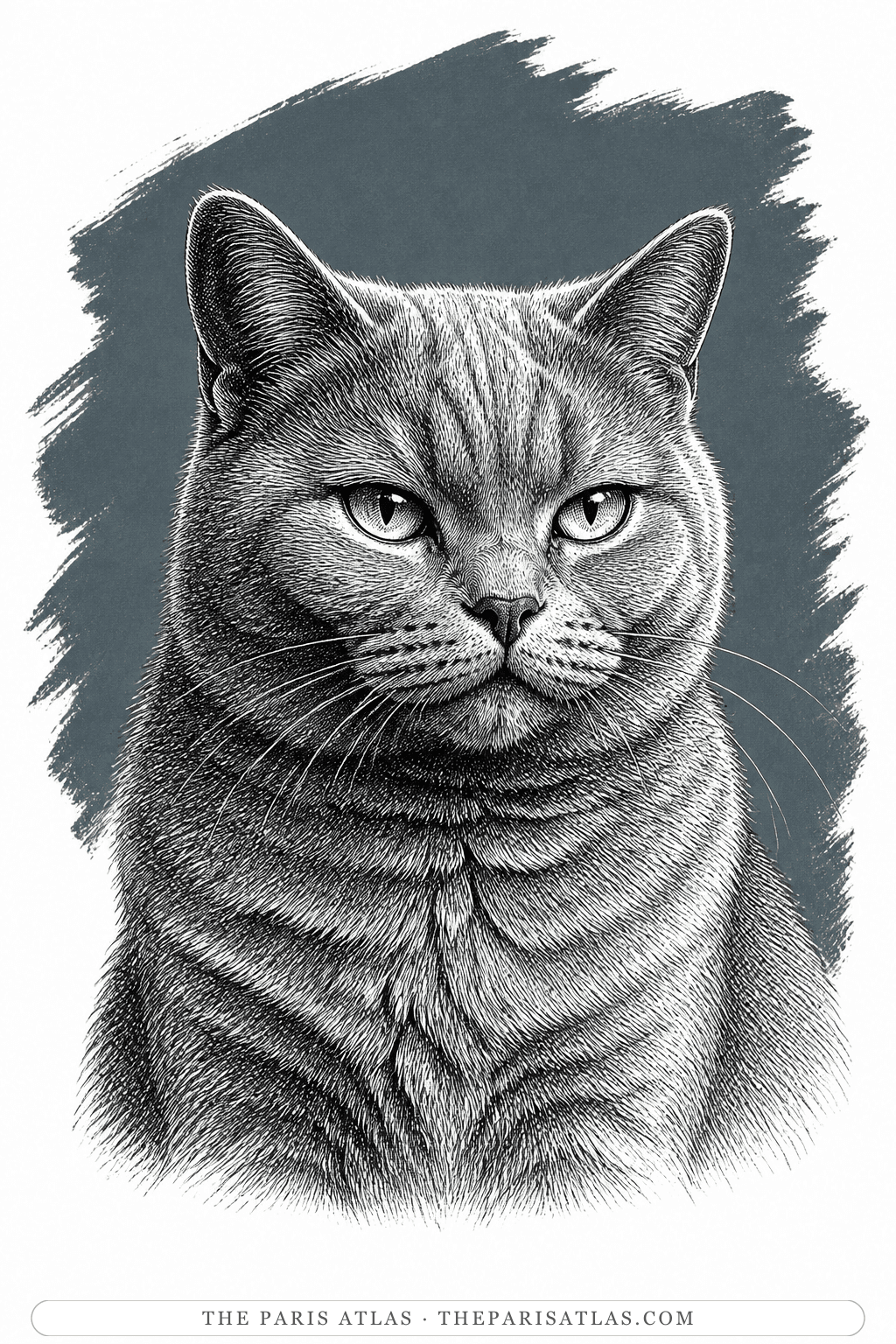
Alain's grey pedigree cat — the third party in the marriage, written with her own will and dignity, and the novel's final claim.
To have Alain back, every day, and to herself. The novel says as much when she stops eating in the garden after the wedding: she seemed to be giving up a hope, and that was probably the hope.
The book

At a glance
- A female cat: a pedigree Chartreux, the French breed with a dense grey-blue coat
- Bought at a cat show at five months old; three years old when the novel opens
- Alain says it half under his breath with the h breathed hard, and said that way it sends her wild — she scatters the poker cards across the table with both front paws
- Alain Amparat's, and the novel never pretends otherwise
- On Alain's chest at Neuilly; on the sponge-topped stool in the bathroom at the flat
- His chimera — a creature out of his own imagination
Who they are in the book
Spoiler-freeSaha is a cat, and one of the three main characters of The Cat, the short novel Colette published in French in 1933 as La Chatte. She is a pedigree Chartreux — the old French breed with a thick grey-blue coat — small, three years old, with deep-set yellow eyes. Alain Amparat, the young man the novel follows, bought her at a cat show when she was five months old, choosing her for the exactness of her face and for the way she sat in her cage, dignified and past hoping.
Colette kept cats all her life and watched them closely, and Saha is the result. She has moods, preferences, judgement and a will of her own, and the book gives her the same attention it gives the two people. She has a vocabulary, which Alain translates with complete confidence. She has a route up the drawing-room wall that only she knows. She will not eat meat off a polished surface, because a cat needs to hold its food down with one paw while it tears at it, and that only works on bare ground or a rug.
The marriage is what happens to her. Alain marries Camille Malmert and moves to a flat on the ninth floor of a new building, leaving Saha behind in the garden at Neuilly. She stops eating, thins, and gives up talking, and by June she is light enough that Alain notices it when he picks her up. He brings her to the flat, where she adapts to twenty-five square metres and to a wife who cannot stand her. In July, alone with her on the balcony, Camille pushes her over the edge. Saha claws at the wall on the way down, and lives.
How Saha Is Portrayed
- What she looks likeIn sunlight her coat is the mauve and blue of a wood pigeon's throat; in the dark Colette calls it moonstone. There are four faint watered stripes between her ears, a full ruff at her chest, and yellow eyes set deep in her head. Alain's names for her run to little bear with fat cheeks, blue pigeon, pearl-coloured demon and my little puma.
- She talks, and Alain answersShe says me-rrouin in the garden at night, me-rraing with some force when she wants her milk, and mouek-mouek-mouek when something she cannot reach is driving her mad. Camille hears the night call and assumes the cat is on heat. Alain says no: it is May, and in any case that particular call is the one a mother cat uses to gather her kittens. Camille throws up her hands and says that if he is going to start interpreting the cat they will never hear the end of it.
- She bites, and then apologisesA tomtit hangs upside down in the elm above the breakfast table to taunt her. Her cheeks swell with fury and her nostrils go damp, and when Alain reaches out to stroke her head she bites him — two small beads of blood on his palm. She lowers her head, sniffs the blood, checks his face anxiously, then picks a piece of toast off the cloth and holds it up in both front paws like a squirrel, because she knows that makes him laugh.
- Up the wall and down onto his shoulderShe climbs the worn brocade almost to the ceiling by a vertical route only she uses, flattens herself against the wall like a lizard with her legs spread, then fakes an attack of vertigo and calls down in a small affected voice. Alain comes and stands underneath and offers his shoulders, and she comes down the wall like a drop of rain running down a window.
- The kissAt night in the dark she sometimes puts her damp nose under his nose, between his nostrils and his lip, for a moment. Colette calls it a cat's kiss, weightless and quick, and notes that Saha granted one only rarely.
- The rope she takes for a snakeShe will play with a piece of string but will not go near the thick cord that works the curtains, because it is exactly the thickness of a snake. Camille asks whether she has ever seen one. No, says Alain: she invents it, she creates it, she has known about snakes since birth, the way people of quality do. Camille asks whether that means she is not a person of quality. Alain tells her, kindly, that she is not, and neither is he.
- She had kittens onceHer first seducer was a white tomcat with no tail. The kittens were taken away from her, and Camille was indignant that she does not appear to give them another thought — a bad mother, she called her. Alain's private answer is that girls are always good mothers beforehand.
- The huntingShe goes straight up into the air like a fish rising and takes a cabbage white, then coughs, spits out a wing and washes herself with great affectation. Chasing a mole down the hole left by an uprooted yew, she loses her dignity completely for about a minute — scratching like a terrier, rolling like a lizard, jumping on all fours like a toad — then gets herself out and sits on the grass, cold and prim, controlling her breathing. Alain has learned to keep a straight face through this.
- When he marries, she stops eatingLeft at Neuilly, she is out all night and comes in with cobweb and pine needles in her coat, refuses her milk, thins, and loses her whole vocabulary. Her coat stops shining. Alain's mother, who has been watching, tells him the cat had been waiting for him. He takes her back to the flat in her travelling basket, with a sack of sand and an old fringed rug.
- Nine floors upShe adapts without any show of disgust: she learns the new mealtimes, picks the sponge-topped stool in the bathroom to sleep on, and listens politely while the cook offers her raw liver. When the couple are out she sits on the parapet over the drop, watching the backs of the swifts below her, and takes to washing herself up there at length. Camille says it turns her stomach and gives her cramp in the calves.
Colette gives the balcony scene at length, and most of it is Saha's. Camille paces from one wall to the other without ever appearing to look at her, driving her off the parapet and then off the floor again, and Saha works out what is happening. She lets out one long miserable cry, and after that makes no sound at all — she would have died rather than cry twice. She retreats by method, jumping only when Camille's feet are already on her, keeping her eyes on her, refusing to rage and refusing to beg. Her paws sweat with fear and leave small flower-shaped prints on the stucco. Then Camille puts out both arms and pushes.
She fell past six floors, by Alain's count, before a second-floor awning broke the fall and bounced her onto the strip of grass by the concierges' lodge. The concierge told Alain he thought an umbrella was coming down. Alain carried her back up alive, set her on the glass dressing table, and she stood square on her feet and looked round the room as though it belonged to strangers, then laid her cheek against his hand.
It is the cat who convicts Camille. Alain asks his wife to feel Saha's head for a bump, and Saha explodes — the wildest spitting cry, the fur up along her back, her mouth open — and stands over the sheet of drawing paper accusing her. Colette writes that the furious face was straining toward a universal language, a word men have forgotten. Alain then reads the damp four-toed prints on the paper as fear sweat, turns back the sheaths that hold her claws, and finds every claw broken from holding on to the wall. That evening she refuses to go out onto the terrace at all, and lies by the door watching the room behind her.
She goes back to the garden that night in the cook's shopping basket, and Alain lets her out into the dark without fussing over her. By morning she is fishing drowned ants out of a full watering can with a hooked paw, and she has to be carried up to Alain's window because she springs at the creeper and falls back, having forgotten that her claws are broken. The last thing the novel shows her doing is sitting on a wicker table beside Alain, watching Camille walk away down the path.
If you like The Cat


If you like Colette
Explore authors with a similar voice, perspective, and influence.

Henry Miller
The Brooklyn dropout who arrived in Paris broke at thirty-eight and wrote the exuberant, banned books that ended American censorship.
View author
Louis-Ferdinand Céline
The doctor of the Paris slums who wrote the century's blackest, funniest novel — and changed the sound of French prose.
View author
Martha Gellhorn
War correspondent who covered the Spanish Civil War, D-Day, and conflicts across five more decades; Hemingway's third wife, 1940–1945.
View author