Colette's Three Earthly Paradises
If you have gone looking for Colette's Earthly Paradise and come back confused, the fault is not yours. There are three of them, and they are not editions of one another.

by Colette
Colette's prose set against fifty photographs by Izis — a late book-club photobook, and not the 1932 art book of nearly the same name.
Paradis terrestre — singular — is a photobook published in Lausanne by La Guilde du Livre in October 1953. Fifty black-and-white photographs by Izis, the Lithuanian-born photographer working in Paris, are set against prose by Colette: four texts taken from her 1949 collection En pays connu, together with eight pieces written for this book. Issued in more than fifteen thousand copies for the members of a book club, it is a very different object from the rare 1932 Paradis terrestres, plural, made with Paul Jouve. (What's inside is described below.)
The book belongs to a genre Izis helped define: the photographer's book of France, in which images of landscape and rural life are paired with a writer's prose. Izis — Israëlis Bidermanas, born in Lithuania in 1911 and working in Paris — supplied fifty photographs, reproduced in heliogravure; Colette supplied the words. She was eighty and near the end of her life when it appeared.
Her contribution is mostly reused. Four of the texts come from En pays connu, her 1949 gathering of prose on familiar ground: 'La Maison proche de la forêt,' 'Le Désert de Retz,' 'Amertume,' and a chapter already called 'Paradis terrestre' — which is where the book gets its title. Eight further pieces were written for this volume, set against the photographs. The subject is landscape and the visible world: forests, gardens, rural France, with the Jardin des Plantes and the zoological park at Clères among the places photographed.
It was made for readers rather than collectors. La Guilde du Livre was a Lausanne book club, and the edition ran to just over fifteen thousand numbered copies reserved for its members — the opposite of the 1932 art book's hundred and fifty. Most dealer records give La Guilde du Livre as publisher, though a few name Éditions Clairefontaine, another Lausanne house connected to it.
There is no plot. The book pairs fifty black-and-white photographs by Izis with prose by Colette on landscape and the visible world — forests, gardens, and rural France, including the Jardin des Plantes and the zoological park at Clères.
Four of Colette's texts are reprinted from her 1949 collection En pays connu: 'La Maison proche de la forêt,' 'Le Désert de Retz,' 'Amertume,' and 'Paradis terrestre,' the chapter that gives the book its name. Eight further pieces were written for this volume. It was published in October 1953 in just over fifteen thousand numbered copies for the members of the Lausanne book club La Guilde du Livre.
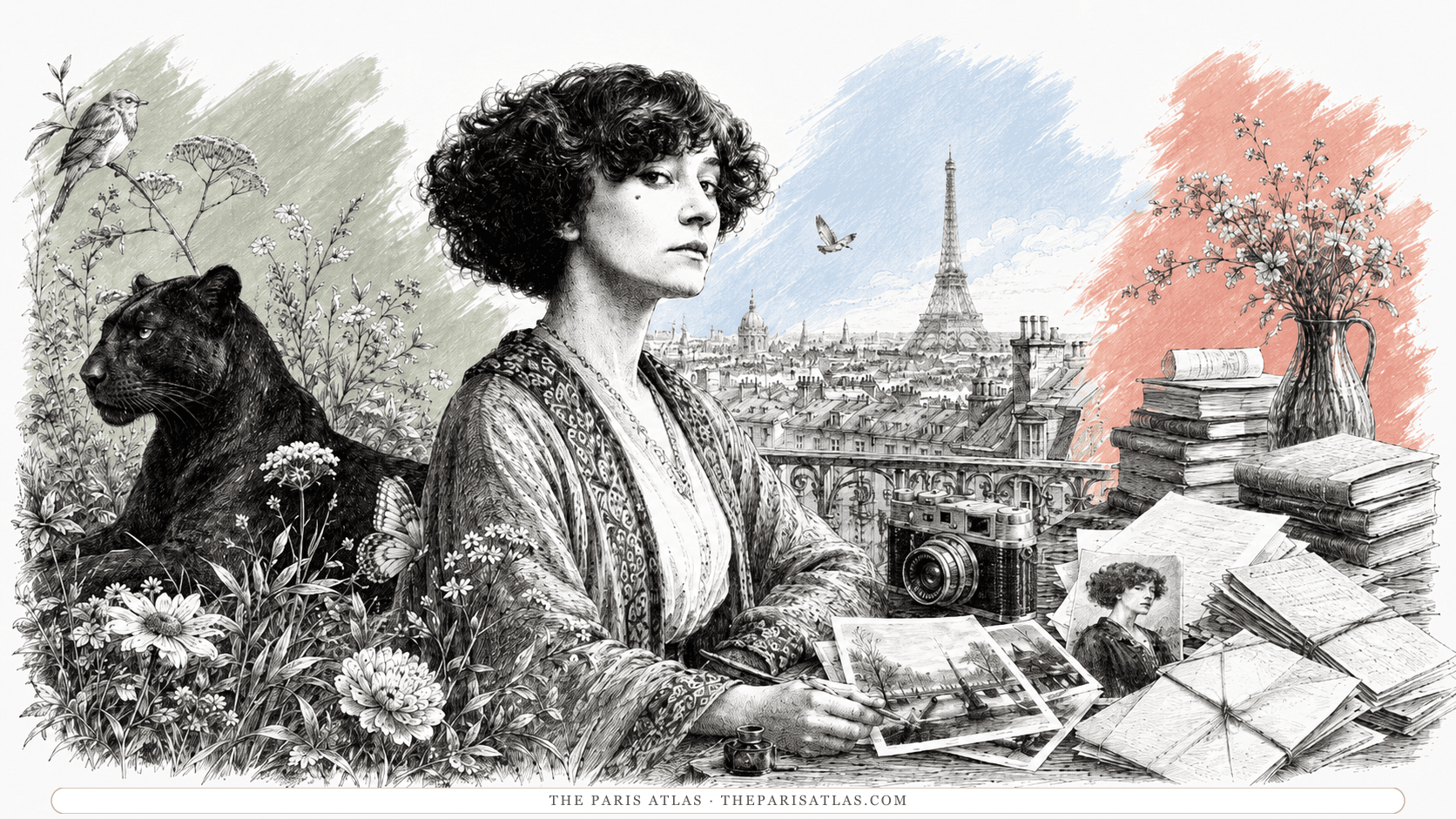
The earlier title essay, reused in this photobook, imagines paradise through encounters at Clères. Animals cross the observer's path without arranging themselves into a comforting human story. Their indifference to one another can itself constitute peace; harmony does not require universal affection. The essay then moves toward theatrical enchantment and the unexpected power of Ravel's music, linking what is seen to what imagination makes possible. Landscape becomes an invitation to revise familiar expectations. This reading concerns Colette's prose, rather than claiming that the imagined viewing scene reproduces a documented sitting with Izis's photographs.
“Le Désert de Retz” holds two wishes in tension: to preserve an extraordinary place and to let its decay continue. A building designed to look ruined is now genuinely deteriorating, while vegetation both sustains and overwhelms the remaining structures. Restoring it might save the architecture yet disturb the atmosphere that makes the visit compelling. The essay's language therefore moves between urgency and reluctance rather than delivering a simple conservation verdict. Its remembered season is a stormy June; the winter illustration is an imaginative response, not the weather Colette describes. Her uncertainty remains part of the place's meaning.
A late pairing of her prose with fifty photographs by one of the defining photographers of postwar Paris.
Written in her eightieth year, its subject is looking — forests, gardens, and the ordinary landscape of France.
Knowing this is the Izis photobook, not the Jouve art book, untangles the most persistent muddle in Colette's bibliography.
If you have gone looking for Colette's Earthly Paradise and come back confused, the fault is not yours. There are three of them, and they are not editions of one another.
1949
En pays connu is published; four of its texts will be reused in this book.
1950
Ferenczi expands En pays connu, the collection from which the later photobook draws four prose pieces.
1953
Paradis terrestre is printed in Lausanne in October by La Guilde du Livre, with fifty photographs by Izis.

The 1932 art book of nearly the same name — a different work, and the source of most confusion.
Read our take
The 1966 English anthology whose title is the English of this one, though it is a separate editorial compilation.
Read our take
The 1949 collection from which four of this book's texts are drawn, including the title chapter.
Read our take
The late memoir written in the same last years, close in its attention to what can still be seen.
Read our takeColette wrote the prose and Izis — Izis Bidermanas — supplied the fifty photographs. It was published in Lausanne by La Guilde du Livre in October 1953.
No. This one, singular, is the 1953 photobook made with Izis. Paradis terrestres, plural, is a rare 1932 art book of animal texts illustrated by Paul Jouve. They share no texts.
It is a photobook on landscape and the visible world — forests, gardens, and rural France — pairing Izis's photographs with Colette's prose.
Mostly not. Four are reprinted from her 1949 collection En pays connu, including the chapter 'Paradis terrestre' that gives the book its title; eight further pieces were written for this volume.
No. Earthly Paradise (1966) is a separate English anthology of Colette's autobiographical writing, edited by Robert Phelps and drawn from around forty of her books. Its title is simply the English of this one.
Explore authors with a similar voice, perspective, and influence.

The Brooklyn dropout who arrived in Paris broke at thirty-eight and wrote the exuberant, banned books that ended American censorship.
View author
The doctor of the Paris slums who wrote the century's blackest, funniest novel — and changed the sound of French prose.
View author
War correspondent who covered the Spanish Civil War, D-Day, and conflicts across five more decades; Hemingway's third wife, 1940–1945.
View authorThe sources below include the primary text, editions, scholarship, archival materials, and other records that informed this page. They document Paradis terrestre (1953), its publication, and its place in literary history.


The primary text represented by this page, used for descriptions of the work’s contents and for any quoted passages shown here.
Complete primary French texts of “Paradis terrestre” (pp. 379–383) and “Le Désert de Retz” (pp. 374–378) read in the 1950 Le Fleuron selection. The already cited Société des amis de Colette bibliography confirms both were reused in the 1953 photobook. These readings concern the earlier prose, not an inspection of the fifty photographs, eight new captions, or the 1953 page-by-page pairings. The winter illustration remains an imaginative response; the Retz essay describes June.
The Société des amis de Colette bibliography verifies the original edition's publisher and publication date.
Used to place Paradis terrestre (1953) within Colette's published work and verify its bibliographic context.

Used for independent biographical, archival, or historical context surrounding Colette's career and the period in which Paradis terrestre (1953) appeared.
Used to cross-check authorship, chronology, and the work's place in Colette's wider catalogue.
Used to verify Colette's bibliography and place Paradis terrestre (1953) within the broader chronology of Colette's career.
The primary text is the baseline reference for every book page. Additional references document publication history, interpretation, and historical context where that evidence is available.
 Explore more resources