Colette's Three Earthly Paradises
If you have gone looking for Colette's Earthly Paradise and come back confused, the fault is not yours. There are three of them, and they are not editions of one another.

by Colette
Colette's animal pieces printed as a rare Swiss art book, with wood-engraved beasts by Paul Jouve — not to be confused with the 1953 photobook of almost the same name.
Paradis terrestres — plural — is a deluxe illustrated book published in Lausanne by Gonin et Cie at the start of 1932. It gathers ten short animal pieces by Colette, printed alongside wood-engraved animal compositions by the great animalier Paul Jouve and issued in a tiny run on Japan paper. The same texts appeared later that year as the opening section of her essay collection Prisons et paradis, which is where nearly all readers meet them. It is a different book from the 1953 Paradis terrestre, singular, a photobook made with Izis. (What's inside is described below.)
This is a livre de peintre — a book made as an art object. Gonin, a Lausanne fine-press publisher, commissioned Colette to write animal texts to accompany wood engravings by Paul Jouve, the foremost French animal artist of the period, cut by the engraver Jules-Léon Perrichon and heightened by hand. The result was issued in loose sheets in a case, on Japan paper, in a run of roughly 150 copies, so surviving examples carry bespoke bindings commissioned by their owners.
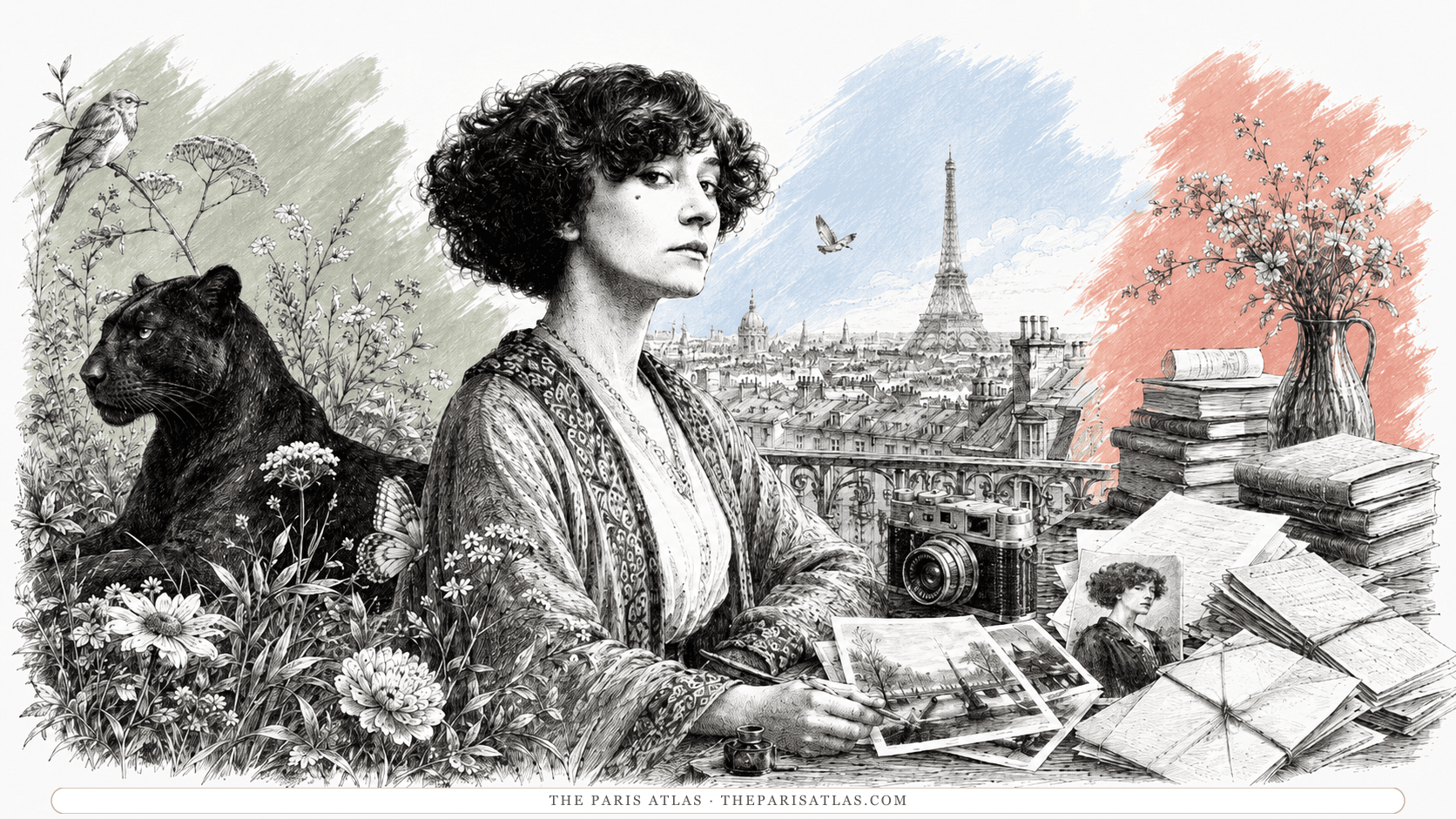
The writing came out of looking. Colette had visited the Antwerp zoo in 1929, and the creatures she watched there feed the pieces: serpents, peacocks, a squirrel, her own bulldog, a lizard, the black panther and the lions, owls, raptors, leopards, monkeys. They are descriptions rather than stories, and they belong to the strand of her work in which animals are studied for their own strangeness rather than made to stand in for people.
The texts did not stay confined to the art book. Later in 1932 they appeared as the opening section, also called 'Paradis terrestres,' of Prisons et paradis, the Ferenczi essay collection — an ordinary trade book that reached thousands of readers rather than a hundred and fifty collectors. Read the Prisons and Paradise page for the texts themselves; this page is about the rare object that printed them first.
There is no plot. The book holds ten short animal pieces — among them serpents, peacocks, a squirrel, a bulldog, a lizard, the black panther and the lions, owls, raptors, leopards, and monkeys — written to accompany Paul Jouve's wood-engraved animal compositions. They are close descriptions rather than stories, drawn in part from Colette's 1929 visit to the Antwerp zoo.
The object matters as much as the text. It was printed in Lausanne by Gonin et Cie in a tiny deluxe run on Japan paper and issued in loose sheets within a case, in the manner of a livre de peintre. The same ten texts appeared later in 1932 as the opening section of Prisons et paradis, which is where they are normally read today.
Read in its later collected form, the encounter contrasts the panther's recent confinement with the lions' settled companionship. Their calm raises a question about what captivity has cost, rather than proving that it suits them. The narrator moves from the panther's explosive, fragmentary appearance to sustained attention to the lioness. Yet greater descriptive detail does not bring complete understanding. Even an imagined life together would leave much of the animal's expression inaccessible. The final appeal seeks a meeting across that difference: attention can approach another creature without claiming to possess its inner life.
The later collected text of “Les paons” repeatedly announces the impossibility of describing its subjects while continuing to try. Color changes as the birds move and the light alters, defeating the names just assigned to it. Their escape from a tiny dog adds another reversal: splendid ceremonial figures become awkward, laboring bodies, briefly exposing the structure beneath their display. On the low roof, beauty renews the challenge instead of settling into a finished picture. The writing makes its corrections and hesitations visible, preserving an encounter that remains more mobile than the words used to hold it.
A meeting between France's foremost animal artist and a writer who watched animals as closely as anyone of her century.
Printed in roughly 150 copies on Japan paper and issued in loose sheets, it survives mostly in bespoke bindings and museum records.
The ten animal pieces most readers know from Prisons et paradis were printed here first.
If you have gone looking for Colette's Earthly Paradise and come back confused, the fault is not yours. There are three of them, and they are not editions of one another.
1929
Colette visits the Antwerp zoo; the animals she watches there feed the book's texts.
1932
Paradis terrestres is printed in Lausanne by Gonin et Cie, with wood engravings after Paul Jouve.
1932
The same ten texts appear later that year as the opening section of Prisons et paradis.

The 1953 photobook of nearly the same name — a different work, easily confused with this one.
Read our take
The 1966 English anthology whose title translates this one's — the third book in the Paradise tangle.
Read our take
The trade collection whose opening section holds these same ten animal texts.
Read our take
Colette's wartime animal book, the other work where beasts are studied for their own sake.
Read our take
Her first animal book, where the talking pets precede this closer, stranger looking.
Read our takeColette. Paradis terrestres was published in Lausanne by Gonin et Cie at the beginning of 1932, a deluxe illustrated book with wood-engraved animal compositions by Paul Jouve.
No. They are different works that share almost the same name. This one, plural, is the 1932 Paul Jouve art book of animal texts. Paradis terrestre, singular, is a 1953 photobook made with Izis, using texts drawn from En pays connu.
It holds ten short animal pieces — serpents, peacocks, a squirrel, a lizard, the black panther and the lions, owls, raptors, leopards, monkeys — close descriptions written to accompany Jouve's engravings.
The same ten texts appeared later in 1932 as the opening section, also titled 'Paradis terrestres,' of Prisons et paradis. That trade collection is where the texts are normally read today.
It was a fine-press luxury edition of roughly 150 copies on Japan paper, issued unbound in sheets, so it surfaces in museum and rare-book records rather than ordinary retail.
Explore authors with a similar voice, perspective, and influence.

The Brooklyn dropout who arrived in Paris broke at thirty-eight and wrote the exuberant, banned books that ended American censorship.
View author
The doctor of the Paris slums who wrote the century's blackest, funniest novel — and changed the sound of French prose.
View author
War correspondent who covered the Spanish Civil War, D-Day, and conflicts across five more decades; Hemingway's third wife, 1940–1945.
View authorThe sources below include the primary text, editions, scholarship, archival materials, and other records that informed this page. They document Paradis terrestres (1932), its publication, and its place in literary history.


The primary text represented by this page, used for descriptions of the work’s contents and for any quoted passages shown here.
Complete primary French texts of “La panthère noire et les lions” (pp. 37–39) and “Les paons” (pp. 11–16) read in the Hachette édition définitive transcription. The already cited Société des amis de Colette bibliography confirms the ten 1932 Gonin texts entered Prisons et paradis. The Hachette copy's exact printing date and the original Gonin text/engraving arrangement were not independently collated.
The Société des amis de Colette bibliography verifies the original edition's publisher and publication date.
Used to verify Paradis terrestres (1932)'s bibliographic context and its place within Colette's published work.

Used for independent archival, institutional, or historical context surrounding Colette and Paradis terrestres (1932).
Used to cross-check chronology, publication history, and the circumstances in which Paradis terrestres (1932) appeared.
Used for an additional scholarly or biographical perspective on Paradis terrestres (1932) and Colette's wider career.
The primary text is the baseline reference for every book page. Additional references document publication history, interpretation, and historical context where that evidence is available.
 Explore more resources