Colette's Three Earthly Paradises
If you have gone looking for Colette's Earthly Paradise and come back confused, the fault is not yours. There are three of them, and they are not editions of one another.

by Colette
The life told in her own words — an autobiography assembled after her death from some forty of her books, and the English Colette most readers meet.
Earthly Paradise is an autobiography of Colette that Colette never wrote. Published in 1966, it was assembled by the American editor Robert Phelps, who went through some forty of her books — memoirs, essays, chronicles, portraits — and arranged the passages into a chronological life, from the Burgundy childhood to the last years at the Palais-Royal. Every word is hers; the shape is his. For English-language readers it is the most widely read of the books called Earthly Paradise, and it is quite separate from the two French books whose title it translates. (What's inside is described below.)
Phelps's method was montage. Colette had written about her own life constantly but never in a single ordered account: the material was scattered across My Mother's House, Sido, My Apprenticeships, The Pure and the Impure, Three… Six… Nine…, The Blue Lantern, and dozens more. Phelps read the lot and selected passages that, laid end to end in the order the events occurred, make a continuous narrative — childhood, the Willy years, the music hall, the marriages, the war, old age.
The result is an unusual object: a genuine autobiography in her voice, produced by an editor's hand. It runs to some five hundred pages and was translated by Herma Briffault and Derek Coltman. Because it draws on the non-fiction rather than the novels, it doubles as an introduction to the memoirist that English readers often reach before they reach Chéri or Gigi.
It is also the main reason the Paradise titles are so tangled. Its English name is the exact translation of Colette's recurring phrase paradis terrestre, and reader databases have sometimes merged it with the 1953 French photobook — occasionally listing this book as 'first published 1953,' which it was not. It is a 1966 editorial compilation, and it shares no publication history with either French book.
The book runs as a life, in order: the Burgundy childhood and Sido; the move to Paris and the Willy years, when Colette's first novels appeared under her husband's name; the music-hall period; the later marriages and motherhood; two wars; and the long final stretch at the Palais-Royal. Every passage is Colette's own writing, drawn from around forty of her books.
The arrangement is the editor's. Robert Phelps selected and sequenced the excerpts so that scattered autobiographical prose reads as a continuous narrative — a life-story built entirely from things she had already written, including material from My Apprenticeships, Three… Six… Nine…, and The Pure and the Impure. It was published by Farrar, Straus & Giroux in 1966, translated by Herma Briffault and Derek Coltman.
In the foreword excerpt reproduced by Narrative, Phelps proposes watching as the autobiography's central action. That choice changes what counts as an event: sustained attention can matter as much as a marriage, a journey or a public success. The advice to look longer at painful things also complicates the promise of the title. This paradise need not mean excluding discomfort from view. Beside the imagined late-life writing scene, the editor's emphasis suggests a continuity of attention across changed circumstances. It is a declared organizing principle, not proof that every recollection offers an unmediated record of experience.
Selection gives the assembled life an argument as well as a sequence. Reviewing the book in 1966, John Weightman identifies Phelps's ambition to bring the private person and the public writing together as an enduring personal image. But he questions the anthology's emphasis, finding some of the nature writing excessively sentimental. That is a critic's objection, not an established verdict on Colette. The disagreement makes the editor's role easier to see: retaining an author's words does not make their arrangement neutral. Readers can ask which Colette this gathering brings forward, and what its apparent continuity leaves less visible.
A continuous autobiography built entirely from passages Colette wrote, gathered from around forty books.
Because it draws on the memoirs and chronicles rather than the novels, it introduces the writer many readers meet only through Chéri and Gigi.
Robert Phelps's sequencing turns scattered self-writing into a life-story without adding a word of his own to the narrative.
If you have gone looking for Colette's Earthly Paradise and come back confused, the fault is not yours. There are three of them, and they are not editions of one another.
1954
Colette dies at the Palais-Royal, leaving her self-writing scattered across some forty books.
1966
Robert Phelps's Earthly Paradise is published by Farrar, Straus & Giroux — her life assembled from her own prose.
1979
A Penguin edition follows the 1970 Sphere paperback, carrying the book to a wider English readership.

The 1953 French photobook whose title this one translates — a separate work, often confused with it.
Read our take
The rare 1932 art book of animal texts, the third and earliest of the Paradise titles.
Read our take
Colette's own memoir of the Willy years, one of the books this anthology draws on.
Read our take

She wrote every word in it, but she did not write the book. Robert Phelps assembled it in 1966 from passages across some forty of her existing books, arranging them into a chronological life-story.
It is Colette's life told in her own prose: the Burgundy childhood, the Willy years, the music hall, her marriages, two wars, and the last years at the Palais-Royal.
No. The title is the English of Colette's recurring phrase, but this is a separate 1966 editorial compilation. It is not a translation of the 1953 French photobook Paradis terrestre or the 1932 art book Paradis terrestres.
Reader databases have sometimes merged this English anthology with the 1953 French book of the same name. Earthly Paradise was first published in 1966 by Farrar, Straus & Giroux.
Herma Briffault and Derek Coltman, working from the many Colette books Phelps drew on. Later English editions include Sphere in 1970 and Penguin in 1979.
Explore authors with a similar voice, perspective, and influence.

The Brooklyn dropout who arrived in Paris broke at thirty-eight and wrote the exuberant, banned books that ended American censorship.
View author
The doctor of the Paris slums who wrote the century's blackest, funniest novel — and changed the sound of French prose.
View author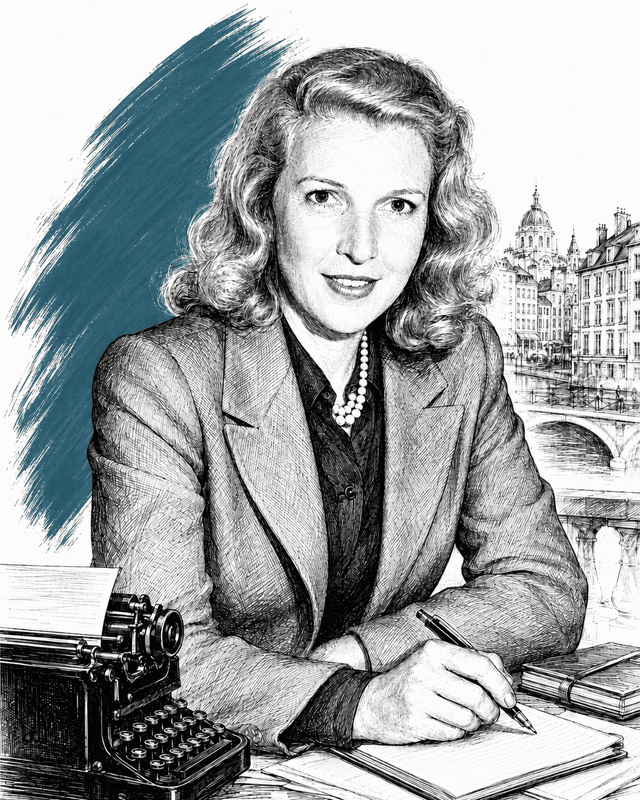
War correspondent who covered the Spanish Civil War, D-Day, and conflicts across five more decades; Hemingway's third wife, 1940–1945.
View authorThe sources below include the primary text, editions, scholarship, archival materials, and other records that informed this page. They document Earthly Paradise, its publication, and its place in literary history.


The primary text represented by this page, used for descriptions of the work’s contents and for any quoted passages shown here.

Public opening of Narrative's Spring 2006 presentation of Earthly Paradise, including its single displayed paragraph from Phelps's Editor's Foreword. The quotation ends before a sign-in requirement; only that public excerpt was read. This supports an analysis of his organizing idea, not a claim to have read the complete foreword or anthology.
John Weightman's June 9, 1966 review, specifically the public passages on Phelps's anthology, the quoted introduction and Weightman's objections to the selection. The critical judgment is explicitly attributed; it is not substituted for a complete reading of the anthology or presented as a consensus verdict.
Used to place Earthly Paradise within Colette's published work and verify its bibliographic context.
Used for independent biographical, archival, or historical context surrounding Colette's career and the period in which Earthly Paradise appeared.
Used to cross-check authorship, chronology, and the work's place in Colette's wider catalogue.
Used to verify Colette's bibliography and place Earthly Paradise within the broader chronology of Colette's career.
The primary text is the baseline reference for every book page. Additional references document publication history, interpretation, and historical context where that evidence is available.
 Explore more resources