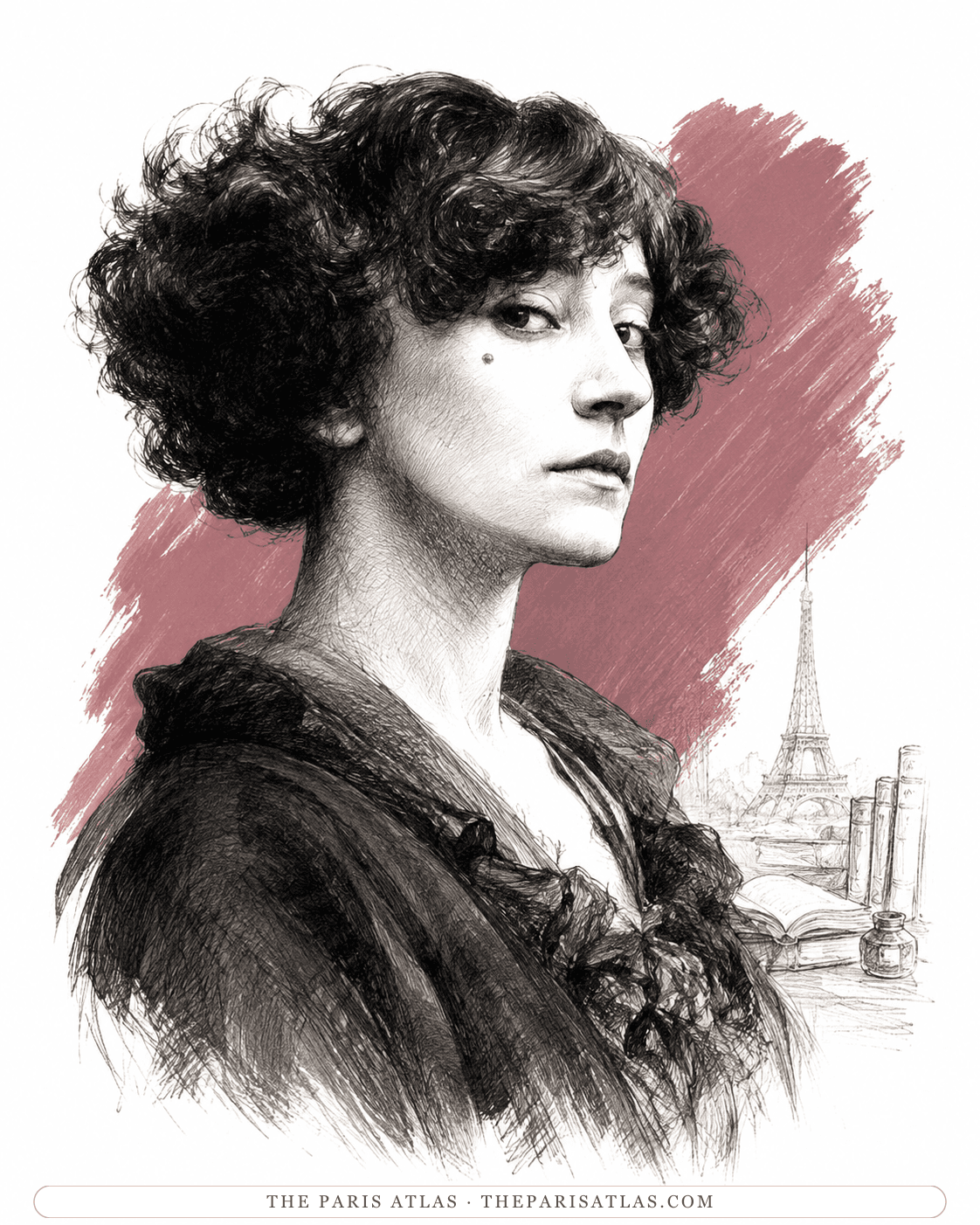


Stroke by Stroke
by Colette
A late book of portraits — the writers, performers, and painters Colette had known, drawn from memory in a few exact strokes.
- 1949
About Colette
The story, briefly
Spoiler-freeStroke by Stroke is a late collection of Colette's portraits, published in 1949. Its French title, Trait pour trait, is a drawing term — feature by feature, line by line — and it names the book's method: short, exact portraits of people Colette had known, sketched from memory. The subjects are a gallery of her age, from the writers Anna de Noailles and Marcel Proust to the actress Sarah Bernhardt, the composer Claude Debussy, and painter friends like Luc-Albert Moreau. It is one of the clearest of her late books to classify: a portrait collection. (What's inside is described below.)
The story, in more detail
The book gathers fifteen pieces, and it has a real unity of purpose: each is a portrait, drawn from Colette's long acquaintance with the artistic life of her time. The gallery is remarkable. Among the writers are Anna de Noailles, Marcel Proust, Georges Courteline, and Léon-Paul Fargue; among performers, Sarah Bernhardt and the singer Emma Calvé; there is the composer Claude Debussy, and painter and artist friends including André Dignimont, Marcel Vertès, Luc-Albert Moreau, and Charles Camoin. A Balzacian figure, Madame de Marneffe, joins the living.
Colette's method is the one her title promises: not the full biographical account but the telling feature, the remembered gesture, the line that fixes a person. Drawn late, from a lifetime of watching, the portraits carry both affection and the exactness of someone who missed very little.
Stroke by Stroke stands with The Flower of Youth and Intermittent Journal among the collectible late volumes from Le Fleuron. It is close in spirit to My Apprenticeships, where Colette drew the figures of her early years at greater length.
What's inside
There is no plot. The book is a collection of fifteen short portraits — people Colette had known across a lifetime in the artistic world, sketched from memory feature by feature. The subjects include the writers Anna de Noailles, Marcel Proust, Georges Courteline, and Léon-Paul Fargue; the actress Sarah Bernhardt and the singer Emma Calvé; the composer Claude Debussy; and painter friends such as André Dignimont, Marcel Vertès, and Luc-Albert Moreau.
The method is the title's: not full biography but the telling feature and remembered gesture, the few exact strokes that fix a person. It is a portrait-chronicle collection, one of the clearest to classify among Colette's late books.
Themes and analysis
An orchestra in one man
Colette's Debussy portrait makes listening visibly active. A remembered symphony first emerges as an uncertain murmur, then recruits his voice, hands, feet and nearby objects to recover its separate sounds. The poker and window turn the room itself into an improvised instrument. His absorption also separates him from the amused company: his laughter answers something within the music rather than their laughter at him. Colette cannot confidently name the symphony, but she fixes the force of its bodily return. Her final jazz-band image is a comic comparison, not a claim about musical invention.
The last meeting
The Proust portrait begins with an admission of misjudgment: his elaborate attentiveness once irritated Colette. Reading Swann changes what she can recognize in him, and the remembered man becomes inseparable from the book that opened childhood to her afresh. Their last encounter does not cancel that first impression so much as rearrange it. Formal clothes, disordered hair and sustained courtesy persist within physical exhaustion. The final image of a young man driven toward death holds incompatible ages together. Portraiture here records the observer's changed understanding as well as the subject's altered appearance.
Why we recommend it
A gallery of the age
Proust, Anna de Noailles, Sarah Bernhardt, Debussy — the artistic world of Colette's lifetime, drawn from memory.
The portrait in a few strokes
Colette fixes a person with the telling feature rather than the full biography, exactly as the title promises.
Late Colette, clearly shaped
One of the most unified of her late books — a genuine portrait collection.
What this book explores
Bring it to book club
- Colette draws each subject in a few strokes rather than a full life. What does that method capture that biography might miss?
- The gallery ranges from Proust to a music-hall singer. What holds so varied a company together?
- A fictional Balzac character joins the real people. Why might Colette place invented and remembered figures side by side?
Timeline
1949
Trait pour trait is published by Le Fleuron — fifteen portraits of the writers, performers, and artists Colette had known.
1950
The portraits enter Volume XIV of the Le Fleuron collected works.
1986
Fayard republishes the collection in a combined volume with En pays connu and two other late collections.
Book editions
Hardcover
- Hardcover
- 1949
Paperback
- Paperback
Ebook
- Ebook
Reader reviews
Readers may also like

Intermittent Journal
The other collectible late gathering from the same series and moment.
Read our take
My Apprenticeships
Colette's memoir of her early years, where she draws many of the same figures at greater length.
Read our takeStroke by Stroke: frequently asked questions
Who wrote Stroke by Stroke?
Colette. Trait pour trait was published in 1949, a collection of her short portraits, in the Le Fleuron series of collectible late volumes.
What is the book about?
It is a book of fifteen short portraits of people Colette had known — writers, performers, a composer, and painter friends — drawn from memory feature by feature.
Who appears in it?
Among others, the writers Anna de Noailles and Marcel Proust, the actress Sarah Bernhardt, the singer Emma Calvé, the composer Claude Debussy, and painter friends such as Luc-Albert Moreau.
Is it a novel?
No. It is a collection of short portraits, without a continuous plot.
Is Stroke by Stroke available in English?
There is no securely verified standalone English edition of the book.
If you like Colette
Explore authors with a similar voice, perspective, and influence.

Henry Miller
The Brooklyn dropout who arrived in Paris broke at thirty-eight and wrote the exuberant, banned books that ended American censorship.
View author
Louis-Ferdinand Céline
The doctor of the Paris slums who wrote the century's blackest, funniest novel — and changed the sound of French prose.
View author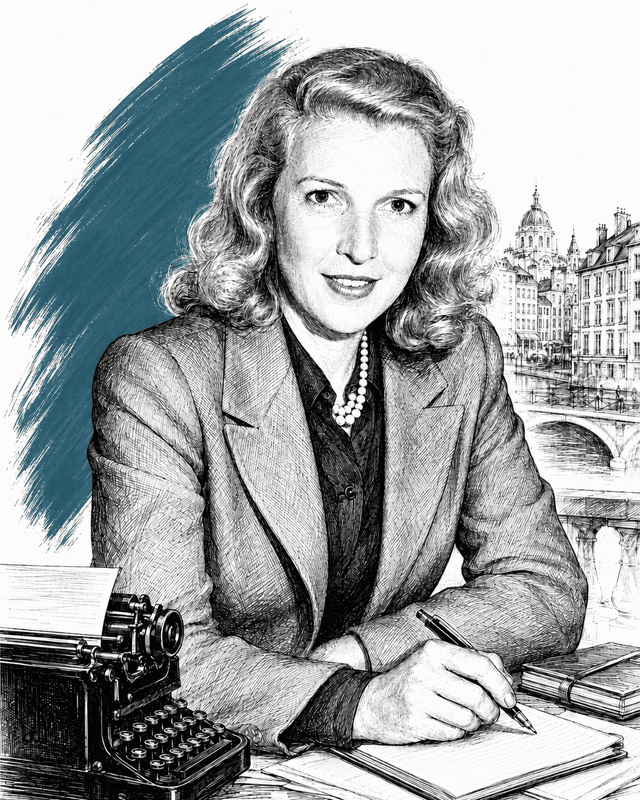
Martha Gellhorn
War correspondent who covered the Spanish Civil War, D-Day, and conflicts across five more decades; Hemingway's third wife, 1940–1945.
View author
References
References
The sources below include the primary text, editions, scholarship, archival materials, and other records that informed this page. They document Stroke by Stroke, its publication, and its place in literary history.

1Stroke by Stroke
NovelColette, 1949Used forThe primary text represented by this page, used for descriptions of the work’s contents and for any quoted passages shown here.
2Trait pour trait — Le Fleuron 1950 collected text
WebsiteWikisourceUsed forComplete Claude Debussy, pp. 191–192, and Marcel Proust, pp. 193–194, read through publicly indexed primary transcriptions of the Le Fleuron 1950 collected text. Not a complete-volume, original 1949 edition or independent historical collation. The symphony's identity remains uncertain, and the jazz-band image is treated as Colette's metaphor.
3Colette — bibliography of original editions
WebsiteSociété des amis de ColetteUsed forThe Société des amis de Colette bibliography verifies the original edition's publisher and publication date.
4Société des amis de Colette — Chronology
WebsiteUsed forUsed to place Stroke by Stroke within Colette's published work and verify its bibliographic context.

5Bibliothèque nationale de France — The Worlds of Colette
Exhibition catalogueUsed forUsed for independent biographical, archival, or historical context surrounding Colette's career and the period in which Stroke by Stroke appeared.
6Library of Congress — Colette resource guide
WebsiteUsed forUsed to cross-check authorship, chronology, and the work's place in Colette's wider catalogue.
7Bibliothèque nationale de France — Colette: online resources
WebsiteUsed forUsed to verify Colette's bibliography and place Stroke by Stroke within the broader chronology of Colette's career.
8En pays connu, suivi de Trait pour trait, Journal intermittent, La fleur de l’âge
WebsiteFayardUsed forPublisher’s record for the combined edition issued on 4 June 1986.
i
Why these sources are here
The primary text is the baseline reference for every book page. Additional references document publication history, interpretation, and historical context where that evidence is available.
 Explore more resources