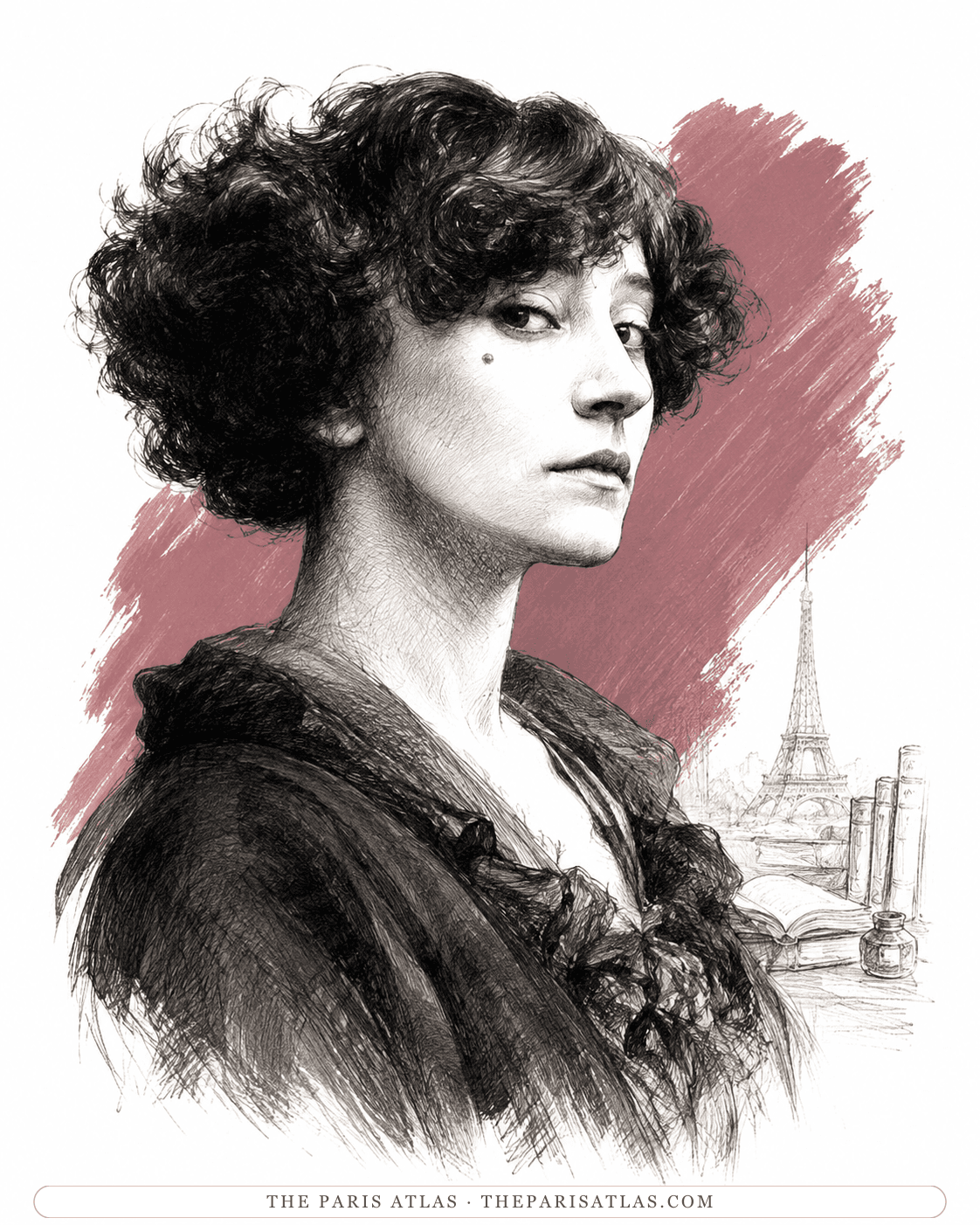
French novelist and critic who wrote Monsieur Vénus, was convicted of pornography for it by a Belgian court, held a police permit to wear men's clothes, and ran the Tuesday salon at the Mercure de France for four decades.
In images
Details
Lived
1860–1953
Born
11 February 1860
Birthplace
Château-l'Évêque, Dordogne
Died
4 April 1953 · aged 93
Place of death
Paris, France
Nationality
French
Married
Alfred Vallette · 1889–1935
Children
Gabrielle Vallette
Roles
AuthorCriticPlaywrightSalon host
Also known as
Marguerite Eymery · Marguerite Vallette-Eymery · Madame Alfred Vallette · Jean de Chilra
About Rachilde
Rachilde was a French novelist and critic who published around sixty books and, from the 1890s, ran the Tuesday salon at the offices of the Mercure de France. She was born Marguerite Eymery in the Dordogne in 1860 and took the pen name at fifteen. Her calling cards were engraved "Rachilde, homme de lettres": man of letters, in the masculine.
The book that made her name was Monsieur Vénus, published in Brussels in 1884, when she was twenty-four. A Belgian court tried it as pornography and convicted her in her absence. She stayed in France and never served the sentence. The novel is about a rich young woman who buys a poor young man, dresses him, marries him and speaks of herself throughout in the masculine, and sexual inversion and cross-dressing run through much of what Rachilde wrote afterwards. She wore men's clothes herself, under a permit from the Paris police.
In 1889 she married Alfred Vallette. He launched the Mercure de France the following year, and it became the headquarters of Symbolism in Paris; Rachilde reviewed novels in it for nearly thirty years, which made her one of the few women in France who could decide whether a first novel was noticed. In 1928 she published a book called Pourquoi je ne suis pas féministe, Why I Am Not a Feminist. She died in 1953 at ninety-three, blind, poor and largely unread.
The novel that was tried in Belgium
Monsieur Vénus was published in Brussels in June 1884 by Auguste Brancart, a publisher of erotica, and the title page credited it to Rachilde and one F. T. The initials stood for Francis Talman. In the introduction to their scholarly edition, Melanie Hawthorne and Liz Constable report the suspicion that Talman was invented to carry the blame, and note that Rachilde had used the same manoeuvre before, attributing indecent material to a Swedish ghost.[1]
The novel follows Raoule de Vénérande, a rich young noblewoman who finds a poor flower-maker called Jacques Silvert, installs him in an apartment, pays for him, dresses him as a woman and eventually marries him. She calls herself his lover in the masculine and treats him as the mistress. He is killed in a duel at the end, and she keeps a wax mannequin of his body, fitted with his hair, his teeth and his nails.
I am in love with a man and not with a woman!
Je suis amoureux d'un homme et non pas d'une femme!
The line does not survive translation intact. Raoule uses the masculine form, amoureux, of herself, which the English cannot show. The book is printed in italics at that point, so the emphasis is Rachilde's rather than a later editor's.
Rachilde at the Otto studio on the place de la Madeleine, inscribed to Alfred Vallette, her husband. The card postdates their marriage in June 1889. (Otto Wegener · Public domain)
Belgian prosecutors moved on the book. A court in Brussels tried it as pornography, convicted Rachilde in her absence, imposed a prison sentence and a fine, and had copies seized and destroyed. She was living in Paris, did not appear, and simply stayed out of Belgium. The accounts do not agree on the numbers: Hawthorne and Constable give two years in prison, and the Rachilde scholar Nelly Sanchez gives one year and a fine of two thousand francs. No account reaches the date of the hearing.[1]
The first French edition came out in 1889 from Félix Brossier, with a preface by Maurice Barrès titled Complications d'amour, and it named Rachilde as the sole author. The chapter attributed to Talman was cut. The publisher's own note in that edition is worth reading twice, because it does not quite confirm the conviction it is trading on: it calls the book one that "beaucoup de personnes croient condamné par les tribunaux de la Belgique", which many people believe was condemned by the Belgian courts.[2]
Barrès admired the novel and did not pretend otherwise. He opens by calling it "assez abominable" and says he is not shocked by it, then spends several pages arguing that its interest is clinical, that it belongs beside Adolphe and Mademoiselle de Maupin as a study of a rare deformation of love. He also gets Rachilde's age wrong, calling her a girl of twenty, which is part of how the legend was built.
The name, the calling cards and the permit to wear trousers
Rachilde was born Marguerite Eymery on 11 February 1860 at Château-l'Évêque in the Dordogne, the only child of a cavalry officer and the daughter of a newspaper editor. She read her way through the family library, placed her first story in a regional paper at fifteen, and came to Paris in 1878 after the family's money went.[3]
The pen name arrived at about the same age and its origin is not established. The story Rachilde told was that it came from a sixteenth-century Swedish nobleman who spoke through a table at a séance. She told a great many stories about herself, and her biographer Melanie Hawthorne treats the embellishment as the central fact of the life rather than a nuisance around the edges of it.
In 1885 she applied to the Paris prefecture of police for a permission de travestissement and got one. A police ordinance of 1800 required a woman to hold such a permit before appearing in the street in men's clothes; George Sand, Rosa Bonheur and the archaeologist Jane Dieulafoy held them too. The prefecture's file on the permits survives in poor condition, and few appear to have been granted.[4]
She had her calling cards engraved "Rachilde, homme de lettres". The word on the card is homme and not femme, and the wording is often misreported, in part because the standard French biography of her, by Claude Dauphiné, is called Rachilde, femme de lettres 1900. Her own explanation for the clothes was that she wanted people to address themselves to her pen rather than to her person.
The Tuesdays at the Mercure de France
In 1889 she married Alfred Vallette, a typographer who had also published a little fiction. Their daughter Gabrielle was born the following year.
The Mercure de France put out its first issue on 1 January 1890. Eleven men founded it, Vallette and Remy de Gourmont among them, and the first year brought eleven subscriptions. It became the review the Symbolists published in and the publishing house that printed them. Vallette directed it from the first issue until he died at his desk in 1935. Its offices were at 15 rue de l'Échaudé-Saint-Germain until 1903 and at 26 rue de Condé afterwards, in a small seventeenth-century house that had once belonged to Beaumarchais.[5]
Rachilde received there on Tuesdays, from five to seven, through the season that ran from January to Easter. The mardis du Mercure lasted from the early 1890s into the 1930s and were the room where the Symbolist and Decadent writers found each other. The reference accounts of who came name:
Alfred Jarry, whom Rachilde and Vallette supported for the whole of his short career
Oscar Wilde, during his French years, and Lord Alfred Douglas
the painters Paul Gauguin and Henri de Toulouse-Lautrec
the composer Maurice Ravel
Paul Léautaud, who worked at the Mercure and left an unkind record of the room
From 1897 to 1925 Rachilde wrote the Mercure's novel criticism, and she sat on its editorial committee until 1924. She refused to be objective about it. She was rude about naturalism and about Zola, missed what Proust and Gide were doing, and read Colette correctly at a time when the Claudine novels were appearing under her husband's name and Colette's part in them was supposed to be a secret.[6]
Two women ran the salons that shaped literary Paris on either side of 1900. Natalie Clifford Barney's Fridays at 20 rue Jacob were about introductions, and about women. Rachilde's Tuesdays were the working room of a review, and what a writer stood to gain there was a page in it. Barney's Académie des Femmes honoured Rachilde from 1927.
Alfred Jarry, and a riot that may not have happened
Alfred Jarry was twenty-one when Rachilde and Vallette took him up, and they stayed with him until he died at thirty-four. The Mercure published Ubu Roi in 1896, and Rachilde pushed the director Aurélien Lugné-Poe to stage it at the Théâtre de l'Œuvre that December. Jarry gave her a copy inscribed from Monsieur Ubu.
Everyone knows what happened on the first night: the play opened with the word merdre and the audience rioted for a quarter of an hour. Rachilde is the source of that account, and she published it in 1928, thirty-two years later, in her book Alfred Jarry ou le Surmâle des lettres. Sebastian Trainor has argued that she largely invented it, that the première was played to an invited and sympathetic house, and that the scandalised bourgeois audience was written in during the 1920s as part of a fight with the Surrealists over who owned Jarry's memory. Her account is still the one that gets quoted.[7]
The books
Rachilde wrote fast and published constantly, from 1880 until her late eighties. The novels that are still read are the ones from the two decades either side of 1890.
Monsieur Vénus (1884), the one that was tried
La Marquise de Sade (1887), which opens with a soldier's small daughter in Clermont-Ferrand being walked past the municipal slaughterhouses every afternoon, and follows what grows out of it
L'Animale (1893) and Le Démon de l'absurde (1894), the second of which Remy de Gourmont rated her best book
La Tour d'amour (1899), set at the Ar-Men lighthouse off the Breton coast, where a young keeper works out what the head keeper Mathurin Barnabas does with the drowned women the sea brings up
La Jongleuse (1900), in which the widow Éliante Donalger tells her suitor she prefers an alabaster amphora to him, and means it
Two of the novels went out under a second pen name, Jean de Chilra, an anagram: La Princesse des ténèbres (1895) and L'Heure sexuelle (1898).
The recurring subject is desire that will not sort itself into the arrangement the period expected of it. Women who behave as men, men who are dressed and handled as women, love that fixes on an object rather than a person, and sex that ends in a death. Rachilde was called the queen of the Decadents by the Decadents, and the label has stuck to her more firmly than to any of the men.
Why I am not a feminist
In 1928 Rachilde published Pourquoi je ne suis pas féministe, Why I Am Not a Feminist. It is a short book, half argument and half memoir, and it goes back to her childhood to explain her: a father who had wanted a son and treated her as a failed one, a mother who was mentally ill and did not want her at all.
The facts of her life run the other way from her title, and both stand. She held a permit to wear men's clothes and used it. She published under her own name, in her own right, for seventy years. She reviewed for the most influential literary review in France and sat on its committee. She took Barney's honours at the Académie des Femmes, an institution founded to answer an Académie française that would not admit women. She also declined, in print, to be counted with the women who were arguing for the vote and for equal rights, and preferred to be described in the masculine.
The last years
Rachilde in about 1920, photographed by Henri Manuel. She was then sixty, and still writing the Mercure's novel criticism. (Henri Manuel, Bibliothèque Marguerite Durand, Ville de Paris · Public domain)
Alfred Vallette died at the Mercure in 1935, and the money went with him. Rachilde was seventy-five. She stayed on in the flat above the offices at 26 rue de Condé and kept publishing, mostly to eat: a book of stories in 1934, memoirs of Paris in the 1880s in 1937 and 1947, novels through the war years.
She went blind and could not get about. The visitors thinned out. She died at the rue de Condé on 4 April 1953, aged ninety-three, and the press barely noticed; the Mercure's own tribute that month spent more of its space on her husband. She is buried in the Bagneux cemetery south of Paris.[8]
Monsieur Vénus came back into print in English in 2004, in a scholarly edition from the Modern Language Association, and her work entered the public domain in France in 2023.
Life events
1860
Born Marguerite Eymery on 11 February at Château-l'Évêque in the Dordogne, the only child of a cavalry officer and a newspaper editor's daughter.
— Nelly Sanchez, Rachilde, célébrité sulfureuse des lettres de la Belle Époque (2019); Rachilde (Q2366473) — authority record
1878
Comes to Paris with her mother after the family's money goes, and begins placing work in the newspapers under the name Rachilde.
— Nelly Sanchez, Rachilde, célébrité sulfureuse des lettres de la Belle Époque (2019)
1884
Monsieur Vénus is published in Brussels by Auguste Brancart, credited to Rachilde and F. T. Belgian prosecutors move on it; a court convicts her in her absence and orders copies destroyed.
Rachilde photographed at the Otto studio, 3 place de la Madeleine in Paris. She inscribed the mount to Alfred Vallette, her husband and the director of the Mercure de France, which dates the card after their marriage in June 1889. Public domain: Otto Wegener died in 1924. (Otto Wegener)
— Rachilde, Monsieur Vénus: A Materialist Novel — translated by Melanie Hawthorne, introduction by Melanie Hawthorne and Liz Constable (2004); Nelly Sanchez, Rachilde, célébrité sulfureuse des lettres de la Belle Époque (2019)
1885
Obtains a permission de travestissement from the Paris prefecture of police, the permit a woman needed to appear in the street in men's clothes.
— Melanie C. Hawthorne, Rachilde and French Women's Authorship: From Decadence to Modernism (2001)
1887
La Marquise de Sade, the second of the novels on which her reputation rests.
— Rachilde, La Marquise de Sade (1887)
1889
The first French edition of Monsieur Vénus appears from Félix Brossier with a preface by Maurice Barrès, naming her as sole author. She marries Alfred Vallette the same year.
— Rachilde, Monsieur Vénus, préface de Maurice Barrès (1889); Nelly Sanchez, Rachilde, célébrité sulfureuse des lettres de la Belle Époque (2019)
1890
The Mercure de France publishes its first issue on 1 January, founded by eleven men including Vallette and Remy de Gourmont. Rachilde's daughter Gabrielle is born the same year.
— Alfred Vallette et la fondation du Mercure de France; Nelly Sanchez, Rachilde, célébrité sulfureuse des lettres de la Belle Époque (2019)
1896
The Mercure publishes Alfred Jarry's Ubu Roi, and Rachilde presses Lugné-Poe to stage it at the Théâtre de l'Œuvre in December. Remy de Gourmont's Le Livre des masques carries his portrait of her.
— Sebastian Trainor, Rachilde's Supermale of Letters and the Invention of the Ubu Roi Riot, in Text and Presentation, pp. 92–108 (2012); Remy de Gourmont, Le Livre des masques: portraits symbolistes (1896)
1897–1925
Writes the Mercure de France's novel criticism, and sits on its editorial committee until 1924.
— Nelly Sanchez, Rachilde, célébrité sulfureuse des lettres de la Belle Époque (2019)
1903
The Mercure moves from the rue de l'Échaudé-Saint-Germain to 26 rue de Condé, where the Tuesday receptions carry on.
— Alfred Vallette et la fondation du Mercure de France
1927
Honoured at Natalie Clifford Barney's Académie des Femmes at 20 rue Jacob, alongside Colette, Gertrude Stein and Djuna Barnes.
— Anna Livia, Barney, Natalie Clifford (1876–1972), in Women in World History: A Biographical Encyclopedia (2002)
1928
Publishes Pourquoi je ne suis pas féministe, and Alfred Jarry ou le Surmâle des lettres, the memoir that is the source of the famous account of the Ubu Roi riot.
Rachilde in about 1920, by the Paris studio photographer Henri Manuel. The print belongs to the Bibliothèque Marguerite Durand in Paris. Public domain: Manuel died in 1947. (Henri Manuel, Bibliothèque Marguerite Durand, Ville de Paris)
— Vallette, Marguerite (1860–1953), in Women in World History: A Biographical Encyclopedia (2002); Sebastian Trainor, Rachilde's Supermale of Letters and the Invention of the Ubu Roi Riot, in Text and Presentation, pp. 92–108 (2012)
1935
Alfred Vallette dies at his desk at the Mercure. Rachilde is seventy-five and left without money; the Tuesdays wind up.
— Nelly Sanchez, Rachilde, célébrité sulfureuse des lettres de la Belle Époque (2019)
1953
Dies on 4 April at 26 rue de Condé, aged ninety-three, blind and largely forgotten. She is buried in the Bagneux cemetery.
— Nelly Sanchez, Rachilde, célébrité sulfureuse des lettres de la Belle Époque (2019); Rachilde (Q2366473) — authority record
People Rachilde Knew
Relationships with other people, with sources for each connection.
Rachilde reviewed the Claudine novels for the Mercure de France while they were appearing under Henry Gauthier-Villars's name, and pointed at Colette's hand in them at a time when her part was supposed to be a secret. Both were later honoured by Natalie Clifford Barney's Académie des Femmes, and Colette named Rachilde in Le Fanal bleu in 1949. The start year is approximate: it marks the Claudine years rather than a first meeting the sources fix.
— Nelly Sanchez, Rachilde, célébrité sulfureuse des lettres de la Belle Époque (2019); Anna Livia, Barney, Natalie Clifford (1876–1972), in Women in World History: A Biographical Encyclopedia (2002)
Barney's Académie des Femmes, the run of salon evenings she began in 1927 to honour women writers, counted Rachilde among the French writers it honoured, alongside Colette, Élisabeth de Gramont and Lucie Delarue-Mardrus. The start year is the Académie's rather than a first meeting: the two moved in overlapping Paris literary circles well before it, and the reference accounts do not date their first meeting.
— Anna Livia, Barney, Natalie Clifford (1876–1972), in Women in World History: A Biographical Encyclopedia (2002); Vallette, Marguerite (1860–1953), in Women in World History: A Biographical Encyclopedia (2002)
Colleagues at the Mercure de France for twenty-five years, from its first issue in January 1890 until Gourmont's death. He was one of its eleven founders; Rachilde was married to its director, Alfred Vallette, wrote its novel criticism and received on Tuesdays in its offices. Gourmont reviewed her plays in the Mercure in August 1891 and gave her one of the portraits in Le Livre des masques in 1896, an essay that argues at length that women's books are always inferior to the women who write them before conceding that Le Démon de l'absurde is her best work. The start year is the review's first issue rather than a first meeting, which the sources do not fix; both were in the same Symbolist circle in Paris from the middle of the 1880s.
— Remy de Gourmont, Le Livre des masques: portraits symbolistes (1896); Remy de Gourmont, The Book of Masks — translated by Jack Lewis (1921); Alfred Vallette et la fondation du Mercure de France; Nelly Sanchez, Rachilde, célébrité sulfureuse des lettres de la Belle Époque (2019)
Rachilde’s Places
The cataloged places connected to Rachilde — through the books, and through the documented record.
Places you can enter today appear first, followed by addresses to see from outside and sites that have vanished.
Anne Charles names Rachilde among the talents of the time the Académie honoured; Anna Livia counts her among its French writers, under her married name Marguerite Vallette. Neither dates her evening, so the year here is the Académie's own and not a date for it.
— Anne Charles, Barney Opens Her Paris Salon (2022), Summary of Event, read 2026-08-11; Anna Livia, Barney, Natalie Clifford (1876–1972), in Women in World History: A Biographical Encyclopedia (2002)
Questions about Rachilde
Who was Rachilde?
A French novelist and critic (1860–1953), born Marguerite Eymery, who published around sixty books and ran the Tuesday salon at the offices of the Mercure de France. Her best-known novel is Monsieur Vénus (1884). She wrote the Mercure's novel criticism from 1897 to 1925, which made her one of the most influential readers in French letters, and she was married to the review's director, Alfred Vallette.
What is Monsieur Vénus about, and why was it banned?
Monsieur Vénus is Rachilde's 1884 novel about Raoule de Vénérande, a rich young noblewoman who buys and keeps a poor flower-maker called Jacques Silvert, dresses him as a woman, marries him, and refers to herself throughout in the masculine. It was published in Brussels, and Belgian prosecutors tried it as pornography. The court convicted Rachilde in her absence, imposed a prison sentence and a fine, and ordered copies destroyed. She was in Paris, never appeared, and avoided Belgium afterwards.
Did Rachilde go to prison?
No. The Belgian conviction was pronounced while she was in France and she simply stayed there, so the sentence was never enforced. The accounts disagree about its length: the scholarly edition by Melanie Hawthorne and Liz Constable gives two years, and the Rachilde specialist Nelly Sanchez gives one year and a two-thousand-franc fine.
Did Rachilde really dress as a man?
Yes, and legally. In 1885 she obtained a permission de travestissement from the Paris prefecture of police, the permit a woman was required to hold under an 1800 ordinance before appearing in the street in men's clothes. George Sand and the painter Rosa Bonheur held the same kind of permit. Rachilde's calling cards were engraved "Rachilde, homme de lettres", man of letters, and she said she dressed that way so that people would address themselves to her pen rather than to her person.
Why did Rachilde write Why I Am Not a Feminist?
Pourquoi je ne suis pas féministe (1928) sets out her refusal to be counted with the women's movement of her day, and it explains her by way of her childhood: a father who had wanted a son, and a mother who was mentally ill. The book sits against a life that went in the other direction. She published under her own name for seventy years, held a police permit to wear men's clothes, judged other writers' novels in the most influential review in France, and accepted an honour from Natalie Clifford Barney's Académie des Femmes, which existed because the Académie française would not take women.
What was the salon at the Mercure de France?
Rachilde's Tuesday receptions in the offices of the Mercure de France, held from five to seven in the afternoon during the season between January and Easter. They ran from the early 1890s into the 1930s, first at 15 rue de l'Échaudé-Saint-Germain and from 1903 at 26 rue de Condé, and they were where the Symbolist and Decadent writers met. Alfred Jarry, Oscar Wilde, Paul Gauguin, Henri de Toulouse-Lautrec and Maurice Ravel are among those the accounts place in the room.
Did Rachilde invent the Ubu Roi riot?
Possibly. The famous account of the audience rioting at the first performance of Alfred Jarry's Ubu Roi in December 1896 comes from Rachilde's memoir of Jarry, published in 1928, thirty-two years after the event. Sebastian Trainor has argued that the première was played to an invited and sympathetic house and that Rachilde wrote the scandal in during the 1920s, while fighting the Surrealists for custody of Jarry's reputation. Her version is still the one usually repeated.
How did Rachilde die, and where is she buried?
She died on 4 April 1953 at 26 rue de Condé in Paris, aged ninety-three, in the flat above the Mercure de France offices where she had lived for fifty years. She had gone blind and was poor; Alfred Vallette's death in 1935 had left her with almost nothing, and she kept publishing largely to live. Her death drew very little press. She is buried in the Bagneux cemetery, south of Paris.
Connections and Sources
Rachilde’s connections to people, places, and works, with the sources behind each one.
Two documented facts meet here rather than one: Barney's Académie des Femmes met at 20 rue Jacob, giving one Friday to each woman writer it honoured, and Rachilde is named among those honoured. The sources do not describe Rachilde in the room on her own evening, which is why this is probable rather than documented.
— Anna Livia, Barney, Natalie Clifford (1876–1972), in Women in World History: A Biographical Encyclopedia (2002); Vallette, Marguerite (1860–1953), in Women in World History: A Biographical Encyclopedia (2002)
Rachilde reviewed the Claudine novels for the Mercure de France while they were appearing under Henry Gauthier-Villars's name, and pointed at Colette's hand in them at a time when her part was supposed to be a secret. Both were later honoured by Natalie Clifford Barney's Académie des Femmes, and Colette named Rachilde in Le Fanal bleu in 1949. The start year is approximate: it marks the Claudine years rather than a first meeting the sources fix.
— Nelly Sanchez, Rachilde, célébrité sulfureuse des lettres de la Belle Époque (2019); Anna Livia, Barney, Natalie Clifford (1876–1972), in Women in World History: A Biographical Encyclopedia (2002)
Barney's Académie des Femmes, the run of salon evenings she began in 1927 to honour women writers, counted Rachilde among the French writers it honoured, alongside Colette, Élisabeth de Gramont and Lucie Delarue-Mardrus. The start year is the Académie's rather than a first meeting: the two moved in overlapping Paris literary circles well before it, and the reference accounts do not date their first meeting.
— Anna Livia, Barney, Natalie Clifford (1876–1972), in Women in World History: A Biographical Encyclopedia (2002); Vallette, Marguerite (1860–1953), in Women in World History: A Biographical Encyclopedia (2002)
Colleagues at the Mercure de France for twenty-five years, from its first issue in January 1890 until Gourmont's death. He was one of its eleven founders; Rachilde was married to its director, Alfred Vallette, wrote its novel criticism and received on Tuesdays in its offices. Gourmont reviewed her plays in the Mercure in August 1891 and gave her one of the portraits in Le Livre des masques in 1896, an essay that argues at length that women's books are always inferior to the women who write them before conceding that Le Démon de l'absurde is her best work. The start year is the review's first issue rather than a first meeting, which the sources do not fix; both were in the same Symbolist circle in Paris from the middle of the 1880s.
— Remy de Gourmont, Le Livre des masques: portraits symbolistes (1896); Remy de Gourmont, The Book of Masks — translated by Jack Lewis (1921); Alfred Vallette et la fondation du Mercure de France; Nelly Sanchez, Rachilde, célébrité sulfureuse des lettres de la Belle Époque (2019)
AD
Honoured by · 1927
Académie des Femmes
Anne Charles names Rachilde among the talents of the time the Académie honoured; Anna Livia counts her among its French writers, under her married name Marguerite Vallette. Neither dates her evening, so the year here is the Académie's own and not a date for it.
— Anne Charles, Barney Opens Her Paris Salon (2022), Summary of Event, read 2026-08-11; Anna Livia, Barney, Natalie Clifford (1876–1972), in Women in World History: A Biographical Encyclopedia (2002)
References
References
The sources below include biographies, scholarly essays, interviews, and primary materials that informed this page. They reflect both the historical record and ongoing critical conversations about Rachilde and their work.
1abMonsieur Vénus: A Materialist Novel — translated by Melanie Hawthorne, introduction by Melanie Hawthorne and Liz Constable
Novel
Modern Language Association of America, 2004
Used for
Primary text included as part of the documented record for Rachilde.
These references anchor the page in the documented record and in the scholarly conversations around Rachilde. Every claim on this page traces back to one or more of the works listed here.



 View source