The Paris AtlasCharting the artists, works, and places worth returning to.
  • Painter
  • Sculptor
· French · 1848–1903

Paul Gauguin

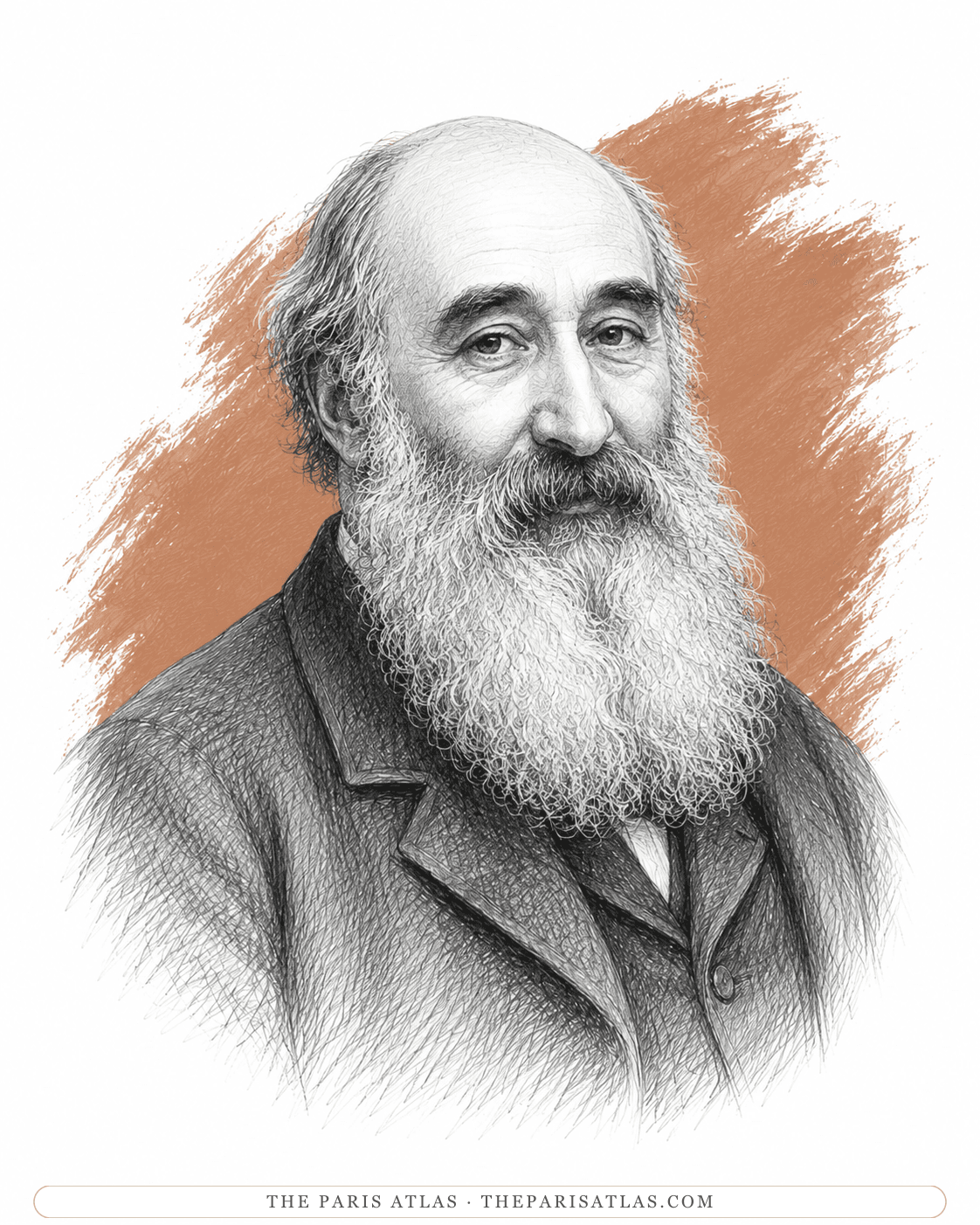
Stockbroker turned painter who came into art through Camille Pissarro, showed with the Impressionists, and left Europe for Polynesia.

In images

Details

Lived
1848–1903
Born
7 June 1848
Birthplace
Paris
Died
8 May 1903 · aged 54
Place of death
Atuona, Hiva Oa, Marquesas Islands
Nationality
French
Married
Mette-Sophie Gad · 1873–1903
Children
Émile Gauguin, Aline Gauguin, Clovis Gauguin, Jean-René Gauguin, Paul 'Pola' Gauguin
Roles
PainterSculptor
Also known as
Eugène Henri Paul Gauguin

About Paul Gauguin

Paul Gauguin was a Paris stockbroker who painted at weekends. He met Camille Pissarro in the 1870s and became something close to an unofficial pupil, brought into the Impressionist circle by the older man and shown how to work outdoors. His early landscapes, still lifes and interiors carry Pissarro and Cezanne plainly.

He gave up the exchange for painting full time in 1883, worked in Brittany and Provence, and from 1891 spent most of the rest of his life in Tahiti and the Marquesas, where he died in 1903. The flat planes and unnatural colour of the late work put him among the painters the twentieth century built on, a long way from the Pontoise fields where he started.

Paul Gauguin had one of the strangest careers in nineteenth-century art. For most of his twenties and early thirties he was a successful Paris stockbroker, a husband and father of five, and a weekend painter who collected Impressionism; after the financial crash of 1882 he gave the conventional life up piece by piece and spent the rest of his own pursuing a new kind of painting in Brittany, Martinique, Provence, Tahiti, and finally the Marquesas Islands. The work that came out of that pursuit — flat fields of intense color, heavy contours, memory and myth given equal footing with observation — helped found Symbolist painting and prepared the way for the Nabis, Henri Matisse and the Fauves, and Expressionism. His life in French Polynesia, lived inside a colonial system whose power he benefited from, and his relationships there with adolescent girls have also made him one of the most debated figures in modern art. Both facts belong on this page.

Lima, the sea, and the stock exchange

Gauguin was born in Paris on 7 June 1848, in a year of revolutions. His father, Clovis Gauguin, was a journalist whose politics put him on the wrong side of Louis-Napoléon Bonaparte's rise, and in 1851 the family sailed for Peru, where his mother had family connections. Clovis died on the voyage. Gauguin spent his early childhood in Lima, and the family stayed in Peru until 1855. He drew on those years for the rest of his life, eventually claiming Inca ancestry — the National Gallery in London notes that the family's connection was in fact to the Spanish colonial aristocracy. Turning biography into legend became a lifelong habit.

As a teenager he went to sea, first in the merchant marine and then the French navy. His mother died in 1867, and the businessman and collector Gustave Arosa became his guardian. Arosa owned contemporary painting and knew Camille Pissarro; through his household Gauguin met art as something living people bought, discussed, and made. In the early 1870s Gauguin took a position connected to the Paris stock exchange and prospered. In 1873 he married a Danish woman, Mette-Sophie Gad, and they had five children. He bought paintings — including works by Paul Cézanne, which he studied at close range — and he painted.

He was better than a hobbyist. The official Salon accepted a landscape of his in 1876, and through Pissarro, his most important early mentor, he joined the Impressionist exhibitions — the National Gallery records his participation in 1880, 1881, and 1882, and he showed through the group's final exhibition in 1886. His early pictures can look surprisingly conventional to anyone who knows only the Tahitian work: broken brushwork, outdoor light, Pontoise fields.

The crash, Copenhagen, and the break

In 1882 the French financial market collapsed, and Gauguin's brokerage career collapsed with it. He treated the disaster as an opening and committed himself to painting full time. Painting paid nothing like finance. The family moved to Copenhagen in 1884, hoping Mette's relatives would provide stability; Gauguin tried other work, failed to settle, and in 1885 returned to Paris with one of his sons while Mette and the other children stayed behind.

The separation became effectively permanent. They corresponded for years, but the household was never rebuilt, and his choice of art over the family he had made remains one of the defining facts of his biography. His material circumstances got worse from here. His most important work was about to begin.

Brittany and the invention of Synthetism

In 1886 Gauguin went to Pont-Aven, a small Breton town that had become a gathering place for artists. Brittany's traditional dress, Catholic ritual, and stone churches seemed to him an older, more spiritual Europe that industrial modernity had not erased — a selective reading, since Pont-Aven was already full of artists and tourists. He was not discovering an untouched culture; he was searching for one. The pattern would repeat.

The decisive change came in 1888, through his exchange with the much younger painter Émile Bernard, who had been experimenting with flat zones of strong color separated by dark outlines — a manner drawn from stained glass, popular prints, and Japanese woodblocks. Gauguin saw what the idea could carry and turned it into an ambitious artistic language. The approach became known as Synthetism: a painting was to synthesize the appearance of a subject, the artist's memory of it, the artist's feeling about it, and the pure arrangement of color and shape. A field could be red because red made the picture stronger.

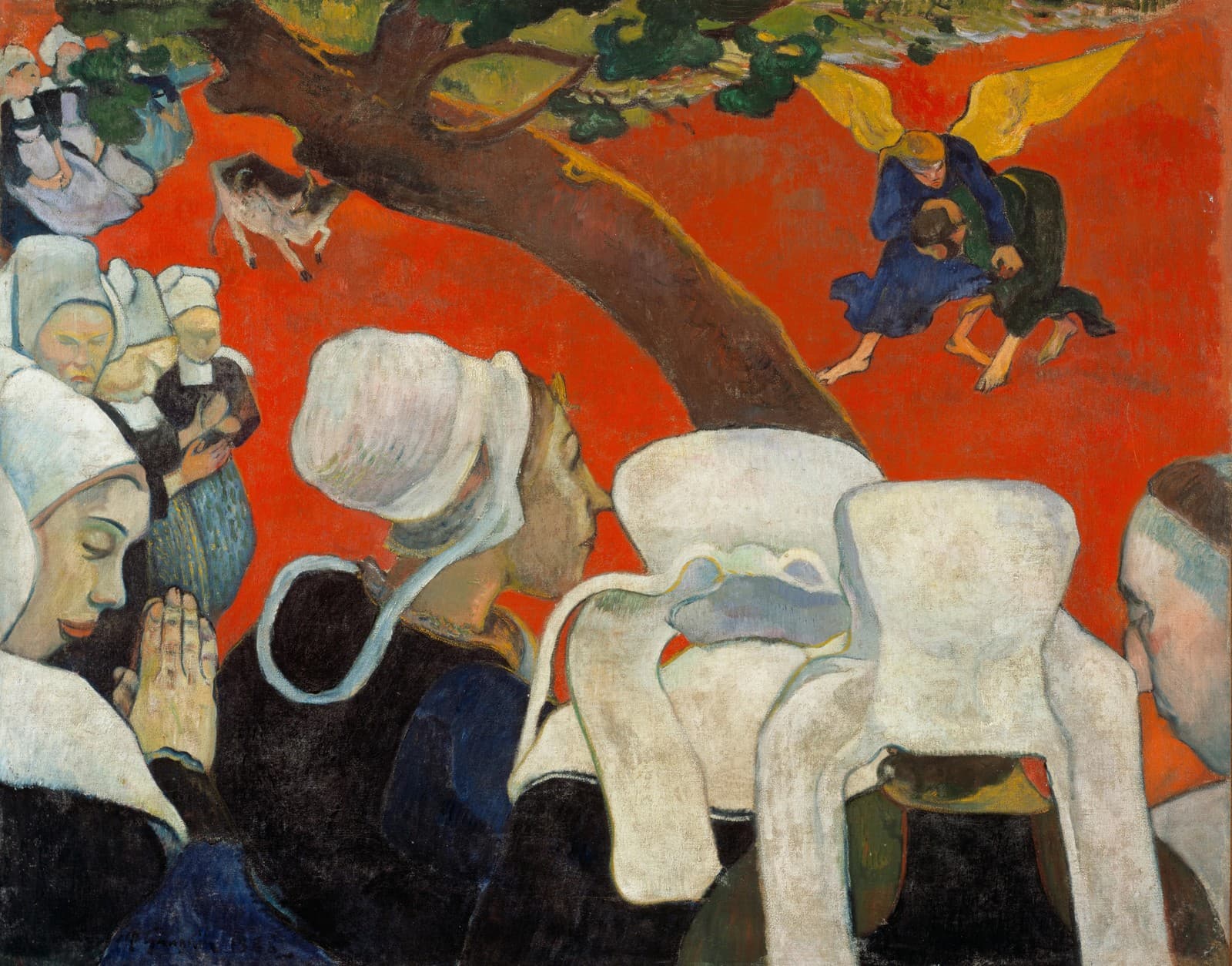
The declaration of the new manner is Vision after the Sermon, painted that year: Breton women in the foreground, and beyond them Jacob wrestling the angel on a field of pure red. Gauguin was no longer painting what he could see. He was painting an idea, a memory, and an imagined vision at once.

Paul Gauguin, Vision after the Sermon (Jacob Wrestling with the Angel), 1888 (National Galleries of Scotland). The declaration of Synthetism: an imagined vision painted on a red field no eye ever saw. (Paul Gauguin, via Wikimedia Commons · Public domain)

Martinique, and nine weeks with van Gogh

The search for a life outside metropolitan France began before Tahiti. In 1887 Gauguin traveled with the painter Charles Laval to Panama and then Martinique. The trip was hard and earned nothing, but four months of tropical light and Caribbean color fed the idealized tropics he would later pursue far more aggressively in the Pacific.

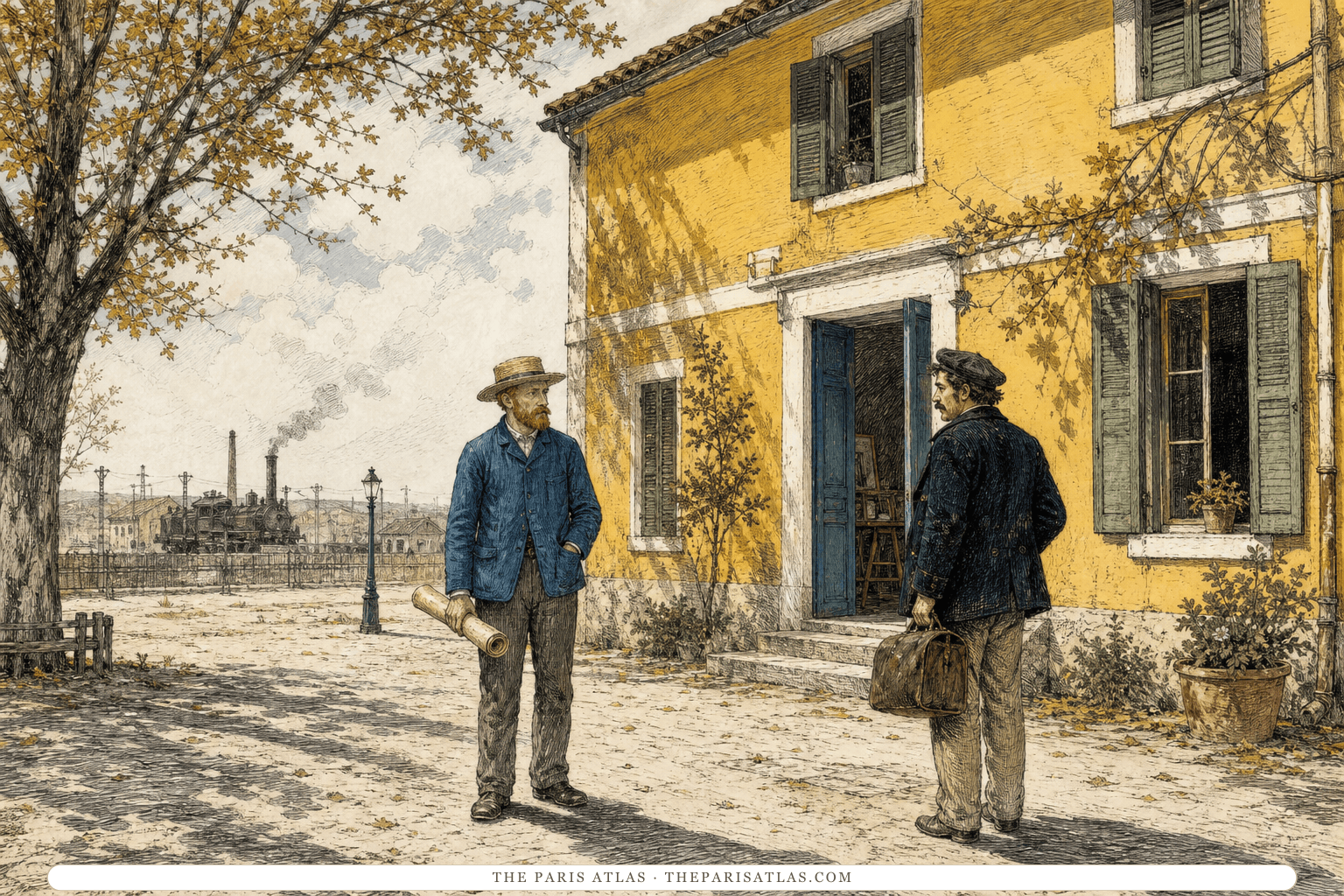
In October 1888 he went south to Arles to live and work with Vincent van Gogh at the Yellow House. Van Gogh dreamed of a cooperative of painters in Provence and wanted Gauguin at its center; his brother Theo, an art dealer supporting both men, helped make the arrangement possible. For about nine weeks they painted the same subjects and argued about method — Gauguin pressing the case for memory and imagination, van Gogh committed to the motif in front of him. In December van Gogh suffered the breakdown in which he mutilated his own ear. Gauguin left Arles immediately, and the southern studio was finished. The encounter marked both men; more than a decade later Gauguin was still invoking van Gogh through sunflowers.

The persona

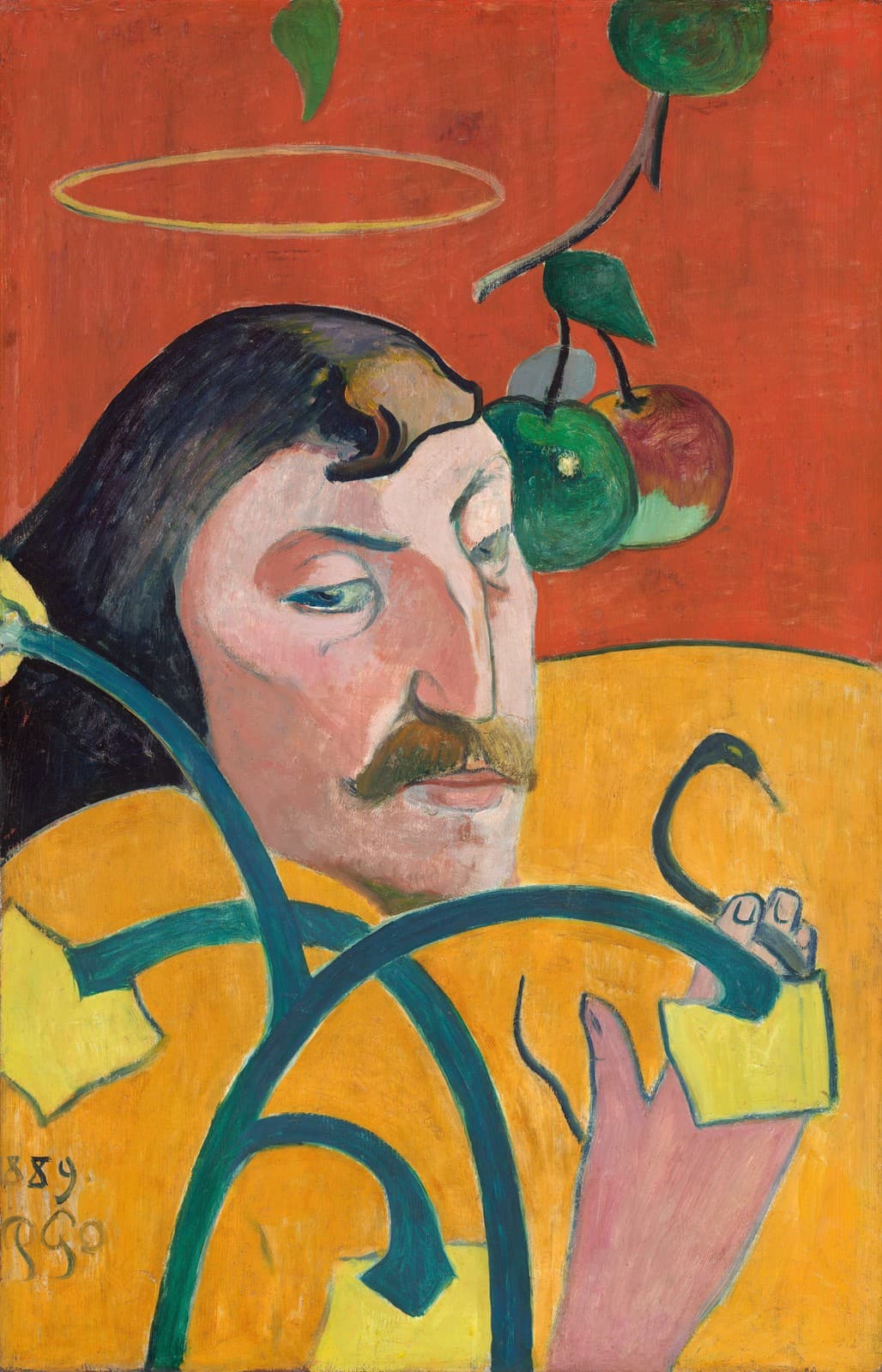
Paul Gauguin, Self-Portrait with Halo and Snake, 1889 (National Gallery of Art, Washington). One of the self-portraits through which he built his public persona — saint and tempter on one panel. (Paul Gauguin, via Wikimedia Commons · Public domain)

At the 1889 Exposition Universelle — the world's fair that built the Eiffel Tower — Gauguin and his circle hung their own exhibition at the Café des Arts on the fairground, run by a Monsieur Volpini. The Volpini show sold almost nothing, but the zincographs Gauguin printed for it, on loud yellow paper, pushed his simplification further: contour and large shape doing the work that modeling used to do.

He was also, by now, constructing a public character. His self-portraits cast him as rebel, outsider, suffering artist, 'savage,' even Christ. Rejection could be read as proof of being ahead of the times; poverty as sacrifice; departure as pilgrimage. Modern scholarship treats the romantic legend of Gauguin cautiously for a simple reason — Gauguin was its principal author, and he understood that the story of Paul Gauguin could help sell the art of Paul Gauguin.

Tahiti, as imagined and as found

Paul Gauguin in 1891, the year he sailed for Tahiti. Photographed in Paris by Louis-Maurice Boutet de Monvel. (Louis-Maurice Boutet de Monvel, via Wikimedia Commons · Public domain)

The colonial pavilions of the 1889 fair had helped fix his imagination on the French Pacific, and in 1891 he sailed for Tahiti expecting an untouched paradise. Papeete, when he arrived, was nothing of the kind. Tahiti had been a French colony since 1880, and decades of missionaries, trade, disease, and colonial administration had transformed Tahitian society. Gauguin was disappointed, moved out to Mataiea on the southern coast, and began producing in paint the Tahiti he had failed to find in fact.

That distinction matters for reading every canvas of the period. The Tahitian paintings are not documentary records of Polynesian culture. Gauguin gave pictures Tahitian titles his limited Tahitian sometimes rendered ungrammatically, and the 'ancient' Polynesian religion in them came largely from a European book — Jacques-Antoine Moerenhout's 1837 account of the islands — rather than from oral tradition. He carried photographs and reproductions with him and borrowed freely: figures in the Tahitian compositions derive from the Buddhist reliefs of Borobudur in Java, from Western classical art, and from Édouard Manet's Olympia. The result is a deliberate hybrid mythology, not ethnography.

Tehamana

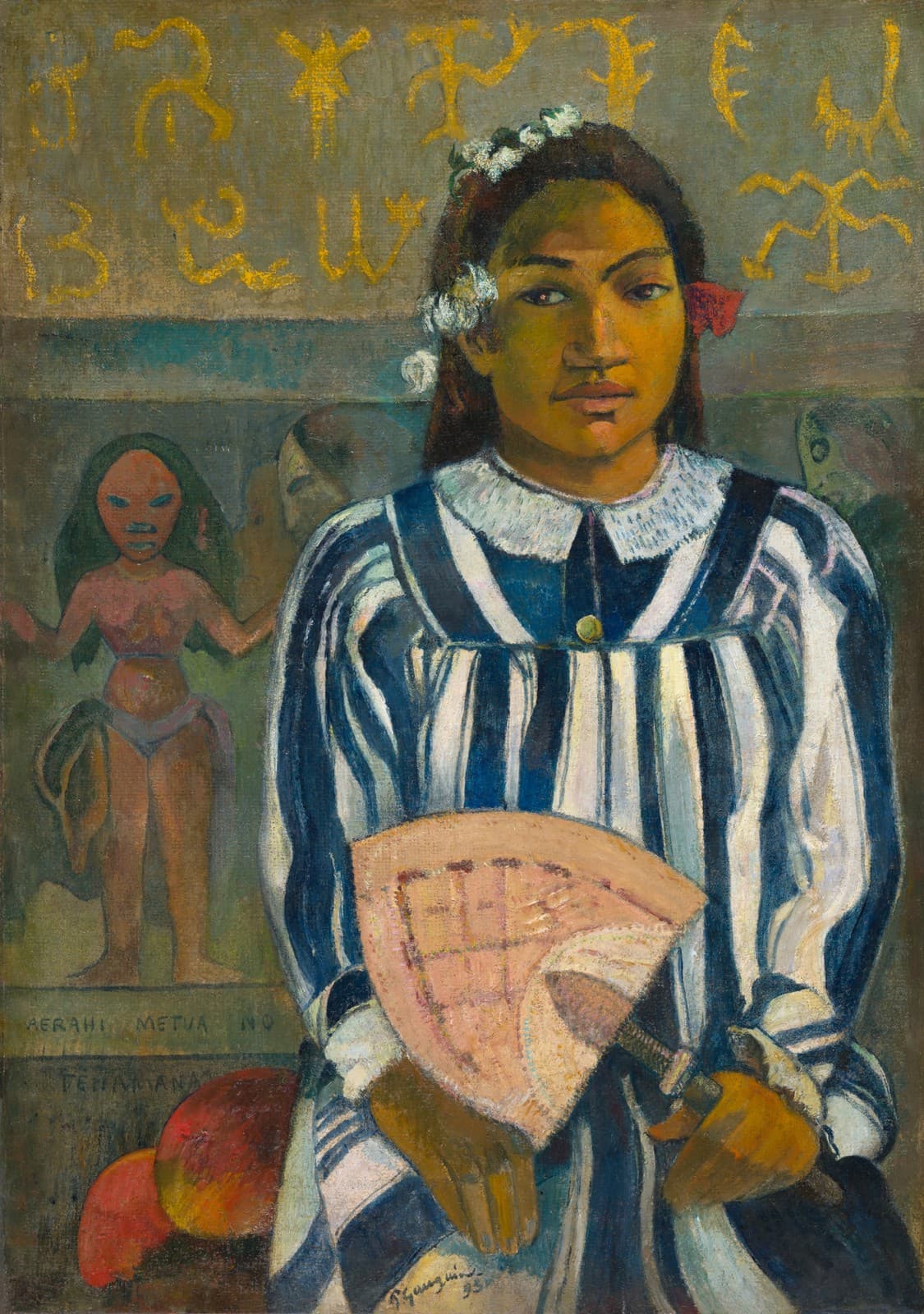
Paul Gauguin, Merahi metua no Tehamana (Tehamana Has Many Parents), 1893 (Art Institute of Chicago). The sitter is the Tahitian adolescent who lived with Gauguin at Mataiea; the 'ancient' script behind her is his invention. (Paul Gauguin, via Wikimedia Commons · Public domain)

While living at Mataiea, Gauguin, then in his forties, took a Tahitian adolescent named Tehamana — Tehura in his own writings — as his companion, or, in the language of the colony, his vahine. The Art Institute of Chicago's record for its portrait of her states she was thirteen; the biographer Sue Prideaux, citing a newly located birth record, argues she was closer to fifteen. Either number describes an adolescent girl living with a middle-aged European colonist, inside a system that gave French men powers Polynesians did not have. Tehamana appears in several of the period's most significant paintings — surrounded, as his sitters usually were, with symbols invented or imported rather than observed.

The same colonial record holds a complication. In his final years in the Marquesas, Gauguin attacked the Catholic missionaries and parts of the French administration, writing against the alliance of church and state and taking up disputes on behalf of his Marquesan neighbors. The National Gallery describes a late Gauguin increasingly at war with the authorities whose system had made his life there possible. Neither fact cancels the other, and a one-word verdict — romantic hero, colonial villain — describes him worse than the two facts side by side.

The problem of the word 'primitive'

Gauguin's project ran on a word that now needs explaining. He imagined that cultures distant from industrial Europe — Breton peasants first, Polynesians after — kept qualities the West had lost: instinct, spirituality, directness, sexual freedom, closeness to nature, artistic purity. The idea said at least as much about European dissatisfaction with Europe as about anyone it described. Actual Breton and Polynesian people were not remnants of an earlier stage of humanity; they lived in changing societies with their own histories, politics, and answers to modernity, and Gauguin repeatedly replaced that complexity with an ideal.

Museums accordingly now hang him inside two histories at once — modern art and colonial exoticism. The Berlin state museums built an entire exhibition, Why Are You Angry?, around the question his pictures raise. Neither history cancels the other, and this page keeps both in view.

Noa Noa and the failed return

In 1893 he returned to France, expecting the Tahitian work to make his reputation and his living. The response was mixed — recognition in the avant-garde, hesitation from collectors. To explain the paintings, and to feed the legend, he began Noa Noa, a literary account of his Tahitian life, and cut for it one of the great woodcut series of the century. Like most of Gauguin's self-presentation, Noa Noa blends experience, borrowed information, and invention; it is indispensable and cannot be read straight.

He wrote all his life — letters, notebooks, essays, manifestos, and at the end the sprawling memoir Avant et après — and the writing was part of the artistic project, not separate from it. It makes him unusually accessible and unusually difficult to trust in the same stroke: he exaggerated, contradicted himself, borrowed from other writers, dramatized his experiences, and manufactured legends, because he understood that the story of Paul Gauguin helped sell the art of Paul Gauguin. Historians lean on his writings constantly and check every sentence against other evidence.

Where Do We Come From? What Are We? Where Are We Going?

In 1895 he left France for good. The second Polynesian period was darker: failing health, chronic money trouble, deepening isolation. In 1897 came the news that his daughter Aline, the child he was most attached to, had died in Copenhagen at nineteen, and the loss fed a severe crisis.

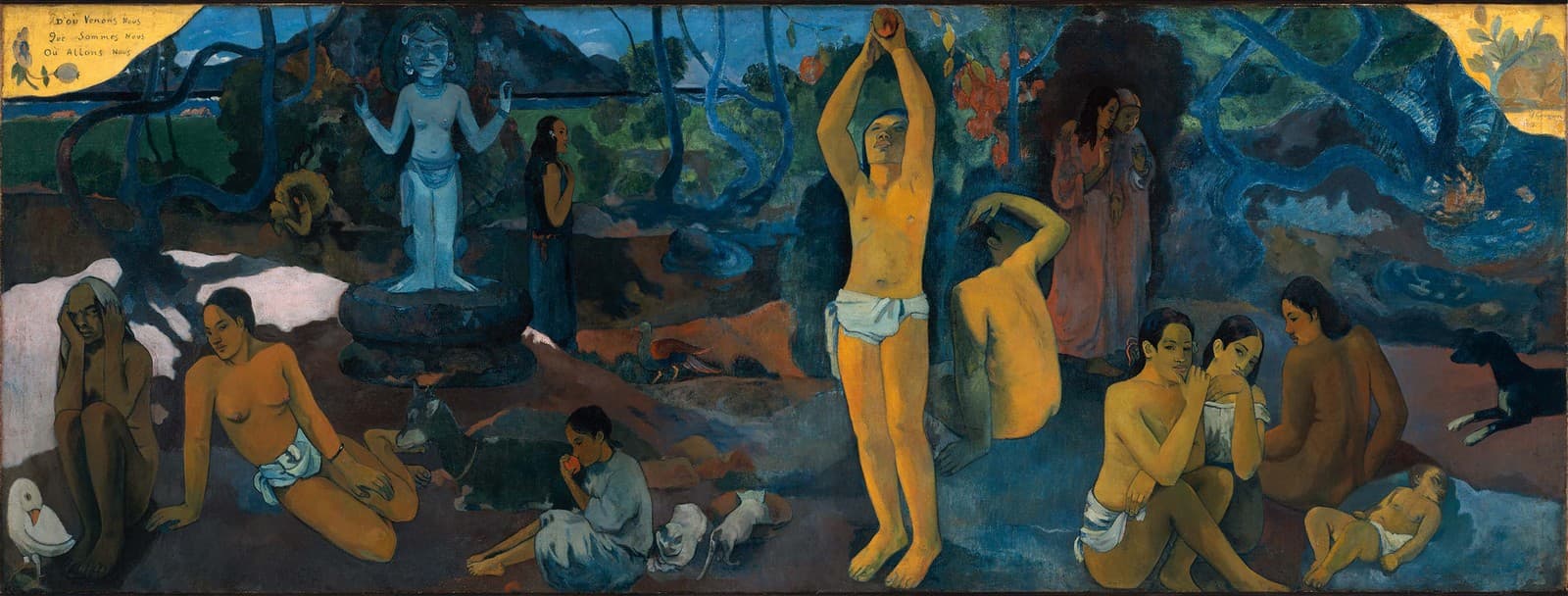
Out of it he painted the largest and most ambitious canvas of his life, Where Do We Come From? What Are We? Where Are We Going? (1897–98, now in the Museum of Fine Arts, Boston). Figures cross the stages of existence — infancy to old age, read from right to left at the painter's own instruction, with a blue idol standing beyond them. The title's questions are never answered inside the frame, and that refusal is the summary of his artistic philosophy: he wanted pictures that provoked meditation, not pictures that explained.

Paul Gauguin, Where Do We Come From? What Are We? Where Are We Going?, 1897–98 (Museum of Fine Arts, Boston). The largest canvas of his career, painted after the death of his daughter Aline and meant to be read from right to left. (Paul Gauguin, via Wikimedia Commons · Public domain)

One long-repeated biographical claim now needs a qualifier. Older accounts state that Gauguin suffered from syphilis. In 2014, teeth recovered from a well beside his last house — identified by DNA comparison as very probably his — were found to carry no trace of mercury, the standard treatment of the day. That does not prove he never had the disease, only that the once-settled diagnosis is now disputed.

Hiva Oa

By 1901 even Tahiti was not remote enough, and he moved east to Atuona on Hiva Oa in the Marquesas. He built a house there and named it, provocatively, the Maison du Jouir — the House of Pleasure — its doorframe carved with images mixing sexuality, Polynesian references, and satire. His legs pained him severely, he depended on morphine, and his quarrels with bishop and gendarmerie continued to the end. He died at Atuona on 8 May 1903, a month short of fifty-five, and was buried on the island.

His reputation was already moving without him. The Salon d'Automne mounted a commemorative exhibition in 1906 — the year before its Cézanne retrospective — and the young painters of Paris took what they needed. Paul Sérusier had already carried The Talisman, the little landscape painted under Gauguin's direction at Pont-Aven in 1888, back to the friends who became the Nabis. Matisse and the Fauves pushed his liberation of color further; the Expressionists took the permission to distort. One of the founding principles of modern art is his: a painting does not have to look natural to communicate something true.

What makes a Gauguin look like a Gauguin

Color is emotional rather than descriptive — grass need not be green if another color makes the feeling stronger. Space is flat: backgrounds climb the canvas, figures press close to the surface, and zones of color lock together like stained glass, an effect that gave the related manner its name, Cloisonnism, after cloisonné enamel. Forms are simplified, contours heavy, and the figures often silent, watchful, and psychologically distant. And reality and invention overlap without apology: a real sitter enters an imagined religious setting, a Breton field hosts a Bible story, a Polynesian landscape holds a figure from a Javanese temple relief.

Painting was only part of the output. He carved wood, made ceramics, cut woodblocks, printed zincographs and monotypes, and wrote constantly — letters, manifestos, Noa Noa, and the late memoir Avant et après. He rejected the hierarchy that put oil painting above the so-called decorative arts, and the carved box and the canvas belong to the same visual world. That refusal, too, the twentieth century kept.

Gauguin and Cézanne: two roads to modern art

He and Paul Cézanne are filed together as Post-Impressionists, and they pushed painting in opposite directions. Cézanne asked how sensation could be organized into durable structure; Gauguin asked how the visible world could be transformed by memory, emotion, symbol, and imagination. Cézanne's road leads hardest toward Cubism and structural abstraction; Gauguin's toward Symbolism, the Nabis, Fauvism, and expressive color.

Both taught the twentieth century that painting did not have to copy appearances. They simply demonstrated different ways of escaping the obligation — and Gauguin, who owned Cézannes and studied them closely, knew exactly whose road ran beside his.

Why Gauguin matters

Cézanne showed modern artists that the structure of the world could be reconstructed. Gauguin taught them something different: the world inside the artist could matter as much as the world outside. A tree could be blue, a field red, a memory a landscape, a dream part of a portrait, a Bible story an event in Brittany, a real sitter a figure in an imaginary mythology. Painting no longer had to ask only what something looks like; it could ask what it means, what it feels like, what can be remembered, what can be invented.

That shift — from observation toward subjective expression — is one of the transformations that produced modern art, and it is why his influence runs through the Nabis, Matisse and the Fauves, and Expressionism. It arrived carrying everything else this page records; the innovation and the colonial record are the same life, and holding both together is the only honest way to understand him.

Life events

  1. 1848

    Born in Paris on 7 June, the son of a republican journalist.

    Gauguin, Paul, 1848–1903

  2. 1851

    The family sails for Peru after Louis-Napoléon's coup; his father dies on the voyage. Gauguin spends his early childhood in Lima, until 1855.

    Gauguin's Journey — The Credit Suisse Exhibition: Gauguin Portraits

  3. 1867

    His mother dies; the collector Gustave Arosa becomes his guardian and brings him close to contemporary painting.

    Gauguin's Journey — The Credit Suisse Exhibition: Gauguin Portraits

  4. 1873

    Marries the Danish woman Mette-Sophie Gad; they have five children. He works as a Paris stockbroker and paints on weekends.

    Gauguin's Journey — The Credit Suisse Exhibition: Gauguin Portraits

  5. 1876

    The official Salon accepts one of his landscapes.

    Gauguin's Journey — The Credit Suisse Exhibition: Gauguin Portraits

  6. 1880–1886

    Shows in the later Impressionist exhibitions, brought into the circle by Camille Pissarro, through the group's final exhibition in 1886.

    Paul Gauguin (1848–1903)

  7. 1882

    The French financial market crashes, ending his brokerage career; he commits to painting full time.

    Gauguin's Journey — The Credit Suisse Exhibition: Gauguin Portraits

  8. 1884–1885

    Moves the family to Copenhagen, fails to establish himself, and returns to Paris; the separation from Mette and the children becomes effectively permanent.

    Gauguin's Journey — The Credit Suisse Exhibition: Gauguin Portraits

  9. 1886

    First working stay at Pont-Aven in Brittany.

    Paul Gauguin (1848–1903)

  10. 1887

    Travels with Charles Laval to Panama and Martinique.

    A New Chapter: Tahiti and the Marquesas Islands — Gauguin Portraits

  11. 1888

    In Brittany, develops Synthetism with Émile Bernard and paints Vision after the Sermon. From October to December, lives and works with Vincent van Gogh at the Yellow House in Arles, leaving after van Gogh's breakdown.

    Paul Gauguin (1848–1903); Special loan: The Little Cat by Paul Gauguin now on display at the Van Gogh Museum

  12. 1889

    Organizes the Volpini exhibition at the Café des Arts on the Exposition Universelle grounds and prints the zincograph series on yellow paper.

    Paul Gauguin (1848–1903)

  13. 1891

    Sails for Tahiti and arrives at Papeete; settles at Mataiea on the south coast.

    Paul Gauguin in 1891, the year he sailed for Tahiti. Photographed in Paris by Louis-Maurice Boutet de Monvel. (Louis-Maurice Boutet de Monvel, via Wikimedia Commons)

    A New Chapter: Tahiti and the Marquesas Islands — Gauguin Portraits

  14. 1893

    Returns to France to market the Tahitian work; begins the Noa Noa text and its woodcut series.

    Paul Gauguin (1848–1903)

  15. 1895

    Leaves France for Tahiti again — permanently. He never returns to Europe.

    Paul Gauguin (1848–1903)

  16. 1897

    Learns that his daughter Aline has died in Copenhagen at nineteen; the loss feeds a severe crisis.

    Where Do We Come From? What Are We? Where Are We Going? (1897–98), Paul Gauguin

  17. 1897–1898

    Paints Where Do We Come From? What Are We? Where Are We Going?, the largest and most ambitious canvas of his career.

    Paul Gauguin, Where Do We Come From? What Are We? Where Are We Going?, 1897–98 (Museum of Fine Arts, Boston). The largest canvas of his career, painted after the death of his daughter Aline and meant to be read from right to left. (Paul Gauguin, via Wikimedia Commons)

    Where Do We Come From? What Are We? Where Are We Going? (1897–98), Paul Gauguin

  18. 1901

    Moves to Atuona on Hiva Oa in the Marquesas and builds the carved house he names the Maison du Jouir.

    A New Chapter: Tahiti and the Marquesas Islands — Gauguin Portraits

  19. 1903

    Dies at Atuona on 8 May, aged fifty-four, and is buried on the island.

    Gauguin – Tahiti, The Workshop of the Tropics

  20. 1906

    The Salon d'Automne mounts a commemorative exhibition that puts his work before the painters of the next generation.

    Paul Gauguin (1848–1903)

Selected works

Cataloged from the holding institutions' records. Reproductions appear only where the rights are verified.

Paintings

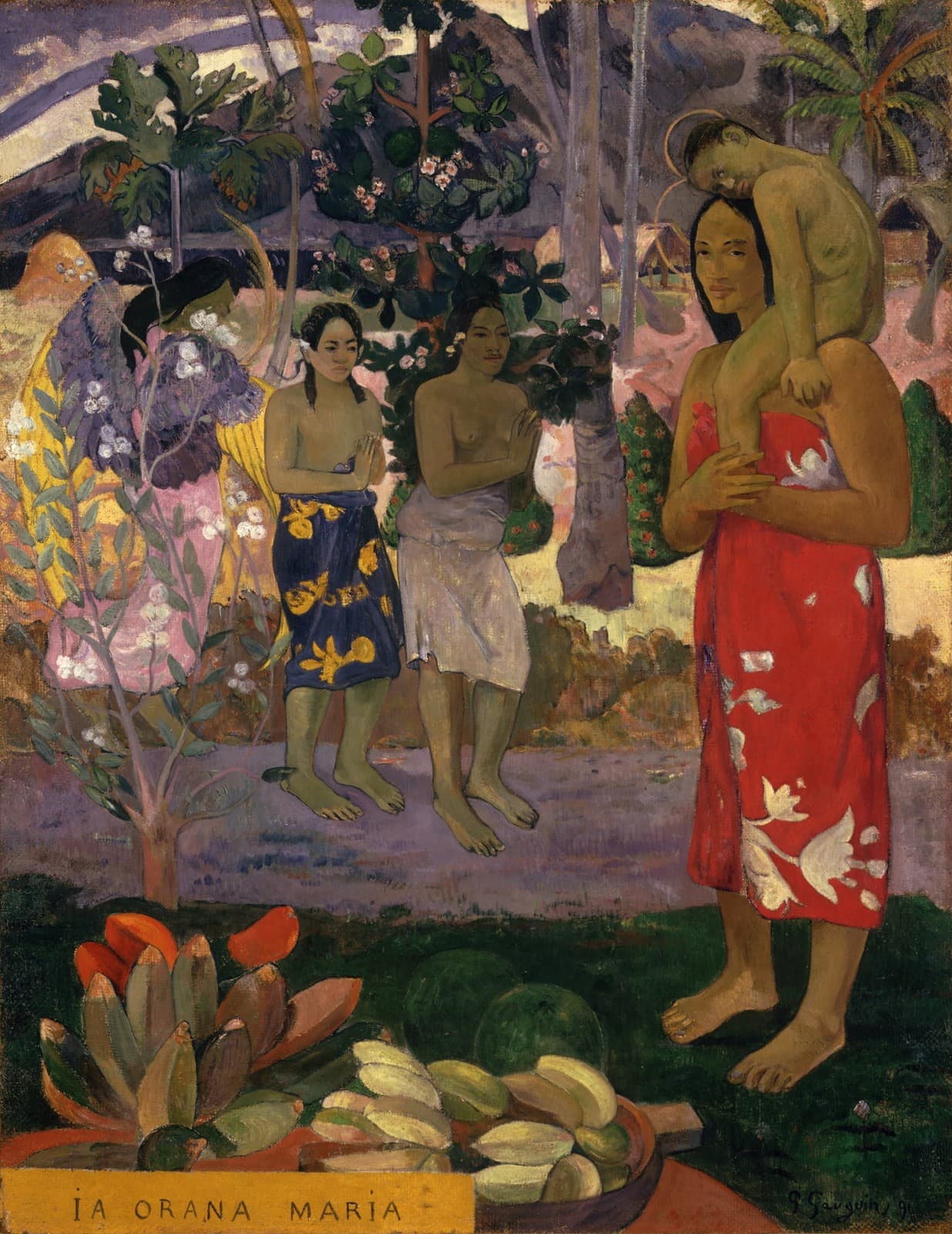
Gauguin's Ia Orana Maria: a Tahitian woman in a red pareu carries a haloed child on her shoulder while two women press their palms together in greeting and a yellow-winged angel watches from behind flowering branches

Artwork reproduction

Painting · First Tahitian period

Ia Orana Maria (Hail Mary)

1891 · Oil on canvas

The first major canvas Paul Gauguin painted in Tahiti, in 1891: a Tahitian Madonna and Child greeted by two women and a yellow-winged angel, the title Tahitian for the Annunciation's 'Hail Mary.' The worshippers' pose comes from a photograph of the Borobudur temple reliefs he carried with him. It hangs at the Metropolitan Museum of Art.
The Metropolitan Museum of Art, New York

Paul Gauguin, Ia Orana Maria (Hail Mary), 1891. The Metropolitan Museum of Art, New York. Image: public domain.

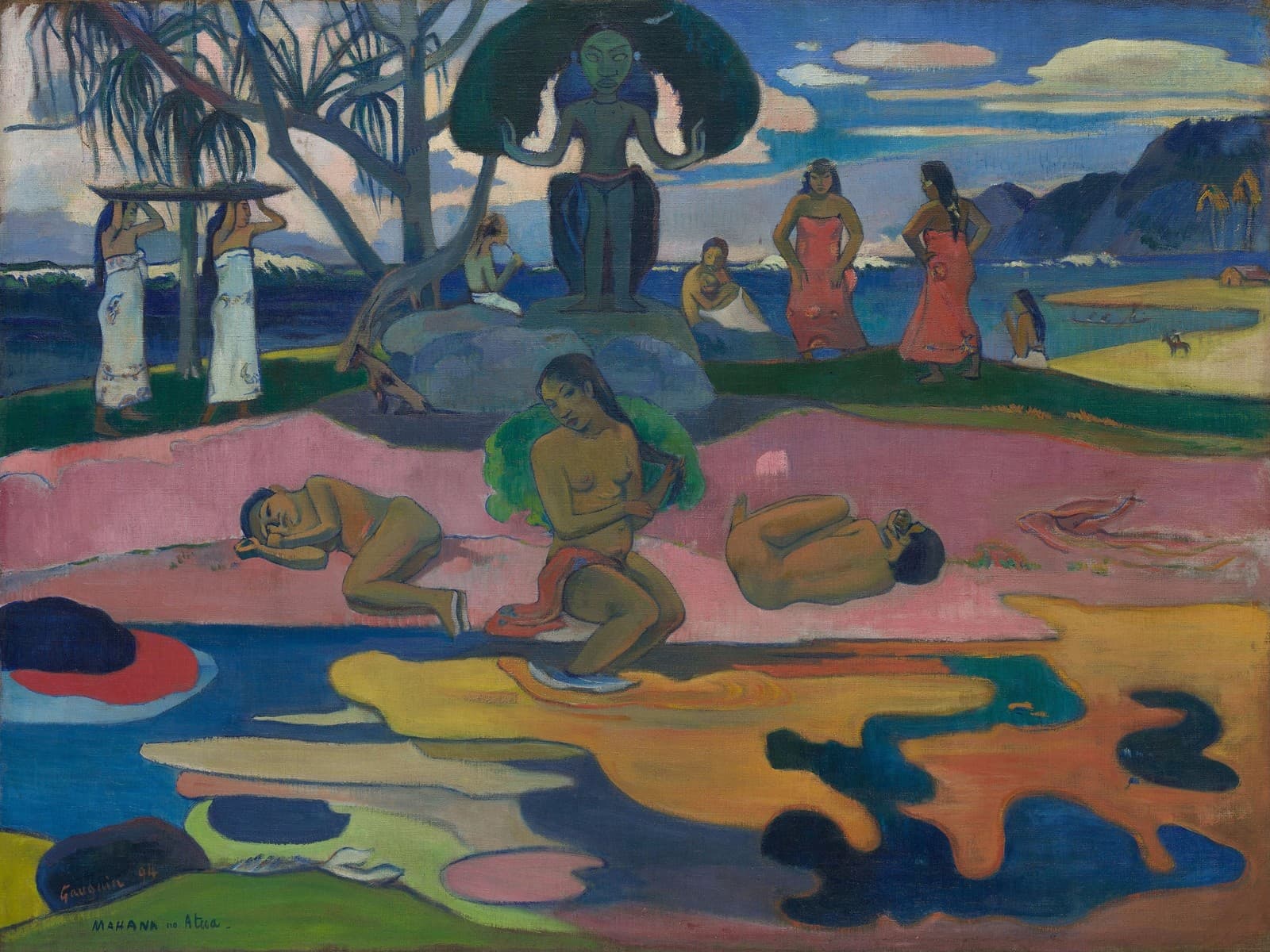
Gauguin's Mahana no atua: a carved idol with raised arms presides over a beach where women carry offerings and dancers cross the sand, while bathers sit at a foreground pool whose surface breaks into flat shapes of pink, yellow, and violet

Artwork reproduction

Painting · Between the Tahitian stays

Mahana no atua (Day of the God)

1894 · Oil on canvas

Gauguin painted this Tahitian scene in Paris in 1894, between his two Pacific stays: a carved idol presides over bathers on a beach, and the pool in the foreground breaks into pure shapes of color that stop describing anything at all. It is in the Art Institute of Chicago.

Art Institute of Chicago

Paul Gauguin, Mahana no atua (Day of the God), 1894. Art Institute of Chicago. Image: public domain.

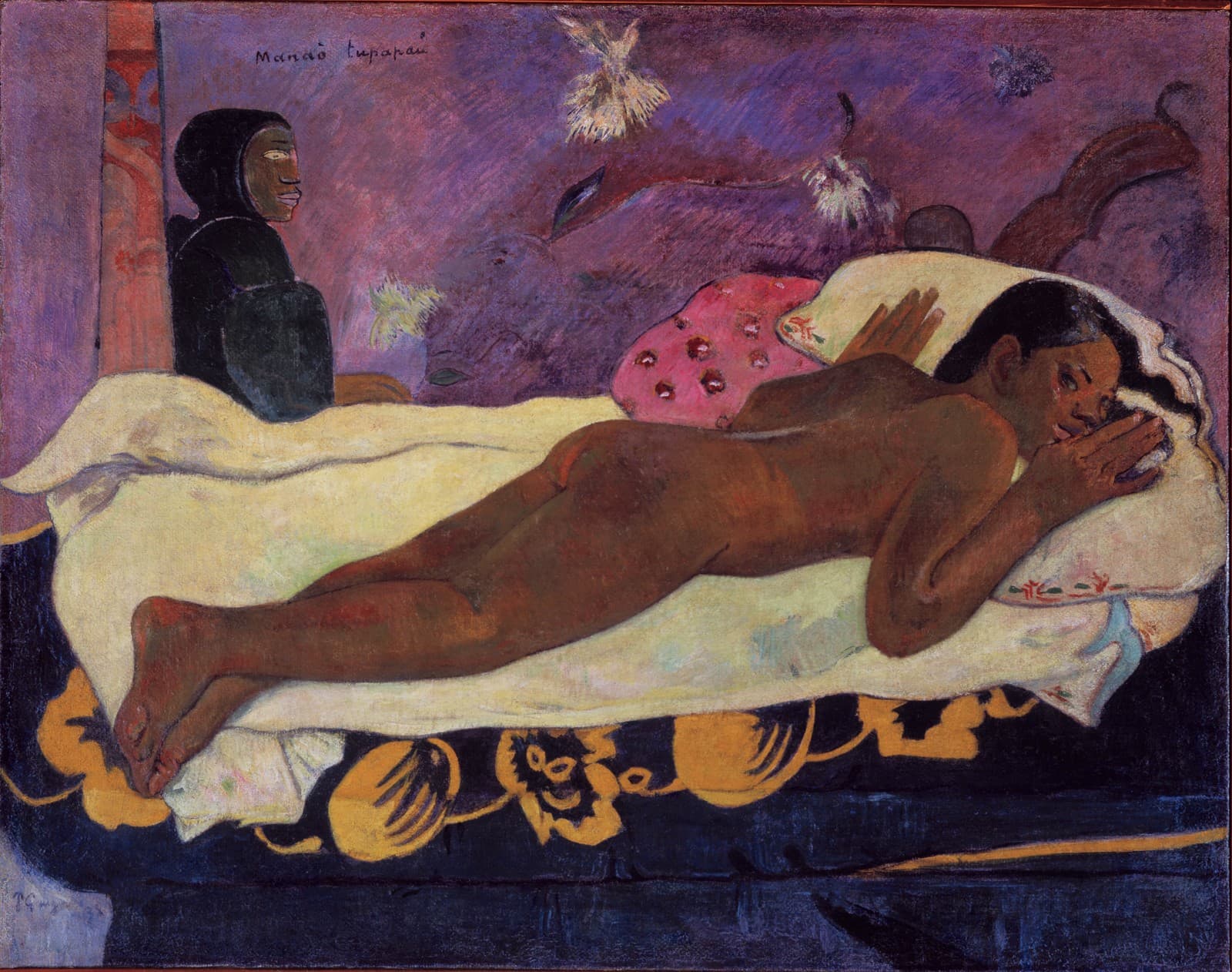
Gauguin's Manao tupapau: a young Tahitian woman lies face-down on a yellow-sheeted bed, eyes toward the viewer, while a hooded figure in black — the spirit of the dead — sits in profile against a violet ground

Artwork reproduction

Painting · First Tahitian period

Manao tupapau (Spirit of the Dead Watching)

1892 · Oil on canvas

Painted in Tahiti in 1892: a young Tahitian woman lies face-down on a bed while the tupapau, the spirit of the dead, sits watching in profile behind her. The sitter is generally identified as Tehamana, the adolescent who lived with Gauguin at Mataiea. The painting, an answer to Manet's Olympia, is in the Buffalo AKG Art Museum.

Buffalo AKG Art Museum

Paul Gauguin, Manao tupapau (Spirit of the Dead Watching), 1892. Buffalo AKG Art Museum. Image: public domain.

Gauguin's portrait of Tehamana: a young Tahitian woman in a blue-and-white striped missionary dress holds a woven fan, with rows of invented glyphs and a carved goddess figure on the yellow wall behind her

Artwork reproduction

Painting · First Tahitian period

Merahi metua no Tehamana (Tehamana Has Many Parents)

1893 · Oil on canvas

Gauguin's 1893 portrait of Tehamana, the Tahitian adolescent who lived with him at Mataiea: she sits in a striped missionary dress holding a woven fan, against a background of invented glyphs and a carved goddess. The Art Institute of Chicago, which owns it, gives her age as thirteen. The title translates as Tehamana Has Many Parents.

Art Institute of Chicago

Paul Gauguin, Merahi metua no Tehamana (Tehamana Has Many Parents), 1893. Art Institute of Chicago. Image: public domain.

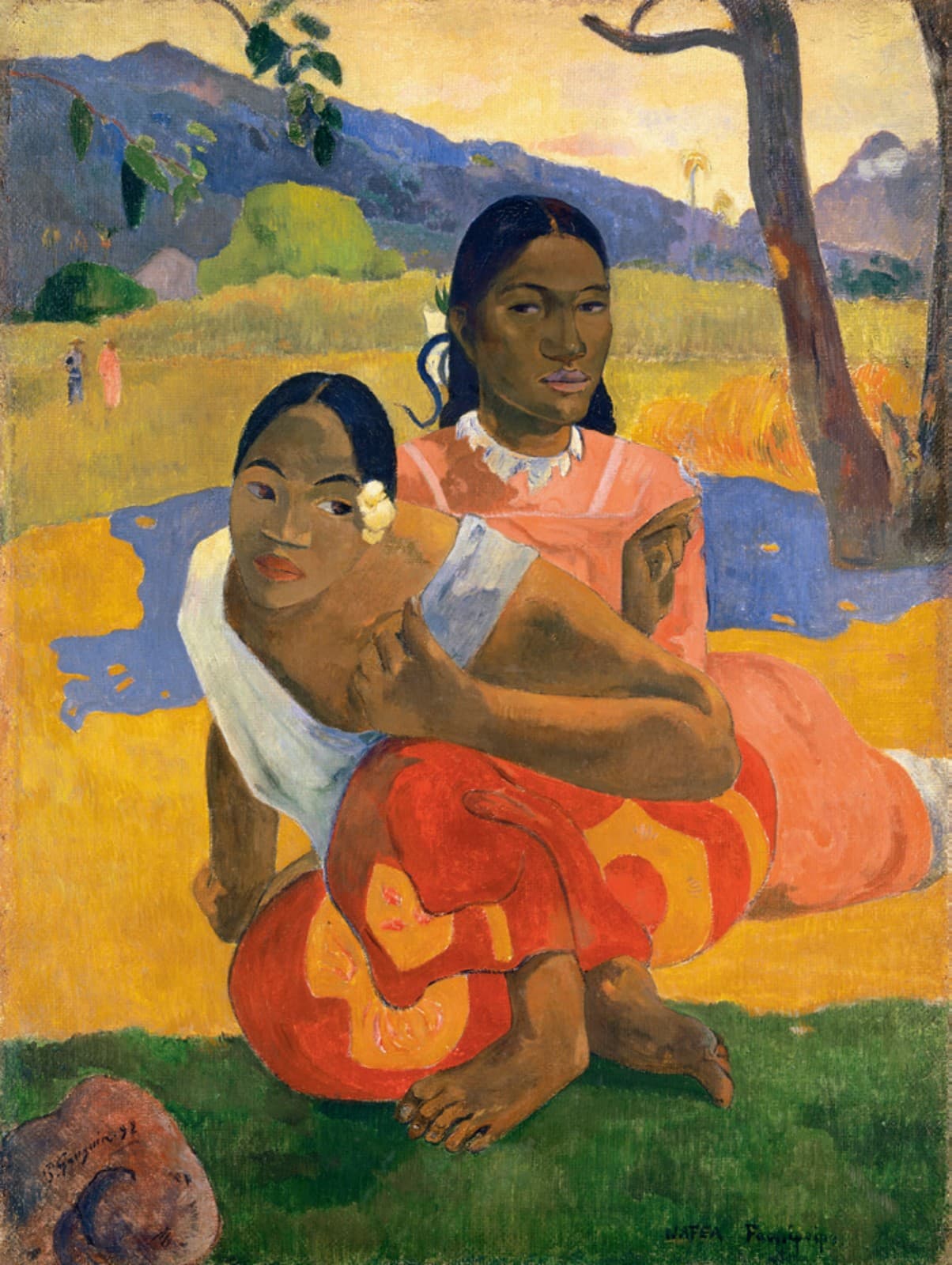
Gauguin's Nafea faa ipoipo: a young Tahitian woman in a blue pareu with a white flower behind her ear crouches on a hillside of pink and green, with an older woman in a high-necked mission dress seated behind her

Artwork reproduction

Painting · First Tahitian period

Nafea faa ipoipo? (When Will You Marry?)

1892 · Oil on canvas

Two Tahitian women on a hillside, painted in 1892: the younger in a traditional pareu with a white tiare flower behind her ear, the older behind her in the high-necked dress of the missions. The Tahitian title asks the question — when will you marry? For decades it hung on loan at the Kunstmuseum Basel; it is now in a private collection.

Paul Gauguin, Nafea faa ipoipo? (When Will You Marry?), 1892. Image: public domain.

Gauguin's Self-Portrait with Halo and Snake: the painter's head between flat red and yellow fields, a thin halo above, apples hanging beside him, and a small snake threaded through his fingers

Artwork reproduction

Painting · Le Pouldu

Self-Portrait with Halo and Snake

1889 · Oil on wood

Paul Gauguin painted this self-portrait on a wooden panel at Le Pouldu, Brittany, in 1889: his own head between a halo and hanging apples, a snake threading his fingers, on flat planes of red and yellow. Saint and tempter on one panel. It is in the National Gallery of Art, Washington, from the Chester Dale Collection.

National Gallery of Art, Washington

Paul Gauguin, Self-Portrait with Halo and Snake, 1889. National Gallery of Art, Washington. Image: public domain.

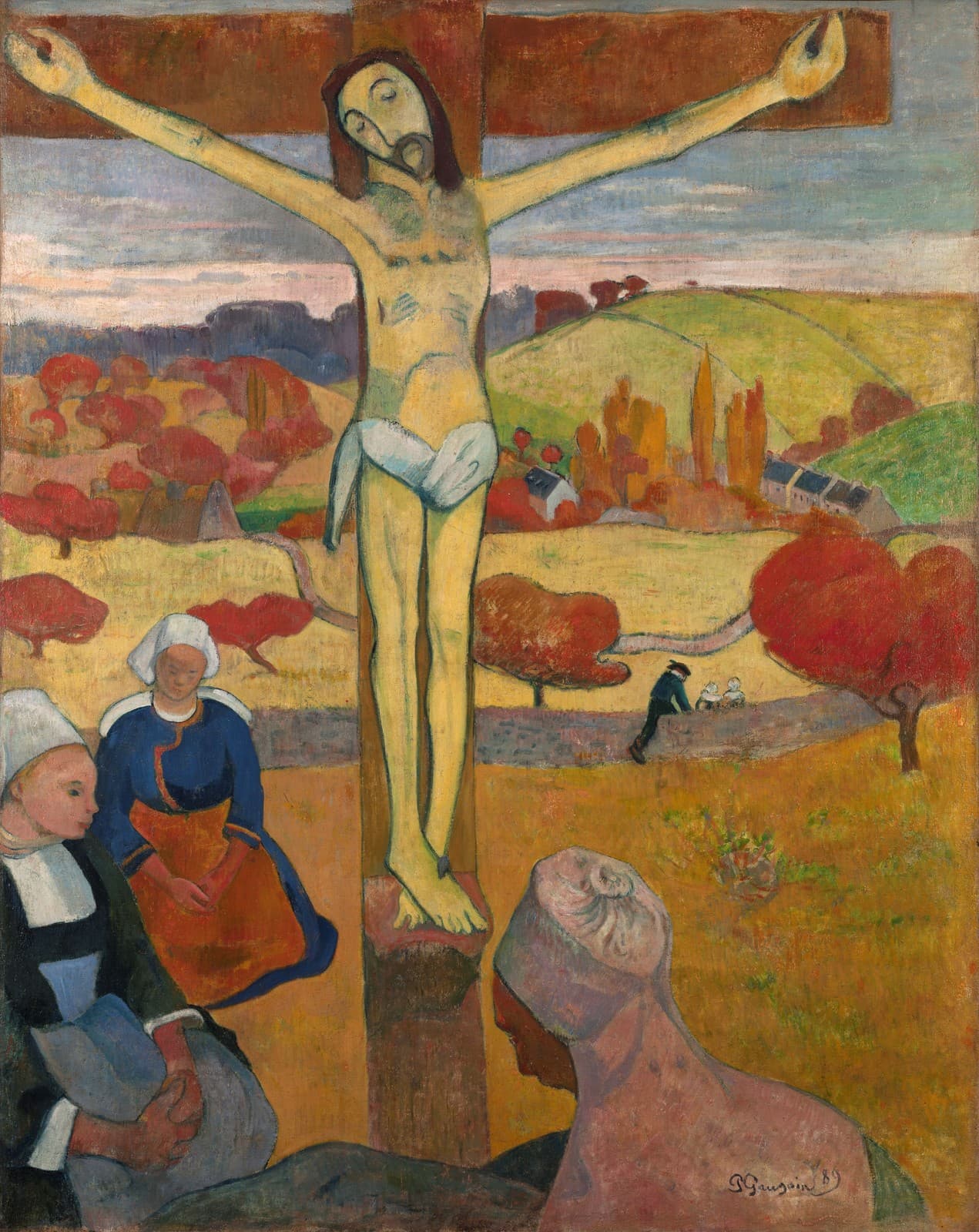
Gauguin's The Yellow Christ: a yellow figure of Christ on the cross in an autumn Breton field, with three women in regional dress kneeling at its foot and a village beyond

Artwork reproduction

Painting · Pont-Aven

The Yellow Christ

1889 · Oil on canvas

Paul Gauguin painted this crucifixion in Brittany in 1889, taking the figure of Christ from a seventeenth-century wooden crucifix in the Trémalo chapel near Pont-Aven and setting it in the autumn fields, painted an unbroken yellow. It hangs in the Buffalo AKG Art Museum.

Buffalo AKG Art Museum

Paul Gauguin, The Yellow Christ, 1889. Buffalo AKG Art Museum. Image: public domain.

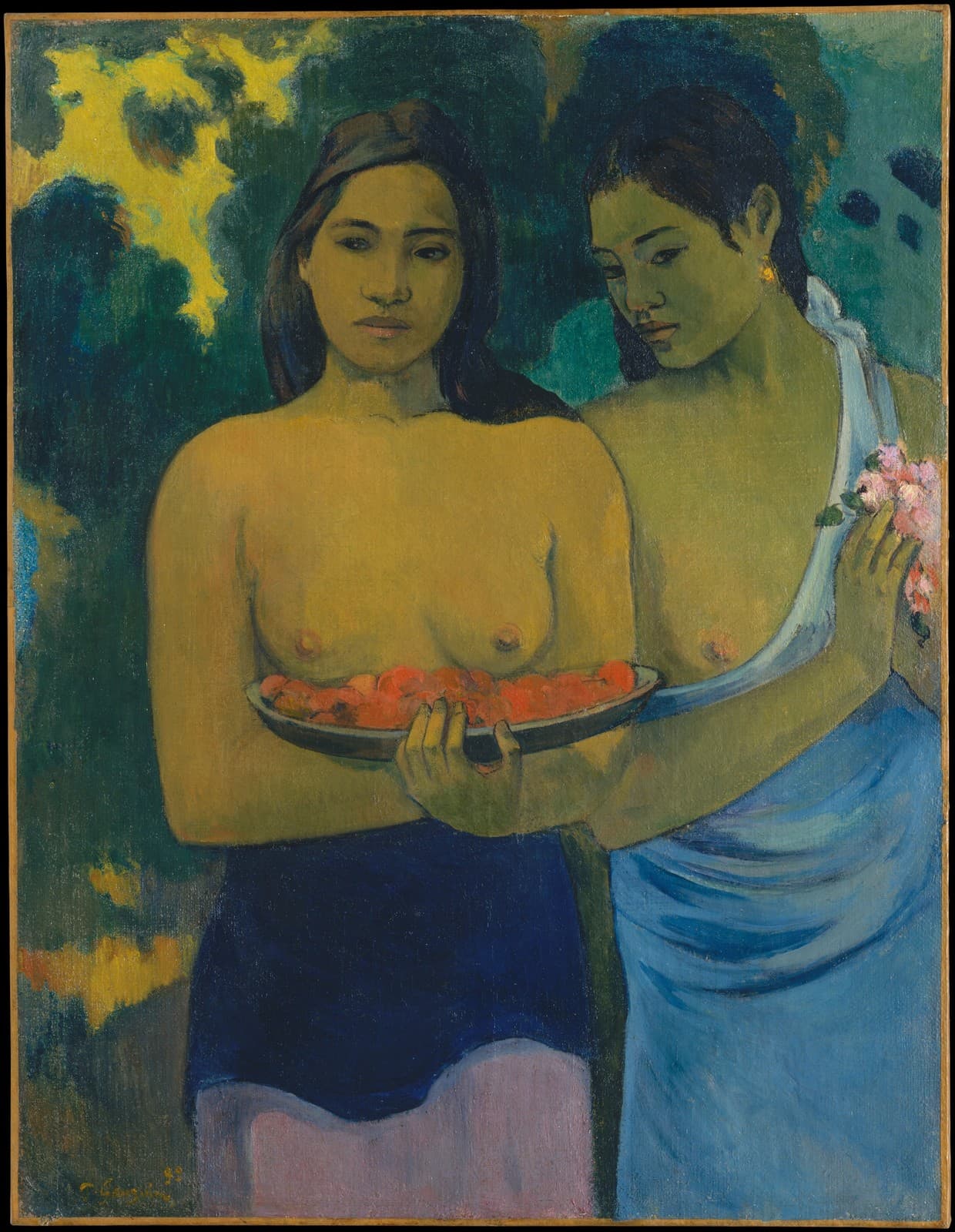
Gauguin's Two Tahitian Women: two women stand close together against a green ground, one carrying a wooden tray of mango blossoms, the other holding a spray of blossoms to her chest

Artwork reproduction

Painting · Second Tahitian period

Two Tahitian Women

1899 · Oil on canvas

Two women stand close together against a green ground, one carrying mango blossoms on a tray — painted in Tahiti in 1899, in the monumental calm of Gauguin's late manner. The Metropolitan Museum of Art has owned it since William Church Osborn's gift of 1949.

The Metropolitan Museum of Art, New York

Paul Gauguin, Two Tahitian Women, 1899. The Metropolitan Museum of Art, New York. Image: CC0.

Gauguin's Vision of the Sermon: Breton women in white coifs seen from behind, praying, while Jacob wrestles a yellow-winged angel on a field of pure red beyond a diagonal tree trunk

Artwork reproduction

Painting · Pont-Aven

Vision of the Sermon (Jacob Wrestling with the Angel)

1888 · Oil on canvas

Paul Gauguin painted this in Pont-Aven, Brittany, in 1888: Breton women in white coifs watch Jacob wrestling the angel on a field of pure red. It is the declaration of Synthetism — the first major canvas in which he painted an idea rather than a view. The National Galleries of Scotland bought it in 1925.

National Galleries of Scotland, Edinburgh

Paul Gauguin, Vision of the Sermon (Jacob Wrestling with the Angel), 1888. National Galleries of Scotland, Edinburgh. Image: public domain.

Gauguin's Where Do We Come From? What Are We? Where Are We Going?: a four-meter frieze of Tahitian figures from a sleeping infant at the right to a crouched old woman at the left, a central figure picking fruit, and a blue idol with raised arms behind them

Artwork reproduction

Painting · Second Tahitian period

Where Do We Come From? What Are We? Where Are We Going?

1897–1898 · Oil on canvas

The largest and most ambitious canvas of Paul Gauguin's career, painted in Tahiti in 1897–98 after the death of his daughter Aline: human figures cross the span of existence from infancy to old age, read from right to left at the painter's instruction, beneath a blue idol. The Museum of Fine Arts, Boston has owned it since 1936.

Museum of Fine Arts, Boston

Paul Gauguin, Where Do We Come From? What Are We? Where Are We Going?, 1897–1898. Museum of Fine Arts, Boston. Image: public domain.

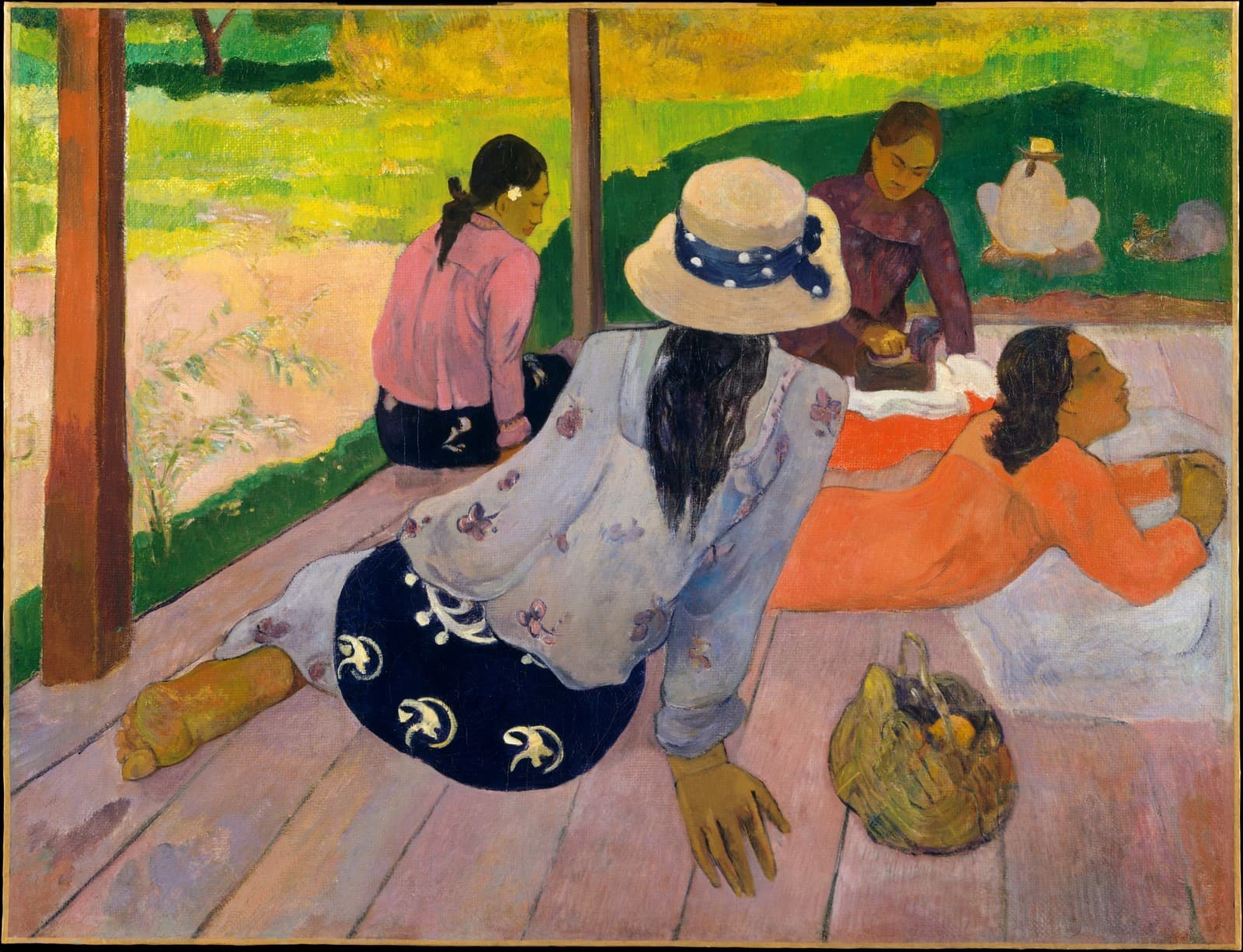
Gauguin's The Siesta: four Tahitian women on a wooden porch in afternoon heat — one ironing white cloth, one in a straw hat watching, one seated at the edge looking out at a pink road, one reclining in orange

Artwork reproduction

Painting · First Tahitian period

The Siesta

c. 1892–1894 · Oil on canvas

Four Tahitian women pass a hot afternoon on a wooden porch — one ironing, the others resting — in a canvas Gauguin worked on across several years, around 1892–94. No idol, no myth, no Tahitian title: the plainest picture of his first Tahitian period, and one of the best loved. The Metropolitan Museum of Art holds it in the Annenberg Collection.

The Metropolitan Museum of Art, New York

Paul Gauguin, The Siesta, c. 1892–1894. The Metropolitan Museum of Art, New York. Image: CC0.

People they knew

Documented connections — every one carries its source.

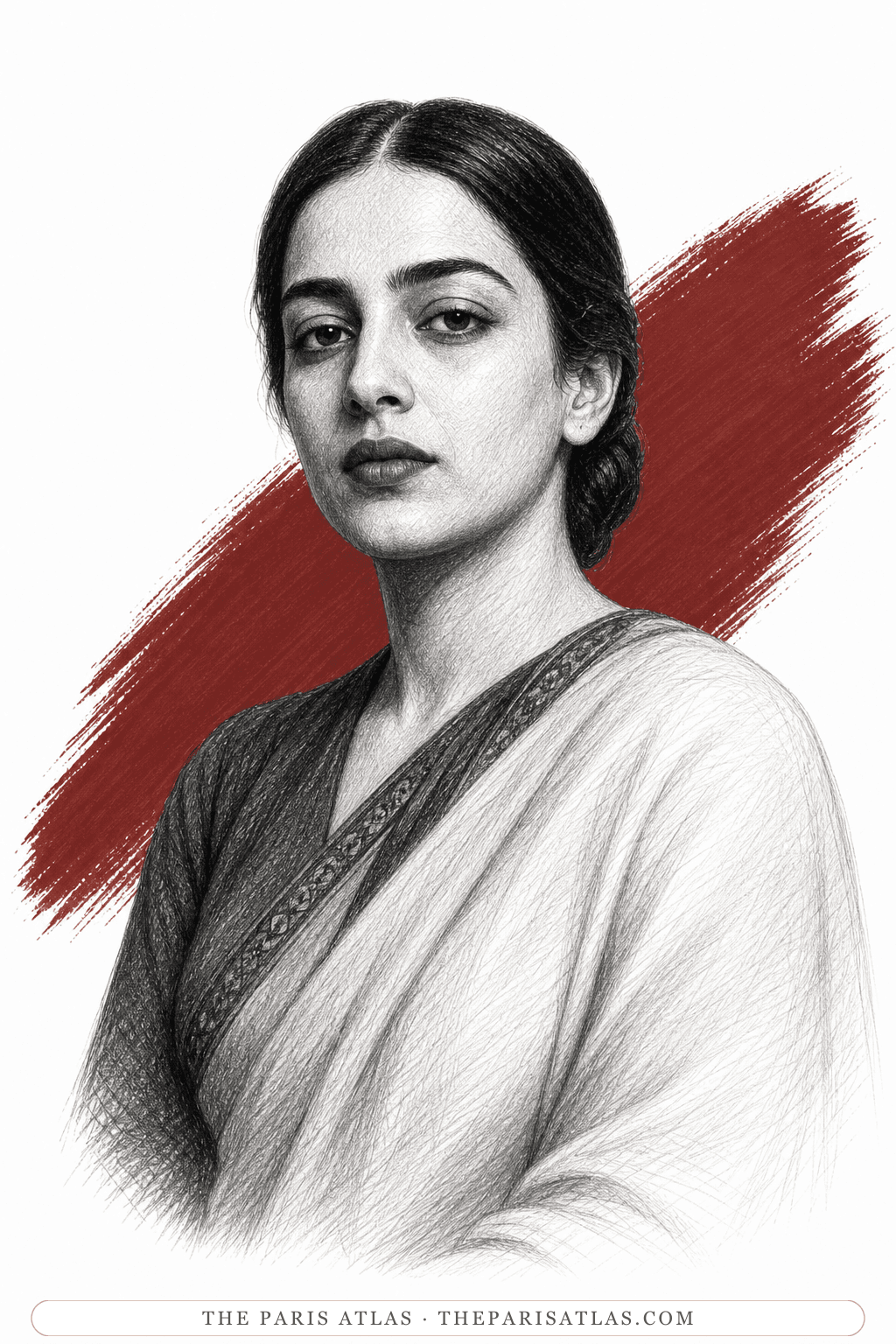
Illustrated portrait of Camille Pissarro

Camille Pissarro

  • Painter

Mentored by

Gauguin was a stockbroker painting at weekends when Pissarro took him up in the 1870s, brought him into the Impressionist circle and taught him to work outdoors. The early landscapes and still lifes carry Pissarro and Cezanne openly.

Paul Gauguin (1848–1903)

Movements

The artistic and literary currents this life ran through.

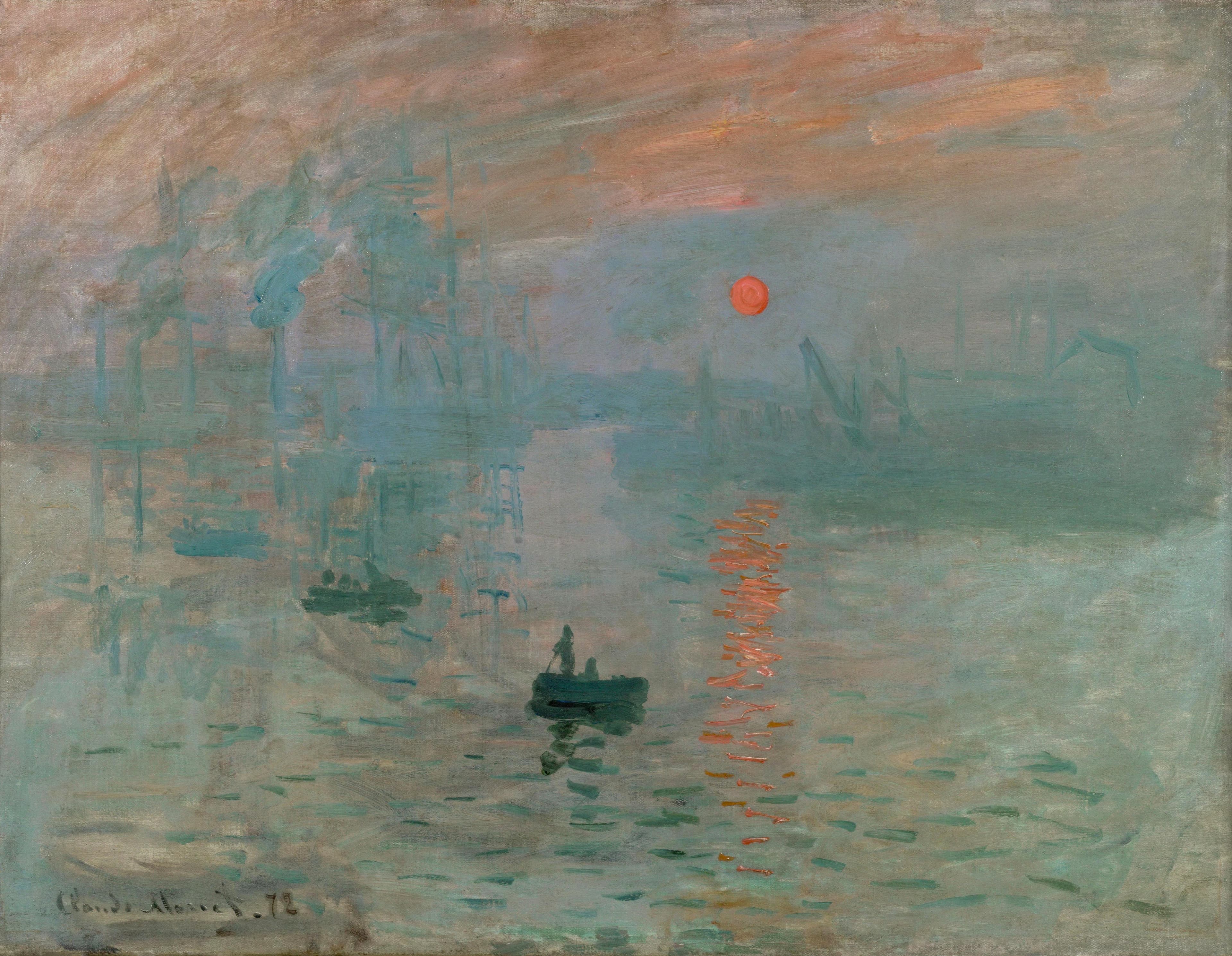
An orange sun over a hazy blue-grey harbor, small boats in the foreground, painted in loose broken strokes

Art movement · 1874–1886

Impressionism

He showed in the last four Impressionist exhibitions, from 1879 to 1886, before the flat colour of the Brittany and Polynesian work took him somewhere else entirely.

Paul Gauguin (1848–1903)

From the journal

Recent coverage of Paul Gauguin's world

All stories

Questions about Paul Gauguin

What is Paul Gauguin famous for?

Gauguin is famous as a founder of Post-Impressionist and Symbolist painting — flat fields of intense, non-naturalistic color, heavy contours, and pictures that mix observation with memory, myth, and invention. He is equally known for the life: a Paris stockbroker who abandoned finance and family for painting, developed Synthetism in Brittany, worked beside Vincent van Gogh in Arles, and spent his last twelve years in Tahiti and the Marquesas.

Was Gauguin an Impressionist?

Early on, yes. Camille Pissarro brought him into the movement, and he showed in the Impressionist exhibitions of the 1880s through the final one in 1886. By 1888 he had rejected Impressionism's devotion to immediate visual sensation in favor of Synthetism — painting built from memory, emotion, and design as much as from looking.

What is Synthetism?

An approach Gauguin developed in Brittany in 1888 with the younger painter Émile Bernard, in which a painting synthesizes the appearance of a subject, the artist's memory of it, the artist's emotional response, and the decorative arrangement of color and shape. Forms are simplified, colors flattened and freed from natural appearance. Vision after the Sermon (1888) is its declaration.

Did Gauguin cut off Vincent van Gogh's ear?

No — the established account is that Vincent van Gogh mutilated his own ear during the December 1888 breakdown that ended the two painters' nine weeks together at the Yellow House in Arles. What passed between them in the preceding argument remains debated, but there is no settled evidence that Gauguin did the cutting. He left Arles immediately afterward.

Why did Gauguin go to Tahiti?

He wanted to escape a Europe he considered commercial and artificial, live cheaply, and find subjects no Paris rival could offer — expectations fed by travel literature and by the colonial pavilions of the 1889 world's fair. The Tahiti he found in 1891 had been a French colony since 1880 and was already deeply transformed; the untouched paradise of the paintings is largely his invention.

Are Gauguin's Tahitian paintings accurate pictures of Polynesian culture?

No, not in a documentary sense. They combine real Polynesian people and places with Christian symbolism, figures borrowed from the Borobudur temple reliefs in Java, poses from Western classical art and Manet's Olympia, and a Polynesian 'religion' drawn mostly from an 1837 European book about the islands. Gauguin was building a hybrid mythology, not recording what he saw.

Who was Tehamana?

A Tahitian adolescent who lived with Gauguin during his first Tahitian stay, beginning when he was in his forties, and who appears in several major paintings of the period. The Art Institute of Chicago's record for its portrait of her gives her age as thirteen; the biographer Sue Prideaux argues from a newly found birth record that she was about fifteen. The relationship is central to the modern debate about Gauguin and colonial power.

Why is Gauguin controversial?

Because his Polynesian life ran on a colonial power imbalance: a middle-aged French colonist taking adolescent girls as companions, and paintings that sold Europe a sexualized, invented image of Polynesian women. In his last years he also attacked the missionaries and parts of the colonial administration on behalf of his Marquesan neighbors. Museums now present both facts together, and this page does the same.

What is Gauguin's most important painting?

The strongest single claim belongs to Where Do We Come From? What Are We? Where Are We Going? (1897–98), the mural-sized canvas now in the Museum of Fine Arts, Boston. Painted after the death of his daughter Aline, it carries human figures from infancy to old age, reads right to left at his instruction, and refuses to answer the questions in its title. Vision after the Sermon (1888) is the other landmark.

Did Gauguin have syphilis?

It was long stated as fact, but it is now disputed. Teeth recovered from a well beside his last house on Hiva Oa — identified by DNA testing as very probably Gauguin's — showed no trace of mercury, the era's standard syphilis treatment, when analyzed in 2014. That does not prove he never had the disease; it does mean the old certainty is gone. He suffered serious chronic illness in his final years either way.

Did Gauguin abandon his family?

In practical terms, yes. He married Mette-Sophie Gad in 1873 and they had five children; after the 1882 crash ended his stockbroking career he chose painting, the family moved to Copenhagen, and from 1885 he lived apart from them — permanently after he left Europe in 1895. They corresponded for years, but the household was never rebuilt.
Who did Gauguin influence?

The Nabis first — Paul Sérusier painted The Talisman under Gauguin's direction at Pont-Aven in 1888 and carried it back to Pierre Bonnard, Édouard Vuillard, and Maurice Denis. His liberation of color from natural appearance prepared the way for Henri Matisse and the Fauves, and his willingness to distort for feeling fed Expressionism. The commemorative exhibition at the 1906 Salon d'Automne put the full range of his work before that generation.
What was Gauguin's painting style?

Flattened perspective, simplified forms, strong outlines, large zones of deliberately non-natural color, decorative pattern, and subjects that mix observation with dreams, memory, religion, and invented mythology. The manner he developed with Émile Bernard in 1888 is called Synthetism; its outlined color zones are also called Cloisonnism, after cloisonné enamel.

Why are Gauguin's colors so unusual?

Because he believed color should communicate emotion independently of the subject's actual color — a landscape could be red or purple if that made the picture stronger. This liberation of color from natural appearance became one of his most influential ideas, carried further by Matisse and the Fauves.

Who taught Gauguin to paint?

No academy — his teacher was Camille Pissarro, who took him on as an informal pupil in the 1870s, taught him Impressionist method, and brought him into the group's exhibitions. Paul Cézanne, whose paintings Gauguin bought and studied closely, was the other formative influence.

Why did Gauguin go to Brittany?

He wanted distance from Paris and believed rural Brittany preserved a simpler, more spiritual, more traditional culture — a romantic and selective reading of a region already full of artists and tourists. The Pont-Aven stays of 1886 and 1888 produced his break with Impressionism and the invention of Synthetism.

Was Gauguin successful during his lifetime?

Within the avant-garde, increasingly; financially, never securely. He earned recognition from fellow painters and critics, especially in his last decade, but steady money always escaped him. The reputation that makes his canvases among the most valuable in the world arrived after his death, beginning with the 1906 Salon d'Automne retrospective.

What other kinds of art did Gauguin make?

Nearly every kind he could reach: ceramics, carved wood reliefs and sculpture, woodcuts, zincographs, monotypes, drawings, watercolors, illustrated manuscripts, and books — Noa Noa and the memoir Avant et après among them. His refusal to rank oil painting above the decorative arts was itself influential.

Where did Gauguin die?

At Atuona on Hiva Oa, in the Marquesas Islands, on 8 May 1903, a month short of his fifty-fifth birthday. He had moved there from Tahiti in 1901, and he is buried on the island.

Why is Gauguin important to modern art?

He helped establish the principle that a painting does not have to reproduce visible reality faithfully — color could be invented, perspective flattened, forms simplified, and observation merged with memory, myth, and dream. The Nabis, the Fauves, and the Expressionists all built on that freedom.

Sourced claims

Every connection the graph holds for Paul, with the evidence behind it.

Associated with

Impressionism

He showed in the last four Impressionist exhibitions, from 1879 to 1886, before the flat colour of the Brittany and Polynesian work took him somewhere else entirely.

Paul Gauguin (1848–1903)

Mentored by

Camille Pissarro

Gauguin was a stockbroker painting at weekends when Pissarro took him up in the 1870s, brought him into the Impressionist circle and taught him to work outdoors. The early landscapes and still lifes carry Pissarro and Cezanne openly.

Paul Gauguin (1848–1903)

Sources and further reading

  • Paul Gauguin (1848–1903)
  • Gauguin's Journey — The Credit Suisse Exhibition: Gauguin Portraits
  • A New Chapter: Tahiti and the Marquesas Islands — Gauguin Portraits
  • Portraiture and Gauguin — The Credit Suisse Exhibition: Gauguin Portraits
  • Paul Gauguin (1848–1903)
  • Gauguin exhibition brochure
  • Merahi metua no Tehamana (Tehamana Has Many Parents or The Ancestors of Tehamana)
  • Special loan: The Little Cat by Paul Gauguin now on display at the Van Gogh Museum
  • The Heritage of Gauguin, by Douglas Cooper (1981)
  • Where Do We Come From? What Are We? Where Are We Going? (1897–98), Paul Gauguin
  • Gauguin – Tahiti, The Workshop of the Tropics
  • Paul Gauguin – Why Are You Angry?
  • Gauguin, Paul, 1848–1903
  • Scientific Tests on Paul Gauguin's Teeth Indicate the Artist Did Not Have Syphilis