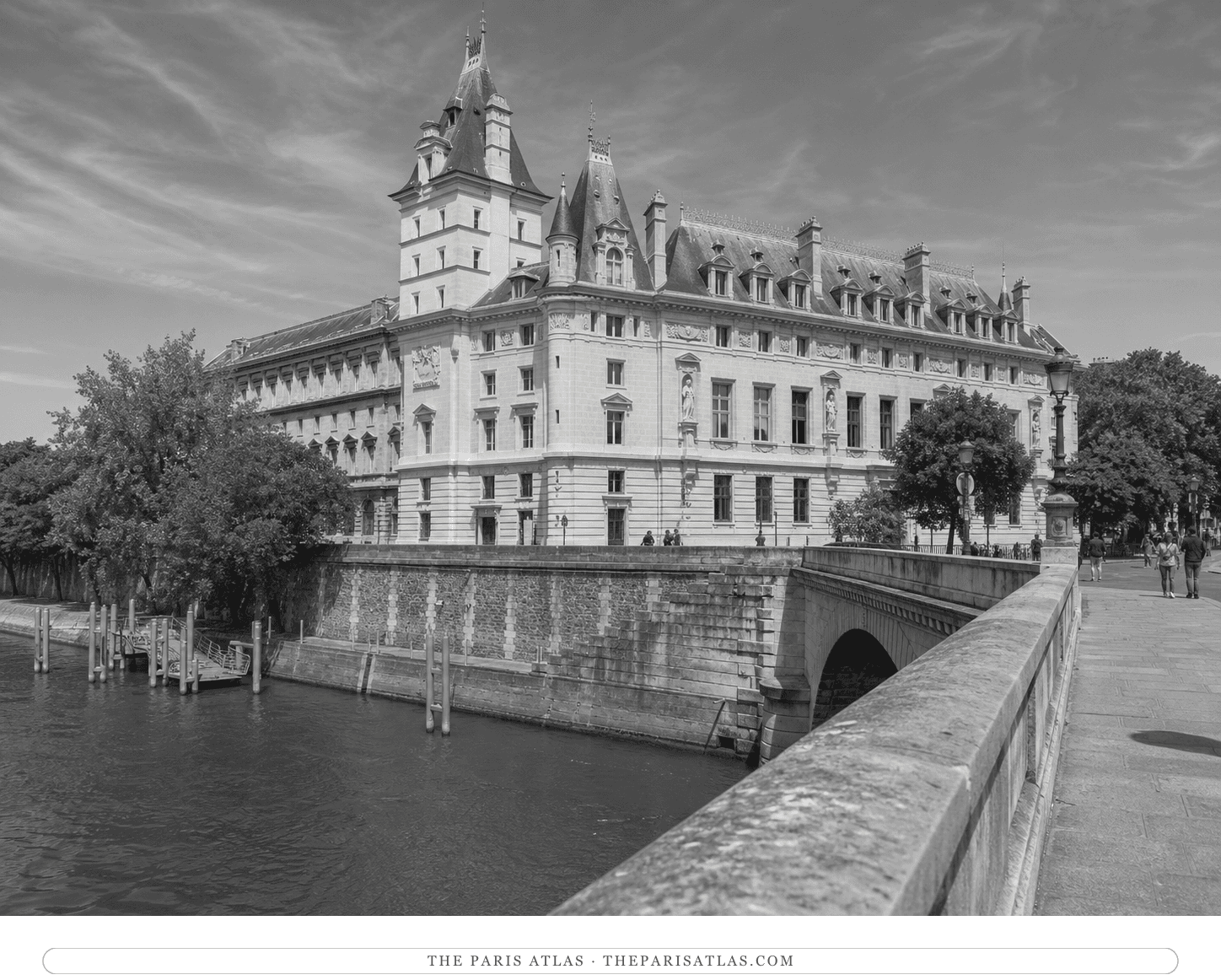
The Paris AtlasCharting the artists, works, and places worth returning to.
  • Painter
· French · 1830–1903

Camille Pissarro

The eldest of the Impressionists and the only painter to show in all eight of the group's exhibitions, 1874 to 1886.

In images

Details

Lived
1830–1903
Born
10 July 1830
Birthplace
Charlotte Amalie, Saint Thomas, Danish West Indies
Died
13 November 1903 · aged 73
Place of death
Paris
Nationality
French
Married
Julie Vellay · 1871–1903
Children
Lucien Pissarro, Georges Henri Manzana Pissarro, Félix Pissarro, Ludovic-Rodo Pissarro, Jeanne Pissarro, known as Cocotte, Paul-Émile Pissarro
Roles
Painter
Also known as
Jacob Abraham Camille Pissarro

About Camille Pissarro

Camille Pissarro was one of the founders of Impressionism and one of the most influential painters of the nineteenth century. Born in the Caribbean in 1830, he became the central elder of the Impressionist circle in France, painting landscapes, peasants, gardens, villages and eventually the crowded boulevards of Paris. He was the only artist to exhibit in all eight Impressionist exhibitions, and his influence extended from Claude Monet and Paul Cézanne to Paul Gauguin, Georges Seurat and the generation that followed.

Pissarro is sometimes overshadowed by Monet, Renoir or Degas, but his place in the history of modern painting is unusually important. He was not simply another Impressionist painter. He helped hold the movement together, encouraged younger artists when their work was still considered radical, and remained willing to change his own style even in middle age. The Ashmolean Museum has described him as a galvanising force behind the emergence of modern art.

Camille Pissarro: quick facts

  • Known for: Landscape painting, rural scenes, peasant life and Paris cityscapes
  • Movements: Realism, Impressionism and Neo-Impressionism
  • Major influences: Jean-Baptiste-Camille Corot, Gustave Courbet and the Barbizon painters
  • Artists he influenced: Paul Cézanne, Paul Gauguin, Lucien Pissarro and numerous younger Impressionist and Neo-Impressionist painters
  • Important places: Saint Thomas, Caracas, Paris, Louveciennes, Pontoise, London and Éragny-sur-Epte
  • Remarkable distinction: The only painter to participate in every one of the eight Impressionist exhibitions between 1874 and 1886

His full name, dates, birthplace, wife and children are in the details card at the top of this page.

Early life: from Saint Thomas to France

Jacob Abraham Camille Pissarro was born on 10 July 1830, in Charlotte Amalie on the Caribbean island of Saint Thomas. At the time, Saint Thomas belonged to the Danish West Indies; today it is part of the U.S. Virgin Islands. His parents, Rachel Manzana-Pomié and Frédéric Abraham-Gabriel Pissarro, ran a general store in Charlotte Amalie and were practising Jews. Pissarro therefore entered the world far from the Parisian art establishment he would later help overthrow.

His Caribbean origins are one of the most distinctive aspects of the Camille Pissarro biography. He grew up amid a port culture connecting Europe, Africa, the Caribbean and the Americas rather than in the artistic circles of France. His family's Sephardic Jewish background also made him something of an outsider throughout his life. The Jewish Museum describes Pissarro as having grown up in a Sephardic Jewish family before becoming interested in anarchism and the lives of working people.

When he was about twelve, his parents sent him to boarding school in Passy, near Paris. There his ability to draw was encouraged. After returning to Saint Thomas as a teenager, however, he was expected to join the family business. Painting was not yet regarded as his career.

Pissarro worked in the shop, but he continued drawing whenever he could. Instead of becoming a merchant, he sketched the harbor, ships, people and landscape around him. That conflict — the respectable family occupation on one side and art on the other — lasted until his early twenties.

Venezuela: where Pissarro became an artist

One of the least-known but most fascinating chapters of Camille Pissarro's life happened not in France but in Venezuela.

Around 1849 he met the Danish painter Fritz Melbye, who encouraged him to take painting seriously. In 1852, Pissarro made a decisive break with the life his family had planned for him: he left Saint Thomas with Melbye and went to Venezuela without his parents' permission. They worked around Caracas and the coastal town of La Guaira until the mid-1850s.

The young Pissarro drew landscapes, roads, tropical vegetation, villages and people going about everyday life. The subjects are revealing. Long before the mature Pissarro paintings of French farmers and village roads, he had already begun looking closely at ordinary places and ordinary people.

A surviving example is Bridge at Caracas, dated 1854. The watercolor shows an arched bridge, distant hills, tropical vegetation and tiny human figures. It belongs to the National Gallery of Art in Washington.

This Venezuelan period deserves much more attention than it usually receives. Pissarro did not become a painter after reaching Paris. By the time he returned to Europe, he had already spent years observing nature and working directly from the world around him.

Pissarro arrives in Paris

Pissarro settled in Paris in 1855, arriving during the year of the Exposition Universelle. There he encountered the work of painters who would shape his early development, particularly Jean-Baptiste-Camille Corot and Gustave Courbet. Corot's landscapes and the anti-establishment Realism of Courbet helped show Pissarro another route beyond academic painting.

Between roughly 1859 and 1861 he attended several academies, including the Académie Suisse, where he encountered artists including Claude Monet, Armand Guillaumin and Paul Cézanne. He exhibited at the official Paris Salon several times during the 1860s and also appeared at the Salon des Refusés in 1863.

His early work was darker and more solidly constructed than the luminous paintings for which Impressionism later became famous. Corot and the Realists encouraged him to study actual landscapes rather than invent ideal ones, while Pissarro gradually pushed that principle further through increasingly direct observation outdoors.

This commitment to what was physically in front of him would remain central to Camille Pissarro's art for the rest of his career.

Pissarro and the invention of Impressionism

During the 1860s and early 1870s, Pissarro developed close relationships with artists who were becoming increasingly dissatisfied with the official Salon system. The group eventually included Monet, Renoir, Degas, Cézanne, Berthe Morisot and others.

Their paintings looked unfinished to conservative critics. Brushstrokes remained visible. Shadows could be blue, violet or green. Subjects might be railway stations, cafés, roads, gardens or anonymous people rather than scenes from mythology and ancient history.

In 1874, they organized their own exhibition outside the Salon. It became the first exhibition associated with what would soon be called Impressionism. The independent exhibitions continued, with changing membership, until 1886.

Pissarro holds a distinction no other artist in the movement can claim: he exhibited in all eight Impressionist exhibitions from 1874 to 1886.

That consistency tells us something important about him. Pissarro believed deeply in artistic independence. Other famous members drifted away from the exhibitions, returned to the Salon or became caught up in arguments over who should be included. Pissarro stayed.

He was also older than most of the group. Born in 1830, he was a decade older than Monet. That age difference, combined with his temperament, made him something of an elder statesman. It is one reason he is frequently called the father of Impressionism.

What did Camille Pissarro paint?

The great subject of Camille Pissarro paintings is everyday life.

He painted roads disappearing into villages, orchards in blossom, kitchen gardens, fields, riverbanks, marketplaces and farm workers. Instead of transforming peasants into heroic symbols, he generally treated their work as a normal part of the landscape around them.

This distinguishes him from some of his Impressionist contemporaries. Monet repeatedly pursued spectacular effects of atmosphere. Degas painted dancers and urban interiors. Renoir became famous for scenes of leisure and sociability. Pissarro returned again and again to people working the land.

The Ashmolean notes that he generally preferred farmers, pastoral scenes and views from his own surroundings rather than the fashionable leisure activities favored by some of his contemporaries.

Those choices were connected to his politics as well as his eye.

Pissarro, anarchism and the dignity of ordinary life

Camille Pissarro held radical political beliefs and became sympathetic to anarchist ideas. His politics were not separate from his painting.

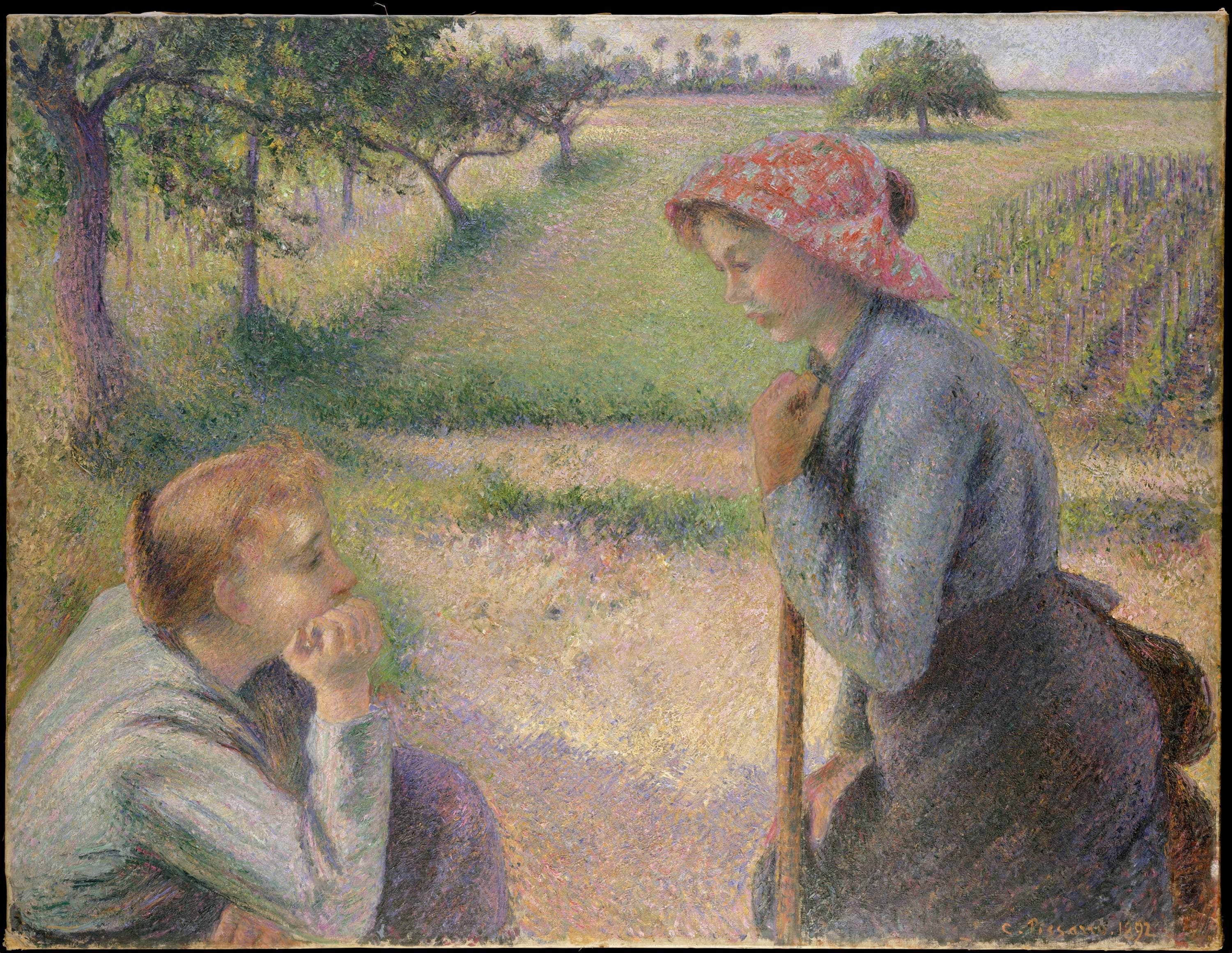
He disliked rigid hierarchies and became particularly interested in communities built around cooperation and labor. In paintings such as Two Young Peasant Women of 1891–92, farm workers occupy the center of the canvas with extraordinary calm and dignity.

The Metropolitan Museum of Art directly connects the painting to Pissarro's anarchist sympathies and his concern for an agrarian world being transformed by industrialization.

This is important when looking at a Pissarro landscape. What initially appears to be nothing more than a pleasant French field can also represent a choice about whose lives deserve to be painted.

His farmers are not background decoration for aristocrats. They are the subject.

Pissarro and Cézanne

One of Pissarro's greatest contributions to modern art may have happened outside his own canvases.

He formed an unusually important relationship with Paul Cézanne. During the 1870s the two artists frequently worked beside one another around Pontoise and Auvers-sur-Oise, sometimes painting closely related views.

Pissarro encouraged Cézanne to work outdoors and helped him move away from the much darker, heavier and more dramatic painting of his early career. Their influence was not simply one-directional: as Cézanne developed, his increasingly structured treatment of landscape also affected Pissarro.

A major Museum of Modern Art exhibition devoted to the pair described their development as a process of artistic exchange rather than isolated invention.

That relationship matters because Cézanne would eventually become one of the crucial bridges between Impressionism and twentieth-century modernism.

In other words, part of Pissarro's legacy survives inside Cézanne.

Pissarro and Paul Gauguin

Pissarro played a similar role in the early career of Paul Gauguin.

Before Gauguin became the famous Post-Impressionist painter associated with Brittany and Tahiti, he was a stockbroker who painted as an amateur. He met Pissarro and became something like an unofficial pupil.

Pissarro invited the younger artist into Impressionist circles. Gauguin's early landscapes, still lifes and interiors were strongly influenced by both Pissarro and Cézanne.

It is remarkable how often Pissarro appears at points where modern art changed direction. Cézanne passed through his orbit. Gauguin passed through his orbit. The Neo-Impressionists would soon do the same.

The Franco-Prussian War and Pissarro in London

War interrupted Pissarro's life in 1870.

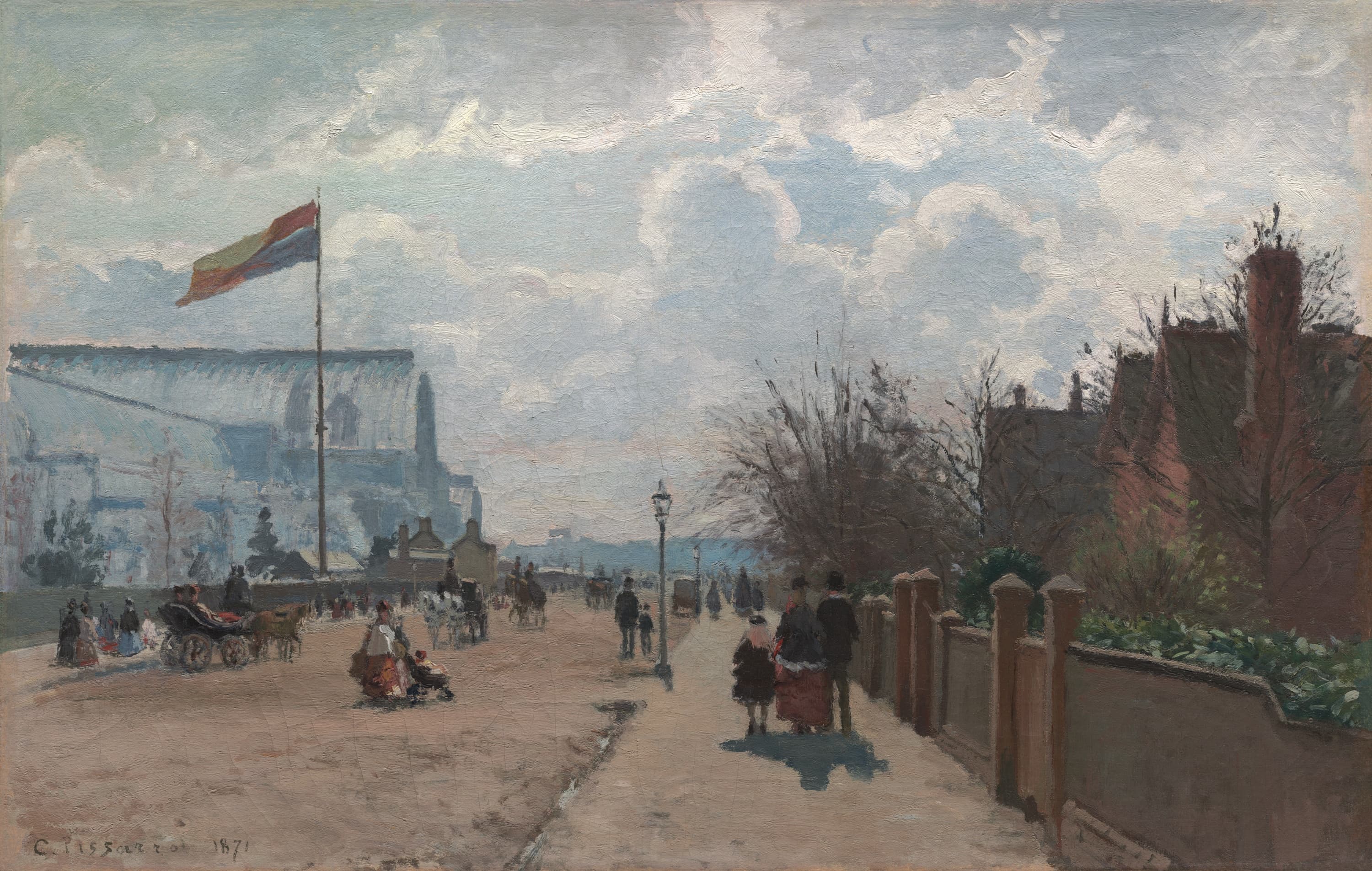
During the Franco-Prussian War, Pissarro — still a Danish national and unable to enter the French army — fled with his family to England. He settled around the Norwood and Crystal Palace area of south London.

The London stay had important consequences. Pissarro met the dealer Paul Durand-Ruel, who later became one of the most important champions of Impressionism. He also encountered British landscape painting and studied the work of artists such as John Constable and J. M. W. Turner.

When Pissarro returned to France, he discovered that his house at Louveciennes had been occupied during the war and many of the canvases he had left there had been destroyed. The National Gallery of Art notes that numerous works were lost during the occupation.

Much of the visual evidence for Pissarro's earliest development therefore disappeared before Impressionism had even officially begun.

Pontoise: Pissarro's great laboratory

Pontoise, northwest of Paris, became one of the defining places in Pissarro's career.

Here he painted roads, houses, hills, fields and workers over many years. It was close enough to Paris to remain connected to the capital but rural enough to provide the subjects that interested him.

More importantly, Pontoise became a kind of laboratory. Cézanne worked alongside him there. Gauguin visited. Guillaumin was part of the wider artistic circle.

The Musée d'Orsay notes that the evolution of Pissarro's painting during these years emerged both from his personal research into light and from artistic discussions among painters including Cézanne, Gauguin and Guillaumin.

Pissarro's importance therefore lies partly in his ability to create artistic communities. His career repeatedly involved exchange rather than isolation.

Camille Pissarro and Pointillism

One of the most fascinating things about Pissarro is that he did not freeze his style after helping invent Impressionism.

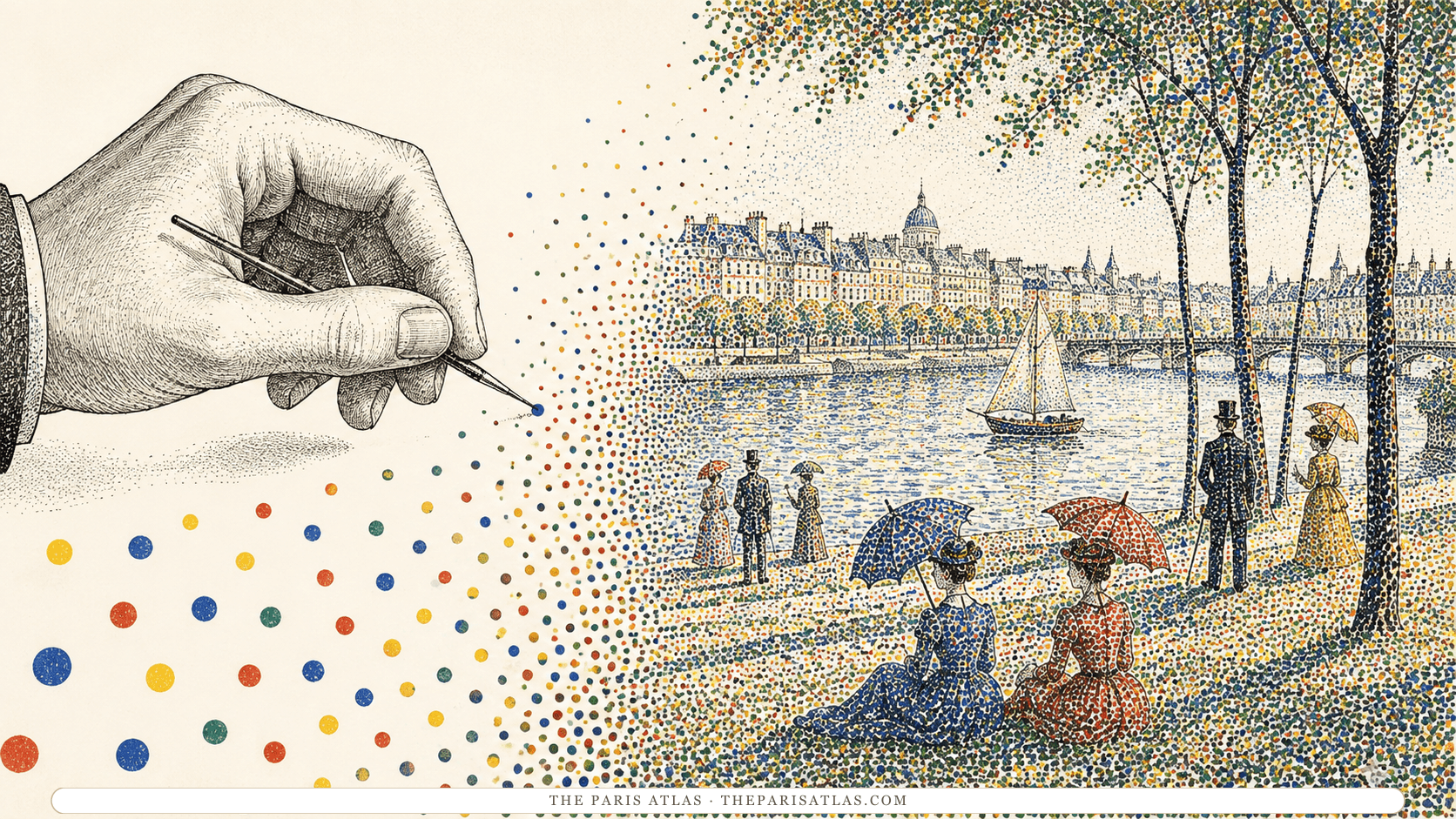
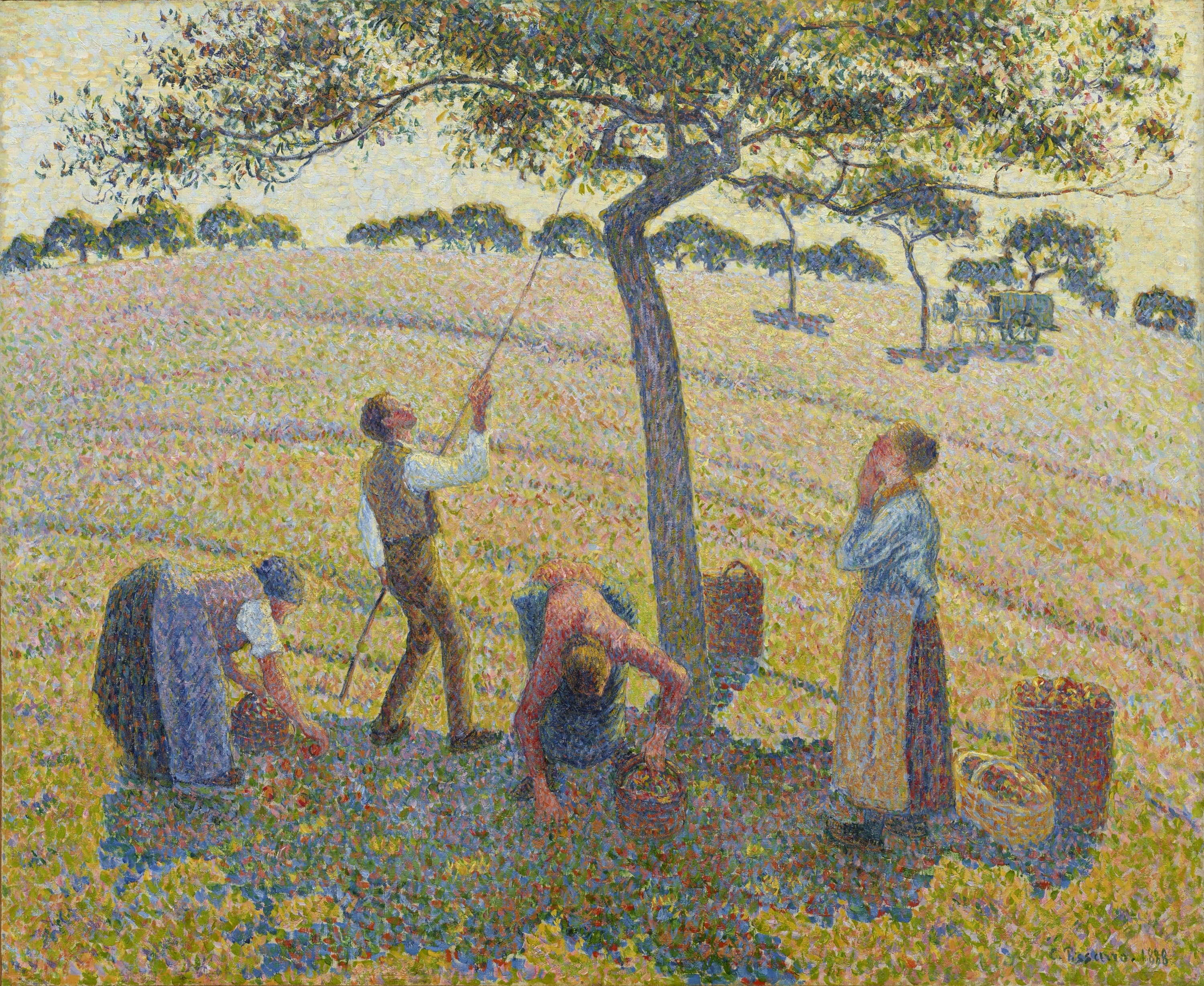
By the 1880s, younger painters including Georges Seurat and Paul Signac were developing Neo-Impressionism. Instead of the loose, spontaneous-looking brushwork associated with Impressionism, they investigated optical theories of color and constructed pictures from small separated strokes or dots.

Pissarro was already in his mid-fifties. And he decided to try it.

Between the mid-1880s and around 1890, Pissarro experimented seriously with the new divided brushwork. The Musée d'Orsay identifies this as a distinct Neo-Impressionist episode in his career.

It was an extraordinary move. One of the founders of Impressionism was allowing artists a generation younger than himself to change the way he painted.

Eventually, Pissarro found the Pointillist method too restrictive for what he wanted to accomplish and returned to a freer technique. But he did not simply revert to his earlier style. His later paintings retain lessons about color and structured brushwork learned from Seurat and Signac.

This is why Pissarro occupies such an interesting position between Impressionism, Neo-Impressionism and Post-Impressionism.

Éragny and the Pissarro family

Pissarro moved to Éragny-sur-Epte in 1884 and spent much of the remainder of his life there. He eventually bought the house in 1892. Gardens, fields, farm workers and the surrounding countryside provided him with an almost endless collection of subjects.

His family was central to life at Éragny.

Pissarro's partner and later wife, Julie Vellay, came from a Burgundy wine-growing family. Together they had eight children. The household was large, and money could be uncertain for many years while Pissarro struggled to sell enough paintings to support everyone.

Art nevertheless became something close to a family occupation.

The National Gallery records that Pissarro regarded Félix as perhaps the most naturally talented of his seven children who survived birth, six of whom became artists.

Among the best-known Camille Pissarro children who became painters were Lucien Pissarro, Georges Henri Manzana Pissarro, Félix Pissarro, Ludovic-Rodo Pissarro and Paul-Émile Pissarro. His daughter Jeanne, known as Cocotte, also made art.

Lucien became particularly important. He eventually settled in England and worked as a painter, printmaker and book designer, helping connect French Neo-Impressionism with British art and the Arts and Crafts world.

The Pissarro artistic dynasty continued into later generations.

Jewish identity and the Dreyfus Affair

Pissarro's Jewish background became particularly important during the political crisis surrounding Alfred Dreyfus, the Jewish French army officer wrongly convicted of treason in 1894.

France became bitterly divided between defenders of Dreyfus and his opponents, and the affair exposed the depth of prejudice in French society.

Pissarro supported Dreyfus.

The controversy damaged some of his artistic friendships. The Ashmolean notes that Edgar Degas took the anti-Dreyfus side and ceased associating with Pissarro after 1894. Pissarro himself had already wondered whether prejudice surrounding his Jewish origins contributed to difficulties he experienced gaining acceptance.

This aspect of his biography complicates the familiar image of Impressionism as a peaceful world of sunlight and gardens. The artists belonged to a society divided by politics, class, nationalism and prejudice.

Pissarro was simultaneously a Caribbean-born outsider, a member of a Jewish family, an anarchist sympathizer and one of the central figures in French painting.

He consequently belongs among the most significant Jewish artists and Jewish painters of the nineteenth century.

Camille Pissarro and Boulevard Montmartre

Late in life, Pissarro underwent another surprising transformation.

An eye condition made prolonged painting outdoors increasingly difficult. Instead of giving up, he changed his working method. Pissarro began renting hotel rooms and apartments with good views and painting the modern city through their windows.

The result was one of the most celebrated periods in his career.

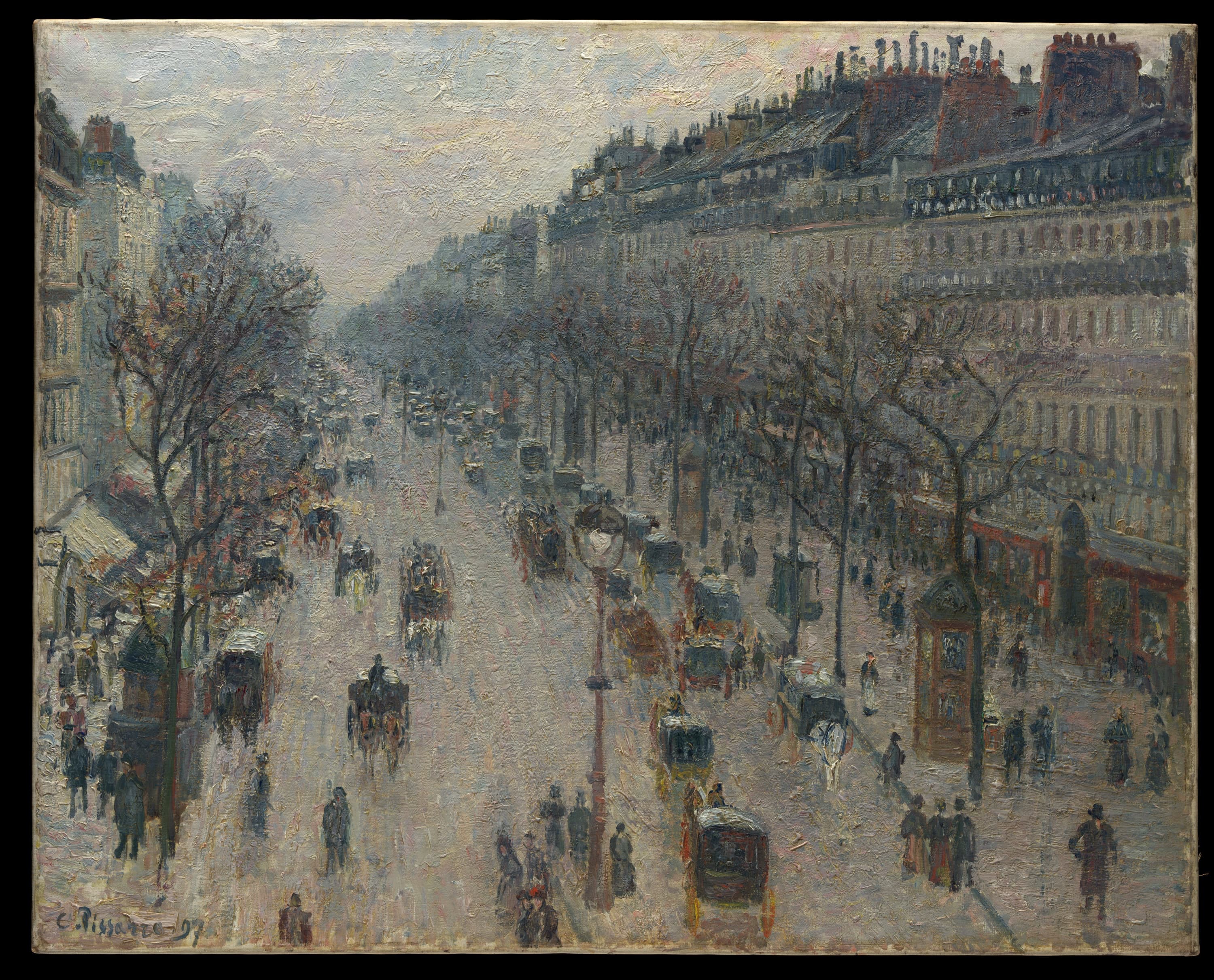
In 1897, Camille Pissarro painted Boulevard Montmartre repeatedly from an elevated hotel room. Rather than treating each canvas as an entirely different composition, he studied the same boulevard as weather, traffic, season and light changed.

He produced 14 views of the Boulevard Montmartre showing snow, rain, fog, morning, afternoon, sunset and other atmospheric effects.

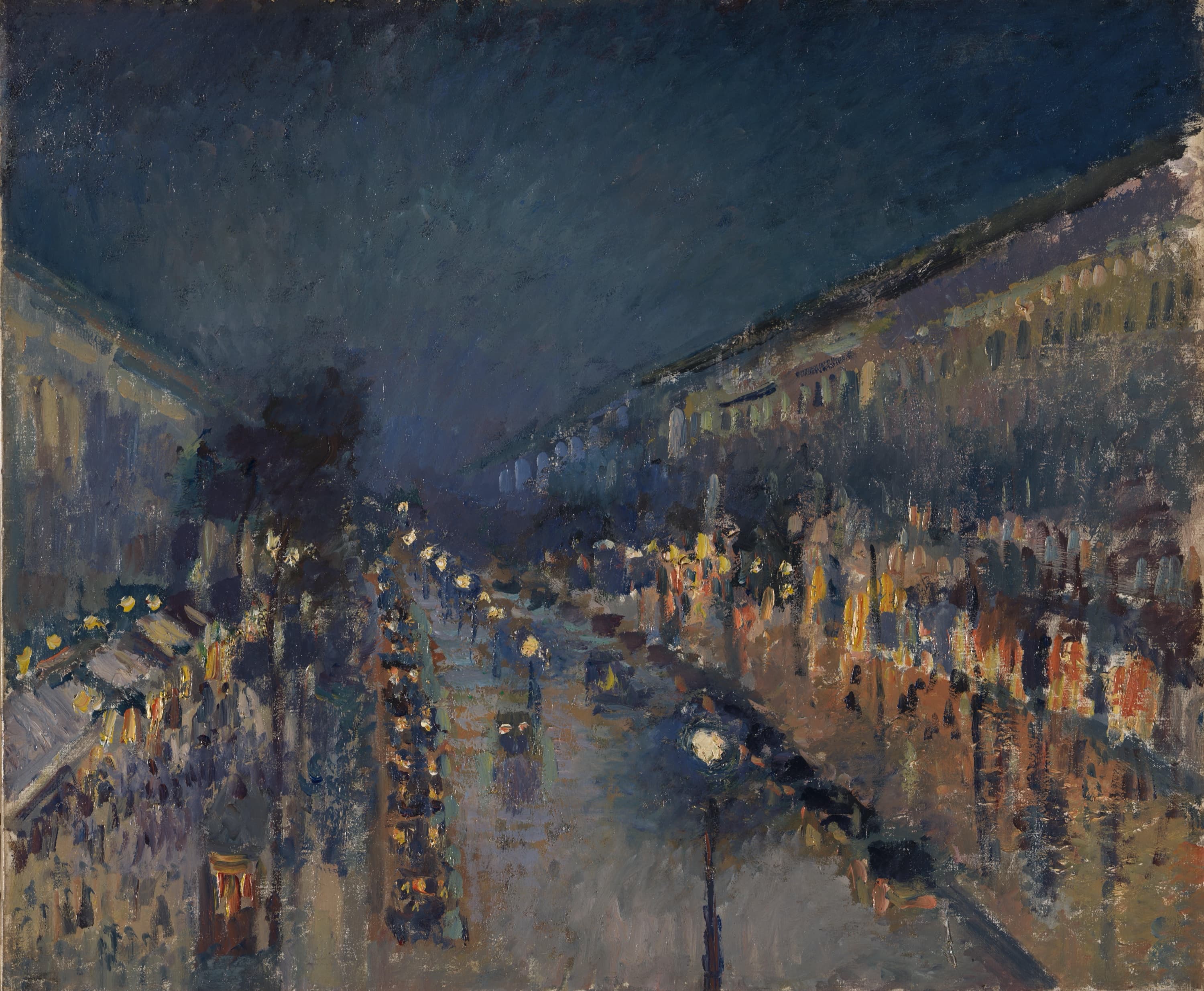
Among them is The Boulevard Montmartre at Night, now in the National Gallery in London. Remarkably, the National Gallery identifies it as the only night painting Pissarro ever made.

Carriages stream along the road. Shopfronts glow. Pedestrians dissolve into tiny touches of paint. The elevated viewpoint turns the boulevard into something almost alive.

He went on to produce city series in Paris, Rouen, Dieppe and Le Havre.

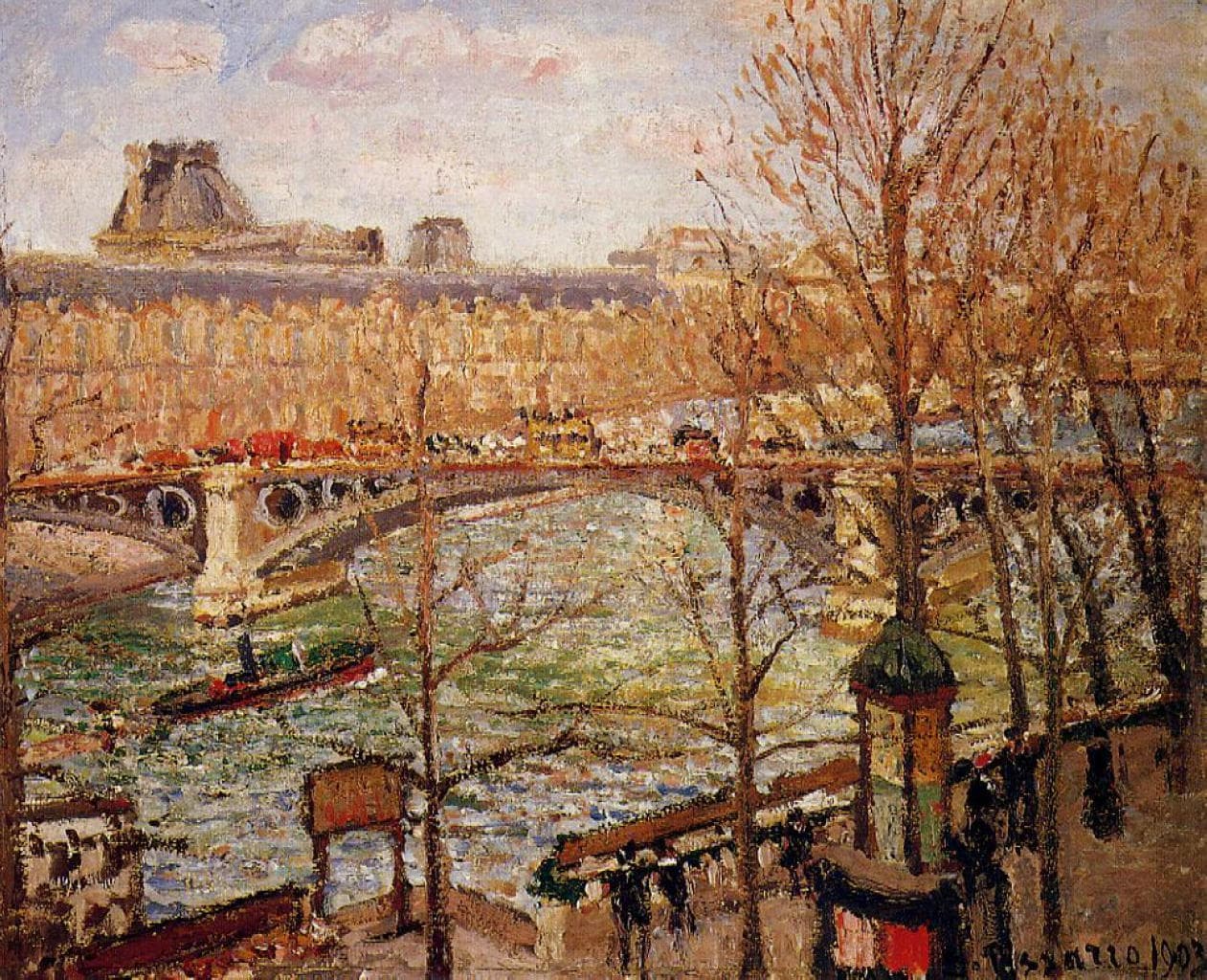
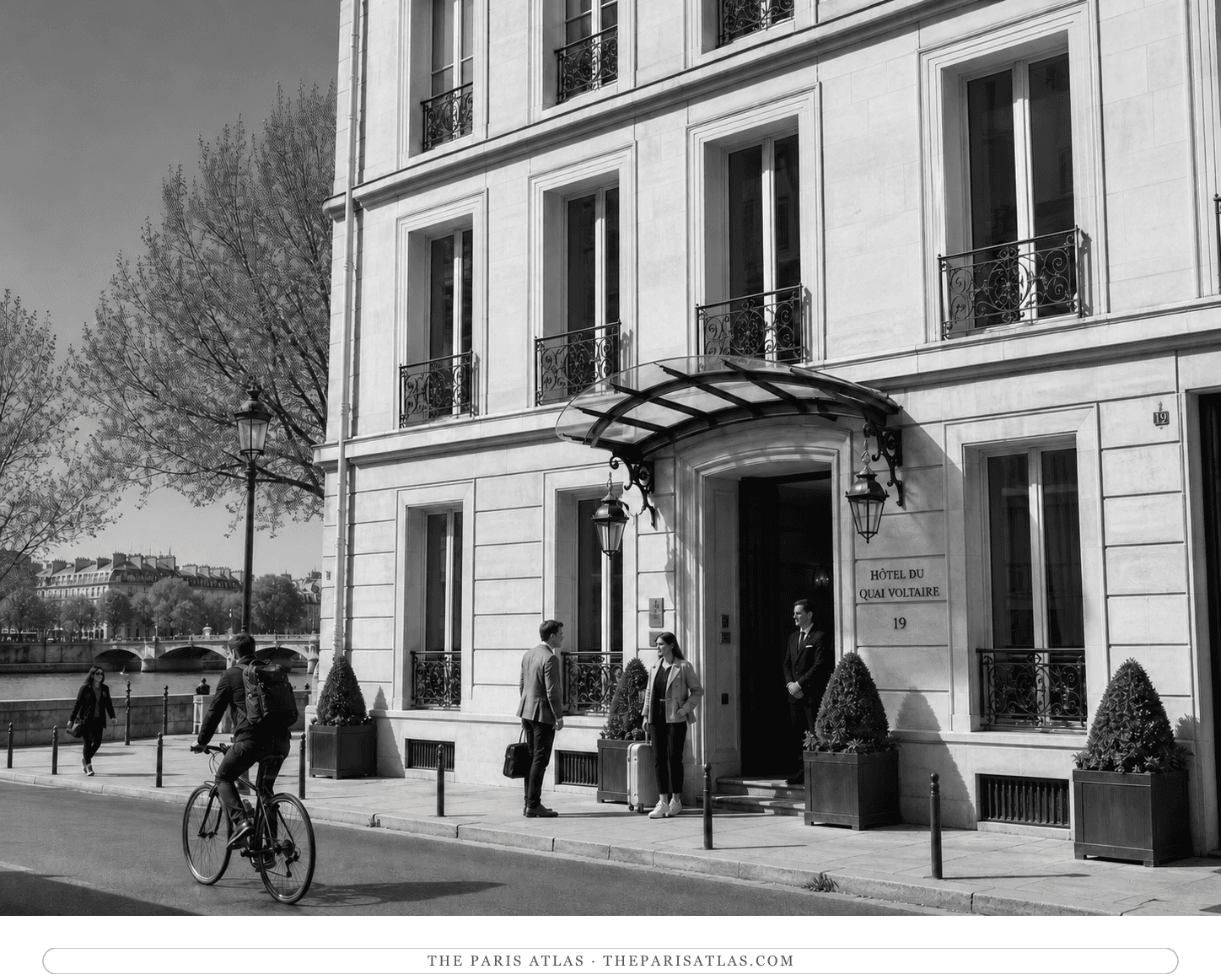
The painter who had spent decades looking across fields now looked down from windows at the machinery of the modern city. The Pont du Carrousel, Afternoon, painted in 1903 from a third-floor room on the quai Voltaire, belongs to the last of those campaigns.
Camille Pissarro's painting style

There is no single Camille Pissarro painting style because his technique changed repeatedly.

His early work reflects Corot, Courbet and nineteenth-century Realism. During the 1870s he adopted the broken brushwork, open-air painting and interest in changing light that characterize Impressionism. During the 1880s he experimented with Neo-Impressionist division of color. His mature work combined aspects of all of these approaches.
What remains consistent is his attention to observation.
Pissarro rarely depended upon theatrical subjects. A road could be enough. A vegetable garden could be enough. Two women talking in a field could be enough. What mattered was the relationship between color, light, weather, landscape and human activity.

That apparent simplicity is one reason his work can initially look quieter than Monet or Van Gogh.

It is also one of the reasons it rewards prolonged looking.

Camille Pissarro's famous paintings

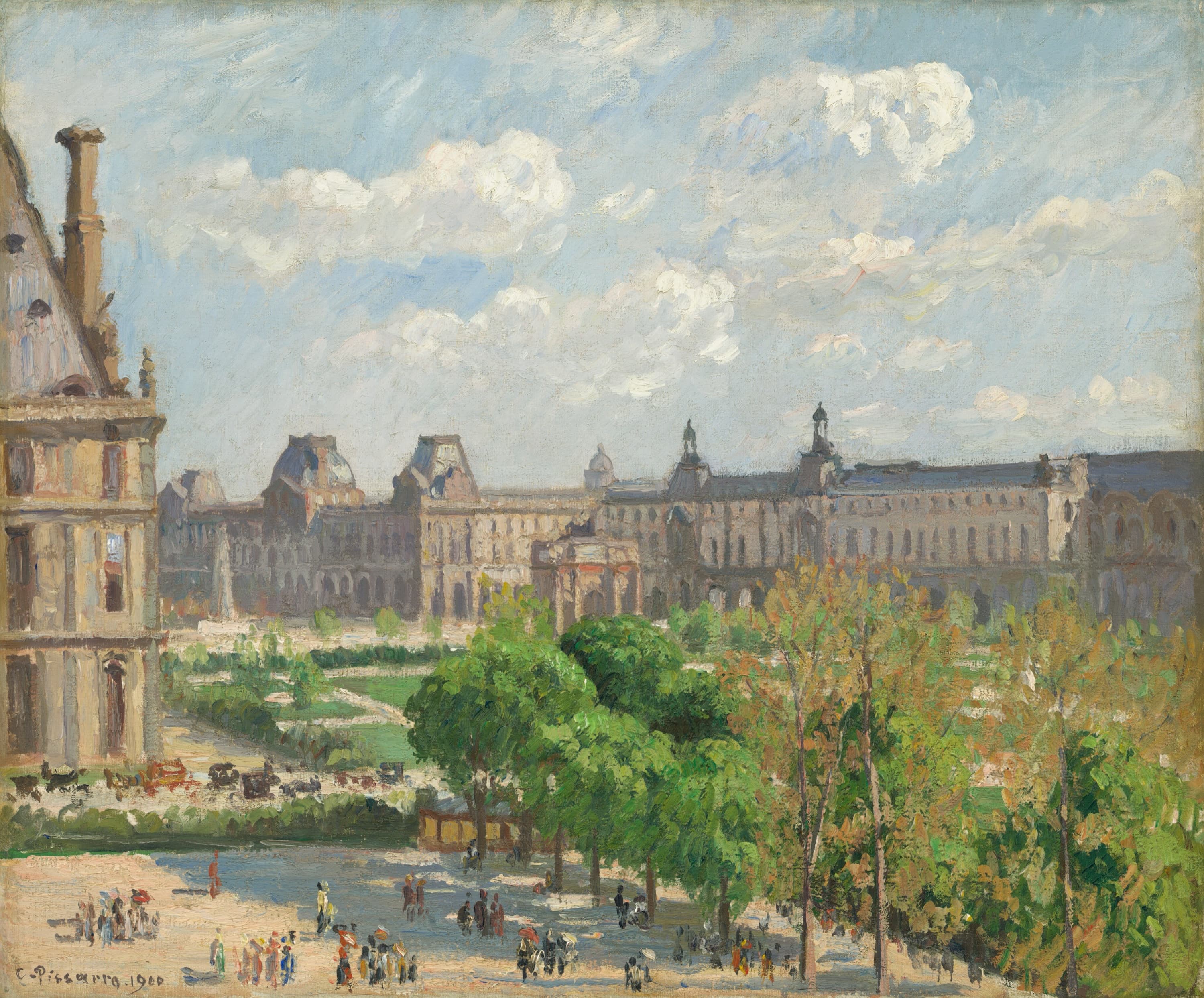
There is no universally agreed Camille Pissarro most famous painting, but several works and series have become particularly closely associated with him. These include The Boulevard Montmartre at Night (1897), The Boulevard Montmartre on a Winter Morning (1897), The Côte des Bœufs at L'Hermitage (1877), Two Young Peasant Women (1891–92), The Artist's Garden at Éragny (1898), Orchard in Bloom, Louveciennes (1872), Place du Carrousel, Paris (1900) and his numerous paintings of Pontoise.

Together, these Camille Pissarro famous paintings reveal the extraordinary breadth of his career: Caribbean and French landscapes, villages and fields, working people, gardens, experiments with Pointillism and finally crowded urban Paris.

His paintings now belong to virtually every major collection of nineteenth-century European art. The Ashmolean Museum in Oxford holds what it describes as the world's largest collection of works by Pissarro.

The final years

Pissarro remained extraordinarily productive into his seventies.

The eye condition that restricted his ability to paint outdoors ultimately generated an entirely new body of work. From rented rooms he observed the Tuileries Gardens, the Louvre, the Seine and the traffic of Paris.

From an apartment at 28 Place Dauphine, he could look across the western end of the Île de la Cité toward the Seine and the Left Bank. These late pictures combine the immediate visual energy of Impressionism with decades of experience organizing complicated scenes.

Camille Pissarro died in Paris on 13 November 1903, aged 73.

By then the artistic rebellion he had spent decades defending had become one of the foundations of modern painting.

Why Camille Pissarro matters

Pissarro's importance cannot be reduced to one masterpiece.

His greatest achievement may instead be the network of ideas and people surrounding him.

He learned from Corot and Courbet. He painted beside Monet. He encouraged Cézanne. He helped Gauguin. He collaborated with Degas in printmaking. He embraced the younger Seurat and Signac when their Neo-Impressionist experiments divided the older Impressionists. He taught his own children. And throughout that entire period, he continued altering his own work.

The Camille Pissarro paintings therefore trace nearly half a century of change in European painting.

He began before Impressionism existed. He helped create it. Then he helped the next generation move beyond it.

That is why father of Impressionism is more than a convenient nickname. Pissarro was one of the people who made the movement possible — artistically, intellectually and socially.

Life events

  1. 1830

    Jacob Abraham Camille Pissarro is born on 10 July in Charlotte Amalie, Saint Thomas, in the Danish West Indies, to a Sephardic Jewish family running a general store.

    Camille Pissarro: Biography and Chronology

  2. c. 1842

    Sent to boarding school at Passy, near Paris, where his drawing is encouraged. He returns to Saint Thomas as a teenager and is expected to join the family business.

    Camille Pissarro: Biography and Chronology

  3. 1852–c. 1855

    Leaves Saint Thomas for Venezuela with the Danish painter Fritz Melbye, without his parents' permission, working around Caracas and La Guaira. Bridge at Caracas dates from 1854.

    Camille Pissarro: Biography and Chronology; Bridge at Caracas, 1854

  4. 1855

    Settles in Paris in the year of the Exposition Universelle, and encounters the work of Corot and Courbet.

    Pissarro: Father of Impressionism — exhibition press release

  5. 1859–1863

    Attends the Académie Suisse, meeting Monet, Guillaumin and Cézanne. Exhibits at the Salon during the 1860s and at the Salon des Refusés in 1863.

    Camille Pissarro — artist record

  6. 1870–1871

    The Franco-Prussian War drives the family to south London. He meets the dealer Paul Durand-Ruel and studies Constable and Turner. The house at Louveciennes is occupied and many early canvases are destroyed.

    The National Gallery acquires a painting by Camille Pissarro; Picturing France, 1830–1900 — teaching packet

  7. 1874

    The first independent exhibition opens outside the Salon. Pissarro will show in all eight, from 1874 to 1886 — the only artist to do so.

    Impressionism: Art and Modernity

  8. 1870s

    Works beside Paul Cézanne around Pontoise and Auvers-sur-Oise, in an exchange that shapes both painters. Paul Gauguin, then a stockbroker, enters the circle as something like an unofficial pupil.

    Pioneering Modern Painting: Cézanne and Pissarro 1865–1885; Paul Gauguin (1848–1903)

  9. 1884

    Moves to Éragny-sur-Epte, buying the house in 1892. Gardens, fields and farm workers supply his subjects for the rest of his life. Julie Vellay, from a Burgundy wine-growing family, runs a household of eight children on uncertain money.

    La Maison de la Folie, Éragny; Pissarro: The Honest Eye; Camille Pissarro at the Ashmolean

  10. mid-1880s–c. 1890

    In his mid-fifties, experiments seriously with the divided brushwork of Seurat and Signac, then returns to a freer technique while keeping what he learned about colour.

    Hommage à Camille Pissarro (1830–1903)

  11. 1891–92

    Paints Two Young Peasant Women, which the Metropolitan Museum connects directly to his anarchist sympathies and to an agrarian world being changed by industry.

    Two Young Peasant Women, 1891–92

  12. 1894

    The Dreyfus Affair divides France. Pissarro supports Dreyfus; Degas takes the other side and stops associating with him.

    Pissarro: Father of Impressionism — exhibition press release; Camille Pissarro: Impressions of City & Country

  13. 1897

    Paints fourteen views of the boulevard Montmartre from an elevated hotel room. One of them, The Boulevard Montmartre at Night, is the only night scene he is known to have painted.

    The Boulevard Montmartre at Night — Picture of the Month

  14. 1900

    Place du Carrousel, Paris. The eye condition has moved him indoors for good, and the late city series are painted through windows.

    Place du Carrousel, Paris, 1900

  15. 1903

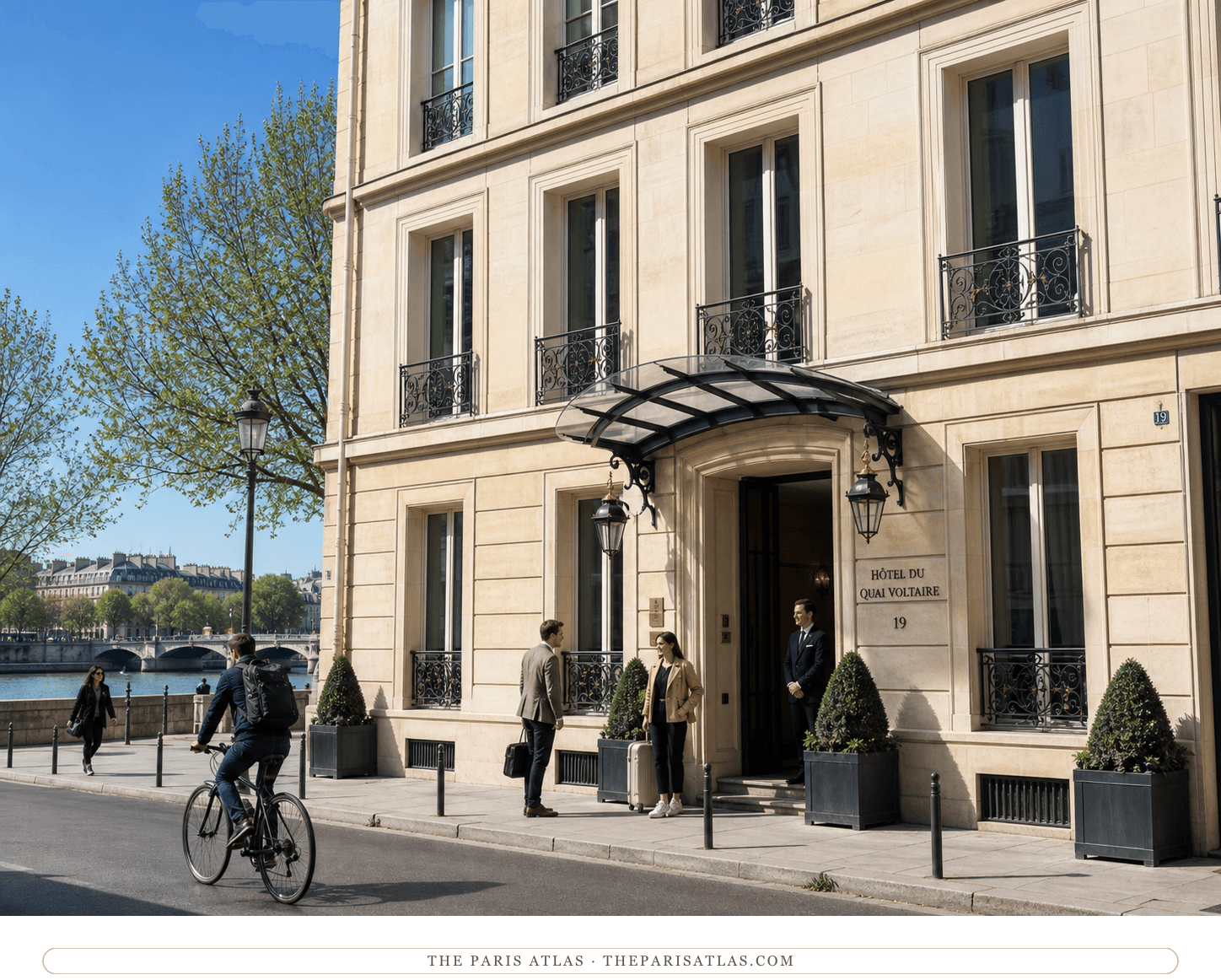
    Paints his last Paris campaign from the Hôtel du Quai Voltaire, then dies in Paris on 13 November, aged seventy-three.

    Camille Pissarro's 1903 painting of the Pont du Carrousel seen from above through bare winter trees, the long Louvre facade running across the far bank, a tug and barge on the green and white water belowPainting · in the catalogThe Pont du Carrousel, Afternoon1903 · Oil on canvas

    The Louvre under Snow

  16. After 1903

    Six of the seven children who survived birth become artists — Lucien, Georges Henri Manzana, Félix, Ludovic-Rodo, Paul-Émile, and Jeanne, known as Cocotte. The Ashmolean in Oxford now holds what it describes as the largest collection of Pissarro's work in the world.

    Portrait of Félix Pissarro; The Pissarro Gallery

  17. 1996

    The French rose breeder Delbard introduces a striped floribunda rose named for him — red, pink, yellow and white on the same flower.

    Camille Pissarro (rose)

Selected works

Cataloged from the holding institutions' records. Reproductions appear only where the rights are verified.

Paintings

Camille Pissarro's 1888 painting of an apple harvest at Éragny, made in small dots of colour: a man knocking fruit down with a long pole, two women stooping over baskets in the grass, and a woman standing at the right beside a full basket, with a cart at the field's edge behind

Artwork reproduction

Painting · The Neo-Impressionist years

Apple Harvest

1888 · Oil on canvas

Camille Pissarro painted this orchard at Éragny in 1888, entirely in small separate dots of colour. He was finishing it when he began writing to his son that he wanted a way of painting without the dot. The Dallas Museum of Art has had it since 1955.

Dallas Museum of Art

Camille Pissarro, Apple Harvest, 1888. Dallas Museum of Art. Image: public domain.

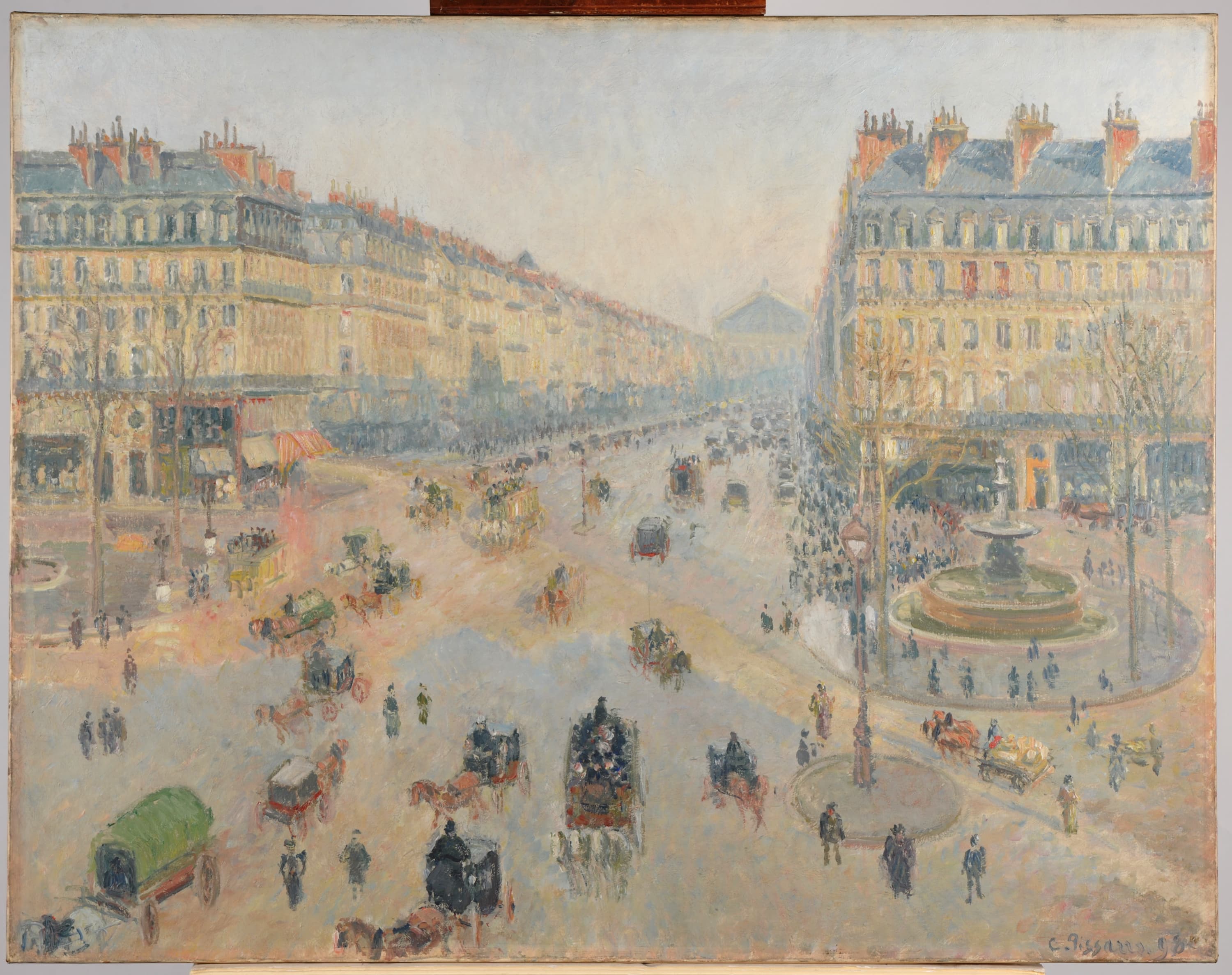
Camille Pissarro's L'Avenue de l'Opéra: the avenue seen from several floors above the place du Théâtre-Français on a winter day, cream Haussmann blocks with blue-grey roofs on either side, the Opéra pale at the far end, a round stone fountain and bare trees at the right, and cabs, horses and dark-coated figures crossing the wide pink-grey square below

Artwork reproduction

Painting · The Paris window series

L'Avenue de l'Opéra

1898 · Oil on canvas

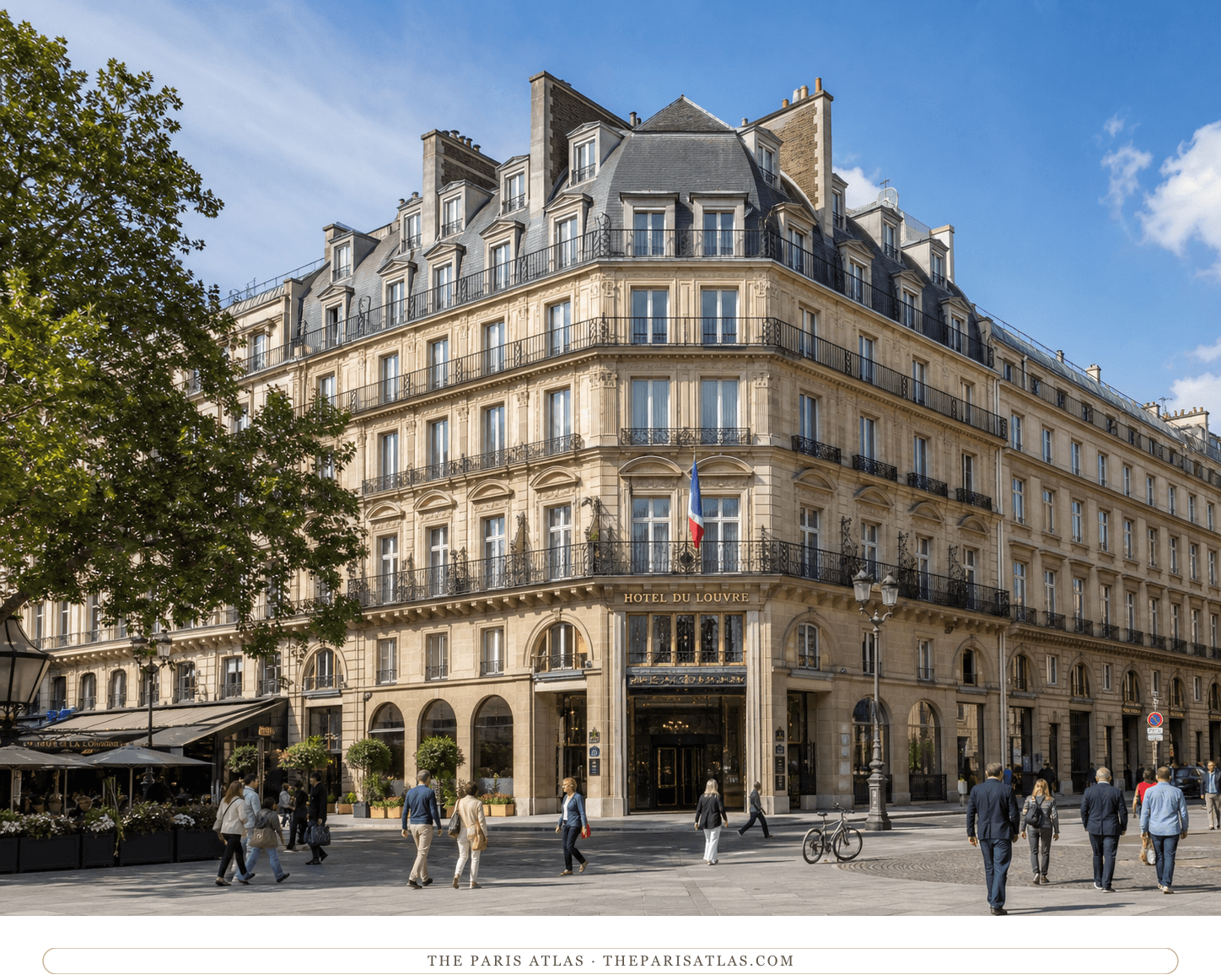
Camille Pissarro painted the avenue de l'Opéra in the winter of 1897 and 1898 from a room at the Grand Hôtel du Louvre. The Musée des Beaux-Arts de Reims says it is the only canvas of the series that stayed in France.

Musée des Beaux-Arts de Reims

Camille Pissarro, L'Avenue de l'Opéra, 1898. Musée des Beaux-Arts de Reims. Image: public domain.

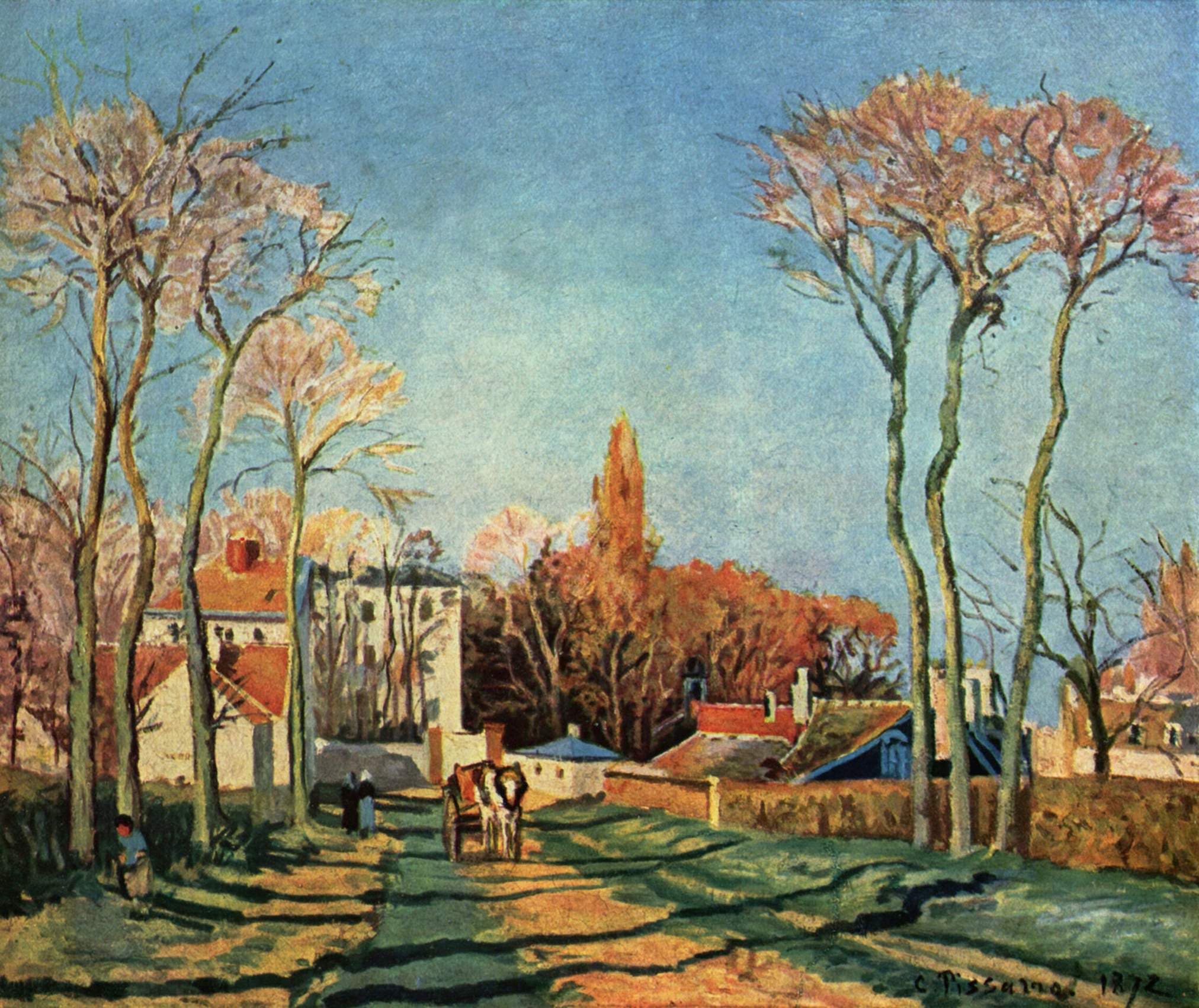
Camille Pissarro's Entrance to the Village of Voisins, 1872: a village road lined with tall bare trees runs into the distance, a pale horse pulling a cart toward the viewer, a woman walking at the verge, red-tiled roofs beyond and long blue shadows across the sunlit road

Artwork reproduction

Painting · Louveciennes

Entrance to the Village of Voisins

1872 · Oil on canvas

Camille Pissarro painted this road into Voisins, a hamlet of Louveciennes west of Paris, in 1872, the year after he came back from London. It is at the Musée d'Orsay, part of the Ernest May donation of 1923.

Musée d'Orsay, Paris

Camille Pissarro, Entrance to the Village of Voisins, 1872. Musée d'Orsay, Paris. Image: public domain.

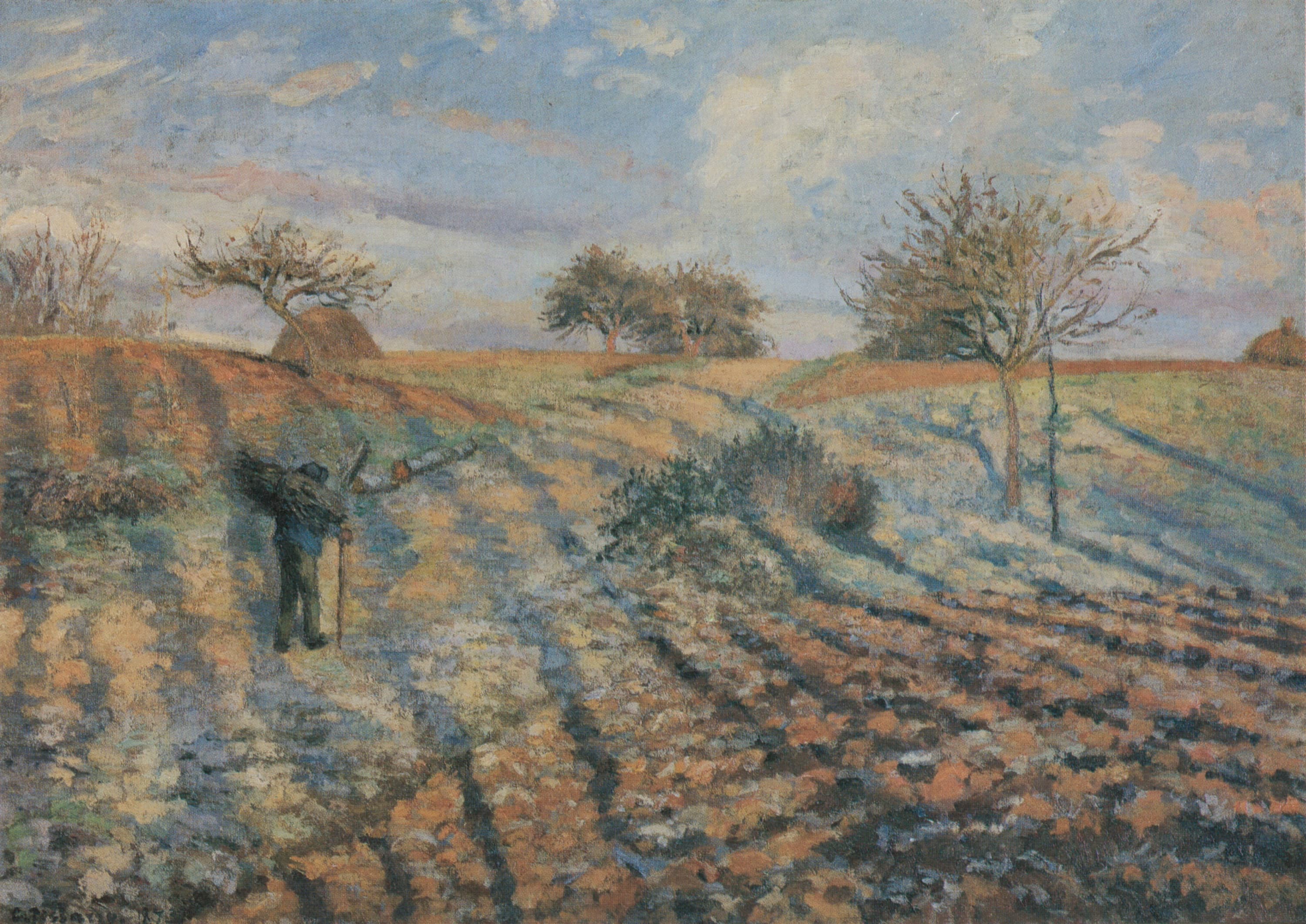
Camille Pissarro's Hoar Frost, 1873: a ploughed winter field near Pontoise, frost in the furrows painted in blue, violet and orange strokes, a man in a blue smock carrying a bundle of sticks across it, a haystack and bare trees on the ridge behind, and long diagonal tree shadows over the ground

Artwork reproduction

Painting · Pontoise

Hoar Frost

1873 · Oil on canvas

Camille Pissarro painted this frost-covered field near Pontoise in 1873 and showed it at the first Impressionist exhibition in April 1874, where the critic Louis Leroy used it as his example of everything wrong with the new painting. It is at the Musée d'Orsay.

Musée d'Orsay, Paris

Camille Pissarro, Hoar Frost, 1873. Musée d'Orsay, Paris. Image: public domain.

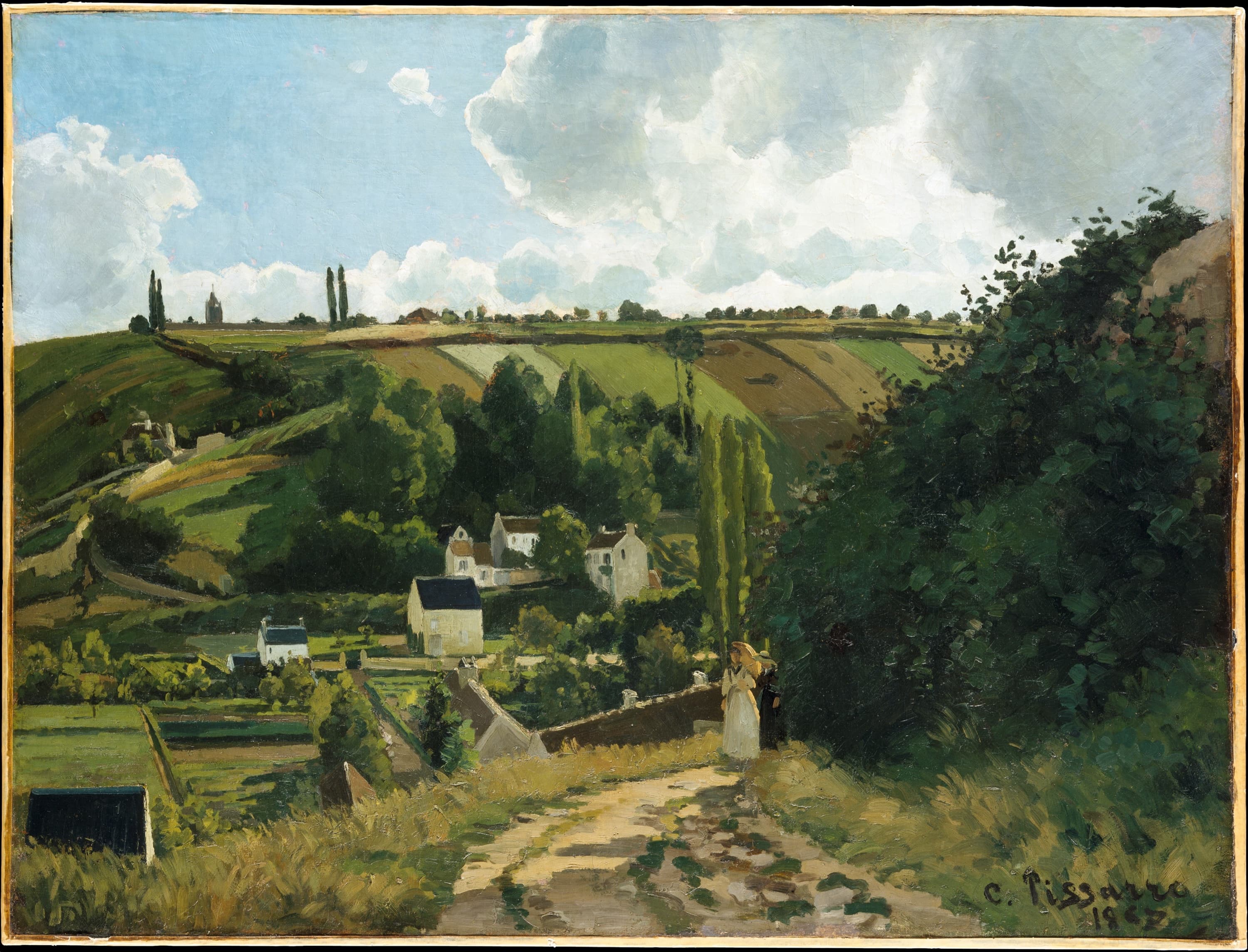
Camille Pissarro's Jalais Hill, Pontoise, 1867: a rutted track runs past a low wall where two women stand, toward pale farm buildings with grey roofs, kitchen gardens and a green hillside cut into strips of crop, under one tall white cloud in a blue sky

Artwork reproduction

Painting · Early Pontoise landscapes

Jalais Hill, Pontoise

1867 · Oil on canvas

Camille Pissarro painted this cultivated hillside outside Pontoise in 1867 and sent it to the Paris Salon the following year, where the writer Émile Zola singled it out. The Metropolitan Museum of Art in New York has held it since 1951.

The Metropolitan Museum of Art, New York

Camille Pissarro, Jalais Hill, Pontoise, 1867. The Metropolitan Museum of Art, New York. Image: CC0.

Camille Pissarro's 1900 painting of the Tuileries seen from an upper window: clipped lawns and gravel walks with green and yellowing trees, the long pale stone range of the Louvre across the background under a blue sky with white cloud, and carriages and walkers crossing the open ground in front

Artwork reproduction

Painting · Late series — Tuileries

Place du Carrousel, Paris

1900 · Oil on canvas

Camille Pissarro painted the gardens beside the Louvre from a rented room on the rue de Rivoli in 1900. It is one of twenty-eight canvases he made of that view. German forces seized it in occupied France, Hermann Göring took it in 1941 and traded it away, and it was restituted after the war.

National Gallery of Art, Washington

Camille Pissarro, Place du Carrousel, Paris, 1900. National Gallery of Art, Washington. Image: public domain.

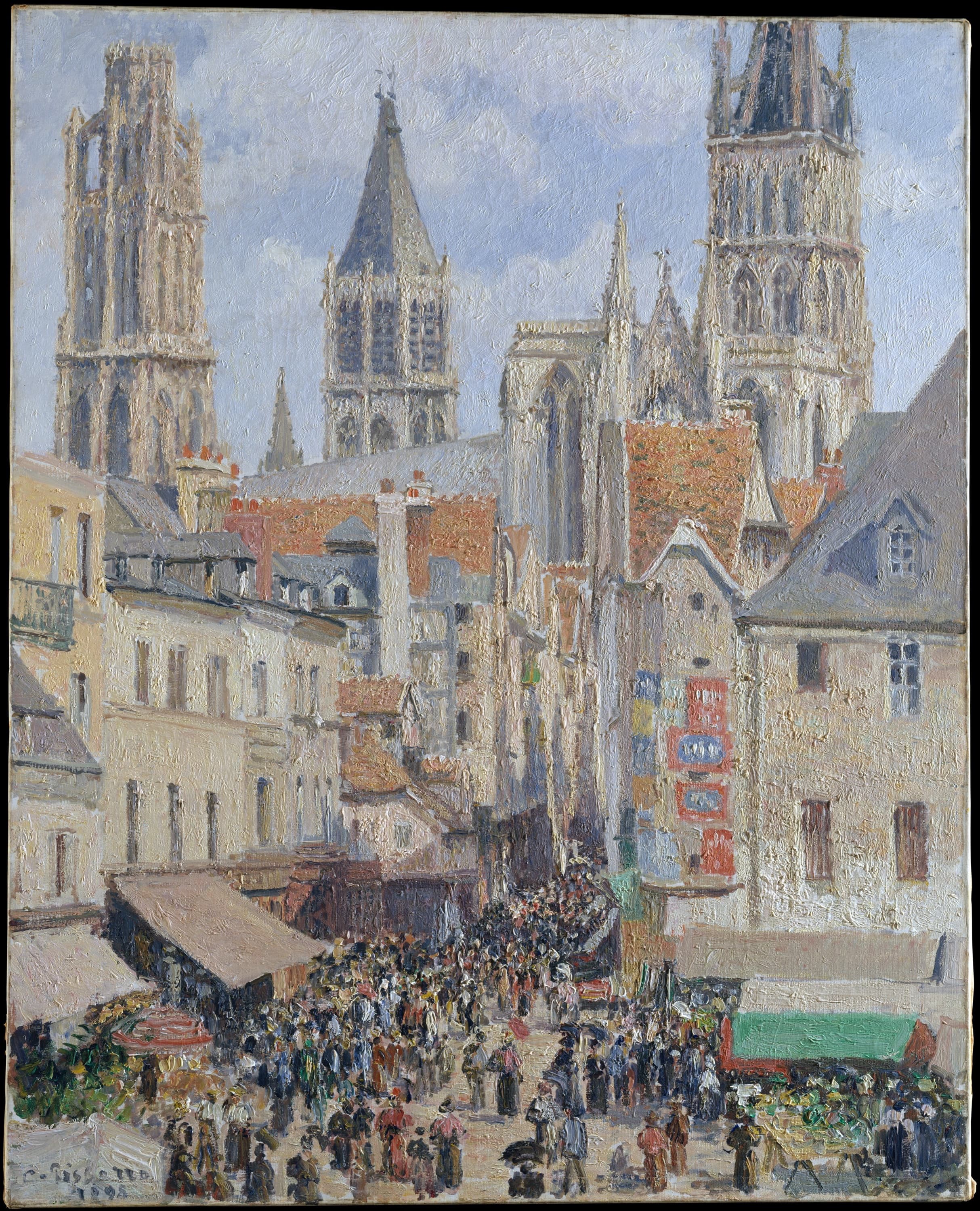
Camille Pissarro's 1898 painting of the rue de l'Epicerie in Rouen: a crowded Friday market under cream and green awnings seen from above, pale plaster houses with orange tile roofs on either side, and the openwork stone towers of Rouen cathedral rising into a blue sky behind

Artwork reproduction

Painting · Late series — Rouen

Rue de l'Epicerie, Rouen (Effect of Sunlight)

1898 · Oil on canvas

Camille Pissarro painted this street in Rouen in 1898, on a Friday, when the market filled it. He painted the view three times and this is the only one of the three with the market under way. The Metropolitan Museum of Art bought it in 1960.

The Metropolitan Museum of Art

Camille Pissarro, Rue de l'Epicerie, Rouen (Effect of Sunlight), 1898. The Metropolitan Museum of Art. Image: CC0.

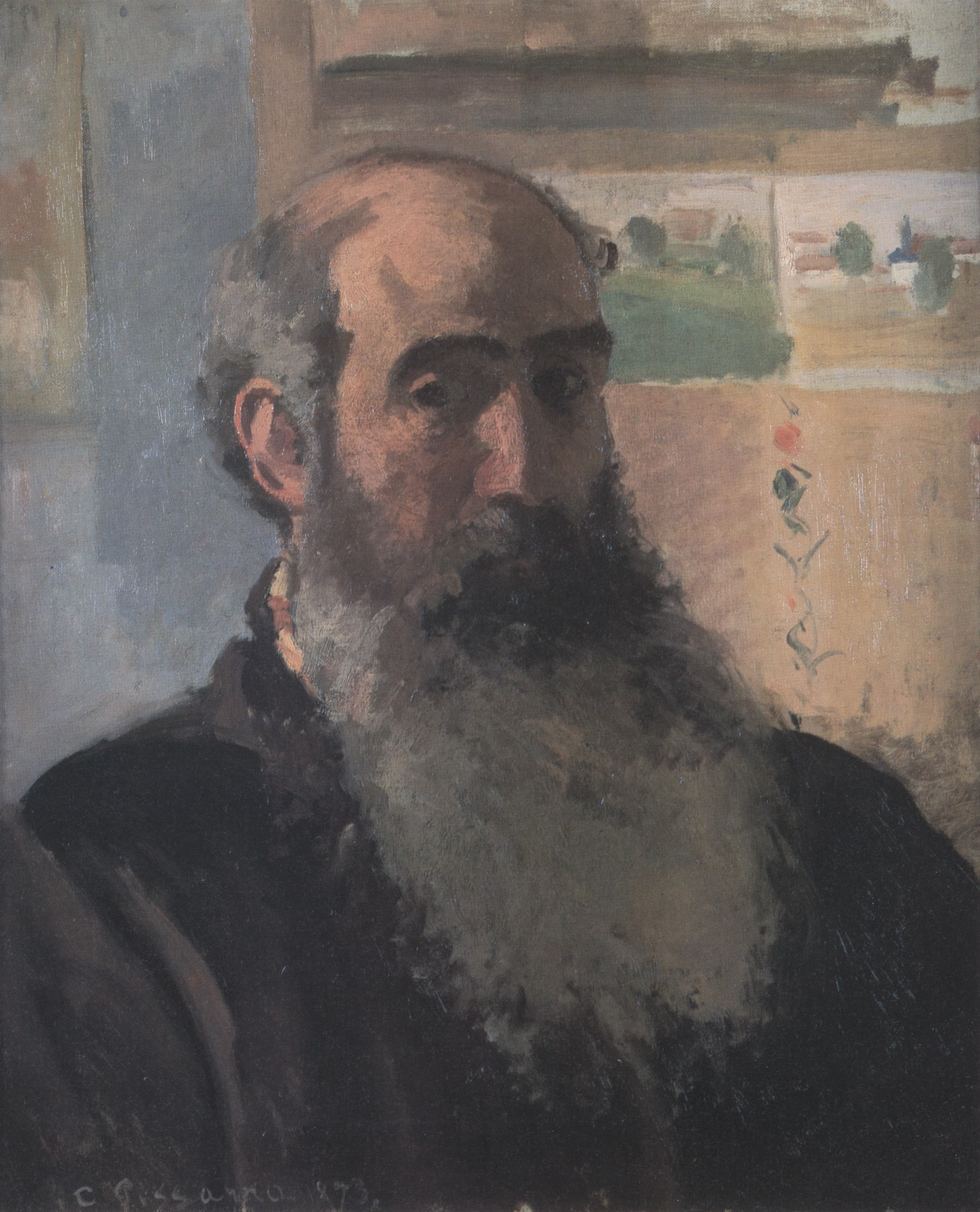
Camille Pissarro's Self-Portrait of 1873: the painter at forty-three, bald with grey hair at the temples and a full grey-brown beard covering his chest, in a dark coat, looking at the viewer, with a green landscape and a pale flowered panel hanging on the wall behind his shoulder

Artwork reproduction

Painting · Portraits

Self-Portrait

1873 · Oil on canvas

Camille Pissarro painted himself in 1873, the year he turned forty-three, bald and heavily bearded in a dark coat, against a wall hung with pictures. His son gave it to the French state in 1930 and it is at the Musée d'Orsay.

Musée d'Orsay, Paris

Camille Pissarro, Self-Portrait, 1873. Musée d'Orsay, Paris. Image: public domain.

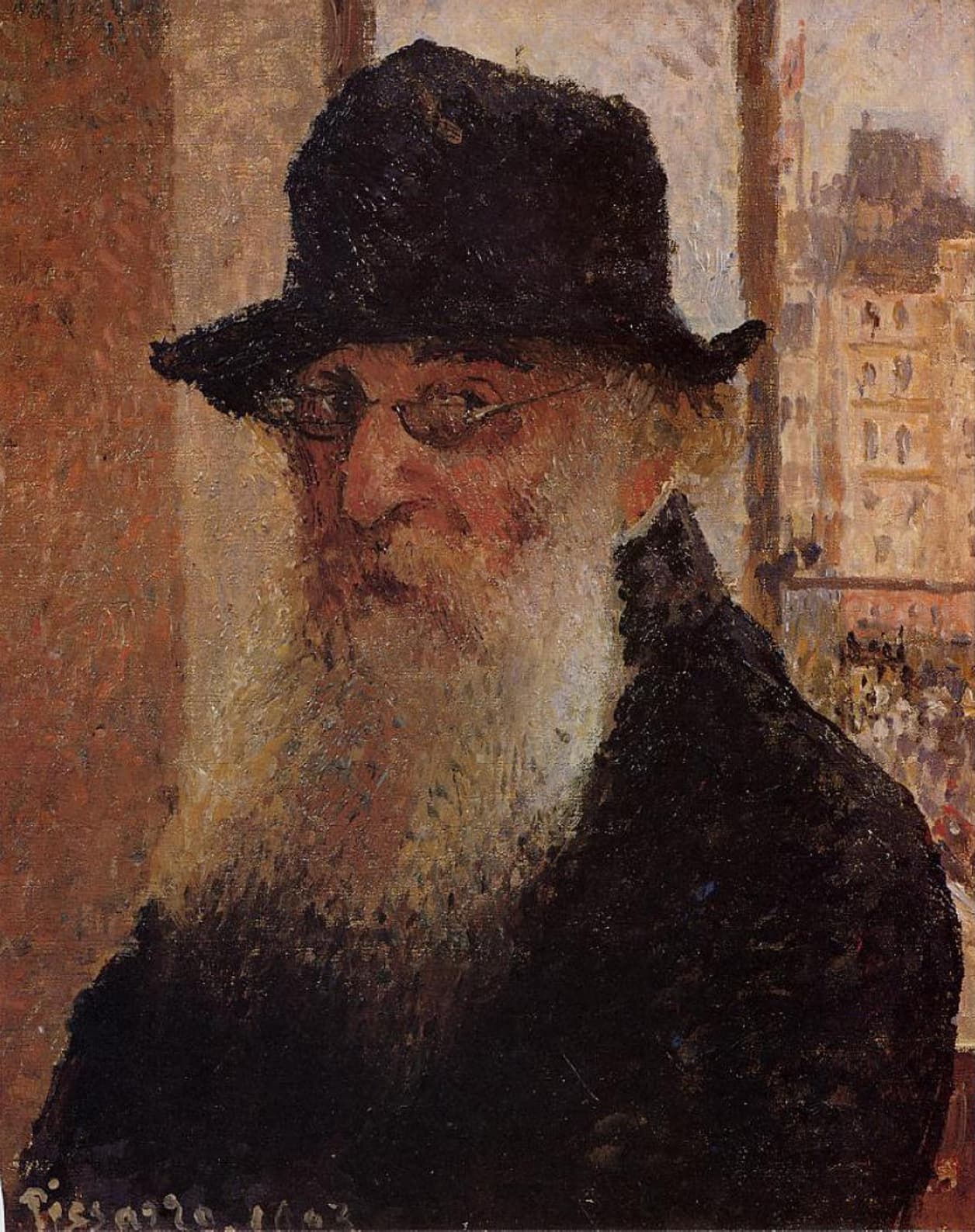
Camille Pissarro's 1903 self-portrait: the painter at seventy-three in a dark rounded hat and oval spectacles, with a long white beard and a heavy dark coat, seated against a reddish-brown wall beside a window showing a Paris building with a mansard roof

Artwork reproduction

Painting · Last works

Self-Portrait

1903 · Oil on canvas

Camille Pissarro painted himself in a hat and spectacles in 1903, the year he died at seventy-three. It is his last signed and dated self-portrait. His son Lucien Pissarro gave it to the Tate in London in 1931.

Tate

Camille Pissarro, Self-Portrait, 1903. Tate. Image: public domain.

Camille Pissarro's The Boulevard Montmartre at Night: a Paris boulevard seen from a high window after dark, a heavy blue-black sky over two receding rooflines, shop windows burning orange and yellow along the right side with their light smeared down the wet road, a white-blue electric street lamp in the foreground and cabs and small dark figures below

Artwork reproduction

Painting · The boulevard Montmartre series

The Boulevard Montmartre at Night

1897 · Oil on canvas

Camille Pissarro painted the boulevard Montmartre after dark from the same hotel window he used for the rest of the 1897 series. The National Gallery in London, which owns it, says it is the only night painting he made.

The National Gallery, London

Camille Pissarro, The Boulevard Montmartre at Night, 1897. The National Gallery, London. Image: public domain.

Camille Pissarro's The Boulevard Montmartre on a Winter Morning: a wide Paris boulevard seen from a fourth-floor window, running away into grey mist, bare plane trees along both pavements, horse omnibuses and cabs on a damp mauve road, pale stone buildings and rows of chimney pots on the right under a flat white sky

Artwork reproduction

Painting · The boulevard Montmartre series

The Boulevard Montmartre on a Winter Morning

1897 · Oil on canvas

One of fourteen views of the boulevard Montmartre that Camille Pissarro painted from a single hotel window between February and April 1897. This is the grey one: bare trees, a damp road, and no shadows anywhere.

The Metropolitan Museum of Art

Camille Pissarro, The Boulevard Montmartre on a Winter Morning, 1897. The Metropolitan Museum of Art. Image: CC0.

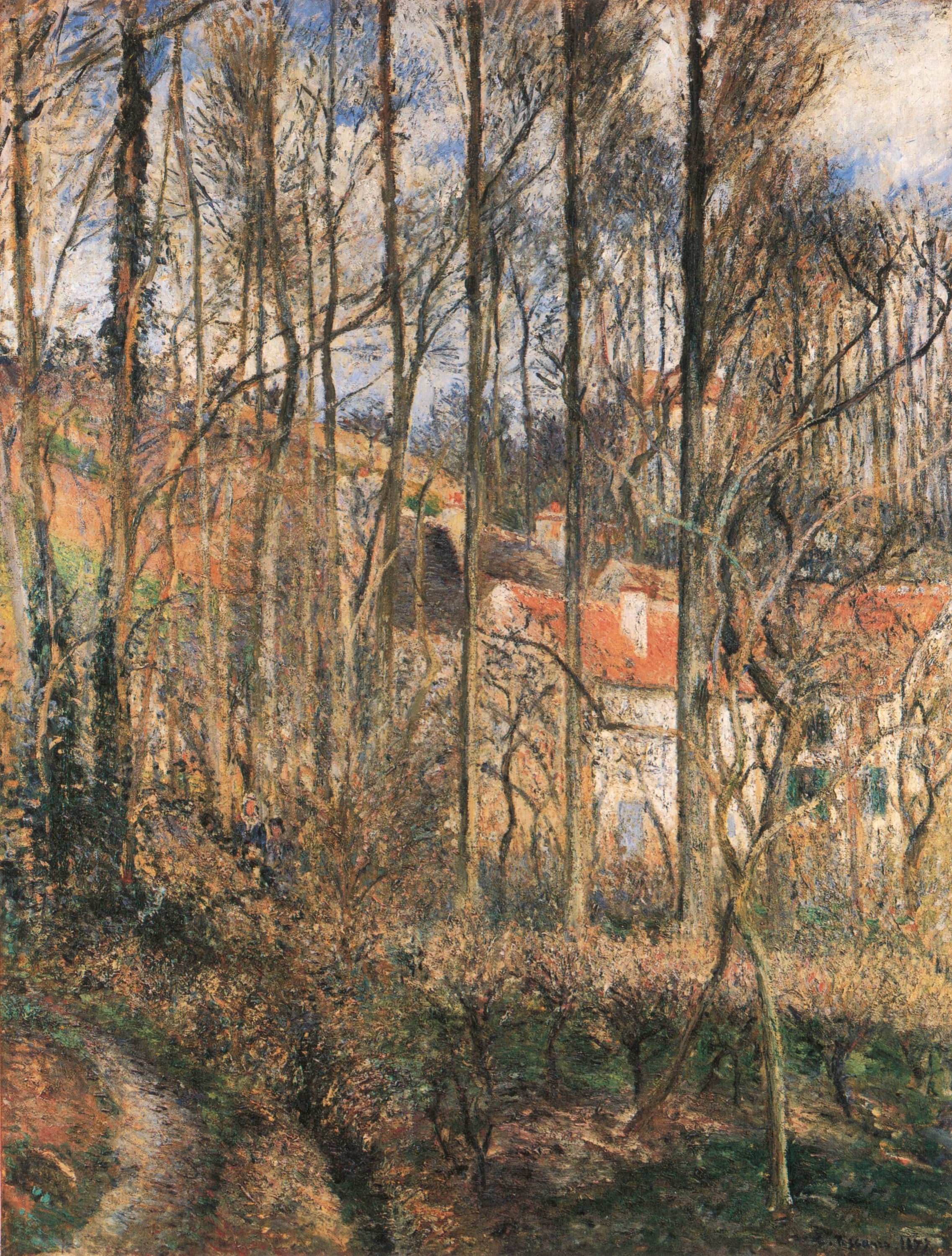
Camille Pissarro's 1877 painting of the Côte des Bœufs at Pontoise: tall bare tree trunks running the height of the upright canvas, pink-roofed houses on the hillside behind them, two small figures at the left and a track of reddish earth in the foreground

Artwork reproduction

Painting · The Pontoise years

The Côte des Bœufs at L'Hermitage

1877 · Oil on canvas

Camille Pissarro painted the wooded slope above his house at Pontoise in 1877, on a canvas almost twice the size he usually worked at. The National Gallery in London has had it since 1950.

The National Gallery, London

Camille Pissarro, The Côte des Bœufs at L'Hermitage, 1877. The National Gallery, London. Image: public domain.

Camille Pissarro's The Crystal Palace, 1871: the long glass-and-iron hall stands at the left under a grey London sky with a coloured flag on a pole, while carriages, a top-hatted man and a woman in a red skirt cross a wide unpaved road lined with new brick houses at Sydenham

Artwork reproduction

Painting · The London year

The Crystal Palace

1871 · Oil on canvas

Camille Pissarro painted Joseph Paxton's glass-and-iron Crystal Palace at Sydenham in south London in 1871, during the year his family spent in England as refugees from the Franco-Prussian War. The Art Institute of Chicago has held it since 1972.

Art Institute of Chicago

Camille Pissarro, The Crystal Palace, 1871. Art Institute of Chicago. Image: CC0.

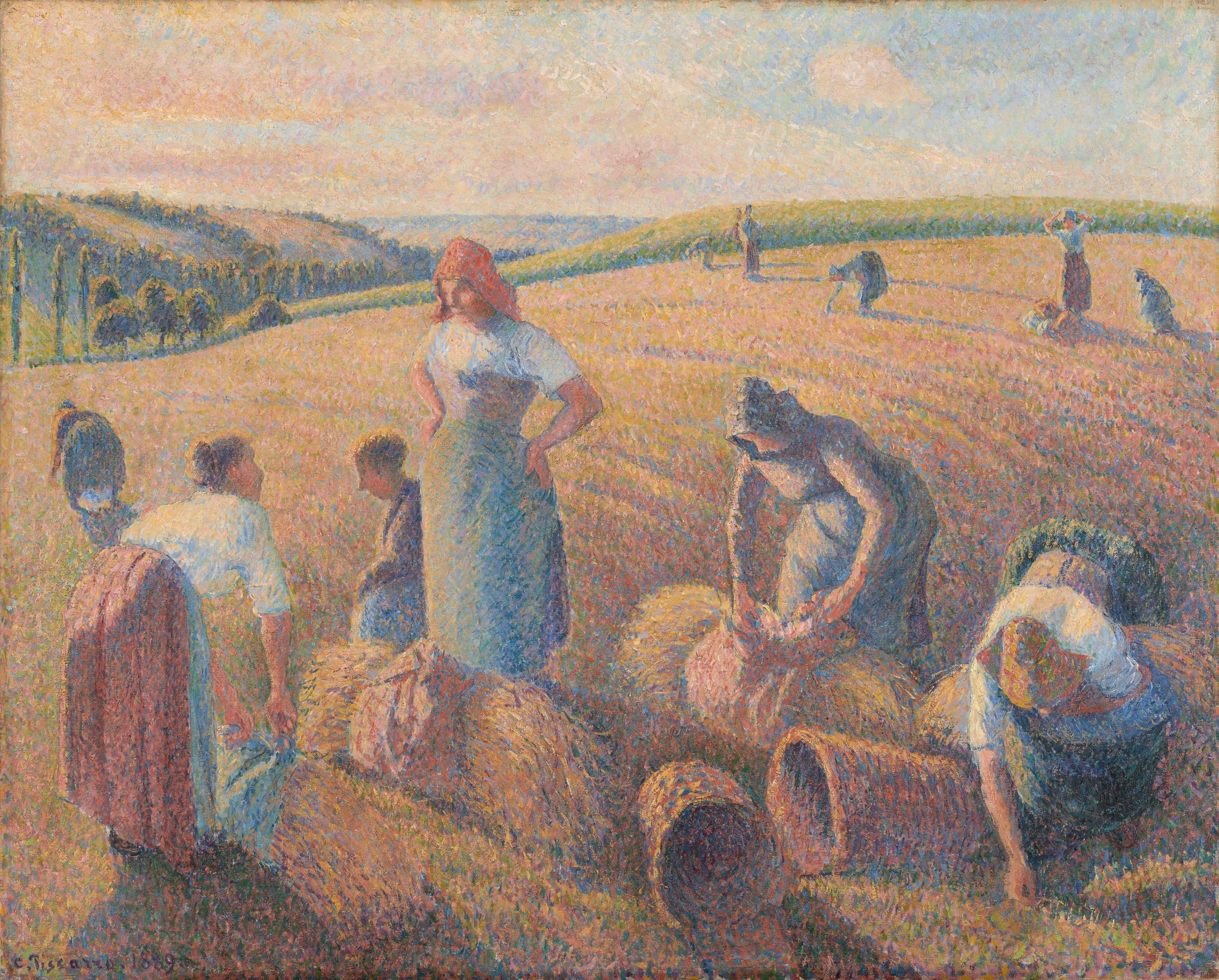
Camille Pissarro's 1889 painting of women gleaning a cut wheatfield in evening light, one standing with her hands on her hips among figures bent over the stubble, two woven baskets lying in the foreground and more gleaners scattered up the slope behind

Artwork reproduction

Painting · The Neo-Impressionist years

The Gleaners

1889 · Oil on canvas

Camille Pissarro painted eleven women gathering the grain left after the harvest, in the evening sun and in small dots of colour. The Kunstmuseum Basel held it on deposit from 1970 and was given it outright in 2021.

Kunstmuseum Basel

Camille Pissarro, The Gleaners, 1889. Kunstmuseum Basel. Image: public domain.

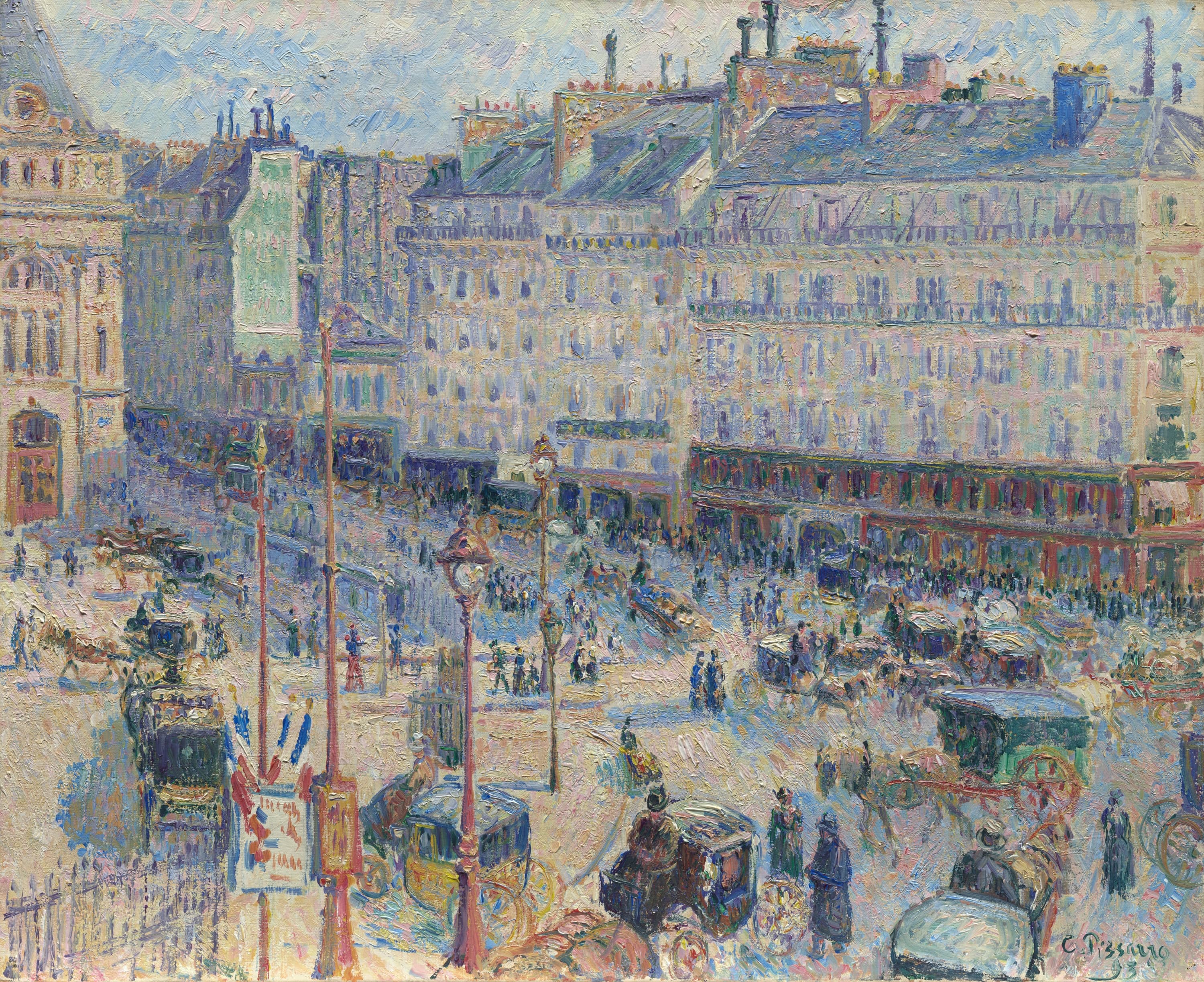
Camille Pissarro's The Place du Havre, Paris: the square outside the Gare Saint-Lazare seen from several floors up on a bright day, cream apartment blocks curving away to the right above shopfronts and awnings, green and yellow horse omnibuses, black cabs, an advertising column and crowds of small dark figures on the pale pavement

Artwork reproduction

Painting · The Paris window series

The Place du Havre, Paris

1893 · Oil on canvas

Camille Pissarro painted the square outside the Gare Saint-Lazare from his window at the Hôtel Garnier, where he stayed for a few weeks early in 1893. It is one of the first Paris pictures he made from a rented room, four years before the boulevard Montmartre series.

Art Institute of Chicago

Camille Pissarro, The Place du Havre, Paris, 1893. Art Institute of Chicago. Image: CC0.

Camille Pissarro's 1903 painting of the Pont du Carrousel seen from above through bare winter trees, the long Louvre facade running across the far bank, a tug and barge on the green and white water below

Artwork reproduction

Painting · Late series — Quai Voltaire

The Pont du Carrousel, Afternoon

1903 · Oil on canvas

One of the last pictures Camille Pissarro painted. He worked it in 1903 from a hotel window on the quai Voltaire, looking downriver at the bridge, and was dead by November.

Matsuoka Museum of Art, Tokyo

Camille Pissarro, The Pont du Carrousel, Afternoon, 1903. Matsuoka Museum of Art, Tokyo. Image: public domain.

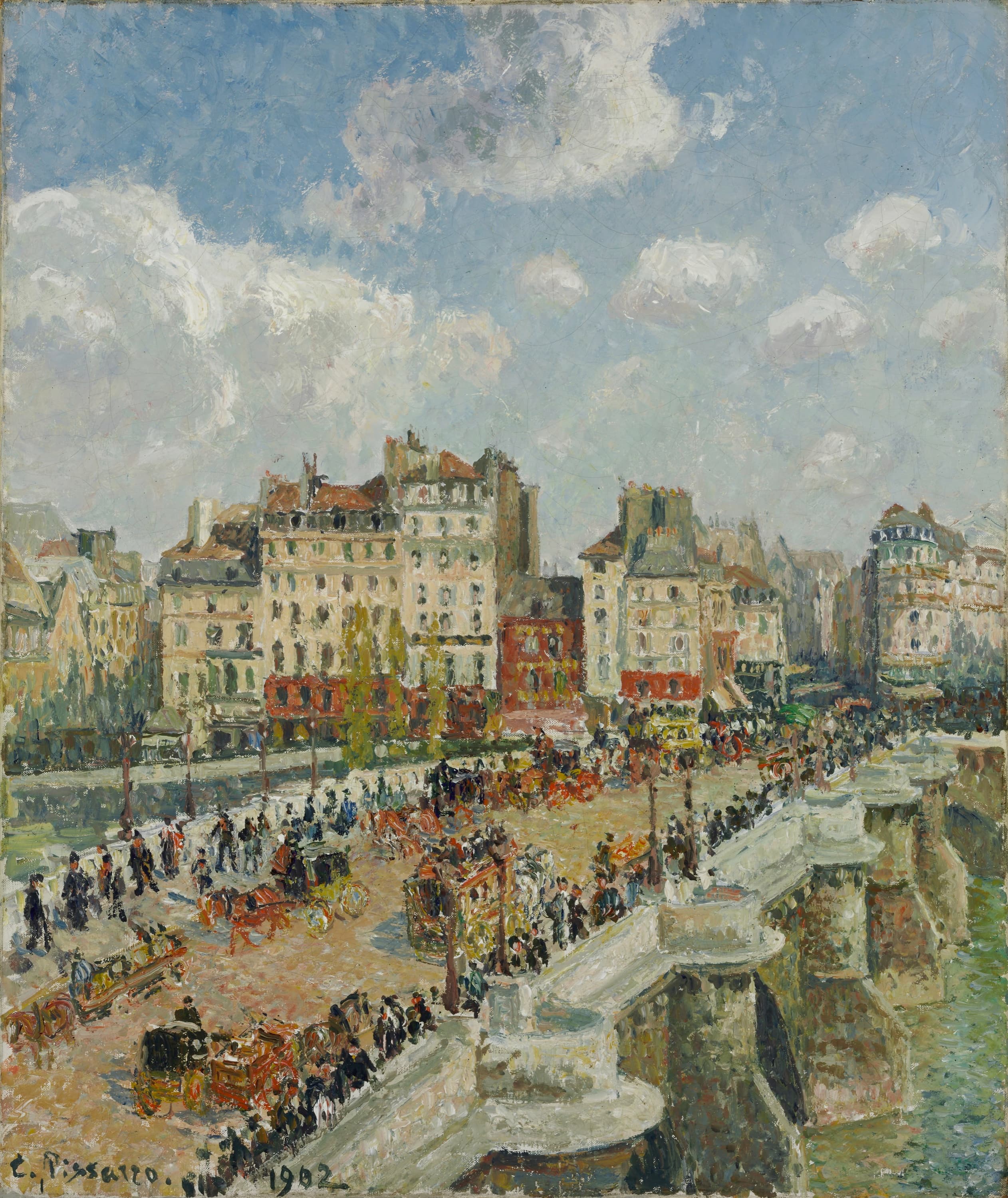
Camille Pissarro's 1902 painting of the Pont-Neuf in Paris seen from above: horse cabs, an omnibus and crowds in dark coats crossing the pale stone bridge with its rounded bays, the dark green Seine at right, a row of cream Paris houses and bare trees on the far bank, under a blue sky with white cloud

Artwork reproduction

Painting · Late series — Place Dauphine

The Pont-Neuf

1902 · Oil on canvas

Camille Pissarro painted the Pont-Neuf in Paris from the window of a rented apartment on the Île de la Cité. This upright canvas of 1902, inventory number 205.B, belongs to the Museum of Fine Arts in Budapest. Three other 1902 paintings of the bridge, all separate pictures, are in Lyon, Cardiff and Hiroshima.

Museum of Fine Arts, Budapest (Szépművészeti Múzeum)

Camille Pissarro, The Pont-Neuf, 1902. Museum of Fine Arts, Budapest (Szépművészeti Múzeum). Image: public domain.

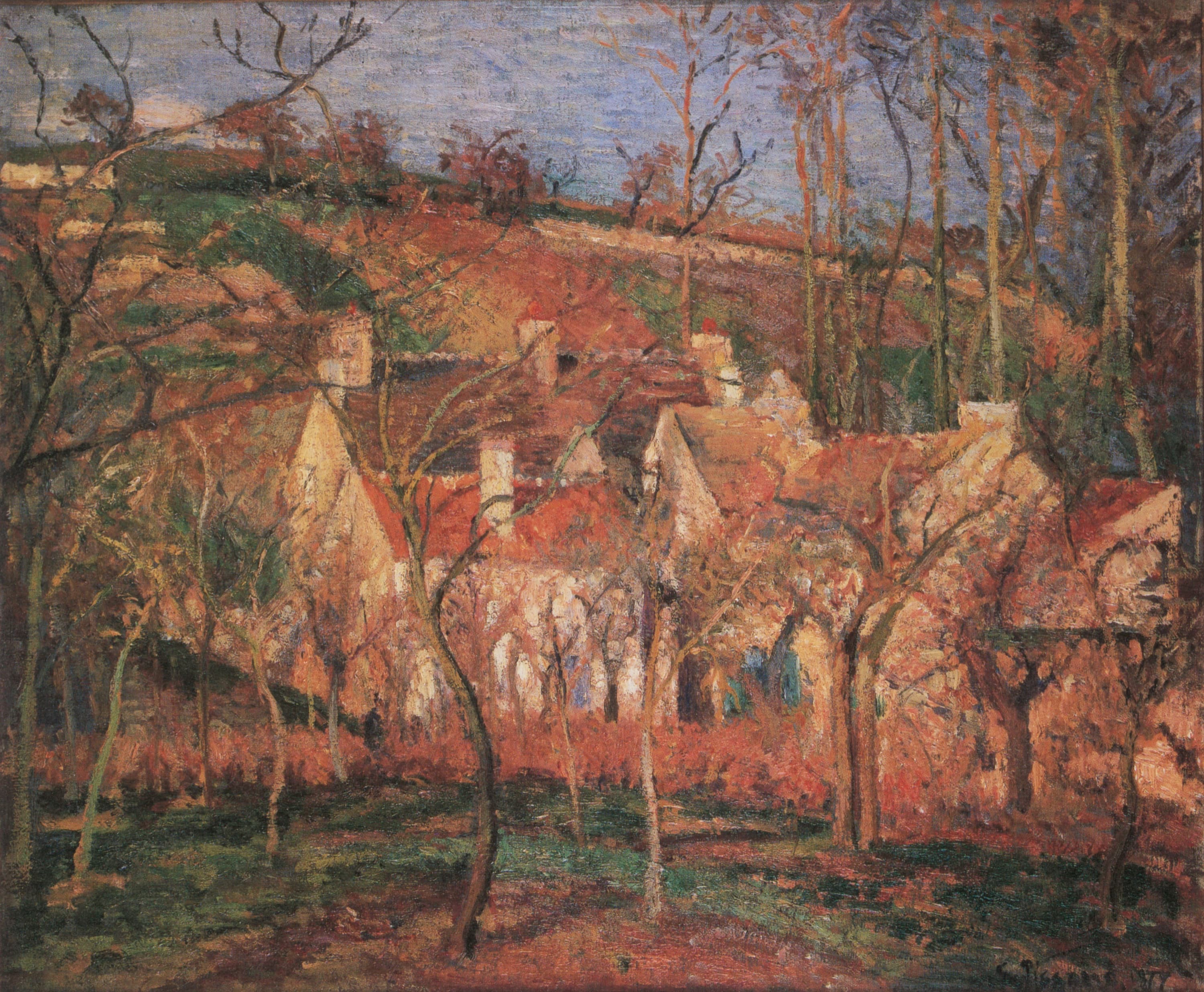
Camille Pissarro's 1877 painting of a village on a hillside at Pontoise, red tiled roofs and pale cream walls seen through a screen of bare winter trees, with green and ochre slopes rising above and a band of blue sky

Artwork reproduction

Painting · The Pontoise years

The Red Roofs, Corner of a Village, Winter

1877 · Oil on canvas

Camille Pissarro painted a corner of Pontoise in the winter of 1877, its red roofs seen through a screen of bare trees. Gustave Caillebotte owned it, and it reached the French national collections through his bequest in 1896. The Musée d'Orsay now catalogues it as Côte Saint-Denis à Pontoise.

Musée d'Orsay, Paris

Camille Pissarro, The Red Roofs, Corner of a Village, Winter, 1877. Musée d'Orsay, Paris. Image: public domain.

Camille Pissarro's Two Young Peasant Women: two women close to the front of the canvas at the edge of a sunlit field, one seated with her chin on her fist in a blue-grey blouse, the other kneeling in a red and white headscarf with her hands folded over a stick, apple trees at the left and rows of stakes on the slope behind them

Artwork reproduction

Painting · Éragny — the late figure paintings

Two Young Peasant Women

1891–92 · Oil on canvas

The largest canvas Camille Pissarro ever painted: two women resting at the edge of a field near his house at Éragny, begun in the summer of 1891 and finished in January 1892. It did not sell, and he gave it to his wife, Julie Vellay.

The Metropolitan Museum of Art

Camille Pissarro, Two Young Peasant Women, 1891–92. The Metropolitan Museum of Art. Image: CC0.

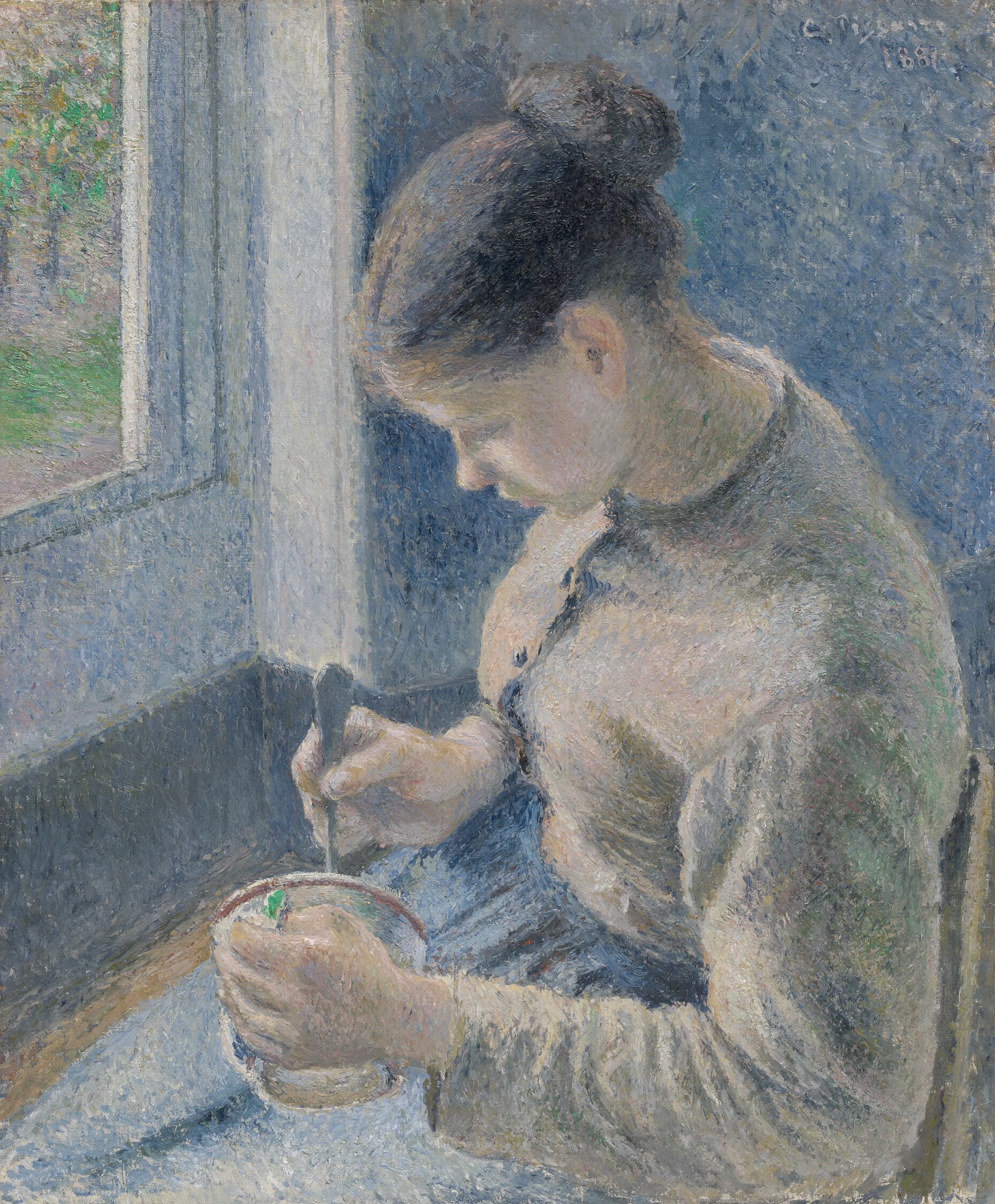
Camille Pissarro's 1881 painting of a young woman in a pale wool jacket seated at a table beside a window in blue-grey light, her head bent, stirring a spoon in a white bowl of coffee

Artwork reproduction

Painting · The figure paintings

Young Peasant Having Her Coffee

1881 · Oil on canvas

Camille Pissarro painted a young woman drinking her morning coffee in 1881 and showed it at the seventh Impressionist exhibition the following spring. It has been in the Art Institute of Chicago since 1922.

Art Institute of Chicago

Camille Pissarro, Young Peasant Having Her Coffee, 1881. Art Institute of Chicago. Image: CC0.

People they knew

Documented connections — every one carries its source.

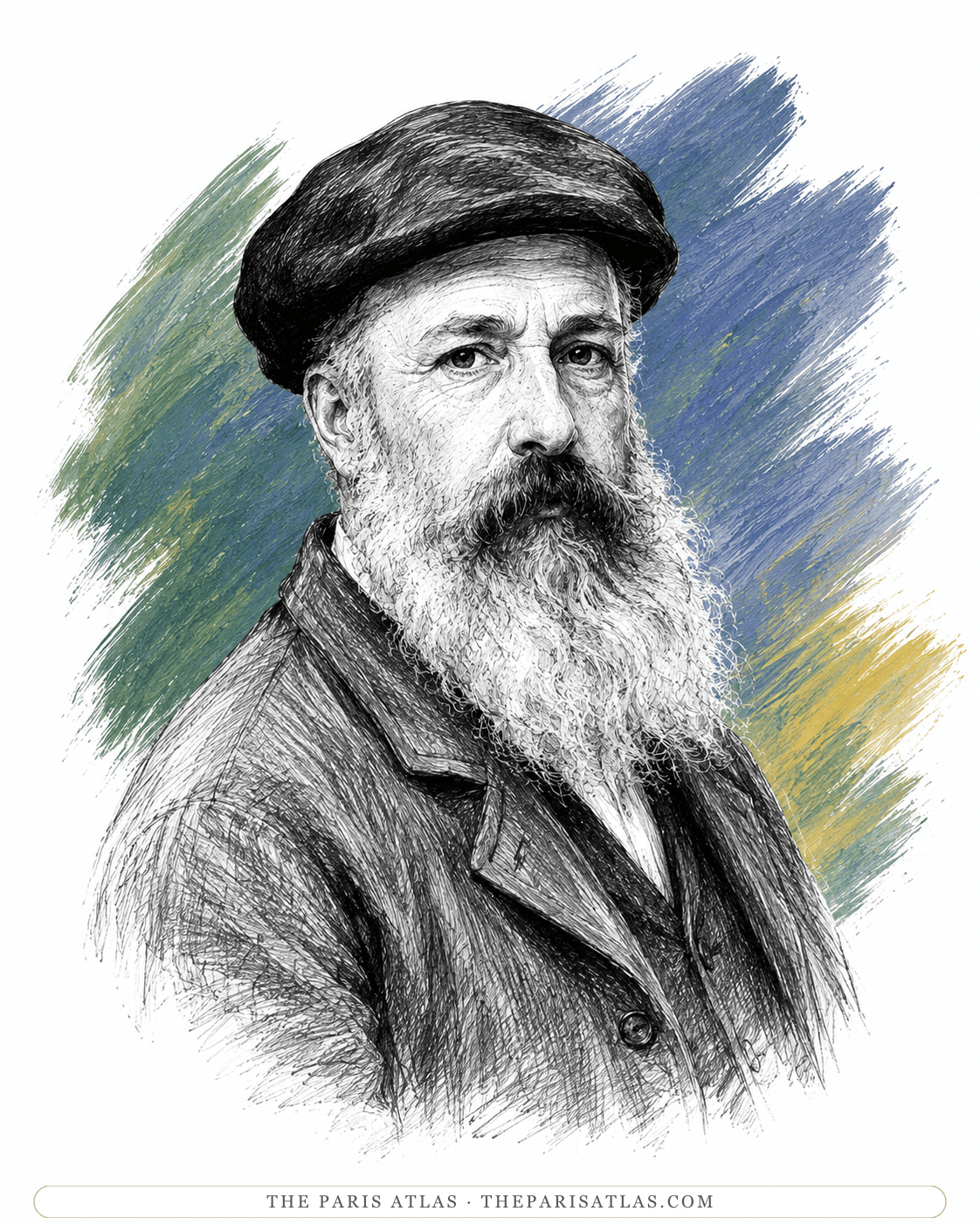
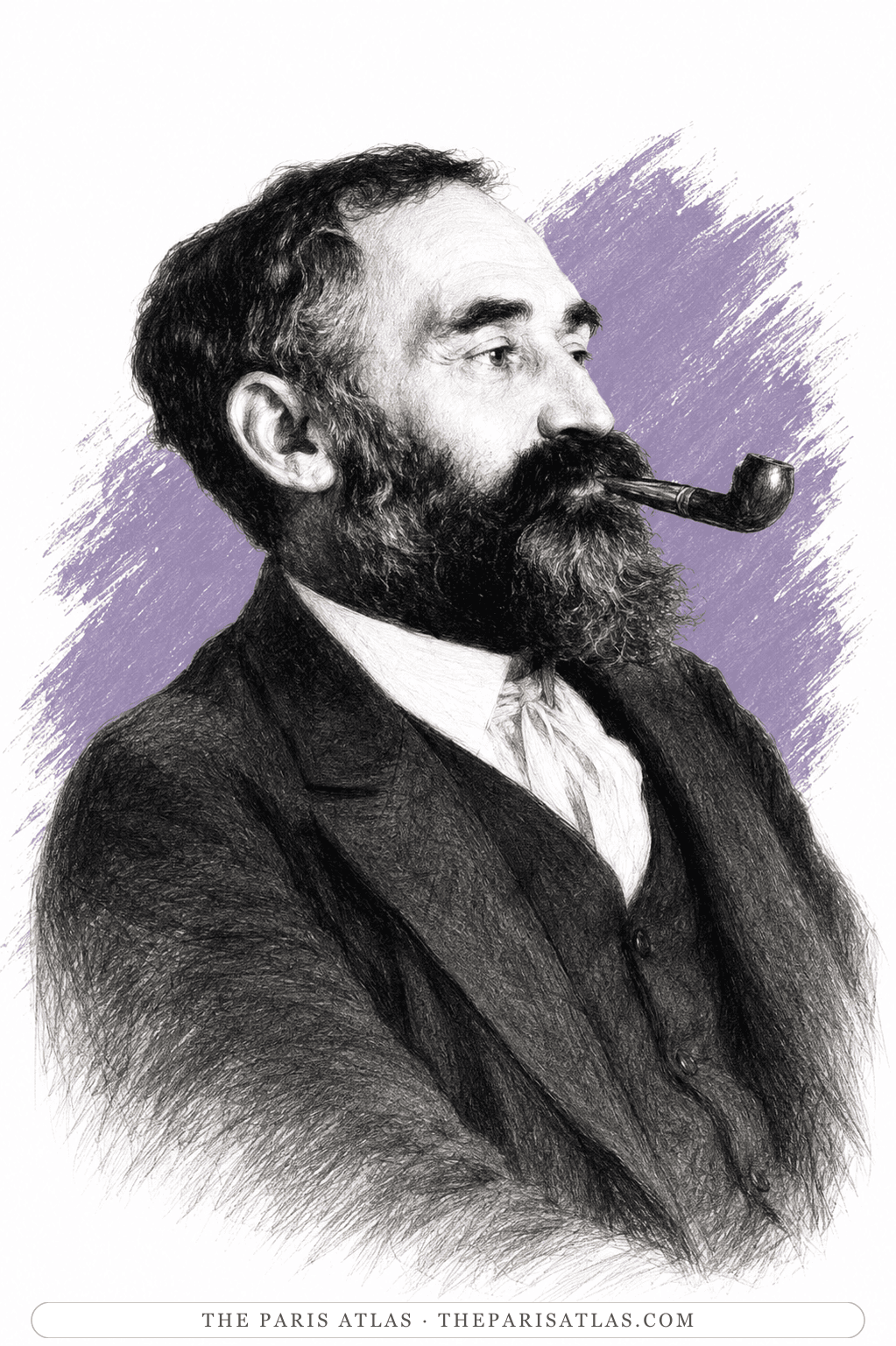
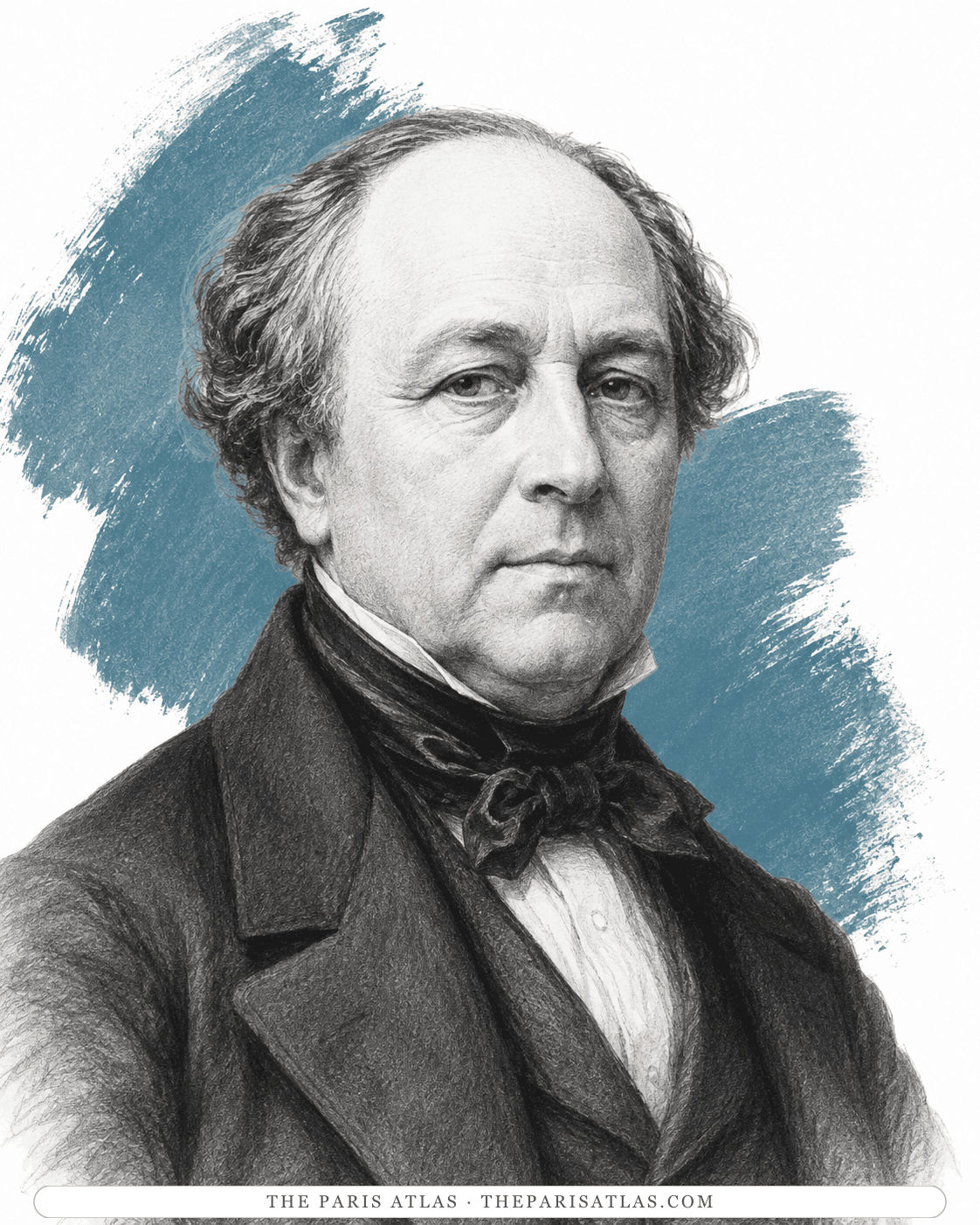
Illustrated portrait of Claude Monet

Claude Monet

  • Painter

Met · 1874

Named together by the Met among the founding members of the independent society whose 1874 exhibition named Impressionism. Pissarro showed in all eight of the group's exhibitions; Monet's Impression, Sunrise named the movement.

Impressionism: Art and Modernity — The Metropolitan Museum of Art

Illustrated portrait of Julie Vellay

Julie Vellay

Married to

They were together for years against his family's wishes before marrying in London in 1871, during the Franco-Prussian exile. Eight children followed.

Pissarro: The Honest Eye

Illustrated portrait of Lucien Pissarro

Lucien Pissarro

  • Painter
  • Illustrator
  • Printer

Mentored

He trained his son himself, and Lucien absorbed the divided brushwork at exactly the moment his father was experimenting with it. Lucien carried it to England in 1890 and founded the Eragny Press there.

Portrait of Félix Pissarro

Parent of

The eldest of the eight, born in Paris in 1863, and the one who took the family trade furthest.

Portrait of Félix Pissarro

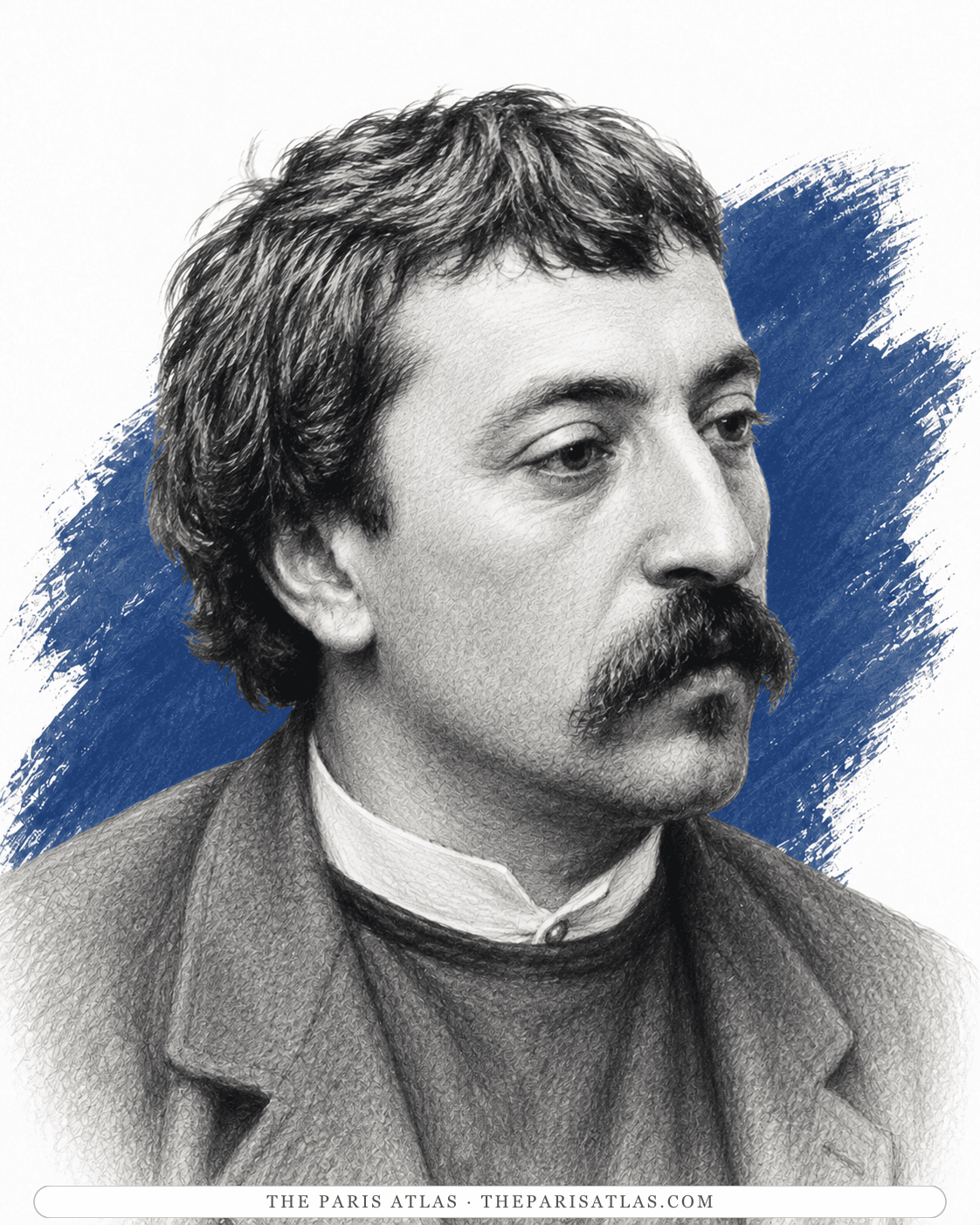
Illustrated portrait of Paul Gauguin

Paul Gauguin

  • Painter
  • Sculptor

Mentored

Gauguin was a stockbroker painting at weekends when Pissarro took him up in the 1870s, brought him into the Impressionist circle and taught him to work outdoors. The early landscapes and still lifes carry Pissarro and Cezanne openly.

Paul Gauguin (1848–1903)

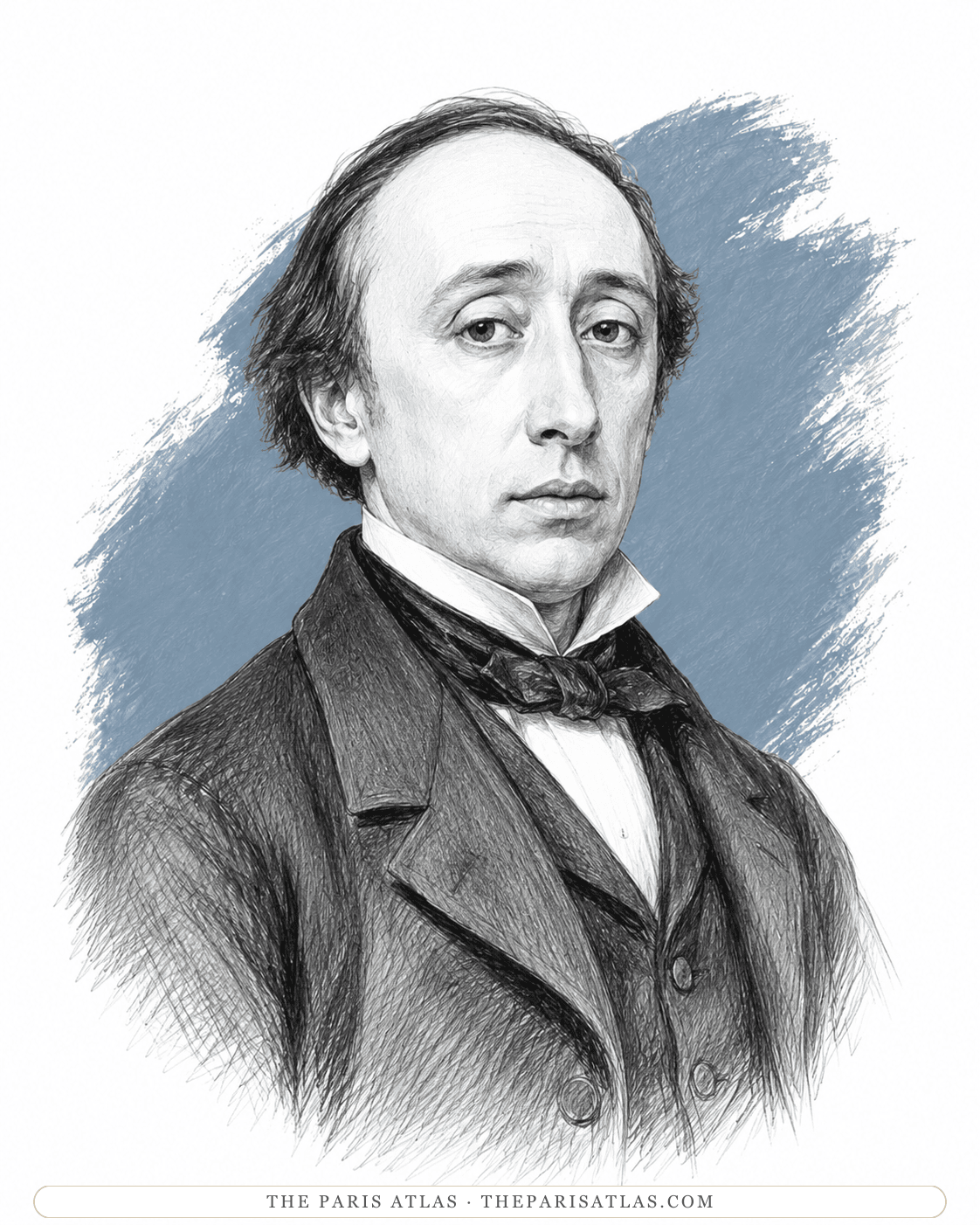
Illustrated portrait of Edgar Degas

Edgar Degas

  • Painter

Clashed with

They had worked together on printmaking. The Dreyfus Affair ended it: Pissarro supported Dreyfus, Degas took the other side, and after 1894 Degas stopped associating with him.

Pissarro: Father of Impressionism — exhibition press release; Camille Pissarro: Impressions of City & Country

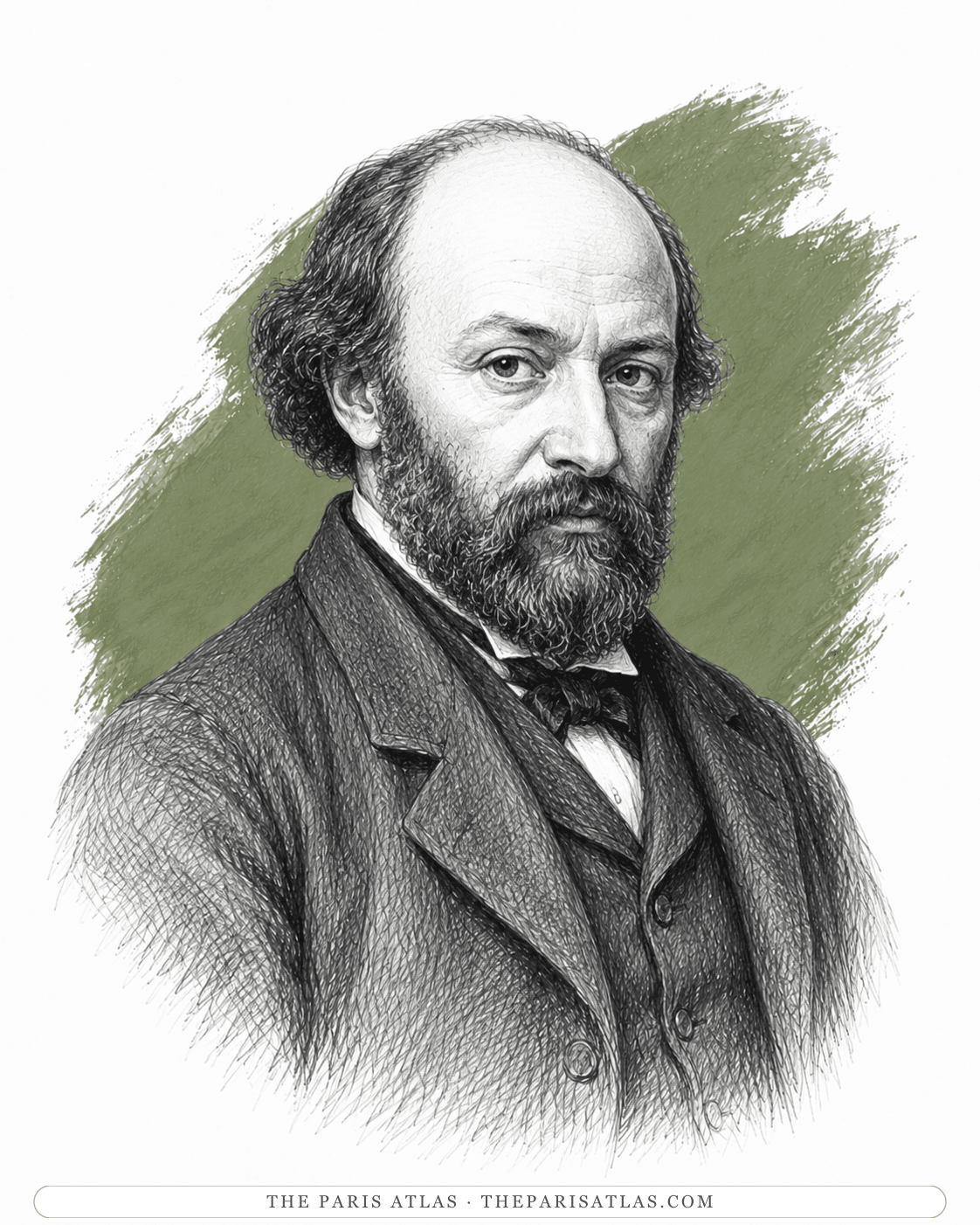
Illustrated portrait of Paul Cézanne

Paul Cézanne

  • Painter

Mentored

They worked side by side around Pontoise and Auvers-sur-Oise through the 1870s. Pissarro moved Cezanne outdoors and away from the dark, dramatic painting of his early career; as Cezanne's structure tightened it came back the other way.

Pioneering Modern Painting: Cézanne and Pissarro 1865–1885

Illustrated portrait of Paul Durand-Ruel

Paul Durand-Ruel

  • Art dealer

Met

They met in London in 1870-71, where both had gone to sit out the Franco-Prussian War. Durand-Ruel became the dealer who carried Impressionism commercially.

The National Gallery acquires a painting by Camille Pissarro

Illustrated portrait of Gustave Caillebotte

Gustave Caillebotte

  • Painter

Met

Fellow exhibitor and the largest single presence in Caillebotte's collection: eighteen Pissarros by Anne Distel's count, seven of which the state accepted from the bequest in 1896. In May 1877 the two joined Renoir and Sisley in a forty-five-painting sale at the Hôtel Drouot — the sale where Caillebotte bought back his own Floor Scrapers.

Le legs Caillebotte (Fanny Matz) — Musée d'Orsay magazine, October 2024; Raboteurs de parquets (Gustave Caillebotte) — Musée d'Orsay

Who they drew from

Influence running inward — the writers and artists whose work fed theirs. Admiration is not acquaintance; these edges claim neither a meeting nor a friendship.

Illustrated portrait of Gustave Courbet

Gustave Courbet

Courbet supplied two things Pissarro kept: ordinary working people as a subject worth the largest canvas, and the example of showing outside the Salon when the Salon would not have you.

Pissarro: Father of Impressionism — exhibition press release

Illustrated portrait of Jean-Baptiste-Camille Corot

Jean-Baptiste-Camille Corot

Pissarro reached Paris in 1855 and took Corot's observed landscape as his starting point, describing himself in early Salon catalogues as Corot's pupil.

Pissarro: Father of Impressionism — exhibition press release

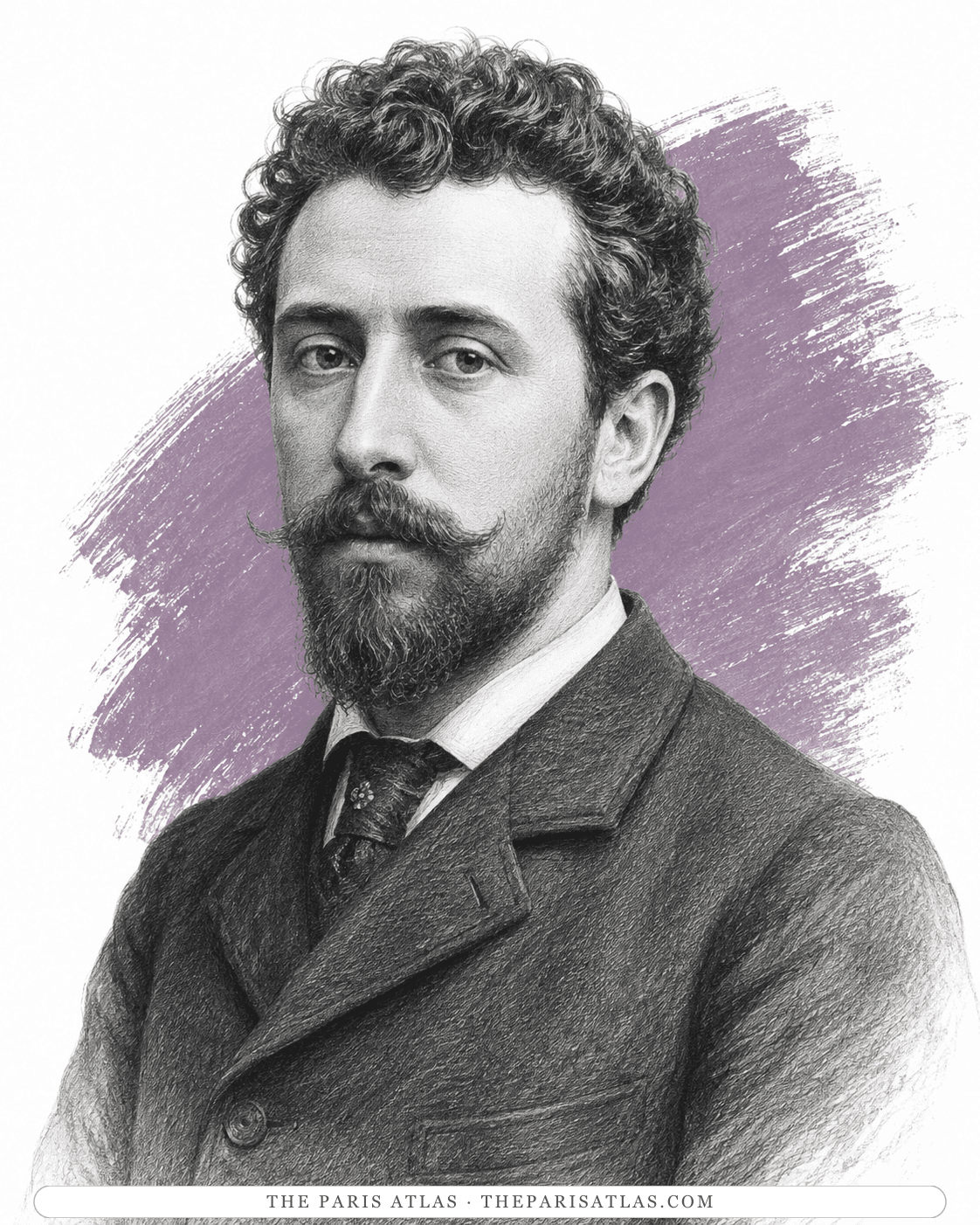
Illustrated portrait of Paul Signac

Paul Signac

Signac and Seurat built Neo-Impressionism out of colour theory, and Pissarro — a founder of Impressionism in his mid-fifties — took up their divided brushwork from the mid-1880s until about 1890.

Hommage à Camille Pissarro (1830–1903)

Who drew from them

Influence running outward — the writers and artists who built on their work.

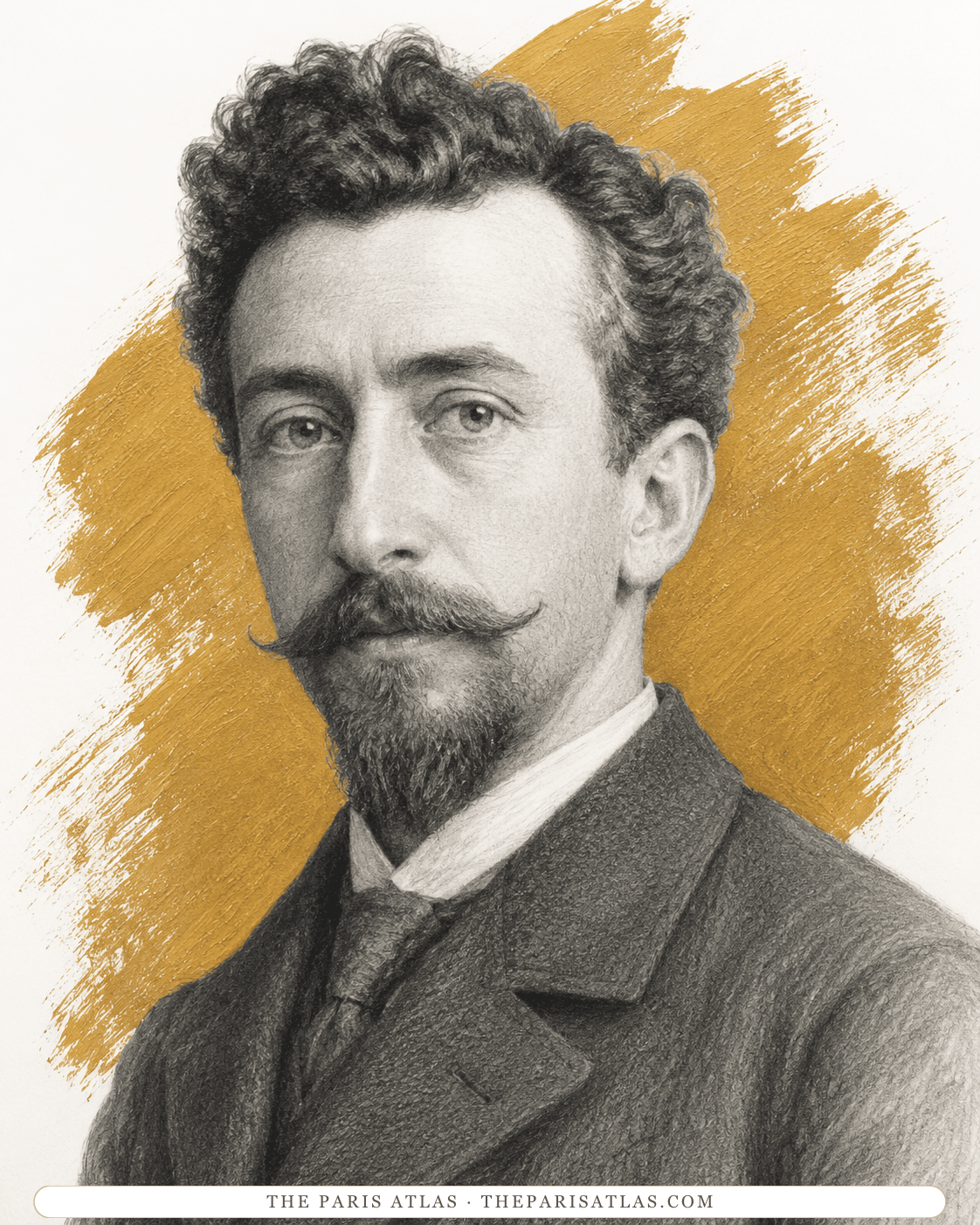
Illustrated portrait of Georges Seurat

Georges Seurat

The influence ran mostly the other way. Pissarro was in his mid-fifties when he took up the divided brushwork Seurat and Signac were developing, and he showed alongside them; what he gave back was the standing of a founding Impressionist willing to be taught.

Camille Pissarro — collection record; Hommage à Camille Pissarro (1830–1903)

Movements

The artistic and literary currents this life ran through.

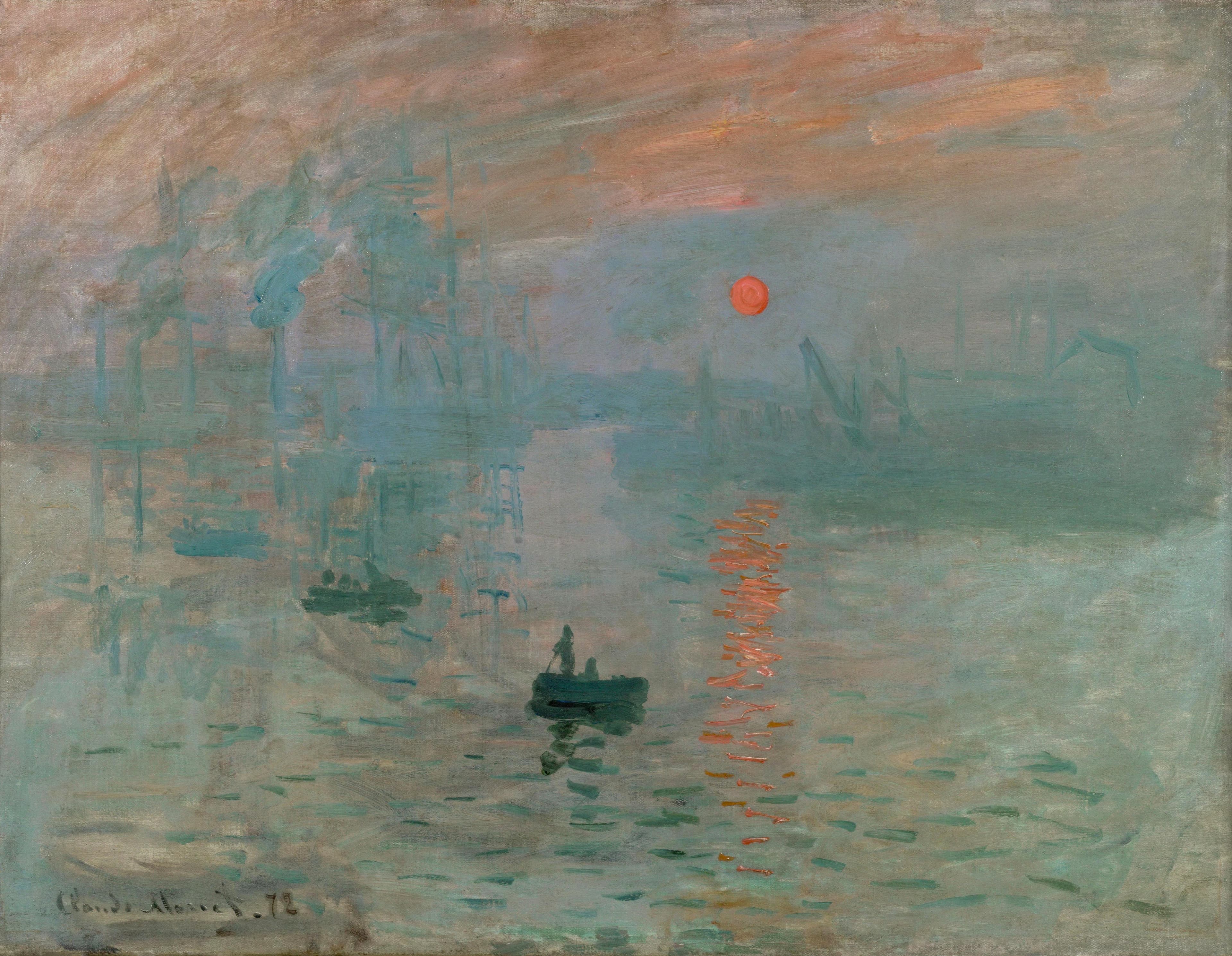
An orange sun over a hazy blue-grey harbor, small boats in the foreground, painted in loose broken strokes

Art movement · 1874–1886

Impressionism

The only painter in all eight of the group's exhibitions, and the one who brought Seurat and Signac into the last of them.

Impressionism: Art and Modernity — The Metropolitan Museum of Art

Questions about Camille Pissarro

Who was Camille Pissarro?

Camille Pissarro was a nineteenth-century painter and one of the founders of Impressionism. Born in Saint Thomas in 1830, he later settled in France and became known for landscapes, peasant scenes and city views. He was the only artist to participate in all eight Impressionist exhibitions held between 1874 and 1886.

Where was Camille Pissarro born?

Camille Pissarro was born in Charlotte Amalie on Saint Thomas on 10 July 1830. Saint Thomas was then part of the Danish West Indies and is now part of the U.S. Virgin Islands.

Was Camille Pissarro an Impressionist?

Yes. Pissarro was one of the founders and most important members of the Impressionist movement. He later experimented with Neo-Impressionism and Pointillism, particularly under the influence of Georges Seurat and Paul Signac.

What is Camille Pissarro's most famous painting?

There is no official single most famous Camille Pissarro painting, but The Boulevard Montmartre at Night of 1897 is among his best-known works. It belongs to a series of fourteen paintings Pissarro made of the boulevard Montmartre under different conditions and is the only night scene he is known to have painted.

How many children did Camille Pissarro have, and were his children painters?

Camille Pissarro and Julie Vellay had eight children. One died at birth. Of the seven surviving birth, six became artists, according to the National Gallery. The best-known painter children include Lucien, Georges Henri Manzana, Félix, Ludovic-Rodo and Paul-Émile Pissarro.

Did Camille Pissarro paint in Venezuela?

Yes. Pissarro lived and worked in Venezuela with the Danish painter Fritz Melbye during the early 1850s, particularly around Caracas and La Guaira. Among the surviving works from this period is Bridge at Caracas, dated 1854 and now in the National Gallery of Art in Washington.

Was Camille Pissarro Jewish?

Yes. Pissarro was born into a Jewish family in the Danish West Indies. His Jewish origins became especially significant during the political climate surrounding the Dreyfus Affair in France. He supported Dreyfus, and the affair contributed to the collapse of his relationship with Edgar Degas.

Did Camille Pissarro use Pointillism?

Yes. During the 1880s Pissarro experimented with the Neo-Impressionist techniques associated with Georges Seurat and Paul Signac, using small separated strokes and dots of colour. He eventually abandoned strict Pointillism but retained elements of its colour theory and brushwork.

Is the painter's name Pissarro, Pissaro, Pisarro or Pizarro?

The correct spelling is Camille Pissarro, with two s's and two r's. Camille Pissaro, Pisarro and Pizarro artist are common search misspellings referring to the same painter.

What is the Camille Pissarro rose?

The Camille Pissarro rose is not a painting. It is a multicoloured floribunda rose introduced by the French rose breeder Delbard in 1996 and named in honour of the Impressionist painter. Its striped flowers combine shades of red, pink, yellow and white.

Sourced claims

Every connection the graph holds for Camille, with the evidence behind it.

Associated with · 1874–1886

Impressionism

The only painter in all eight of the group's exhibitions, and the one who brought Seurat and Signac into the last of them.

Impressionism: Art and Modernity — The Metropolitan Museum of Art

Met · 1874

Claude Monet

Named together by the Met among the founding members of the independent society whose 1874 exhibition named Impressionism. Pissarro showed in all eight of the group's exhibitions; Monet's Impression, Sunrise named the movement.

Impressionism: Art and Modernity — The Metropolitan Museum of Art

Married to

Julie Vellay

They were together for years against his family's wishes before marrying in London in 1871, during the Franco-Prussian exile. Eight children followed.

Pissarro: The Honest Eye

Mentored

Lucien Pissarro

He trained his son himself, and Lucien absorbed the divided brushwork at exactly the moment his father was experimenting with it. Lucien carried it to England in 1890 and founded the Eragny Press there.

Portrait of Félix Pissarro

Mentored

Paul Gauguin

Gauguin was a stockbroker painting at weekends when Pissarro took him up in the 1870s, brought him into the Impressionist circle and taught him to work outdoors. The early landscapes and still lifes carry Pissarro and Cezanne openly.

Paul Gauguin (1848–1903)

Clashed with

Edgar Degas

They had worked together on printmaking. The Dreyfus Affair ended it: Pissarro supported Dreyfus, Degas took the other side, and after 1894 Degas stopped associating with him.

Pissarro: Father of Impressionism — exhibition press release; Camille Pissarro: Impressions of City & Country

Influenced

Georges Seurat

The influence ran mostly the other way. Pissarro was in his mid-fifties when he took up the divided brushwork Seurat and Signac were developing, and he showed alongside them; what he gave back was the standing of a founding Impressionist willing to be taught.

Camille Pissarro — collection record; Hommage à Camille Pissarro (1830–1903)

Mentored

Paul Cézanne

They worked side by side around Pontoise and Auvers-sur-Oise through the 1870s. Pissarro moved Cezanne outdoors and away from the dark, dramatic painting of his early career; as Cezanne's structure tightened it came back the other way.

Pioneering Modern Painting: Cézanne and Pissarro 1865–1885

Met

Paul Durand-Ruel

They met in London in 1870-71, where both had gone to sit out the Franco-Prussian War. Durand-Ruel became the dealer who carried Impressionism commercially.

The National Gallery acquires a painting by Camille Pissarro

Influenced by

Gustave Courbet

Courbet supplied two things Pissarro kept: ordinary working people as a subject worth the largest canvas, and the example of showing outside the Salon when the Salon would not have you.

Pissarro: Father of Impressionism — exhibition press release

Influenced by

Jean-Baptiste-Camille Corot

Pissarro reached Paris in 1855 and took Corot's observed landscape as his starting point, describing himself in early Salon catalogues as Corot's pupil.

Pissarro: Father of Impressionism — exhibition press release

Parent of

Lucien Pissarro

The eldest of the eight, born in Paris in 1863, and the one who took the family trade furthest.

Portrait of Félix Pissarro

Influenced by

Paul Signac

Signac and Seurat built Neo-Impressionism out of colour theory, and Pissarro — a founder of Impressionism in his mid-fifties — took up their divided brushwork from the mid-1880s until about 1890.

Hommage à Camille Pissarro (1830–1903)

Met

Gustave Caillebotte

Fellow exhibitor and the largest single presence in Caillebotte's collection: eighteen Pissarros by Anne Distel's count, seven of which the state accepted from the bequest in 1896. In May 1877 the two joined Renoir and Sisley in a forty-five-painting sale at the Hôtel Drouot — the sale where Caillebotte bought back his own Floor Scrapers.

Le legs Caillebotte (Fanny Matz) — Musée d'Orsay magazine, October 2024; Raboteurs de parquets (Gustave Caillebotte) — Musée d'Orsay