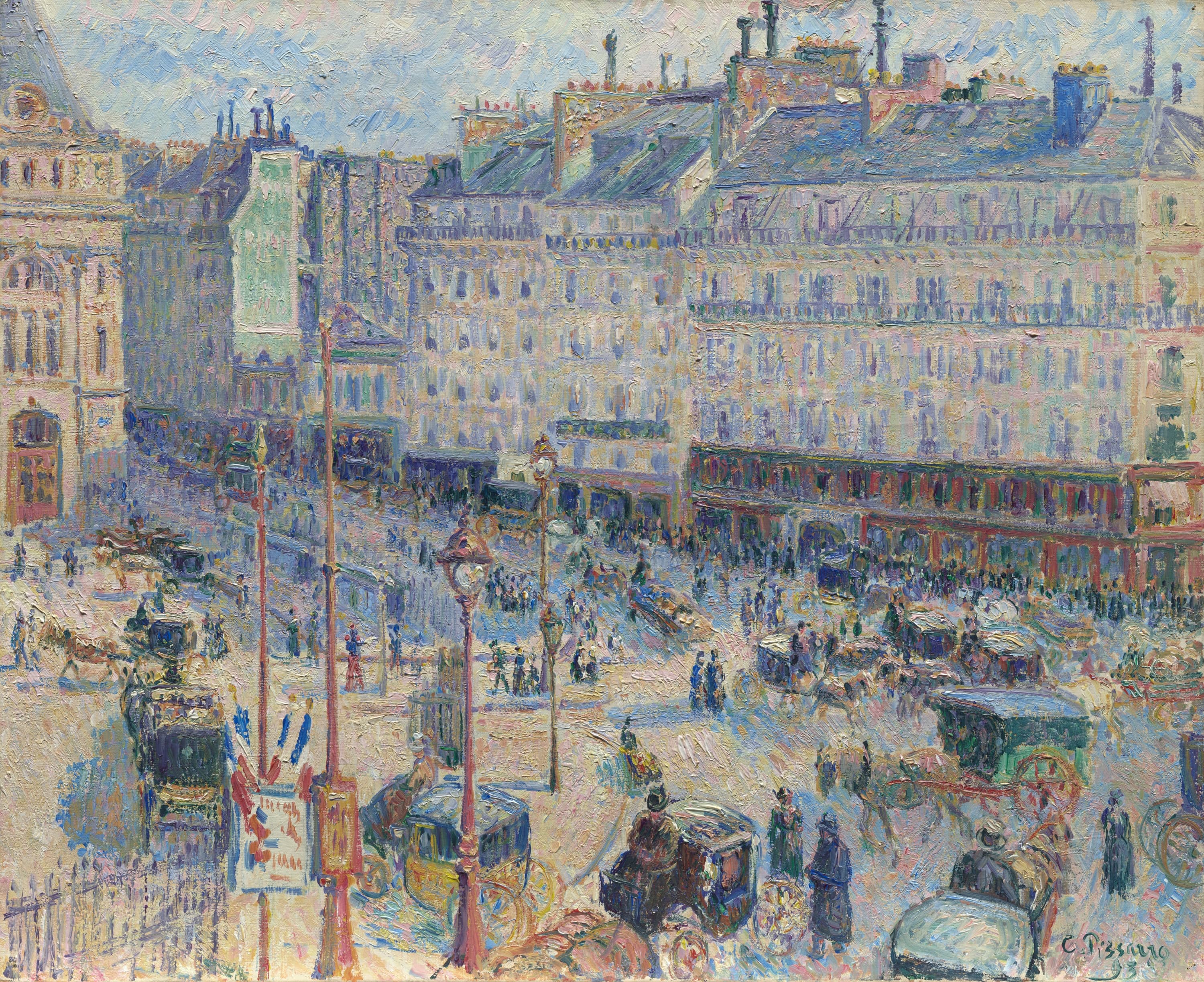
The Place du Havre, Paris
Camille Pissarro painted the square outside the Gare Saint-Lazare from his window at the Hôtel Garnier, where he stayed for a few weeks early in 1893. It is one of the first Paris pictures he made from a rented room, four years before the boulevard Montmartre series.
- 1893
- Oil on canvas
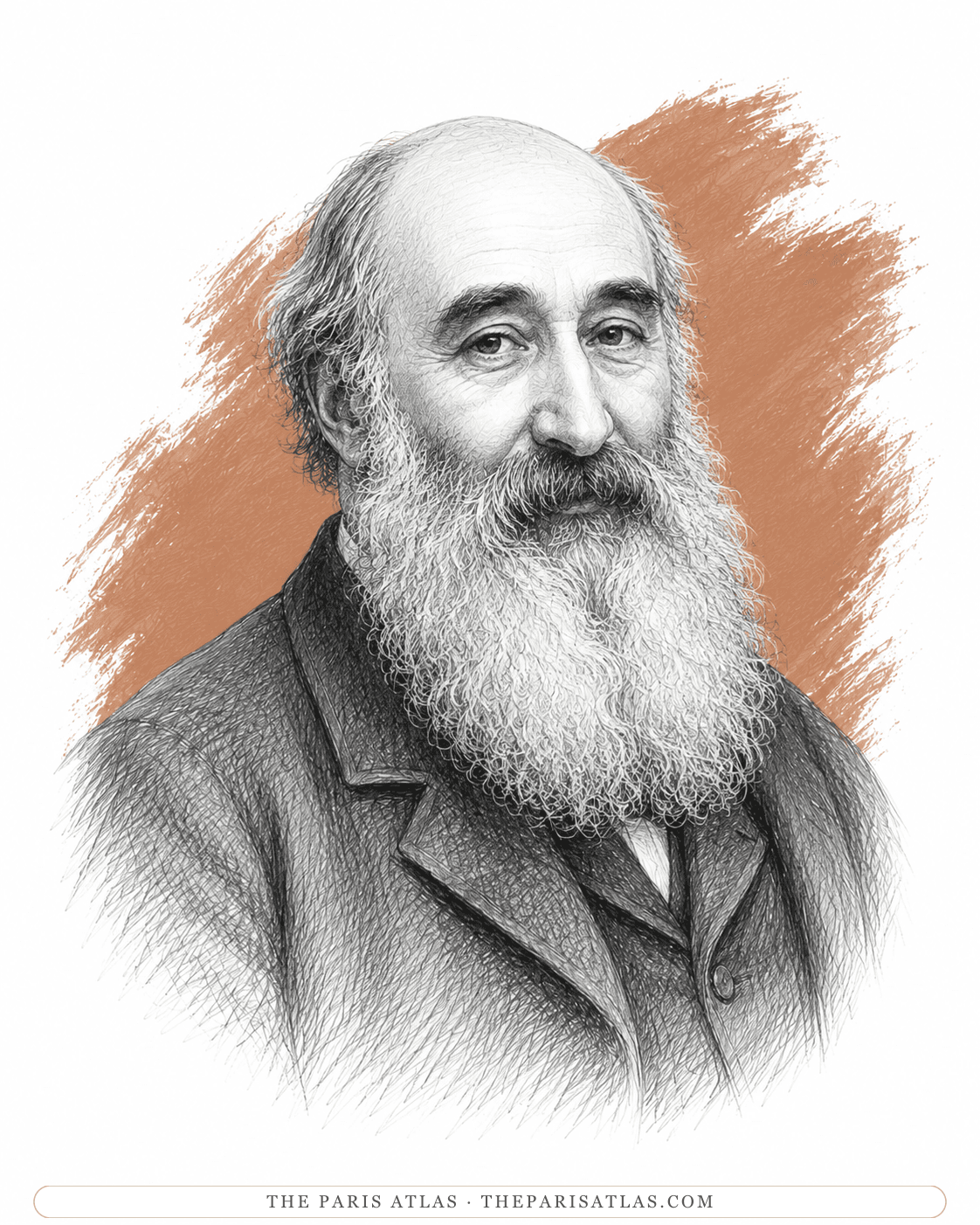
About Camille Pissarro
What the painting shows
The viewer is several floors above the street, looking down and across a wide square on a clear day. The corner of the Gare Saint-Lazare, the railway station the square serves, fills the left edge with its arched openings. From there a run of pale apartment blocks curves away to the right, cream and lilac, five storeys of shuttered windows above a continuous line of shopfronts and awnings. Chimneys stand in rows along the roofs against a sky of white and blue.
The street below is busy in the ordinary way. Horse omnibuses in green and yellow are drawn up along the near side, black cabs cut across the open pavement, a kiosk and an advertising column pasted with bills stand in the foreground, and tall lamp posts rise past the viewer's eye level. Perhaps a hundred people are in the picture, most of them a few centimetres tall and painted as a dark coat and a hat.
Nothing casts a hard shadow. Camille Pissarro built the whole surface from short separate touches of paint, so the pavement is a weave of pink, blue, cream and grey, and the crowd holds together as a texture before it resolves into people.
The window at the Hôtel Garnier
The Art Institute of Chicago, which owns the picture, places the view at the artist's window at the Hôtel Garnier, where Pissarro stayed for a few weeks early in 1893. He was sixty-two.
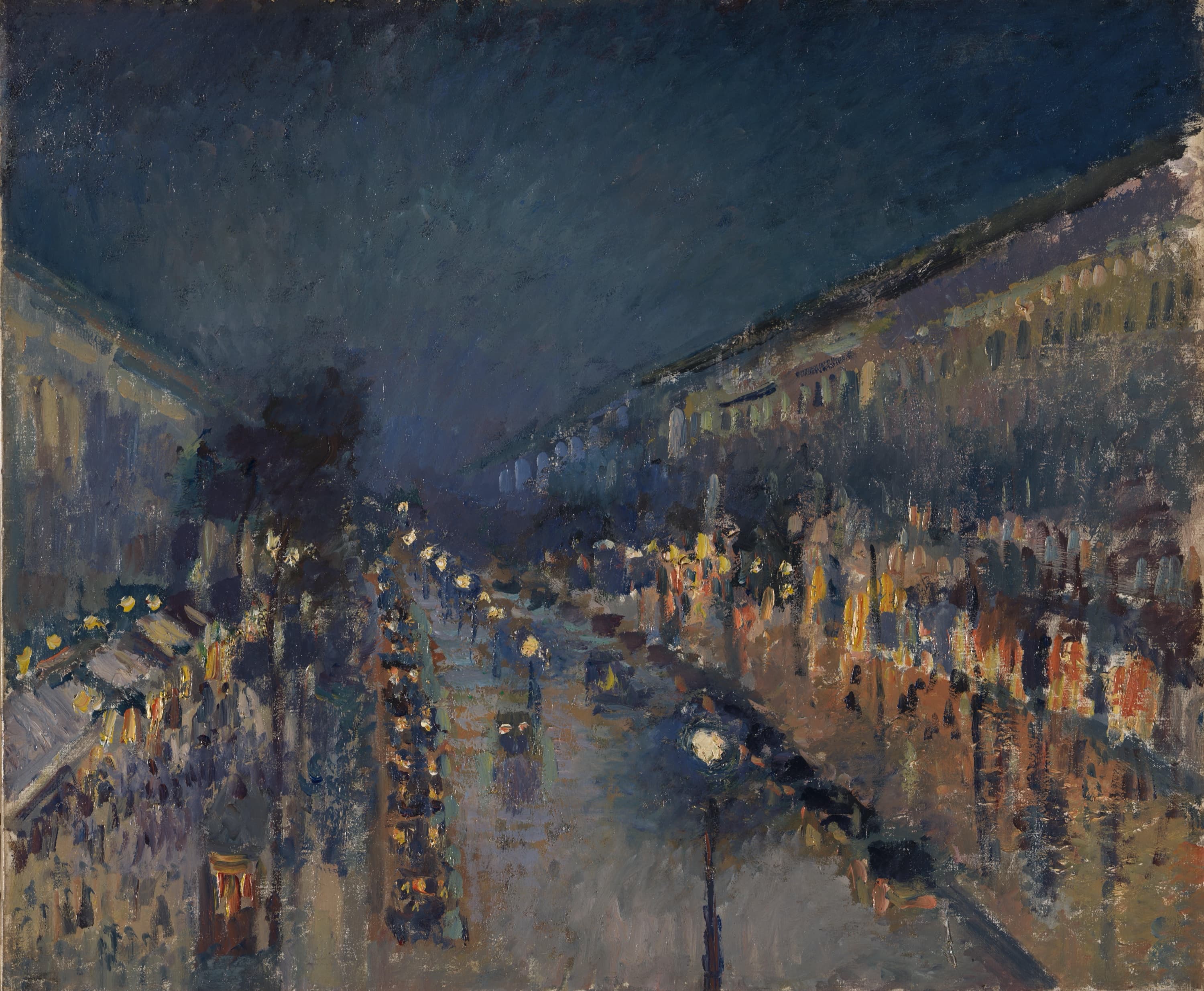
Working from a rented room was becoming his method. A recurring eye complaint made long spells outdoors in wind and dust painful, and from the 1890s he answered it by taking rooms above the streets he wanted to paint. The Philadelphia Museum of Art describes the condition only as a persistent eye infection, and no museum that holds the paintings names it more precisely. The place du Havre came four years before the fourteen views of the boulevard Montmartre that made the method famous, and ten years before the last campaign, painted from the quai Voltaire in the year he died.
One picture, three names
The painting was exhibited twice in its first two years and was called something different each time. Durand-Ruel showed it in March 1893 as number 40, la Place du Havre. In March 1894 it came back as number 8, Cour du Havre. The gallery's own stock books recorded it as Place du Hârve, a misspelling, under New York stock number 1168 and Paris stock number 2707.
The Art Institute registers no French title of its own for it. The forms above are the dealer's.
Sold to Chicago in fifteen months
Durand-Ruel bought the canvas from Pissarro on 17 March 1893, within weeks of its being painted. On 28 June 1894 the gallery sold it to Potter Palmer of Chicago for 1,200 dollars. A painting made in a Paris hotel room in the winter had an American owner before the following summer was out.
It stayed in the family after Palmer's death in 1902 and came to the Art Institute of Chicago in 1922, where it is catalogued in the Potter Palmer Collection.
Shown as a series painting
The picture spent most of the twentieth century hanging on its own in Chicago. Two large exhibitions showed it again alongside the rest of the series: the Camille Pissarro retrospective that travelled from the Hayward Gallery in London to the Grand Palais in Paris and the Museum of Fine Arts in Boston in 1980 and 1981, and The Impressionists and the City: Pissarro's Series Paintings, which opened at the Dallas Museum of Art in November 1992 and went on to Philadelphia and the Royal Academy in London.
The Museo Thyssen-Bornemisza in Madrid borrowed it again for its Pissarro exhibition in 2013.
Close reading
Reading the work, detail by detail
Pissarro's elevated view turns the busy square outside Gare Saint-Lazare into a layered system of streets, roofs, and crossings. The details show how modern movement competes with the fixed mass of the station district.
1.The square is held together by crossing traffic
Dark vehicles and people move across the light paving in several directions. Their paths make the square readable as a junction rather than an empty opening between buildings.
2.Roofs compress the railway district
Overlapping roofs, awnings, and façades crowd the middle distance. Pissarro conveys infrastructure without isolating a single engineering landmark; the district reads as accumulated urban machinery.
3.Distance converts the city into pattern
The steep viewpoint reduces faces, wheels, and shopfronts to compact strokes. It lets the painter hold a large amount of city life in one frame without pretending to stop it.
4.Station canopies identify a city organized by arrivals
Long low roofs mark the Gare Saint-Lazare district even where trains are not clearly seen. The architecture explains why so many routes and vehicles converge in the square.
5.The omnibus carries public movement through the traffic
The larger shared vehicle can be distinguished from smaller carriages by mass and route. It adds public transport to the overlapping systems that make the square modern.
6.The high window turns congestion into a readable plan
From street level, vehicles would block one another. Seen from above, their directions become patterns, allowing Pissarro to paint congestion without losing the square's structure.
Timeline
1893
Pissarro takes a room at the Hôtel Garnier for a few weeks early in the year and paints the square below it. The canvas is inscribed lower right, C. Pissarro / 93.
17 March 1893
Sold by the artist to Durand-Ruel, Paris.
March 1893
Shown at Durand-Ruel as number 40, under the title la Place du Havre.
March 1894
Shown at Durand-Ruel again, as number 8, now called Cour du Havre.
28 June 1894
Sold by Durand-Ruel to Potter Palmer of Chicago for 1,200 dollars.
1922
Given to the Art Institute of Chicago by the Palmer family, accession 1922.434, as part of the Potter Palmer Collection.
1980–81
Lent to the retrospective Camille Pissarro 1830–1903 at the Hayward Gallery, the Grand Palais and the Museum of Fine Arts, Boston, as number 73.
1992–93
Shown in The Impressionists and the City: Pissarro's Series Paintings at the Dallas Museum of Art, 15 November to 31 January, as number 38, then in Philadelphia and at the Royal Academy in London.
2013
Lent to Pissarro at the Museo Thyssen-Bornemisza, Madrid, as number 62.
Where to see it
Art Institute of Chicago
111 South Michigan Avenue, Chicago, IL 60603, United States
Displays and loans can change. Check whether this work is on view before making a special trip.
Plan your visit on the museum’s official website (opens in a new tab)Frequently asked questions
Where is the Place du Havre, and what is the building on the left?
The place du Havre is the square in front of the Gare Saint-Lazare in central Paris, and the station is the building at the left edge of the canvas. Camille Pissarro painted the view in 1893 from a window several floors above the square.
Where did Pissarro paint The Place du Havre from?
From his window at the Hôtel Garnier, where he stayed for a few weeks early in 1893. The Art Institute of Chicago gives that vantage on its record for the painting. Neither the hotel's street number nor the room is documented.
Why did Pissarro paint cities from windows?
Because a recurring eye complaint made long spells of work outdoors, in wind and dust, painful. Camille Pissarro's answer was to rent rooms overlooking the streets he wanted and paint from inside them, which also gave him a raised viewpoint and a view he could return to in any weather. The Philadelphia Museum of Art describes the condition as a persistent eye infection and does not name it further.
Where is The Place du Havre, Paris now?
The Art Institute of Chicago, accession number 1922.434, in the Potter Palmer Collection. The Palmer family gave it to the museum in 1922.
How much did The Place du Havre sell for?
Durand-Ruel bought it from Camille Pissarro on 17 March 1893 and sold it to the Chicago collector Potter Palmer on 28 June 1894 for 1,200 dollars. It has not been on the market since; the Palmer family gave it to the Art Institute of Chicago in 1922.
Why does the painting have several different titles?
Because its dealer kept changing them. Durand-Ruel showed the canvas as la Place du Havre in March 1893 and as Cour du Havre in March 1894, and the gallery's stock books entered it as Place du Hârve, a misspelling. The Art Institute of Chicago exhibits it as The Place du Havre, Paris and registers no French title of its own.
More by Camille Pissarro
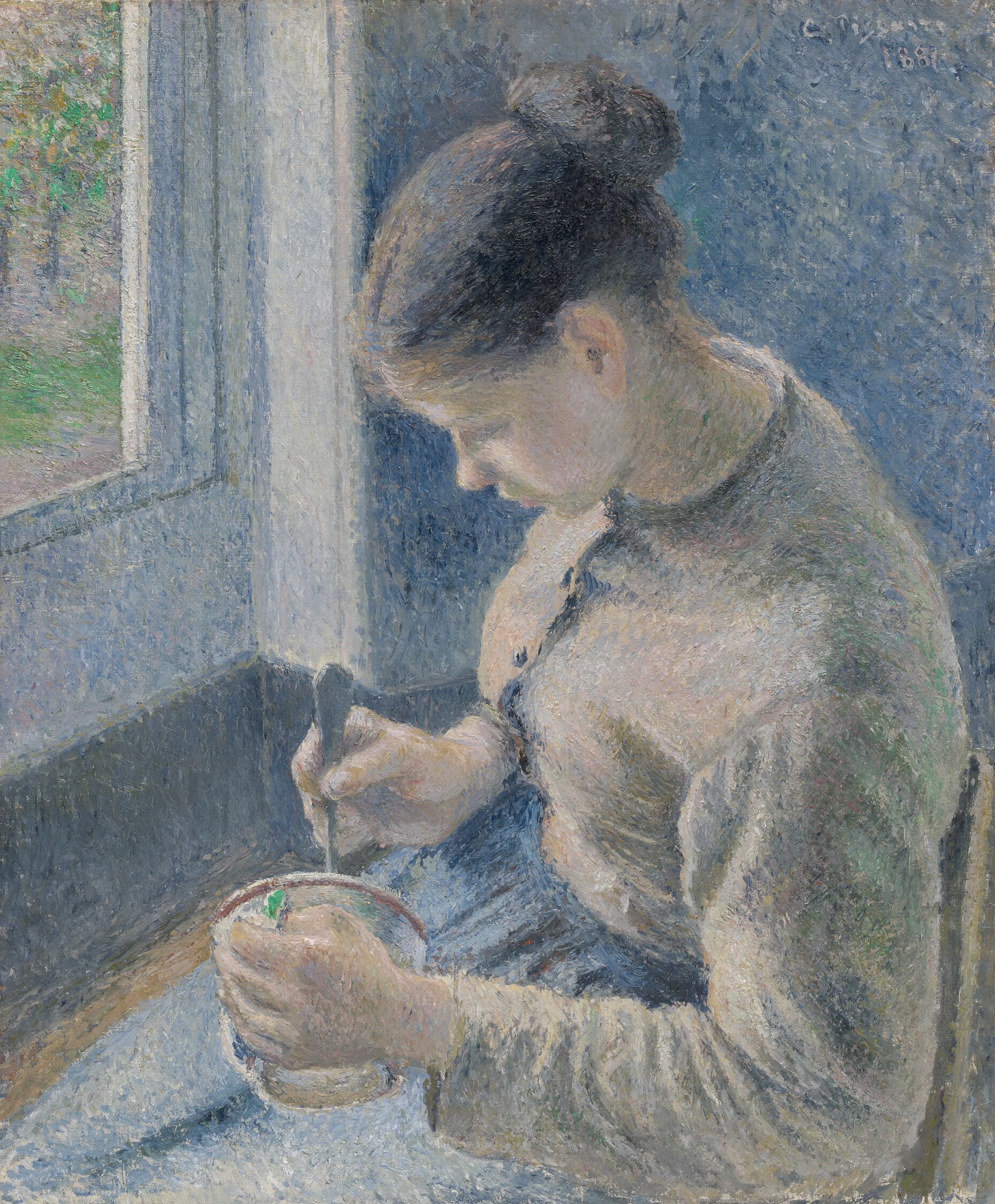
If you like Camille Pissarro
Explore painters from the same movements and circles.
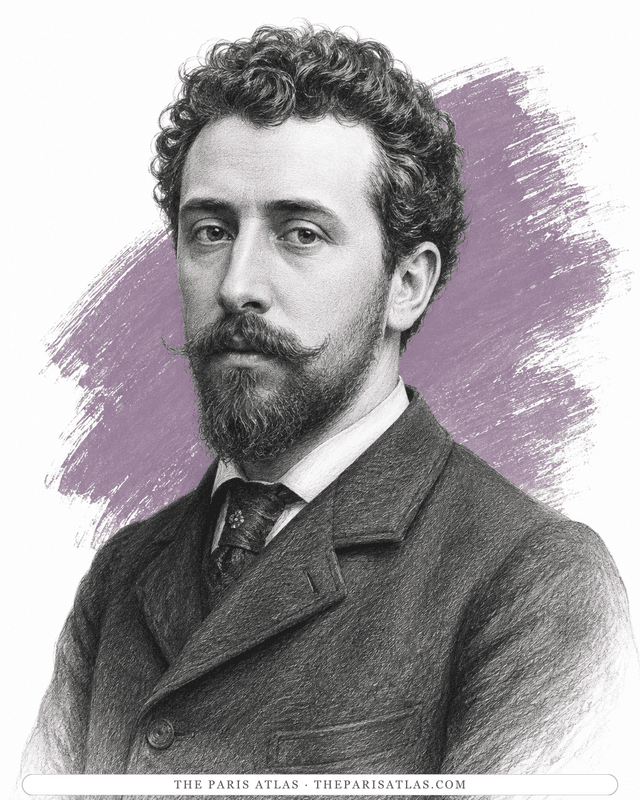
Georges Seurat
Parisian painter who built pictures from small dots of pure colour on optical principle, co-founded the Salon des Indépendants, and detonated the last Impressionist exhibition of 1886 with A Sunday on La Grande Jatte. He died at thirty-one.
View artist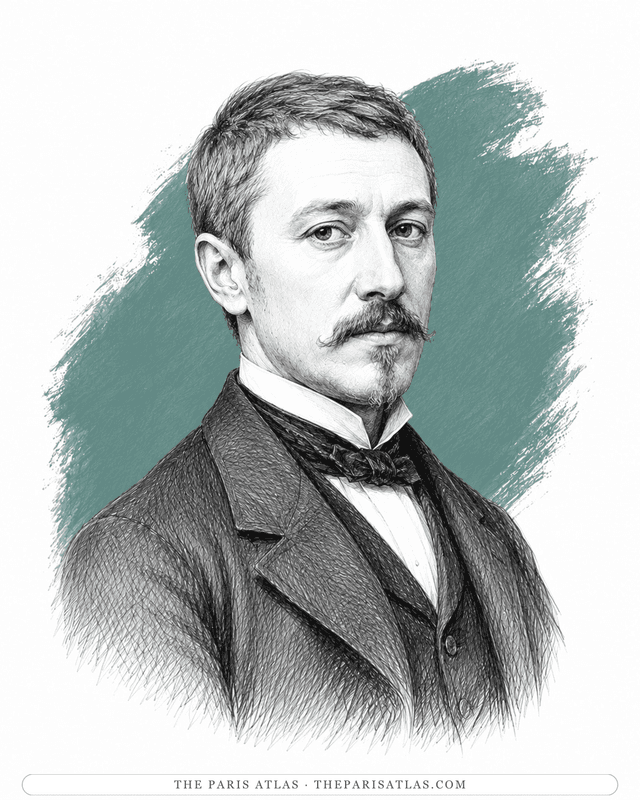
Gustave Caillebotte
Painter of Haussmann's geometry and the group's organizer-financier; his bequest of Impressionist paintings forced the French state to take the movement in.
View artist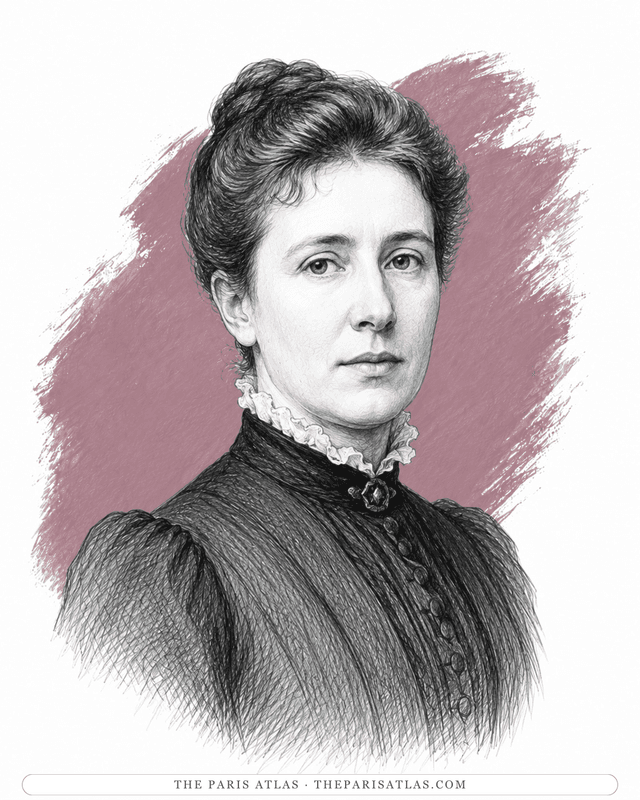
Mary Cassatt
Mary Cassatt was an American painter and printmaker known for her depictions of women and children. Based in France for the last fifty-two years of her life, she was the only American to exhibit with the original French Impressionist group, participating in four of its eight exhibitions. Edgar Degas invited her to exhibit with the group in 1877 after the Salon jury rejected her submissions.
View artist
References
The sources below include collection records, catalogues, scholarly research, and primary materials that informed this page. They document The Place du Havre, Paris, its making, and its place in cultural history.


1Art Institute of Chicago — The Place du Havre, Paris
WebsiteUsed forWeb source consulted for documented facts and historical context presented on the The Place du Havre, Paris page.
2Art Institute of Chicago — collection records
WebsiteUsed forWeb source consulted for documented facts and historical context presented on the The Place du Havre, Paris page.
3Pissarro Exhibition Guide: Sights of Paris
WebsiteDenver Art MuseumUsed forWeb source consulted for documented facts and historical context presented on the The Place du Havre, Paris page.
4Philadelphia Museum of Art — collection
WebsiteUsed forWeb source consulted for documented facts and historical context presented on the The Place du Havre, Paris page.
These references provide the documented foundation for this work's history and interpretation. Claim-level citations remain attached to the specific claims they support.
 Explore more resources