The Crystal Palace
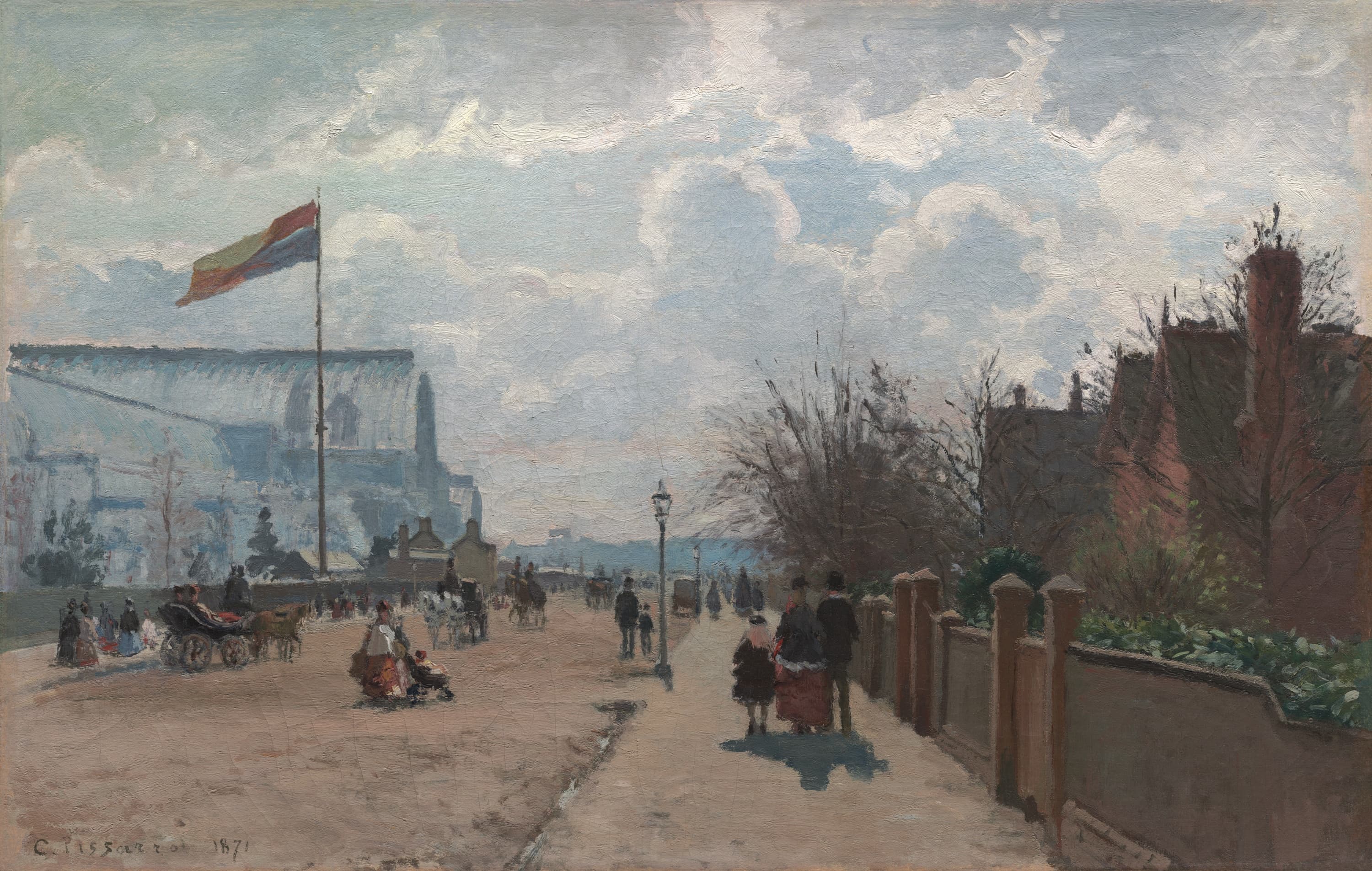
Camille Pissarro painted Joseph Paxton's glass-and-iron Crystal Palace at Sydenham in south London in 1871, during the year his family spent in England as refugees from the Franco-Prussian War. The Art Institute of Chicago has held it since 1972.
- 1871
- Oil on canvas
About Camille Pissarro
What the painting shows
The viewer stands at the edge of a wide unpaved road that runs away into the distance. On the left, filling about a quarter of the canvas, is the long glass-and-iron hall, pale blue-grey, its roofline running off the edge of the picture. A flagpole in front of it flies a flag in coloured bands.
The rest is a street in use. Carriages and small groups of figures cross the left half of the road. A cast-iron lamppost stands near the middle. On the right a brick garden wall with square piers runs beside new brick houses with gables and chimneys, and bare trees rise behind them. A man in a top hat, a woman in a red skirt and a child in white walk away from the viewer along the near pavement. The sky is grey and heaped with cloud.
The canvas is small for its subject, 47.2 by 73.5 centimetres, and is inscribed at the lower left: C. Pissarro 1871.[1]
Why a French painter was in south London
France declared war on the North German Confederation on 18 July 1870. As German troops advanced on Paris, Camille Pissarro and his family had to leave their house at Louveciennes, west of the city. They sheltered first with his friend the painter Ludovic Piette, where a second daughter, Adèle-Emma, was born and died within weeks. The National Gallery in London records that the Prussians commandeered the Louveciennes house when they invaded in September 1870, and that the family then moved to London, where Pissarro's mother and brother were already living. Tate's account of the same months says the house was used as stables.[2][3]
They arrived in early December 1870. The National Gallery places them first in the south London village then called Lower Norwood, which is where the Art Institute of Chicago's record leaves them, and then in Upper Norwood; the two districts merged fifteen years later, which is why both names attach to the same stay. Twelve pictures from the London months survive, by the National Gallery's count.[2][1]
The exile had consequences beyond the paintings. In London Pissarro met Claude Monet, and the painter Charles-François Daubigny, another refugee, introduced him to the Paris dealer Paul Durand-Ruel, who became the main buyer and champion of the Impressionists. Camille Pissarro and Julie Vellay, together since 1860, married on 14 July 1871.[4][3]
The building had already been moved once
Joseph Paxton designed the Crystal Palace for the Great Exhibition of 1851 in Hyde Park. It was praised at once for its iron frame and glass skin, and two years later it was taken down and re-erected at Sydenham, a few miles south. That is the version Pissarro painted. It burned down in 1936.[1]
It was still spoken of as the largest building in the world, and the painting does not treat it as a monument. The Art Institute puts the choice this way:[1]
“Pissarro relegated what was considered the world's largest building to the left side of the canvas, as if to give equal space to the “modern-life” scene of families and carriages parading by Sydenham's more recently constructed middle-class homes.”
What the three London pictures Pissarro painted in 1871 actually show has been argued in print. Martin Reid put the question in the Burlington Magazine in April 1977, and John House answered it in the same journal in October 1978. The Art Institute cites both.[1]
What was waiting at Louveciennes
The family went home in 1871 and found the house destroyed. Almost all of Pissarro's early work was gone. Kunstmuseum Basel's chronology of his life records that only about forty paintings survived, rescued by a neighbour.[4]
How many were destroyed is not established. A figure of roughly 1,500 canvases circulates widely, but the museum chronologies say only that almost everything early was lost, and then count what was left. Almost everything that survives from his first twenty years is work that had already gone out of the house, together with the paintings the neighbour saved.
From a Cheshire drawing room to Chicago
The earliest firm record of the painting is in England. Charles J. Galloway had it at Thorneyholme in Cheshire by 1892, when it appeared in the catalogue of his collection. It may have been shown earlier that decade in Paris: the Art Institute lists a possible appearance at Durand-Ruel's Pissarro exhibition of 3 to 21 March 1894, as either Upper Norwood, Crystal Palace or Upper Norwood, Crystal Palace, temps de neige, without deciding which.[1]
It sold at the Galloway estate sale at Christie's in London on 26 June 1905 to the dealers Bernheim-Jeune, and passed within weeks to Durand-Ruel in Paris, then to Durand-Ruel in New York by 1931. Henry Johnson Fisher bought it in 1941. It went to Hirschl & Adler in 1970 and to B. E. Bensinger of Chicago in 1971, and it entered the Art Institute of Chicago in fractional gifts from 1972, becoming wholly the museum's in 1974.[1]
Its public life was mostly twentieth-century: Glasgow in 1901, the International Society in London in 1906, Manchester in 1907, Mannheim in 1909, and the Pissarro retrospective that travelled from the Hayward Gallery to the Grand Palais and the Museum of Fine Arts, Boston, in 1980 and 1981. It was not at the Salon, and not at any of the eight Impressionist exhibitions.[1]
Close reading
Reading the work, detail by detail
Pissarro places the Crystal Palace behind an ordinary suburban foreground instead of treating it as an isolated monument. The details show modern glass architecture competing with roads, trees, and daily movement.
1.The palace rises as a pale industrial horizon
The enormous structure is compressed into a distant band of repeated uprights and roofs. Its scale is understood through length rather than dominance, a manufactured horizon behind the neighborhood.
2.The foreground belongs to ordinary passage
A road, fences, and small walkers occupy the space closest to the viewer. Pissarro makes the exhibition building part of lived surroundings rather than an object approached through ceremony.
3.Branches answer the iron framework
Irregular branches overlay the palace's mechanical repetition. Natural and industrial structures remain distinguishable, but the painted surface lets their lines mingle.
4.Ordinary brick houses resist the palace's exceptional scale
Dark roofs and compact walls occupy the same view as the vast glass building. Pissarro presents the landmark as part of a lived neighborhood rather than an isolated engineering marvel.
5.Walkers make the approach a daily route
Small figures move along the foreground road without ceremonial purpose. Their presence turns the palace from a distant attraction into something encountered within ordinary passage.
6.Repeated ribs make the palace resemble a second horizon
The building is described by long pale bands and repeated verticals. At this distance, engineering becomes a measured atmospheric line between houses and sky.
Timeline
1851
Joseph Paxton's Crystal Palace opens in Hyde Park for the Great Exhibition; it is dismantled and re-erected at Sydenham two years later.
1870
France declares war on 18 July. The Prussians commandeer the family's house at Louveciennes in September, and the Pissarros reach London in early December.
1871
Painted at Sydenham and inscribed at the lower left, C. Pissarro 1871.
1871
Camille Pissarro and Julie Vellay marry on 14 July. The family returns to Louveciennes to find the house destroyed and almost all the early work gone; about forty paintings survive.
1892
Recorded in Charles J. Galloway's collection at Thorneyholme, Cheshire.
1894
Possibly shown at Galerie Durand-Ruel, Paris, 3–21 March, as Upper Norwood, Crystal Palace. The Art Institute records this as uncertain.
1901
Exhibited at the Glasgow International Exhibition, catalogue number 1371, lent by Galloway.
1905
Sold at the Galloway estate sale, Christie's, London, 26 June, to Bernheim-Jeune, and on to Durand-Ruel in Paris in July.
1936
The Crystal Palace burns down at Sydenham.
1972
Given to the Art Institute of Chicago in fractional interests by Mr. and Mrs. B. E. Bensinger; full ownership in 1974. Reference number 1972.1164.
Where to see it
Art Institute of Chicago
111 South Michigan Avenue, Chicago, IL 60603, United States
Displays and loans can change. Check whether this work is on view before making a special trip.
Plan your visit on the museum’s official website (opens in a new tab)Frequently asked questions
What is Pissarro's The Crystal Palace?
It is a small oil painting Camille Pissarro made in 1871 of the Crystal Palace at Sydenham in south London, seen from the road beside it, with carriages, walkers and new brick houses taking up most of the picture. He painted it while living in England as a refugee from the Franco-Prussian War.
Where can I see The Crystal Palace?
At the Art Institute of Chicago, which has owned it outright since 1974. Its reference number is 1972.1164 and the credit line reads “Gift of Mr. and Mrs. B. E. Bensinger.”
Why was Camille Pissarro painting in London?
Because of the Franco-Prussian War. France declared war in July 1870, and the Prussians commandeered the family's house at Louveciennes when they invaded in September. The Pissarros reached London in early December, where his mother and brother already lived. They stayed in Lower Norwood and then Upper Norwood, south of the city. In London he met Claude Monet and, through Charles-François Daubigny, the dealer Paul Durand-Ruel.
Is the Crystal Palace still standing?
No. It burned down in 1936. Joseph Paxton built it in Hyde Park for the Great Exhibition of 1851, and it was taken apart and rebuilt at Sydenham two years later, which is where Pissarro painted it twenty years after that.
How big is the painting?
47.2 by 73.5 centimetres, so it is wider than it is tall. Several websites print the two numbers the other way round; the Art Institute's own record gives the height first.
Did Pissarro show it at an Impressionist exhibition?
No. It was not at the Salon either. The earliest showing the Art Institute records as certain is the Glasgow International Exhibition of 1901, thirty years after it was painted, by which time it belonged to an English collector.
How many of Pissarro's paintings were destroyed in the war?
The number is not settled. Kunstmuseum Basel's chronology records that the Louveciennes house was wrecked, that almost all of his early work was lost, and that only about forty paintings survived, rescued by a neighbour. Round figures for the number destroyed circulate without a museum record behind them.
More by Camille Pissarro
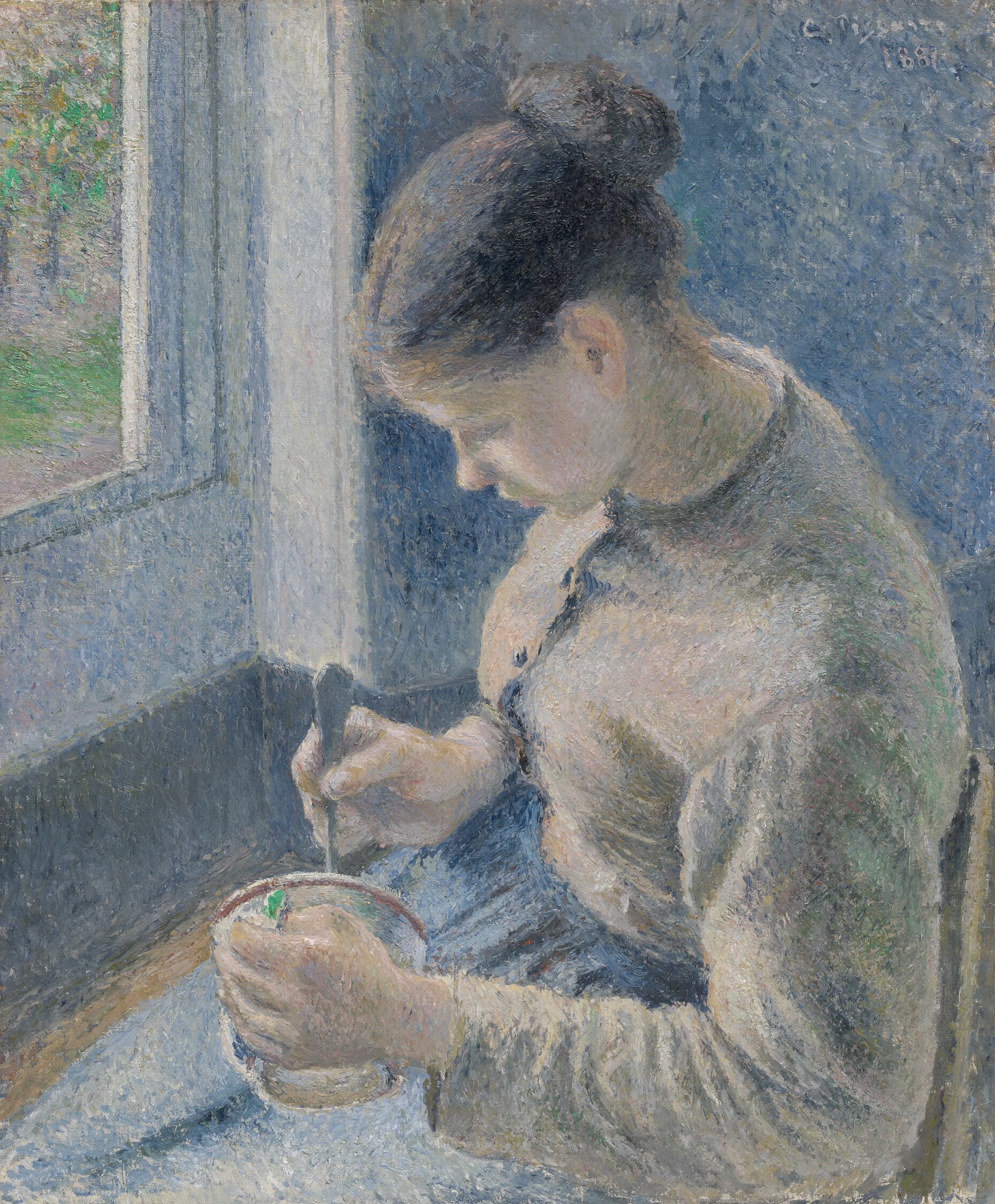
If you like Camille Pissarro
Explore painters from the same movements and circles.
Georges Seurat
Parisian painter who built pictures from small dots of pure colour on optical principle, co-founded the Salon des Indépendants, and detonated the last Impressionist exhibition of 1886 with A Sunday on La Grande Jatte. He died at thirty-one.
View artist
Gustave Caillebotte
Painter of Haussmann's geometry and the group's organizer-financier; his bequest of Impressionist paintings forced the French state to take the movement in.
View artist
Mary Cassatt
Mary Cassatt was an American painter and printmaker known for her depictions of women and children. Based in France for the last fifty-two years of her life, she was the only American to exhibit with the original French Impressionist group, participating in four of its eight exhibitions. Edgar Degas invited her to exhibit with the group in 1877 after the Salon jury rejected her submissions.
View artist
References
The sources below include collection records, catalogues, scholarly research, and primary materials that informed this page. They document The Crystal Palace, its making, and its place in cultural history.


These references provide the documented foundation for this work's history and interpretation. Claim-level citations remain attached to the specific claims they support.
 Explore more resources