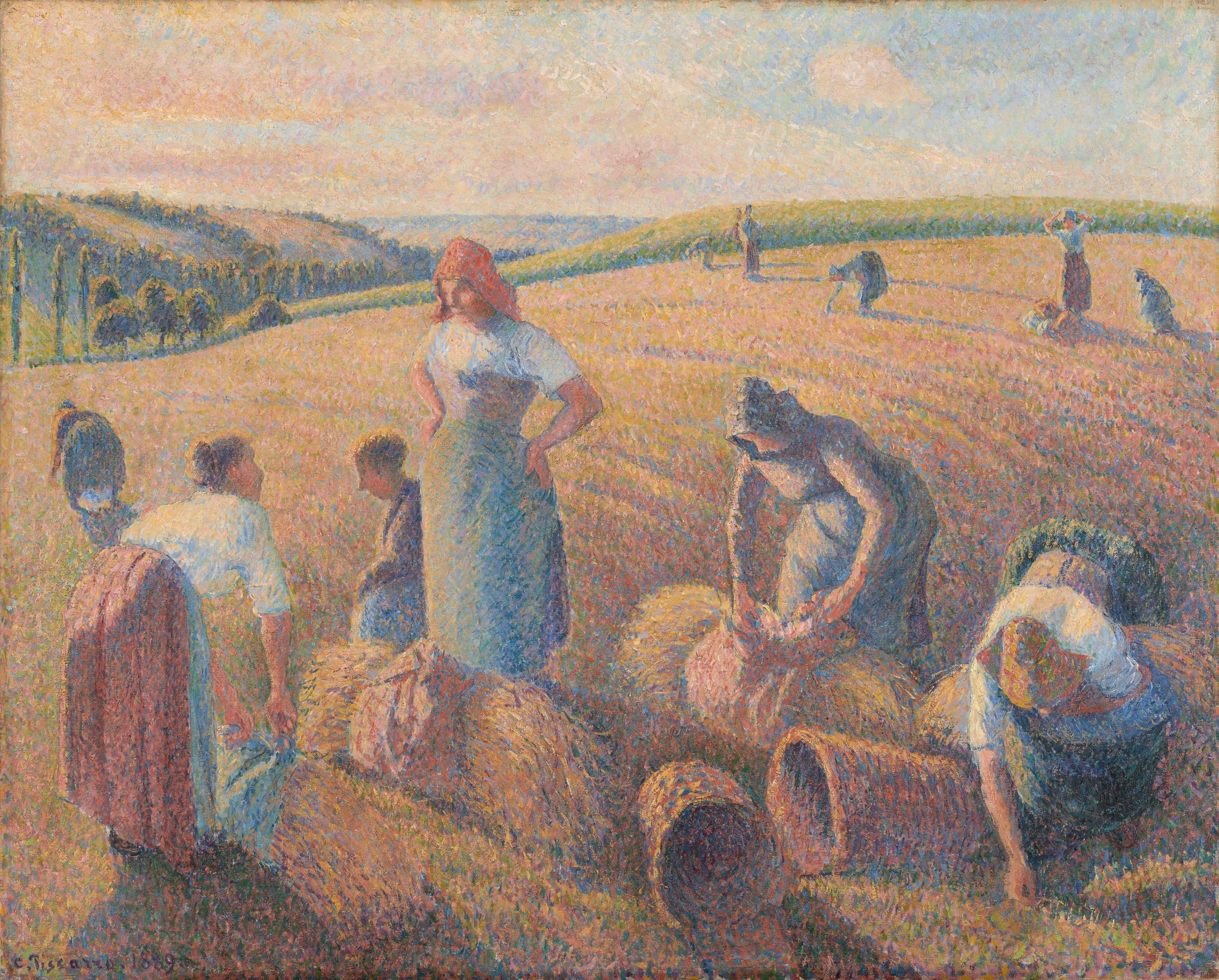
The Gleaners
Camille Pissarro painted eleven women gathering the grain left after the harvest, in the evening sun and in small dots of colour. The Kunstmuseum Basel held it on deposit from 1970 and was given it outright in 2021.
- 1889
- Oil on canvas
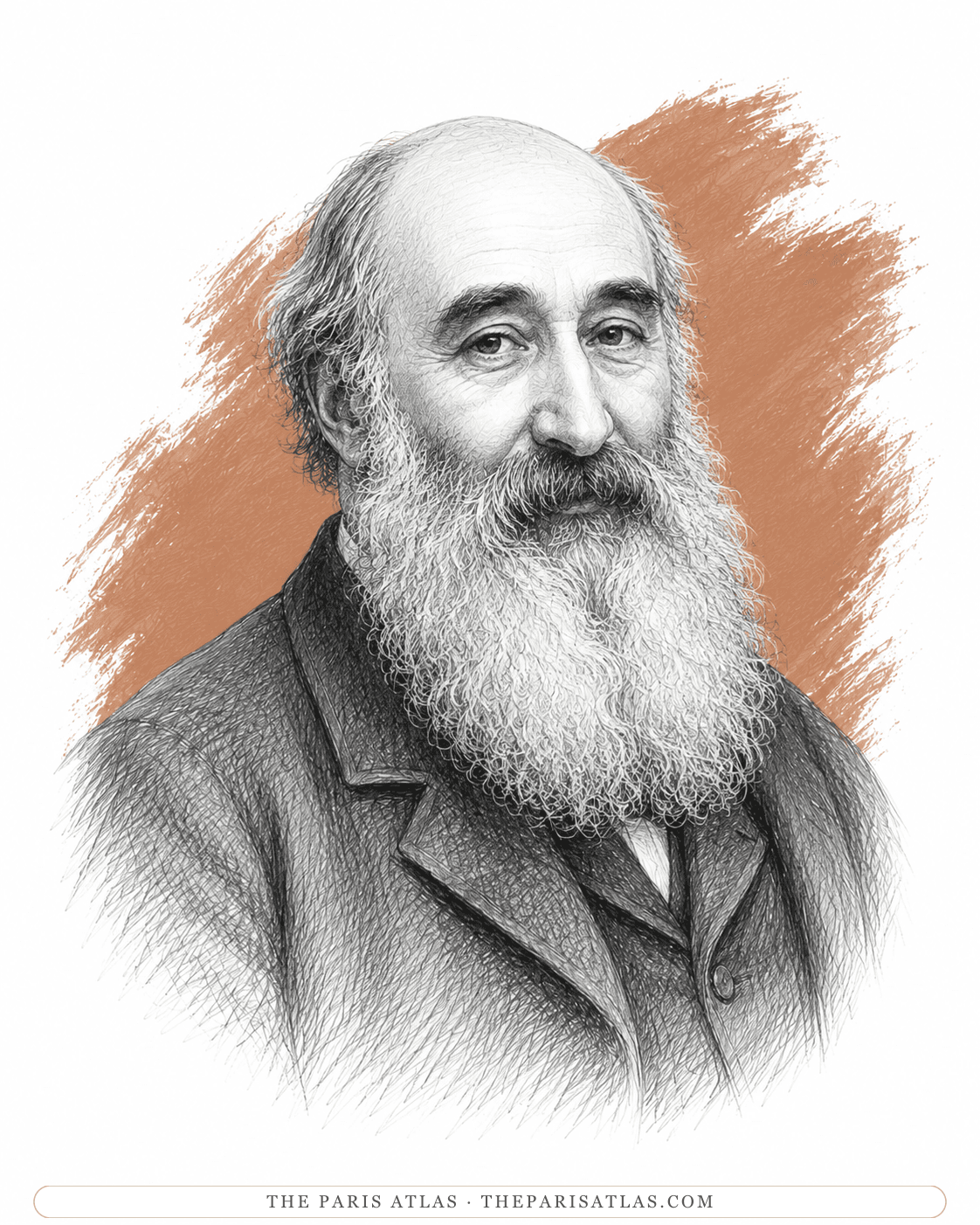
About Camille Pissarro
What the painting shows
A cut wheatfield on a slope, late in the day. In the foreground a group of women work over the stubble: several bent low with their backs to the viewer, one standing upright among them in a white blouse and a long blue-grey skirt with her hands on her hips, one at the right reaching down with both arms. Two big woven baskets lie on their sides in the grass. More figures are scattered up the field behind them, small and stooping, with two more on the crest against the sky.[1]
The Kunstmuseum Basel counts eleven gleaners in all, spread across the field in the evening sun and each shown in a different position. None of them has a face. The museum notes that by leaving out individual features Pissarro makes the figures read as types rather than portraits.[1]
The whole surface, ground and sky and clothing alike, is built from small separate touches of pink, gold, blue and green. The canvas is signed and dated at the lower left, C. Pissarro 1889.[1]
What gleaning was
Gleaning is the gathering of what the harvest leaves behind: the stalks and loose ears dropped in the field once the reapers have finished and the sheaves have been carted away. It was slow work with a small return, done by the people who had no crop of their own.
The Kunstmuseum Basel is direct about that. It describes the gleaners as a particularly precarious group, and says it is no accident that Camille Pissarro put them at the centre of a picture.[1]
The picture behind this one
The subject had a famous precedent. Jean-François Millet's Des glaneuses, painted in 1857 and now in the Musée d'Orsay, shows a small group of women bent over the stubble of a wide, nearly empty field.
Pissarro's field is not empty and his gleaners are not alone. Work is going on all over the slope, eleven bodies in eleven different attitudes, in the flat gold of a summer evening. He had been irritated for years by critics who filed him under Millet, and had told the critic Théodore Duret so in writing. This is Millet's subject painted by someone arguing with him.
How it was made
This is a composed picture, not a glimpse. The Kunstmuseum Basel says Pissarro worked on it long and intensively and assembled the group of eleven figures from numerous preparatory studies. He was at work on it by April 1888 and finished it in 1889.[1]
One of those studies survives in a public collection: a gouache of the same composition, made with charcoal, crayon and watercolour around 1889, roughly 46 by 58 centimetres, at the Cummer Museum of Art and Gardens in Jacksonville, Florida. It was lent back to Basel for the 2021 retrospective.[1]
The paint is applied in the Neo-Impressionist method Pissarro had taken up after meeting Georges Seurat in 1885: small dots of unmixed colour set side by side, left to combine in the eye of anyone standing far enough back. Basel calls Les Glaneuses one of the principal works of what it describes as a short and intense period, and dates his break with Neo-Impressionism to around 1890 — the year after he signed this canvas. What he kept from it, in the museum's reading, is the way figures and landscape are held in one harmony.[1][2]
The politics in it
Camille Pissarro was an anarchist by conviction, not by association. The Kunstmuseum Basel records that he read the movement's texts, argued about them at the cafés and dinners where the Impressionists met, and supported anarchist journals with money and with gifts of his own work.[1]
The museum connects that to the subject directly: self-sufficiency in small rural communities was an anarchist goal, as was the idea of radical social equality, so a field of women taking what the harvest left is not a neutral choice of motif. The politics are in what the picture chooses to look at rather than in any gesture the figures make.[1]
How Basel came to own it
The painting hung in the Kunstmuseum Basel for fifty years before the museum owned it. From 1970 it was a deposit of the Dr h.c. Emile Dreyfus Foundation, a long-term loan that formed part of the permanent nineteenth-century display, familiar to anyone who visited.[1]
On 30 August 2021 the museum announced that the picture had been given to the Öffentliche Kunstsammlung Basel, through contributions from an anonymous donor, the Max Geldner-Stiftung and the Stiftung Im Obersteg. Its inventory number changed with its status: G 1970.14 while it was on deposit, G 2021.8 now that the museum owns it.[1]
Basel has a long history with this painter. The museum holds eight paintings, ten drawings and watercolours and ten prints by Pissarro, which it believes to be the most important group of his work in Switzerland, and its Un coin de l'Hermitage, Pontoise of 1878 was bought in 1912, on the initiative of three young artists, as the first Impressionist painting ever acquired by a Swiss museum.[1]
The gift was announced to coincide with Camille Pissarro. The Studio of Modernism, the retrospective curated by Christophe Duvivier and Josef Helfenstein that ran at the Kunstmuseum Basel until 23 January 2022, and which also showed Turpitudes Sociales, his drawings of 1889 and 1890 on social injustice, lent by the collector Jean Bonna.[1]
Close reading
Reading the work, detail by detail
The figures in Pissarro's harvest field are defined by repeated bending, reaching, and carrying. The close views keep attention on labor while showing how late light and divided marks spread the action through the landscape.
1.Repetition makes labor collective
Several bodies repeat the same lowered arc without becoming identical. The rhythm describes a shared task, while small differences in pose keep each worker from dissolving into a decorative pattern.
2.One upright figure interrupts the field
The upright body creates a vertical pause among the repeated stoops. That contrast gives the scene its tempo: labor includes lifting, carrying, and momentary rest as well as gathering.
3.Grain and light share the same broken marks
Short touches describe stubble, scattered grain, shadow, and sunlight simultaneously. The field does not sit behind the workers; it is the textured condition through which their bodies move.
4.Hands stay close to the ground where the remaining grain lies
The action is small and repetitive rather than spectacular. By keeping hands near the earth, Pissarro shows that the work depends on careful attention to what harvesting has left behind.
5.Bands of cut field organize labor across distance
Horizontal changes in color and texture divide near gathering from farther work. The land's organization makes the women's repeated movements part of a larger agricultural cycle.
6.Head coverings identify practical protection, not costume
The women wear coverings suited to sun and field work. Differences in color help separate bodies while keeping clothing tied to the conditions of labor.
Timeline
1884
Pissarro settles at Éragny, the village north of Paris where the harvest fields of his later paintings are.
1885
Meets Georges Seurat and takes up painting in separate dots of colour.
1888
At work on Les Glaneuses by April.
1889
Finished and signed at the lower left. A gouache study of the same composition dates from about this year and is now at the Cummer Museum of Art and Gardens in Jacksonville.
1890
Breaks with Neo-Impressionism, by the Kunstmuseum Basel's dating, keeping the balance of figure and landscape it taught him.
1970
Placed at the Kunstmuseum Basel as a deposit of the Dr h.c. Emile Dreyfus Foundation, inventory number G 1970.14, and hung in the permanent nineteenth-century display.
2021
Given to the Öffentliche Kunstsammlung Basel on 30 August, through an anonymous donor, the Max Geldner-Stiftung and the Stiftung Im Obersteg. The inventory number becomes G 2021.8.
2021
Shown in Camille Pissarro. The Studio of Modernism at the Kunstmuseum Basel, which ran until 23 January 2022.
Where to see it
Kunstmuseum Basel
St. Alban-Graben 16, 4051 Basel, Switzerland
This is the Hauptbau address. The museum has three buildings; confirm the artwork’s current building and display before travelling.
Plan your visit on the museum’s official website (opens in a new tab)Frequently asked questions
Where is Pissarro's The Gleaners?
The Kunstmuseum Basel, in Switzerland, under the inventory number G 2021.8. The painting had hung there since 1970 as a long-term deposit, and the museum was given it outright in 2021.
What is gleaning?
Collecting the grain the harvest leaves in the field: the loose ears and stalks dropped once the reapers have gone and the sheaves are carted off. It was done by people who had no harvest of their own, and the Kunstmuseum Basel describes the gleaners as a particularly precarious group.
How many women are in the painting?
Eleven, by the Kunstmuseum Basel's count, spread across the field in the evening sun and each in a different posture. Camille Pissarro left their faces blank, which the museum reads as making them archetypes rather than individuals.
Is this the same painting as Millet's The Gleaners?
No. Jean-François Millet's Des glaneuses of 1857 is a different painting, in the Musée d'Orsay in Paris. Camille Pissarro's Gleaners of 1889 takes the same subject thirty-two years later, fills the field with figures and paints it in the small dots of colour he had adopted from Georges Seurat.
Was it shown at an Impressionist exhibition?
It cannot have been. The eighth and last of the Impressionist exhibitions was held in 1886, three years before this canvas was finished. Camille Pissarro was the only painter who showed in all eight of them.
Why does the painting have two inventory numbers?
Because its ownership changed. It was catalogued as G 1970.14 while it was on deposit at the Kunstmuseum Basel from the Dr h.c. Emile Dreyfus Foundation, and became G 2021.8 when the museum was given the painting in 2021. Older references and image files still carry the 1970 number.
Is there a study for it?
Yes. A gouache of the same composition, worked up with charcoal, crayon and watercolour around 1889, is at the Cummer Museum of Art and Gardens in Jacksonville, Florida, which bought it with funds from the Morton R. Hirschberg Bequest. The Kunstmuseum Basel says the eleven figures were assembled from numerous preparatory studies.
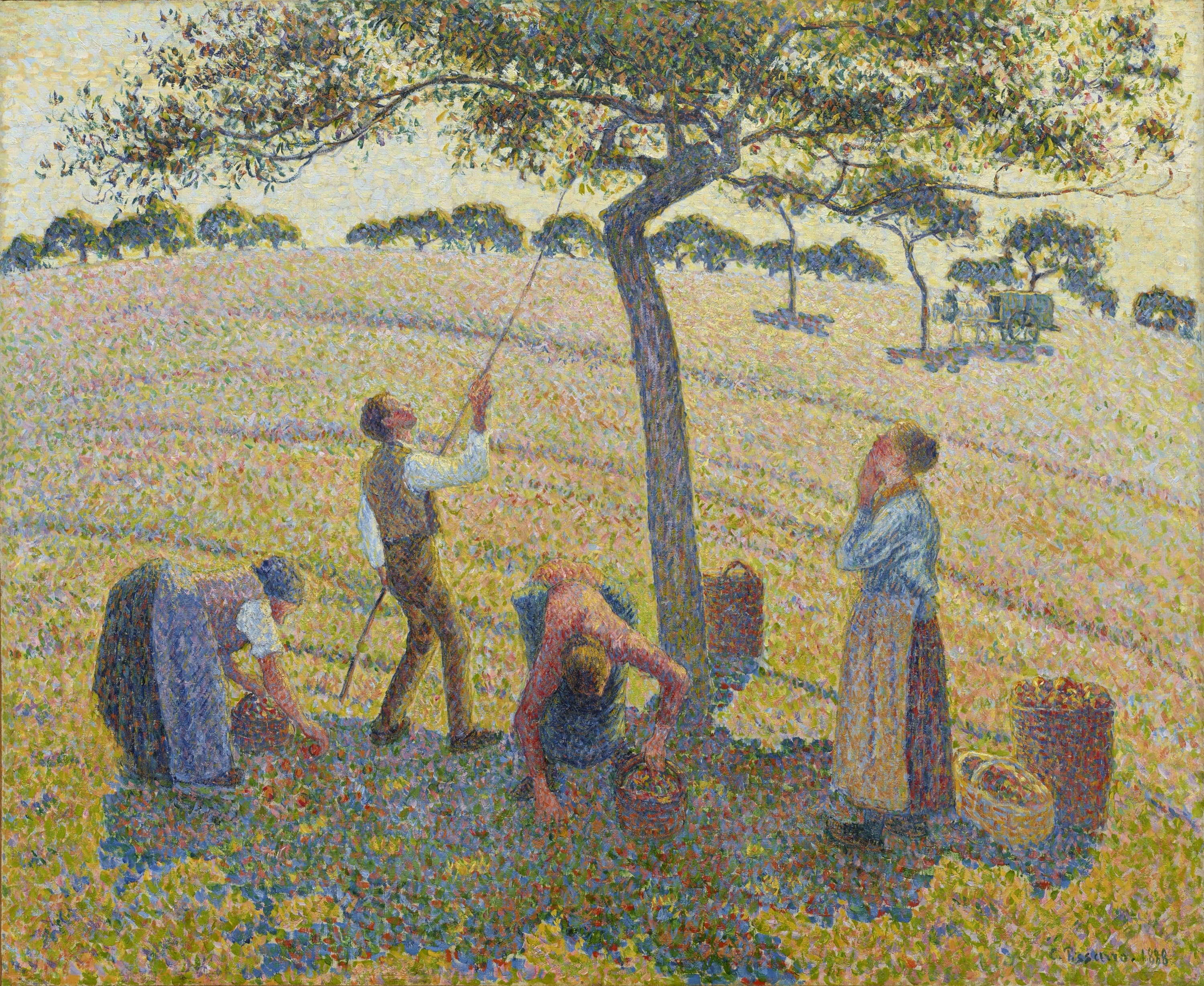
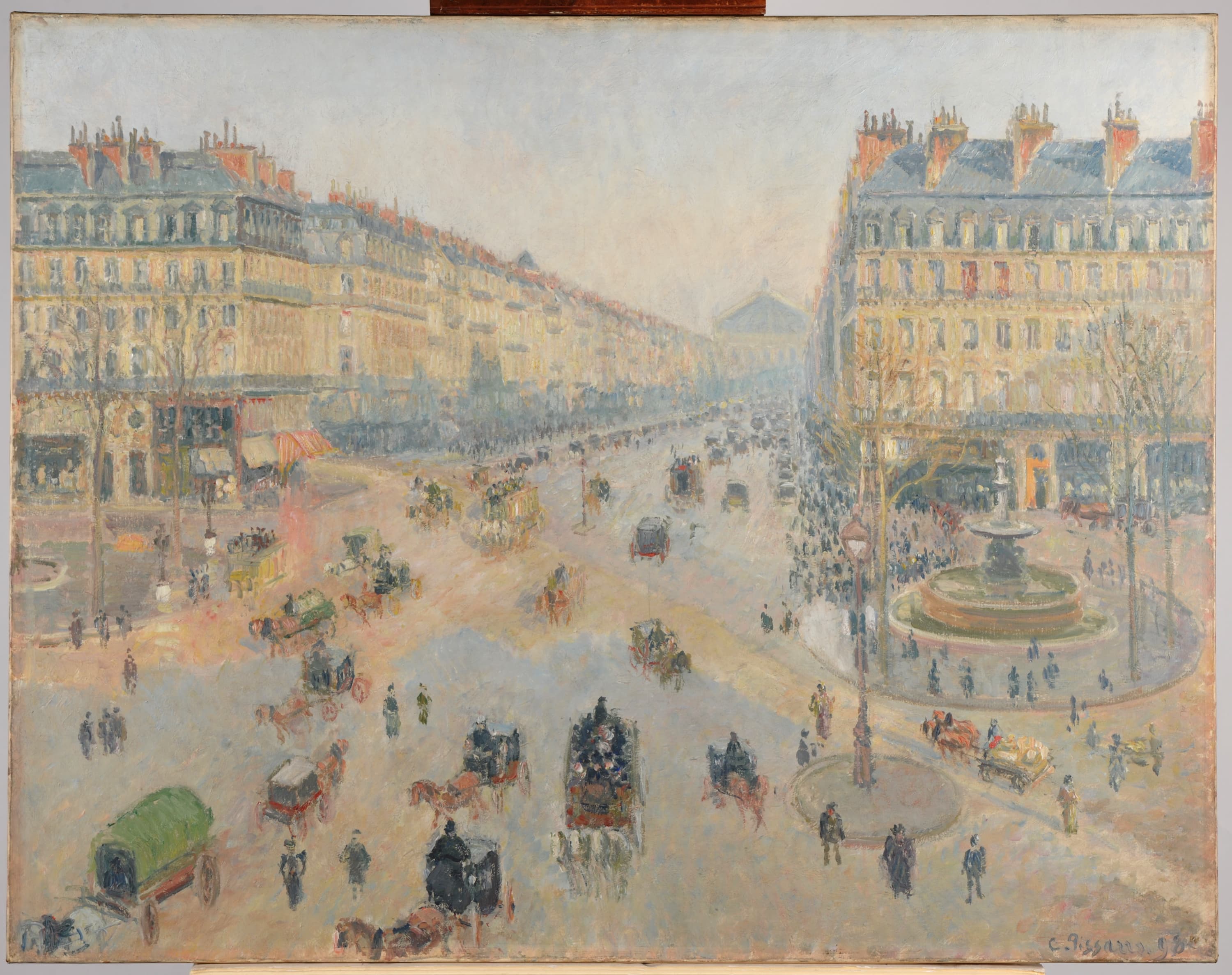
More by Camille Pissarro
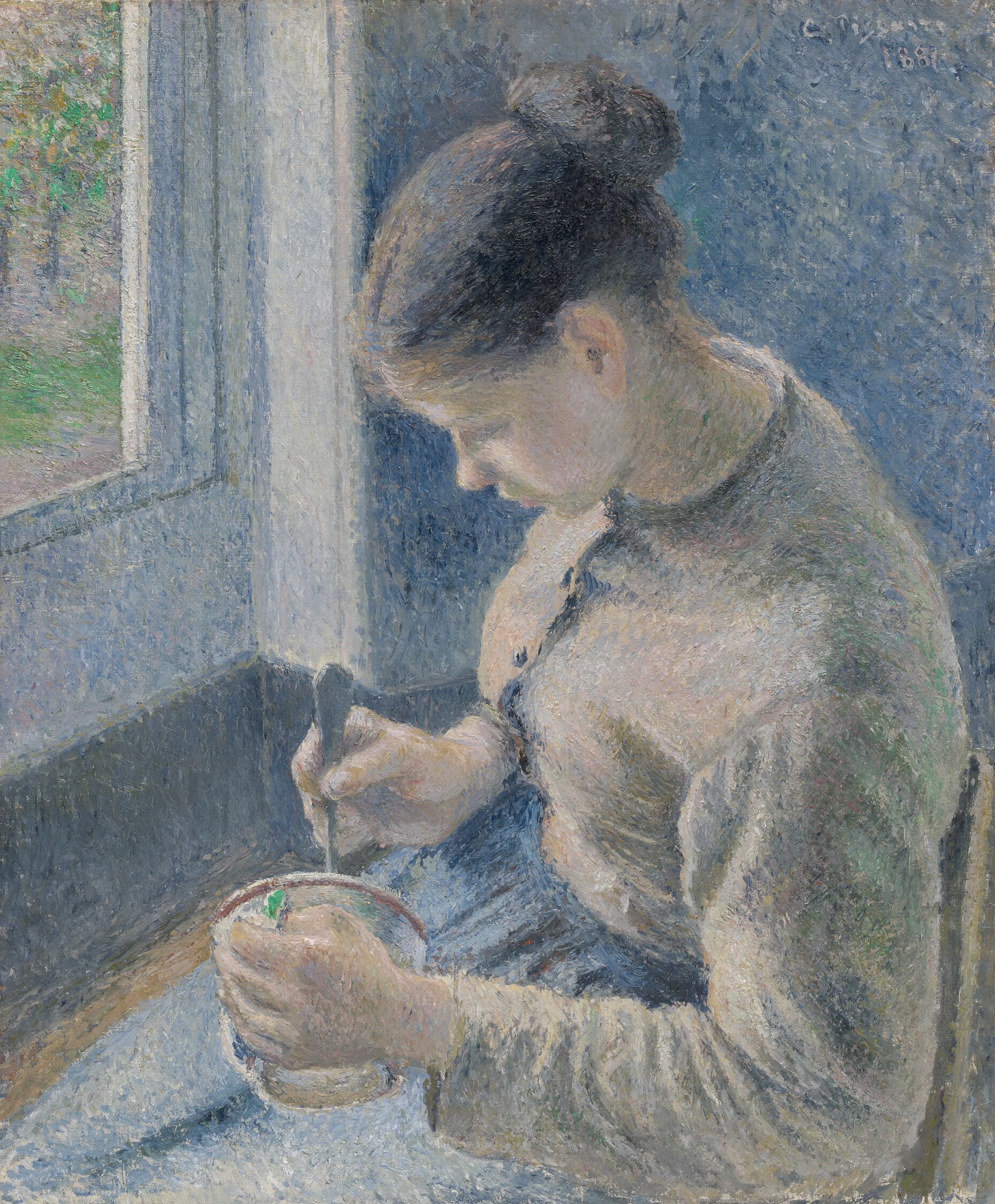
If you like Camille Pissarro
Explore painters from the same movements and circles.
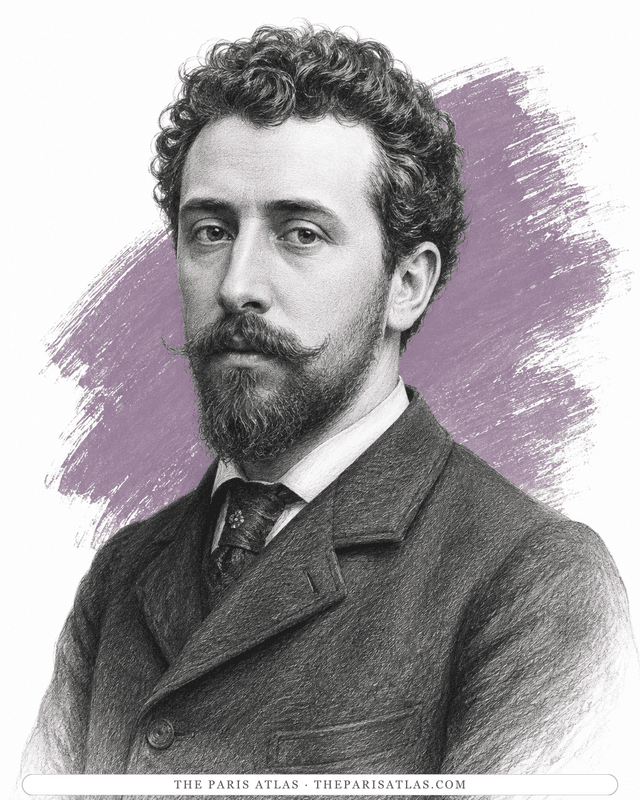
Georges Seurat
Parisian painter who built pictures from small dots of pure colour on optical principle, co-founded the Salon des Indépendants, and detonated the last Impressionist exhibition of 1886 with A Sunday on La Grande Jatte. He died at thirty-one.
View artist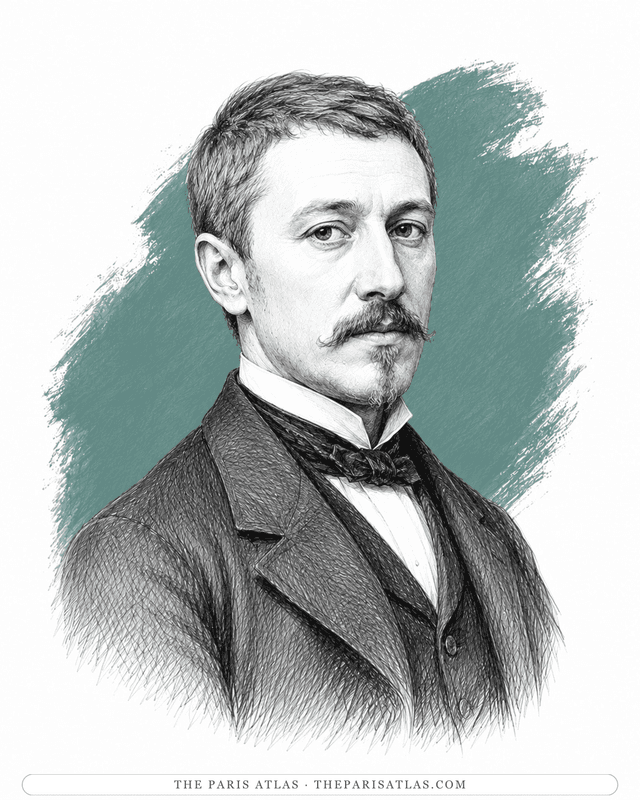
Gustave Caillebotte
Painter of Haussmann's geometry and the group's organizer-financier; his bequest of Impressionist paintings forced the French state to take the movement in.
View artist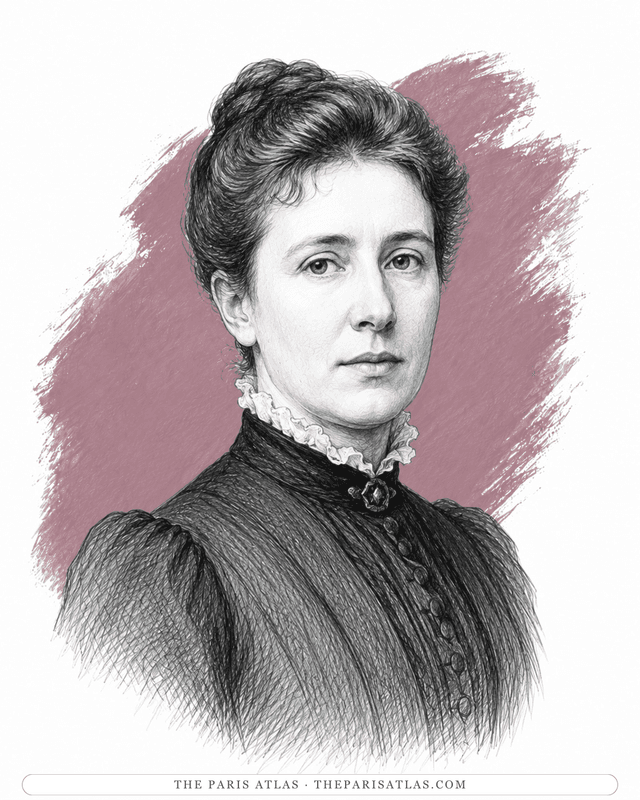
Mary Cassatt
Mary Cassatt was an American painter and printmaker known for her depictions of women and children. Based in France for the last fifty-two years of her life, she was the only American to exhibit with the original French Impressionist group, participating in four of its eight exhibitions. Edgar Degas invited her to exhibit with the group in 1877 after the Salon jury rejected her submissions.
View artist
References
The sources below include collection records, catalogues, scholarly research, and primary materials that informed this page. They document The Gleaners, its making, and its place in cultural history.


2↑Camille Pissarro: Biography and Chronology
WebsiteKunstmuseum BaselUsed forWeb source consulted for documented facts and historical context presented on the The Gleaners page.
3The National Gallery, London — Late Afternoon in our Meadow (NG6689)
WebsiteUsed forWeb source consulted for documented facts and historical context presented on the The Gleaners page.
4La Maison de la Folie, Éragny
WebsiteMusée d'OrsayUsed forWeb source consulted for documented facts and historical context presented on the The Gleaners page.
These references provide the documented foundation for this work's history and interpretation. Claim-level citations remain attached to the specific claims they support.
 Explore more resources