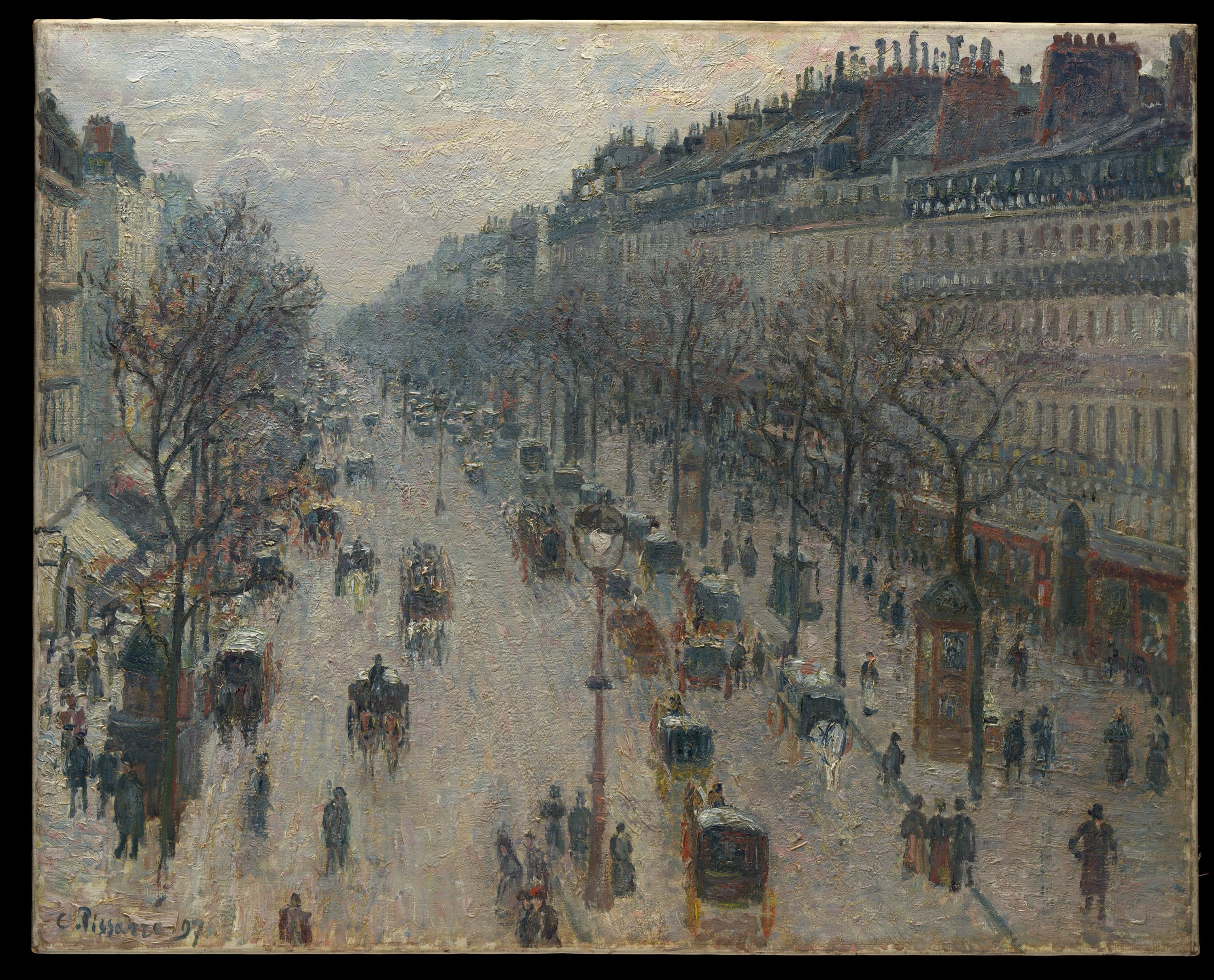
The Boulevard Montmartre on a Winter Morning
One of fourteen views of the boulevard Montmartre that Camille Pissarro painted from a single hotel window between February and April 1897. This is the grey one: bare trees, a damp road, and no shadows anywhere.
- 1897
- Oil on canvas
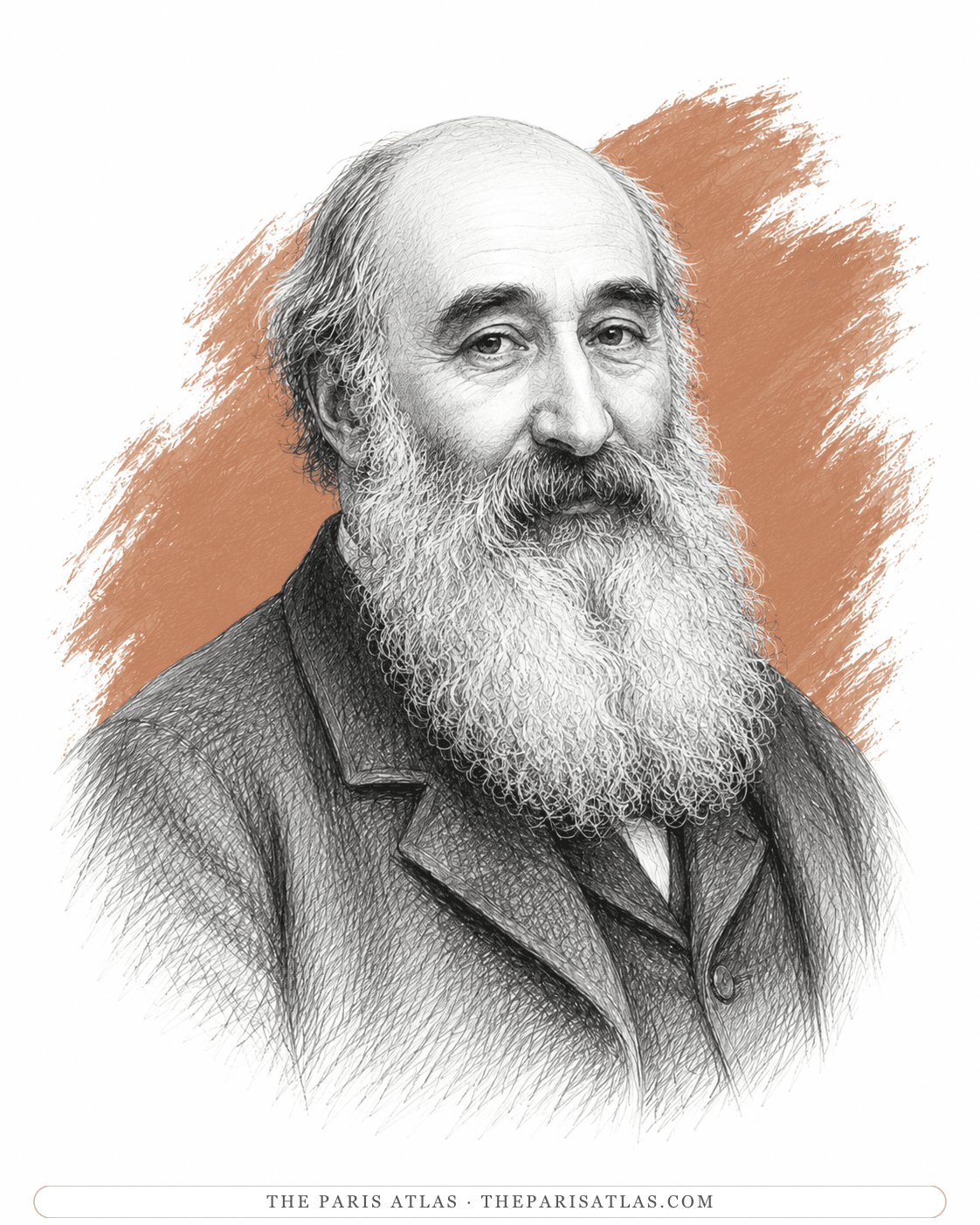
About Camille Pissarro
What the painting shows
The viewer is several floors above the pavement, looking along a wide Paris street that runs away to the upper left and dissolves into mist before it ends. The right-hand side of the boulevard catches what light there is: five and six storeys of pale stone, rows of chimney pots ranked along the roofline, shopfronts and awnings underneath, one red awning near the front. The left-hand side is in shadow and painted in grey and violet.
Bare plane trees line both pavements, thin enough to see the buildings through. The roadway is a damp mauve-grey with horse omnibuses and cabs strung down the middle of it, one behind another, and the pavements carry a scatter of dark figures with a kiosk among them at the lower right.
There is no snow and no sun. The sky is a flat white-grey, and because nothing casts a shadow the whole picture holds together as tone rather than as light and dark. It is signed at the lower left, C. Pissarro 97.
Sixteen canvases from one window
Camille Pissarro took a room at the Grand Hôtel de Russie, on the rue Drouot, in February 1897. He was sixty-six. The room gave him a corner view, and the Metropolitan Museum of Art records that he marvelled at it.
“almost a bird's-eye view of carriages, omnibuses, people, between big trees, big houses that have to be set straight”
He could, he said, see down the whole length of the boulevards. From February through April he painted the boulevard des Italiens to the right twice and the boulevard Montmartre to the left fourteen times, so a single window produced sixteen canvases in three months. The National Gallery in London, which owns one of them, gives the same count of fourteen and the same date for the room.
The hotel's street number is not recorded, and neither is the room.
Why he was painting indoors
Pissarro had spent thirty years working out of doors, in fields and village streets. From the 1890s a recurring eye complaint made that increasingly hard: wind and dust were the problem, and a day in the open cost him more than it was worth.
The museums that hold the paintings are careful about the diagnosis. The Philadelphia Museum of Art calls it a persistent eye infection and stops there. Ophthalmological literature has identified it as chronic dacryocystitis, an infection of the tear sac at the inner corner of the eye; accounts disagree on which eye was affected, and no holding museum names the condition at all. What is not in dispute is the effect on his working life. He rented rooms above the streets he wanted, and painted through the glass.
The constraint suited what he wanted to do anyway. A window fixes the subject and leaves only the weather to change, which is the condition a series needs.
The same view, again
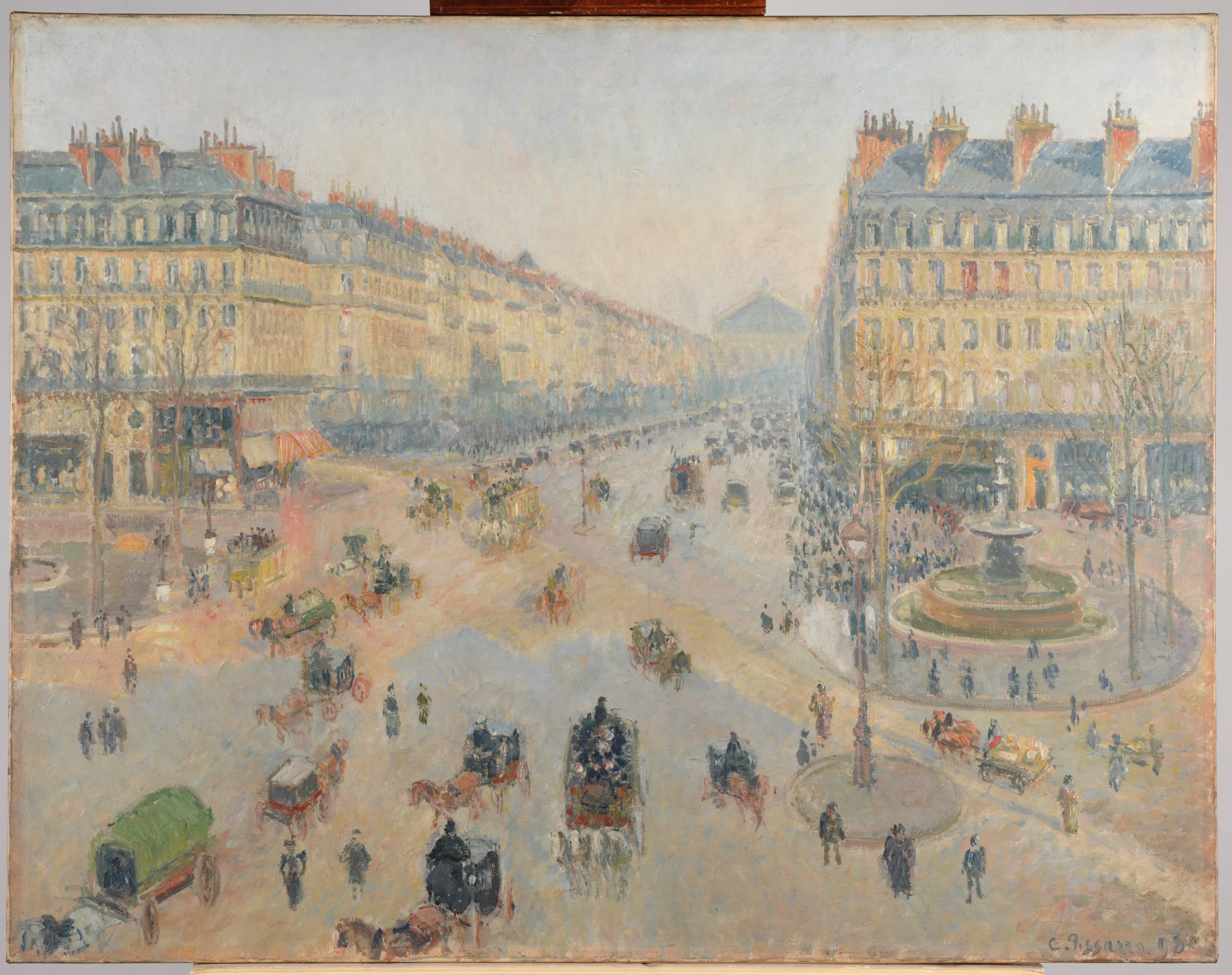
A series is not a set of different pictures of a place. It is one subject painted over and over from one spot, so that what changes between the canvases, and only that, carries the meaning. Pissarro had already worked this way on the place du Havre in 1893, from a hotel window near the Gare Saint-Lazare, and he would do it again on the avenue de l'Opéra in 1898 and on the Seine from the quai Voltaire in 1903, the year he died.
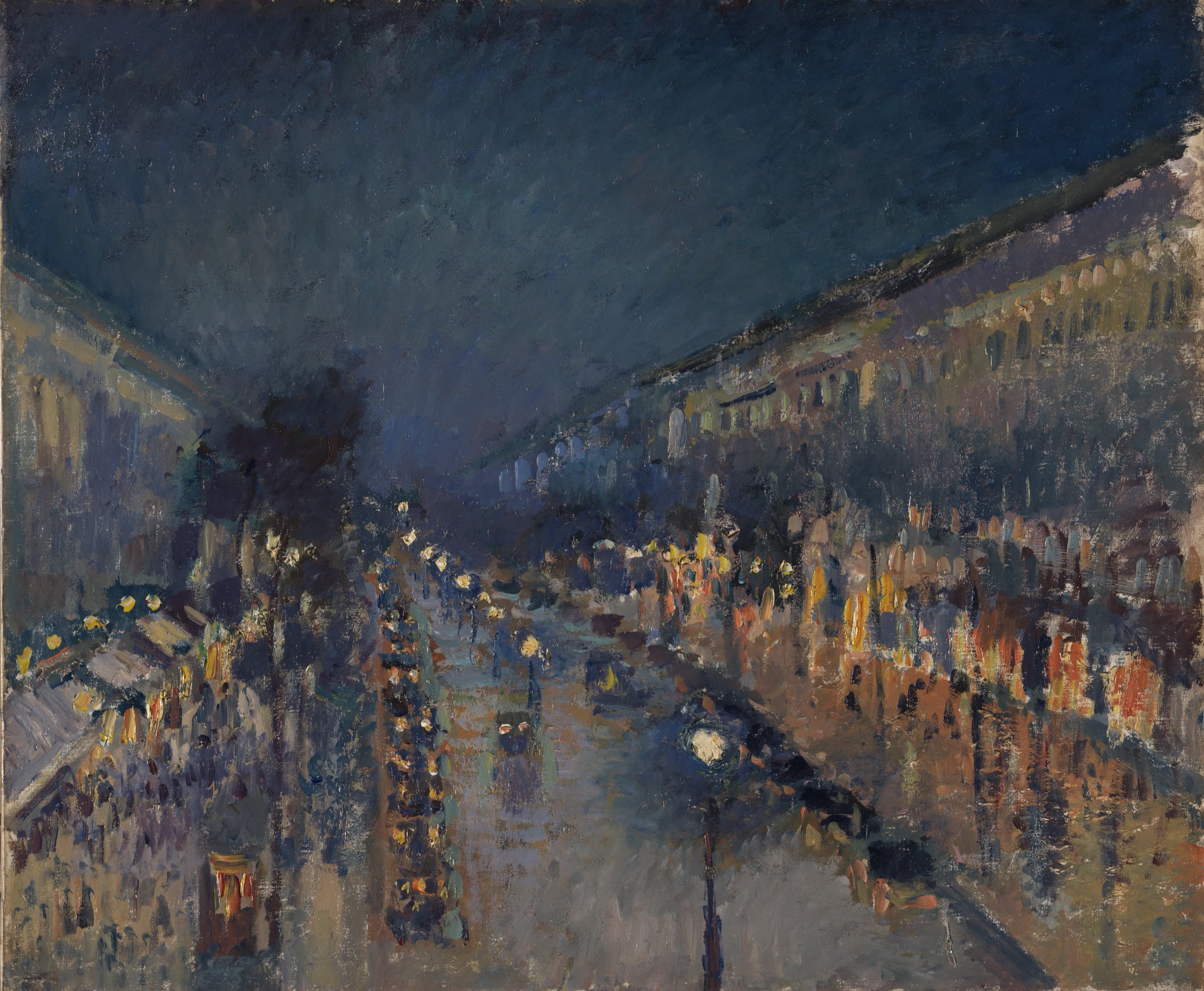
The boulevard Montmartre canvases are the fullest run of it. Out of the same window came morning and afternoon, sun and rain and fog, and one picture painted after dark, The Boulevard Montmartre at Night, now in the National Gallery in London. This one is the winter morning: cold, still, and lit by nothing in particular.
How it came to New York
Katrin S. Vietor gave the painting to the Metropolitan Museum of Art in 1960, in memory of Ernest G. Vietor. It is accession number 60.174. The fourteen canvases went their separate ways after 1897, and this one crossed the Atlantic; the night picture from the same window stayed in Europe and belongs to the National Gallery in London.
Close reading
Reading the work, detail by detail
From the same elevated room used across the Boulevard Montmartre series, Pissarro lets winter light remake a familiar street. Close views show pale atmosphere, compact traffic, and façades that frame rather than overpower the morning.
1.Cold air shortens the boulevard
Contrast falls away rapidly toward the horizon. Buildings and traffic remain present, but winter haze brings the far end of the street into the same silvery register as the sky.
2.Traffic gathers in the central channel
Dark carriages and pedestrians collect along the boulevard's center like marks on a pale ground. Their irregular spacing interrupts the architecture's orderly recession.
3.Façades catch light in broken planes
Windows, balconies, awnings, and walls appear as short horizontal and vertical touches. Pissarro preserves the boulevard's density without hardening every building into a diagram.
4.Bare trees repeat the boulevard's vertical architecture
Thin trunks and branches stand between pavement and façades. Their irregular lines soften the strict repetition of windows without hiding the avenue's planned order.
5.The pale sky makes the winter light feel shallow
The sky contains little dramatic weather or deep blue. Its muted brightness spreads evenly across roofs and street, producing the compressed atmosphere of a cold morning.
6.A larger foreground carriage establishes the scale of recession
The nearest vehicle is still abbreviated, but its size lets smaller marks farther away register as the same traffic receding down the street.
Timeline
1893
An earlier campaign from a hotel window, at the place du Havre by the Gare Saint-Lazare, establishes the method.
February 1897
Pissarro takes a room at the Grand Hôtel de Russie on the rue Drouot, Paris.
February–April 1897
Paints fourteen views of the boulevard Montmartre and two of the boulevard des Italiens from the same window.
1897
This canvas signed and dated at the lower left, C. Pissarro 97.
1960
Given to the Metropolitan Museum of Art by Katrin S. Vietor, in loving memory of Ernest G. Vietor. Accession 60.174.
Where to see it
The Metropolitan Museum of Art
1000 Fifth Avenue, New York, NY 10028, United States
Displays and loans can change. Check whether this work is on view before making a special trip.
Plan your visit on the museum’s official website (opens in a new tab)Frequently asked questions
Where is The Boulevard Montmartre on a Winter Morning?
The Metropolitan Museum of Art in New York, accession number 60.174. Katrin S. Vietor gave it to the museum in 1960 in memory of Ernest G. Vietor.
How many boulevard Montmartre paintings did Pissarro make?
Fourteen. The Metropolitan Museum of Art and the National Gallery in London both give that number. Camille Pissarro painted them between February and April 1897, along with two views of the boulevard des Italiens from the same window, which makes sixteen canvases from one room.
Where did Pissarro paint the boulevard Montmartre from?
A room at the Grand Hôtel de Russie on the rue Drouot in Paris, taken in February 1897. The room looked out over a corner, giving him the boulevard Montmartre to the left and the boulevard des Italiens to the right. Neither the hotel's street number nor the room number is documented.
Why did Pissarro paint from a window instead of outdoors?
A recurring eye complaint made long spells outdoors in wind and dust painful, and from the 1890s Camille Pissarro rented rooms above the streets he wanted to paint. The Philadelphia Museum of Art describes the condition as a persistent eye infection; ophthalmological literature has identified it as chronic dacryocystitis, an infection of the tear sac, though no museum that holds the paintings names it and accounts disagree on which eye was affected.
Is it snowing in the painting?
No. There is no snow on the street and none falling. It is a grey winter morning with bare trees, a damp mauve road and a flat white sky, and nothing in the picture casts a shadow.
Is this the same view as The Boulevard Montmartre at Night?
Yes, the same stretch of street from the same window, at a different hour. The night version, painted in 1897 as well, is in the National Gallery in London, which states that it is the only night painting Camille Pissarro made.
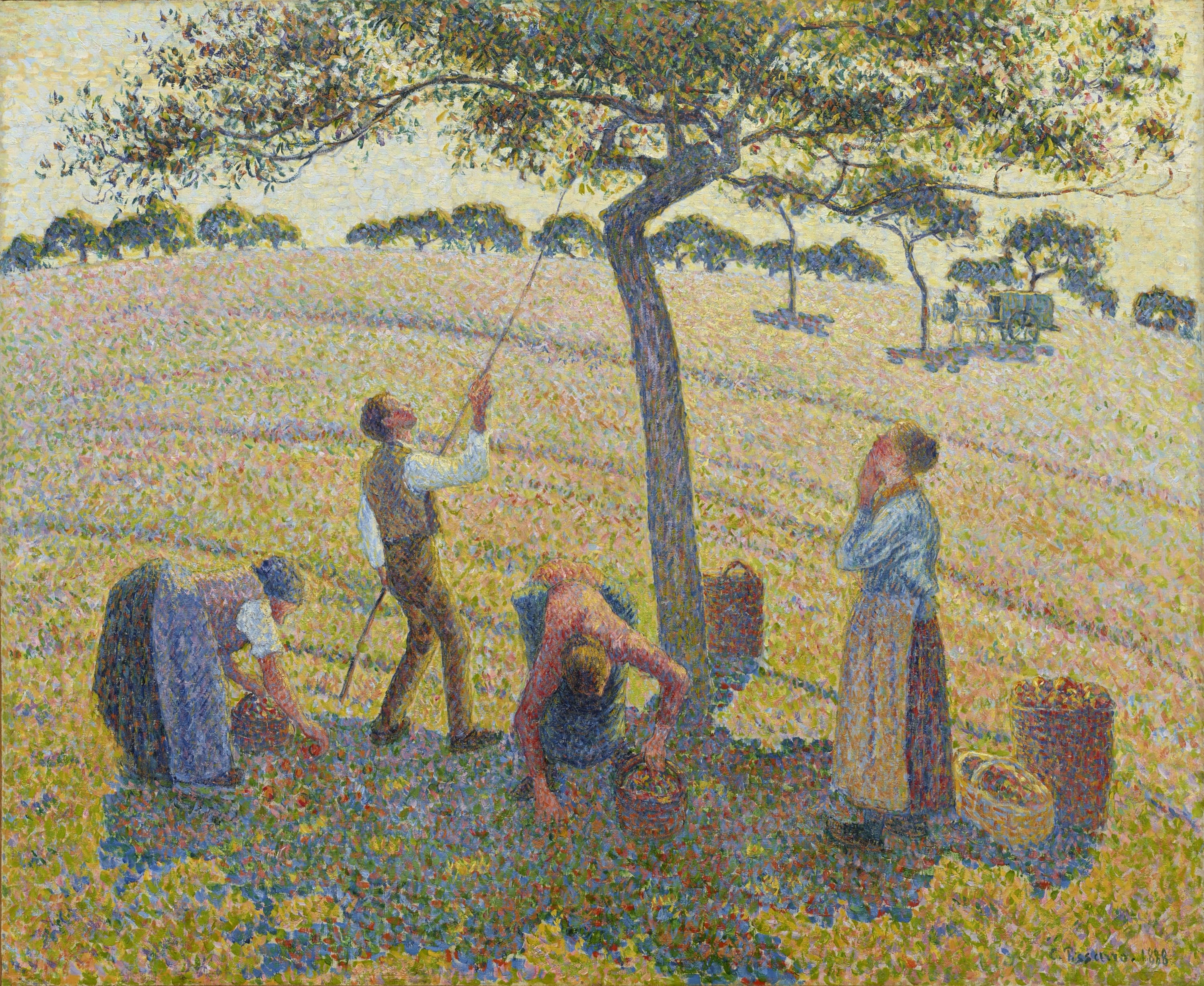
More by Camille Pissarro
If you like Camille Pissarro
Explore painters from the same movements and circles.
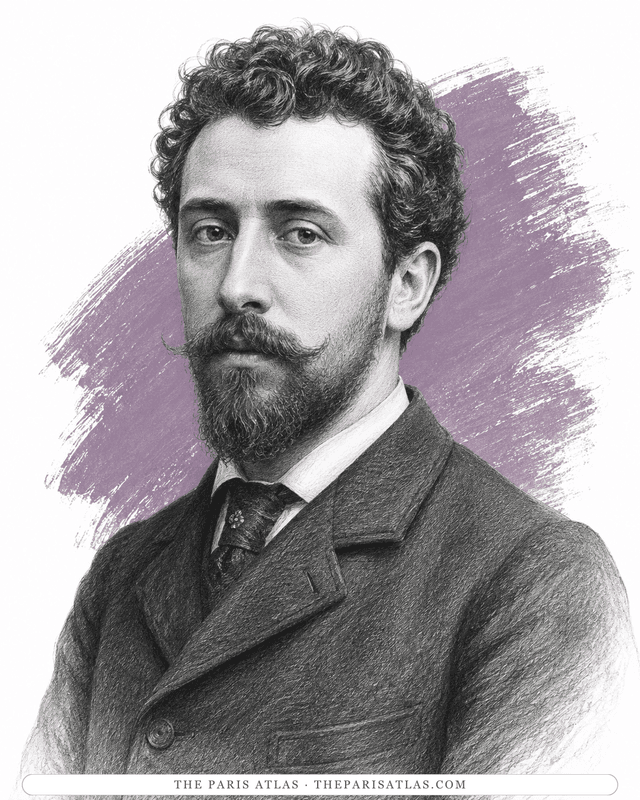
Georges Seurat
Parisian painter who built pictures from small dots of pure colour on optical principle, co-founded the Salon des Indépendants, and detonated the last Impressionist exhibition of 1886 with A Sunday on La Grande Jatte. He died at thirty-one.
View artist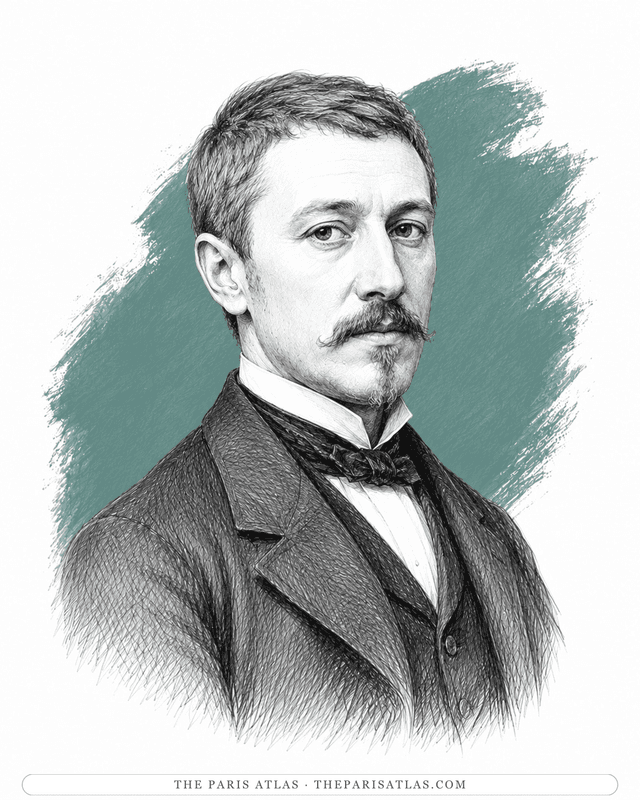
Gustave Caillebotte
Painter of Haussmann's geometry and the group's organizer-financier; his bequest of Impressionist paintings forced the French state to take the movement in.
View artist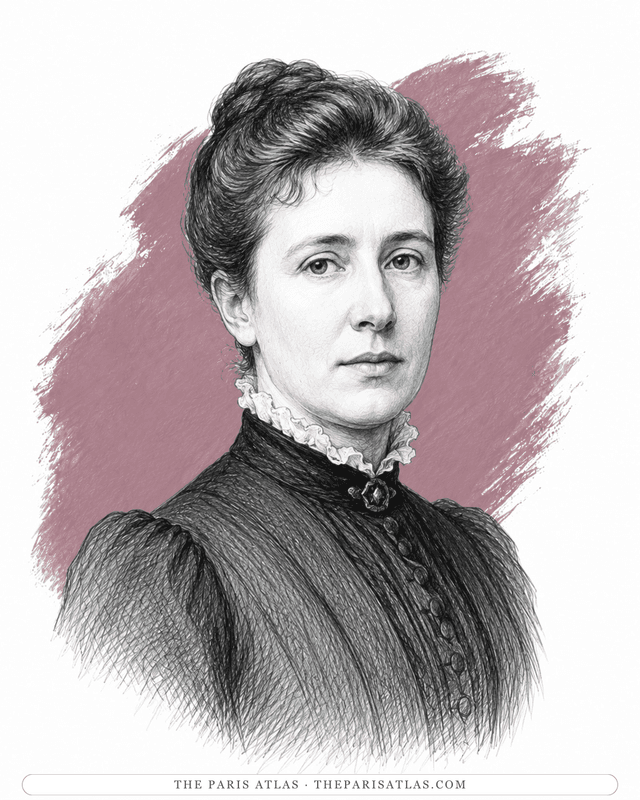
Mary Cassatt
Mary Cassatt was an American painter and printmaker known for her depictions of women and children. Based in France for the last fifty-two years of her life, she was the only American to exhibit with the original French Impressionist group, participating in four of its eight exhibitions. Edgar Degas invited her to exhibit with the group in 1877 after the Salon jury rejected her submissions.
View artist
References
The sources below include collection records, catalogues, scholarly research, and primary materials that informed this page. They document The Boulevard Montmartre on a Winter Morning, its making, and its place in cultural history.


1Camille Pissarro, The Boulevard Montmartre on a Winter Morning
WebsiteThe Metropolitan Museum of ArtUsed forWeb source consulted for documented facts and historical context presented on the The Boulevard Montmartre on a Winter Morning page.
2The Metropolitan Museum of Art — collection records
WebsiteUsed forWeb source consulted for documented facts and historical context presented on the The Boulevard Montmartre on a Winter Morning page.
3The Boulevard Montmartre at Night — Picture of the Month
WebsiteThe National Gallery, LondonUsed forWeb source consulted for documented facts and historical context presented on the The Boulevard Montmartre on a Winter Morning page.
4Philadelphia Museum of Art — collection
WebsiteUsed forWeb source consulted for documented facts and historical context presented on the The Boulevard Montmartre on a Winter Morning page.
5Art Institute of Chicago — collection records
WebsiteUsed forWeb source consulted for documented facts and historical context presented on the The Boulevard Montmartre on a Winter Morning page.
These references provide the documented foundation for this work's history and interpretation. Claim-level citations remain attached to the specific claims they support.
 Explore more resources