Rue de l'Epicerie, Rouen (Effect of Sunlight)
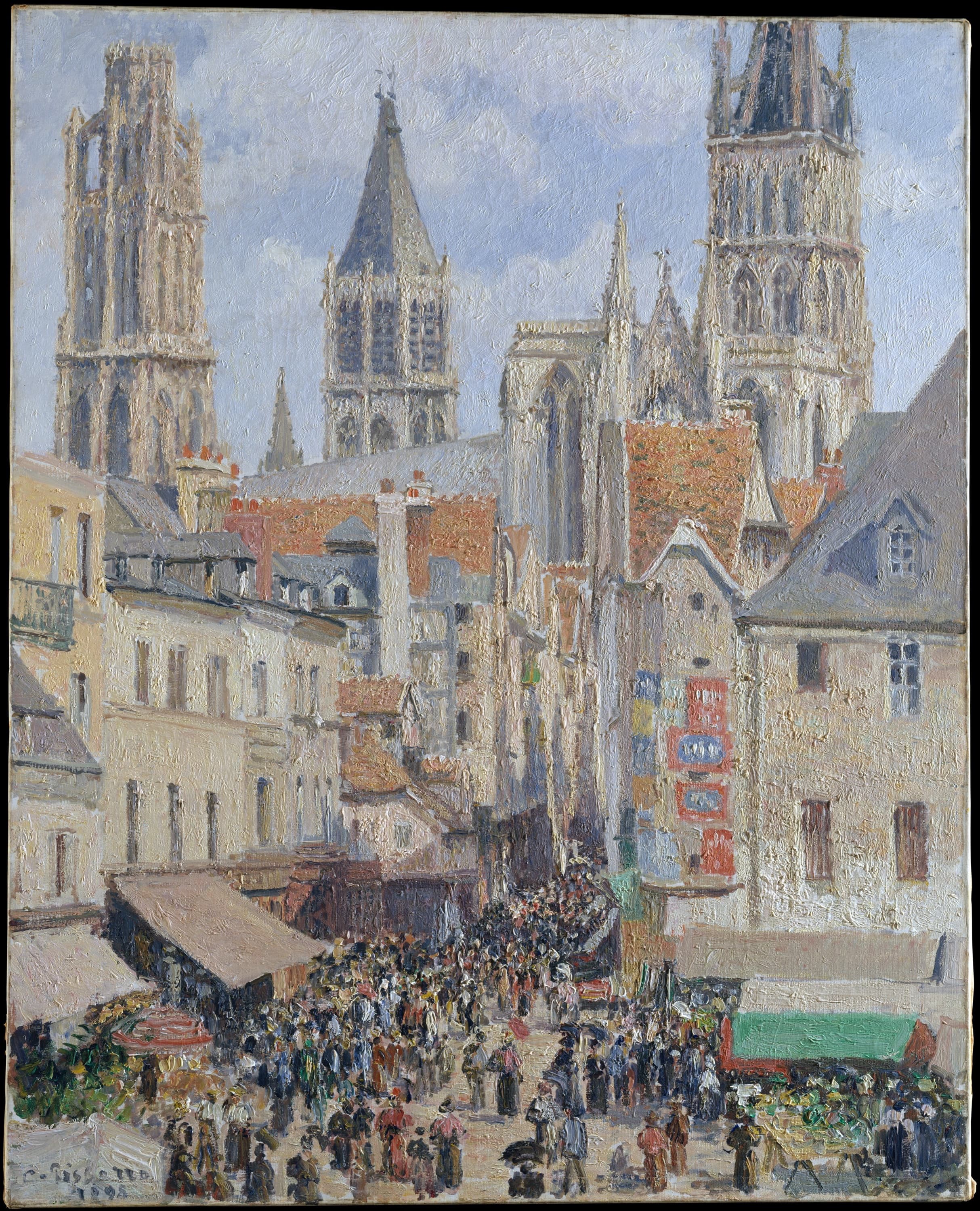
Camille Pissarro painted this street in Rouen in 1898, on a Friday, when the market filled it. He painted the view three times and this is the only one of the three with the market under way. The Metropolitan Museum of Art bought it in 1960.
- 1898
- Oil on canvas
About Camille Pissarro
What the painting shows
The viewer stands above the street, looking down it. The bottom third of the canvas is market: awnings in cream and green, a red parasol, trestles of produce, and a crowd packed shoulder to shoulder in dark coats and pale hats. Individual faces are a stroke each.
Above the crowd the houses close in on both sides, plaster and pale stone under orange tile roofs, with painted shop signs in red, blue and white hung flat against the upper walls. Behind the roofs the towers of Rouen cathedral rise into a blue sky, their stone cut with tracery open enough to show daylight through it.
The Metropolitan Museum of Art's audio guide places the market on the Place de la Haute-Vieille-Tour, with the cathedral standing behind. The canvas is signed and dated at lower left, C. Pissarro 1898.
He found the spot by walking
This was Camille Pissarro's fourth stay in Rouen, and the Met's curatorial note says he already knew the city's subjects by the time he arrived. What he did not have was a place to work from. He wrote to his eldest son, Lucien, on 19 August 1898.
“Yesterday I found an excellent place from which I can paint the rue de l'Epicerie and even the market, a really interesting one, which takes place every Friday.”
Most of his late city paintings were made from rented rooms above the street, and the museums that hold them usually name the hotel. For this picture the Met names neither hotel nor window. What it records is the letter, and a vantage point he went out and found.
Three canvases, one market
Pissarro painted the rue de l'Epicerie three times. The Met states that its picture is the only one of the three that shows the market actually in progress, which is what he had gone looking for: the market ran on Fridays, so the subject existed one day in seven.
Related canvases of the street are in the Rijksmuseum in Amsterdam and at Newfields in Indianapolis, which has published a technical report on its version, accession 79.283.
Why the canvas stands upright
At 81.3 by 65.1 centimetres this is a tall picture, not a wide one. The boulevard series he had been painting in Paris runs the other way, long and horizontal, because a boulevard is long and horizontal. A narrow street with a cathedral at the end of it is neither.
The Met's audio guide raises the obvious comparison, Claude Monet, who had painted the same cathedral in a long series of canvases. The difference is in what gets the room. Here the cathedral is scenery at the top of the picture and the market has the foreground.
Close reading
Reading the work, detail by detail
Pissarro compresses a busy Rouen street between close façades and a distant church. The crops show sunlight breaking architecture into color while the crowd supplies a second, restless pattern below.
1.The church anchors the narrow opening
The distant tower and roofline appear through a corridor of nearer buildings. Their vertical accent gives the crowded street a destination and keeps the compressed perspective from closing completely.
2.Sunlight breaks stone into patches
Walls are assembled from cream, gold, rose, and shadow rather than one local color. The effect of sunlight named in the title is not added to the buildings; it determines how much of their solidity survives.
3.The crowd becomes a current
Heads, hats, wheels, and shadows resolve only briefly into separate people and vehicles. Together they form a dark, uneven stream running through the brighter architecture.
4.Shopfronts narrow the route before it opens at the church
Dark lower façades press close to the moving crowd. Their compressed scale makes the brighter opening around the cathedral feel earned rather than simply placed in the distance.
5.Awnings turn the lower street into a sequence of interruptions
Short projecting shapes break the vertical walls and mark the commercial life of the street. They create a human-height rhythm beneath the much taller cathedral.
6.Light makes the cathedral less solid than the nearby shops
The distant stone is built from pale, separated touches that merge at normal viewing distance. The monument appears atmospheric while the closer street remains darker and more compact.
Timeline
1898
Pissarro's fourth stay in Rouen. The Metropolitan Museum of Art records that he already knew the city's subjects by then.
19 August 1898
Writes to his son Lucien that he has found a place to paint the rue de l'Epicerie and the Friday market.
1898
Painted; signed and dated lower left.
1960
Bought by the Metropolitan Museum of Art, New York, accession 60.5, with a gift from Mr. and Mrs. Richard J. Bernhard.
Where to see it
The Metropolitan Museum of Art
1000 Fifth Avenue, New York, NY 10028, United States
Displays and loans can change. Check whether this work is on view before making a special trip.
Plan your visit on the museum’s official website (opens in a new tab)Frequently asked questions
What is happening in Rue de l'Epicerie, Rouen?
It is market day. The crowd filling the lower part of the picture is the Friday market at Rouen, which Camille Pissarro had written to his son about a few days before he began. The Metropolitan Museum of Art, which owns the painting, says this is the only one of his three canvases of the street that shows the market in progress.
Where is the street in the painting?
In Rouen, in Normandy, north-west of Paris. The Met's audio guide places the market on the Place de la Haute-Vieille-Tour, at the end of the rue de l'Epicerie, with Rouen cathedral behind it.
Is the church in the background Rouen cathedral?
Yes. The towers above the roofline belong to Rouen cathedral, the same building Claude Monet painted in his own series of canvases. Camille Pissarro keeps it in the background and gives the front of the picture to the market stalls.
Did Pissarro paint it from a hotel window?
The museum does not say. Camille Pissarro's Paris series of these years were painted from rented rooms above the street, and the holding museums usually name the hotel, but the Met names no hotel and no window for this picture. His letter says only that he had found an excellent place to paint from.
How big is the painting?
81.3 by 65.1 centimetres, and upright rather than wide — the reverse of the long horizontal boulevard scenes Camille Pissarro was painting in Paris in the same years.
Where can I see it?
The Metropolitan Museum of Art in New York, in the European Paintings department. The museum bought it in 1960 and it carries the accession number 60.5.
More by Camille Pissarro
If you like Camille Pissarro
Explore painters from the same movements and circles.
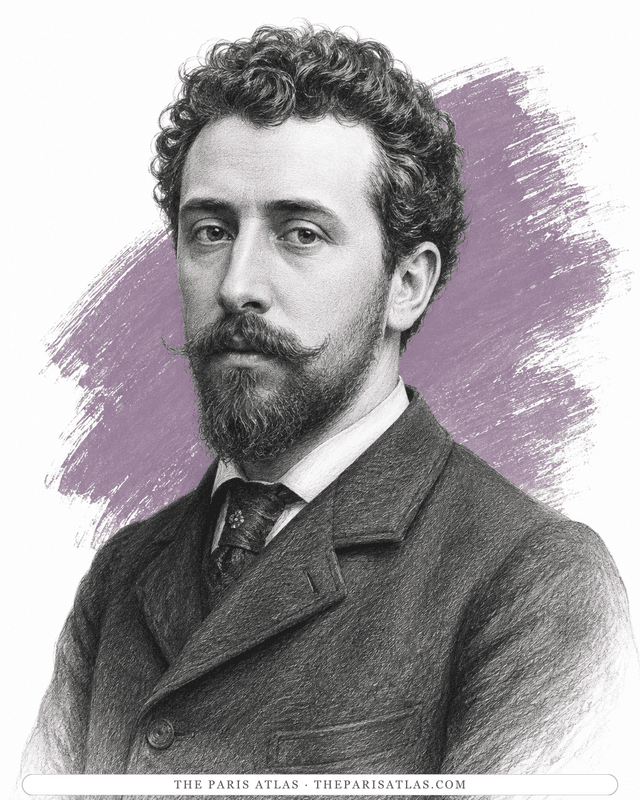
Georges Seurat
Parisian painter who built pictures from small dots of pure colour on optical principle, co-founded the Salon des Indépendants, and detonated the last Impressionist exhibition of 1886 with A Sunday on La Grande Jatte. He died at thirty-one.
View artist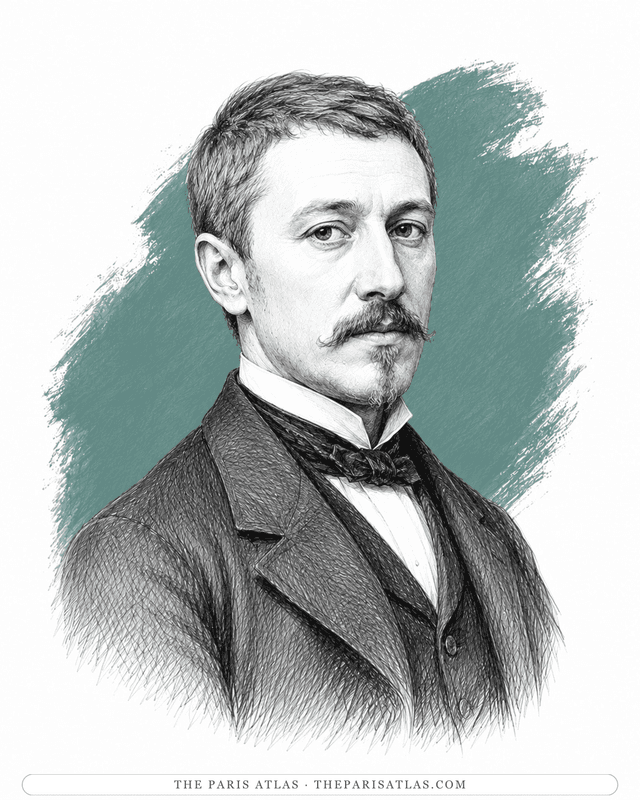
Gustave Caillebotte
Painter of Haussmann's geometry and the group's organizer-financier; his bequest of Impressionist paintings forced the French state to take the movement in.
View artist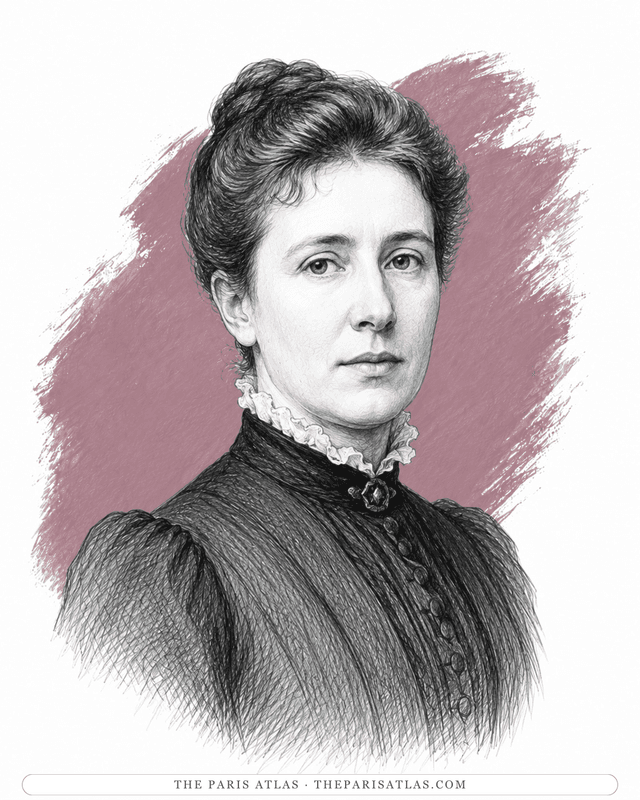
Mary Cassatt
Mary Cassatt was an American painter and printmaker known for her depictions of women and children. Based in France for the last fifty-two years of her life, she was the only American to exhibit with the original French Impressionist group, participating in four of its eight exhibitions. Edgar Degas invited her to exhibit with the group in 1877 after the Salon jury rejected her submissions.
View artist
References
The sources below include collection records, catalogues, scholarly research, and primary materials that informed this page. They document Rue de l'Epicerie, Rouen (Effect of Sunlight), its making, and its place in cultural history.


1Rue de l'Epicerie, Rouen (Effect of Sunlight), 1898
WebsiteThe Metropolitan Museum of ArtUsed forWeb source consulted for documented facts and historical context presented on the Rue de l'Epicerie, Rouen (Effect of Sunlight) page.
2The Metropolitan Museum of Art — collection records
WebsiteUsed forWeb source consulted for documented facts and historical context presented on the Rue de l'Epicerie, Rouen (Effect of Sunlight) page.
3Camille Pissarro — artist record
WebsiteMusée d'OrsayUsed forThe Musée d'Orsay artist record supplies institutional context for Pissarro's late urban series and working method.
4Camille Pissarro — artist biography
WebsiteMuseo Nacional Thyssen-BornemiszaUsed forThe Museo Thyssen-Bornemisza biography provides an independent chronology of Pissarro's mature city paintings.
These references provide the documented foundation for this work's history and interpretation. Claim-level citations remain attached to the specific claims they support.
 Explore more resources