The Letter
by Mary Cassatt
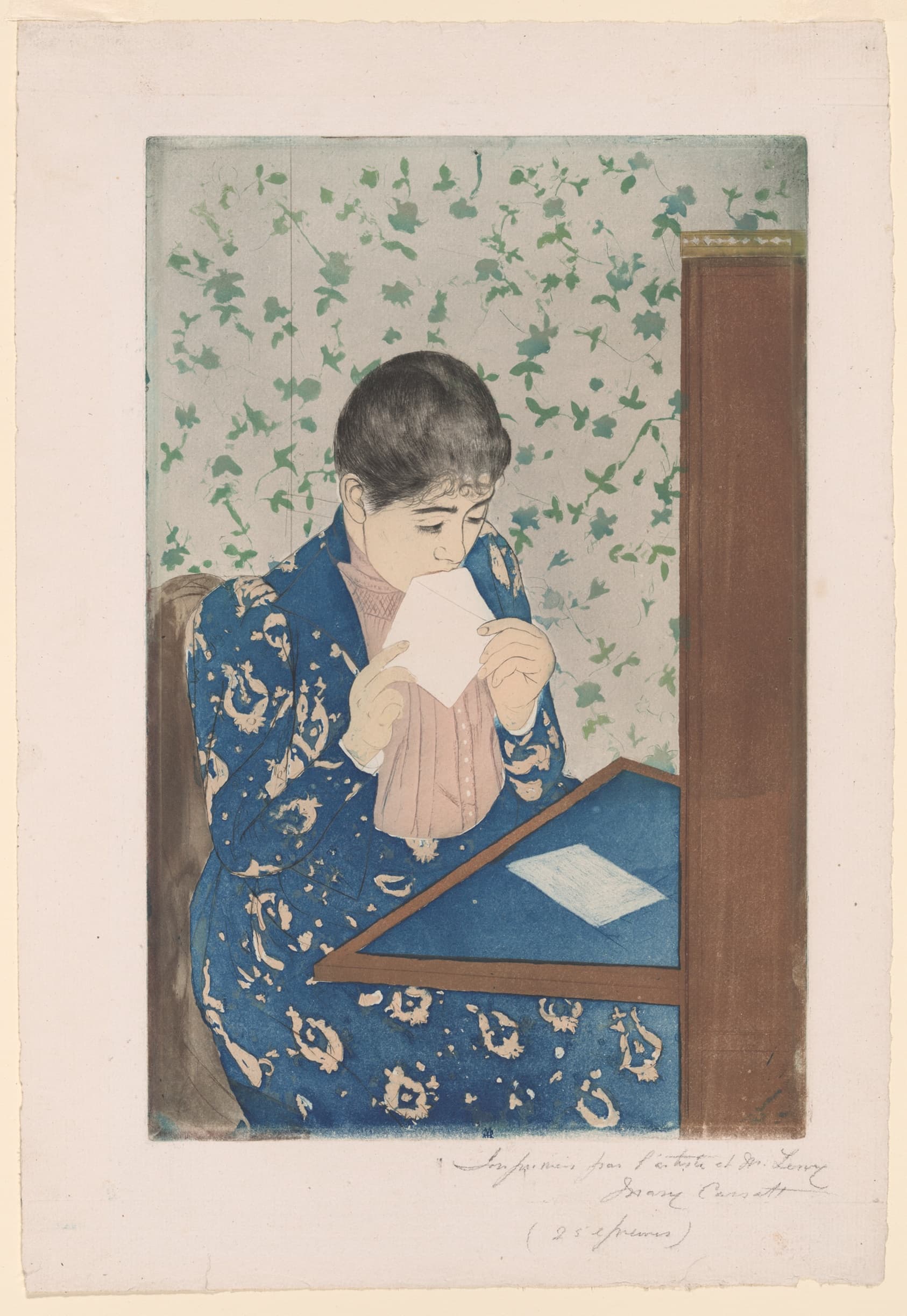
A woman sits at a small writing desk in a blue patterned dress, holding a sealed envelope up to her mouth. Behind her the wallpaper carries a second pattern, and the two press flat against each other with almost no room between them. Mary Cassatt made it in 1890–91 as one of a suite of ten color prints, working the plates and the inking with a printer named Leroy.
- 1890–91
- Color aquatint and drypoint on off-white laid paper
About Mary Cassatt
Two patterns and a letter
The composition is built from pattern. The woman's dress is a small blue print, the wall behind her another, and the writing desk sits at an angle that gives the picture almost no depth. The Art Institute of Chicago describes Cassatt using those patterns and the printing inks to manipulate space, following what she had seen in Japanese prints.
The drawn detail is finer than the flat color suggests. The Philadelphia Museum of Art, which holds another impression, points to the layering of delicate drypoint lines under the watercolor-like blue and pink of the aquatint. The wispy hair and the eyelashes are drypoint, and the museum calls the combination a remarkable technical feat.
The Art Institute reads the subject as of a piece with the rest of her work: women indoors, because the social rules of the time kept them there.
Three plates, four states, twenty-five proofs
The Metropolitan Museum of Art holds two states of this print and its records set out the method plainly. The first state is drypoint alone, printed in black from a single plate. The finished print is drypoint and aquatint together, printed in color from three plates, and it is the fourth state of four.
Cassatt did not do it alone, and she said so on the sheet. The inscription in graphite below the image reads "Imprimée par l'artiste et Mr. Leroy / Mary Cassatt / (25 épreuves)" — printed by the artist and Mr. Leroy, twenty-five proofs. The Metropolitan credits the printing to the two of them jointly. Philadelphia suggests the credit may echo the Japanese practice of signing a print with both the artist's and the printer's names.
The Cleveland Museum of Art holds Cassatt's preparatory drawing for the print, and its back carries soft-ground lines transferred from an etching plate — a physical trace of how she moved the design from paper to copper.
Number eight of ten
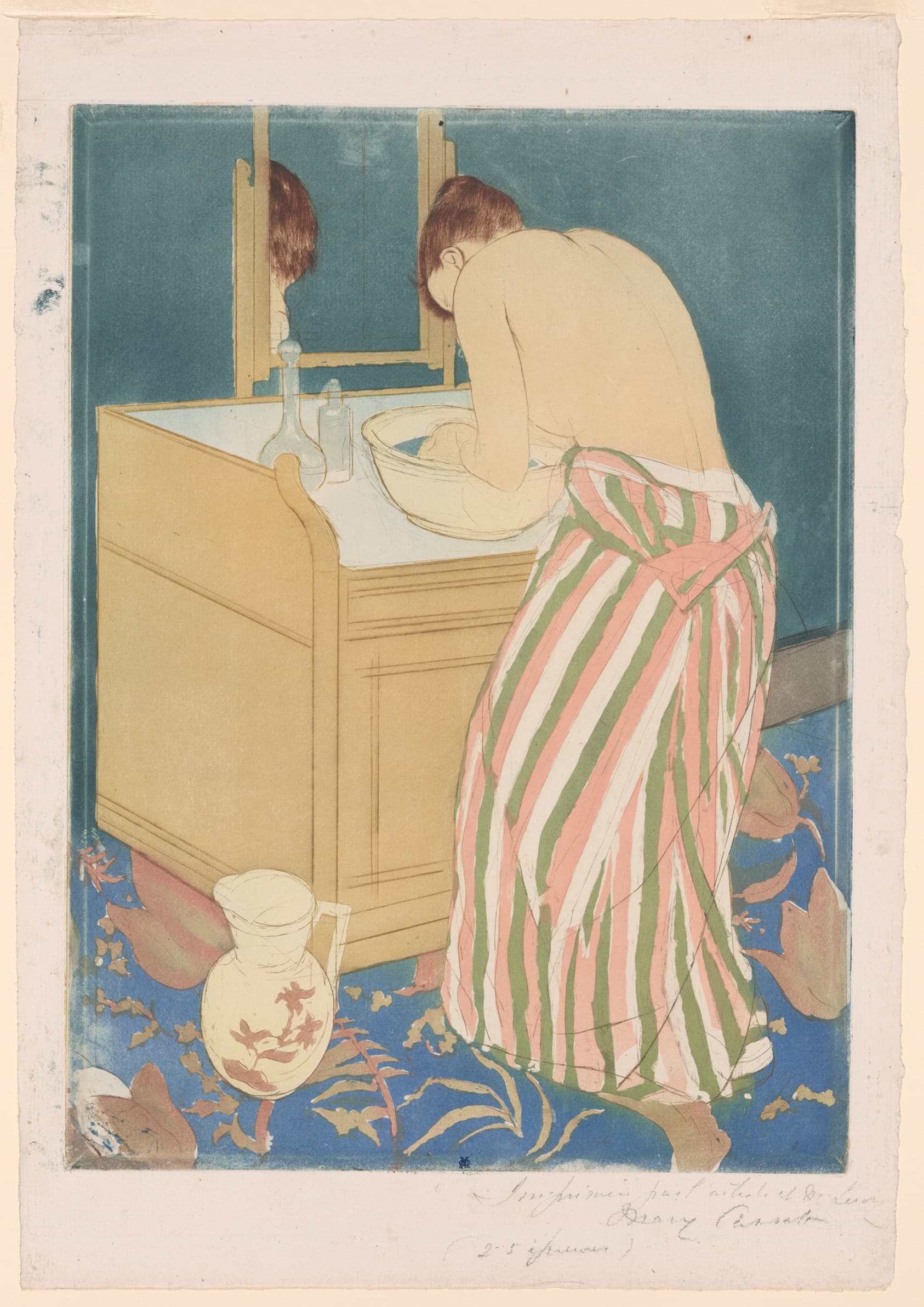
The print belongs to the set of ten Cassatt made in 1890–91 after seeing a large exhibition of Japanese woodblock prints in Paris — the same suite as Woman Bathing, which the Art Institute also holds. The Philadelphia Museum of Art describes the ten as scenes of ordinary moments in the lives of modern, upper-class women: dressing, bathing a child, taking tea, riding the omnibus, and here, finishing a letter.
In the standard catalogue of the color prints, compiled by Nancy Mowll Mathews and Barbara Stern Shapiro, The Letter is number eight of the ten. Adelyn Breeskin's earlier catalogue of the graphic work numbers it 146.
This impression
The Art Institute's sheet came from Cassatt to Durand-Ruel, then to the Chicago dealer Albert Roullier, and was given to the museum in 1932 by Martin A. Ryerson and his wife — the same gift that brought Chicago its set of the ten. Its accession number is 1932.1282, and it is on view in Gallery 184.
Other impressions are at the Philadelphia Museum of Art, the Metropolitan Museum of Art and the National Gallery of Art, which holds several.
Close reading
Reading the work, detail by detail
A woman brings an envelope to her lips within a room of close, overlapping patterns. Look from the fine lines of her face and hands to the larger shapes of dress, wallpaper, and writing desk.
1.The lowered eyes
The face is built from delicate lines within a lightly colored area. Lowered eyes concentrate the action close to the mouth, while the dark hair gives the small head a clear boundary against the patterned wall.
2.The envelope and fingers
The unpatterned paper makes a pause among the surrounding flowers and folds. Fingers approach it from either side, turning the envelope's simple shape into the meeting point of the figure's movements.
3.Flowers across the blue dress
The pale motifs remain sharply visible against the blue. Their irregular spacing carries attention over the fabric, while the dress's larger outline keeps the repeated marks attached to a seated body.
4.The climbing wall pattern
The stems scatter small movements across a broad, quiet background. Their light color and open spacing distinguish the wall from the denser dress pattern, even where the two surfaces seem pressed together.
5.The angled writing surface
The desk projects into the figure through a strong diagonal. Its plain blue area gives the eye room to rest, and the light sheet repeats the envelope's color lower in the composition.
6.Marks below the image
The pencil marks draw attention to the sheet as a physical object. Their loose lines occupy the margin beyond the carefully bounded scene, adding another kind of handwriting to an image about preparing a letter.
Timeline
1890
Cassatt sees the exhibition of Japanese woodblock prints in Paris and begins a set of ten color prints.
1890–91
The Letter is worked through four states, from a black drypoint to a color print from three plates, and editioned at twenty-five proofs with the printer Leroy.
1932
Martin A. Ryerson and his wife give this impression to the Art Institute of Chicago — accession 1932.1282.
1936
Shown as number 27 in Mary Cassatt at the Baltimore Museum of Art.
1989–90
Included in Mary Cassatt: The Color Prints at the Williams College Museum of Art, the exhibition whose catalogue numbers the set.
1998–99
Number 59 in Mary Cassatt: Modern Woman at the Art Institute of Chicago.
Where to see it
Art Institute of Chicago
111 South Michigan Avenue, Chicago, IL 60603, United States
Displays and loans can change. Check whether this work is on view before making a special trip.
Plan your visit on the museum’s official website (opens in a new tab)Frequently asked questions
Where is Mary Cassatt's The Letter?
Impressions are in several museums, because the print was editioned at twenty-five. The Art Institute of Chicago's is accession 1932.1282, on view in Gallery 184. The Philadelphia Museum of Art, the Metropolitan Museum of Art and the National Gallery of Art hold others.
How was The Letter printed?
Drypoint and aquatint together, printed in color from three copper plates. It went through four states — the first was drypoint alone in black ink from one plate — and the finished color print is the fourth.
Who was Leroy?
The professional printer Cassatt worked with on the set of ten. She credited him by hand on each sheet, and the Metropolitan Museum of Art records the printing as done jointly by the artist and him. No museum record gives his first name.
How many prints are in the set?
Ten, made in 1890–91. The Letter is number eight in the Mathews and Shapiro catalogue; Woman Bathing is number ten. The subjects are ordinary moments in the lives of modern women — writing, bathing, dressing, taking tea.
What is the woman doing?
Finishing a letter. She sits at a writing desk and holds the envelope up to her mouth, either licking or pressing the flap. The Art Institute describes her as sealing it.
Did Cassatt use soft-ground etching in The Letter?
Not in the plates. Every museum record for this print names drypoint and aquatint only, though she did use soft-ground in other prints from the same set. The one soft-ground trace connected to The Letter is on the back of her preparatory drawing at the Cleveland Museum of Art, where lines were transferred from an etching plate.
More by Mary Cassatt
If you like Mary Cassatt
Explore painters from the same movements and circles.
Gustave Caillebotte
Painter of Haussmann's geometry and the group's organizer-financier; his bequest of Impressionist paintings forced the French state to take the movement in.
View artist
Paul Cézanne
Painter between Impressionism and everything after — shown in the independents' exhibitions, emulated by the Cubists, and present at the Orangerie through 15 works in the Walter-Guillaume collection.
View artist
Edgar Degas
Painter of dancers, racecourses, and café interiors — among the founders of the independent exhibitions that became Impressionism, though he preferred the word 'independent' himself.
View artist
References
The sources below include collection records, catalogues, scholarly research, and primary materials that informed this page. They document The Letter, its making, and its place in cultural history.

1The Letter (Mary Cassatt, 1890–91) — Art Institute of Chicago
WebsiteArt Institute of ChicagoUsed forWeb source consulted for documented facts and historical context presented on the The Letter page.
2The Letter, fourth state of four (Mary Cassatt) — The Metropolitan Museum of Art
WebsiteThe Metropolitan Museum of ArtUsed forThe Metropolitan Museum holds the first and fourth states, and its records give the plate count and the joint printing credit.
3The Letter (Mary Cassatt, 1890–91) — Philadelphia Museum of Art
WebsitePhiladelphia Museum of ArtUsed forPhiladelphia's label describes the set of ten and reads the Leroy credit as an echo of Japanese printmaking practice.
4The Letter, preparatory drawing (Mary Cassatt) — Cleveland Museum of Art
WebsiteCleveland Museum of ArtUsed forCleveland holds the preparatory drawing, whose verso carries soft-ground lines transferred from an etching plate.
5Van Gogh Museum acquires four remarkable prints by Mary Cassatt
WebsiteVan Gogh Museum, 2022Used forWeb source consulted for documented facts and historical context presented on the The Letter page.
These references provide the documented foundation for this work's history and interpretation. Claim-level citations remain attached to the specific claims they support.
 Explore more resources