Little Girl in a Blue Armchair
by Mary Cassatt
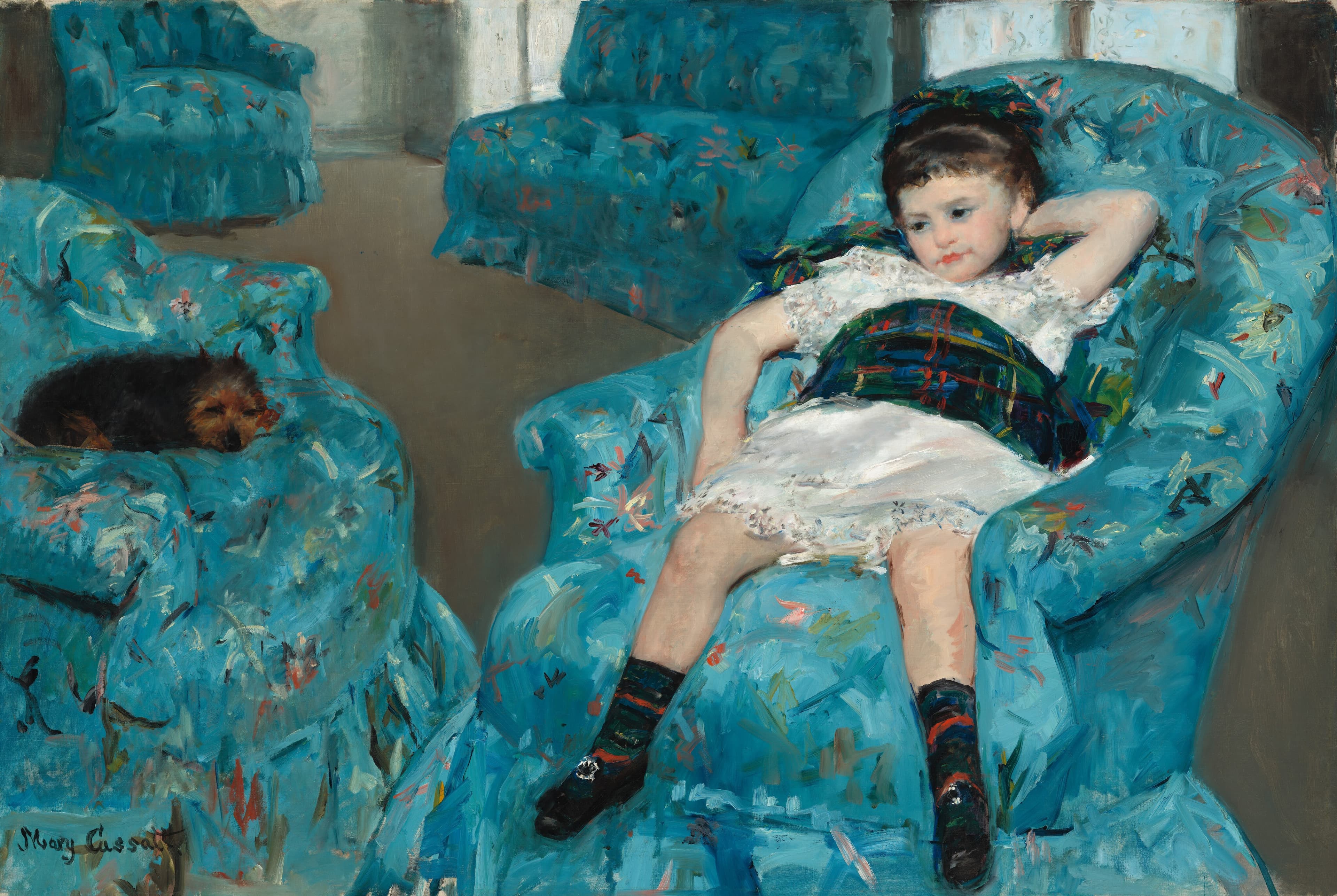
A small girl lies flung sideways across a big blue floral armchair, one leg out, looking thoroughly unimpressed; her dog sleeps on the chair opposite. Mary Cassatt painted it in 1878, Edgar Degas advised her on it and painted part of the background himself, and an American jury rejected it that same year. It is at the National Gallery of Art in Washington.
- 1878
- Oil on canvas
About Mary Cassatt
A child who is done with the afternoon
Cassatt painted children as people rather than as small decorative adults, and this is the clearest case of it. The girl has slid down the seat until she is more horizontal than upright, her arm behind her head, her expression somewhere between bored and mutinous. The National Gallery's own text asks the obvious questions and refuses to settle them: is she tired from playing, has she been told to behave, or is she simply bored?
The room gives her no help. Four matching blue armchairs crowd the picture and overlap each other, cropped hard by the edges of the canvas, and the windows are cut off at the top. She is the smallest thing in a room of furniture built for other people.
The girl was the daughter of friends of Degas. Neither the museum nor the scholarship names her. The dog is a Brussels griffon — the National Gallery identifies it as Cassatt's own dog Baptiste, a breed Degas helped her acquire, and she kept griffons for the rest of her life.
What Degas painted
Around 1903 Cassatt wrote to the dealer Ambroise Vollard about this picture, and said that Degas had advised her on the background and had worked on it himself. The letter survives in the Archives of American Art.
For a century that letter was the only evidence. Then conservators at the National Gallery cleaned and examined the painting for the 2014 exhibition Degas/Cassatt, and found the proof in the paint itself. Under magnification, strokes of a grayish, almost silvery-brown paint appear in the corner of the room and nowhere else in the picture. The surface there had also been deliberately scraped. Both the color and the scraping are typical of Degas's work in those years, and absent from Cassatt's.
Infrared imaging showed what he had changed. Cassatt had painted a single flat back wall facing the viewer, with one horizontal line for the edge of the floor. Degas added a corner, turning that flat wall into two walls meeting at an angle, which opened the room out and gave it depth.
Degas's corner forced Cassatt into other changes. She had to move and repaint the armless couch in the center so that it lined up with the newly sloping wall. The infrared image also shows her trying the dog on the floor in front of the couch before she put it back on the chair where it now sleeps.
Rejected in 1878
Cassatt submitted the painting to the American section of the 1878 Exposition Universelle in Paris, and the jury turned it down. In the same letter to Vollard she said she was furious, the more so because Degas had worked on it, and noted that the jury was three people, one of them a pharmacist.
The scholar Judith Barter has argued that the pose was not the problem. A picture of a similarly sprawling child, by the Belgian painter Alfred Cluysenaar, was accepted elsewhere at the same fair. What was new in Cassatt's canvas was the background — flat, cropped and steeply angled, the part Degas had a hand in.
The painting probably went next into the fourth Impressionist exhibition of 1879, Cassatt's first showing with the group, though the evidence stops short of certainty. The National Gallery's own catalogue record lists it as possibly number 47 in that exhibition, under the title Portrait de petite fille.
Vollard, Brame, Mellon
Ambroise Vollard bought the painting from Cassatt, and his name and address are still written in pencil on the wooden crossbar behind the canvas. It passed to the Paris dealer Hector Brame, who sold it in November 1963 to Paul Mellon and his wife, of Upperville, Virginia. They gave it to the National Gallery of Art in 1983, where it hangs in Gallery M86 with the accession number 1983.1.18.
Close reading
Reading the work, detail by detail
The child's loose pose sits within an unusually expansive arrangement of blue furniture. These details follow the body, the resting dog, and the patterned upholstery surrounding them.
1.An unposed expression
Her gaze does not address the viewer. Together with the tilted head, it makes the scene feel like an interval of private boredom or rest rather than a formal sitting.
2.An arm behind the head
The raised elbow spreads the pose across the furniture. Her body follows the chair's available space instead of holding itself upright for display.
3.The splayed legs
The divergent legs anchor the casual pose. The shoes form dark accents against the bright chair, making the body's relaxed arrangement easy to follow.
4.The small dog
The compact animal supplies a second resting body. Its low, horizontal shape echoes the child's inactivity without repeating her expansive pose.
5.Patterned upholstery
The pattern remains lively even where no figure is present. Changes in brush direction help distinguish rounded cushions and fabric folds within the dominant blue.
6.Space between chairs
The narrow passage of floor prevents the blue furniture from becoming one continuous surface. It gives the room depth while leaving the oversized chairs visually dominant.
Timeline
1878
Painted in Paris with Degas advising; he adds the corner of the room himself. The American section of the Exposition Universelle rejects it.
1879
Possibly number 47, as Portrait de petite fille, in the fourth Impressionist exhibition — Cassatt's first showing with the group.
c. 1903
Cassatt writes to the dealer Ambroise Vollard describing Degas's part in the painting; the letter is now in the Archives of American Art.
1963
Sold by the Paris dealer Hector Brame to Paul and Bunny Mellon in November.
1983
Given to the National Gallery of Art by Mr. and Mrs. Paul Mellon — accession 1983.1.18.
2014
Cleaning, x-radiographs and infrared imaging for the National Gallery's Degas/Cassatt exhibition identify exactly which passages Degas painted; the picture is number 1 in the show.
Where to see it
National Gallery of Art, Washington
Constitution Avenue NW, between 4th and 6th Streets, Washington, DC 20565, United States
The West Building entrance is at 6th Street; the East Building entrance is at 4th Street. Check the museum’s current display information for the work’s building and gallery.
Plan your visit on the museum’s official website (opens in a new tab)Frequently asked questions
Where is Little Girl in a Blue Armchair?
At the National Gallery of Art in Washington, West Building Main Floor, Gallery M86 — accession number 1983.1.18, given by Mr. and Mrs. Paul Mellon in 1983.
Did Edgar Degas paint part of Little Girl in a Blue Armchair?
Yes. Cassatt said so in a letter of about 1903, and technical study for the National Gallery's 2014 Degas/Cassatt exhibition confirmed it. Degas added the corner of the room, replacing the single flat back wall Cassatt had painted with two walls meeting at a diagonal. Paint in that area differs from her handling everywhere else in the picture.
Who is the little girl?
She is not identified. The National Gallery says only that she was the daughter of friends of Degas, who supplied the model.
Why was the painting rejected in 1878?
The American section of the 1878 Exposition Universelle in Paris turned it down. Cassatt blamed the jury — three people, one a pharmacist, as she put it — and the art historian Judith Barter has argued the sticking point was the flat, steeply cropped background rather than the child's sprawling pose.
What is the dog in the painting?
A Brussels griffon. The National Gallery identifies it as Cassatt's own dog Baptiste; Degas helped her get the puppy, and she kept the breed for the rest of her life.
How big is Little Girl in a Blue Armchair?
89.5 by 129.8 centimeters — about 35 by 51 inches, a wide horizontal canvas that gives the room's empty chairs as much space as the child.
More by Mary Cassatt
If you like Mary Cassatt
Explore painters from the same movements and circles.
Gustave Caillebotte
Painter of Haussmann's geometry and the group's organizer-financier; his bequest of Impressionist paintings forced the French state to take the movement in.
View artist
Paul Cézanne
Painter between Impressionism and everything after — shown in the independents' exhibitions, emulated by the Cubists, and present at the Orangerie through 15 works in the Walter-Guillaume collection.
View artist
Edgar Degas
Painter of dancers, racecourses, and café interiors — among the founders of the independent exhibitions that became Impressionism, though he preferred the word 'independent' himself.
View artist
References
The sources below include collection records, catalogues, scholarly research, and primary materials that informed this page. They document Little Girl in a Blue Armchair, its making, and its place in cultural history.


1Little Girl in a Blue Armchair (Mary Cassatt) — National Gallery of Art
WebsiteNational Gallery of Art, WashingtonUsed forWeb source consulted for documented facts and historical context presented on the Little Girl in a Blue Armchair page.

2Degas/Cassatt exhibition brochure — National Gallery of Art
Exhibition catalogueNational Gallery of Art, 2014Used forThe 2014 exhibition brochure sets out the conservation findings: the silvery-brown paint in the corner, the abraded surface, and the infrared evidence that Degas replaced a flat back wall with a corner.
3Mary Cassatt letter to Ambroise Vollard, circa 1903
LettersArchives of American Art, Smithsonian InstitutionUsed forCassatt's own account of Degas's part in the painting and of the 1878 rejection.
4Mary Stevenson Cassatt (1844–1926) — Heilbrunn Timeline of Art History
WebsiteThe Metropolitan Museum of ArtUsed forWeb source consulted for documented facts and historical context presented on the Little Girl in a Blue Armchair page.
These references provide the documented foundation for this work's history and interpretation. Claim-level citations remain attached to the specific claims they support.
 Explore more resources