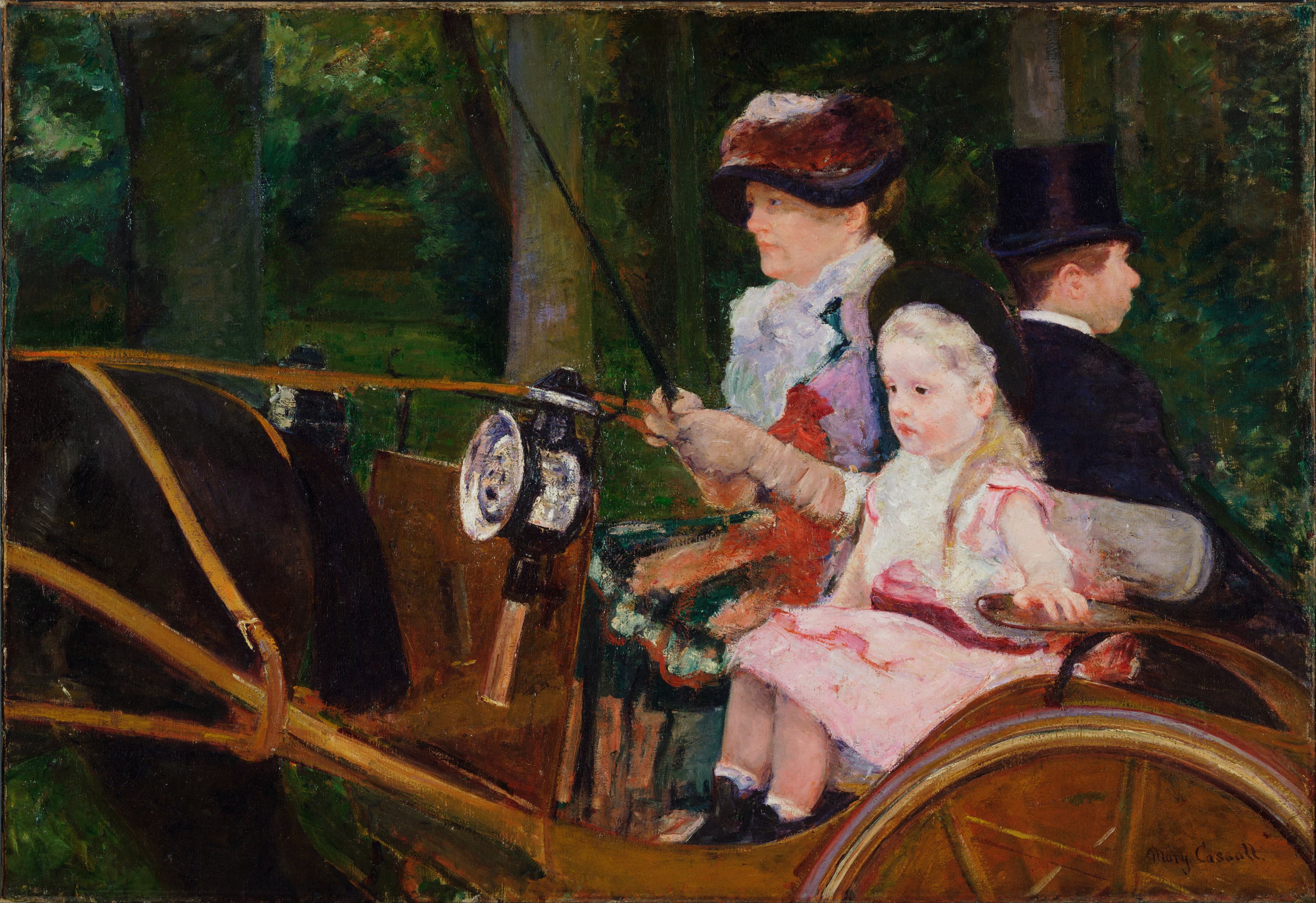
A woman holds the reins and a whip and looks straight ahead down the road. A small girl sits beside her, looking elsewhere. Behind them both, turned away, sits a groom whose face is barely visible. Mary Cassatt painted her sister Lydia driving in the Bois de Boulogne in 1881, and the painting has been at the Philadelphia Museum of Art since 1921.
The woman drives. Her hands are steady on the reins, the whip angles up to the left, and her attention is entirely on the road — not on the child beside her, and not on the viewer. The girl in the pink dress sits primly at her side and looks out and slightly down. The groom sits behind and above them at the right, turned away, his face mostly hidden by his top hat.
The horse is cut off by the left edge, leaving only its hindquarters and the pale shafts of the two-wheeled cart. A cartwheel is cropped at the lower right. The Philadelphia Museum of Art's older handbook attributes that abrupt truncation on all four sides to the example of Cassatt's friend Edgar Degas, and calls the odd viewpoint and blurred detail what set her apart from her American contemporaries.
The museum reads the picture as a departure for her: an outdoor scene rather than a domestic interior, and a record of the freedom of movement upper-class women could have.
Lydia, a niece of Degas, and a groom
The driver is Lydia Cassatt, the artist's older sister, who modeled for her repeatedly. The Philadelphia Museum of Art identifies the girl as Odile Fèvre, a niece of Edgar Degas. That name comes from the museum's current label and is not corroborated in the published Degas family literature, which names the Fèvre children differently — worth knowing before repeating it.
The groom has never been identified. The museum says so outright, and the museum's own 1922 catalogue described him only as a groom seated behind. A name for him circulates online; no museum record supports it.
The horse is on firmer ground. She was called Bichette, and the Cassatt family bought her with a small carriage in 1879. Driving in the park was something Lydia and Mary Cassatt did together after that.
A year before Lydia died
Lydia Cassatt was ill while sitting for this. She died in 1882 of Bright's disease, the period name for chronic nephritis, roughly a year to eighteen months after the painting was made. Her sister stopped painting for months afterward.
That is the context, not the subject. Nothing in the picture is about illness: a woman handles a horse competently on an afternoon outing, and the painting is one of the last records of her doing it.
It never left the family until 1921
The painting went to Cassatt's brother Alexander Johnston Cassatt, president of the Pennsylvania Railroad, and stayed in the family for forty years — to his wife Lois, then to their son Edward. The City of Philadelphia bought it for the museum in 1921 with the W. P. Wilstach Fund, and it is accession W1921-1-1.
The museum's 1922 catalogue of the Wilstach collection listed it as number 55, under a third title: Woman and Child Driving. Its description is plain — a woman seated in a two-wheel cart, driving through a wood, a little girl beside her and a groom seated behind.
Because it sat in the family until 1921, it was probably never publicly exhibited in Cassatt's lifetime. It was not in the sixth Impressionist exhibition of 1881, where she showed eleven other works.
Close reading
Reading the work, detail by detail
The carriage fills the frame so tightly that its journey seems to continue beyond the canvas. These details follow the driver's control, the passengers' separate attention, and the cropped equipment that carries them forward.
1.The driver's profile
The clear profile directs attention toward the road outside the picture. Her upright head holds steady against the broken greens of the woodland, giving the moving scene a point of concentration.
2.Hands on the reins
Several thin lines converge at the hands, making this small area the practical center of the carriage. The reins pull toward the cropped horse, while the whip introduces a steeper diagonal above them.
3.The girl's separate gaze
The pale dress and light hair bring the child forward against the darker passengers. Her gaze turns away from the driver's line of sight, allowing two kinds of attention to occupy the same narrow seat.
4.The backward-facing passenger
His dark back forms a compact block behind the girl's light head. The opposite direction of his profile extends the scene in two directions, suggesting a world continuing around the carriage.
5.The cropped horse and harness
The horse enters the picture as a cropped mass held by bright harness lines. Those lines lead toward the carriage and make its forward movement legible even though the animal's head remains beyond the frame.
6.The wheel at the edge
The wheel's broad arc gives the lower corner a strong sweep. Cropping it close to the viewer enlarges the carriage's presence and makes the space around the passengers feel unusually immediate.
At the Philadelphia Museum of Art — accession number W1921-1-1, bought with the W. P. Wilstach Fund in 1921. The museum's record listed it as not currently on view, so check before travelling.
Who is the woman driving?
Lydia Cassatt, the artist's older sister. She sat for many of Cassatt's paintings in these years and died the following year, in 1882.
Who is the girl?
A niece of Edgar Degas. The Philadelphia Museum of Art names her Odile Fèvre, though that identification appears only on the museum's own label and is not corroborated in the published literature on the Degas family.
Who is the man in the back?
A groom, and the museum says plainly that he is unidentified. A name for him circulates online but no museum record supports it.
Why is the horse cut off?
Cassatt cropped it deliberately. The composition is cut on all four sides: the horse at the left, a cartwheel at the lower right. The museum's handbook connects that truncation to the example of Degas, and it makes the scene read as something glimpsed rather than posed.
Was the painting shown in an Impressionist exhibition?
No. Cassatt showed eleven other works at the sixth Impressionist exhibition in 1881, seven of them pastels, and this canvas was not among them. It went to her brother Alexander and stayed in the family until 1921.
Why is it also called Driving?
The museum's database currently displays the short title Driving, while its own label, its print shop and its earlier catalogues use A Woman and a Girl Driving. The 1922 Wilstach catalogue called it Woman and Child Driving. All three name the same painting.
In the atlas
What the graph records about this work — every claim carries its citation.
The Philadelphia Museum of Art identifies the woman holding the reins as Lydia Cassatt, the artist's sister. The family had bought a small carriage and a horse called Bichette in 1879, and the sisters drove together in the park.
— Driving / A Woman and a Girl Driving (Mary Cassatt, 1881) — Philadelphia Museum of Art
Explore painters from the same movements and circles.
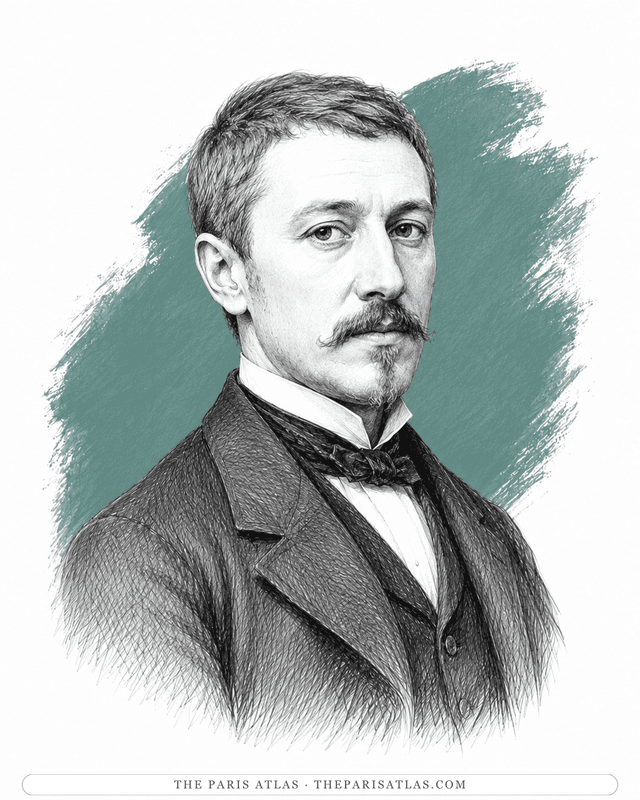
Gustave Caillebotte
Painter of Haussmann's geometry and the group's organizer-financier; his bequest of Impressionist paintings forced the French state to take the movement in.
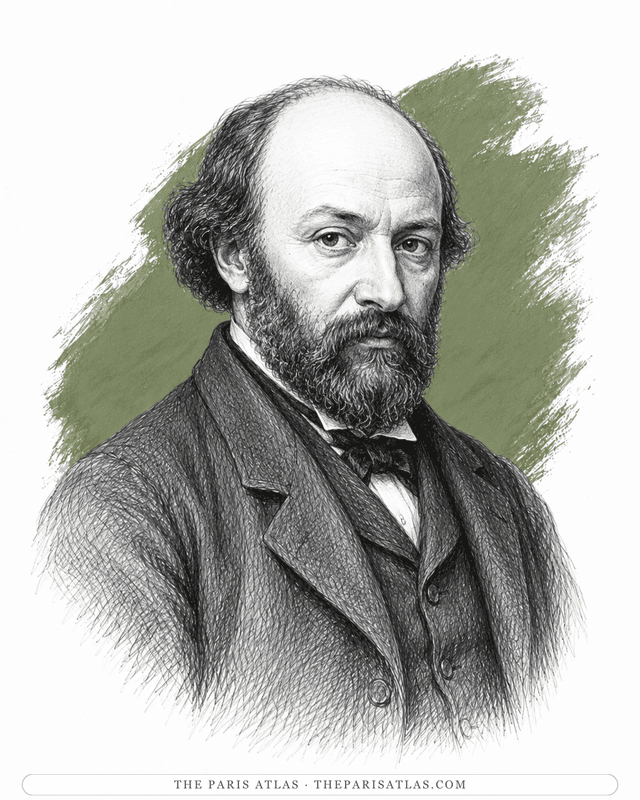
Painter between Impressionism and everything after — shown in the independents' exhibitions, emulated by the Cubists, and present at the Orangerie through 15 works in the Walter-Guillaume collection.
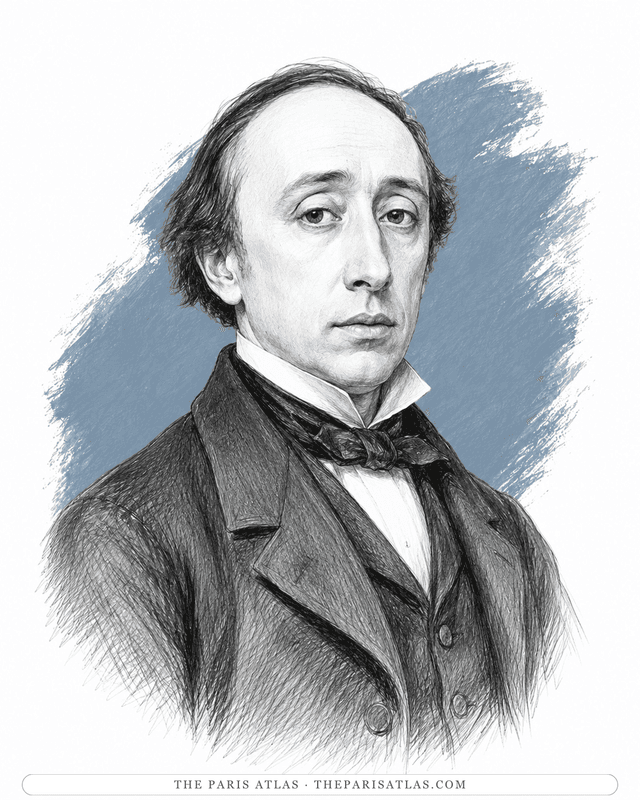
Painter of dancers, racecourses, and café interiors — among the founders of the independent exhibitions that became Impressionism, though he preferred the word 'independent' himself.
The sources below include collection records, catalogues, scholarly research, and primary materials that informed this page. They document A Woman and a Girl Driving, its making, and its place in cultural history.
1Driving / A Woman and a Girl Driving (Mary Cassatt, 1881) — Philadelphia Museum of Art
Website
Philadelphia Museum of Art
Used for
Web source consulted for documented facts and historical context presented on the A Woman and a Girl Driving page.
These references provide the documented foundation for this work's history and interpretation. Claim-level citations remain attached to the specific claims they support.


 View source