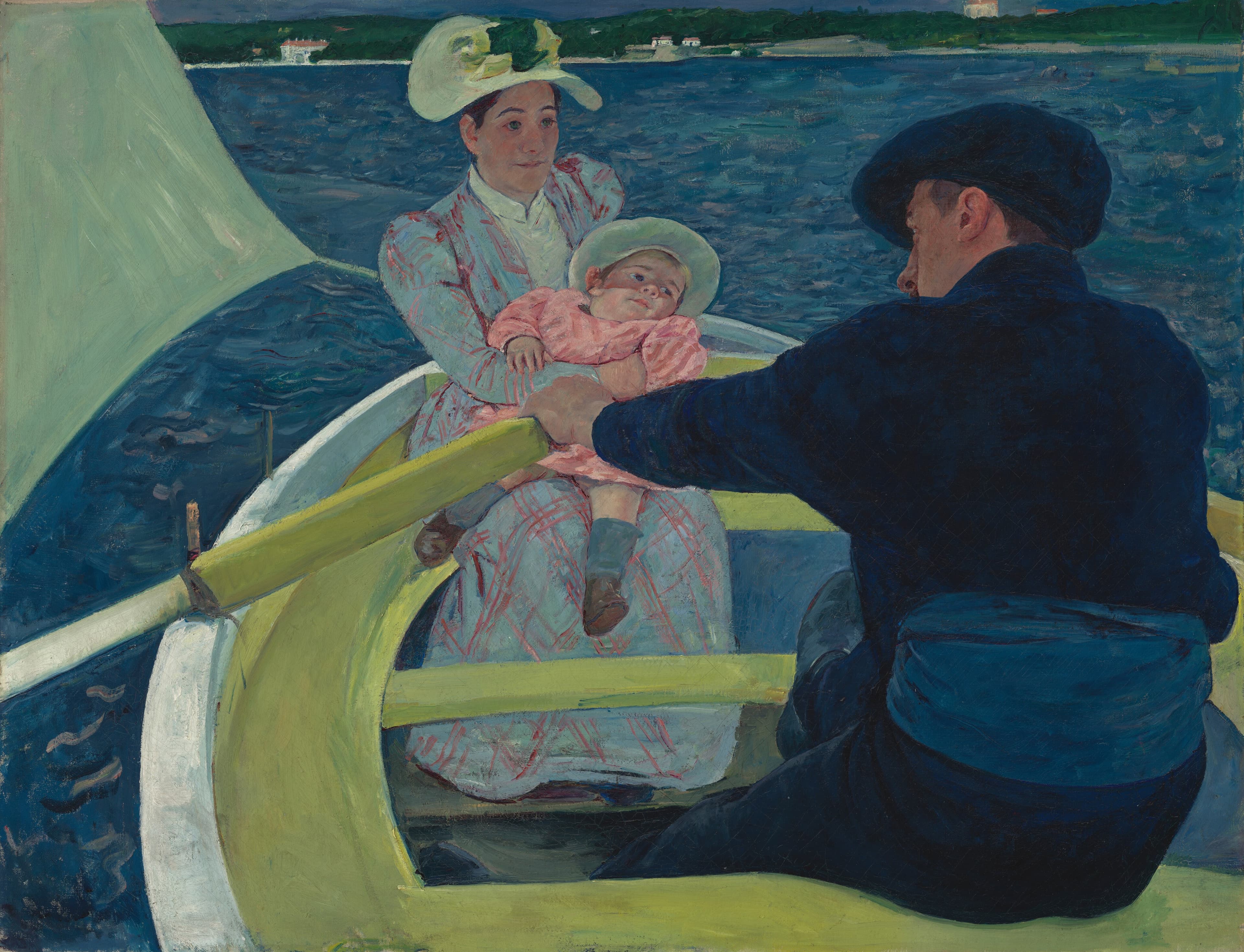
The Boating Party
by Mary Cassatt
A boatman in dark blue sits at the oars with his back to the viewer, filling the left of the canvas, while a woman holding a baby faces him under a curving yellow sail. Mary Cassatt painted it on the Mediterranean coast at Antibes in the winter of 1893–94, and at roughly three feet by four it is one of the largest pictures she made. It has been at the National Gallery of Art in Washington since 1963.
- 1893/1894
- Oil on canvas
About Mary Cassatt
The boatman's back
The dark shape of the rower dominates the picture and blocks the view out to sea, pressing the whole scene flat against the surface of the canvas. The horizon sits near the top edge, so there is almost no distance to look into, and the viewpoint is high enough to see down into the boat, whose crossbeams cut the hull into bands. The National Gallery reads all of this as the influence of Japanese prints, which were widely collected and admired in Paris in the late 1800s.
The color does the rest. Citron yellow and blue sweep through the picture in strong arcs — the sail, the water, the boatman's clothes — dividing it into shapes the museum describes as assertive and almost abstract. On that basis the Gallery places the painting alongside Post-Impressionists such as Paul Gauguin and Vincent van Gogh, rather than with the Impressionist work Cassatt had shown in the 1880s.
None of the three people has been identified.
A winter on the Mediterranean
From 1893 Cassatt began spending long stretches on the Mediterranean coast at Antibes. The National Gallery attributes the change in her color to that light: under the intense southern sun she began working with harder, more decorative color than she had used in Paris.
The painting was the centerpiece of her first solo exhibition in the United States, held at the Durand-Ruel Galleries in New York in 1895, where it hung as number 1 in the catalogue.
Twenty years in her own hands
Cassatt kept it for two decades. In February 1914 she wrote to her dealer Paul Durand-Ruel about the picture, which she called La Barque, and the National Gallery cites that letter as evidence she still owned it. In 1917 and 1918 she lent it to a touring American exhibition of six women painters, where it was shown as Party in a Boat.
Durand-Ruel's New York gallery had it by the 1920s and sold it on 1 October 1929 to Chester Dale, a New York bond trader whose wife Maud Murray Dale had drawn him into collecting modern French painting. Dale became a trustee of the National Gallery in 1943 and its president in 1955, and his 1963 bequest brought the painting to Washington with roughly 240 others. It hangs in Gallery M86 with the accession number 1963.10.94.
Five cents, 1966
The United States Post Office issued the painting as a five-cent stamp on 17 November 1966, the sixth in its annual American Painting series. Robert J. Jones designed it, and it was printed in six inks across two passes through the press, in sheets of fifty, with 120 million stamps authorized to start. The Smithsonian's National Postal Museum holds an example.
Close reading
Reading the work, detail by detail
A boatman fills the foreground while a woman and child sit across from him. The boat's curves, the crossing oar, and the high shoreline hold the figures in a compressed space.
1.The mother opposite
Her upright posture gives the crowded boat a relatively still point. The light hat and face separate her from the dark blue water behind.
2.The child's loose pose
The head tilts sideways while the small arms and legs lie at different angles. This loose pose contrasts with the deliberate positions of both adults.
3.The boatman's back
His back takes up much of the foreground and partly blocks the view. The broad dark shape makes the woman and child appear brighter and farther away.
4.The crossing oar
The oar links the near edge to the figures opposite. Its straight diagonal cuts across the boat's curves and makes the boatman's work structurally central.
5.The curved hull
The emphatic curve contains the figures within a shallow bowl of color. Repeated seats cross that bowl, making the enclosed space easy to read despite the close viewpoint.
6.The high shoreline
Placing the shore near the upper edge leaves most of the background to water. The small distant buildings establish how tightly the boat and its passengers have been brought toward the viewer.
Timeline
1893–94
Painted at Antibes on the Mediterranean coast, where Cassatt spent the winter with her mother.
1895
Number 1 in Cassatt's first solo exhibition in the United States, at the Durand-Ruel Galleries in New York.
1914
Still Cassatt's own: she writes to Paul Durand-Ruel about the picture, which she calls La Barque, on 12 February.
1917–18
Lent by Cassatt to Exhibition of Paintings by Six American Women Painters, touring Pittsburgh, Cleveland, Cincinnati, Kansas City and St. Louis, as Party in a Boat.
1929
Sold by Durand-Ruel's New York gallery to the collector Chester Dale on 1 October.
1963
Enters the National Gallery of Art with the Chester Dale bequest — accession 1963.10.94.
1966
Reproduced on a five-cent United States postage stamp, issued 17 November in the American Painting series.
Where to see it
National Gallery of Art, Washington
Constitution Avenue NW, between 4th and 6th Streets, Washington, DC 20565, United States
The West Building entrance is at 6th Street; the East Building entrance is at 4th Street. Check the museum’s current display information for the work’s building and gallery.
Plan your visit on the museum’s official website (opens in a new tab)Frequently asked questions
Where is Mary Cassatt's The Boating Party?
At the National Gallery of Art in Washington, West Building Main Floor, Gallery M86 — accession number 1963.10.94, part of the Chester Dale Collection.
Where was The Boating Party painted?
At Antibes on the French Mediterranean coast, in the winter of 1893–94. Cassatt began spending time there from 1893, and the National Gallery credits the southern light with the harder, more decorative color in the painting.
Who are the people in The Boating Party?
They have never been identified. The boatman, the woman and the baby are unnamed in the museum's record and in the scholarship on the painting.
How big is The Boating Party?
90 by 117.3 centimeters — about 35 by 46 inches, or nearly three feet by four. It is one of the largest canvases Cassatt painted.
Why does the composition look so flat?
Cassatt took the devices from Japanese woodblock prints, which were widely collected in Paris at the time. The horizon sits at the top edge, the viewpoint is high enough to look down into the boat, and the dark figure of the boatman presses the whole scene onto the surface of the canvas.
Was The Boating Party on a stamp?
Yes. The United States Post Office issued it as a five-cent stamp on 17 November 1966, the sixth in its American Painting series, designed by Robert J. Jones.
More by Mary Cassatt
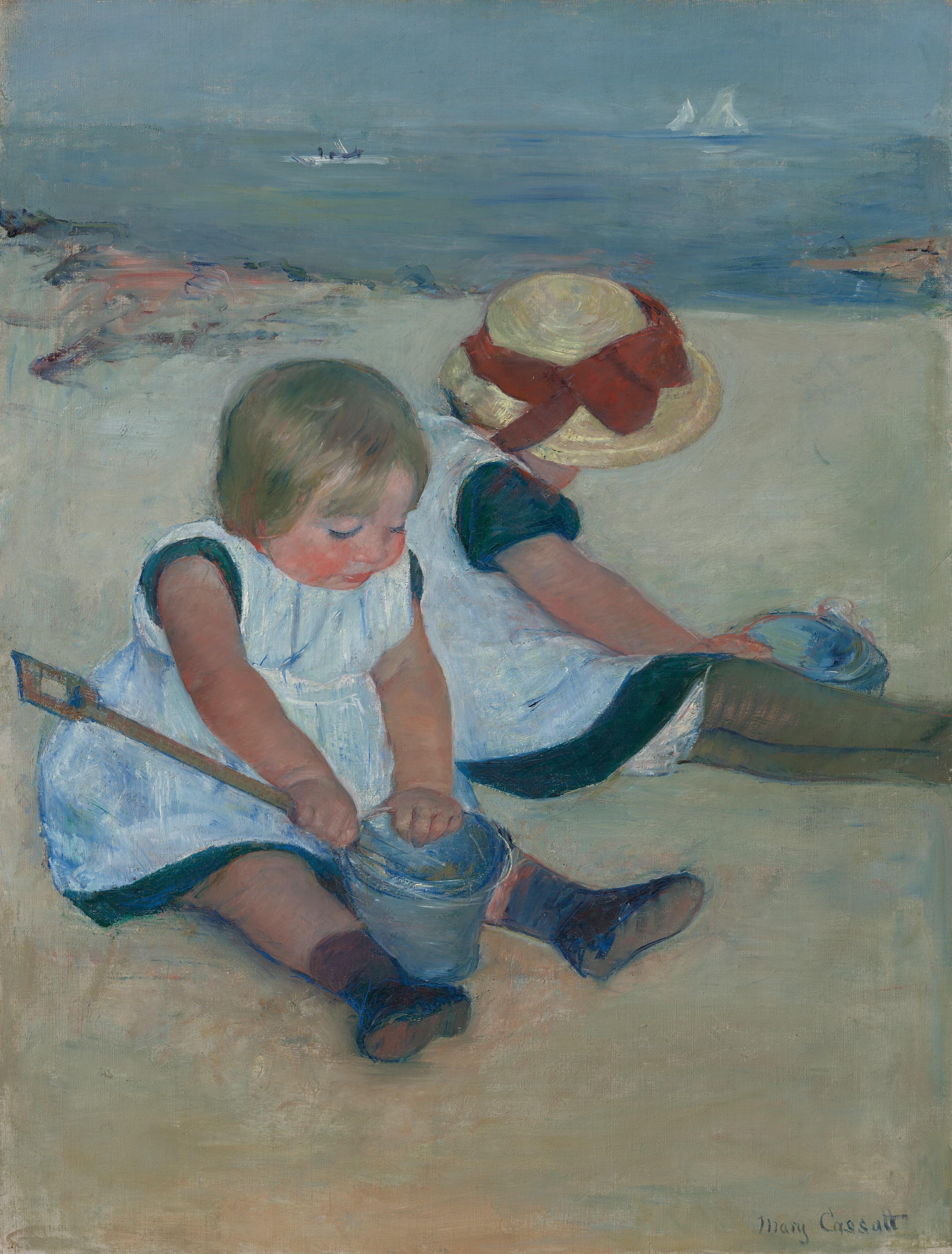
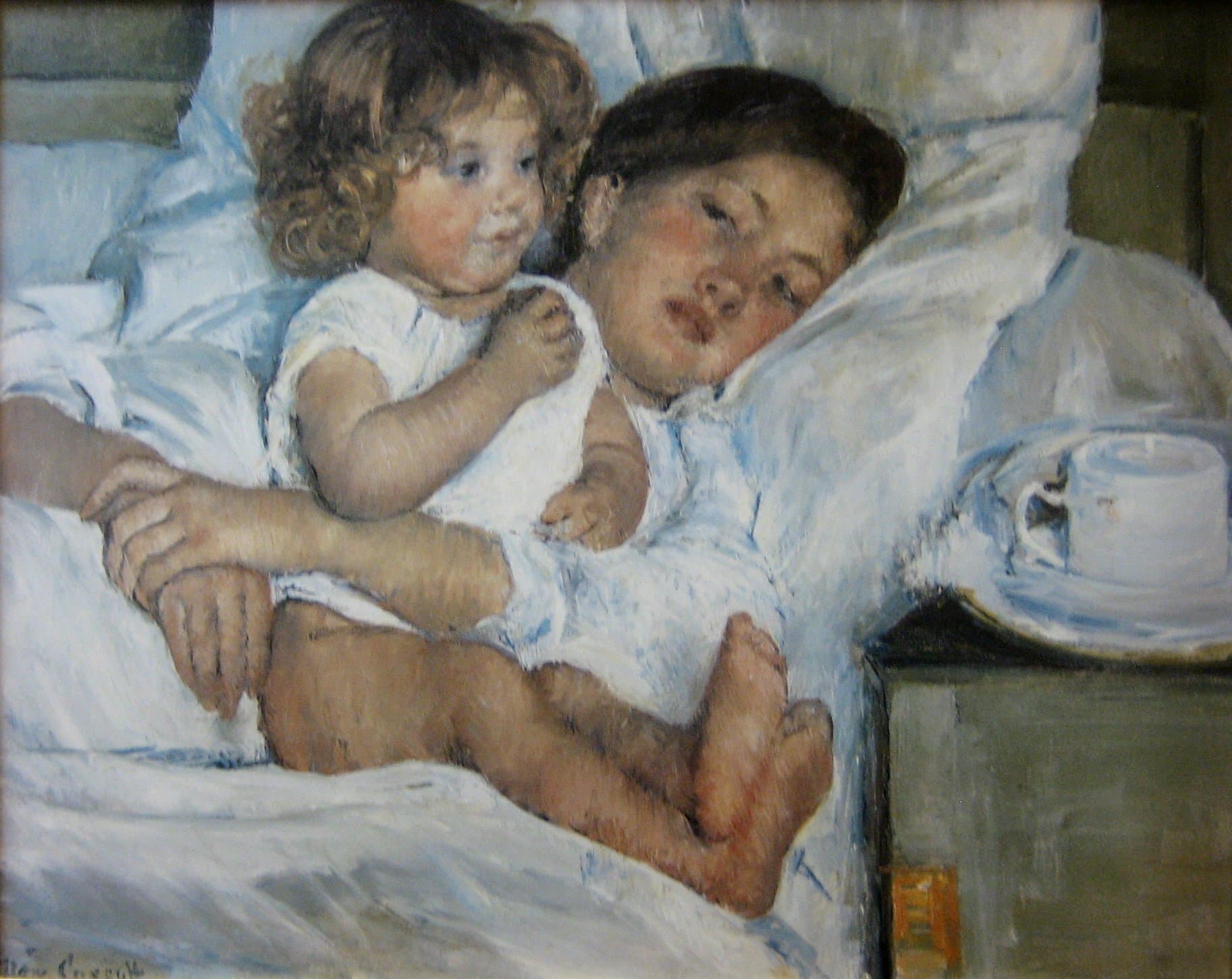
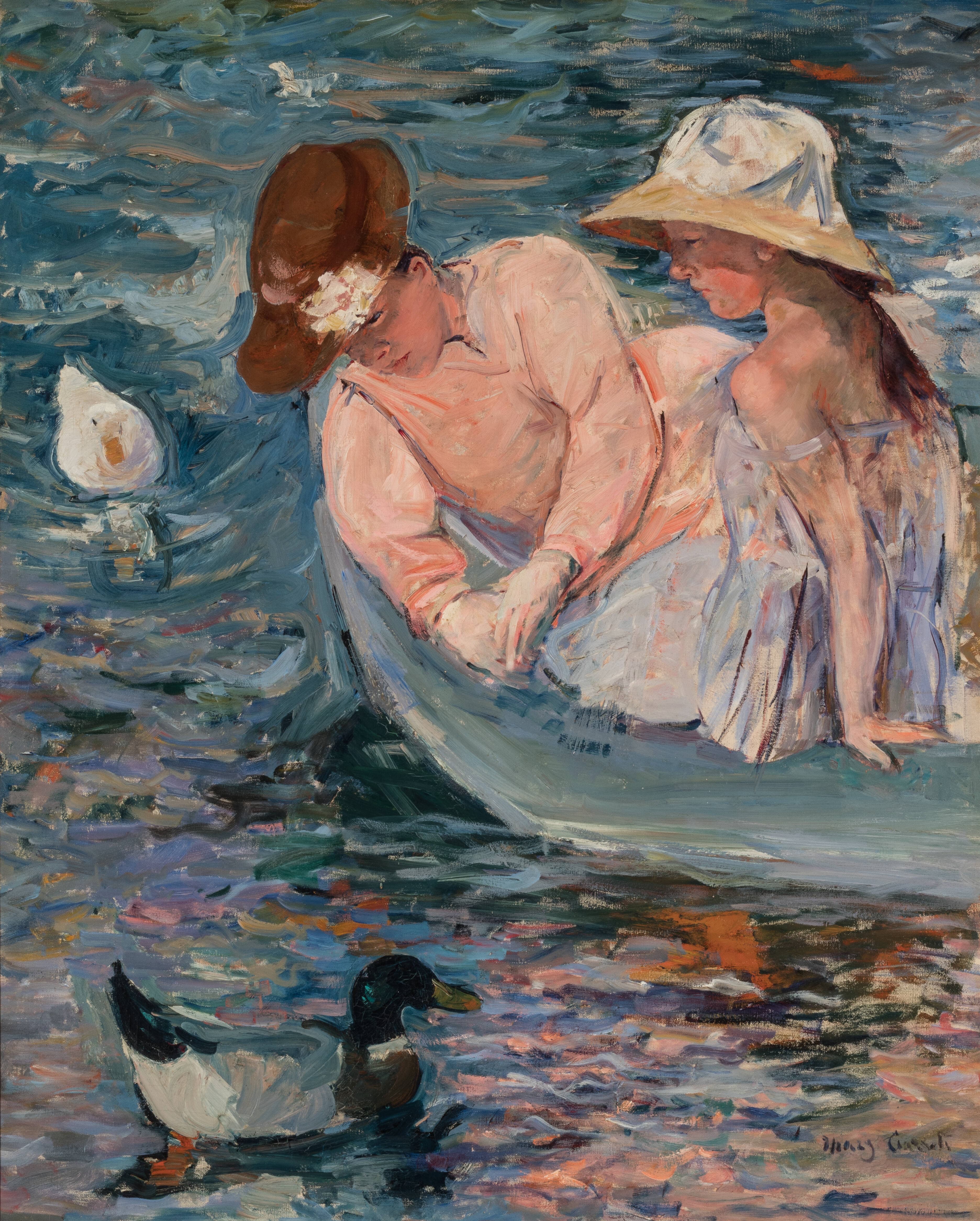
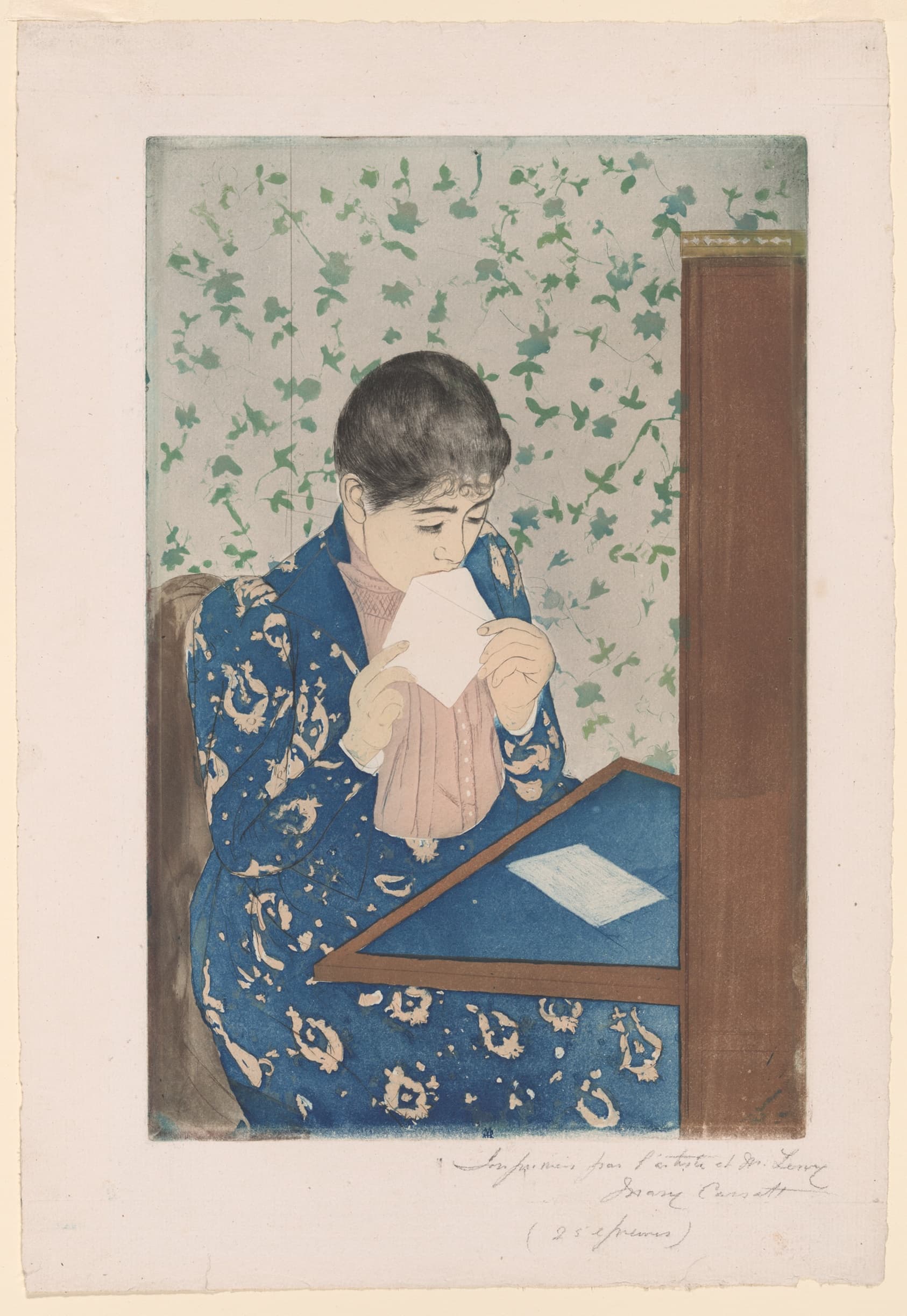
If you like Mary Cassatt
Explore painters from the same movements and circles.
Gustave Caillebotte
Painter of Haussmann's geometry and the group's organizer-financier; his bequest of Impressionist paintings forced the French state to take the movement in.
View artist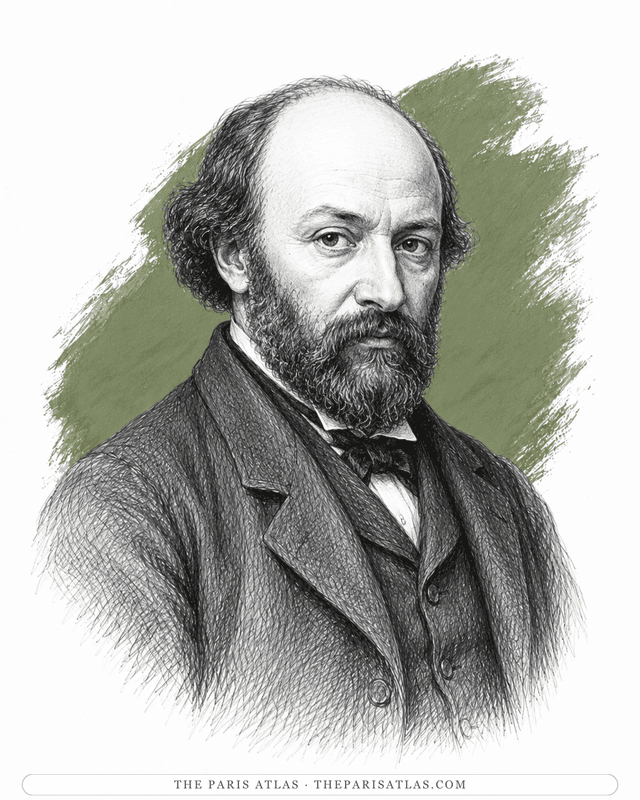
Paul Cézanne
Painter between Impressionism and everything after — shown in the independents' exhibitions, emulated by the Cubists, and present at the Orangerie through 15 works in the Walter-Guillaume collection.
View artist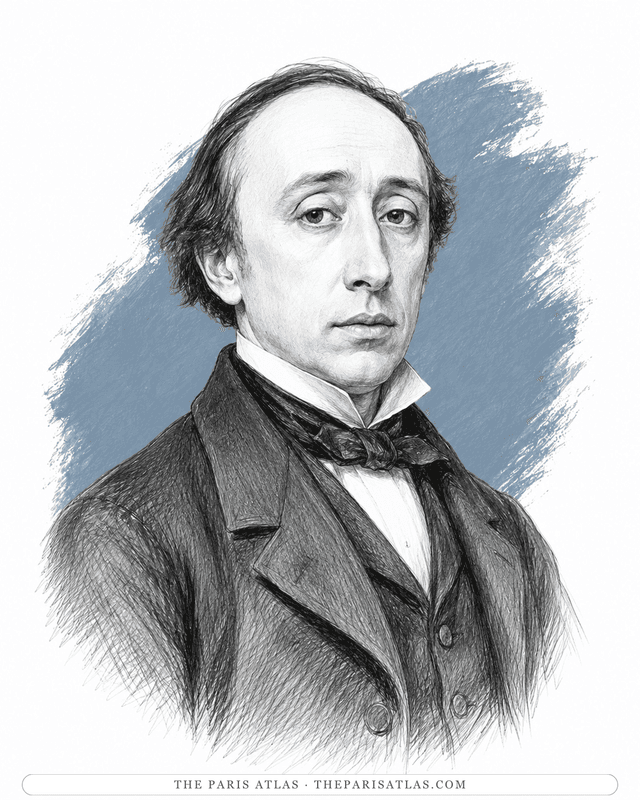
Edgar Degas
Painter of dancers, racecourses, and café interiors — among the founders of the independent exhibitions that became Impressionism, though he preferred the word 'independent' himself.
View artist
References
The sources below include collection records, catalogues, scholarly research, and primary materials that informed this page. They document The Boating Party, its making, and its place in cultural history.


1The Boating Party (Mary Cassatt, 1893/1894) — National Gallery of Art
WebsiteNational Gallery of Art, WashingtonUsed forWeb source consulted for documented facts and historical context presented on the The Boating Party page.

2Degas/Cassatt exhibition brochure — National Gallery of Art
Exhibition catalogueNational Gallery of Art, 2014Used forSupplies the arc of Cassatt's career either side of the Antibes winter.
3Mary Stevenson Cassatt (1844–1926) — Heilbrunn Timeline of Art History
WebsiteThe Metropolitan Museum of ArtUsed forWeb source consulted for documented facts and historical context presented on the The Boating Party page.
4Mary Cassatt Brings Girls and Women to the Museum — National Gallery of Art
WebsiteNational Gallery of Art, WashingtonUsed forWeb source consulted for documented facts and historical context presented on the The Boating Party page.
These references provide the documented foundation for this work's history and interpretation. Claim-level citations remain attached to the specific claims they support.
 Explore more resources