The Child's Bath
by Mary Cassatt
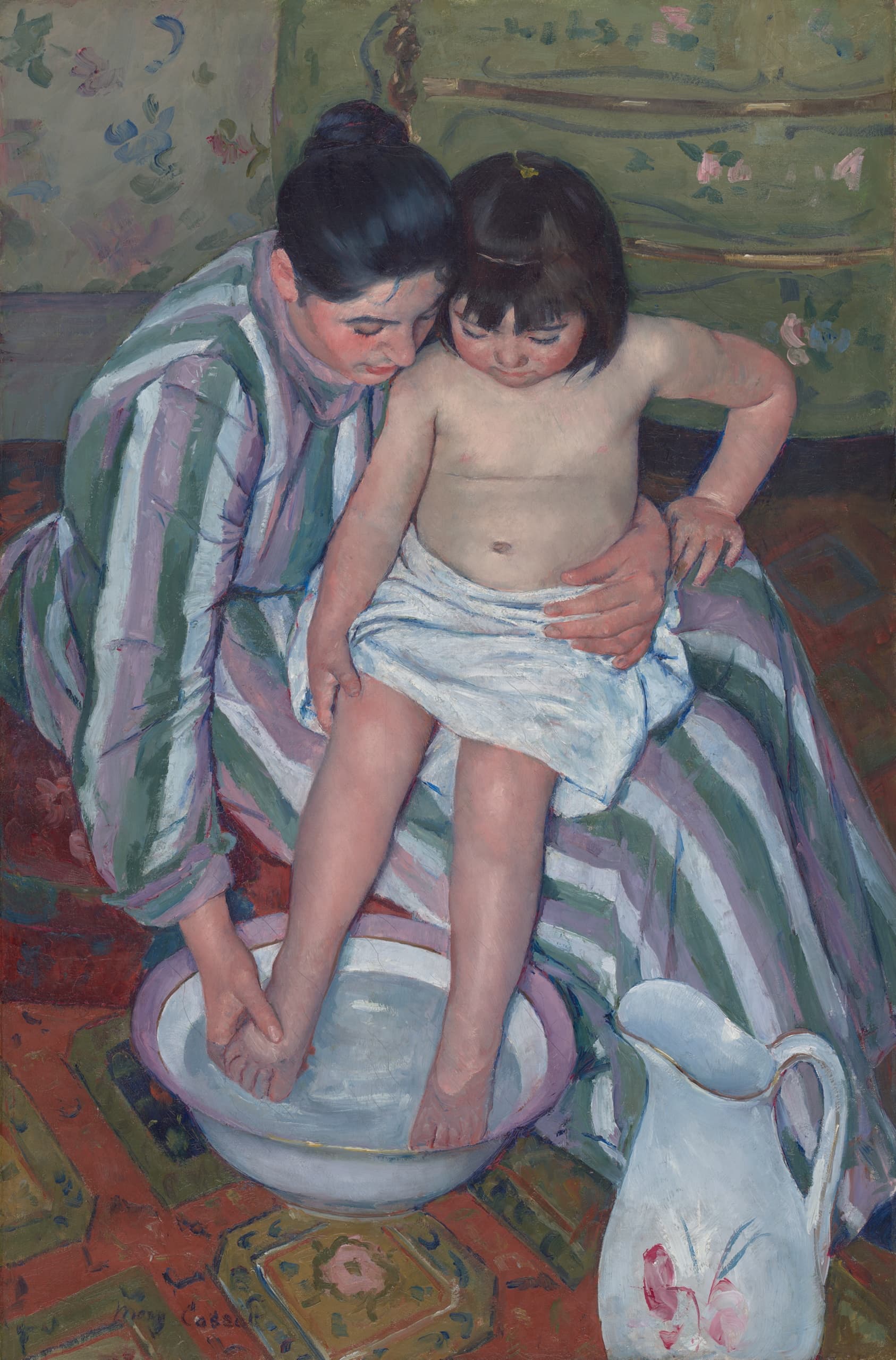
A woman washes a child's feet in a basin, and the viewer looks down on both of them from almost directly above. Mary Cassatt painted it in 1893, after three years spent working out what Japanese woodblock prints could teach Western painting. It has been at the Art Institute of Chicago since 1910, and the museum calls it one of her masterworks.
- 1893
- Oil on canvas
About Mary Cassatt
Seen from above
A woman in a striped dress holds a child on her lap and washes the child's feet in a flowered basin, a water pitcher beside them on the patterned carpet. Her cheek rests near the child's shoulder, and the child's hand sits on her own knee. The Art Institute's text calls her a caregiver rather than a mother, and names no model.
The unusual part is the viewpoint. Cassatt painted the scene from a steep angle looking downward, as if the viewer were standing over the woman and the child. That angle flattens the room into bands of pattern — carpet, wallpaper, the stripes of the dress — and presses the two figures together into a single shape. Annelise K. Madsen, the museum's curator of American art, describes the effect as a scene with almost no depth in it, seen from a tilted angle.
Three years after the Japanese prints
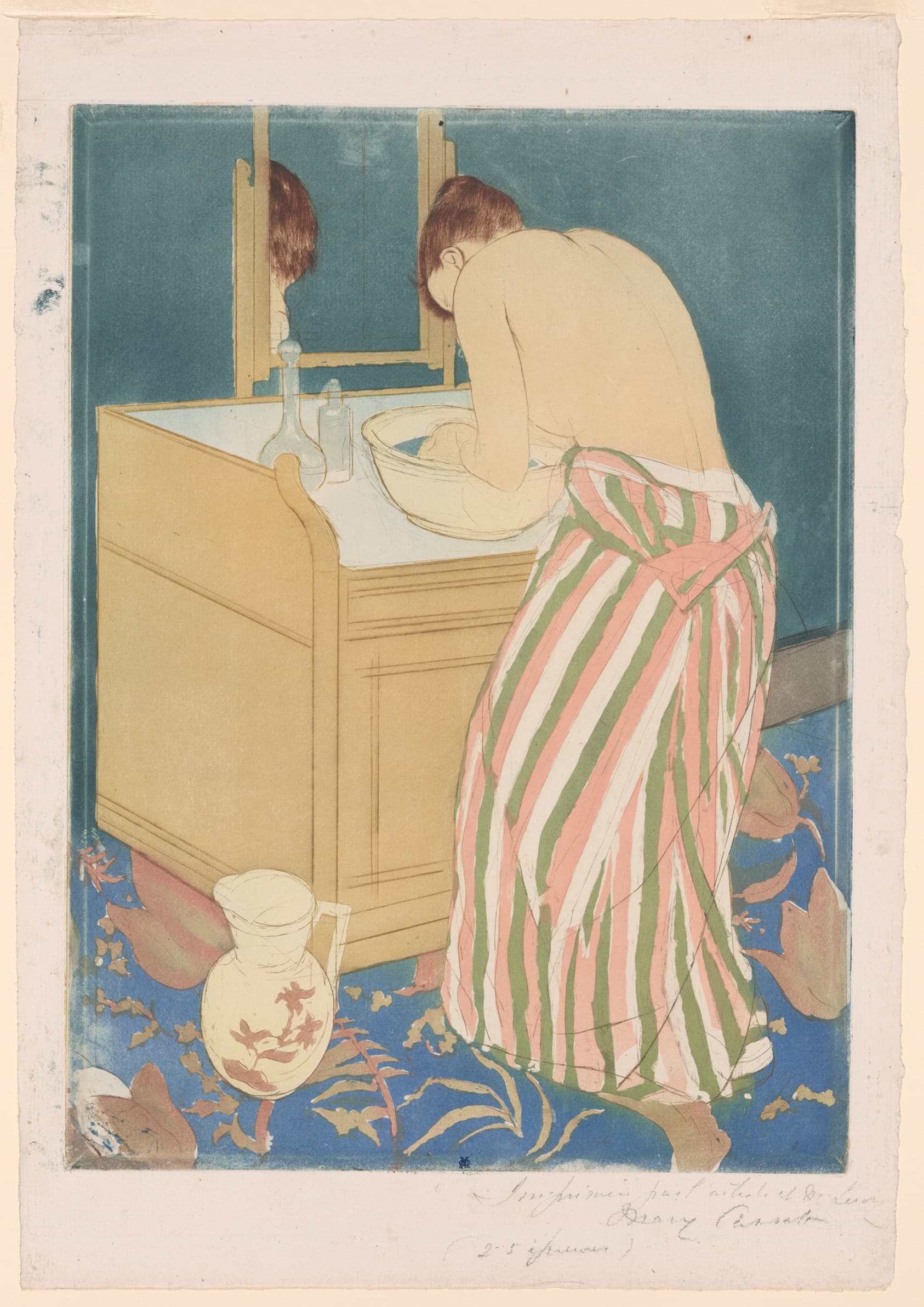
In April 1890 the École des Beaux-Arts in Paris held a large exhibition of Japanese color woodblock prints. Cassatt went, and urged Berthe Morisot to come too: "You must see the Japanese. Come as soon as you can." She then spent 1890–91 making a suite of ten color aquatints in the Japanese manner, including a bathing scene titled The Bath.
The Art Institute presents this painting as the result of that print work: the flattened space, the decorative patterning, and the bright color all carried from the prints back into oil paint. Cassatt showed it in November 1893 at Galerie Durand-Ruel in Paris, in a large solo exhibition of her paintings, pastels and prints. It hung as number 1 in the catalogue, under the title La Toilette de l'Enfant.
Durand-Ruel, Whittemore, Chicago
The painting sold quickly and kept moving. Paul Durand-Ruel, Cassatt's dealer, bought it from her on 24 November 1893, during the Paris exhibition. He sold it in January 1894 to Harris Whittemore, a Connecticut collector, who sold it back to Durand-Ruel's New York gallery in February 1899. The Art Institute of Chicago bought it in 1910 with the Robert A. Waller Fund, and it has been in the collection ever since — accession number 1910.2, on view in Gallery 184.
Close reading
Reading the work, detail by detail
The elevated viewpoint brings faces, hands, feet, and basin into one continuous act of care. Follow that movement, then the competing patterns around it.
1.Looking down together
Their adjacent heads share a downward direction. The action gathers their attention inside the picture instead of asking either figure to look outward.
2.The supporting hand
The spread fingers describe a secure hold with great economy. This hand steadies the body while the other performs the washing.
3.Washing the foot
The small contact is the practical center of the scene. Curving fingers, foot, and basin repeat one another's rounded shapes.
4.The basin from above
The steep viewpoint opens the basin toward the viewer. Its elliptical rim gives a clear spatial shape amid the surrounding patterns.
5.Stripes around the body
The stripes follow the sleeve and skirt as they fold around the child. They make the supporting body's shape visible without separating it from the decorative surface.
6.Pitcher and patterned floor
The pitcher supplies another curved vessel at the near edge. Its pale surface creates a pause within the floor's dense ornament and completes the small group of washing objects.
The Child's Bath quotes
You must see the Japanese. Come as soon as you can.
Timeline
1890
Cassatt visits the April exhibition of Japanese woodblock prints at the École des Beaux-Arts in Paris and begins her suite of ten color aquatints.
1893
Painted in France; shown November–December as number 1, La Toilette de l'Enfant, in Cassatt's solo exhibition at Galerie Durand-Ruel, Paris; sold to Durand-Ruel on 24 November.
1894
Sold to the Connecticut collector Harris Whittemore in January.
1899
Whittemore sells it back to Durand-Ruel's New York gallery in February.
1910
Bought by the Art Institute of Chicago with the Robert A. Waller Fund — accession 1910.2.
1926–27
Hangs in the Art Institute's memorial exhibition held after Cassatt's death, as number 29.
1998–99
Number 72 in Mary Cassatt: Modern Woman, the retrospective shown in Chicago, Boston and Washington.
2014–15
Number 4 in Paul Durand-Ruel: Defender of the Impressionists, at the Musée d'Orsay, the National Gallery in London, and Philadelphia.
Where to see it
Art Institute of Chicago
111 South Michigan Avenue, Chicago, IL 60603, United States
Displays and loans can change. Check whether this work is on view before making a special trip.
Plan your visit on the museum’s official website (opens in a new tab)Frequently asked questions
Where is The Child's Bath?
At the Art Institute of Chicago, in Gallery 184 — accession number 1910.2. The museum bought it in 1910 with the Robert A. Waller Fund.
Who is the woman in The Child's Bath?
The museum does not name a model. The Art Institute's own text calls her a caregiver rather than the child's mother, and the picture is catalogued by its subject, not its sitters.
Why is the perspective in The Child's Bath so steep?
Cassatt took the downward viewpoint and flat patterning from Japanese woodblock prints. She had seen a large exhibition of them at the École des Beaux-Arts in Paris in April 1890, spent 1890–91 making ten color prints in that manner, and carried the same devices into this oil in 1893.
Is The Child's Bath the same painting as The Bath?
Yes — the painting has been exhibited as The Bath, The Toilet, and La Toilette de l'Enfant, and the Art Institute settled on The Child's Bath. It is a different work from Cassatt's 1890–91 color print The Bath, which the museum also holds.
How big is The Child's Bath?
101.3 by 67.3 centimeters — about 40 by 26 inches, a vertical canvas slightly over a meter tall.
Was The Child's Bath exhibited in Cassatt's lifetime?
Yes, repeatedly. It was number 1 in her November 1893 solo exhibition at Galerie Durand-Ruel in Paris, and went to Durand-Ruel's New York gallery in 1895. It then appeared at the Pennsylvania Academy of the Fine Arts annual in 1898, before Chicago bought it in 1910.
More by Mary Cassatt
If you like Mary Cassatt
Explore painters from the same movements and circles.
Gustave Caillebotte
Painter of Haussmann's geometry and the group's organizer-financier; his bequest of Impressionist paintings forced the French state to take the movement in.
View artist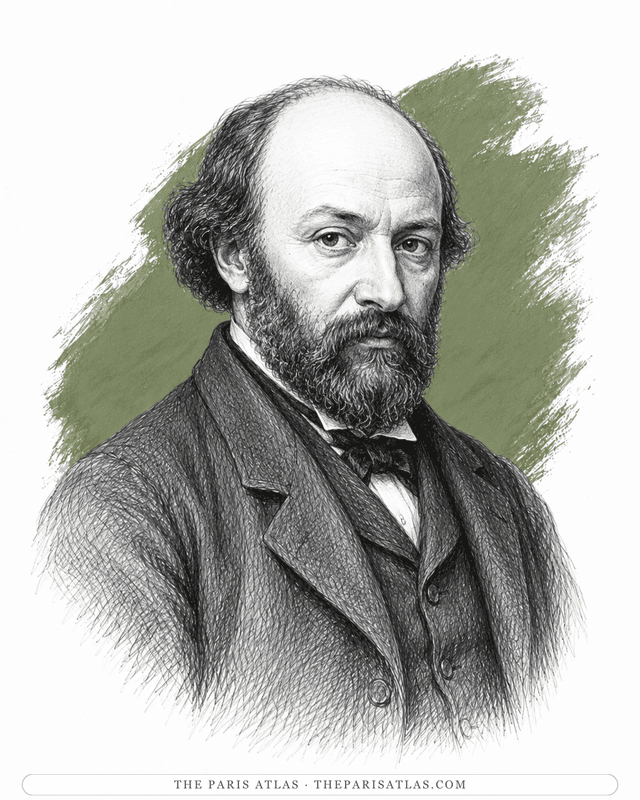
Paul Cézanne
Painter between Impressionism and everything after — shown in the independents' exhibitions, emulated by the Cubists, and present at the Orangerie through 15 works in the Walter-Guillaume collection.
View artist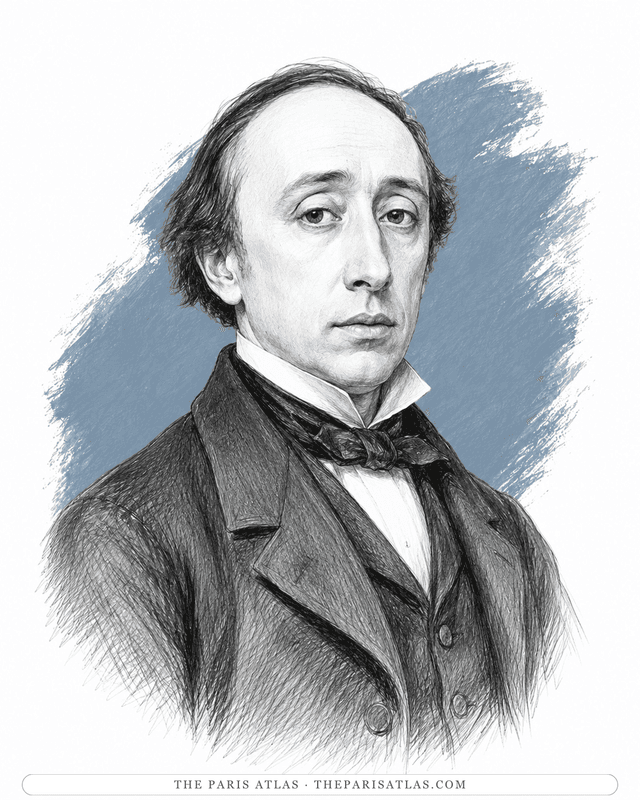
Edgar Degas
Painter of dancers, racecourses, and café interiors — among the founders of the independent exhibitions that became Impressionism, though he preferred the word 'independent' himself.
View artist
References
The sources below include collection records, catalogues, scholarly research, and primary materials that informed this page. They document The Child's Bath, its making, and its place in cultural history.


1The Child's Bath (Mary Cassatt, 1893) — Art Institute of Chicago
WebsiteArt Institute of ChicagoUsed forWeb source consulted for documented facts and historical context presented on the The Child's Bath page.
2Cassatt's Modern Vision of the Everyday — Art Institute of Chicago
WebsiteArt Institute of ChicagoUsed forThe museum's curatorial article supplies the acquisition date and the reading of the skewed, downward perspective.
3Juxtaposing Japanese and Impressionist Art — Harvard Art Museums
WebsiteHarvard Art MuseumsUsed forQuotes Cassatt's 1890 letter urging Berthe Morisot to see the Japanese print exhibition.

4Degas/Cassatt exhibition brochure — National Gallery of Art
Exhibition catalogueNational Gallery of Art, 2014Used forDates the Japanese print exhibition to April 1890 and describes the color etchings Cassatt made after it.
5Mary Stevenson Cassatt (1844–1926) — Heilbrunn Timeline of Art History
WebsiteThe Metropolitan Museum of ArtUsed forWeb source consulted for documented facts and historical context presented on the The Child's Bath page.
These references provide the documented foundation for this work's history and interpretation. Claim-level citations remain attached to the specific claims they support.
 Explore more resources