The Paris AtlasCharting the artists, works, and places worth returning to.
  • Painter
· French · 1848–1894

Gustave Caillebotte

Painter of Haussmann's geometry and the group's organizer-financier; his bequest of Impressionist paintings forced the French state to take the movement in.

In images

Details

Lived
1848–1894
Born
19 August 1848
Birthplace
Paris
Died
21 February 1894 · aged 45
Place of death
Petit Gennevilliers
Nationality
French
Roles
Painter

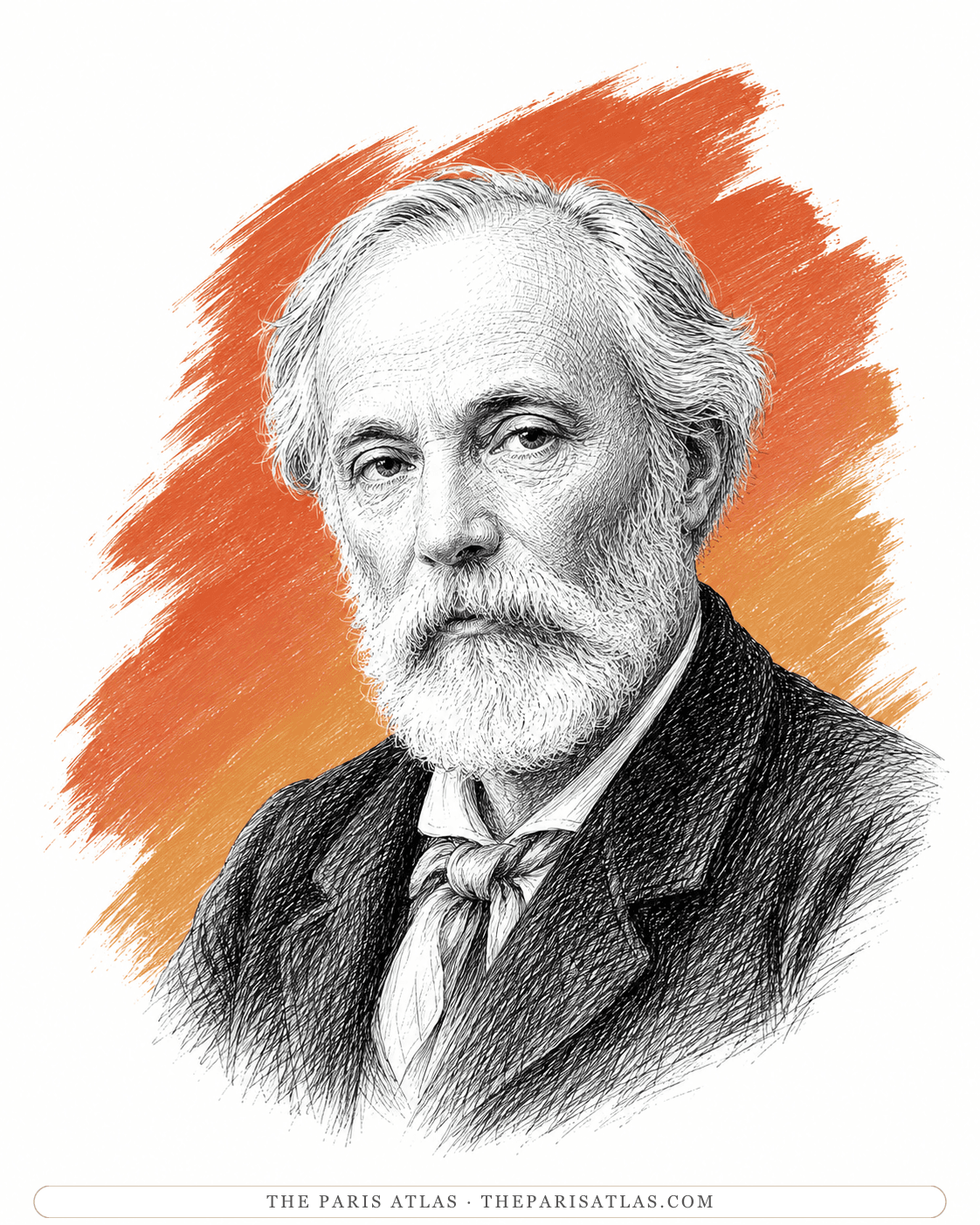
About Gustave Caillebotte

Gustave Caillebotte led three lives at once. He painted the rebuilt Paris of the 1870s — the wet cobbles, the iron bridges, the men at windows — with a drawn precision unlike anyone else in the movement. He organized and financed the Impressionist exhibitions, finding the rooms, paying the bills and hanging the pictures for painters who could not. And he collected his friends when almost nobody else would, so that when he died at forty-five his will forced the French state to decide, in public, whether Impressionism belonged in its museums.

For most of a century the third life buried the first. The collection he left — the Monets, Renoirs and Pissarros that now anchor the Musée d'Orsay — was famous while his own paintings sat with his family, largely unsold because he had never needed to sell. The revaluation since has been steep: in 2021 the Getty paid $53 million for Young Man at His Window, and in 2022 France classed Boating Party a national treasure rather than let it leave the country.

Caillebotte around 1878, in the middle of the decade when he painted, funded and organized the movement at once. (Anonymous photographer (public domain), via Wikimedia Commons · Public domain)

Born into the Paris he would paint

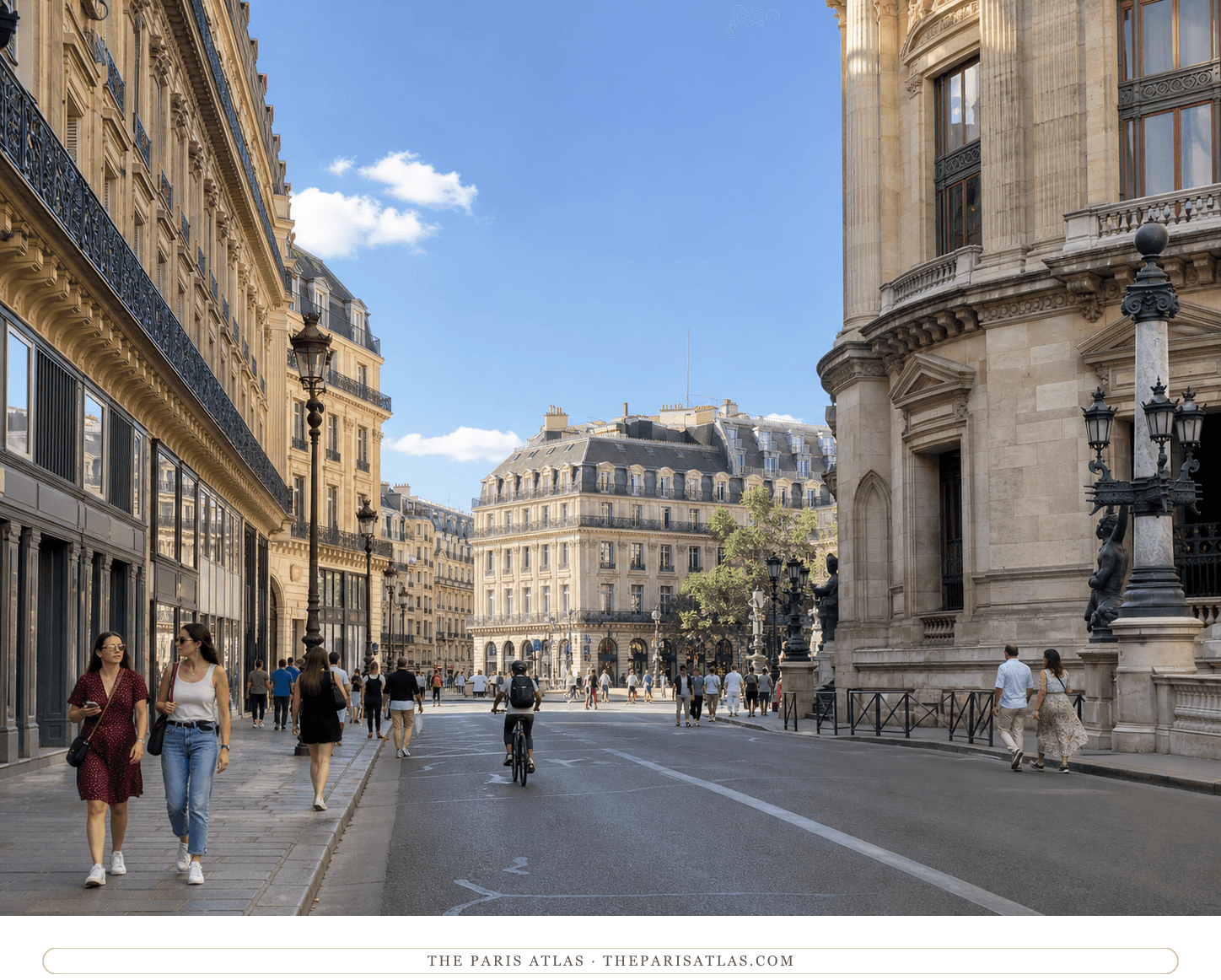
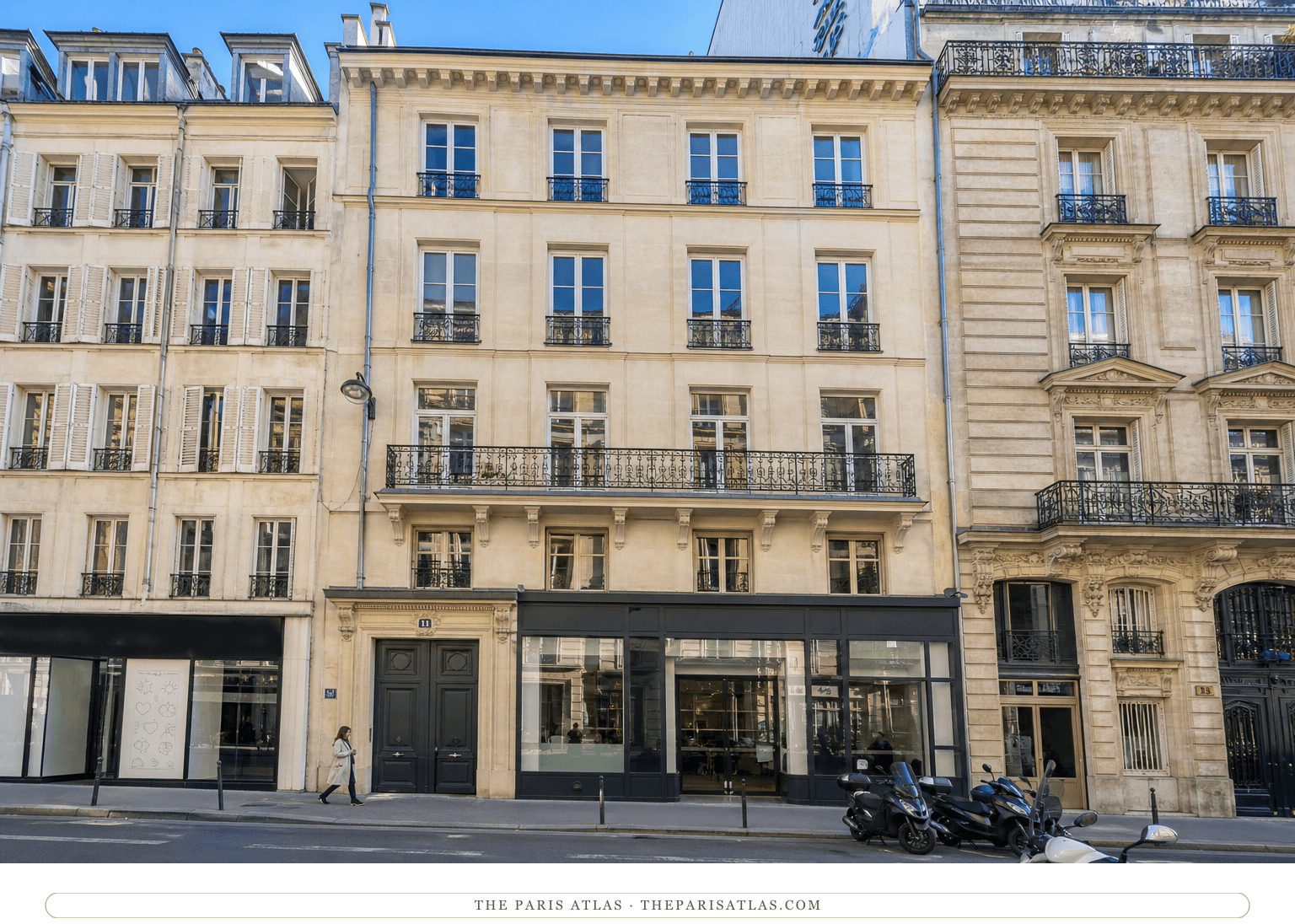
He was born on 19 August 1848 in Paris, into money that came from exactly the city he would later paint. His father, Martial Caillebotte, ran the family's military textile business — beds and canvas for the French army — sat as a judge at the commercial tribunal of the Seine, and invested in the building boom that followed Baron Haussmann's demolition of old Paris. In 1868 the elder Caillebotte put up a grand house at the corner of the rue de Miromesnil and the rue de Lisbonne, in the freshly cut streets of the 8th arrondissement, fitted with hot water, gas light and electric bells.

Gustave did what such families' sons did: a law degree in 1868, a license to practice in 1870. The Franco-Prussian War interrupted — he served in the Garde Nationale Mobile de la Seine from July 1870 to March 1871 — and the law never resumed. He entered the studio of the academic painter Léon Bonnat in 1872 and passed the entrance examination of the École des Beaux-Arts in 1873. In December 1874 his father died, leaving a fortune; a critic of the day put the painter's income at 150,000 francs a year. He was twenty-six, trained, and free never to sell a picture.

Yerres: the river summers

The family's other pole was the country estate at Yerres, southeast of Paris — eleven hectares of park running down to the river, bought by his father in 1860, when Gustave was eleven. More than eighty paintings and pastels came out of the place before the brothers sold it in 1879, after both parents had died: bathers, skiffs, kitchen gardens, the family at cards and at luncheon.

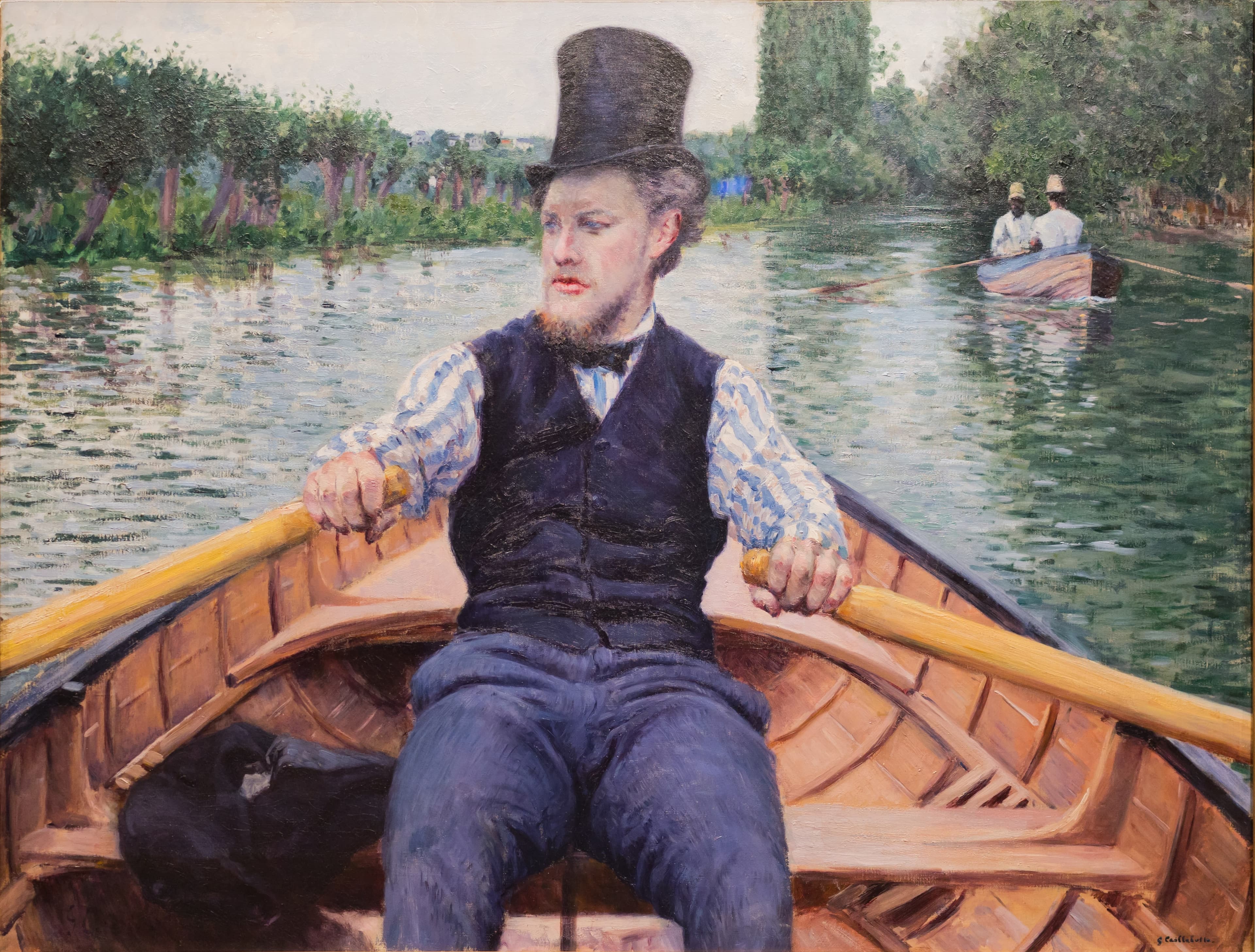
Boating Party (Partie de bateau), c. 1877–78 — the Yerres at the bottom of the family garden, the viewer seated as the rower's passenger. Musée d'Orsay, acquired 2022. (Gustave Caillebotte (public domain), via Wikimedia Commons — photographed at the Art Institute of Chicago's 2025 exhibition · Public domain)

Those river pictures gave him his second subject and his most immersive compositions. In Boating Party the top-hatted rower pulls his oars a seat's length from the viewer; at the fourth Impressionist exhibition in 1879 Caillebotte hung thirty-five paintings and pastels, his largest showing anywhere, much of it from the Yerres. There were two Caillebottes from the start — the painter of stone and iron, and the painter of water — and the country one has taken longest to come back into focus.

The Floor Scrapers and the open door

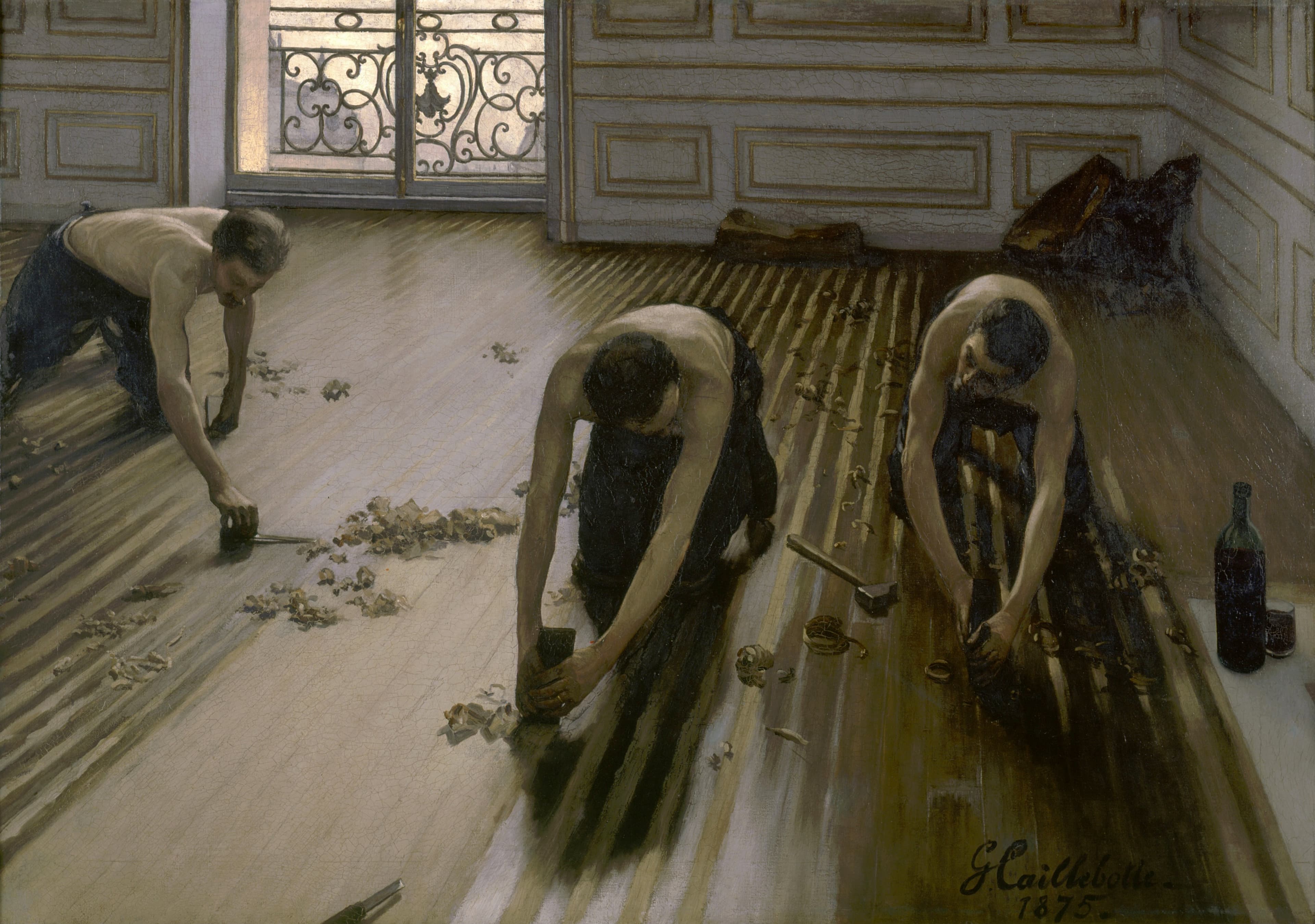
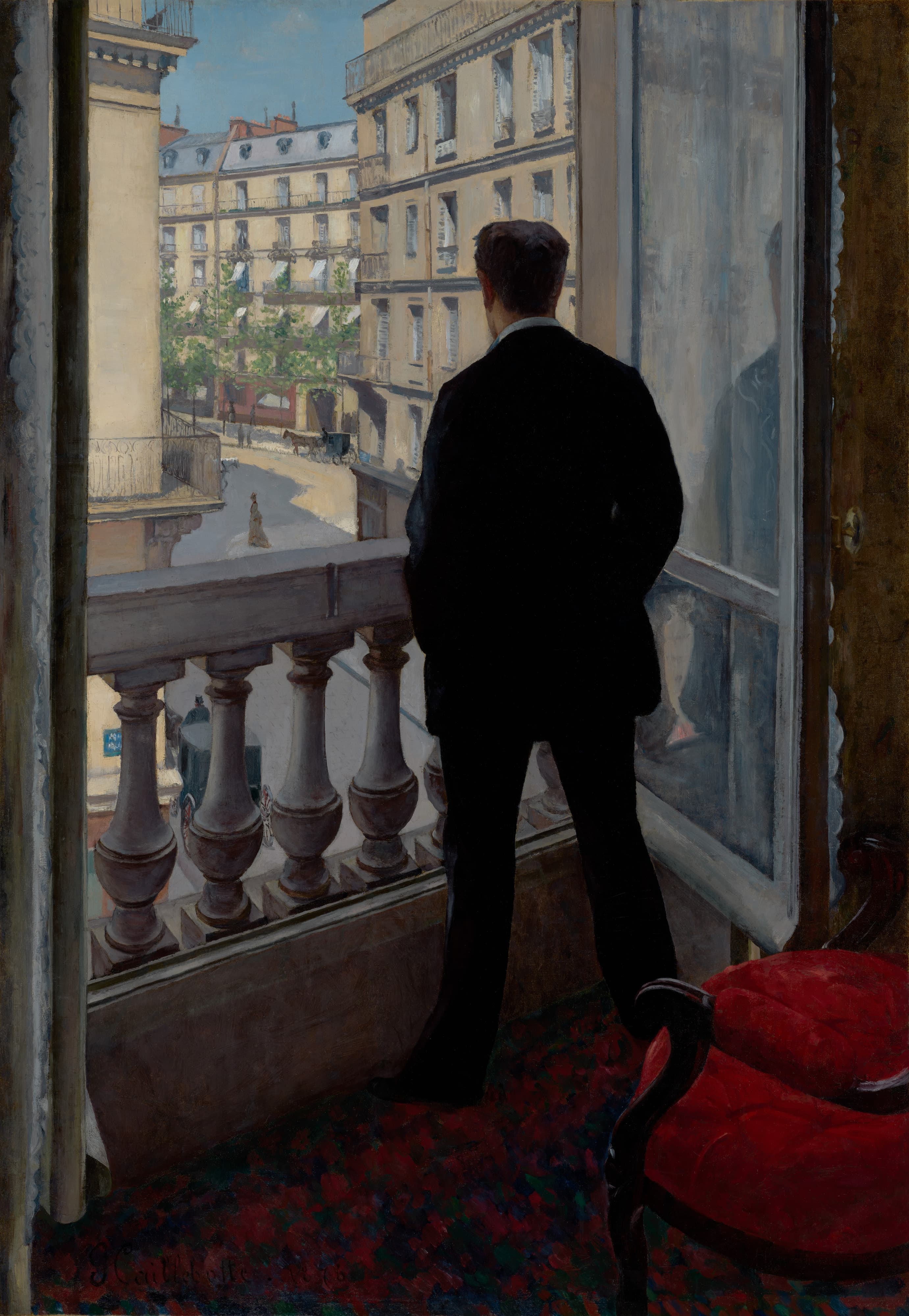
In 1875 he submitted The Floor Scrapers to the Salon: three workers stripped to the waist, scraping the parquet of a room in the family's own house. The jury refused it — critics of the day spoke of a 'vulgar subject' — and the refusal decided his direction. In February 1876 came a formal invitation signed by Pierre-Auguste Renoir and Henri Rouart, and that April Caillebotte hung eight works at the second Impressionist exhibition at Durand-Ruel's gallery, The Floor Scrapers among them, beside the portrait of his brother René at the window of the family apartment.

The Floor Scrapers (1875), rejected by the Salon jury, shown with the Impressionists in 1876 — now at the Musée d'Orsay. (Gustave Caillebotte (public domain), via Wikimedia Commons — Google Art Project scan · Public domain)

The debut startled the critics into asking who he was. 'Who knows Caillebotte? Where does he come from? In what school was he trained? No one has been able to tell me,' wrote Marius Chaumelin, predicting fame for him anyway. Émile Zola filed the new pictures under 'anti-artistic… bourgeois by dint of exactness' — a complaint about the very precision that now reads as the point.

René, and the will of a twenty-eight-year-old

In November 1876 his younger brother René died suddenly at twenty-six — the same René who stands at the window in that year's painting. Two days later, Gustave, twenty-eight and evidently persuaded his own life would be short, wrote his will with the family notary, Albert Courtier of Meaux. It set aside thirty to forty thousand francs — roughly a year of his own income — to mount the 1878 exhibition of 'the painters known as Intransigents or Impressionists,' naming Degas, Monet, Pissarro, Renoir, Cézanne, Sisley and Berthe Morisot. And it gave the state his collection, on one famous condition.

I give to the State the paintings I possess; only, as I want this gift to be accepted, and accepted in such a way that the paintings go neither into an attic nor into a provincial museum, but straight to the Luxembourg and later to the Louvre…

Gustave Caillebotte's will, 3 November 1876 — preserved at the Archives départementales de Seine-et-Marne

A codicil of 1883 dropped the exhibition clause, its work long done, and confirmed the bequest. The will then waited eighteen years in the notary's files for the argument it would start.

Making Impressionism function

Caillebotte showed in five of the eight Impressionist exhibitions — 1876, 1877, 1879, 1880 and 1882 — and sat out the sixth and eighth over disagreements with Edgar Degas. But his deeper role was operational. For the third exhibition, in April 1877, he found the rooms — a five-room apartment at 6 rue Le Peletier — put up most of the money, sent the invitations and hung the show. It was the exhibition where the group first accepted the name 'Impressionists,' and where Caillebotte's own two 'immense pictures,' Paris Street; Rainy Day and Le Pont de l'Europe, dominated the walls.

The support ran person by person. He paid Claude Monet's rent when it needed paying and took a studio for him near the Gare Saint-Lazare; he began buying his friends' paintings in 1875, when few others would, and kept buying for two decades — Pierre-Auguste Renoir's Bal du moulin de la Galette hung in his collection from 1879 until his death. One historian's summary of the ledger: he found and rented the venues, rallied the painters, paid the publicity, loaned the pictures, did the hanging and made the purchases.

The geometry of modern Paris

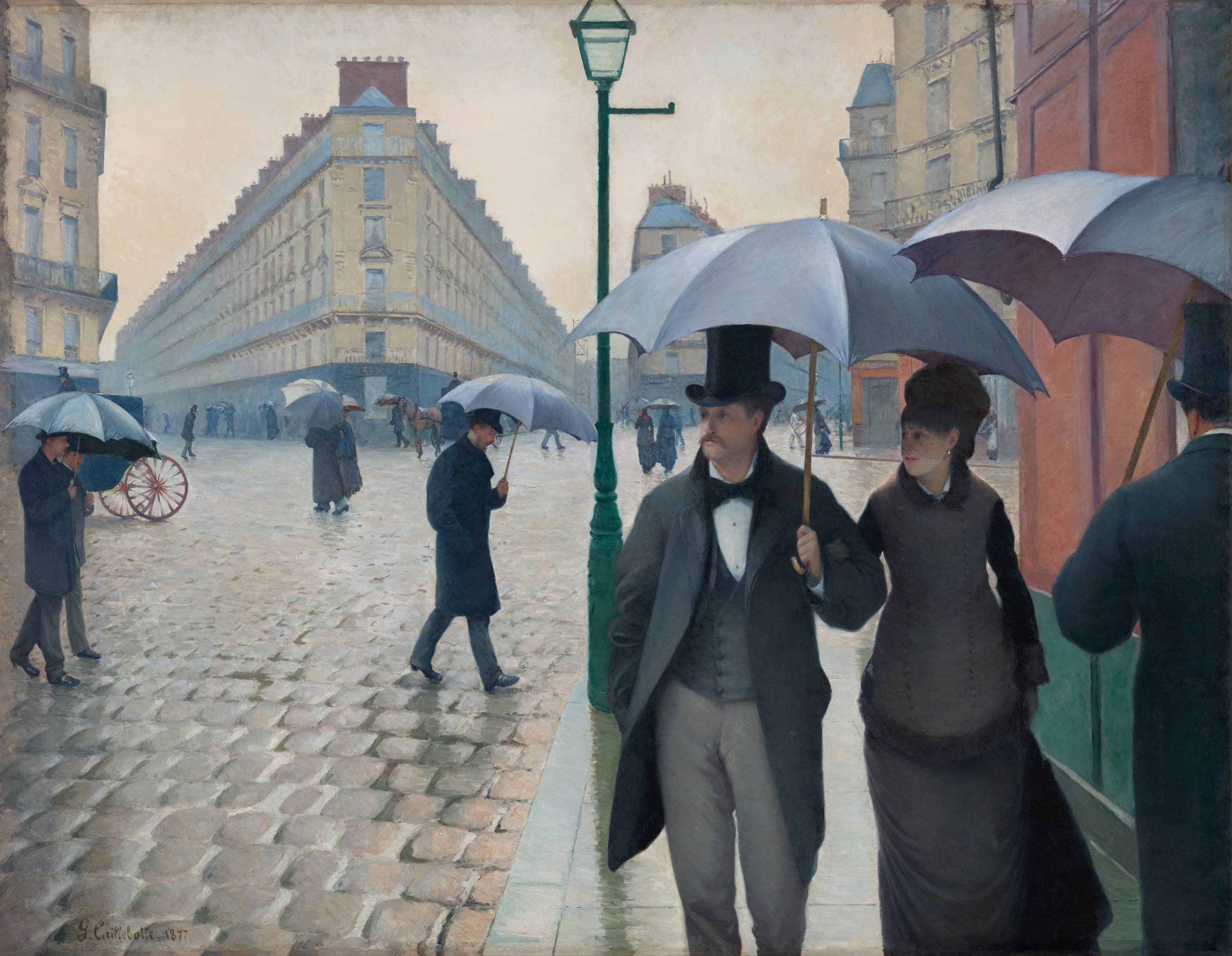
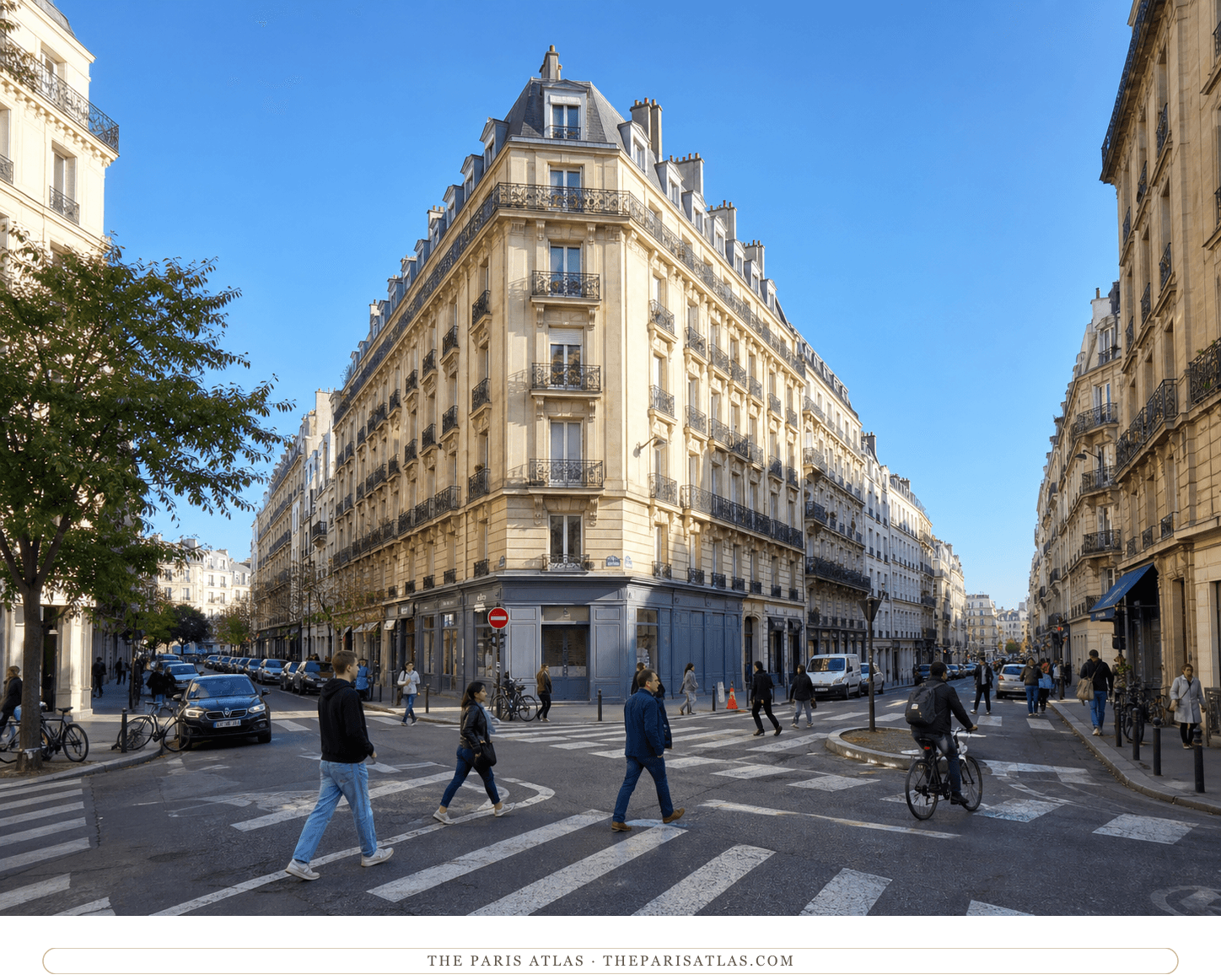
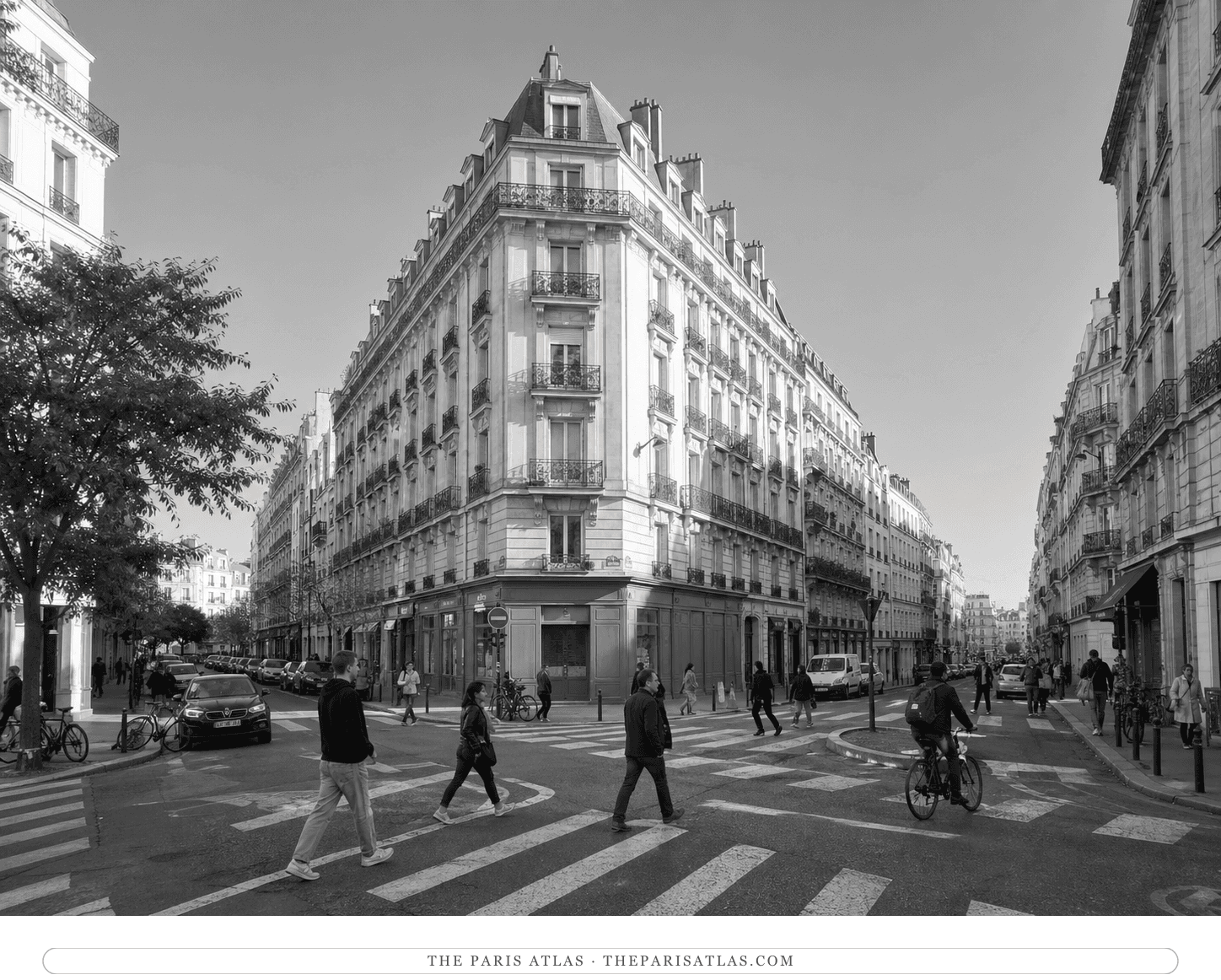
His signature pictures are engineered. For Paris Street; Rainy Day — the nearly ten-foot canvas of an intersection near the family house, painted in 1877 — he drew the architecture piece by piece, squared it onto the canvas, and anchored his perspective lines with pins; the Art Institute of Chicago's technical study found the pinholes still in the paint at the vanishing points, and concluded he likely worked with a camera lucida. A critic at the 1877 show sniffed that Caillebotte was 'an Impressionist in name only' because he knew how to draw. The line was meant to wound and instead describes him.

Paris Street; Rainy Day (1877) — the unnamed intersection now called the place de Dublin, a few blocks from the family house. Art Institute of Chicago. (Gustave Caillebotte (Art Institute of Chicago, CC0), via the museum's open-access program · CC0)

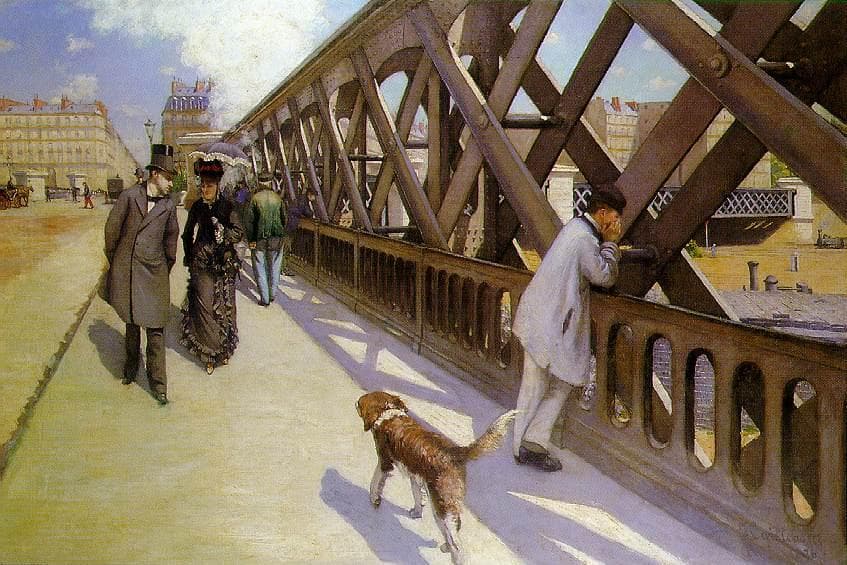
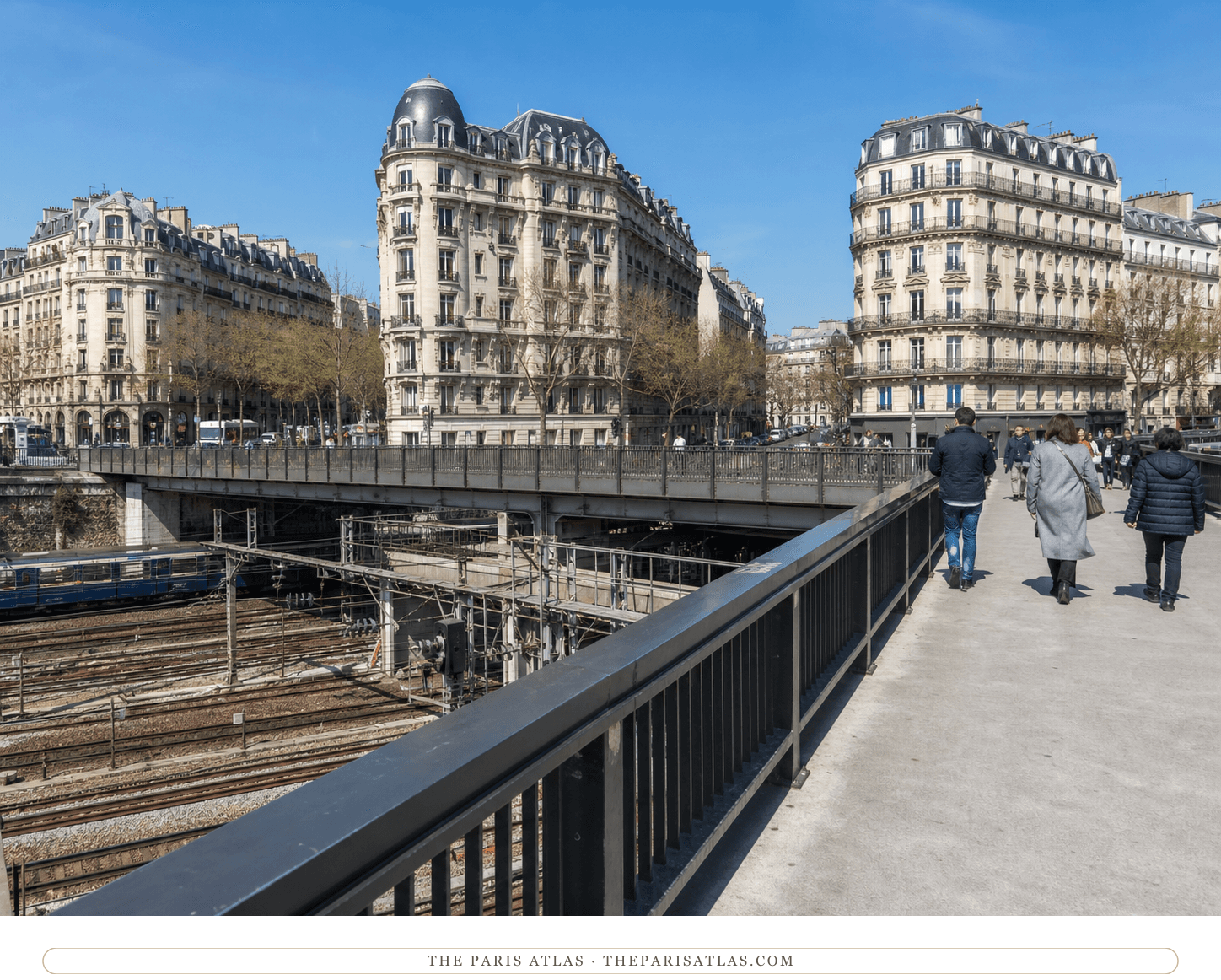
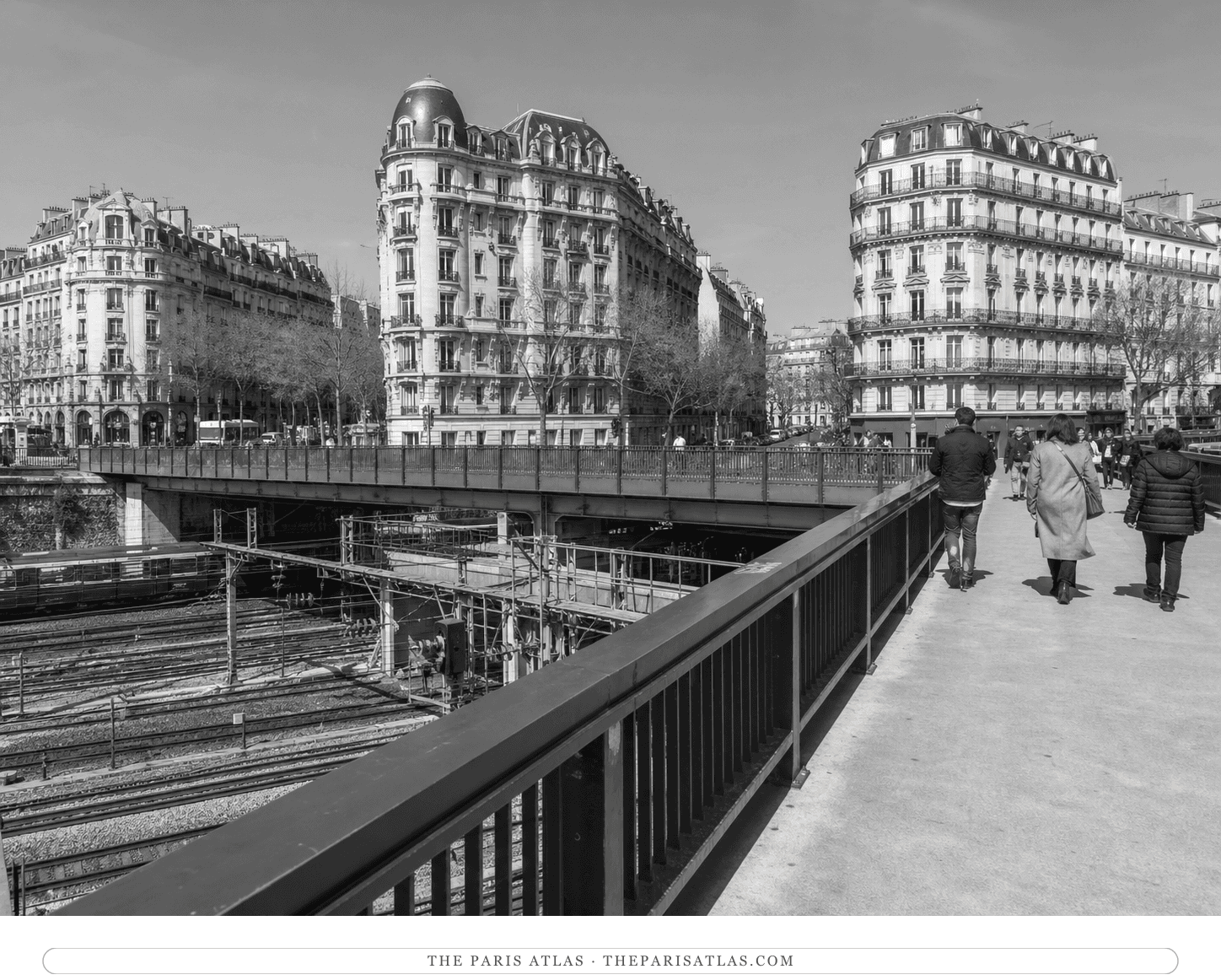
The same eye built Le Pont de l'Europe: the iron star of bridges above the Gare Saint-Lazare rail cutting, its X-braced girders receding like a machine the pedestrians live inside. Monet painted the station below in the same months, dissolving it in steam; Caillebotte bolted it together, and bought three of Monet's station pictures for his own walls. His viewpoint experiments — plunging perspectives, figures cropped by the frame, backs turned to the viewer — anticipated developments in photography and cinema by decades, as the Getty's curator puts it. His brother Martial was a photographer, and the two worked the same streets in different mediums.

Le Pont de l'Europe (1876). The iron bridge itself was demolished in 1931; the painting is in Geneva. (Gustave Caillebotte (public domain), via Wikimedia Commons · Public domain)

Men, at work and at home

Where his colleagues painted women at the piano and in the garden, Caillebotte painted men: floor scrapers and house painters at work, his brothers at the piano and at luncheon, oarsmen mid-stroke, a bather toweling off in Man at His Bath (1884), bourgeois strollers watching the street and each other. The Musée d'Orsay's 2024 retrospective read The Floor Scrapers as 'the artist's expression of a modern male ideal, masculine, republican, rooted in the notion of collective effort, work, equality and fraternity' — and titled the whole exhibition Painting Men.

He never married. In his last years he lived at Petit Gennevilliers with Charlotte Berthier, a companion who rarely appears in his pictures and to whom his will left a sizeable annuity; Renoir painted her portrait in 1883. What the paintings of men meant to their painter is a live scholarly argument, conducted across the recent retrospectives; the pictures themselves say only what they show.

The collection in his apartment

By the count of Anne Distel, printed by the Musée d'Orsay, the collection Caillebotte assembled held seventy-two works. It was a working painter's museum of his friends at their best, bought early:

He bought what the market refused, at the moment of refusal — which is why the collection later carried the weight it did.

Petit Gennevilliers: sails and greenhouses

In May 1881 Gustave and his brother Martial bought a property at Petit Gennevilliers, on the Seine opposite Argenteuil, next door to the Cercle de la Voile de Paris; he bought out Martial's share when his brother married in 1887 and moved there for good in 1888. Sailing became a second career conducted seriously: the club, whose vice-president he became in 1880, still describes him as the most decorated racer in France of his day and a gifted naval architect — it counts plans for twenty-six yachts, from the silk-sailed Condor to the five-tonner Dahut of 1893. He was also, briefly, a municipal councillor, reportedly speeding local business along by paying for things himself.

Caillebotte with his dog Bergère in the garden at Petit Gennevilliers, December 1891. (Anonymous photographer (public domain), via Wikimedia Commons · Public domain)

The garden was the other passion. He built a greenhouse, grew orchids, and traded cuttings and horticultural letters with Claude Monet, whose Giverny garden ran on the same obsession. The late canvases fill with dahlias, roses and the Seine at his doorstep; a dining-room decoration of orchids was still unfinished when he died.

Death at forty-five

On 21 February 1894 Caillebotte was taken ill while working in his garden at Petit Gennevilliers, and died at home. He was forty-five. Period accounts give the cause as 'cerebral congestion' — the era's term; modern museum summaries usually say a stroke. He was buried in the family chapel at Père Lachaise cemetery in Paris.

Monet's verdict on the loss survives: had Caillebotte lived, he said, 'he would have benefited from the same turn of fortune as the rest of us, for he was full of talent.' The words were truer than Monet could have known — the turn of fortune arrived, a century late.

The bequest: the state against the attic

On 11 March 1894, Pierre-Auguste Renoir, named executor, notified the fine-arts administration of the will. Then came two years of negotiation. The will's condition — everything to hang at the Musée du Luxembourg, nothing in an attic or a provincial museum — collided with the museum's space and with the politics of hanging radical painting in a state institution, and the compromise reached in January 1895 let the state choose. It took thirty-eight Impressionist works plus the two Millet drawings — forty in all: eight Monets, seven Pissarros, six Renoirs, six Sisleys, seven Degas pastels, two Cézannes, two Manets. The decree was signed on 25 February 1896, the paintings were handed over that November, and the Caillebotte room at the Luxembourg opened to the public on 9 February 1897.

It was the first time Impressionist paintings hung in a French museum, and protest followed within the month: members of the Académie des Beaux-Arts signed a public letter against the display. The refused works were offered to the state again in 1904 and in 1908, and refused both times; when the administration finally reached for them in 1928, Martial's widow declined, and after her death the remainder sold — Cézanne's Baigneurs went to Albert Barnes in 1932. The accepted collection moved from the Luxembourg to the Louvre around 1929, through the Jeu de Paume, and hangs today at the Musée d'Orsay. His own paintings were never part of it: The Floor Scrapers entered the national collection separately, as a gift of his heirs arranged by Renoir.

The painter, recovered

Because he had not needed to sell, his own work stayed with the family, and for decades he was filed as the collector who happened to paint. The recovery began when the paintings reached the market in the 1950s — the Art Institute of Chicago bought Paris Street; Rainy Day in 1964, before the reassessment had a name — and accelerated through the retrospectives of 1976 and 1994 and the scholarship of Kirk Varnedoe.

The last five years have finished the argument. The Getty paid $53 million for Young Man at His Window in 2021, a record for the artist. France classed Boating Party a national treasure and acquired it for the Musée d'Orsay in 2022 with LVMH's patronage — at which point the national collections held only thirteen Caillebottes. The triple retrospective of 2024–25 (Orsay, Getty, Art Institute) rebuilt the 1897 Caillebotte room as its finale, and in January 2026 the Portrait of the Artist at His Easel entered the national collections by dation. The man who spent his money making other painters permanent has ended up permanent himself.

Life events

  1. 1848

    Born 19 August in Paris, eldest son of Martial Caillebotte, whose fortune comes from military textiles, the commercial bench, and Haussmann-era property.

    Gustave Caillebotte — Encyclopaedia Britannica; Caillebotte, peintre et jardinier — dossier pédagogique, Musée des impressionnismes Giverny

  2. 1860

    His father buys the estate at Yerres — eleven hectares on the river southeast of Paris, the family's summer pole for two decades.

    Caillebotte, peintre et jardinier — dossier pédagogique, Musée des impressionnismes Giverny

  3. 1868–1870

    Law degree, then the license to practice; the house at the corner of the rue de Miromesnil and the rue de Lisbonne is newly built.

    Caillebotte, peintre et jardinier — dossier pédagogique, Musée des impressionnismes Giverny

  4. 1870–71

    Serves in the Garde Nationale Mobile de la Seine through the Franco-Prussian War.

    Gustave Caillebotte exhibition explores the artist's fascination with masculinity — Getty news

  5. 1872–73

    Enters Léon Bonnat's studio, then passes the entrance examination of the École des Beaux-Arts.

    Caillebotte, peintre et jardinier — dossier pédagogique, Musée des impressionnismes Giverny

  6. 1874

    His father dies in December, leaving a fortune a contemporary put at 150,000 francs a year in income.

    Caillebotte, peintre et jardinier — dossier pédagogique, Musée des impressionnismes Giverny; Men Watching Men (Tom Crewe) — London Review of Books, Vol. 48 No. 6, April 2026

  7. 1875

    The Salon jury rejects The Floor Scrapers. He buys his first Monet the same year.

    Gustave Caillebotte, The Floor Scrapers (Raboteurs de parquets), 1875 (Musée d'Orsay) — rejected by the 1875 Salon, shown at the second Impressionist exhibition in 1876. (Gustave Caillebotte (public domain), via Wikimedia Commons — Google Art Project scan)

    Raboteurs de parquets (Gustave Caillebotte) — Musée d'Orsay

  8. 1876

    Debuts with eight works at the second Impressionist exhibition in April. His brother René dies in November at twenty-six; two days later Caillebotte writes the will promising his collection to the state.

    Gustave Caillebotte, Young Man at His Window, 1876 (J. Paul Getty Museum) — his brother René at the family apartment; sold in 2021 for $53 million, the artist's auction record. (Gustave Caillebotte (J. Paul Getty Museum, CC0), via the Getty's open content program)

    Le testament de Gustave Caillebotte (3 novembre 1876, cote 112E623-1) — Archives départementales de Seine-et-Marne; Getty Museum acquires Gustave Caillebotte's iconic Young Man at His Window — Getty news, 11 November 2021

  9. 1877

    Organizes and largely finances the third exhibition at 6 rue Le Peletier, hanging Paris Street; Rainy Day and Le Pont de l'Europe — the press's two 'immense pictures.'

    Gustave Caillebotte, Paris Street; Rainy Day, 1877 (Art Institute of Chicago) — Haussmann's new Paris at full scale, shown at the third exhibition in 1877. (Gustave Caillebotte (Art Institute of Chicago, CC0), via the museum's open-access program)

    Cat. 2: Paris Street; Rainy Day, 1877 — Caillebotte Paintings and Drawings at the Art Institute of Chicago (Gloria Groom and Kelly Keegan)

  10. 1879

    Shows thirty-five paintings and pastels at the fourth exhibition, much of it from the Yerres river summers; the family sells the estate the same year.

    Gustave Caillebotte, Boating Party (Partie de bateau), c. 1877–78 (Musée d'Orsay) — classed a French national treasure in 2020, acquired for the state with LVMH's patronage in 2022. (Gustave Caillebotte (public domain), via Wikimedia Commons — photographed at the Art Institute of Chicago's 2025 exhibition)

    Partie de bateau (Gustave Caillebotte) — Musée d'Orsay; Caillebotte, peintre et jardinier — dossier pédagogique, Musée des impressionnismes Giverny

  11. 1880–1882

    Shows at the fifth and seventh exhibitions, skipping the sixth and eighth over disagreements with Degas. Becomes vice-president of the Cercle de la Voile de Paris in 1880.

    Caillebotte, peintre et jardinier — dossier pédagogique, Musée des impressionnismes Giverny; Les Impressionnistes — history pages of the Cercle de la Voile de Paris

  12. 1881

    Buys the property at Petit Gennevilliers with his brother Martial, on the Seine beside the sailing club; moves there permanently in 1888, with Charlotte Berthier.

    Caillebotte, peintre et jardinier — dossier pédagogique, Musée des impressionnismes Giverny

  13. 1893

    Designs and races the five-tonner Dahut — the sailing club counts plans for twenty-six yachts across his second career as a naval architect.

    Les Impressionnistes — history pages of the Cercle de la Voile de Paris

  14. 1894

    Taken ill in his garden at Petit Gennevilliers, he dies on 21 February, at forty-five. Renoir, as executor, notifies the state of the bequest on 11 March.

    Gustave Caillebotte with his dog Bergère in the garden at Petit Gennevilliers, December 1891 — around two years before his death there. (Anonymous photographer (public domain), via Wikimedia Commons)

    Le legs Caillebotte (Fanny Matz) — Musée d'Orsay magazine, October 2024; Gustave Caillebotte — Encyclopaedia Britannica

  15. 1896–97

    After two years of negotiation the state accepts forty works — thirty-eight Impressionist paintings and pastels plus two Millet drawings. The Caillebotte room opens at the Musée du Luxembourg on 9 February 1897: the first Impressionist paintings displayed in a French museum.

    Le legs Caillebotte (Fanny Matz) — Musée d'Orsay magazine, October 2024; Gustave Caillebotte — Encyclopaedia Britannica

  16. 1964

    The Art Institute of Chicago buys Paris Street; Rainy Day — before the reassessment of the painter had properly begun.

    Paris Street; Rainy Day (Gustave Caillebotte) — Art Institute of Chicago

  17. 2021

    The Getty buys Young Man at His Window at Christie's for $53 million, the artist's auction record.

    Getty Museum acquires Gustave Caillebotte's iconic Young Man at His Window — Getty news, 11 November 2021

  18. 2022

    Boating Party, classed a national treasure in 2020, is acquired for the Musée d'Orsay with LVMH's exclusive patronage — the national collections hold only thirteen Caillebottes at the time.

    La Partie de bateau, un Trésor national qui accoste au musée d'Orsay — Ministère de la Culture; Partie de bateau (Gustave Caillebotte) — Musée d'Orsay

  19. 2024–26

    The Painting Men retrospective tours the Orsay, the Getty and the Art Institute; in January 2026 the Portrait of the Artist at His Easel enters the national collections by dation.

    Gustave Caillebotte: Painting Men — exhibition presentation, Musée d'Orsay; Entrée dans les collections nationales d'une œuvre majeure de Gustave Caillebotte acquise par dation en paiement — Ministère de la Culture, 30 January 2026

Selected works

Cataloged from the holding institutions' records. Reproductions appear only where the rights are verified.

Paintings

Caillebotte's Boating Party: a man in a black top hat, white shirt and waistcoat rows a wooden skiff directly toward the viewer on the green river Yerres, oars mid-pull, the tree-lined banks closing a high horizon

Artwork reproduction

Painting

Boating Party

c. 1877–78 · Oil on canvas

A man in a top hat rows a skiff on the Yerres, in shirtsleeves, oars mid-pull, so close that the viewer sits in the boat with him. France classed the painting a national treasure in 2020 and it entered the Musée d'Orsay in 2022, bought for the state with LVMH's patronage at a reported €43 million.

Musée d'Orsay, Paris

Gustave Caillebotte, Boating Party, c. 1877–78. Musée d'Orsay, Paris. Image: public domain.

Caillebotte's Le Pont de l'Europe: a man in a top hat and a woman in black walk across an iron bridge whose X-braced girders recede down the right side, a workman leaning on the rail and a dog trotting away from the viewer under a pale sky

Artwork reproduction

Painting

Le Pont de l'Europe

1876 · Oil on canvas

A man in a top hat strides across the iron bridge above the Gare Saint-Lazare rail cutting, glancing back at a woman in black; a workman leans on the girders; a dog trots ahead into the picture. Gustave Caillebotte painted the Pont de l'Europe in 1876 and showed it beside Paris Street; Rainy Day the following spring. The bridge he painted was demolished in 1931.

Association des Amis du Petit Palais, Geneva

Gustave Caillebotte, Le Pont de l'Europe, 1876. Association des Amis du Petit Palais, Geneva. Image: public domain.

Caillebotte's Paris Street; Rainy Day: a top-hatted man and a woman in a fur-trimmed dress share an umbrella on wet cobblestones, a green lamppost bisecting the canvas and a wedge-shaped Haussmann building receding behind them under a grey sky full of umbrellas

Artwork reproduction

Painting

Paris Street; Rainy Day

1877 · Oil on canvas

A top-hatted couple share an umbrella at a wet Paris intersection, walking straight at the viewer across almost ten feet of canvas. Gustave Caillebotte painted the crossing near his home in 1877, hung it as number 1 at the third Impressionist exhibition, and made the rebuilt city itself the subject. The Art Institute of Chicago calls it his largest and most ambitious work.

Art Institute of Chicago

Gustave Caillebotte, Paris Street; Rainy Day, 1877. Art Institute of Chicago. Image: CC0.

Caillebotte's The Floor Scrapers: three shirtless workers kneel on the pale parquet of an empty Haussmann room, scraping the floor in long strips, with curls of wood shaving around them, a bottle of wine against the wall, and light from a balcony window falling across their backs

Artwork reproduction

Painting

The Floor Scrapers

1875 · Oil on canvas

Three workers, stripped to the waist, scrape the parquet of a Haussmann apartment while afternoon light from the balcony window catches their backs. The Salon jury of 1875 turned it down; the second Impressionist exhibition of 1876 hung it, and Gustave Caillebotte arrived in one picture.

Musée d'Orsay, Paris

Gustave Caillebotte, The Floor Scrapers, 1875. Musée d'Orsay, Paris. Image: public domain.

Caillebotte's Young Man at His Window: a man in a dark suit seen from behind, hands in pockets, standing at a tall open window with a red armchair behind him, looking down on a sunlit Paris street where a lone woman in dark dress crosses toward the boulevard

Artwork reproduction

Painting

Young Man at His Window

1876 · Oil on canvas

A young man in a dark suit stands with his back to us at a tall open window, hands in pockets, watching a woman cross the sunlit street below. The model is Gustave Caillebotte's brother René, the window is the family's Paris apartment, and in 2021 the painting became the most expensive Caillebotte ever sold — bought at auction by the Getty for $53 million.

J. Paul Getty Museum, Los Angeles

Gustave Caillebotte, Young Man at His Window, 1876. J. Paul Getty Museum, Los Angeles. Image: CC0.

People they knew

Documented connections — every one carries its source.

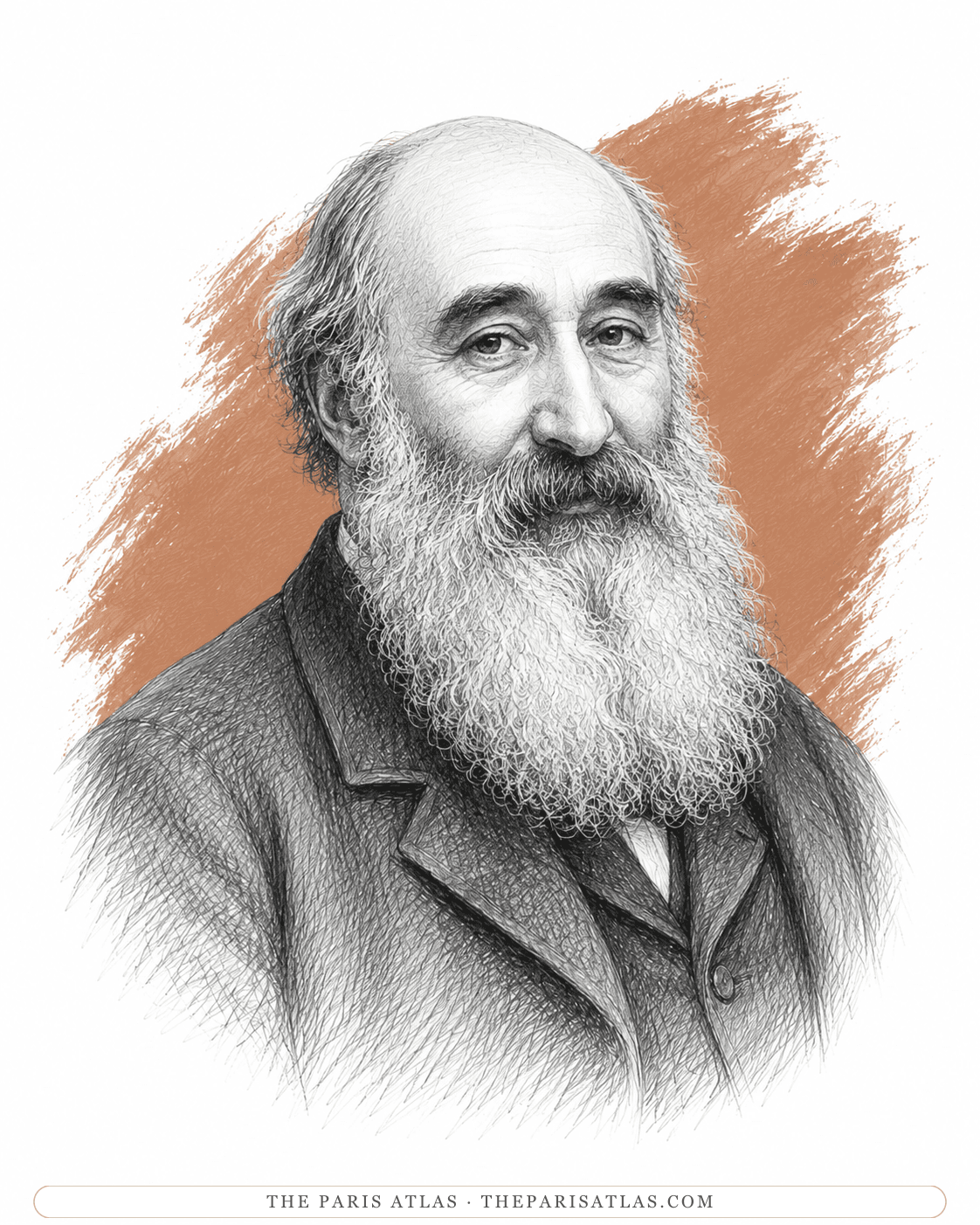
Illustrated portrait of Camille Pissarro

Camille Pissarro

  • Painter

Met

Fellow exhibitor and the largest single presence in Caillebotte's collection: eighteen Pissarros by Anne Distel's count, seven of which the state accepted from the bequest in 1896. In May 1877 the two joined Renoir and Sisley in a forty-five-painting sale at the Hôtel Drouot — the sale where Caillebotte bought back his own Floor Scrapers.

Le legs Caillebotte (Fanny Matz) — Musée d'Orsay magazine, October 2024; Raboteurs de parquets (Gustave Caillebotte) — Musée d'Orsay

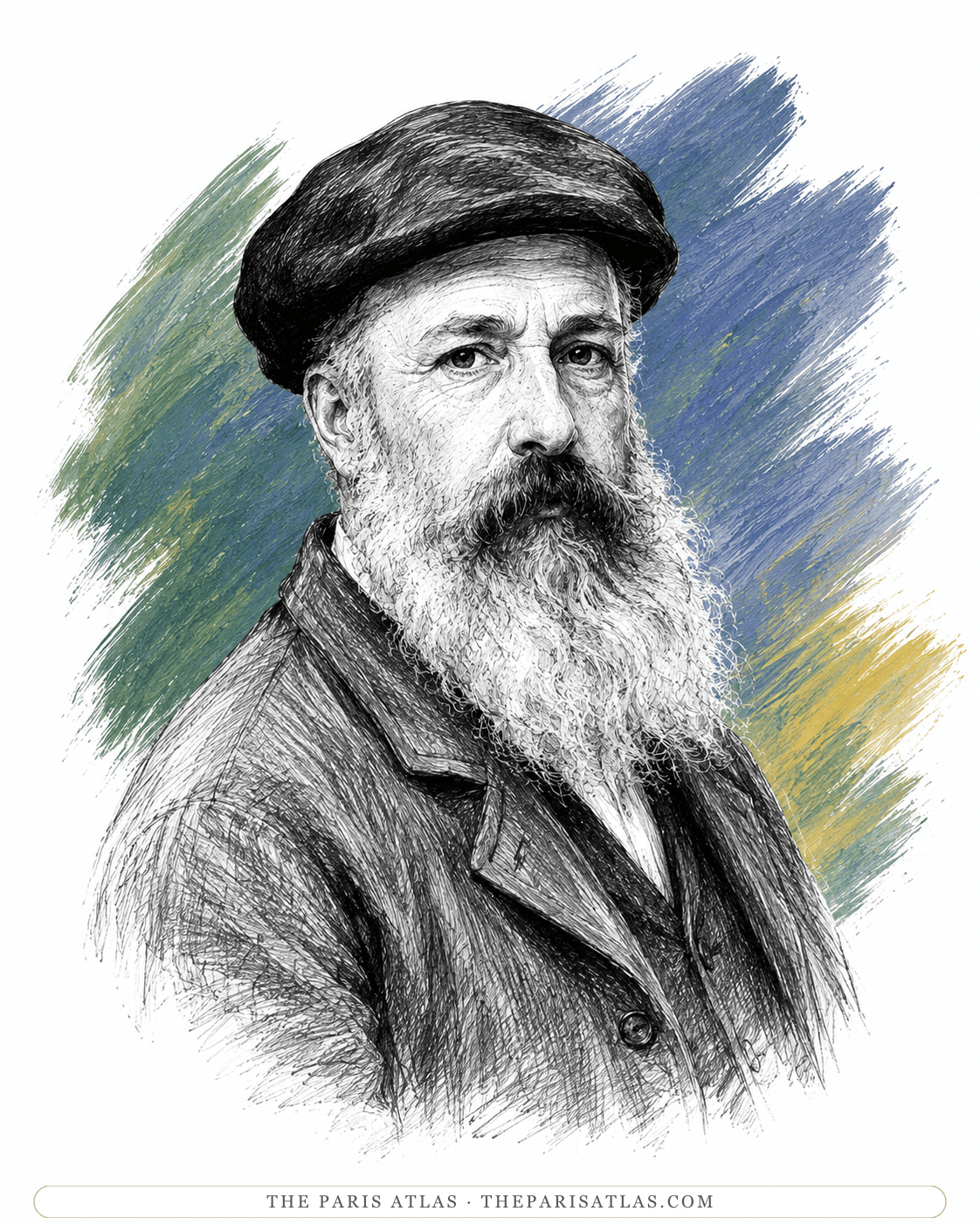
Illustrated portrait of Claude Monet

Claude Monet

  • Painter

Met

Patron, fellow exhibitor, and fellow gardener. Caillebotte paid Monet's rent when it needed paying, took a studio for him near the Gare Saint-Lazare, and owned sixteen of his paintings — including three of the 1877 station pictures. Monet kept Caillebotte's oil sketch for Paris Street; Rainy Day in his bedroom at Giverny until his death, and the two traded horticultural letters and cuttings for years.

Men Watching Men (Tom Crewe) — London Review of Books, Vol. 48 No. 6, April 2026; Le legs Caillebotte (Fanny Matz) — Musée d'Orsay magazine, October 2024; Rue de Paris. Temps de pluie (Gustave Caillebotte, sketch) — Musée Marmottan Monet

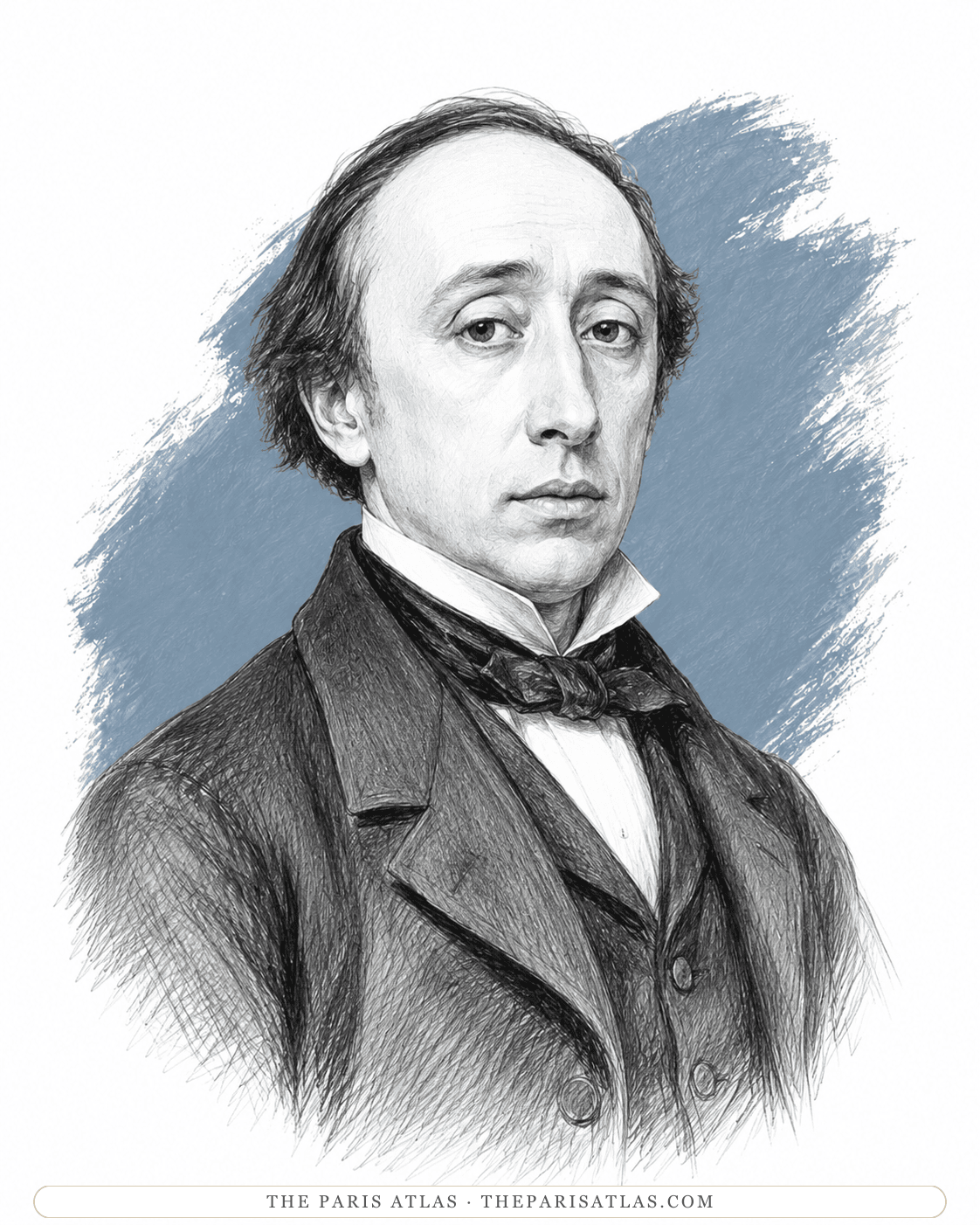
Illustrated portrait of Edgar Degas

Edgar Degas

  • Painter

Met

Fellow exhibitor and frequent adversary inside the group. Caillebotte named Degas first among the painters his 1876 will was written to support, and owned eight of his pastels — but disagreements with Degas kept Caillebotte out of the sixth and eighth Impressionist exhibitions, per the Musée des impressionnismes Giverny's chronology.

Caillebotte, peintre et jardinier — dossier pédagogique, Musée des impressionnismes Giverny; Le testament de Gustave Caillebotte (3 novembre 1876, cote 112E623-1) — Archives départementales de Seine-et-Marne; Le legs Caillebotte (Fanny Matz) — Musée d'Orsay magazine, October 2024

Illustrated portrait of Pierre-Auguste Renoir

Pierre-Auguste Renoir

  • Painter
  • Sculptor

Met

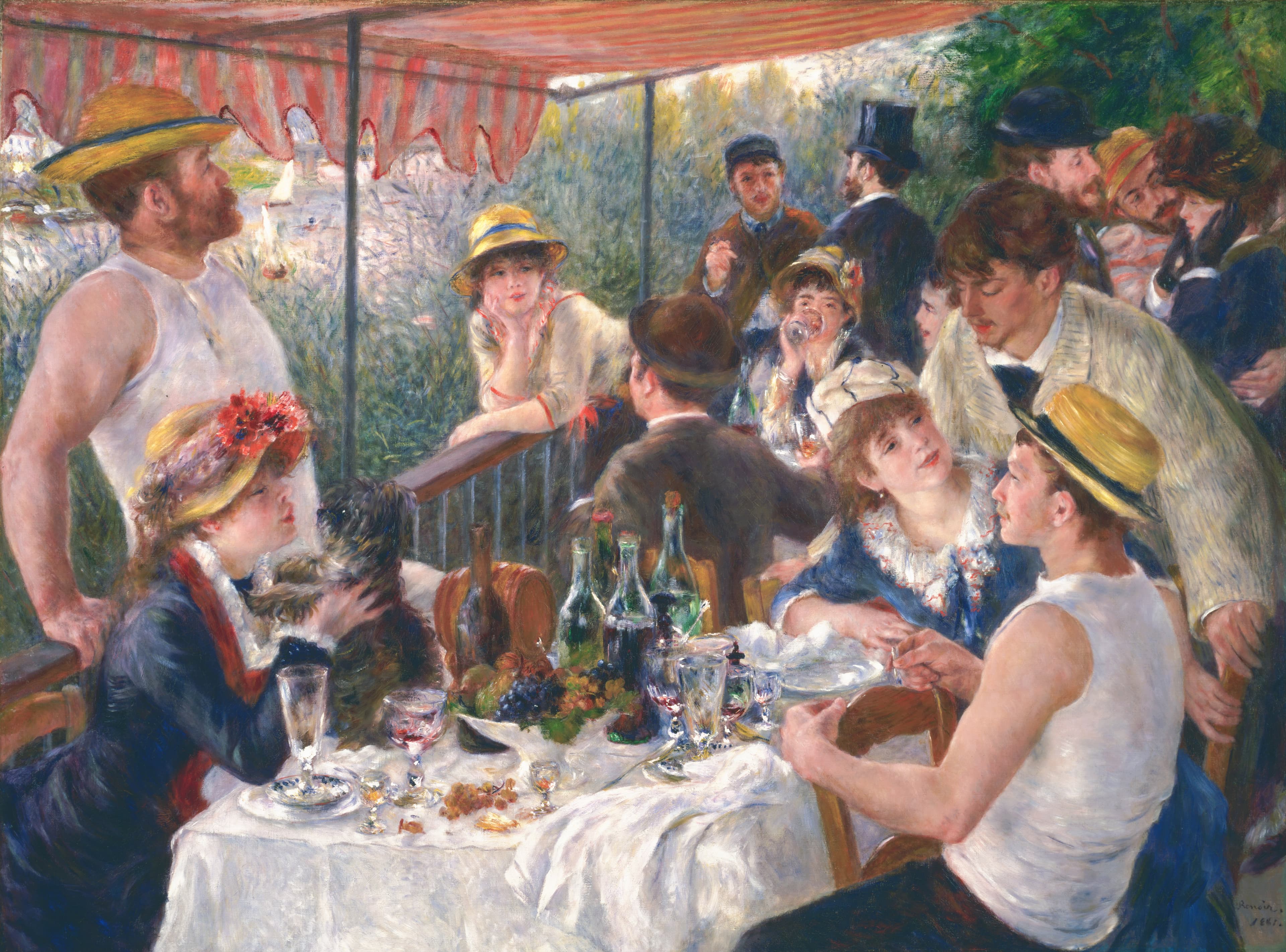
Friend, fellow exhibitor, and first owner of Bal du moulin de la Galette — Caillebotte acquired it between 1877 and 1879, and his bequest carried it into the French national collection in 1896. He sits backward in his chair in Luncheon of the Boating Party, across the table from Aline Charigot.

Bal du moulin de la Galette (Auguste Renoir) — Musée d'Orsay; Luncheon of the Boating Party — The Phillips Collection

Movements

The artistic and literary currents this life ran through.

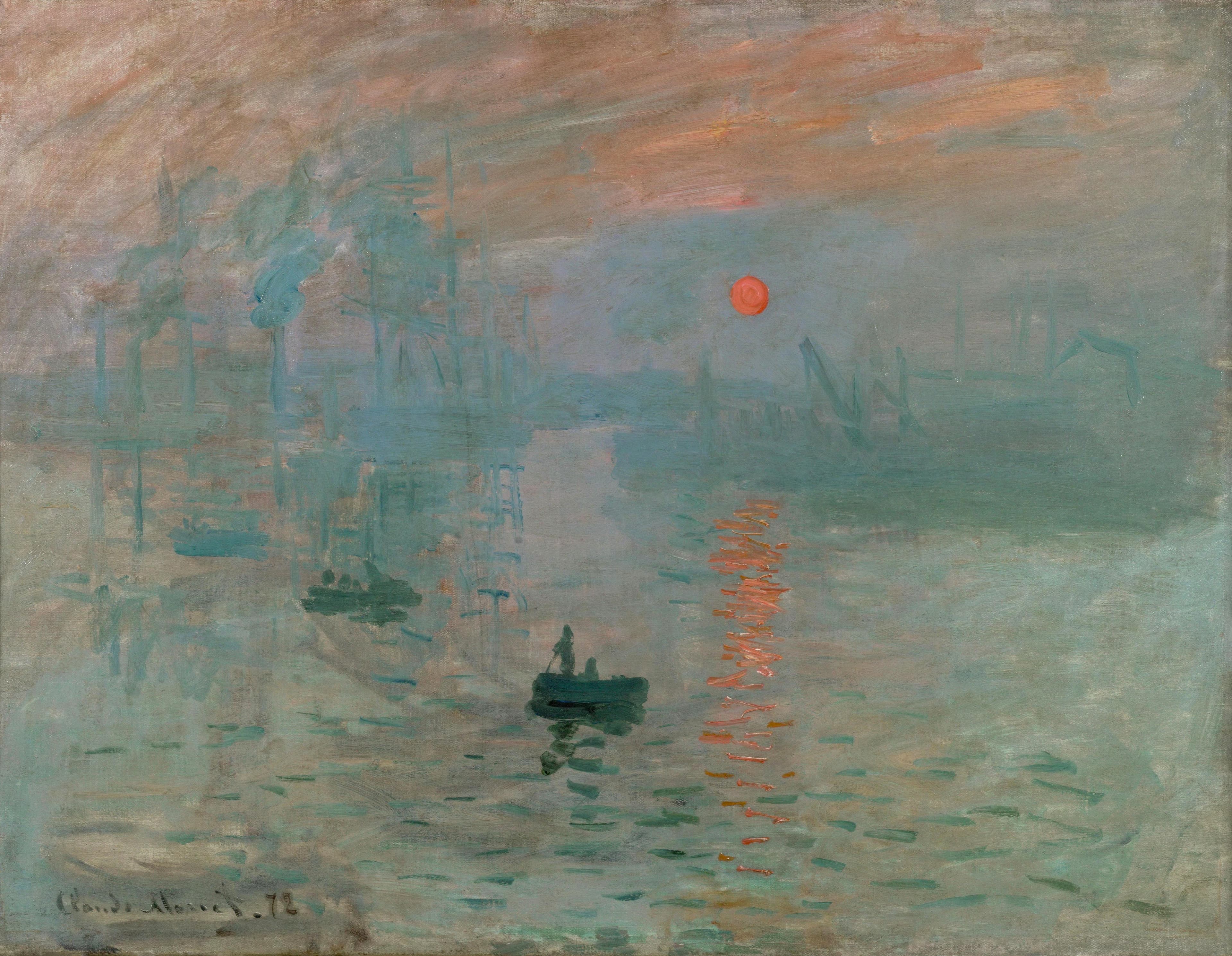
An orange sun over a hazy blue-grey harbor, small boats in the foreground, painted in loose broken strokes

Art movement · 1874–1886

Impressionism

The Salon jury rejected The Floor Scrapers in 1875; he showed it at the group's second exhibition in 1876 instead, and the NGA describes him as the vital organizer who helped curate and finance the exhibitions. His bequest of more than seventy works entered the Musée du Luxembourg in 1896.

Raboteurs de parquet (Gustave Caillebotte) — Musée d'Orsay; Gustave Caillebotte: The Painter's Eye — National Gallery of Art

Questions about Gustave Caillebotte

How do you pronounce Caillebotte?

KAI-eh-BOT is the usual English rendering — three quick syllables, stress at the end.

What is Gustave Caillebotte famous for?

Three things at once: painting the rebuilt Paris of the 1870s with unusual precision (Paris Street; Rainy Day, The Floor Scrapers), organizing and financing the Impressionist exhibitions, and collecting his friends' paintings — the Caillebotte bequest forced the French state to hang Impressionism in a museum for the first time, in 1897.

Was Caillebotte an Impressionist?

He showed in five of the eight Impressionist exhibitions and held the group together operationally, but his tight drawing and engineered perspective sit apart from Monet's or Renoir's handling — a 1877 critic quipped he was 'an Impressionist in name only' because he knew how to draw. Most accounts now call him a realist of modern life working inside the movement.

How did Gustave Caillebotte die?

He was taken ill while working in his garden at Petit Gennevilliers and died at home on 21 February 1894, aged forty-five. Period accounts call the cause 'cerebral congestion,' the era's term; modern museum summaries usually describe it as a stroke. He is buried in the family chapel at Père Lachaise in Paris.

Why was Caillebotte wealthy?

His father ran the family business supplying textiles and beds to the French army, sat as a judge at the Seine's commercial tribunal, and invested in Haussmann-era Paris property. When he died in 1874, Gustave — then twenty-six — inherited an income a contemporary put at 150,000 francs a year, which is what let him paint without selling and bankroll the Impressionist exhibitions.

What was the Caillebotte bequest?

His collection of his friends' paintings, left to the French state in a will written in 1876, when he was twenty-eight. After two years of negotiation following his death, the state accepted forty works — Monets, Renoirs, Pissarros, Sisleys, Degas pastels, Cézannes, Manets and two Millet drawings — and opened the Caillebotte room at the Musée du Luxembourg in February 1897, the first display of Impressionist painting in a French museum. The accepted works hang today at the Musée d'Orsay.

Where can I see Caillebotte's paintings?

The Musée d'Orsay in Paris holds The Floor Scrapers and Boating Party, with the self-portrait at the easel joining by dation in 2026; the Art Institute of Chicago has Paris Street; Rainy Day; the Getty in Los Angeles has Young Man at His Window. His family's summer estate at Yerres, southeast of Paris, is open to the public as the Maison Caillebotte.

Sourced claims

Every connection the graph holds for Gustave, with the evidence behind it.

Associated with · 1876

Impressionism

The Salon jury rejected The Floor Scrapers in 1875; he showed it at the group's second exhibition in 1876 instead, and the NGA describes him as the vital organizer who helped curate and finance the exhibitions. His bequest of more than seventy works entered the Musée du Luxembourg in 1896.

Raboteurs de parquet (Gustave Caillebotte) — Musée d'Orsay; Gustave Caillebotte: The Painter's Eye — National Gallery of Art

Met

Camille Pissarro

Fellow exhibitor and the largest single presence in Caillebotte's collection: eighteen Pissarros by Anne Distel's count, seven of which the state accepted from the bequest in 1896. In May 1877 the two joined Renoir and Sisley in a forty-five-painting sale at the Hôtel Drouot — the sale where Caillebotte bought back his own Floor Scrapers.

Le legs Caillebotte (Fanny Matz) — Musée d'Orsay magazine, October 2024; Raboteurs de parquets (Gustave Caillebotte) — Musée d'Orsay

Met

Claude Monet

Patron, fellow exhibitor, and fellow gardener. Caillebotte paid Monet's rent when it needed paying, took a studio for him near the Gare Saint-Lazare, and owned sixteen of his paintings — including three of the 1877 station pictures. Monet kept Caillebotte's oil sketch for Paris Street; Rainy Day in his bedroom at Giverny until his death, and the two traded horticultural letters and cuttings for years.

Men Watching Men (Tom Crewe) — London Review of Books, Vol. 48 No. 6, April 2026; Le legs Caillebotte (Fanny Matz) — Musée d'Orsay magazine, October 2024; Rue de Paris. Temps de pluie (Gustave Caillebotte, sketch) — Musée Marmottan Monet

Met

Edgar Degas

Fellow exhibitor and frequent adversary inside the group. Caillebotte named Degas first among the painters his 1876 will was written to support, and owned eight of his pastels — but disagreements with Degas kept Caillebotte out of the sixth and eighth Impressionist exhibitions, per the Musée des impressionnismes Giverny's chronology.

Caillebotte, peintre et jardinier — dossier pédagogique, Musée des impressionnismes Giverny; Le testament de Gustave Caillebotte (3 novembre 1876, cote 112E623-1) — Archives départementales de Seine-et-Marne; Le legs Caillebotte (Fanny Matz) — Musée d'Orsay magazine, October 2024

Met

Pierre-Auguste Renoir

Friend, fellow exhibitor, and first owner of Bal du moulin de la Galette — Caillebotte acquired it between 1877 and 1879, and his bequest carried it into the French national collection in 1896. He sits backward in his chair in Luncheon of the Boating Party, across the table from Aline Charigot.

Bal du moulin de la Galette (Auguste Renoir) — Musée d'Orsay; Luncheon of the Boating Party — The Phillips Collection