The Floor Scrapers
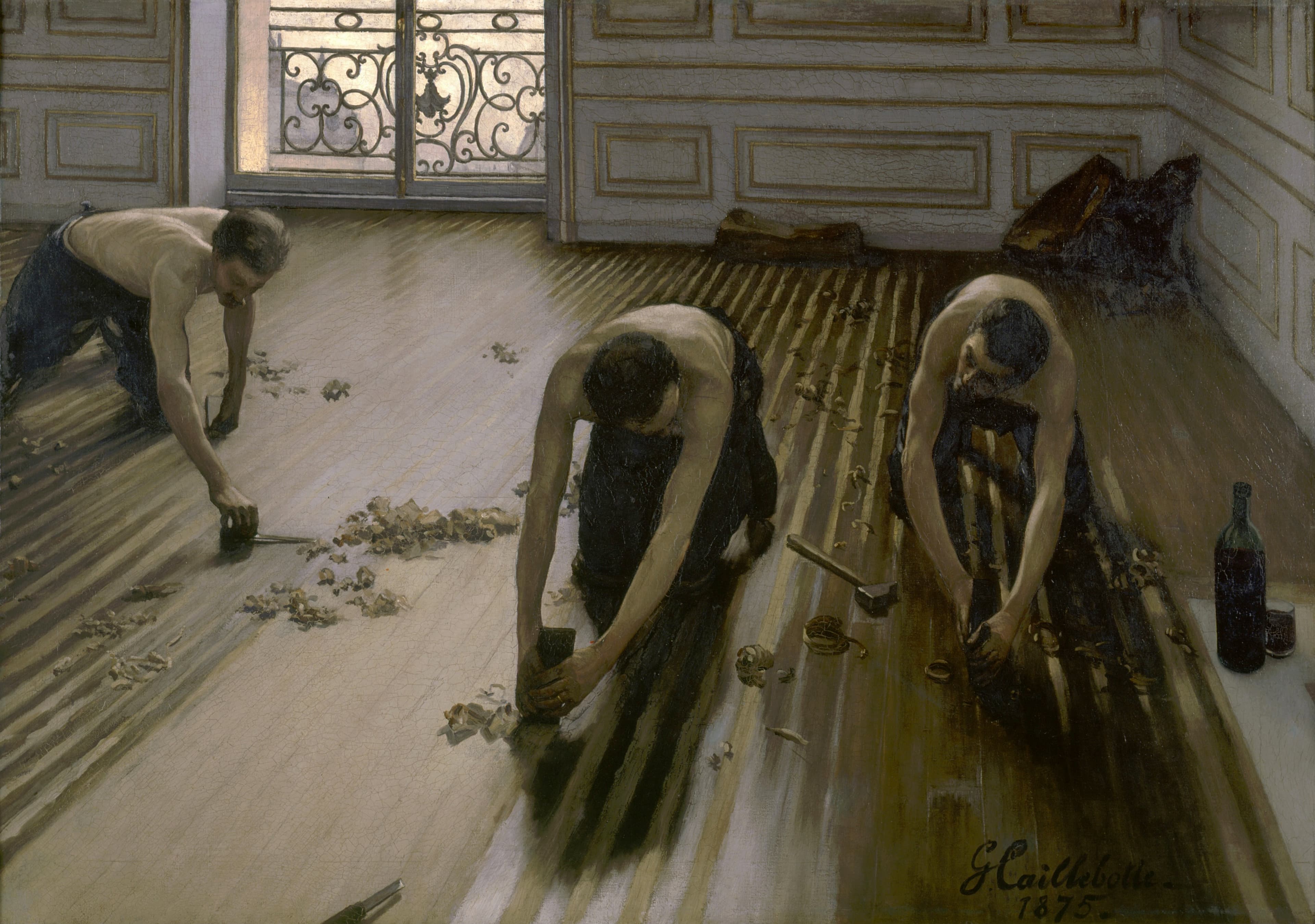
Three workers, stripped to the waist, scrape the parquet of a Haussmann apartment while afternoon light from the balcony window catches their backs. The Salon jury of 1875 turned it down; the second Impressionist exhibition of 1876 hung it, and Gustave Caillebotte arrived in one picture.
- 1875
- Oil on canvas
About Gustave Caillebotte
What the painting shows
Three men kneel on the floor of an empty room, planing and scraping the parquet in long strips. They have taken their shirts off and their tools are laid out around them — plane, scraper, hammer, file — with a bottle of wine open against the wall. Light comes in from the window at the back, through the wrought-iron scroll of a balcony rail, and runs down their spines and along the raked lines of the floorboards.
The room is real. The wainscoting, the marble of the chimney piece and the ironwork of the window are the fittings of a new Haussmann apartment, and scholars place the scene in the Caillebotte family's own house at 77 rue de Miromesnil in the 8th arrondissement — the room is generally identified as the painter's studio there, and the Musée d'Orsay says the models were the family's employees.
The floor plunges toward the viewer. Caillebotte drew every part of the picture separately and transferred the drawings to canvas by the traditional squaring method, and the museum's notice points out the paradox that made the picture so strange in 1875: an academically constructed perspective, applied to men nobody painted.
The Salon said no
Caillebotte submitted the painting to the Salon of 1875, and the jury rejected it. The Musée d'Orsay's notice reads the refusal as shock at the picture's crude realism, and records that critics of the day spoke of a 'vulgar subject.' Working men existed in French painting — Courbet's stone breakers, Millet's gleaners — but they broke rocks and gleaned wheat in the country. The Orsay calls The Floor Scrapers one of the first paintings of the urban proletariat, and notes in the same breath that Caillebotte attaches no message to them: no sermon, no politics, three men doing a job.
One picture, and he had arrived
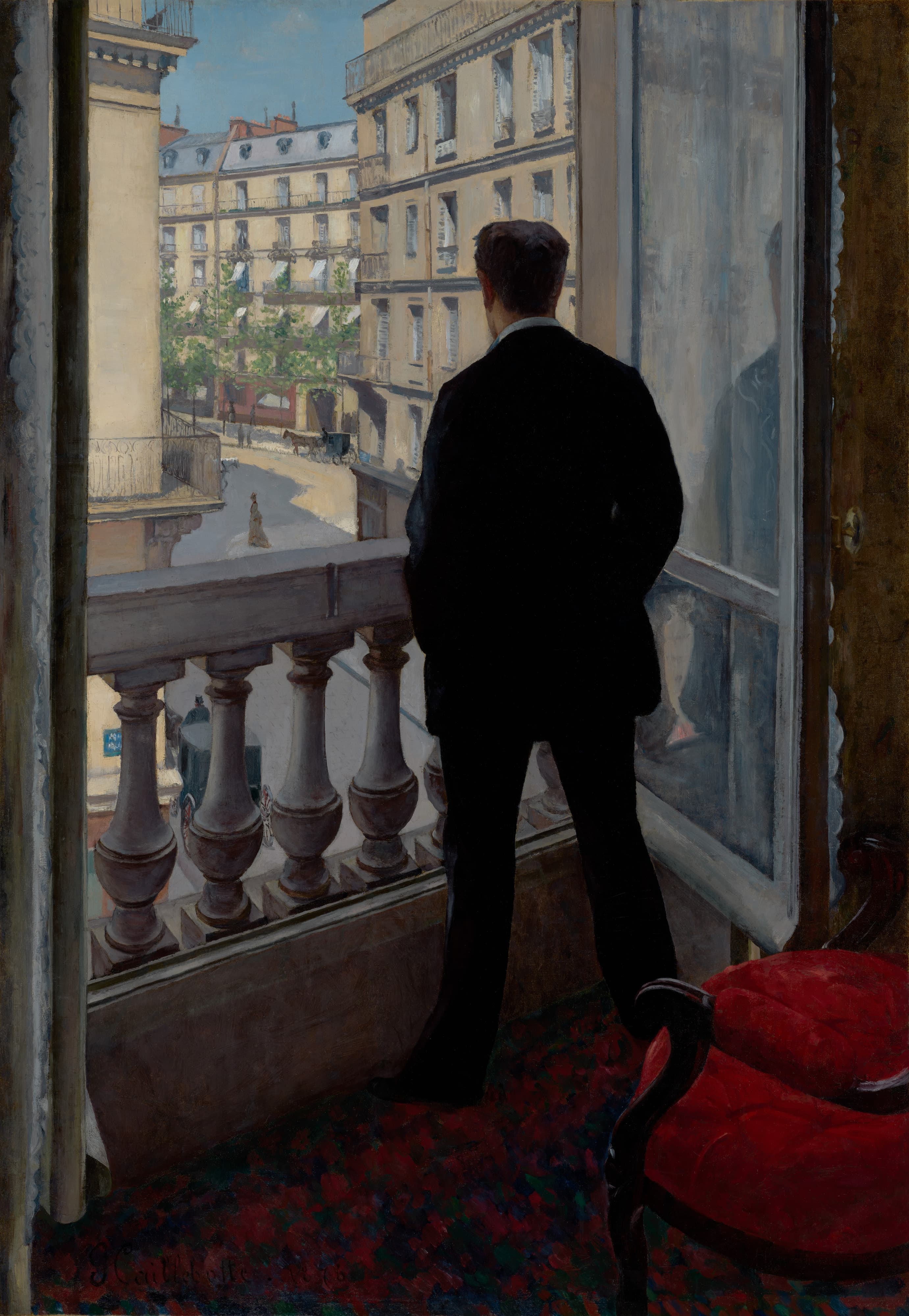
The rejected painting went instead to the second Impressionist exhibition, open through April 1876 at Durand-Ruel's gallery, 11 rue Le Peletier — number 17 in the catalogue, one of eight works by a newcomer nobody had shown before. Beside it hung a second, smaller Floor Scrapers painted in 1876 in another room of the house, and Young Man at His Window, the picture of his brother René. Degas showed his first ironers in the same rooms.
Émile Zola, reviewing the show for Le Messager de l'Europe that June, granted the picture its 'astonishing relief' and then delivered the line that followed it for a century: 'une peinture tout à fait anti-artistique, une peinture claire comme le verre, bourgeoise, à force d'exactitude' — a completely anti-artistic painting, clear as glass, bourgeois by dint of exactness. Photography of reality, Zola said, is a pitiable thing when talent has not left its mark on it.
Other critics split the same way: too exact for the avant-garde, too raw for the Salon. One compared the drawing of the workers to the early Florentines; another complained their arms were too thin and their chests too narrow.
A gift, not the bequest
The painting never left Caillebotte's hands. It appeared in the sale he and Pissarro, Renoir and Sisley held at the Hôtel Drouot in May 1877 — forty-five paintings between them — and he bought it back himself. It was still in his collection when he died in February 1894.
It is natural to assume it entered the museums with the famous Caillebotte bequest, and it did not. The bequest was his collection of the others — the Monets, Renoirs, Pissarros, Sisleys, Cézannes and Degas he had bought when few else would; his own paintings stayed with his brother Martial and his friends. The Floor Scrapers went to the state separately, as a gift of his heirs arranged by Auguste Renoir, his executor, accepted in 1894. It physically entered the Musée du Luxembourg in 1896, moved to the Louvre in 1929, hung in the Jeu de Paume from 1947, and has been at the Musée d'Orsay since the museum opened its doors in 1986.
The reassessment
For most of the twentieth century Caillebotte was filed as the collector who happened to paint. The revaluation of the last fifty years runs through this canvas. The Getty, announcing the Painting Men exhibition it shared with the Orsay and the Art Institute of Chicago in 2024–25, credited the picture with having 'introduced the figure of the urban laborer into modern French painting'; the Orsay hung it as the centerpiece of the exhibition's room on men at work.
The two museums do not even agree on the bodies. The Orsay's notice sees the bare torsos of antique heroes in the three workers; the Grand Palais's teaching site reads the same backs as pointedly un-idealized. Both readings are printed, which is its own measure of how much weight the painting now carries.
Close reading
Reading the work, detail by detail
The Floor Scrapers brings physical labor into a bourgeois apartment and makes the room's perspective serve the workers' repeated motion. Close views reveal bodies, tools, and reflected light acting on the same wooden surface.
1.Three bodies repeat one demanding posture
Bent backs and extended arms form a sequence across the room. The men are individualized, but their shared posture makes the labor collective and gives the composition its forward pressure.
2.Tool marks record time across the boards
The scraper follows the board while pale curls gather beside the workers. Finished and unfinished strips make progress visible: the floor holds a record of each repeated pull.
3.Window light turns the floor into the main field
Light enters at the far end and travels along the boards toward the viewer. The strong recession enlarges the workers' task and makes the apartment's expensive surface the material they must physically remake.
4.Bare torsos show heat as well as exertion
Rolled clothing and exposed backs make the room's physical conditions visible. The workers are not idealized athletes; their bodies respond to repetitive effort in a warm, enclosed apartment.
5.The doorway extends the workplace beyond the frame
A second room remains visible beyond the labor in front. That opening turns the scene into part of a larger renovation and prevents the workers from appearing on an abstract stage.
6.A bottle records the human rhythm around the work
The bottle and glass introduce rest, thirst, and time into the room. They are small practical objects, but they keep the painting from reducing labor to posture and tool marks alone.
Timeline
1875
Painted, signed and dated lower right. Submitted to the Salon of 1875 and rejected by the jury; critics of the day speak of a 'vulgar subject.'
1876
Number 17 at the second Impressionist exhibition, Durand-Ruel's gallery, 11 rue Le Peletier, open 30 March to 30 April — one of eight works in Caillebotte's debut, beside the smaller 1876 second version and Young Man at His Window. Zola calls it 'anti-artistic… bourgeois by dint of exactness.'
1877
In the four-artist sale at the Hôtel Drouot on 28 May (Caillebotte, Pissarro, Renoir, Sisley — forty-five paintings); Caillebotte buys it back and keeps it for life.
1894
Accepted by the French state as a gift of Caillebotte's heirs, arranged by Auguste Renoir as his executor — separate from the bequest of his Impressionist collection.
1896
Physically enters the Musée du Luxembourg, Paris.
1929
Assigned to the Musée du Louvre on 5 January.
1947
Hung in the Jeu de Paume, then the Louvre's museum of Impressionism.
1986
Assigned to the Musée d'Orsay. Inventory RF 2718.
2024–25
Travels with Gustave Caillebotte: Painting Men to the Musée d'Orsay, the Getty, and the Art Institute of Chicago.
Where to see it

Musée d'Orsay, Paris
Esplanade Valéry Giscard d’Estaing, 75007 Paris, France
Displays and loans can change. Check whether this work is on view before making a special trip.
Plan your visitFrequently asked questions
Where is The Floor Scrapers?
The Musée d'Orsay in Paris, inventory RF 2718 — the museum's notice lists it on the upper level, room 31. It entered the national collection in 1894 as a gift of Caillebotte's heirs arranged by Auguste Renoir and hung first at the Musée du Luxembourg from 1896.
Why was The Floor Scrapers rejected by the Salon?
The jury of the 1875 Salon turned it down. The Musée d'Orsay reads the refusal as shock at its crude realism and records that critics called the subject vulgar: laborers, half-dressed, inside a bourgeois Paris apartment, painted at a scale reserved for history.
What did Zola say about The Floor Scrapers?
Reviewing the 1876 Impressionist exhibition in Le Messager de l'Europe, Émile Zola granted the picture its 'astonishing relief' and then called it 'une peinture tout à fait anti-artistique, une peinture claire comme le verre, bourgeoise, à force d'exactitude' — completely anti-artistic, clear as glass, bourgeois by dint of exactness.
Is the room in The Floor Scrapers a real place?
Yes — a room in the Caillebotte family's house at 77 rue de Miromesnil in the 8th arrondissement of Paris, generally identified in the scholarship as the painter's own studio there. The Musée d'Orsay says the models were the family's employees.
Are there two versions of The Floor Scrapers?
Yes. Besides the 1875 canvas at the Musée d'Orsay, Caillebotte painted a smaller second version in 1876 — a different room, two workers instead of three, their knee pads clearly visible. Both hung at the 1876 Impressionist exhibition. The second version is recorded in a private collection.
How big is The Floor Scrapers?
102 by 147 centimetres, as the Musée d'Orsay gives it — oil on canvas, signed and dated 1875 at lower right.
More by Gustave Caillebotte
If you like Gustave Caillebotte
Explore painters from the same movements and circles.

Mary Cassatt
Mary Cassatt was an American painter and printmaker known for her depictions of women and children. Based in France for the last fifty-two years of her life, she was the only American to exhibit with the original French Impressionist group, participating in four of its eight exhibitions. Edgar Degas invited her to exhibit with the group in 1877 after the Salon jury rejected her submissions.
View artist
Paul Cézanne
Painter between Impressionism and everything after — shown in the independents' exhibitions, emulated by the Cubists, and present at the Orangerie through 15 works in the Walter-Guillaume collection.
View artist
Edgar Degas
Painter of dancers, racecourses, and café interiors — among the founders of the independent exhibitions that became Impressionism, though he preferred the word 'independent' himself.
View artist
References
The sources below include collection records, catalogues, scholarly research, and primary materials that informed this page. They document The Floor Scrapers, its making, and its place in cultural history.


1Raboteurs de parquets (Gustave Caillebotte) — Musée d'Orsay
WebsiteMusée d'OrsayUsed forWeb source consulted for documented facts and historical context presented on the The Floor Scrapers page.
2Gustave Caillebotte: Painting Men — exhibition presentation, Musée d'Orsay
WebsiteMusée d'OrsayUsed forWeb source consulted for documented facts and historical context presented on the The Floor Scrapers page.
3Gustave Caillebotte exhibition explores the artist's fascination with masculinity — Getty news
WebsiteJ. Paul Getty MuseumUsed forWeb source consulted for documented facts and historical context presented on the The Floor Scrapers page.
4Young Man at the Window (Caillebotte) — utpictura18, Université d'Aix-Marseille, printing Zola's 1876 review
WebsiteUniversité d'Aix-MarseilleUsed forWeb source consulted for documented facts and historical context presented on the The Floor Scrapers page.
These references provide the documented foundation for this work's history and interpretation. Claim-level citations remain attached to the specific claims they support.
 Explore more resources