Young Man at His Window
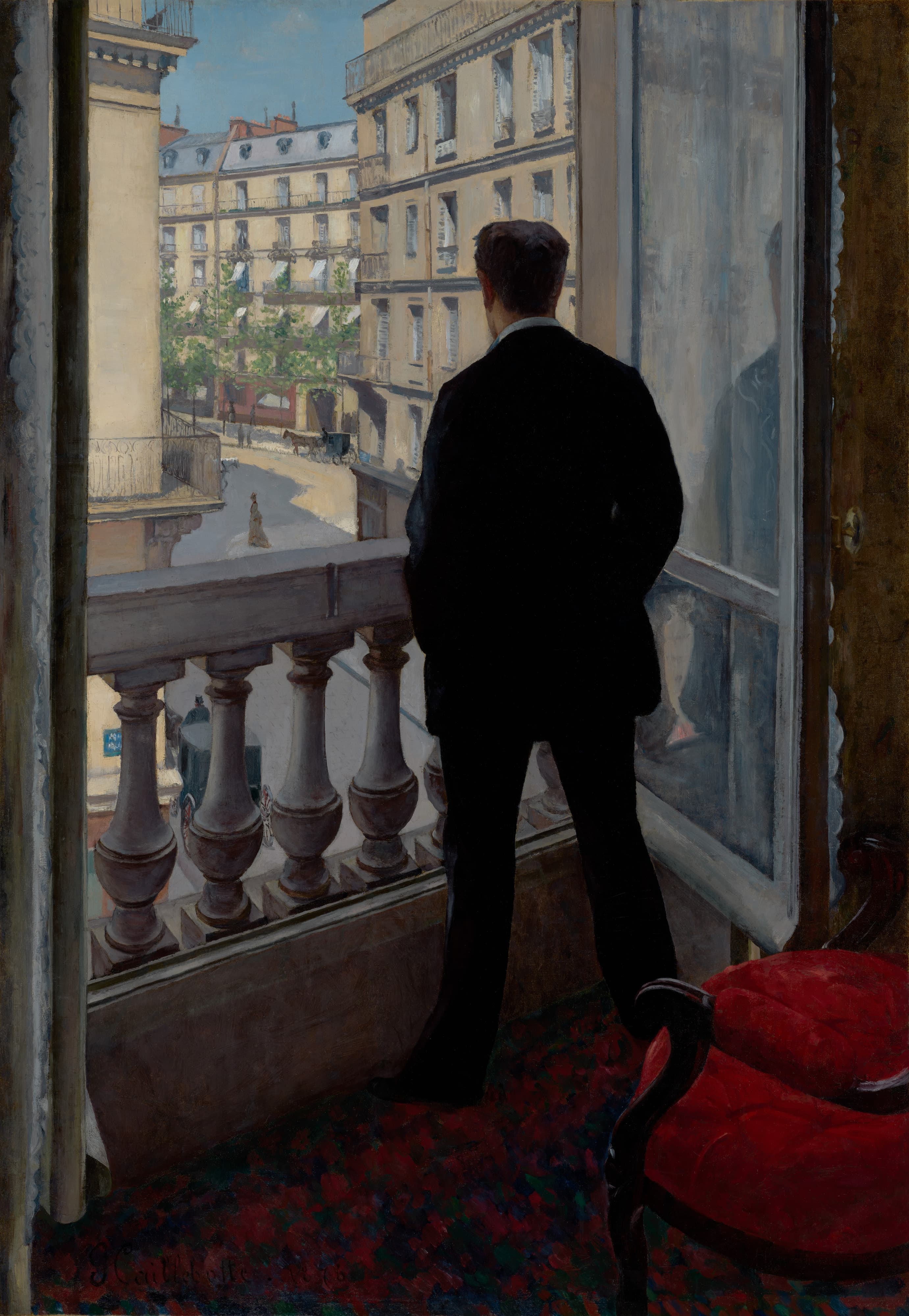
A young man in a dark suit stands with his back to us at a tall open window, hands in pockets, watching a woman cross the sunlit street below. The model is Gustave Caillebotte's brother René, the window is the family's Paris apartment, and in 2021 the painting became the most expensive Caillebotte ever sold — bought at auction by the Getty for $53 million.
- 1876
- Oil on canvas
About Gustave Caillebotte
What the painting shows
The figure fills the window like a doorman nobody asked for: feet planted apart, hands in pockets, velvet armchair pushed back as if he has just stood up. He is René Caillebotte, the painter's brother, identified by a handwritten note in the family's own album of photographs of the paintings. The window is on an upper floor of the Caillebotte apartment building at the corner of the rue de Miromesnil and the rue de Lisbonne, in the 8th arrondissement — a house their father, a fortune-maker in Haussmann's building boom, had put up in 1868 with hot water, gas light and electric bells.
What René watches is the point. The street runs away toward the boulevard Malesherbes in full sunlight, nearly empty except for carriages and a single fashionable woman crossing — small, but pinned at the center of the plunging perspective so insistently that every viewer follows his gaze to her. She does not know she is being looked at. The Getty's curator calls the picture's tension exactly that: visual acuity matched by 'psychological tension and ambiguity.'
A figure seen from behind at a window is an old Romantic device — Caspar David Friedrich painted his wife that way in 1822 — but nobody had aimed it at a new Paris street. When the critic Edmond Duranty published The New Painting after the 1876 exhibition, arguing that modern art should show modern people in their real settings, seen from behind if a back could tell the story, Caillebotte's picture was among his obvious models.
The 1876 debut, and René's year
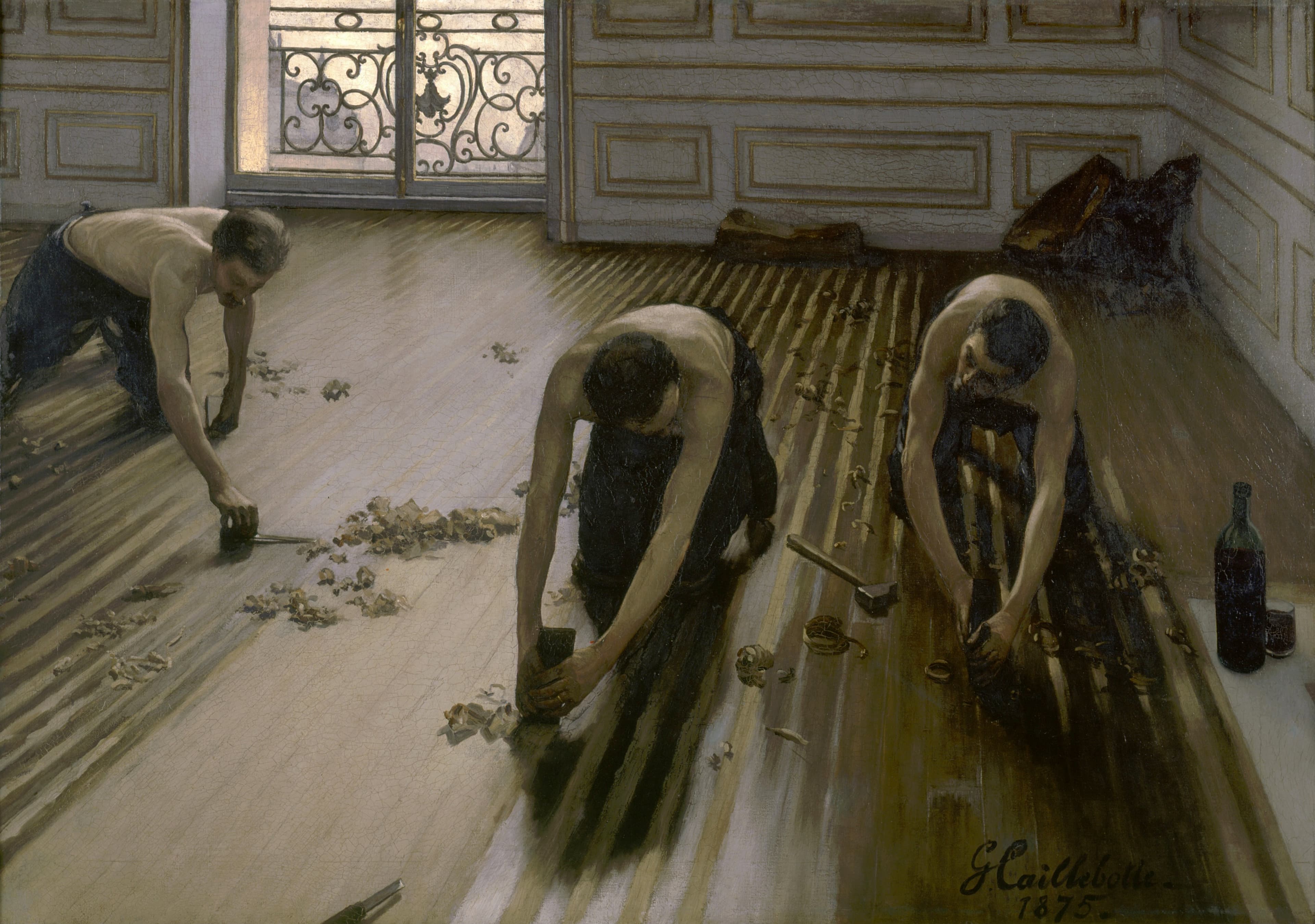
The painting was finished shortly before the second Impressionist exhibition opened in April 1876 at Durand-Ruel's gallery on the rue Le Peletier, and hung there as number 20 — part of Caillebotte's eight-work public debut, alongside The Floor Scrapers. Of his submissions it drew the most notice after that picture. The critic Marius Chaumelin asked the room's question: 'Who knows Caillebotte? Where does he come from? In what school was he trained? No one has been able to tell me' — and predicted he would be famous before long.
René Caillebotte died the same year, in his mid-twenties, unexpectedly. Two days after his death, in November 1876, the twenty-eight-year-old painter wrote the will that would eventually deliver his Impressionist collection to the French state. The young man at the window is part of a trio of family interiors painted that year — his brother Martial at the piano, René and their mother at luncheon — and within months of the exhibition the family it recorded had begun to disappear.
From a notary's parlor to the Getty
The painting left the family in the artist's own lifetime, as a gift to Albert Courtier, the Caillebottes' notary and friend — which is why, when Claude Monet wrote to Renoir after the painter's death suggesting it for the state bequest, it was already out of reach. It descended in Courtier's family, passed through Paris and New York dealers in the mid-century, and in 1995 was bought by the Dallas collector Edwin L. Cox, who hung it over his desk.
At Christie's New York on 11 November 2021, in the sale of Cox's collection, it brought $53,030,000 — more than double the previous Caillebotte record — with a dealer bidding for the J. Paul Getty Museum. The Getty announced it that day as 'the most important painting by Gustave Caillebotte in private hands' and the first Caillebotte to enter its collection, and hung it in the Impressionist gallery at the Getty Center, accession 2021.67.
Close reading
Reading the work, detail by detail
René Caillebotte stands between a wealthy apartment and the new street below, seen from behind. The details show how pose, furniture, and the view beyond the glass turn looking into a picture of class, privacy, and modern urban distance.
1.A turned back carries the portrait
Feet planted and hands in pockets, René blocks the center without offering his face. His stance communicates possession and attention while withholding the exchange expected from portraiture.
2.The boulevard appears as a private prospect
The street is visible beyond the figure but separated from him by height and glass. A small pedestrian below supplies scale, making René's secure interior position unmistakable without turning it into an explicit lesson.
3.The pushed-back chair marks a moment just interrupted
The chair sits at an angle as though he has just risen from it. That small displacement gives the still scene a before and after: looking out the window has interrupted the room's comfort.
4.The balcony rail holds the viewer inside
The dark horizontal barrier separates private interior from public boulevard. The man can look outward, but the rail makes his position as an observer unmistakable.
5.Tiny pedestrians become objects of attention
People in the boulevard are reduced by distance, yet the man's posture directs us toward them. The painting makes looking itself the subject without revealing exactly whom or what he follows.
6.The curtain makes the city view feel temporarily uncovered
A strip of fabric frames the bright exterior and reminds us that this view belongs to a furnished room. The city appears as something the inhabitant can reveal, watch, and withdraw from.
Timeline
1876
Painted at the family apartment, corner of the rue de Miromesnil and the rue de Lisbonne; finished shortly before the second Impressionist exhibition opens in April, where it hangs as number 20 in Caillebotte's eight-work debut.
1876
René Caillebotte, the model, dies unexpectedly in November; two days later Gustave writes the will that founds the future bequest.
late 1870s
Given by the artist to Albert Courtier, the family's notary, in whose family it descends.
1886
Shown in New York as Before the Window in the first large American exhibition of Impressionist painting.
1894
Number 97 in the Durand-Ruel memorial retrospective, months after the painter's death.
1951
Through the Galerie de l'Elysée, Paris, to Wildenstein, New York.
1995
Bought from Wildenstein by Edwin L. Cox of Dallas, the year it tours in the Urban Impressionist retrospective.
2021
Sold at Christie's New York on 11 November for $53,030,000 — the Caillebotte auction record — to the J. Paul Getty Museum, accession 2021.67.
2025
Anchors Gustave Caillebotte: Painting Men at the Getty, after the Musée d'Orsay run.
Where to see it
J. Paul Getty Museum, Los Angeles
1200 Getty Center Drive, Los Angeles, CA 90049, United States
Displays and loans can change. Check whether this work is on view before making a special trip.
Plan your visit on the museum’s official website (opens in a new tab)Frequently asked questions
Who is the man in Young Man at His Window?
René Caillebotte, the painter's brother, identified by a handwritten note in the family's album of photographs of the paintings. He died unexpectedly later the same year, in his mid-twenties.
Where is Young Man at His Window?
The J. Paul Getty Museum in Los Angeles, accession 2021.67 — its first Caillebotte, bought at Christie's New York in November 2021 and displayed in the Getty Center's Impressionist gallery.
How much did Young Man at His Window sell for?
$53,030,000 at Christie's New York on 11 November 2021, in the Edwin L. Cox collection sale — the auction record for Caillebotte, more than doubling the previous mark.
What street is seen through the window?
The view runs from the family apartment at the corner of the rue de Miromesnil and the rue de Lisbonne toward the boulevard Malesherbes, in the 8th arrondissement — the freshly rebuilt quarter where Caillebotte's father had made part of his fortune.
Why is the figure painted from behind?
A figure at a window seen from the back is an old Romantic motif — Caspar David Friedrich's Woman at the Window is the famous precedent — but Caillebotte pointed it at a modern street. The critic Edmond Duranty, whose 1876 essay The New Painting called for exactly such figures, argued a back could reveal 'temperament, age and social position.'
More by Gustave Caillebotte
If you like Gustave Caillebotte
Explore painters from the same movements and circles.
Mary Cassatt
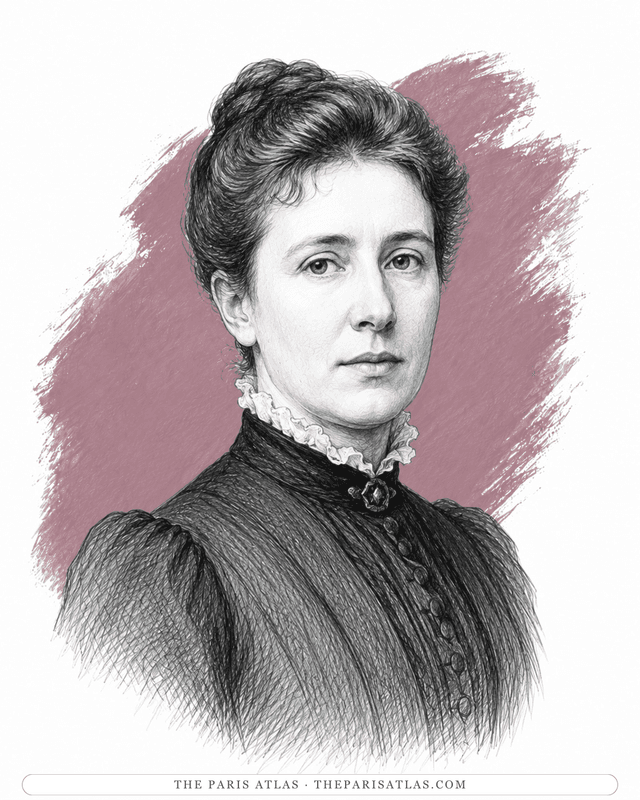
Mary Cassatt was an American painter and printmaker known for her depictions of women and children. Based in France for the last fifty-two years of her life, she was the only American to exhibit with the original French Impressionist group, participating in four of its eight exhibitions. Edgar Degas invited her to exhibit with the group in 1877 after the Salon jury rejected her submissions.
View artist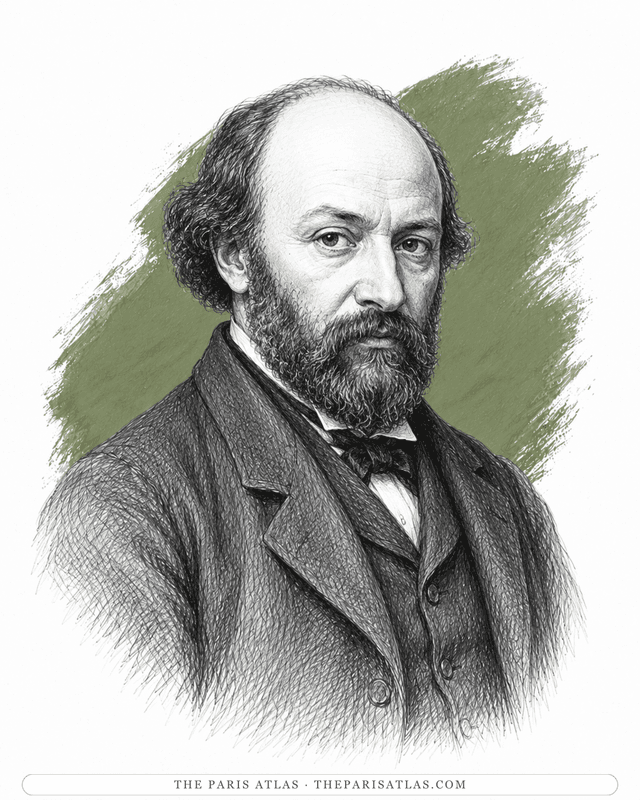
Paul Cézanne
Painter between Impressionism and everything after — shown in the independents' exhibitions, emulated by the Cubists, and present at the Orangerie through 15 works in the Walter-Guillaume collection.
View artist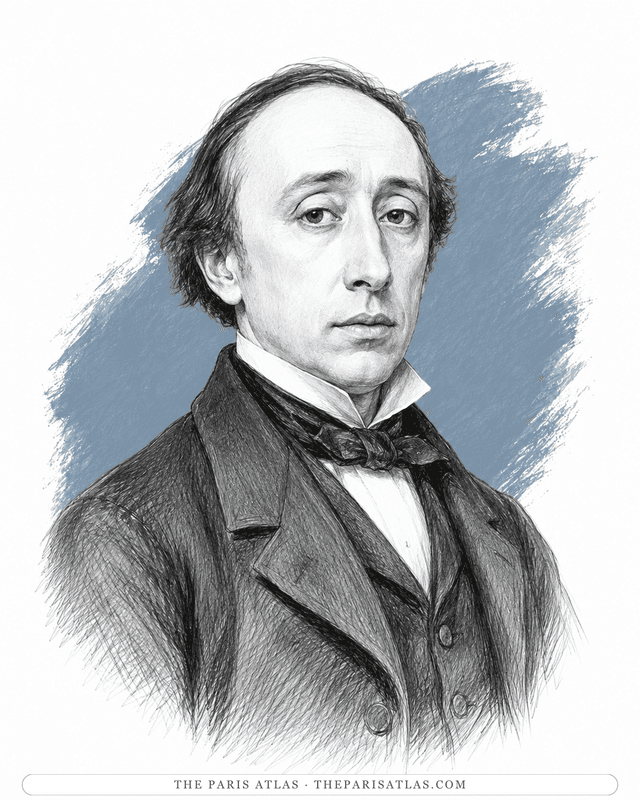
Edgar Degas
Painter of dancers, racecourses, and café interiors — among the founders of the independent exhibitions that became Impressionism, though he preferred the word 'independent' himself.
View artist
References
The sources below include collection records, catalogues, scholarly research, and primary materials that informed this page. They document Young Man at His Window, its making, and its place in cultural history.


1Getty Museum acquires Gustave Caillebotte's iconic Young Man at His Window — Getty news, 11 November 2021
WebsiteJ. Paul Getty MuseumUsed forWeb source consulted for documented facts and historical context presented on the Young Man at His Window page.
2Gustave Caillebotte, Jeune homme à sa fenêtre — Christie's, The Cox Collection evening sale, lot 23, 11 November 2021
WebsiteChristie'sUsed forWeb source consulted for documented facts and historical context presented on the Young Man at His Window page.
3Gustave Caillebotte: Painting Men — exhibition presentation, Musée d'Orsay
WebsiteMusée d'OrsayUsed forWeb source consulted for documented facts and historical context presented on the Young Man at His Window page.
4Young Man at the Window (Caillebotte) — utpictura18, Université d'Aix-Marseille, printing Zola's 1876 review
WebsiteUniversité d'Aix-MarseilleUsed forWeb source consulted for documented facts and historical context presented on the Young Man at His Window page.

5Young Man at His Window, 1876
Official recordJ. Paul Getty MuseumUsed forOfficial record used to verify names, dates, institutional details, or other factual information on this page.
These references provide the documented foundation for this work's history and interpretation. Claim-level citations remain attached to the specific claims they support.
 Explore more resources